REVIEW 3 major objections 4 minor 37 references
Fast and Stable Diffusion Planning through Variational Adaptive Weighting
T0 review · 3 major / 4 minor · reviewed 2026-08-15 · deepseek-v4-flash
Pith's one-line read The paper derives a variationally optimal loss-weighting function for flow-based generative planners and shows, with a closed-form polynomial estimator, that it reaches prior state-of-the-art offline-RL performance in up to 40 times fewer…
desk verdict The polynomial online-regression weighting trick is a genuinely useful practical idea, but the paper's variational derivation is internally inconsistent and the headline speedup is confounded with a generative-model swap. read the letter →
The pith
A machine-rendered reading of the paper's core claim, the machinery that carries it, and where it could break.
The reading
What carries the argument
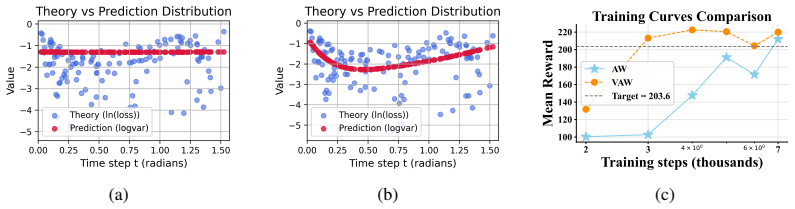
The load-bearing object is the variational optimality condition: the weight $u(\sigma)$ that minimizes the continuous uncertainty objective satisfies $u^*(\sigma)=\log\lambda(\sigma)+\log L(D_\theta;\sigma)$, which the paper derives by differentiating the functional with respect to $u$ and setting the derivative to zero. The machinery that makes it usable is the online polynomial estimator: transform the noise scale to $x=\log\sigma$, regress the observed log-losses $y=\log L$ on a degree-5 polynomial in $x$ by least squares through a Vandermonde matrix, and update the coefficient vector by an exponential moving average across training batches. This produces the full weight $u(\sigma)=\log\lambda(\sigma)+P(\log\sigma)$ at every step, in closed form, without a neural-network approximator or gradient updates. The polynomial's job is to track the sharp, early-training structure of the per-noise loss curve that the paper shows the MLP-based approximator misses.
What would settle it
Train the same TrigFlow planner twice, once with variational adaptive weighting and once with uniform weighting, holding every other setting identical, and compare the step counts at which each crosses the DV* target rewards on maze2d-large and kitchen-mixed; if the two curves coincide, the weighting contributes none of the reported acceleration. A complementary check is to insert the variational weighting into the original VP-SDE planner: if it does not accelerate that formulation, the speedup lives in the flow-formulation switch rather than in the weight.
Extended reading notes
Core claim
Stated on the paper's own terms, the discovery is that the per-noise loss weighting of a flow-based diffusion planner should not be a learned black box: the variationally optimal log-variance weight is $u^*(\sigma)=\log\lambda(\sigma)+\log L(D_\theta;\sigma)$, obtained by making the functional $L[u]=\mathbb{E}_{\sigma\sim p(\sigma)}[\lambda(\sigma)L(D_\theta;\sigma)e^{-u(\sigma)}+u(\sigma)]$ stationary in $u$. Because the unknown piece is just the log of the current per-noise training loss, the paper approximates it online with a degree-5 polynomial $P(\log\sigma)$ fit by least squares to a mini-batch of $(\log\sigma_i,\log L_i)$ pairs, with an exponential moving average over the coefficients to keep the estimate smooth. Inserted into the trajectory module of a diffusion planner, this variational adaptive weighting reaches or surpasses the previous state-of-the-art rewards on Maze2D (umaze, medium, large) and Franka Kitchen (mixed, partial), converging in roughly 3k–40k training steps where the VP-SDE baseline needs 50k–200k, and in 5 sampling steps instead of 20. The paper's claim is that this speedup and the stability that comes with it follow from having a closed-form target rather than an auxiliary neural approximator.
Load-bearing premise
The load-bearing premise is that the variationally derived weighting, which weights each noise scale by the log of its current training loss, is what accelerates training, even though the headline speedup is measured against a baseline that replaced both the generative formulation and the weighting at the same time.
Editorial extensions
If this is right
- Flow-based planners using this weighting reach or surpass prior state-of-the-art Maze2D and Kitchen rewards with roughly 5x–40x fewer training steps than the VP-SDE baseline on the same tasks.
- Planning-time cost drops as well, because the trained model needs only 5 ODE sampling steps rather than the 20 used by the VP-SDE planner.
- Within the same flow-based framework, variational adaptive weighting converges faster than both uniform weighting and the MLP-based adaptive weighting, with the clearest margin on the hardest Maze2D task.
- Because the weight is computed by closed-form least squares plus an exponential moving average, the added per-step computation is negligible, so the speedup is not paid for by heavier gradient steps.
- The recipe of deriving the log-loss weight variationally, regressing a low-degree polynomial online, and smoothing by EMA is stated for the flow-matching objective generally, so it applies to any planner built on that framework, not only the tested Maze2D and Kitchen instantiations.
Reading between the lines
- Because $u^*(\sigma)$ equals the log of the current per-noise loss, the weighting behaves as a per-noise-scale self-scaled gradient that up-weights the noise levels where the model still errs; a natural untested extension would be to steer the noise sampling distribution $p(\sigma)$ with the same polynomial estimate rather than only the loss weight.
- The 40x headline compares pipelines that changed two ingredients at once, the VP-SDE to TrigFlow formulation and the fixed to adaptive weighting, and the paper's appendix shows the formulation switch alone accelerates linear flow; attributing the full gain to the weighting would require an ablation the paper does not report.
- The polynomial-EMA regressor is generic: any per-noise statistic, such as gradient norms or signal-to-noise ratios, could be tracked the same way, which suggests the mechanism may transfer to image, audio, or video generation training rather than only offline-RL planners, an extension the paper does not pursue.
Signed reviews
Editorial analysis
A structured set of objections, weighed in public.
Referee Report
Summary. This paper proposes Variational Adaptive Weighting (VAW) for flow-based diffusion planners. After defining a continuous noise-conditioned uncertainty-weighted objective in Eq. (7), the authors use variational calculus to obtain u*(σ)=log λ(σ)+log L(Dθ;σ), and approximate log L with a streaming degree-5 polynomial regression under an exponential moving average. The resulting planner, Flow Veteran (FV), replaces the VP-SDE trajectory generator in Diffusion Veteran with a TrigFlow-based flow model plus VAW. Experiments on D4RL Maze2D and Kitchen tasks report state-of-the-art or competitive final performance with 5x-40x fewer training steps than DV, and Q3 provides a weighting-function ablation.
Significance. If the method is sound, the contribution is a cheap, non-parametric weighting estimator that removes an auxiliary network and may speed up diffusion planner training. The paper has several strengths: Q3 directly compares uniform, MLP-based adaptive, and variational weightings; Appendix A isolates the effect of the TrigFlow path; Algorithm 1 is simple and computationally light; and the experimental coverage includes standard D4RL navigation and manipulation benchmarks. However, the theoretical derivation contains a sign inconsistency, the claimed variational optimum collapses to a trivial objective, and the headline speedup conflates the change of generative model with the change of weighting. The significance is therefore conditional on substantial revision and re-analysis.
major comments (3)
- [Appendix C, Eqs. (15)-(17) and Sec. 4, Eq. (7)] The appendix derivation of Eq. (7) is internally inconsistent. Starting from the discrete uncertainty loss L_discrete = Σ(L_i/(2σ_i²)+1/2 log σ_i²) and u_i=log σ_i², the correct rewrite is Σ(L_i e^{-u_i}+u_i), not Σ(L_i e^{u_i}+u_i) as written in Eq. (15). The sign error propagates to Eqs. (16)-(17), where the continuous objective contains e^{u(σ)} and λ(σ) multiplies both terms, whereas the main-text Eq. (7) contains exp(-u(σ)) with λ(σ) multiplying only the loss term. These two objectives are not equivalent: the functional derivative of Eq. (16) is λ(σ)(L(Dθ;σ)e^{u}+1), which is strictly positive for positive L, so it has no finite stationary point and cannot yield Eq. (10). The derivation of the central formula u*(σ)=log λ(σ)+log L(Dθ;σ) is therefore unsupported as written.
- [Sec. 4, Eqs. (7)-(10) and Algorithm 1] Even accepting the main-text sign convention, the 'variationally optimal' result is degenerate. Substituting u*(σ)=log λ(σ)+log L(Dθ;σ) into Eq. (7) gives L_cont = 1 + E_σ[log λ(σ)] + E_σ[log L(Dθ;σ)], so the λ-weighted loss term collapses to the constant 1 and the θ-gradient becomes ∇_θ E_σ[log L(Dθ;σ)], independent of λ. The derivation therefore does not identify a nontrivial adaptive weighting; it merely restates that the chosen objective can be made constant per noise level. Furthermore, λ(σ) is never defined in the main text or appendices: it appears in Eqs. (7), (8), (13), and Algorithm 1 without a specification, so the proposed method is not fully reproducible and the role of the claimed optimal weighting is unclear.
- [Sec. 5.2 Q2 and Appendix A] The headline 5x-40x convergence speedup is confounded. FV differs from the VP-SDE baseline in two simultaneous changes: the generative model is switched from VP-SDE to TrigFlow, and the fixed/MLP weighting is replaced by VAW. Appendix A shows that switching to TrigFlow alone accelerates convergence substantially (e.g., Maze2D-Medium converges at 8k vs 40k steps). Q3 and Figure 3 provide a useful weighting ablation, but the quantitative speedup claim in Q2 compares FV (TrigFlow+VAW) against VP-SDE, so the comparison cannot separate the contribution of VAW from the change of generative model. A controlled experiment (e.g., VP-SDE+VAW, or TrigFlow+uniform over the same training curves) is required to support attributing the speedup to the proposed weighting; without it the abstract's 'up to 10 times fewer training steps' is not established.
minor comments (4)
- [Table 1] Several table entries appear to have missing separators, such as '76.177.3' and '163.6181.8'; these need to be formatted properly. The paper also omits variances despite stating that results are averaged over 150 episode seeds, which makes it difficult to assess the claimed best-performance results, especially where margins over DV* are small (e.g., Kitchen Mixed 72.5 vs 72.0).
- [Fig. 2 caption] The caption reads 'TrigFlow+V AE (FV)' and appears to contain a typo; it should be 'TrigFlow+VAW (FV)'.
- [Sec. 5.2 Q1] The claim that 'Our method achieves the best performance across all benchmark tasks' is stronger than the paper's stated focus on training efficiency, and it is not supported statistically given the missing variances and the use of literature-reported baseline numbers.
- [Algorithm 1] The algorithm depends on the unspecified function λ(σ) and on hyperparameters d and µ; the paper should state how these are chosen and whether the results are sensitive to them.
Circularity Check
The variational optimum u*(σ)=log λ(σ)+log L(Dθ;σ) is, by construction, the log of the per-noise loss it weights; Algorithm 1 then regresses exactly that loss curve and relabels the fit as the optimal weighting, so the theoretical claim reduces to a smoothed copy of its own input. The empirical speedups are genuine experiments, but the central weighting derivation has no independent content.
-
self definitional
[Section 4, Eqs. (7)-(10)]
"Lcont =E σ∼p(σ)[ λ(σ)·L(D θ;σ)/exp(u(σ)) +u(σ) ] ... Taking the functional derivative and setting it to zero gives: δL/δu(σ) =− λ(σ)·L(D θ;σ)/exp(u(σ)) + 1 = 0 ... Solving Equation (9) yields the optimal weighting function: u∗(σ) = logλ(σ) + logL(D θ;σ)"
The objective (7) is minimized over u while holding L(Dθ;σ) fixed, so the stationarity condition forces u* to be the log of the very per-noise loss that the weighting is supposed to modulate. The output u* is therefore defined in terms of the input loss curve and contains no information beyond it. Substituting Eq. (10) into Eq. (7) gives λ(σ)L(Dθ;σ)/exp(u*(σ)) = 1 identically, so the weighted loss term collapses to the constant 1 and the θ-gradient reduces to ∇θ E[log L + log λ]; the λ-dependent reweighting cancels exactly. The claimed variationally optimal weighting is thus equivalent to plain log-loss minimization, not an independently derived adaptive mechanism.
-
fitted input called prediction
[Section 4, 'Polynomial approximation for online estimation' and Algorithm 1]
"Let xi := logσi and yi := logL(Dθ;σi) ... We fit a polynomial of degree d, P(x)=Σ wk xk, such that P(logσ)≈logL(Dθ;σ). The overall approximation of the optimal uncertainty weight then becomes: u(σ) = logλ(σ) + P(logσ). ... Transform pairs: xi←logσi, yi←logLi ... Compute polynomial coefficients: ŵ←(X⊤X)−1X⊤y ... Output: u(σ)←logλ(σ)+Σ wk(logσ)^k."
The regression target yi is exactly log L(Dθ;σi), the same quantity that defines the claimed optimum u* in Eq. (10) up to the additive logλ term. The 'online estimation' therefore fits the weighting function to the loss curve it multiplies, and the fitted output is, by construction, a smoothed and EMA-averaged copy of its own input. This is not a prediction of an external quantity: the polynomial coefficients are computed from the current per-noise losses and immediately reused as the loss weight, so the procedure reduces to fitting the input loss and renaming it the variationally optimal uncertainty.
full rationale
The central theoretical contribution reduces to its own input by construction. Eq. (7) defines the objective with u(σ) appearing only through the factor λL/exp(u) + u; varying u while holding L fixed gives u* = log λ + log L. That is exactly the log-loss curve the method then estimates: Algorithm 1 fits y_i = log L(Dθ;σ_i) and outputs u(σ) = log λ(σ) + P(log σ). The 'variationally optimal weighting' is therefore not derived from first principles; it is a fitted copy of the per-noise loss it is meant to weight. Worse, substituting the purported optimum back into Eq. (7) makes λL/exp(u*) = 1, so the λ-dependent weighted term is constant and the parameter gradient reduces to ∇θ E[log L + log λ], meaning the proposed weighting cancels out of the optimization and leaves ordinary log-loss minimization. This is a self-definitional collapse of the theoretical claim. The empirical convergence results (Q1-Q3, Figures 2-3) are real experimental comparisons and are not logically forced by the derivation, so they do not by themselves count as circular; however, they also cannot rescue the theoretical claim. I additionally flag a separate, non-circular correctness defect: Appendix C, cited as the derivation of Eq. (7), instead defines Lcont = ∫ λ(σ)(L e^{u} + u)p(σ)dσ with e^{+u} and λ multiplying both terms. That objective differs from Eq. (7), has no finite stationary point for L>0, and does not yield Eq. (10); this is an unsupported-derivation problem rather than a circularity. No load-bearing self-citation appears in the paper: the cited baselines (DV, EDM2, sCM, Diffuser, etc.) are external prior work, and the internal Appendix C inconsistency does not create a circular citation chain. Overall, because the paper's central 'variationally optimal weighting' claim is equivalent to fitting its own loss curve, but the empirical speedup findings remain independent experimental evidence, the circularity score is 6 rather than higher.
Assumptions & free parameters
free parameters (4)
- Polynomial degree d =
5
- EMA coefficient µ =
[0.999, 0.9995]
- λ(σ) weighting function =
undefined (stated as aligned with EDM2)
- Time/noise schedule parameters Pmean, Pstd, σdata =
-0.4, 1.6, 1.0
assumptions (4)
- domain assumption log L(Dθ;σ) is well approximated by a degree-5 polynomial in log σ throughout training.
- domain assumption The variationally optimal u* derived with Dθ fixed is still near-optimal when Dθ and u are optimized jointly.
- ad hoc to paper The continuous uncertainty-weighted objective in Eq (7) is a valid and useful training loss for flow matching.
- standard math Functional differentiation with respect to u(σ) yields the global minimizer of Eq (8).
Cite this review
Pith. "Pith review of Fast and Stable Diffusion Planning through Variational Adaptive Weighting." pith.science (2026). https://pith.science/paper/NGIVPJFF
@misc{pith2026250616688,
  author       = {Pith},
  title        = {Pith review of: Fast and Stable Diffusion Planning through Variational Adaptive Weighting},
  year         = {2026},
  howpublished = {\url{https://pith.science/paper/NGIVPJFF}},
  note         = {Machine review of arXiv:2506.16688}
}
read the original abstract
Diffusion models have recently shown promise in offline RL. However, these methods often suffer from high training costs and slow convergence, particularly when using transformer-based denoising backbones. While several optimization strategies have been proposed -- such as modified noise schedules, auxiliary prediction targets, and adaptive loss weighting -- challenges remain in achieving stable and efficient training. In particular, existing loss weighting functions typically rely on neural network approximators, which can be ineffective in early training phases due to limited generalization capacity of MLPs when exposed to sparse feedback in the early training stages. In this work, we derive a variationally optimal uncertainty-aware weighting function and introduce a closed-form polynomial approximation method for its online estimation under the flow-based generative modeling framework. We integrate our method into a diffusion planning pipeline and evaluate it on standard offline RL benchmarks. Experimental results on Maze2D and Kitchen tasks show that our method achieves competitive performance with up to 10 times fewer training steps, highlighting its practical effectiveness.
Figures


Figures from the paper (1 more)

Reference graph
Works this paper leans on
-
[1]
Anurag Ajay, Yilun Du, Abhi Gupta, Joshua Tenenbaum, Tommi Jaakkola, and Pulkit Agrawal. Is conditional generative modeling all you need for decision-making?arXiv preprint arXiv:2211.15657, 2022
arXiv 2022
-
[2]
A Markovian decision process.Journal of Mathematics and Mechanics, pages 679–684, 1957
Richard Bellman. A Markovian decision process.Journal of Mathematics and Mechanics, pages 679–684, 1957
work page 1957
-
[3]
Simple hierarchi- cal planning with diffusion.arXiv preprint arXiv:2401.02644, 2024
Chang Chen, Fei Deng, Kenji Kawaguchi, Caglar Gulcehre, and Sungjin Ahn. Simple hierarchi- cal planning with diffusion.arXiv preprint arXiv:2401.02644, 2024. 8
arXiv 2024
-
[4]
Huayu Chen, Cheng Lu, Chengyang Ying, Hang Su, and Jun Zhu. Offline reinforcement learning via high-fidelity generative behavior modeling.arXiv preprint arXiv:2209.14548, 2022
arXiv 2022
-
[5]
Pilco: A model-based and data-efficient approach to policy search
Marc Deisenroth and Carl E Rasmussen. Pilco: A model-based and data-efficient approach to policy search. InProceedings of the International Conference on Machine Learning, pages 465–472, 2011
work page 2011
-
[6]
Diffusion models beat gans on image synthesis
Prafulla Dhariwal and Alexander Nichol. Diffusion models beat gans on image synthesis. Advances in neural information processing systems, 34:8780–8794, 2021
2021
-
[7]
Zibin Dong, Yifu Yuan, Jianye Hao, Fei Ni, Yi Ma, Pengyi Li, and Yan Zheng. Cleandiffuser: An easy-to-use modularized library for diffusion models in decision making.arXiv preprint arXiv:2406.09509, 2024
arXiv 2024
-
[8]
Zibin Dong, Yifu Yuan, Jianye Hao, Fei Ni, Yao Mu, Yan Zheng, Yujing Hu, Tangjie Lv, Changjie Fan, and Zhipeng Hu. Aligndiff: Aligning diverse human preferences via behavior- customisable diffusion model.arXiv preprint arXiv:2310.02054, 2023
Show all 37 references
-
[9]
Learning universal policies via text-guided video generation.Advances in neural information processing systems, 36:9156–9172, 2023
Yilun Du, Sherry Yang, Bo Dai, Hanjun Dai, Ofir Nachum, Josh Tenenbaum, Dale Schuurmans, and Pieter Abbeel. Learning universal policies via text-guided video generation.Advances in neural information processing systems, 36:9156–9172, 2023
2023
-
[10]
Scaling rectified flow trans- formers for high-resolution image synthesis
Patrick Esser, Sumith Kulal, Andreas Blattmann, Rahim Entezari, Jonas Müller, Harry Saini, Yam Levi, Dominik Lorenz, Axel Sauer, Frederic Boesel, et al. Scaling rectified flow trans- formers for high-resolution image synthesis. InForty-first international conference on machine...
2024
-
[11]
D4rl: Datasets for deep data-driven reinforcement learning.arXiv preprint arXiv:2004.07219, 2020
Justin Fu, Aviral Kumar, Ofir Nachum, George Tucker, and Sergey Levine. D4rl: Datasets for deep data-driven reinforcement learning.arXiv preprint arXiv:2004.07219, 2020
2004 arXiv
-
[12]
Efficient diffusion training via min-snr weighting strategy
Tiankai Hang, Shuyang Gu, Chen Li, Jianmin Bao, Dong Chen, Han Hu, Xin Geng, and Baining Guo. Efficient diffusion training via min-snr weighting strategy. InProceedings of the IEEE/CVF international conference on computer vision, pages 7441–7451, 2023
2023
-
[13]
Idql: Implicit q-learning as an actor-critic method with diffusion policies.arXiv preprint arXiv:2304.10573, 2023
Philippe Hansen-Estruch, Ilya Kostrikov, Michael Janner, Jakub Grudzien Kuba, and Sergey Levine. Idql: Implicit q-learning as an actor-critic method with diffusion policies.arXiv preprint arXiv:2304.10573, 2023
2023 arXiv
-
[14]
Denoising diffusion probabilistic models.Advances in neural information processing systems, 33:6840–6851, 2020
Jonathan Ho, Ajay Jain, and Pieter Abbeel. Denoising diffusion probabilistic models.Advances in neural information processing systems, 33:6840–6851, 2020
2020
-
[15]
Classifier-free diffusion guidance
Jonathan Ho and Tim Salimans. Classifier-free diffusion guidance. InNeurIPS 2021 Workshop on Deep Generative Models and Downstream Applications, 2021
2021
-
[16]
Planning with diffusion for flexible behavior synthesis.arXiv preprint arXiv:2205.09991, 2022
Michael Janner, Yilun Du, Joshua B Tenenbaum, and Sergey Levine. Planning with diffusion for flexible behavior synthesis.arXiv preprint arXiv:2205.09991, 2022
2022 arXiv
-
[17]
Analyzing and improving the training dynamics of diffusion models
Tero Karras, Miika Aittala, Jaakko Lehtinen, Janne Hellsten, Timo Aila, and Samuli Laine. Analyzing and improving the training dynamics of diffusion models. InProceedings of the IEEE/CVF Conference on Computer Vision and Pattern Recognition, pages 24174–24184, 2024
2024
-
[18]
Multi-task learning using uncertainty to weigh losses for scene geometry and semantics
Alex Kendall, Yarin Gal, and Roberto Cipolla. Multi-task learning using uncertainty to weigh losses for scene geometry and semantics. InProceedings of the IEEE conference on computer vision and pattern recognition, pages 7482–7491, 2018
2018
-
[19]
Understanding diffusion objectives as the elbo with simple data augmentation.Advances in Neural Information Processing Systems, 36:65484–65516, 2023
Diederik Kingma and Ruiqi Gao. Understanding diffusion objectives as the elbo with simple data augmentation.Advances in Neural Information Processing Systems, 36:65484–65516, 2023
2023
-
[20]
Adam: A method for stochastic optimization.arXiv preprint arXiv:1412.6980, 2014
Diederik P Kingma. Adam: A method for stochastic optimization.arXiv preprint arXiv:1412.6980, 2014
2014 arXiv
-
[21]
Offline reinforcement learning with implicit q-learning.arXiv preprint arXiv:2110.06169, 2021
Ilya Kostrikov, Ashvin Nair, and Sergey Levine. Offline reinforcement learning with implicit q-learning.arXiv preprint arXiv:2110.06169, 2021. 9
2021 arXiv
-
[22]
Conservative q-learning for offline reinforcement learning.Advances in neural information processing systems, 33:1179– 1191, 2020
Aviral Kumar, Aurick Zhou, George Tucker, and Sergey Levine. Conservative q-learning for offline reinforcement learning.Advances in neural information processing systems, 33:1179– 1191, 2020
2020
-
[23]
Offline reinforcement learning: Tutorial, review, and perspectives on open problems.arXiv preprint arXiv:2005.01643, 2020
Sergey Levine, Aviral Kumar, George Tucker, and Justin Fu. Offline reinforcement learning: Tutorial, review, and perspectives on open problems.arXiv preprint arXiv:2005.01643, 2020
2005 arXiv
-
[24]
Hierarchical diffusion for offline decision making
Wenhao Li, Xiangfeng Wang, Bo Jin, and Hongyuan Zha. Hierarchical diffusion for offline decision making. InInternational Conference on Machine Learning, pages 20035–20064. PMLR, 2023
2023
-
[25]
Adaptdif- fuser: Diffusion models as adaptive self-evolving planners.arXiv preprint arXiv:2302.01877, 2023
Zhixuan Liang, Yao Mu, Mingyu Ding, Fei Ni, Masayoshi Tomizuka, and Ping Luo. Adaptdif- fuser: Diffusion models as adaptive self-evolving planners.arXiv preprint arXiv:2302.01877, 2023
2023 arXiv
-
[26]
Flow matching for generative modeling.arXiv preprint arXiv:2210.02747, 2022
Yaron Lipman, Ricky TQ Chen, Heli Ben-Hamu, Maximilian Nickel, and Matt Le. Flow matching for generative modeling.arXiv preprint arXiv:2210.02747, 2022
2022 arXiv
-
[27]
Flow straight and fast: Learning to generate and transfer data with rectified flow.arXiv preprint arXiv:2209.03003, 2022
Xingchao Liu, Chengyue Gong, and Qiang Liu. Flow straight and fast: Learning to generate and transfer data with rectified flow.arXiv preprint arXiv:2209.03003, 2022
2022 arXiv
-
[28]
Contrastive energy prediction for exact energy-guided diffusion sampling in offline reinforcement learning
Cheng Lu, Huayu Chen, Jianfei Chen, Hang Su, Chongxuan Li, and Jun Zhu. Contrastive energy prediction for exact energy-guided diffusion sampling in offline reinforcement learning. InInternational Conference on Machine Learning, pages 22825–22855. PMLR, 2023
2023
-
[29]
Simplifying, stabilizing and scaling continuous-time consistency models.arXiv preprint arXiv:2410.11081, 2024
Cheng Lu and Yang Song. Simplifying, stabilizing and scaling continuous-time consistency models.arXiv preprint arXiv:2410.11081, 2024
2024 arXiv
-
[30]
What makes a good diffusion planner for decision making? InThe Thirteenth International Conference on Learning Representations, 2025
Haofei Lu, Dongqi Han, Yifei Shen, and Dongsheng Li. What makes a good diffusion planner for decision making? InThe Thirteenth International Conference on Learning Representations, 2025
2025
-
[31]
Sit: Exploring flow and diffusion-based generative models with scalable interpolant transformers
Nanye Ma, Mark Goldstein, Michael S Albergo, Nicholas M Boffi, Eric Vanden-Eijnden, and Saining Xie. Sit: Exploring flow and diffusion-based generative models with scalable interpolant transformers. InEuropean Conference on Computer Vision, pages 23–40. Springer, 2024
2024
-
[32]
Improved denoising diffusion probabilistic models
Alexander Quinn Nichol and Prafulla Dhariwal. Improved denoising diffusion probabilistic models. InInternational conference on machine learning, pages 8162–8171. PMLR, 2021
2021
-
[33]
PIPPS: Flexible model- based policy search robust to the curse of chaos
Paavo Parmas, Carl Edward Rasmussen, Jan Peters, and Kenji Doya. PIPPS: Flexible model- based policy search robust to the curse of chaos. InInternational Conference on Machine Learning, pages 4065–4074. PMLR, 2018
2018
-
[34]
Scalable diffusion models with transformers
William Peebles and Saining Xie. Scalable diffusion models with transformers. InProceedings of the IEEE/CVF international conference on computer vision, pages 4195–4205, 2023
2023
-
[35]
Score-based generative modeling through stochastic differential equations.arXiv preprint arXiv:2011.13456, 2020
Yang Song, Jascha Sohl-Dickstein, Diederik P Kingma, Abhishek Kumar, Stefano Ermon, and Ben Poole. Score-based generative modeling through stochastic differential equations.arXiv preprint arXiv:2011.13456, 2020
2011 arXiv
-
[36]
Diffusion policies as an expressive policy class for offline reinforcement learning.arXiv preprint arXiv:2208.06193, 2022
Zhendong Wang, Jonathan J Hunt, and Mingyuan Zhou. Diffusion policies as an expressive policy class for offline reinforcement learning.arXiv preprint arXiv:2208.06193, 2022
2022 arXiv
-
[37]
Fasterdit: Towards faster diffusion transformers training without architecture modification.Advances in Neural Information Processing Systems, 37:56166–56189, 2024
Jingfeng Yao, Cheng Wang, Wenyu Liu, and Xinggang Wang. Fasterdit: Towards faster diffusion transformers training without architecture modification.Advances in Neural Information Processing Systems, 37:56166–56189, 2024. A Ablation Study We perform an ablation study to assess ...
2024
Reviewed August 15, 2026 · model on record in the stance chip above.
Discussion (0). Continue with ORCID to comment.