REVIEW 5 major objections 6 minor 30 references
Multimodal Political Bias Identification and Neutralization
T0 review · 5 major / 6 minor · reviewed 2026-08-06 · deepseek-v4-flash
Pith's one-line read The paper claims to have built a multimodal pipeline that detects and neutralizes political bias in both news text and images, replacing slanted images with semantically similar, less biased ones.
desk verdict A candid course-project report whose architecture idea is fine but whose central 'succeeded' claim is unsupported by the evidence, mainly because the image-bias labels are outlet-level and circular. read the letter →
The pith
A machine-rendered reading of the paper's core claim, the machinery that carries it, and where it could break.
The reading
What carries the argument
The load-bearing object is the continuous bias score in [-1, 1] assigned to each news source and image. It feeds three places: the ViT regression target, the definition of the "bias neighborhood" (images within 10% of the anchor's score) used to form positive pairs in the bias-aware angular loss, and the evaluation metrics that measure retrieved-image bias. The second central object is the angular loss with a centroid term, which the paper adapts from cross-modal semantic alignment to simultaneously group images by topic and separate them by bias.
What would settle it
Give 100 randomly chosen article-image pairs to independent raters of both political leanings, asking each rater to pick the more neutral image from a retrieval pair; if agreement with the model's neutrality ranking is no better than chance, or if replacement images are consistently judged to shift bias in the opposite direction, the claim of neutralization fails. A quantitative version is to recompute Equations 3 and 4 under two independent bias-score annotations and check whether retrieved-image neutrality rankings are stable across the two label sets.
Extended reading notes
Core claim
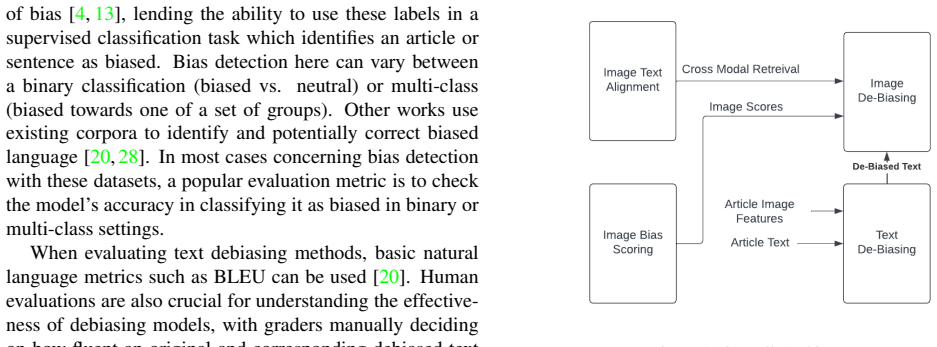
The central claim is that political bias identification and neutralization can be done multimodally: a BERT-style detector flags biased tokens, a masked language model replaces them with neutral alternatives, CLIP is fine-tuned with an angular loss that pulls together images of the same topic and, via a new bias-aware version of the loss, keeps images with similar manual bias scores close while pushing apart images with different scores, and a ViT regressor assigns each image a bias score from -1 to 1. At inference, the de-biased text retrieves the nearest semantically similar image whose bias score is closer to zero, thereby replacing slanted images. The paper describes this as succeeding in devising an architecture that can de-bias emotionally charged language, while cautioning that results were limited by training time and resources.
Load-bearing premise
The architecture's idea of "neutral" is inherited from manual bias scores that the authors assigned to each news source, and every learned component—the ViT regressor, the bias-aware alignment pairs, and the retrieval evaluation—depends on those scores; if the scores are subjective or noisy, the retrieved "neutral" images merely mirror the annotators' political judgments.
Editorial extensions
If this is right
- A newsroom or browser extension could feed a biased article through the pipeline and receive rewritten text plus a replacement image in one pass, preserving roughly the same subject matter.
- Because image debiasing is retrieval-based rather than generative, the replacement is always a real image, so the system is fast and avoids fabricating new visual content.
- The text module can be used alone on corpora like Wikipedia edits where paired neutral rewrites exist, making it testable without the image modules.
- Error compounding is a direct concern: a wrong bias score on a source propagates through alignment, retrieval, and evaluation.
Reading between the lines
- Because the paper models bias on a single left-right spectrum, the system has no explicit handle on non-ideological bias or multi-issue ideology; a multi-dimensional score would likely change both training and retrieval behavior.
- Since source-level scores are assigned by the authors for sites without public ratings, the entire neutrality target is partly subjective; an independent replication with multiple annotators or crowd-sourced scores would test whether "neutral" is stable across labelers.
- The same architecture could transfer to other polarizing domains, such as product reviews or public-health messaging, whenever a bias score can be defined; the paper does not claim this, but its mechanism does not depend on politics specifically.
- A testable extension would replace the fixed 10% bias neighborhood with a threshold scaled by annotator variance and measure whether retrieval neutrality improves.
Editorial analysis
A structured set of objections, weighed in public.
Referee Report
Summary. This manuscript describes a four-module pipeline for reducing political bias in news text and images: (i) BERT-based biased-word detection and neutralization (Section 3.1), (ii) CLIP-based cross-modal embedding with a bias-aware angular loss (Section 3.2), (iii) ViT-based image bias scoring (Section 3.3), and (iv) retrieval-based image replacement (Section 3.2). The authors report qualitative token-level bias detection examples (Section 4.1), an average cosine similarity of 0.396 between original and replaced words (Section 4.2), a single qualitative retrieval example (Section 4.3), and unquantified training and validation loss trends for the ViT (Section 4.4). The paper concludes that the attempt succeeded, while also stating that more time and resources were needed and that some modules did not produce the desired results.
Significance. The task of detecting and mitigating political bias in both text and images is timely, and the proposed architecture is a reasonable conceptual framework if the individual modules can be made to work. The paper builds on existing datasets (the Politics Dataset of Thomas and Kovashka and the Wikipedia Neutrality Corpus), provides a GitHub link to the code, and includes a thoughtful ethical discussion in Section 6 that acknowledges subjectivity in source scoring, the single-spectrum assumption, censorship risks, and potential misuse. However, the paper does not provide sufficient evidence to establish any of its main claims. The single quantitative text metric is misinterpreted, the image evaluation is circular, key modules are unvalidated, and the conclusion contradicts the reported results. Consequently, the paper cannot currently be considered a valid scientific contribution.
major comments (5)
- [Section 4.2, cosine similarity evaluation] The evaluation of bias word neutralization uses an average cosine similarity of 0.396 between the original and re-predicted words and compares this to 0.240 for the synonyms 'vacation'/'holiday'. The authors interpret the higher value as showing that the model 'is not producing synonymous words in the majority of cases.' This reading is backwards: a higher cosine with the original word means the predicted word is closer to the original than a typical synonym pair is, so the metric suggests the model is producing very similar (often identical) words, not unrelated ones. The metric is also uninformative without baselines such as random replacement, the identity mapping, or a contextual-appropriateness measure, and the qualitative example in the same section ('discharged' replaced by 'graduate') shows that cosine similarity does not capture whether the replacement fits the sentence context. This undermines the text-neutralization claim.
- [Section 3 and Equations 3-4] The image-debiasing evaluation is circular. The 'ground truth bias' b(x) in Equations 3 and 4 is the manually assigned source-level score from -1 to 1 per website (Section 3), and the same b(x) is used to define the 10% bias neighborhoods in the angular loss (Equation 2) and to fine-tune the ViT in Section 3.3. Thus Equations 3-4 measure how close retrieved images are to the authors' source-level labels, not whether the images are visually neutral or less biased in any content-based sense. The paper's acknowledgment in Section 6 of possible human bias in scoring does not address this deeper issue: an outlet score is being treated as an image-level label without any image-level annotation. As a result, the reported image retrieval results cannot support the claim that neutral images are being retrieved.
- [Section 4.1, bias word identification] Bias word identification is evaluated only with a few qualitative examples and no quantitative baseline. The authors state that 'there was no appropriate baseline to consider,' yet the WNC dataset provides ground-truth biased/neutral sentence pairs, and the system of Pryzant et al. [20] is a natural baseline since the detection module is taken from it. Without precision/recall or a comparison against [20] on a common test set, the claim in Section 5 that the model 'identified the biased text for most of the cases correctly' is unsupported. The statement in Section 4.1 that the model was trained for at most one epoch further weakens evidence of effectiveness.
- [Section 4.4, ViT validation] The ViT image bias predictor is not validated. Section 4.4 states that the authors 'were unable to get the R2 and RMSE score' and only reports 'encouraging results for our training and validation loss,' without providing the loss values or curves. Without any quantitative performance measure, the claim in Section 5 that 'we received good loss scores' cannot be assessed, and the module's role in the retrieval pipeline is unconfirmed.
- [Section 5, conclusion vs. reported results] The central claim in Section 5 that 'our attempt to de-bias both the text and images of our news succeeded' is contradicted by the paper's own findings: Section 4.3 reports that image retrieval 'did not produce the desired results,' Figure 8 shows retrieved images whose relevance to the query text is unclear, Section 4.2 describes a clear contextual failure ('discharged' → 'graduate'), and Section 4.4 provides no ViT performance numbers. The conclusion should be limited to the proposal of an architecture, not the demonstration of a working system, and the manuscript's current evidence cannot support the success claim.
minor comments (6)
- [Throughout] There are numerous typographical and grammatical errors; for example, 'multitmodal' (Section 2.1), 'intial' (Section 4.5), 'we shared a score of 0' (Section 3), and 'B b(xa)' in Equation 2 should be 'B(xa)'.
- [Equation 1] The angular loss is written without the hinge/truncation and margin term used in the original angular loss [29]; please clarify the exact formulation and specify the margin alpha value used.
- [Sections 3.2 and 4.3] Section 4.3 says 'a pre-trained CLIP model is used and fine-tuned using a modified triplet loss' while Section 3.2 describes the angular loss and the new bias loss; the relationship between these losses and the term 'modified triplet loss' should be clarified.
- [Section 4.5] The human evaluation form link in Section 4.5 is empty ('()'); include a working link or remove the claim that the form exists.
- [Figures 3 and 4] Figures 3 and 4 are referenced but the manuscript as provided does not include the figure images; please ensure all figures are embedded so that the alignment and retrieval visualizations can be inspected.
- [Section 3.1] The 'visual BERT' model fine-tuned with Wikipedia images and text is described without training details, hyperparameters, or results; specify which VisualBERT variant is used and how it is trained.
Circularity Check
Image 'neutrality' is defined, trained, and evaluated with the same manually assigned website-level bias scores; Eqs. 3-4 measure agreement with the model's own labels, not independent neutrality.
-
fitted input called prediction
[Section 3; Section 3.2; Section 3.3; Section 4.3, Eqs. 3-4]
"Based on their political leaning, we labeled the website from a score of -1 to 1 on a continuous scale... For websites we did not have a score, we looked at their wording, sourcing, story choices, and political affiliation to give them a score from -1 to 1. ... We will fine-tune this model further with more images and its respective bias score. ... b is the bias function of an image that returns the ground truth bias for known images in the embedding space and estimated bias for newly scored input images."
Every image inherits the website-level manual bias score assigned by the authors (or taken from mediabiasfactcheck.com). That same score is used as the ViT training label, defines the 10% bias neighborhood in the embedding loss, and is the b(...) in Eqs. 3-4 that measures whether a retrieved replacement image is neutral or moved toward neutrality. The retrieval evaluation therefore is not an independent test of image neutrality; it measures agreement with the annotators' own source-level scale. A model could 'succeed' simply by retrieving images from websites scored near 0, even if the pictures themselves are equally charged.
-
self definitional
[Section 3.2, Eq. 2; Section 4.3, Eq. 4]
"Aside from the angular loss that draws together distinct images of the same topic, the images should also be separated by bias. This process is done with another angular loss objective in which we create positive pairs using an image with similar bias of the anchor and negative pairs using an image with a different bias score. ... Equation 4 measures the average divergence towards neutrality of the retrieved images as compared to the original images in the test set."
The bias-aware angular loss is trained to place images with similar manual scores near each other and images with different manual scores apart. 'Divergence towards neutrality' in Eq. 4 is then computed with those same manual scores. Hence the evaluation criterion is literally the training objective: the metric cannot independently validate the debiasing claim because it is defined by the same labels that built the embedding.
full rationale
The text-debiasing chain is not circular: biased-word identification uses the external detector of Pryzant et al. and the Wikipedia Neutrality Corpus of biased/neutral pairs, and the neutralization evaluation (cosine similarity to the original word) is an external semantic metric, albeit a weak one. The circularity is confined to the image side. The paper assigns one bias score per website, either from mediabiasfactcheck.com or from the authors' own judgment, and every image from that website inherits the score. This score is then used in three roles: as the label for fine-tuning the ViT bias predictor, as the 10% 'bias neighborhood' that defines positive/negative pairs in the bias-aware angular loss, and as the ground-truth b(...) in Eqs. 3-4 that measures whether retrieved replacement images are neutral or moved toward neutrality. Because the evaluation target is identical to the training target, the image-neutralization claim is a self-consistency check rather than an independent demonstration: retrieval can lower |b| simply by returning images from sources the authors scored closer to 0. Section 6 acknowledges possible human bias in the manual scores but does not address the fact that the same scores define the objective, the training neighborhoods, and the metric. The paper's own qualitative retrieval result (Fig. 8) is inconclusive, and no human evaluation was completed. Overall this is partial circularity affecting the central image-side claim.
Assumptions & free parameters
free parameters (2)
- Manual news-source bias scores (-1 to 1) =
-1 (far left) to +1 (right), 0 neutral; unlisted websites scored by authors' judgment
- Bias-neighborhood threshold =
10% of bias score range
assumptions (4)
- ad hoc to paper Political bias is adequately represented by a single scalar left-right score for each article and image.
- domain assumption Dahlberg's public-sphere qualities are the correct normative standard for news neutrality, and reducing the scalar bias score moves articles toward those qualities.
- ad hoc to paper A 10% bias-neighborhood angular loss preserves semantic alignment while separating images by bias in CLIP space.
- domain assumption The pre-trained BERT, CLIP, Doc2Vec, and fastText models transfer to the political-news domain without further validation.
invented entities (1)
-
Bias neighborhood in the shared CLIP embedding space
Cite this review
Pith. "Pith review of Multimodal Political Bias Identification and Neutralization." pith.science (2026). https://pith.science/paper/SPD22QBM
@misc{pith2026250617372,
  author       = {Pith},
  title        = {Pith review of: Multimodal Political Bias Identification and Neutralization},
  year         = {2026},
  howpublished = {\url{https://pith.science/paper/SPD22QBM}},
  note         = {Machine review of arXiv:2506.17372}
}
read the original abstract
Due to the presence of political echo chambers, it becomes imperative to detect and remove subjective bias and emotionally charged language from both the text and images of political articles. However, prior work has focused on solely the text portion of the bias rather than both the text and image portions. This is a problem because the images are just as powerful of a medium to communicate information as text is. To that end, we present a model that leverages both text and image bias which consists of four different steps. Image Text Alignment focuses on semantically aligning images based on their bias through CLIP models. Image Bias Scoring determines the appropriate bias score of images via a ViT classifier. Text De-Biasing focuses on detecting biased words and phrases and neutralizing them through BERT models. These three steps all culminate to the final step of debiasing, which replaces the text and the image with neutralized or reduced counterparts, which for images is done by comparing the bias scores. The results so far indicate that this approach is promising, with the text debiasing strategy being able to identify many potential biased words and phrases, and the ViT model showcasing effective training. The semantic alignment model also is efficient. However, more time, particularly in training, and resources are needed to obtain better results. A human evaluation portion was also proposed to ensure semantic consistency of the newly generated text and images.
Figures


Figures from the paper (5 more)


Reference graph
Works this paper leans on
-
[27]
Preserving Semantic Neighborhoods for Robust Cross-modal Retrieval
Christopher Thomas and Adriana Kovashka. Preserving Se- mantic Neighborhoods for Robust Cross-modal Retrieval, July 2020. arXiv:2007.08617 [cs]. 2, 4, 6
work page Pith review arXiv 2020
-
[20]
Automatically Neutralizing Subjective Bias in Text
Reid Pryzant, Richard Diehl Martinez, Nathan Dass, Sadao Kurohashi, Dan Jurafsky, and Diyi Yang. Automati- cally Neutralizing Subjective Bias in Text, Dec. 2019. arXiv:1911.09709 [cs]. 1, 2, 3, 5, 6
work page Pith review arXiv 2019
-
[26]
Predicting the Politics of an Image Using Webly Supervised Data
Christopher Thomas and Adriana Kovashka. Predicting the Politics of an Image Using Webly Supervised Data. 1, 2, 3
-
[1]
English word vectors · fastText. 6
-
[2]
Jost, Jonathan Nagler, Joshua A
Pablo Barber ´a, John T. Jost, Jonathan Nagler, Joshua A. Tucker, and Richard Bonneau. Tweeting From Left to Right: Is Online Political Communication More Than an Echo Chamber?Psychological Science, 26(10):1531–1542, Oct. 2015. Publisher: SAGE Publications Inc. 1
work page 2015
-
[3]
Slanted Images: Measuring Nonverbal Media Bias During the 2016 Election, Apr
Levi Boxell. Slanted Images: Measuring Nonverbal Media Bias During the 2016 Election, Apr. 2021. 2
work page 2016
-
[4]
Detecting Media Bias in News Articles using Gaussian Bias Distributions, Oct
Wei-Fan Chen, Khalid Al-Khatib, Benno Stein, and Henning Wachsmuth. Detecting Media Bias in News Articles using Gaussian Bias Distributions, Oct. 2020. arXiv:2010.10649 [cs]. 2, 3
arXiv 2020
-
[5]
Analyzing Political Bias and Unfairness in News Articles at Different Levels of Granularity
Wei-Fan Chen, Khalid Al-Khatib, Henning Wachsmuth, and Benno Stein. Analyzing Political Bias and Unfairness in News Articles at Different Levels of Granularity, Oct. 2020. arXiv:2010.10652 [cs]. 2
work page Pith review arXiv 2020
Show all 30 references
-
[6]
Learning to Model and Ignore Dataset Bias with Mixed Ca- pacity Ensembles, Nov
Christopher Clark, Mark Yatskar, and Luke Zettlemoyer. Learning to Model and Ignore Dataset Bias with Mixed Ca- pacity Ensembles, Nov. 2020. arXiv:2011.03856 [cs]. 2
2020 arXiv
-
[7]
Echo Chamber or Public Sphere? Predicting Political Orien- tation and Measuring Political Homophily in Twitter Using Big Data.Journal of Communication, 64(2):317–332, Apr
Elanor Colleoni, Alessandro Rozza, and Adam Arvidsson. Echo Chamber or Public Sphere? Predicting Political Orien- tation and Measuring Political Homophily in Twitter Using Big Data.Journal of Communication, 64(2):317–332, Apr
-
[8]
The Habermasian public sphere: A spec- ification of the idealized conditions of democratic communi- cation.Studies in Social and Political Thought, Jan
Lincoln Dahlberg. The Habermasian public sphere: A spec- ification of the idealized conditions of democratic communi- cation.Studies in Social and Political Thought, Jan. 2004. 1
2004
-
[9]
BERT: Pre-training of Deep Bidirectional Transformers for Language Understanding, May 2019
Jacob Devlin, Ming-Wei Chang, Kenton Lee, and Kristina Toutanova. BERT: Pre-training of Deep Bidirectional Transformers for Language Understanding, May 2019. arXiv:1810.04805 [cs]. 3
2019 arXiv
-
[10]
Multi-Dimensional Gender Bias Classification, May 2020
Emily Dinan, Angela Fan, Ledell Wu, Jason Weston, Douwe Kiela, and Adina Williams. Multi-Dimensional Gender Bias Classification, May 2020. arXiv:2005.00614 [cs]. 2
2020 arXiv
-
[11]
An Image is Worth 16x16 Words: Transformers for Image Recognition at Scale, June 2021
Alexey Dosovitskiy, Lucas Beyer, Alexander Kolesnikov, Dirk Weissenborn, Xiaohua Zhai, Thomas Unterthiner, Mostafa Dehghani, Matthias Minderer, Georg Heigold, Syl- vain Gelly, Jakob Uszkoreit, and Neil Houlsby. An Image is Worth 16x16 Words: Transformers for Image Recognition ...
2021 arXiv
-
[12]
A Survey on Bias in Visual Datasets, June 2022
Simone Fabbrizzi, Symeon Papadopoulos, Eirini Ntoutsi, and Ioannis Kompatsiaris. A Survey on Bias in Visual Datasets, June 2022. arXiv:2107.07919 [cs]. 2
2022 arXiv
-
[13]
Detecting Political Bias in News Articles Using Headline Attention
Rama Rohit Reddy Gangula, Suma Reddy Duggenpudi, and Radhika Mamidi. Detecting Political Bias in News Articles Using Headline Attention. InProceedings of the 2019 ACL Workshop BlackboxNLP: Analyzing and Interpreting Neural Networks for NLP, pages 77–84, Florence, Italy, Aug. 2...
2019
-
[14]
Quanti- fying Societal Bias Amplification in Image Captioning
Yusuke Hirota, Yuta Nakashima, and Noa Garcia. Quanti- fying Societal Bias Amplification in Image Captioning. In 2022 IEEE/CVF Conference on Computer Vision and Pat- tern Recognition (CVPR), pages 13440–13449, New Or- leans, LA, USA, June 2022. IEEE. 2
2022
-
[15]
VisualBERT: A Simple and Per- formant Baseline for Vision and Language, Aug
Liunian Harold Li, Mark Yatskar, Da Yin, Cho-Jui Hsieh, and Kai-Wei Chang. VisualBERT: A Simple and Per- formant Baseline for Vision and Language, Aug. 2019. arXiv:1908.03557 [cs]. 3
2019 arXiv
-
[16]
Towards Debiasing Sentence Representations, July 2020
Paul Pu Liang, Irene Mengze Li, Emily Zheng, Yao Chong Lim, Ruslan Salakhutdinov, and Louis-Philippe Morency. Towards Debiasing Sentence Representations, July 2020. arXiv:2007.08100 [cs]. 1
2020 arXiv
-
[17]
Thomas Manzini, Yao Chong Lim, Yulia Tsvetkov, and Alan W. Black. Black is to Criminal as Caucasian is to Po- lice: Detecting and Removing Multiclass Bias in Word Em- beddings, July 2019. arXiv:1904.04047 [cs, stat]. 1
2019 arXiv
-
[18]
Examining and mitigating gender bias in text emotion detection task
Odbal, Guanhong Zhang, and Sophia Ananiadou. Examining and mitigating gender bias in text emotion detection task. Neurocomputing, 493:422–434, July 2022. 2
2022
-
[19]
Same Candidates, Different Faces: Uncov- ering Media Bias in Visual Portrayals of Presidential Can- didates with Computer Vision.Journal of Communication, 68(5):920–941, Oct
Yilang Peng. Same Candidates, Different Faces: Uncov- ering Media Bias in Visual Portrayals of Presidential Can- didates with Computer Vision.Journal of Communication, 68(5):920–941, Oct. 2018. 2
2018
-
[21]
Learning Transferable Visual Models From Natural Language Supervision, Feb
Alec Radford, Jong Wook Kim, Chris Hallacy, Aditya Ramesh, Gabriel Goh, Sandhini Agarwal, Girish Sastry, Amanda Askell, Pamela Mishkin, Jack Clark, Gretchen Krueger, and Ilya Sutskever. Learning Transferable Visual Models From Natural Language Supervision, Feb. 2021. arXiv:210...
2021 arXiv
-
[22]
Linguistic Models for Analyzing and Detect- ing Biased Language
Marta Recasens, Cristian Danescu-Niculescu-Mizil, and Dan Jurafsky. Linguistic Models for Analyzing and Detect- ing Biased Language. InProceedings of the 51st Annual Meeting of the Association for Computational Linguistics (Volume 1: Long Papers), pages 1650–1659, Sofia, Bulga...
2013
-
[23]
Robertson.Social Media and Civic Engagement: History, Theory, and Practice
Scott P. Robertson.Social Media and Civic Engagement: History, Theory, and Practice. Synthesis Lectures on Human-Centered Informatics. Springer International Pub- lishing, Cham, 2018. 1
2018
-
[24]
Determining Sub- jective Bias in Text through Linguistically Informed Trans- former based Multi-Task Network
Manjira Sinha and Tirthankar Dasgupta. Determining Sub- jective Bias in Text through Linguistically Informed Trans- former based Multi-Task Network. InProceedings of the 30th ACM International Conference on Information & Knowledge Management, CIKM ’21, pages 3418–3422, New Yor...
2021
-
[25]
Worst of Both Worlds: Biases Compound in Pre-trained Vision-and-Language Mod- els, May 2022
Tejas Srinivasan and Yonatan Bisk. Worst of Both Worlds: Biases Compound in Pre-trained Vision-and-Language Mod- els, May 2022. arXiv:2104.08666 [cs]. 2
2022 arXiv
-
[28]
A Multibias-mitigated and Sentiment Knowledge Enriched Transformer for Debiasing in Multimodal Conversational Emotion Recognition, July 2022
Jinglin Wang, Fang Ma, Yazhou Zhang, and Dawei Song. A Multibias-mitigated and Sentiment Knowledge Enriched Transformer for Debiasing in Multimodal Conversational Emotion Recognition, July 2022. arXiv:2207.08104 [cs]. 3
2022 arXiv
-
[29]
Deep Metric Learning with Angular Loss, Aug
Jian Wang, Feng Zhou, Shilei Wen, Xiao Liu, and Yuanqing Lin. Deep Metric Learning with Angular Loss, Aug. 2017. arXiv:1708.01682 [cs]. 4
2017 arXiv
-
[30]
De- moting Racial Bias in Hate Speech Detection, May 2020
Mengzhou Xia, Anjalie Field, and Yulia Tsvetkov. De- moting Racial Bias in Hate Speech Detection, May 2020. arXiv:2005.12246 [cs]. 2
2020 arXiv
Reviewed August 6, 2026 · model on record in the stance chip above.
Discussion (0). Sign in to comment.