REVIEW 4 major objections 4 minor 67 references
Integrating LLMs and Digital Twins for Adaptive Multi-Robot Task Allocation in Construction
T0 review · 4 major / 4 minor · reviewed 2026-08-06 · deepseek-v4-flash
Pith's one-line read This paper claims that a closed-loop digital twin, integer programming, and an LLM interface can make multi-robot construction task allocation adaptive to real-time changes, with GPT-4.1 extracting constraint edits at a 97.6% correct rate…
desk verdict Solid systems integration paper whose headline 97.6% LLM accuracy is honest but only on the authors' own in-distribution test set; the IP side is clean and fast, and the paper deserves a serious referee with expectations of revision. read the letter →
The pith
A machine-rendered reading of the paper's core claim, the machinery that carries it, and where it could break.
The reading
What carries the argument
The load-bearing object is an integer program for task assignment and scheduling. Its objective is makespan-primary, $C_m \max_{i\in\mathcal{T}} t^e_i + C_s \sum_{i\in\mathcal{T}} t^e_i + C_r \sum_{i\in\mathcal{T}}\sum_{r\in\mathcal{R}} x_{ir}$, with constraints for task dependencies, capability requirements ($\sum_{r\in\mathcal{R}} a_{kr} x_{ir} \ge b_{ki}$), no-overlap robot schedules, optional time windows, and task conflicts. Around this, the LLM acts as a pure translator $M: N \to \{(C_k, \theta_k)\}$, emitting five flag types (dependency, duration, start-time, robot-count, conflict) that map to template insertion points in the optimization code, so the solver's logic is never rewritten. A replanning variant freezes the assignments and schedules of completed and ongoing tasks and penalizes deviations from the original plan through $\Delta_x = \sum_{i\in\mathcal{T}^+}\sum_{r\in\mathcal{R}} |x_{ir} - {}^0x_{ir}|$ and $\Delta_t$. The digital twin (built on Unity with ROS# and BIM data) closes the loop by synchronizing physical robot states and task statuses back into re-optimization.
What would settle it
Take the paper's exact prompt template and apply it to a corpus of unseen, naturally recorded site instructions—with dialect, abbreviations, implicit task references, and off-topic chatter—and measure Correct Rate; a large drop below the reported 97.6% on this realistic corpus, or any extracted constraint that contradicts the digital twin's recorded task state, would refute the claim of practical adaptability.
Extended reading notes
Core claim
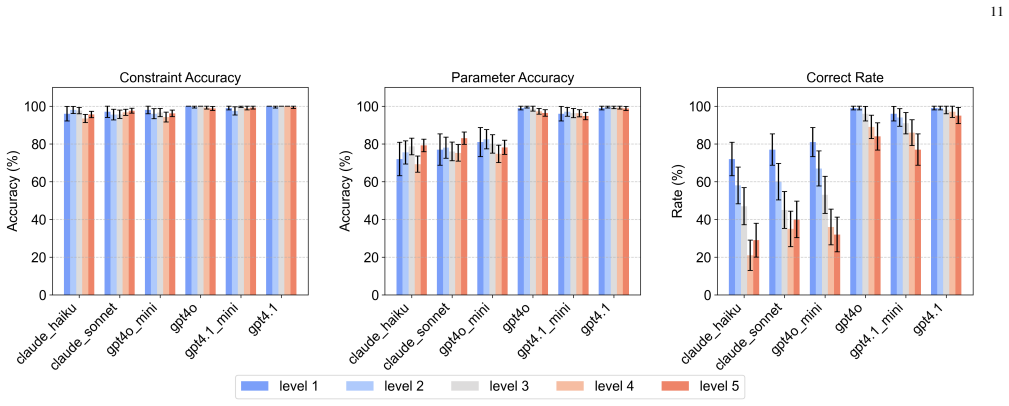
On its own terms, the paper claims to show that multi-robot task allocation on dynamic construction sites can be made adaptive by decoupling reasoning from optimization: a large language model maps free-form narrative updates from site personnel into typed constraint modifications (dependencies, durations, start times, robot counts, conflicts), a digital twin keeps the virtual model synchronized with physical progress through ROS and BIM, and an integer program solved by CP-SAT re-optimizes the assignment and schedule while freezing completed and ongoing tasks and penalizing deviations. In the case study, GPT-4.1 reaches a 97.6% Correct Rate on a 500-narrative test set, and the optimizer finds optimal solutions in under one second on average across 1000+ scenarios.
Load-bearing premise
The load-bearing premise is that the 500 hand-written narratives in the test set, which share the same task vocabulary and writing style as the few-shot prompt examples, genuinely represent the informal and ambiguous language that construction site personnel will actually use; the paper's own discussion flags that reliability on more ambiguous or informal narratives needs further investigation.
Editorial extensions
If this is right
- Site supervisors can replan multi-robot construction work by typing or speaking natural-language updates; the LLM converts each update into a typed constraint (dependency, duration, start-time, robot-count, conflict) and the optimizer recomputes the schedule.
- The decomposition keeps the optimization interpretable: because the LLM only edits flagged template parameters and never the solver logic, every schedule change can be traced back to the narrative that caused it.
- Replanning preserves execution consistency: tasks that are completed or underway keep their original assignments and timing, and the optimizer is charged a penalty for altering the remaining plan.
- The same three-layer architecture is claimed to transfer to other sequenced, heterogeneous-agent domains such as manufacturing, logistics, and industrial assembly.
Reading between the lines
- Editorial: the five flag types form a closed vocabulary, so real narratives that mention, say, spatial conflicts or robot energy limits would be silently ignored or mis-mapped; extending the flag set to cover such constraints would require re-benchmarking LLM accuracy on the larger output space.
- Editorial: the accuracy claim is in-distribution; testing on genuinely out-of-distribution narratives (recorded speech with disfluencies, implicit references, mixed languages) would be the natural stress test, and the authors' own limitation note suggests they expect degradation.
- Editorial: the closed-loop digital twin could double as a consistency checker—if the LLM-derived constraints contradict the twin's task-state model, the system could flag the discrepancy and ask the human to confirm, a safeguard the current pipeline does not include.
Editorial analysis
A structured set of objections, weighed in public.
Referee Report
Summary. This paper proposes a closed-loop framework for multi-robot task allocation in construction that combines a digital twin, integer programming (IP), and large language models (LLMs). The IP model assigns heterogeneous robots to precedence-constrained tasks with scheduling and no-overlap constraints, optional time-window and task-conflict constraints, and a replanning variant with deviation penalties. An LLM converts natural-language site narratives into five types of constraint or parameter updates that are injected into the optimization without rewriting the code. The authors report a Gazebo/Unity/Rhino case study with CP-SAT solve times and an LLM evaluation on 500 author-generated narratives, where GPT-4.1 reaches a 97.6% Correct Rate. The conclusion claims practicality, adaptability, and cross-domain applicability of the proposed methods.
Significance. The IP formulation is standard and appears internally consistent, and the reported solve times are plausible for the small instance sizes tested; the replanning formulation with deviation penalties is a useful component. The LLM evaluation is thoughtfully structured, with three metrics across five complexity levels and six models, and it is a genuine strength that the paper separates LLM reasoning from optimization. However, the empirical basis for the headline adaptability claim is narrow: the LLM test set is author-generated and in-distribution with the prompt, and there is no end-to-end demonstration connecting a narrative input to constraint updates, replanning, and digital-twin feedback. The paper is therefore better framed as a component-level feasibility study than as validation of a deployable adaptive system. With that reframing, or with additional out-of-distribution and integrated evaluation, the contribution would be solid.
major comments (4)
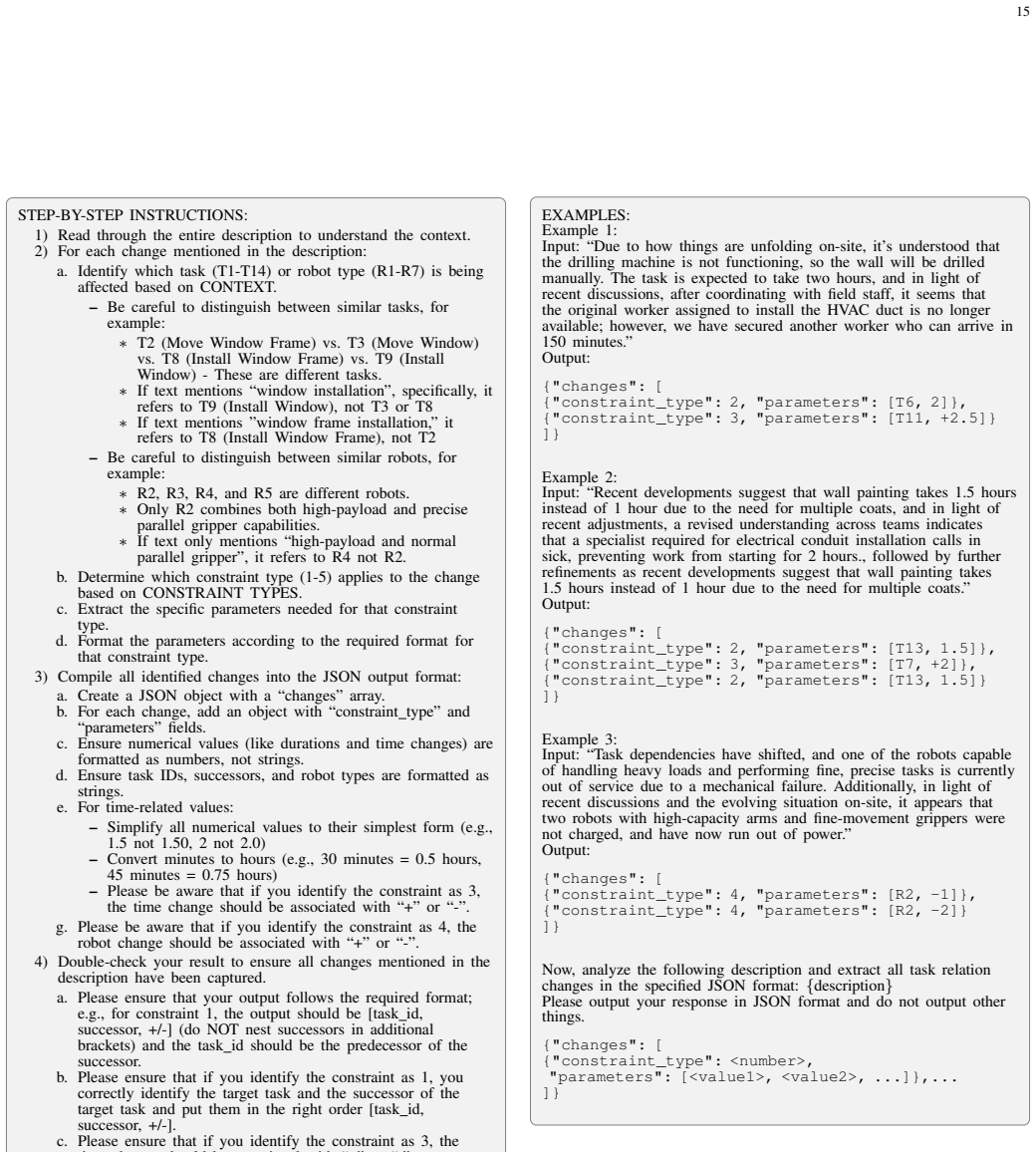
- [Section IV-C, Table V, Appendix A, Section V] The headline result (Table V: GPT-4.1 Correct Rate 97.6%) is measured on 500 narratives generated by the authors, and the prompt in Appendix A embeds the exact task vocabulary and disambiguation rules for the same 14-task/7-robot schema. The test narratives are therefore in-distribution paraphrases of the prompt schema. The authors themselves note in Section V that their reliability in processing "more ambiguous or informal construction narratives" needs further investigation. Because the abstract and conclusion use this accuracy to claim practicality, adaptability, and cross-domain applicability, the claim outruns the evidence. Please either add an out-of-distribution or human-collected narrative evaluation, or explicitly scope the contribution to structured, prompt-aligned narratives.
- [Sections III-C, IV-C, IV-D, Fig. 8] No end-to-end evaluation ties the LLM output to the optimization and digital twin. The LLM benchmark in Section IV-C and the optimization benchmark in Section IV-D are run separately, and the replanning example in Fig. 8 is described manually rather than traced through the pipeline of Fig. 3 and Eqs. (20)-(21) to solver inputs and an updated twin state. Since the central claim is a closed-loop adaptive framework, an integrated case study with at least one realistic narrative should be reported, or the claims should be limited to the components.
- [Sections III-B, III-E, IV-D] The scheduling variables are declared continuous in Eqs. (4)-(5), but the reported experiments use Google OR-Tools CP-SAT, which requires integer variable domains. Durations in Table III are fractional hours (e.g., 0.25 and 0.5), so as written the model is not an integer program and the solve times are not reproducible without specifying a time discretization (e.g., minutes) or an alternative MIP solver formulation. Please state the discretization, the value of T_large, and the objective weights C_m, C_s, C_r, C_x, C_t used in the experiments.
- [Section III-E, Eqs. (8), (25), (26)] The replanning constraints (25)-(26) fix start times, end times, and assignments for ongoing or completed tasks, while Eq. (8) links each task's duration to its start and end times. If the LLM extracts a duration change for an ongoing task, the fixed variables can make the replanning model infeasible unless the duration change is disallowed for such tasks. Please state whether duration changes are restricted to not-yet-started tasks, or extend the replanning model to handle duration updates for ongoing tasks.
minor comments (4)
- [Section III-B, Eqs. (4)-(5)] The symbols t^d_i and t^d_ir are not defined in Table I; they appear to be upper bounds on start times. Please clarify the notation.
- [Section IV-C] The procedure for generating the 500 test narratives is not described (who wrote them, whether templates were used, how randomness was applied). This detail is needed for readers to assess distribution shift and reproducibility.
- [Abstract and Section IV] The abstract refers to "real-time synchronization between physical operations and their digital representations," but the case study uses a Gazebo simulation rather than physical robots. Please qualify this as simulated operations or add evidence from physical experiments.
- [General] No code, data, or full prompt-output examples beyond Appendix A are provided; releasing these artifacts would materially improve reproducibility and would let readers verify the reported 97.6% Correct Rate.
Circularity Check
No significant circularity: the IP results are measured on generated instances, and the LLM accuracy, while in-distribution and over-interpreted in the abstract, is an empirical measurement rather than a derivation from its own input.
full rationale
The derivation chain is not circular. The IP model (Section III-B) is a standard formulation built from task-dependency, capability, no-overlap, time-window, and conflict constraints; the solve-time results (Table VI) are measured on randomly generated instances from Tables III-IV, not on any fitted target, so the optimization claims are externally grounded. The LLM accuracy claim (Table V) is a measured performance on a 500-narrative test set constructed by the authors (Section IV-C), and the few-shot prompt (Appendix A) embeds the same task/robot schema, so the 97.6% Correct Rate is an in-distribution result; the abstract's broader inference of 'practicality, adaptability, and cross-domain applicability' is not entailed by that number alone. The authors themselves flag this limitation in Section V: 'their reliability in processing more ambiguous or informal construction narratives need further investigations.' However, an in-distribution benchmark is a validity and extrapolation limitation, not a circular derivation: the accuracy score is not defined in terms of, nor equivalent to, the claim it supports, and no fitted parameter is renamed as a prediction. The only self-citation, the synchronized visualization module 'adapted from the authors' previous work [32],' is a component reuse; the current paper provides its own Unity/Gazebo demonstration, so the citation is not load-bearing. No equation reduces to its own input, and no uniqueness or ansatz is imported via self-citation.
Assumptions & free parameters
free parameters (3)
- Objective weights C_m, C_s, C_r =
not specified, ordered C_m >> C_s ≈ C_r
- Replanning weights C_x, C_t =
not specified, balanced with C_s
- Big-M constant T_large =
not specified
assumptions (4)
- domain assumption Task durations, dependencies, and capability requirements are known and fixed unless an LLM-updated constraint changes them.
- domain assumption The digital twin state update F in Eq. (1) faithfully mirrors physical site and robot states.
- ad hoc to paper The five constraint types in Table II are sufficient to capture all relevant narrative-driven schedule adaptations.
- domain assumption The LLM mapping M in Eq. (20) is reliable when the structured task knowledge base is provided.
Cite this review
Pith. "Pith review of Integrating LLMs and Digital Twins for Adaptive Multi-Robot Task Allocation in Construction." pith.science (2026). https://pith.science/paper/UTIR7LHP
@misc{pith2026250618178,
  author       = {Pith},
  title        = {Pith review of: Integrating LLMs and Digital Twins for Adaptive Multi-Robot Task Allocation in Construction},
  year         = {2026},
  howpublished = {\url{https://pith.science/paper/UTIR7LHP}},
  note         = {Machine review of arXiv:2506.18178}
}
read the original abstract
Multi-robot systems are emerging as a promising solution to the growing demand for productivity, safety, and adaptability across industrial sectors. However, effectively coordinating multiple robots in dynamic and uncertain environments, such as construction sites, remains a challenge, particularly due to unpredictable factors like material delays, unexpected site conditions, and weather-induced disruptions. To address these challenges, this study proposes an adaptive task allocation framework that strategically leverages the synergistic potential of Digital Twins, Integer Programming (IP), and Large Language Models (LLMs). The multi-robot task allocation problem is formally defined and solved using an IP model that accounts for task dependencies, robot heterogeneity, scheduling constraints, and re-planning requirements. A mechanism for narrative-driven schedule adaptation is introduced, in which unstructured natural language inputs are interpreted by an LLM, and optimization constraints are autonomously updated, enabling human-in-the-loop flexibility without manual coding. A digital twin-based system has been developed to enable real-time synchronization between physical operations and their digital representations. This closed-loop feedback framework ensures that the system remains dynamic and responsive to ongoing changes on site. A case study demonstrates both the computational efficiency of the optimization algorithm and the reasoning performance of several LLMs, with top-performing models achieving over 97% accuracy in constraint and parameter extraction. The results confirm the practicality, adaptability, and cross-domain applicability of the proposed methods.
Figures


Figures from the paper (8 more)




Reference graph
Works this paper leans on
-
[1]
Digitalization and au- tomation in construction project’s life-cycle: A review,
H. Begi ´c, M. Gali ´c, and Z. Dola ˇcek-Alduk, “Digitalization and au- tomation in construction project’s life-cycle: A review,”Journal of information technology in construction, vol. 27, pp. 441–460, 2022
work page 2022
-
[2]
Construction automation: Research areas, industry concerns and suggestions for advancement,
Q. Chen, B. G. de Soto, and B. T. Adey, “Construction automation: Research areas, industry concerns and suggestions for advancement,” Automation in construction, vol. 94, pp. 22–38, 2018
work page 2018
-
[3]
A. Klarin and Q. Xiao, “Automation in architecture, engineering and construction: a scientometric analysis and implications for management,” Engineering, Construction and Architectural Management, vol. 31, no. 8, pp. 3308–3334, 2024
work page 2024
-
[4]
K. S. Saidi, T. Bock, and C. Georgoulas, “Robotics in construction,” in Springer handbook of robotics. Springer, 2016, pp. 1493–1520
work page 2016
-
[5]
Digital twin-enabled advance exe- cution for human-robot collaborative assembly,
S. Liu, X. V . Wang, and L. Wang, “Digital twin-enabled advance exe- cution for human-robot collaborative assembly,”CIRP annals, vol. 71, no. 1, pp. 25–28, 2022
work page 2022
-
[6]
Automatic high-level motion sequencing methods for enabling multi- tasking construction robots,
X. Wang, S. Wang, C. C. Menassa, V . R. Kamat, and W. McGee, “Automatic high-level motion sequencing methods for enabling multi- tasking construction robots,”Automation in Construction, vol. 155, p. 105071, 2023
work page 2023
-
[7]
Digital twin-based smart manufacturing: Dynamic line reconfiguration for disturbance handling,
B. Fu, M. Bi, S. Umeda, T. Nakano, Y . Nonaka, Q. Zhou, T. Matsui, D. M. Tilbury, and K. Barton, “Digital twin-based smart manufacturing: Dynamic line reconfiguration for disturbance handling,”IEEE Trans- actions on Automation Science and Engineering, vol. 22, pp. 14 892– 14 905, 2025
work page 2025
-
[8]
Robotics in assembly- based industrialized construction: A narrative review and a look for- ward,
B. M. Tehrani, S. BuHamdan, and A. Alwisy, “Robotics in assembly- based industrialized construction: A narrative review and a look for- ward,”International Journal of Intelligent Robotics and Applications, vol. 7, no. 3, pp. 556–574, 2023
work page 2023
Show all 67 references
-
[9]
Adaptive visual perception for robotic construction process: A multi-robot coordination framework,
J. Xu, M. Dixit, and X. Wang, “Adaptive visual perception for robotic construction process: A multi-robot coordination framework,”arXiv preprint arXiv:2412.11275, 2024
2024 arXiv
-
[10]
Robotic technologies for on-site building construction: A systematic review,
M. Gharbia, A. Chang-Richards, Y . Lu, R. Y . Zhong, and H. Li, “Robotic technologies for on-site building construction: A systematic review,” Journal of Building Engineering, vol. 32, p. 101584, 2020
2020
-
[11]
Construction robotics: review of intelligent features,
A. Attalla, O. Attalla, A. Moussa, D. Shafique, S. B. Raean, and T. Hegazy, “Construction robotics: review of intelligent features,”Inter- national Journal of Intelligent Robotics and Applications, vol. 7, no. 3, pp. 535–555, 2023
2023
-
[12]
Recent advancements of robotics in construction,
B. Xiao, C. Chen, and X. Yin, “Recent advancements of robotics in construction,”Automation in Construction, vol. 144, p. 104591, 2022
2022
-
[13]
Robust task scheduling for heterogeneous robot teams under capability uncertainty,
B. Fu, W. Smith, D. M. Rizzo, M. Castanier, M. Ghaffari, and K. Barton, “Robust task scheduling for heterogeneous robot teams under capability uncertainty,”IEEE Transactions on Robotics, vol. 39, no. 2, pp. 1087– 1105, 2022
2022
-
[14]
Multi-robot task allocation methods: A fuzzy optimization approach,
O. Valero, J. Antich, A. Tauler-Rossell ´o, J. Guerrero, J.-J. Mi ˜nana, and A. Ortiz, “Multi-robot task allocation methods: A fuzzy optimization approach,”Information Sciences, vol. 648, p. 119508, 2023
2023
-
[15]
A convex optimization approach to multi-robot task allocation and path planning,
T. Lei, P. Chintam, C. Luo, L. Liu, and G. E. Jan, “A convex optimization approach to multi-robot task allocation and path planning,”Sensors, vol. 23, no. 11, p. 5103, 2023
2023
-
[16]
Simultaneous schedul- ing of multiple construction projects considering supplier selection and material transportation routing,
B. Abdzadeh, S. Noori, and S. F. Ghannadpour, “Simultaneous schedul- ing of multiple construction projects considering supplier selection and material transportation routing,”Automation in construction, vol. 140, p. 104336, 2022
2022
-
[17]
L. A. Wolsey,Integer programming. John Wiley & Sons, 2020
2020
-
[18]
Genetic algorithms for task scheduling problem,
F. A. Omara and M. M. Arafa, “Genetic algorithms for task scheduling problem,”Journal of Parallel and Distributed computing, vol. 70, no. 1, pp. 13–22, 2010
2010
-
[19]
A stochastic integer programming approach to air traffic scheduling and operations,
K. Wang and A. Jacquillat, “A stochastic integer programming approach to air traffic scheduling and operations,”Operations Research, vol. 68, no. 5, pp. 1375–1402, 2020
2020
-
[20]
A stochastic integer programming approach to reserve staff scheduling with pref- erences,
C. Perreault-Lafleur, M. Carvalho, and G. Desaulniers, “A stochastic integer programming approach to reserve staff scheduling with pref- erences,”International Transactions in Operational Research, vol. 32, no. 1, pp. 289–313, 2025
2025
-
[21]
A genetic algorithm for scheduling open shops with sequence-dependent setup times,
L. R. Abreu, J. O. Cunha, B. A. Prata, and J. M. Framinan, “A genetic algorithm for scheduling open shops with sequence-dependent setup times,”Computers & Operations Research, vol. 113, p. 104793, 2020
2020
-
[22]
Research on the risk early warning of construction engineering under the coupling disaster of typhoons and rainstorms in coastal areas based on bp neural network,
J. Deng, “Research on the risk early warning of construction engineering under the coupling disaster of typhoons and rainstorms in coastal areas based on bp neural network,”Journal of Coastal Research, vol. 105, no. SI, pp. 151–154, 2020
2020
-
[23]
Weather-related construction delays in a changing climate: a systematic state-of-the-art review,
S. J. Schuldt, M. R. Nicholson, Y . A. Adams, and J. D. Delorit, “Weather-related construction delays in a changing climate: a systematic state-of-the-art review,”Sustainability, vol. 13, no. 5, p. 2861, 2021
2021
-
[24]
Multiobjec- tive evolutionary model of the construction industry based on network planning,
D. Yu, Q. Lv, G. Srivastava, C.-H. Chen, and J. C.-W. Lin, “Multiobjec- tive evolutionary model of the construction industry based on network planning,”IEEE Transactions on Industrial Informatics, vol. 19, no. 2, pp. 2173–2182, 2022
2022
-
[25]
Workflow dependency approach for modular building construction manufacturing process using dependency structure matrix (dsm),
J. Lee, M. Park, H.-S. Lee, T. Kim, S. Kim, and H. Hyun, “Workflow dependency approach for modular building construction manufacturing process using dependency structure matrix (dsm),”KSCE journal of civil engineering, vol. 21, pp. 1525–1535, 2017
2017
-
[26]
Improving resource utilization by timely fine-grained scheduling,
T. Jin, Z. Cai, B. Li, C. Zheng, G. Jiang, and J. Cheng, “Improving resource utilization by timely fine-grained scheduling,” inProceedings of the Fifteenth European Conference on Computer Systems, 2020, pp. 1–16
2020
-
[27]
A comprehensive overview of large language models,
H. Naveed, A. U. Khan, S. Qiu, M. Saqib, S. Anwar, M. Usman, N. Akhtar, N. Barnes, and A. Mian, “A comprehensive overview of large language models,”arXiv preprint arXiv:2307.06435, 2023
2023 arXiv
-
[28]
Collaborative robotics in construction: A test case on screwing gypsum boards on ceiling,
M. Gautam, H. Fagerlund, B. Greicevci, F. Christophe, and J. Havula, “Collaborative robotics in construction: A test case on screwing gypsum boards on ceiling,” in2020 5th international conference on green technology and sustainable development (GTSD). IEEE, 2020, pp. 88–93
2020
-
[29]
Design and assembly automation of the robotic reversible timber beam,
A. Kunic, R. Naboni, A. Kramberger, and C. Schlette, “Design and assembly automation of the robotic reversible timber beam,”Automation in Construction, vol. 123, p. 103531, 2021
2021
-
[30]
From bim to digital twins: A systematic review of the evolution of intelligent building represen- tations in the aec-fm industry
M. Deng, C. C. Menassa, and V . R. Kamat, “From bim to digital twins: A systematic review of the evolution of intelligent building represen- tations in the aec-fm industry.”Journal of Information Technology in Construction, vol. 26, 2021
2021
-
[31]
Development of bim- integrated construction robot task planning and simulation system,
S. Kim, M. Peavy, P.-C. Huang, and K. Kim, “Development of bim- integrated construction robot task planning and simulation system,” Automation in Construction, vol. 127, p. 103720, 2021
2021
-
[32]
Enabling building information model-driven human-robot collaborative construction workflows with closed-loop digital twins,
X. Wang, H. Yu, W. McGee, C. C. Menassa, and V . R. Kamat, “Enabling building information model-driven human-robot collaborative construction workflows with closed-loop digital twins,”Computers in Industry, vol. 161, p. 104112, 2024
2024
-
[33]
Bim-integrated collaborative robotics for application in building construction and maintenance,
C. Follini, V . Magnago, K. Freitag, M. Terzer, C. Marcher, M. Riedl, A. Giusti, and D. T. Matt, “Bim-integrated collaborative robotics for application in building construction and maintenance,”Robotics, vol. 10, no. 1, p. 2, 2020
2020
-
[34]
Optimization techniques for multi-robot task allocation problems: Review on the state- of-the-art,
H. Chakraa, F. Gu ´erin, E. Leclercq, and D. Lefebvre, “Optimization techniques for multi-robot task allocation problems: Review on the state- of-the-art,”Robotics and Autonomous Systems, vol. 168, p. 104492, 2023
2023
-
[35]
Group-based distributed auction algorithms for multi-robot task as- signment,
X. Bai, A. Fielbaum, M. Kronm ¨uller, L. Knoedler, and J. Alonso-Mora, “Group-based distributed auction algorithms for multi-robot task as- signment,”IEEE Transactions on Automation Science and Engineering, vol. 20, no. 2, pp. 1292–1303, 2022
2022
-
[36]
An algorithm for task allocation and planning for a heterogeneous multi-robot system to minimize the last task completion time,
A. Patil, J. Bae, and M. Park, “An algorithm for task allocation and planning for a heterogeneous multi-robot system to minimize the last task completion time,”Sensors, vol. 22, no. 15, p. 5637, 2022
2022
-
[37]
An effective collaboration evolutionary algorithm for multi-robot task allocation and scheduling in a smart farm,
H. Guo, Z. Miao, J. Ji, and Q. Pan, “An effective collaboration evolutionary algorithm for multi-robot task allocation and scheduling in a smart farm,”Knowledge-Based Systems, vol. 289, p. 111474, 2024
2024
-
[38]
Resilient task allocation in heterogeneous multi-robot systems,
S. Mayya, D. S. D’antonio, D. Salda ˜na, and V . Kumar, “Resilient task allocation in heterogeneous multi-robot systems,”IEEE Robotics and Automation Letters, vol. 6, no. 2, pp. 1327–1334, 2021
2021
-
[39]
Resource-based task allocation for multi-robot systems,
D.-H. Lee, “Resource-based task allocation for multi-robot systems,” Robotics and Autonomous Systems, vol. 103, pp. 151–161, 2018
2018
-
[40]
Multi- robot task allocation clustering based on game theory,
J. G. Martin, F. J. Muros, J. M. Maestre, and E. F. Camacho, “Multi- robot task allocation clustering based on game theory,”Robotics and Autonomous Systems, vol. 161, p. 104314, 2023
2023
-
[41]
Multi-robot task allocation games in dynamically changing environments,
S. Park, Y . D. Zhong, and N. E. Leonard, “Multi-robot task allocation games in dynamically changing environments,” in2021 IEEE Interna- tional Conference on Robotics and Automation (ICRA). IEEE, 2021, pp. 8678–8684
2021
-
[42]
Solving the multi-robot task allocation with functional tasks based on a hyper-heuristic algorithm,
F. Yan and K. Di, “Solving the multi-robot task allocation with functional tasks based on a hyper-heuristic algorithm,”Applied Soft Computing, vol. 146, p. 110628, 2023
2023
-
[43]
An integrated approach for automatic safety inspection in construction: Domain knowledge with multimodal large language model,
Y . Wang, H. Luo, and W. Fang, “An integrated approach for automatic safety inspection in construction: Domain knowledge with multimodal large language model,”Advanced Engineering Informatics, vol. 65, p. 103246, 2025
2025
-
[44]
Large language model-empowered paradigm for automated geotechnical site planning and geological characterization,
Z. Qian and C. Shi, “Large language model-empowered paradigm for automated geotechnical site planning and geological characterization,” Automation in Construction, vol. 173, p. 106103, 2025. 14
2025
-
[45]
Autorepo: A general framework for multimodal llm-based automated construction reporting,
H. Pu, X. Yang, J. Li, and R. Guo, “Autorepo: A general framework for multimodal llm-based automated construction reporting,”Expert Systems with Applications, vol. 255, p. 124601, 2024
2024
-
[46]
Meet2mitigate: An llm-powered framework for real-time issue identi- fication and mitigation from construction meeting discourse,
G. Chen, A. Alsharef, A. Ovid, A. Albert, and E. Jaselskis, “Meet2mitigate: An llm-powered framework for real-time issue identi- fication and mitigation from construction meeting discourse,”Advanced Engineering Informatics, vol. 64, p. 103068, 2025
2025
-
[47]
Semantic enrichment for bim-based build- ing energy performance simulations using semantic textual similarity and fine-tuning multilingual llm,
K. Forth and A. Borrmann, “Semantic enrichment for bim-based build- ing energy performance simulations using semantic textual similarity and fine-tuning multilingual llm,”Journal of Building Engineering, vol. 95, p. 110312, 2024
2024
-
[48]
Investigating the use of chatgpt for the scheduling of construction projects,
S. A. Prieto, E. T. Mengiste, and B. Garc ´ıa de Soto, “Investigating the use of chatgpt for the scheduling of construction projects,”Buildings, vol. 13, no. 4, p. 857, 2023
2023
-
[49]
Context-aware and adaptive task planning for autonomous construction robots through llm-robot communication,
K. Kim, M. Ivashchenko, P. Ghimire, and P.-C. Huang, “Context-aware and adaptive task planning for autonomous construction robots through llm-robot communication,”Available at SSRN 4827728
-
[50]
A prompt pattern catalog to enhance prompt engineering with chatgpt,
J. White, Q. Fu, S. Hays, M. Sandborn, C. Olea, H. Gilbert, A. El- nashar, J. Spencer-Smith, and D. C. Schmidt, “A prompt pattern catalog to enhance prompt engineering with chatgpt,”arXiv preprint arXiv:2302.11382, 2023
2023 arXiv
-
[51]
Prompt design matters for computational social science tasks but in unpredictable ways,
S. Atreja, J. Ashkinaze, L. Li, J. Mendelsohn, and L. Hemphill, “Prompt design matters for computational social science tasks but in unpredictable ways,”arXiv preprint arXiv:2406.11980, 2024
2024 arXiv
-
[52]
Chain-of-thought prompting elicits reasoning in large language models,
J. Wei, X. Wang, D. Schuurmans, M. Bosma, F. Xia, E. Chi, Q. V . Le, D. Zhouet al., “Chain-of-thought prompting elicits reasoning in large language models,”Advances in neural information processing systems, vol. 35, pp. 24 824–24 837, 2022
2022
-
[53]
Language mod- els are few-shot learners,
T. Brown, B. Mann, N. Ryder, M. Subbiah, J. D. Kaplan, P. Dhariwal, A. Neelakantan, P. Shyam, G. Sastry, A. Askellet al., “Language mod- els are few-shot learners,”Advances in neural information processing systems, vol. 33, pp. 1877–1901, 2020
1901
-
[54]
Tabllm: Few-shot classification of tabular data with large language models,
S. Hegselmann, A. Buendia, H. Lang, M. Agrawal, X. Jiang, and D. Sontag, “Tabllm: Few-shot classification of tabular data with large language models,” inInternational Conference on Artificial Intelligence and Statistics. PMLR, 2023, pp. 5549–5581
2023
-
[55]
Measuring massive multitask language understanding,
D. Hendrycks, C. Burns, S. Basart, A. Zou, M. Mazeika, D. Song, and J. Steinhardt, “Measuring massive multitask language understanding,” arXiv preprint arXiv:2009.03300, 2020
2009 arXiv
-
[56]
Nphardeval: Dynamic benchmark on reasoning ability of large language models via complexity classes,
L. Fan, W. Hua, L. Li, H. Ling, and Y . Zhang, “Nphardeval: Dynamic benchmark on reasoning ability of large language models via complexity classes,”arXiv preprint arXiv:2312.14890, 2023
2023 arXiv
-
[57]
Diagnostic performances of gpt- 4o, claude 3 opus, and gemini 1.5 pro in “diagnosis please
Y . Sonoda, R. Kurokawa, Y . Nakamura, J. Kanzawa, M. Kurokawa, Y . Ohizumi, W. Gonoi, and O. Abe, “Diagnostic performances of gpt- 4o, claude 3 opus, and gemini 1.5 pro in “diagnosis please” cases,” Japanese journal of radiology, vol. 42, no. 11, pp. 1231–1235, 2024
2024
-
[58]
siemens/ros-sharp,
Siemens, “siemens/ros-sharp,” https://github.com/siemens/ros-sharp/ wiki, 2025, [Online; accessed June 10, 2025]. APPENDIX A. Prompt Template Figs. 9-11 (due to the page length, we break it into three parts) show the prompt design for the information extraction in the context ...
2025
-
[59]
+” indicates a newly added successor, “-
Task Dependency Adjustments •Format: [task id, successor, +/-] •task id: the target task •successor: the successors of the target task •+/-: “+” indicates a newly added successor, “-” means the dependency has been removed
-
[60]
Task Duration Variations •Format: [task id, new duration] •task id: the target task •new duration: the new duration of the target task in hours
-
[61]
Task Starting Time Changes •Format: [task id, start time change] •task id: the target task •start time change: the changes in start time of the target task (e.g., +2 means delayed by 2 hours; -2 means ahead by 2 hours)
-
[62]
Number of Robot Variations •Format: [robot type id, robot number change] •robot type id: the type of robot (e.g., R1, R2, R3, etc.) •robot number change: the number changes of the robot (e.g., +1 means one more robot; -1 means one less robot)
-
[63]
9: Prompt design for construction project scheduling - Part 1
Task Conflict Constraints •Format: [task id1, task id2] •task id1: the first task in the conflict •task id2: the second task in the conflict Fig. 9: Prompt design for construction project scheduling - Part 1. 15 STEP-BY-STEP INSTRUCTIONS:
-
[64]
Read through the entire description to understand the context
-
[65]
window installation
For each change mentioned in the description: a. Identify which task (T1-T14) or robot type (R1-R7) is being affected based on CONTEXT. –Be careful to distinguish between similar tasks, for example: ∗T2 (Move Window Frame) vs. T3 (Move Window) vs. T8 (Install Window Frame) vs....
-
[66]
changes” array. b. For each change, add an object with “constraint type
Compile all identified changes into the JSON output format: a. Create a JSON object with a “changes” array. b. For each change, add an object with “constraint type” and “parameters” fields. c. Ensure numerical values (like durations and time changes) are formatted as numbers, ...
-
[67]
+” or “-
Double-check your result to ensure all changes mentioned in the description have been captured. a. Please ensure that your output follows the required format; e.g., for constraint 1, the output should be [task id, successor, +/-] (do NOT nest successors in additional brackets)...
Reviewed August 6, 2026 · model on record in the stance chip above.
Discussion (0). Sign in to comment.