REVIEW 3 major objections 5 minor 199 references
From Barthel Randers Kropina Geometries to the Accelerating Universe: A Brief Review of Recent Advances in Finslerian Cosmology
T0 review · 3 major / 5 minor · reviewed 2026-08-15 · deepseek-v4-flash
Pith's one-line read The review argues that a Finslerian spacetime metric, depending on position and an internal direction, can generate an effective dark energy, with one variant fitting the data as well as the standard cosmological model.
desk verdict A useful self-review of the authors' Finslerian cosmology program with a new DESI DR2 comparison, but the 'viable alternative' claim is a parametric fit, not a geometric prediction. read the letter →
The pith
A machine-rendered reading of the paper's core claim, the machinery that carries it, and where it could break.
The reading
What carries the argument
The machinery is the Barthel connection of an $(\alpha,\beta)$ metric, evaluated on the osculating vector field $Y=b$. For both Randers and Kropina metrics this connection coincides with the Levi–Civita connection of the Riemannian metric $\hat g_{IJ}(x)=g_{IJ}(x,b(x))$, so a direction-dependent Finsler geometry becomes an ordinary Riemannian geometry with extra structure. Imposing homogeneity and isotropy pins the one-form to $b=(a\eta,0,0,0)$, leaving one free function $\eta(t)$; every dark-energy-like term in the Friedmann equations is built from $\eta,\eta',\eta''$. The construction reduces an otherwise intractable Finsler gravity theory to standard Einstein equations plus corrections, at the cost that the function generating the dark energy is not fixed by any equation of motion.
What would settle it
Compute the gravitational field equations for $F=\alpha^2/\beta$ from an action principle on the unit tangent bundle instead of postulating Eq. (59); if the action's Friedmann equations do not reduce to Eqs. (71)–(72) with the same free $\eta(t)$, then the Barthel–Kropina fit is not the prediction of the geometry—the fitted $\eta(t)$ would need to be redetermined or the model abandoned.
Extended reading notes
Core claim
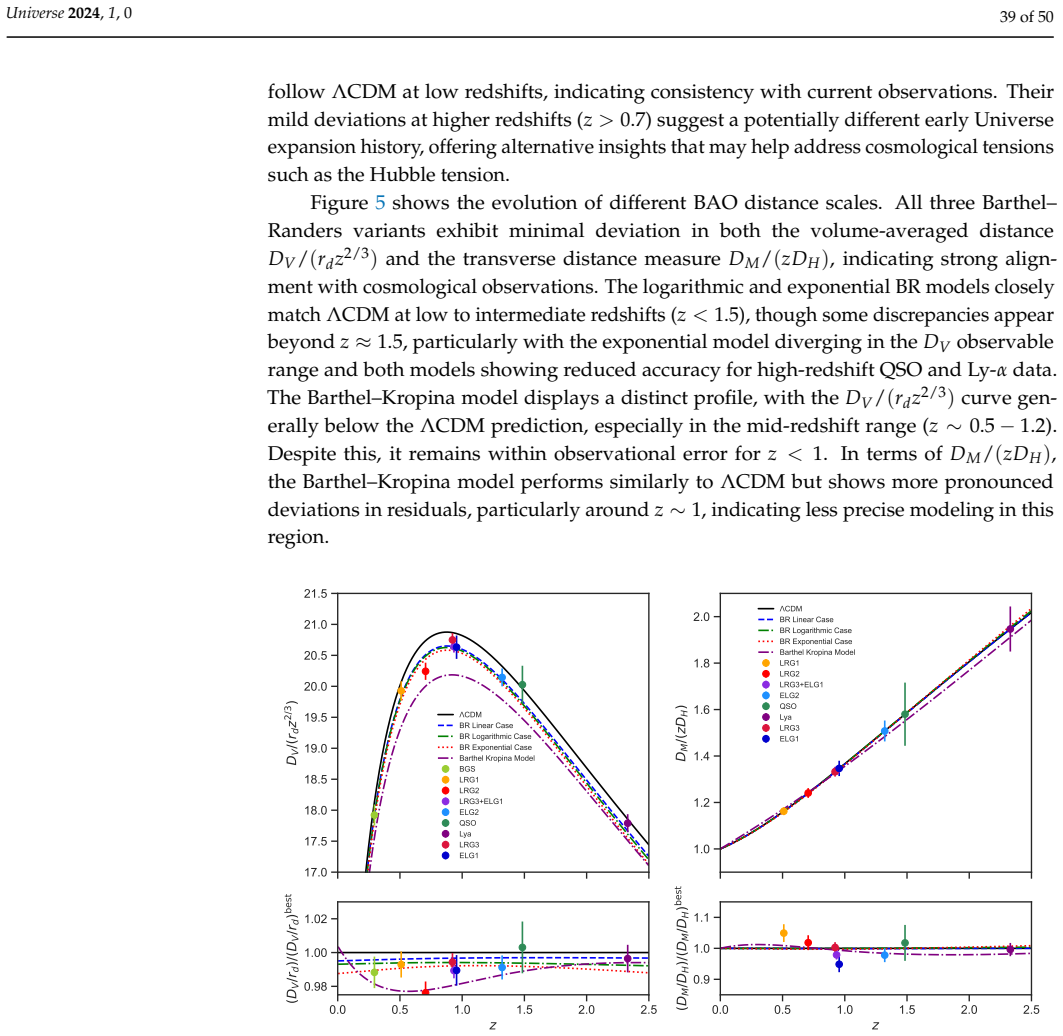
On its own terms, the central claim is that the accelerating expansion of the Universe can emerge from Finslerian geometry rather than from a cosmological constant. In the Barthel–Kropina model, the Finsler function is $F=\alpha^2/\beta$, where $\alpha$ is the Riemannian FLRW metric and $\beta=b_I y^I$ is a one-form; after the osculating reduction the generalized Friedmann equations acquire terms built from $\eta(t)$, and these terms act as an effective dark energy. The statistical part of the review compares the Barthel–Randers variants and the Barthel–Kropina model with $\Lambda$CDM using cosmic chronometer, Type Ia supernova, and baryon acoustic oscillation data under an MCMC analysis. It finds $\chi^2_{\rm tot}=1762.37$ for Barthel–Kropina versus $1780.94$ for $\Lambda$CDM, with AIC lower by 14.6 and BIC lower by 3.7, while the Barthel–Randers variants are slightly less favored. The authors conclude that these Finslerian models are a statistically viable alternative to the standard cosmological model.
Load-bearing premise
The load-bearing premise is that fixing the internal Finsler direction to the one-form $b=(a\eta,0,0,0)$ and postulating the Einstein-like field equations (59) is the correct way to turn a Finsler spacetime into a gravity theory; if a variational principle or a different choice of internal direction changes those equations, the effective dark energy and all fitted results are not consequences of Finsler geometry.
Editorial extensions
If this is right
- The late-time acceleration can be reproduced without a cosmological constant or dark energy fluid, so the dark-energy problem shifts from finding a substance to explaining why the spacetime metric carries a time-dependent internal direction.
- The Barthel–Kropina model makes specific cosmographic predictions—transition redshift $z_{\rm tr}\approx 0.72$ and present jerk $j_0\approx 0.45$—that differ from $\Lambda$CDM and are testable with high-redshift surveys.
- Because matter is not conserved in these theories, particle creation from geometry is a built-in consequence; its creation pressure and rate could be compared with thermodynamic bounds.
- The same osculating Barthel construction applies to any $F=\alpha\,\phi(s)$, yielding a family of modified-gravity cosmologies that are no harder to compute than general relativity.
Reading between the lines
- Editorial inference: the data comparison exercises only the background expansion; no perturbation equations are derived, so growth of structure, weak lensing, and CMB anisotropies remain uncalculated tests of the geometry.
- Editorial inference: with $\eta(t)$ a free function possessing no dynamics, the good fit may partly reflect the model's flexibility; a version that derives $\eta$ from an action, or fixes it by symmetry, would show how much predictive power the framework truly has.
- Editorial inference: deriving the same field equations from a Finsler–Einstein action for $F=\alpha^2/\beta$ would close the main gap between the postulated equations (59) and a fully variational theory, and would make the fitted $\eta(t)$ a solution rather than an input.
- Editorial inference: the particle-creation channel ties the model to semiclassical gravity; entropy production requirements could constrain $\dot\phi$ and thereby select among the fitted expansion histories.
Signed reviews
Editorial analysis
A structured set of objections, weighed in public.
Referee Report
Summary. This manuscript reviews a line of work on Finslerian cosmological models based on the osculating Barthel connection for (α,β) metrics. It covers Barthel-Randers (F=α+β), Barthel-Kropina (F=α²/β), and conformally transformed Barthel-Kropina geometries: generalized Friedmann equations are derived, energy-balance equations are written, and a thermodynamic interpretation in terms of particle creation is developed. The paper then presents an MCMC analysis of three Barthel-Randers variants (linear, logarithmic, exponential φ(z)) and one Barthel-Kropina model, using Cosmic Chronometer, Pantheon+ SNe Ia, and DESI DR2 BAO data, with AIC/BIC model comparison against ΛCDM. The Abstract and Section 7 claim that these Finslerian models provide a satisfactory fit and represent a viable alternative to the standard cosmological model.
Significance. If the central claim were supported, the paper would establish a geometrically motivated alternative to dark energy, with Finslerian geometry generating an effective cosmological constant. The review usefully collects the mathematical machinery of osculating (α,β) geometries and shows that, for Y=b, the Barthel connection reduces to the Levi-Civita connection of an effective Riemannian metric; the derivation of the generalized Friedmann equations within that setup is self-contained and generally correct. The statistical pipeline is described in reasonable detail, and the paper makes explicit use of standard likelihood functions and convergence diagnostics. However, the central viability claim is not currently supported: the Finslerian terms are not predicted but are implemented through hand-chosen functions (φ(z) for Randers, initial conditions and EoS parameter for Kropina) that are fitted to the same data used for the comparison. The paper is therefore best read as a review of a specific phenomenological framework, and the observational comparison should be presented as a test of that parametrization rather than of Finsler gravity itself.
major comments (3)
- [Section 4.1, Eq. (116)] The normalized Hubble function h(z) in Eq. (116) contains the denominator (1+z)φ'(z) − 2φ(z). With the stated forms φ(z)=1+βz, φ(z)=1+ln(1+βz), and φ(z)=e^{2βz}, and with the flatness constraint (117), evaluation at z=0 yields h(0) = (2−β)/(β−2) = −1 for the linear model, and similarly h(0)=−1 for the other two variants. This contradicts the requirement h(0)=1 for a normalized Hubble function and the fact that H(z)=H0 h(z) should be positive. Please correct the sign in the denominator (the likely form is 2φ(z) − (1+z)φ'(z)) and re-verify, and if necessary re-run, the Barthel-Randers MCMC results reported in Sections 5 and 6.
- [Section 3.4 and Section 4.1] The Barthel-Kropina field equations (71)–(72) contain four unknowns (a, η, ρ, p) and, as the text explicitly states, remain underdetermined even after imposing an equation of state; a supplementary relation is needed. Section 4.1 then introduces the integrated ODE system (118)–(120) for the Barthel-Kropina model without specifying the closure relation that connects f(z), u(z), and h(z) to the variables (a, η, ρ, p) of Section 3.4, and without defining the physical meaning of f and u. Consequently, the MCMC analysis of the Barthel-Kropina model is not reproducible from the manuscript, and the statistical comparison in Table 3 cannot be verified as a test of the Finsler-derived equations rather than of an unspecified phenomenological ansatz. Please provide the missing closure relation and definitions, or clearly declare (118)–(120) to be a separate phenomenological model.
- [Abstract, Sections 4 and 7, Table 3] The claim that the Finslerian models are a viable alternative to ΛCDM rests on fits in which the Finslerian input is a free function fitted to the data: the Barthel-Randers models use ad hoc forms φ(z)=1+βz, 1+ln(1+βz), and e^{2βz} in Eq. (116), with no equation of motion for φ (or η); and the Barthel-Kropina model fits the initial conditions f0, u0 and an equation-of-state parameter ω=1.045, which corresponds to a stiff fluid rather than baryonic matter. The ΔAIC=−14.6 preference for the Barthel-Kropina model in Table 3 therefore reflects the flexibility of a phenomenological parametrization (plus an unphysical matter component), not a successful prediction of Finsler geometry. The paper should explicitly state that η(t) has no dynamical law, that the fitted 'geometric dark energy' is a curve-fitting device, and should soften the 'viable alternative' conclusion accordingly.
minor comments (5)
- [Section 3.3, text after Eq. (70)] The sentence 'By substituting the expression of H² from the Friedmann equation (60), we recover equation (70)' appears circular; presumably the intended statement is that the first Friedmann equation reproduces the conservation equation (68) or a similar consistency check. Please clarify.
- [Section 5.4.3] The interpretation of the p-value is reversed: a p-value smaller than 0.05 indicates that the observed χ² is unlikely under the model, i.e., a poor fit, not evidence that the model is a good fit. The text should be corrected to avoid this statistical misunderstanding.
- [Section 6.1] There are typographical errors in the reported Gelman-Rubin statistics: the Barthel-Kropina line reads '1.0071.007' instead of a comma-separated list, and some braces in the Barthel-Randers lines are incorrectly placed. These should be fixed for clarity.
- [Section 4.1] The symbol h(z) is used for the normalized Hubble function in Eq. (116) and in the Barthel-Kropina system (118)–(120), but the paper never states the condition h(0)=1 for the Barthel-Kropina case. Please state this normalization explicitly, as it is used in the initial conditions for the ODE system.
- [Title page] The manuscript header includes 'Academic Editor', 'Received', 'Revised', 'Accepted', and a journal-style citation with a DOI placeholder. For an arXiv preprint this information is unusual and should be removed or updated to avoid confusion about the paper's status.
Circularity Check
The Finslerian 'dark energy' is a fitted free function: Randers uses hand-picked φ(z) with fitted β, Kropina closes an underdetermined system with fitted initial conditions and ω, so the statistical success is a fit rather than a geometric prediction.
-
fitted input called prediction
[Section 4.1, Eq. (116); Section 3.3, Eqs. (60)-(62)]
"Our starting point is the family of cosmological scenarios proposed in [120], where three distinct variants of the Barthel–Randers model were introduced. Each of these variants is characterized by a specific choice of the function φ(z). ... The form of φ(z) determines the behavior of each specific model and encodes the influence of the underlying Finslerian geometry."
In the Randers derivation the entire Finslerian modification is carried by φ=1+aη (Eq. (62)), with η(x0) a free function that obeys no equation of motion. The normalized Hubble function (116) is then built from φ(z) plus fitted parameters Ωm0, β, H0, M, rd, while ΩΛ0 is defined by Eq. (117) in terms of φ′(0). The three 'variants' are three arbitrary ansätze for φ (linear, logarithmic, exponential). The abstract's 'effective dark energy component' is therefore not a prediction of the geometry: it is the chosen φ with its fitted β, and the reported χ2/AIC values test that parametrization, not Finsler gravity.
-
fitted input called prediction
[Section 3.4, Eqs. (71)-(73); Section 4.1, Eqs. (118)-(120); Table 2]
"By considering an equation of state for the baryonic matter, p=p(ρ), the number of unknowns in the system of generalized Friedmann equations becomes three, and the system is still underdetermined. Therefore, to obtain solvable cosmological models, and to close the system, we must impose a supplementary independent relation."
The text concedes that the Kropina Friedmann system (71)-(72) is underdetermined and requires an extra closure, but the review never states the relation that turns it into the integrated ODEs (118)-(120). The numerical solutions then treat f0, u0, and the baryonic equation-of-state parameter ω as free, with best fits f0=0.0420, u0=0.3641, ω=1.045 (Table 2). Since ω≈1.045 describes a stiff fluid, not standard baryonic matter, the ΔAIC=−14.6 advantage (Table 3) measures the flexibility of a six-parameter phenomenological H(z), not a successful prediction of Kropina geometry. The 'effective dark energy' appears because the free function and initial conditions are fitted to the same expansion data.
1 more flagged steps
-
ansatz smuggled in via citation
[Section 3.3-3.4 (Eqs. (60)-(61), (71)-(72)); Section 4.1 (after [120], [121])]
"The generalized Friedmann equations in this geometry take the form [120]. ... In the case of the Barthel–Kropina geometry, we adopt the model proposed by [121]."
The load-bearing evolution equations and the functional ansätze used for the fits are taken from the authors' own previous papers [120,121] rather than derived in this review. Those papers contain the same unconstrained η(t)/φ(z) input and, for Kropina, the same admitted 'supplementary independent relation' needed to close an underdetermined system (Section 3.4). Hence the statistical comparison tests a parametrization whose flexibility was fixed by the authors' earlier choices; the present paper adds MCMC fitting but not an independent derivation of the Finslerian 'dark energy' terms.
full rationale
Most of the mathematics in Sections 2-3.1 — the (α,β) metric formalism, the b-osculating Riemannian metric, and the theorem that the Barthel connection coincides with the Levi-Civita connection when Y=b — is genuine geometry, checkable independently of the cosmological claims, and not circular. The circularity enters when this geometry is converted into cosmology. The one-form β is fixed to (aη,0,0,0) by isotropy, but η(t) remains a completely free function with no equation of motion; the Friedmann equations therefore contain extra terms that are not determined by the Finsler structure. In the Barthel-Randers fits these terms become three arbitrary φ(z) ansätze with a fitted β, and ΩΛ0 is defined by Eq. (117) from φ′(0). In the Barthel-Kropina case the paper itself states that the system (71)-(72) is underdetermined and needs a supplementary relation; the integrated system (118)-(120) is then solved with fitted f0, u0, and ω≈1.045. The ΔAIC/BIC comparisons in Table 3 therefore measure how well a free function plus fitted initial conditions can match the expansion history, not whether Finsler geometry predicts dark energy. The abstract's claim that the geometric terms 'generate' an effective cosmological constant is a renaming of this fitted freedom. The score is 6 because the central statistical claim partially reduces by construction, even though the underlying Finsler geometry and the field-equation postulate are not themselves circular.
Assumptions & free parameters
free parameters (9)
- BR linear model parameter beta =
0.00213 +/- 0.00061
- BR logarithmic model parameter beta =
0.00448 +/- 0.00055
- BR exponential model parameter beta =
0.00820 +/- 0.00016
- Functional form of phi(z) in BR models =
Linear, logarithmic, or exponential, chosen by hand
- BK initial condition f0 =
0.0420 +/- 0.0015
- BK initial condition u0 =
0.3641 +/- 0.0066
- BK equation-of-state parameter omega =
1.045 +/- 0.047
- Standard joint fit parameters H0, Omega_m0, M, rd =
H0 about 66-69, Omega_m0 about 0.288-0.306, M about -19.42 to -19.45, rd about 147.9-149.0
- Conformal factor phi(x0) in conformal Barthel-Kropina =
Unconstrained
assumptions (6)
- standard math For (alpha, beta)-metrics evaluated at Y=b, the Cartan tensor vanishes and the Barthel connection equals the Levi-Civita connection of the osculating metric, Eqs. (51)-(52).
- domain assumption The gravitational field equations are the Einstein equations for the osculating Barthel curvature, Eq. (59).
- domain assumption The cosmological background is FLRW, the one-form has only a temporal component b0=a eta, and the matter four-velocity is comoving and described by a perfect fluid, Section 3.2.
- ad hoc to paper The Finslerian internal vector is identified with the one-form field, Y=b, Section 3.1.3.
- domain assumption In Barthel-Randers cosmology the covariant divergence of the energy-momentum tensor with the Barthel connection vanishes, Eq. (68); in Barthel-Kropina it does not, and the non-conservation is interpreted as particle creation.
- ad hoc to paper The functional forms phi(z)=1+beta z, phi(z)=1+ln(1+beta z), and phi(z)=e^{2 beta z} are adopted to close the Barthel-Randers model.
invented entities (1)
-
Effective time-dependent Finslerian dark-energy function phi(t)/eta(t)
Cite this review
Pith. "Pith review of From Barthel Randers Kropina Geometries to the Accelerating Universe: A Brief Review of Recent Advances in Finslerian Cosmology." pith.science (2026). https://pith.science/paper/SOGCZKCV
@misc{pith2026250618422,
  author       = {Pith},
  title        = {Pith review of: From Barthel Randers Kropina Geometries to the Accelerating Universe: A Brief Review of Recent Advances in Finslerian Cosmology},
  year         = {2026},
  howpublished = {\url{https://pith.science/paper/SOGCZKCV}},
  note         = {Machine review of arXiv:2506.18422}
}
abstract
We review recent developments in cosmological models based on Finsler geometry and extensions of general relativity within this framework. Finsler geometry generalizes Riemannian geometry by allowing the metric tensor to depend on position and an additional internal degree of freedom, typically represented by a vector field at each point of the spacetime manifold. We explore whether Finsler-type geometries can describe gravitational interaction and cosmological dynamics. In particular, we examine the Barthel connection and $(\alpha, \beta)$ geometries, where $\alpha$ is a Riemannian metric and $\beta$ is a one-form. For a specific construction of $\beta$, the Barthel connection coincides with the Levi-Civita connection of the associated Riemann metric. We review gravitational field and cosmological evolution in three geometries: Barthel-Randers ($F = \alpha + \beta$), Barthel-Kropina ($F = \alpha^2 \beta$), and the conformally transformed Barthel-Kropina geometry. After presenting the mathematical foundations of Finslerian-type modified gravity theories, we derive generalized Friedmann equations in these geometries assuming a Friedmann-Lema\^itre-Robertson-Walker type metric. We also present the matter-energy balance equations, interpreting them from the perspective of thermodynamics with particle creation. The cosmological properties of Barthel-Randers and Barthel-Kropina models are explored in detail. The additional geometric terms in these models can be interpreted as an effective dark energy component, generating an effective cosmological constant. Several cosmological solutions are compared with observational data (Cosmic Chronometers, Type Ia Supernovae, Baryon Acoustic Oscillations) using MCMC analysis. A comparison with the $\Lambda$CDM model shows that Finslerian models fit observational data well, suggesting they offer a viable alternative to general relativity.
Figures


Figures from the paper (3 more)


Reference graph
Works this paper leans on
-
[1]
Gravitation und Elektrizität
Weyl, H. Gravitation und Elektrizität. InSitzungsberichte der Königlich Preussischen Akademie der Wissenschaften zu Berlin, 1918th ed.; Königlich Preussische Akademie: Berlin, Germany, 1918; pp. 465–480
1918
-
[2]
Weyl, H.Space, Time, Matter; Dover Publications: New York, NY, USA, 1952
1952
-
[3]
Über Kurven und Flächen in Allgemeinen Räumen
Finsler, P . Über Kurven und Flächen in Allgemeinen Räumen. Dissertation, University of Göttingen, Göttingen, Germany, 1918
1918
-
[4]
Die Feldgleichungen der Gravitation
Einstein, A. Die Feldgleichungen der Gravitation. InSitzungsberichte der Königlich Preussischen Akademie der Wissenschaften zu Berlin, 1915th ed.; Königlich Preussische Akademie: Berlin, Germany, 1915; pp. 844–847
1915
-
[5]
Die Grundlage der allgemeinen Relativitätstheorie.Ann
Einstein, A. Die Grundlage der allgemeinen Relativitätstheorie.Ann. Der Phys.1916,49, 769–822
1916
-
[6]
Die Grundlagen der Physik
Hilbert, D. Die Grundlagen der Physik. InNachrichten von der Gesellschaft der Wissenschaften zu Göttingen, Mathematisch-Physikalische Klasse1915,1915, 395–408
1915
-
[7]
InBeyond Einstein: Perspectives on Geometry, Gravitation, and Cosmology in the Twentieth Century; Rowe, D.E., Sauer, T., Walter, S.A., Eds.; Springer: New York, NY, USA, 2018; pp
Scholz, The Unexpected Resurgence of Weyl Geometry in late 20th-Century Physics. InBeyond Einstein: Perspectives on Geometry, Gravitation, and Cosmology in the Twentieth Century; Rowe, D.E., Sauer, T., Walter, S.A., Eds.; Springer: New York, NY, USA, 2018; pp. 261–360
2018
-
[8]
Über die Hypothesen, welche der Geometrie zu Grunde liegen.Abh
Riemann, B. Über die Hypothesen, welche der Geometrie zu Grunde liegen.Abh. KöNiglichen Ges. Wiss. GöTtingen1868,13, 133–150
Show all 199 references
-
[9]
Finsler Geometry Is Just Riemannian Geometry without the Quadratic Restriction.Not
Chern, S.S. Finsler Geometry Is Just Riemannian Geometry without the Quadratic Restriction.Not. Am. Math. Soc.1996,43, 959–963
1996
-
[10]
Rund, H.The Differential Geometry of Finsler Spaces; Springer: Berlin, Germany, 1959
1959
-
[11]
Bejancu, A.Finsler Geometry and Applications; Ellis Horwood: New York, NY, USA, 1990
1990
-
[12]
Bao, D.; Chern, S.-S.; Shen, Z.An Introduction to Riemann-Finsler Geometry; Springer: New York, NY, USA, 2000
2000
-
[13]
Shen, Y.-B.; Shen, Z.Introduction to Modern Finsler Geometry; World Scientific: Singapore, 2016
2016
-
[14]
The Confrontation between General Relativity and Experiment.Living Rev
Will, C.M. The Confrontation between General Relativity and Experiment.Living Rev. Relativ.2014,17, 4
2014
-
[15]
Abbott, B.P . et al. [LIGO Scientific Collaboration and Virgo Collaboration]. Observation of GravitationalWaves from a Binary Black Hole MergerPhysical Rev. Lett.2016,116, 061102
2016
-
[16]
Abbott, R. et al. [LIGO Scientific Collaboration and Virgo Collaboration]. GW190814: GravitationalWaves from the Coalescence of a 23 Solar Mass Black Hole with a 2.6 Solar Mass Compact Object.Astrophysical J. Lett.2020,896, L44
2020
-
[17]
Sur les variétés à connexion affine et la théorie de la relativité généralisée.Ann
Cartan, É. Sur les variétés à connexion affine et la théorie de la relativité généralisée.Ann. De L’École Norm. Supérieure1924,41, 1–25
-
[18]
Sur les variétés à connexion affine et la théorie de la relativité généralisée.Ann
Cartan, É. Sur les variétés à connexion affine et la théorie de la relativité généralisée.Ann. De L’École Norm. Supérieure1925,42, 17–88
-
[19]
Weitzenböck, R.Invariantentheorie; Noordhoff: Groningen, The Netherlands, 1923
1923
-
[20]
The Geometry of Free Fall and Light Propagation.Gen
Ehlers, J.; Pirani, F.A.E.; Schild, A. The Geometry of Free Fall and Light Propagation.Gen. Relativ. Gravit.2012,44, 1587
2012
-
[21]
Constructive Axiomatics in Spacetime Physics Part I: Walkthrough to the Ehlers-Pirani-Schild Axiomati- sation.arXiv2021, arXiv:2112.14063
Linnemann, N.; Read, J. Constructive Axiomatics in Spacetime Physics Part I: Walkthrough to the Ehlers-Pirani-Schild Axiomati- sation.arXiv2021, arXiv:2112.14063
-
[22]
Constructive Axiomatics in Spacetime Physics Part II: Constructive Axiomatics in Context
Adlam, E.; Linnemann, N.; Read, J. Constructive Axiomatics in Spacetime Physics Part II: Constructive Axiomatics in Context. arXiv2022, arXiv:2211.05672
-
[23]
Constructive Axiomatics in Spacetime Physics Part III: A Constructive Axiomatic Approach to Quantum Spacetime.arXiv2022, arXiv:2208.07249
Adlam, E.; Linnemann, N.; Read, J. Constructive Axiomatics in Spacetime Physics Part III: A Constructive Axiomatic Approach to Quantum Spacetime.arXiv2022, arXiv:2208.07249
-
[24]
Finsler Spacetime Geometry in Physics.Int
Pfeifer, C. Finsler Spacetime Geometry in Physics.Int. J. Geom. Methods Mod. Phys.2019,16(Suppl. 02), 1941004
2019
-
[25]
On an Asymmetrical Metric in the Four-Space of General Relativity.Phys
Randers, G. On an Asymmetrical Metric in the Four-Space of General Relativity.Phys. Rev.1941,59, 195
1941
-
[26]
On the Geometrically Absolute Optical Representation in the Electron Microscope.Trav
Ingarden, R. On the Geometrically Absolute Optical Representation in the Electron Microscope.Trav. Société Sci. Lettres Wrocław Série B1957,45, 3
-
[27]
The Geometry of Ingarden Spaces.Rep
Miron, R. The Geometry of Ingarden Spaces.Rep. Math. Phys.2004,54, 131
2004
-
[28]
On the Geometrization of Quantum Mechanics.Ann
Tavernelli, I. On the Geometrization of Quantum Mechanics.Ann. Phys.2016,371, 239
2016
-
[29]
On the Self-Interference in Electron Scattering: Copenhagen, Bohmian and Geometrical Interpretations of Quantum Mechanics.Ann
Tavernelli, I. On the Self-Interference in Electron Scattering: Copenhagen, Bohmian and Geometrical Interpretations of Quantum Mechanics.Ann. Phys.2018,393, 447. Universe2024,1, 0 45 of 50
2018
-
[30]
Finslerian Geometrization of Quantum Mechanics in the Hydrodynamical Representation
Liang, S.-D.; Sabau, S.V .; Harko, T. Finslerian Geometrization of Quantum Mechanics in the Hydrodynamical Representation. Phys. Rev. D2019,100, 105012
-
[31]
Gravitational Quantum Dynamics: A Geometrical Perspective.Found
Tavernelli, I. Gravitational Quantum Dynamics: A Geometrical Perspective.Found. Phys.2021,51, 46
2021
-
[32]
The Kinetic Gas Universe.Eur
Hohmann, M.; Pfeifer, C.; Voicu, N. The Kinetic Gas Universe.Eur. Phys. J. C2020,80, 809
-
[33]
From Kinetic Gases to an Exponentially Expanding Universe.arXiv 2025, arXiv:2504.08062
Pfeifer, C.; Voicu, N.; Friedl-Szász, A.; Popovici-Popescu, E. From Kinetic Gases to an Exponentially Expanding Universe.arXiv 2025, arXiv:2504.08062
2025
-
[34]
Geometry of Physical Dispersion Relations.Phys
Rätzel, D.; Rivera, S.; Schuller, F.P . Geometry of Physical Dispersion Relations.Phys. Rev. D2011,83, 044047
-
[35]
Finsler Spinoptics.Commun
Duval, C. Finsler Spinoptics.Commun. Math. Phys.2008,283, 701–727
2008
-
[36]
Classical Lagrangians and Finsler Structures for the Nonminimal Fermion Sector of the Standard-Model Extension
Schreck, M. Classical Lagrangians and Finsler Structures for the Nonminimal Fermion Sector of the Standard-Model Extension. Phys. Rev. D2016,93, 105017
-
[37]
Riemann–Finsler Geometry and Lorentz-Violating Scalar Fields.Phys
Edwards, B.R.; Kostelecký, V .A. Riemann–Finsler Geometry and Lorentz-Violating Scalar Fields.Phys. Lett. B2018,786, 319–326
-
[38]
A Geometrical Model for the Unified Theory of Physical Fields.Phys
Horváth, J.I. A Geometrical Model for the Unified Theory of Physical Fields.Phys. Rev.1950,80, 901
1950
-
[39]
Entwicklung einer einheitlichen Feldtheorie begründet auf die Finslersche Geometrie.Z
Horváth, J.I.; Moór, A. Entwicklung einer einheitlichen Feldtheorie begründet auf die Finslersche Geometrie.Z. Für Phys.1952, 131, 548
1952
-
[40]
Gravitational Field in Finsler Spaces.Lett
Takano, Y. Gravitational Field in Finsler Spaces.Lett. Nuovo Cimento1974,10, 747
-
[41]
Variation Principle in Finsler Spaces.Lett
Takano, Y. Variation Principle in Finsler Spaces.Lett. Nuovo Cimento1974,11, 486
-
[42]
A Finslerian Extension of General Relativity.Found
Asanov, G.S. A Finslerian Extension of General Relativity.Found. Phys.1981,11, 137
1981
-
[43]
Reidel: Dordrecht, The Netherlands, 1985
Asanov, G.S.Finsler Geometry, Relativity and Gauge Theories; D. Reidel: Dordrecht, The Netherlands, 1985
1985
-
[44]
Finslerian Solution for Static Spherically Symmetric Gravitational Field.Fortschritte Phys.1991,39, 185
Asanov, G.S. Finslerian Solution for Static Spherically Symmetric Gravitational Field.Fortschritte Phys.1991,39, 185
1991
-
[45]
Finslerian Extension of Schwarzschild Metric.Fortschritte Phys.1992,40, 667
Asanov, G.S. Finslerian Extension of Schwarzschild Metric.Fortschritte Phys.1992,40, 667
1992
-
[46]
Shadow analysis and light deflection in charged Finslerian Kiselev black holes under spherical accretion.Ann
Malligawad, M.; Narasimhamurthy, S.K.; Nekouee, Z.; Yashwanth, B.R. Shadow analysis and light deflection in charged Finslerian Kiselev black holes under spherical accretion.Ann. Phys.2025,477, 70005
2025
-
[47]
Exploring null geodesic of Finslerian hairy black hole.Class
Nekouee, Z.; Narasimhamurthy, S.K.; Yashwanth, B.R.; Sanjay, T. Exploring null geodesic of Finslerian hairy black hole.Class. Quantum Gravity2025,42, 045002
-
[48]
Geodesics of Finsler Hayward Black Hole Surrounded by Quintessence.Eur
Yashwanth, B.R.; Narasimhamurthy, S.K.; Nekouee, Z.; Malligawad, M. Geodesics of Finsler Hayward Black Hole Surrounded by Quintessence.Eur. Phys. J. C2025,84, 1276
-
[49]
Exploring the quintessential influence on shadows of black holes in Finsler-Hayward geometry.Phys
Malligawad, M.; Narasimhamurthy, S.K.; Nekouee, Z. Exploring the quintessential influence on shadows of black holes in Finsler-Hayward geometry.Phys. Lett. B2024,856, 138963
-
[50]
Generalized Finslerian Wormhole Models in f(R , T) Gravity.Particles 2024,7, 747–767
Yashwanth, B.R.; Narasimhamurthy, S.K.; Nekouee, Z. Generalized Finslerian Wormhole Models in f(R , T) Gravity.Particles 2024,7, 747–767
2024
-
[51]
Black Hole Solutions with Constant Ricci Scalar in a Model of Finsler Gravity.J
Nekouee, Z.; Narasimhamurthy, S.K.; Pacif, S.K.J. Black Hole Solutions with Constant Ricci Scalar in a Model of Finsler Gravity.J. Cosmol. Astropart. Phys.2024,2024, 061
2024
-
[52]
Finslerian wormhole solution in the framework of modified gravity.Phys
Malligawad, M.; Narasimhamurthy, S.K.; Nekouee, Z.; Kumbar, M.Y. Finslerian wormhole solution in the framework of modified gravity.Phys. Scr.2024,99, 045206
2024
-
[53]
Traversable wormhole model in Finslerian geometry
Sanjay, T.; Narasimhamurthy, S.K.; Nekouee, Z.; Manjunatha, H.M. Traversable wormhole model in Finslerian geometry. Pramana—J. Phys.2024,98, 16
2024
-
[54]
Thermodynamic product formulae for Finslerian Kiselev black hole.Eur
Nekouee, Z.; Narasimhamurthy, S.K. Thermodynamic product formulae for Finslerian Kiselev black hole.Eur. Phys. J. C2023,83, 723
-
[55]
Finsler geometry insights into wormhole traversability and physical properties.Indian J
Manjunath, M.; Narasimhamurthy, S.K.; Nekouee, Z.; Yashwanth, B.R.; Mallikarjun, Y.K. Finsler geometry insights into wormhole traversability and physical properties.Indian J. Phys.2025, https://doi.org/10.1007/s12648-025-03638-5
2025 doi
-
[56]
(In Romanian)
Miron, R.; Anastasiei, M.Vector Bundles, Lagrange Spaces, and Applications to the Theory of Relativity; Editura Academiei Române: Bucharest, Romania, 1987. (In Romanian)
1987
-
[57]
Ikeda, S.Advanced Studies in Applied Geometry; Seizansha: Sagamihara, Japan, 1995
1995
-
[58]
A Finsler Generalisation of Einstein’s Vacuum Field Equations.Gen
Rutz, S.F. A Finsler Generalisation of Einstein’s Vacuum Field Equations.Gen. Relativ. Gravit.1993,25, 1139
1993
-
[59]
Towards a gravitation theory in Berwald–Finsler space.Chin
Li, X.; Chang, Z. Towards a gravitation theory in Berwald–Finsler space.Chin. Phys. C2010,34, 28
-
[60]
Finsler Gravity Action from Variational Completion.Phys
Hohmann, M.; Pfeifer, C.; Voicu, N. Finsler Gravity Action from Variational Completion.Phys. Rev. D2019,100, 064035
-
[61]
Riess, A.G. et al. [Supernova Search Team]. Observational Evidence from Supernovae for an Accelerating Universe and a Cosmological Constant.Astron. J.1998,116, 1009
1998
-
[62]
Perlmutter, S. et al. [Supernova Cosmology Project]. Measurements of Ω and Λ from 42 High-Redshift Supernovae.Astrophys. J. 1999,517, 565
1999
-
[63]
New Constraints on ΩM, ΩΛ, and w from an Independent Set of Eleven High-Redshift Supernovae Observed with HST
Knop, R.A.; Aldering, G.; Amanullah, R.; Astier, P .; Blanc, G.; Burns, M.S.; Conley, A.; Deustua, S.E.; Doi, M.; Ellis, R.; Fabbro, S.; et al. New Constraints on ΩM, ΩΛ, and w from an Independent Set of Eleven High-Redshift Supernovae Observed with HST. Astrophys. J.2003,598,...
2003
-
[64]
Spectra and Hubble space telescope Light Curves of Six Type Ia Supernovae at 0.511 <z< 1.12 and the Union2 Compilation.Astrophys
Amanullah, R.; Lidman, C.; Rubin, D.; Aldering, G.; Astier, P .; Barbary, K.; Burns, M.S.; Conley, A.; Dawson, K.S.; Deustua, S.E.; et al. Spectra and Hubble space telescope Light Curves of Six Type Ia Supernovae at 0.511 <z< 1.12 and the Union2 Compilation.Astrophys. J.2010,716, 712
2010
-
[65]
Observational Probes of Cosmic Acceleration
Weinberg, D.H.; Mortonson, M.J.; Eisenstein, D.J.; Hirata, C.; Riess, A.G.; Rozo, E. Observational Probes of Cosmic Acceleration. Phys. Rep.2013,530, 87
2013
-
[66]
Einstein, A.Kosmologische Betrachtungen zur Allgemeinen Relativitätstheorie; Sitzungsberichte der Königlich Preußischen Akademie der Wissenschaften: Berlin, Germany, 1917; Part 1, pp. 142–152
1917
-
[67]
The Cosmological Constant Problem.Rev
Weinberg, S. The Cosmological Constant Problem.Rev. Mod. Phys.1989,61, 1
1989
-
[68]
Paradigms and Scenarios for the Dark Matter Phenomenon.Universe2020,6, 118
Salucci, P .; Turini, N.; Di Paolo, C. Paradigms and Scenarios for the Dark Matter Phenomenon.Universe2020,6, 118
-
[69]
Alam, S. et al. [BOSS Collaboration]. The Clustering of Galaxies in the Completed SDSS-III Baryon Oscillation Spectroscopic Survey: Cosmological Analysis of the DR12 Galaxy Sample.Mon. Not. R. Astron. Soc.2017,470, 2617
2017
-
[70]
Abbott, T.M.C. et al. [DES Collaboration]. Dark Energy Survey Year 1 Results: Cosmological Constraints from Galaxy Clustering and Weak Lensing.Phys. Rev. D2018,98, 043526
-
[71]
Tanabashi, M. et al. [Particle Data Group]. Review of Particle Physics.Phys. Rev. D2018,98, 030001
-
[72]
Aghanim, N. et al. [Planck Collaboration]. Planck 2018 Results. VI. Cosmological Parameters.Astron. Astrophys.2020,641, A6
2018
-
[73]
Likely Values of the Cosmological Constant.Astrophys
Martel, H.; Shapiro, P .R.; Weinberg, S. Likely Values of the Cosmological Constant.Astrophys. J.1998,492, 29
1998
-
[74]
The Cosmological Constant Problems
Weinberg, S. The Cosmological Constant Problems. InSources and Detection of Dark Matter and Dark Energy in the Universe; Cline, D.B., Ed.; Springer: Berlin, Germany, 2001; p. 18
2001
-
[75]
Why space could be quantised on a different scale to matter.SciPost Phys
Lake, M.J. Why space could be quantised on a different scale to matter.SciPost Phys. Proc.2021,4, 014
2021
-
[76]
Large Magellanic Cloud Cepheid Standards Provide Foundation for the Determination of the Hubble Constant and Stronger Evidence for Physics Beyond LCDM.Astrophys
Riess, A.G.; Casertano, S.; Yuan, W.; Macri, L.M.; Scolnic, D. Large Magellanic Cloud Cepheid Standards Provide Foundation for the Determination of the Hubble Constant and Stronger Evidence for Physics Beyond LCDM.Astrophys. J.2019,876, 85
2019
-
[77]
Hubble Space Telescope Observations of Mira Variables in the SN Ia Host NGC 1559: An Alternative Candle to Measure the Hubble Constant.Astrophys
Huang, C.D.; Riess, A.G.; Yuan, W.; Macri, L.M.; Zakamska, N.L.; Casertano, S.; Whitelock, P .A.; Hoffmann, S.L.; Filippenko, A.V .; Scolnic, D. Hubble Space Telescope Observations of Mira Variables in the SN Ia Host NGC 1559: An Alternative Candle to Measure the Hubble Consta...
2020
-
[78]
The Megamaser Cosmology Project
Pesce, D.W.; Braatz, J.A.; Reid, M.J.; Riess, A.G.; Scolnic, D.; Condon, J.J.; Gao, F.; Henkel, C.; Impellizzeri, C.M.V .; Kuo, C.Y.; Lo, K.Y. The Megamaser Cosmology Project. XIII. Combined Hubble Constant Constraints.Astrophys. J. Lett.2020,891, L1
2020
-
[79]
Beyond Einstein’s General Relativity: Hybrid Metric-Palatini Gravity and Curvature-Matter Couplings
Harko, T.; Lobo, F.S.N. Beyond Einstein’s General Relativity: Hybrid Metric-Palatini Gravity and Curvature-Matter Couplings. Int. J. Mod. Phys. D2020,29, 2030008
-
[80]
Weyl-Cartan-Weitzenböck Gravity as a Generalization of Teleparallel Gravity.J
Haghani, Z.; Harko, T.; Sepangi, H.R.; Shahidi, S. Weyl-Cartan-Weitzenböck Gravity as a Generalization of Teleparallel Gravity.J. Cosmol. Astropart. Phys.2012,10, 061
2012
-
[81]
Weyl-Cartan-Weitzenböck Gravity through Lagrange Multiplier.Phys
Haghani, Z.; Harko, T.; Sepangi, H.R.; Shahidi, S. Weyl-Cartan-Weitzenböck Gravity through Lagrange Multiplier.Phys. Rev. D 2013,88, 044024
2013
-
[82]
Symmetric Teleparallel General Relativity.Chin
Nester, J.M.; Yo, H.-J. Symmetric Teleparallel General Relativity.Chin. J. Phys.1999,37, 113
1999
-
[83]
Coincident General Relativity.Phys
Beltrán Jiménez, J.; Heisenberg, L.; Koivisto, T. Coincident General Relativity.Phys. Rev. D2018,98, 044048
-
[84]
Growth of Matter Perturbations in Nonminimal Teleparallel Dark Energy.Phys
D’Agostino, R.; Luongo, O. Growth of Matter Perturbations in Nonminimal Teleparallel Dark Energy.Phys. Rev. D2018,98, 124013
-
[85]
Teleparallel gravity equivalent of general relativity as a gauge theory: Translation or Cartan connection?Phys
Fontanini, M.; Huguet, E.; Le Delliou, M. Teleparallel gravity equivalent of general relativity as a gauge theory: Translation or Cartan connection?Phys. Rev. D2019,99, 064006
-
[86]
The Spectrum of Teleparallel Gravity.Universe2019,5, 80
Koivisto, T.; Tsimperis, G. The Spectrum of Teleparallel Gravity.Universe2019,5, 80
-
[87]
Gauge Structure of Teleparallel Gravity.Universe2019,5, 139
Pereira, J.G.; Obukhov, Y.N. Gauge Structure of Teleparallel Gravity.Universe2019,5, 139
-
[88]
On the Gauge Fixing in the Hamiltonian Analysis of General Teleparallel Theories.Universe 2019,5, 143
Blixt, D.; Hohmann, M.; Pfeifer, C. On the Gauge Fixing in the Hamiltonian Analysis of General Teleparallel Theories.Universe 2019,5, 143
2019
-
[89]
Symmetry and Equivalence in Teleparallel Gravity.J
Coley, A.A.; van den Hoogen, R.J.; McNutt, D.D. Symmetry and Equivalence in Teleparallel Gravity.J. Math. Phys.2020,61, 072503
2020
-
[90]
The Weyl–Cartan Gauss–Bonnet Gravity.Class
Haghani, Z.; Khosravi, N.; Shahidi, S. The Weyl–Cartan Gauss–Bonnet Gravity.Class. Quantum Gravity2015,32, 215016
-
[91]
f(R) Theories of Gravity.Rev
Sotiriou, T.P .; Faraoni, V . f(R) Theories of Gravity.Rev. Mod. Phys.2010,82, 451
2010
-
[92]
f(R) Theories.Living Rev
De Felice, A.; Tsujikawa, S. f(R) Theories.Living Rev. Relativ.2010,13, 3
2010
-
[93]
f(T) Teleparallel Gravity and Cosmology.Rep
Cai, Y.F.; Capozziello, S.; De Laurentis, M.; Saridakis, E.N. f(T) Teleparallel Gravity and Cosmology.Rep. Prog. Phys.2016,79, 106901
2016
-
[94]
Modified Gravity Theories on a Nutshell: Inflation, Bounce and Late-Time Evolution
Nojiri, S.; Odintsov, S.D.; Oikonomou, V .K. Modified Gravity Theories on a Nutshell: Inflation, Bounce and Late-Time Evolution. Phys. Rep.2017,692, 1
2017
-
[95]
Recent Advances in Inflation.Symmetry 2023,15, 1701
Odintsov, S.D.; Oikonomou, V .K.; Giannakoudi, I.; Fronimos, F.P .; Lymperiadou, E.C. Recent Advances in Inflation.Symmetry 2023,15, 1701
2023
-
[96]
Cosmological Equivalence between the Finsler–Randers spacetime and the DGP Gravity Model.Phys
Basilakos, S.; Stavrinos, P . Cosmological Equivalence between the Finsler–Randers spacetime and the DGP Gravity Model.Phys. Rev. D2013,87, 043506. Universe2024,1, 0 47 of 50
-
[97]
Randers geometry as MOND/dark matter.J
Exirifard, Q. Randers geometry as MOND/dark matter.J. Cosmol. Astropart. Phys.2015,11, 026
2015
-
[98]
A nonlinear dynamics for the scalar field in Randers spacetime.Phys
Silva, J.E.G.; Maluf, R.V .; Almeida, C.A.S. A nonlinear dynamics for the scalar field in Randers spacetime.Phys. Lett. B2017,766, 263
-
[99]
Finsler–Randers cosmology: Dynamical analysis and growth of matter perturbations.Class
Papagiannopoulos, G.; Basilakos, S.; Paliathanasis, A.; Savvidou, S.; Stavrinos, P .C. Finsler–Randers cosmology: Dynamical analysis and growth of matter perturbations.Class. Quantum Gravity2017,34, 225008
-
[100]
Dynamics in varying vacuum Finsler–Randers cosmology.Eur
Papagiannopoulos, G.; Basilakos, S.; Paliathanasis, A.; Pan, S.; Stavrinos, P . Dynamics in varying vacuum Finsler–Randers cosmology.Eur. Phys. J. C2020,80, 816
-
[101]
Finsler–Randers cosmology in the framework of a particle creation mechanism: A dynamical systems perspective.Eur
Raushan, R.; Chaubey, S. Finsler–Randers cosmology in the framework of a particle creation mechanism: A dynamical systems perspective.Eur. Phys. J. Plus2020,135, 228
-
[102]
Schwarzschild-like solutions in Finsler-Randers gravity.Eur
Triantafyllopoulos, A.; Basilakos, S.; Kapsabelis, E.; Stavrinos, P .C. Schwarzschild-like solutions in Finsler-Randers gravity.Eur. Phys. J. C2020,80, 1200
-
[103]
Applications of the Schwarzschild-Finsler-Randers model.Eur
Kapsabelis, E.; Triantafyllopoulos, A.; Basilakos, S.; Stavrinos, P .C. Applications of the Schwarzschild-Finsler-Randers model.Eur. Phys. J. C2021,81, 990
-
[104]
Kapsabelis, E.; Kevrekidis, P .G.; Stavrinos, P .C.; Triantafyllopoulos, Schwarzschild–Finsler–Randers spacetime: Geodesics, dynamical analysis and deflection angle.Eur. Phys. J. C2022,82, 1098
-
[105]
Finsler–Randers model for anisotropic constant-roll inflation.Eur
Nekouee, Z.; Narasimhamurthy, S.K.; Manjunatha, H.M.; Srivastava, S.K. Finsler–Randers model for anisotropic constant-roll inflation.Eur. Phys. J. Plus2022,137, 1388
-
[106]
Theoretical analysis on the Barrow holographic dark energy in the Finsler–Randers cosmology.Int
Feng, W.; Yang, W.; Jiang, B.; Wang, Y.; Han, T.; Wu, Y. Theoretical analysis on the Barrow holographic dark energy in the Finsler–Randers cosmology.Int. J. Mod. Phys. D2023,32, 2350029
-
[107]
Possible existence of traversable wormhole in Finsler–Randers geometry.Eur
Das, P .D.; Debnath, U. Possible existence of traversable wormhole in Finsler–Randers geometry.Eur. Phys. J. C2023,83, 821
-
[108]
Raychaudhuri Equations, Tidal Forces, and the Weak-Field Limit in Schwarzshild–Finsler–Randers Spacetime.Universe2024,10, 26
Triantafyllopoulos, A.; Kapsabelis, E.; Stavrinos, P .C. Raychaudhuri Equations, Tidal Forces, and the Weak-Field Limit in Schwarzshild–Finsler–Randers Spacetime.Universe2024,10, 26
-
[109]
Finsler–Randers–Sasaki gravity and cosmology.Eur
Kapsabelis, E.; Saridakis, E.N.; Stavrinos, P .C. Finsler–Randers–Sasaki gravity and cosmology.Eur. Phys. J. C2024,84, 538
-
[110]
Exploring compact stellar structures in Finsler–Randers geometry with the Barthel connection.Eur
Praveen, J.; Narasimhamurthy, S.K.; Yashwanth, B.R. Exploring compact stellar structures in Finsler–Randers geometry with the Barthel connection.Eur. Phys. J. C2024,84, 597
-
[111]
Nonlinear Dynamics in Variable-Vacuum Finsler–Randers Cosmology with Triple Interacting Fluids
r Liu, J.; Wang, R.; Gao, F. Nonlinear Dynamics in Variable-Vacuum Finsler–Randers Cosmology with Triple Interacting Fluids. Universe2024,10, 302
-
[112]
A phenomenological approach to the dark energy models in the Finsler–Randers framework.Ann
Nekouee, Z.; Narasimhamurthy, S.K.; Pourhassan, B.; Pacif, S.K.J. A phenomenological approach to the dark energy models in the Finsler–Randers framework.Ann. Phys.2024,470, 169787
2024
-
[113]
Cosmological tests of the dark energy models in Finsler-Randers Space-time.J
Nekouee, Z.; Chaudhary, H.; Narasimhamurthy, S.K.; Pacif, S.K.J.; Malligawad, M. Cosmological tests of the dark energy models in Finsler-Randers Space-time.J. High Energy Astrophys.2024,44, 19
2024
-
[114]
Matter bounce cosmology within Finsler-Randers geometry: A comprehensive study of anisotropic influences.J
Praveen, J.; Narasimhamurthy, S.K. Matter bounce cosmology within Finsler-Randers geometry: A comprehensive study of anisotropic influences.J. High Energy Astrophys.2024,44, 300
2024
-
[115]
The influence of density models on wormhole formation in Finsler–Barthel–Randers geometry.Eur
Yashwanth, B.R.; Narasimhamurthy, S.K.; Praveen, J.; Malligawad, M. The influence of density models on wormhole formation in Finsler–Barthel–Randers geometry.Eur. Phys. J. C2024,84, 1272
-
[116]
The role of Finsler-Randers geometry in shaping anisotropic metrics and thermodynamic properties in black holes theory.New Astron.2025,119, 102404
Praveen, J.; Narasimhamurthy, S.K. The role of Finsler-Randers geometry in shaping anisotropic metrics and thermodynamic properties in black holes theory.New Astron.2025,119, 102404
2025
-
[117]
Cosmology of Lorentz Fiber-Bundle Induced Scalar-Tensor Theories.Phys
Ikeda, S.; Saridakis, E.N.; Stavrinos, P .C.; Triantafyllopoulos, A. Cosmology of Lorentz Fiber-Bundle Induced Scalar-Tensor Theories.Phys. Rev. D2019,100, 124035
-
[118]
Berwald Spacetimes and Very Special Relativity.Phys
Fuster, A.; Pabst, C.; Pfeifer, C. Berwald Spacetimes and Very Special Relativity.Phys. Rev. D2018,98, 084062
-
[119]
Cosmological Finsler Spacetimes.Universe2020,6, 65
Hohmann, M.; Pfeifer, C.; Voicu, N. Cosmological Finsler Spacetimes.Universe2020,6, 65
-
[120]
Cosmological Evolution and Dark Energy in Osculating Barthel–Randers Geometry
Hama, R.; Harko, T.; Sabau, S.V .; Shahidi, S. Cosmological Evolution and Dark Energy in Osculating Barthel–Randers Geometry. Eur. Phys. J. C2021,81, 742
-
[121]
Dark Energy and Accelerating Cosmological Evolution from Osculating Barthel–Kropina Geometry.Eur
Hama, R.; Rattanasak, R.; Harko, T.; Sabau, S.V . Dark Energy and Accelerating Cosmological Evolution from Osculating Barthel–Kropina Geometry.Eur. Phys. J. C2022,82, 385
-
[122]
Cosmological Tests of the Osculating Barthel–Kropina Dark Energy Model.Eur
Bouali, A.; Chaudhary, H.; Hama, R.; Harko, T.; Sabau, S.V .; San Martín, M. Cosmological Tests of the Osculating Barthel–Kropina Dark Energy Model.Eur. Phys. J. C2023,83, 121
-
[123]
Conformal Gravitational Theories in Barthel–Kropina-Type Finslerian Geometry and Their Cosmological Implications.Eur
Hama, R.; Harko, T.; Sabau, S.V . Conformal Gravitational Theories in Barthel–Kropina-Type Finslerian Geometry and Their Cosmological Implications.Eur. Phys. J. C2023,83, 1030
-
[124]
Finsler Spaces and the Underlying Geometry of spacetime.Phys
Tavakol, R.K.; Van den Bergh, N. Finsler Spaces and the Underlying Geometry of spacetime.Phys. Lett. A1985,112, 23
-
[125]
Geometry of Spacetime and Finsler Geometry.Int
Tavakol, R.K. Geometry of Spacetime and Finsler Geometry.Int. J. Mod. Phys. A2009,24, 1678
-
[126]
Miron, R.; Hrimiuc, D.; Shimada, H.; Sabau, S.V .The Geometry of Hamilton and Lagrange Spaces; Kluwer Academic Publishers: Dordrecht, The Netherlands, 2001
2001
-
[127]
On the Definition and Examples of Finsler Metrics.Ann
Javaloyes, M.A.; Sánchez, M. On the Definition and Examples of Finsler Metrics.Ann. Sc. Norm. Super. Pisa Cl. Sci.2014,13, 813
2014
-
[128]
Kropina Metrics and Zermelo Navigation on Riemannian Manifolds.Geom
Yoshikawa, R.; Sabau, S.V . Kropina Metrics and Zermelo Navigation on Riemannian Manifolds.Geom. Dedicata2014,171, 119. Universe2024,1, 0 48 of 50
-
[129]
Kropina, V . K. On Projective Finsler Spaces with a Metric of Special Form.Nauchnye Dokl. Vyss. Shkoly Fiz.-Mat. Nauk.1959,2, 38
1959
-
[130]
On projective two-dimensional Finsler spaces with a special metric.Trudy Sem
Kropina, V .K. On projective two-dimensional Finsler spaces with a special metric.Trudy Sem. Vektor. Tenzor. Anal1961,11, 277-292
-
[131]
On C-Reducible Finsler Spaces.Tensor, New Ser.1972,24, 29–37
Matsumoto, M. On C-Reducible Finsler Spaces.Tensor, New Ser.1972,24, 29–37
1972
-
[132]
Theory of Finsler Spaces with (α,β)-Metric.Rep
Matsumoto, M. Theory of Finsler Spaces with (α,β)-Metric.Rep. Math. Phys.1992,31, 43–83
1992
-
[133]
Curvature Properties of (α,β)-Metrics.Adv
Bácsó, S.; Cheng, X.; Shen, Z. Curvature Properties of (α,β)-Metrics.Adv. Stud. Pure Math.2007,48, 73–110
2007
-
[134]
Antonelli, P .L.; Ingarden, R.S.; Matsumoto, M.The Theory of Sprays and Finsler Spaces with Applications in Physics and Biology; Kluwer Academic Publishers: Dordrecht, The Netherlands, 1993
1993
-
[135]
Some remarks on the geometry of Kropina spaces.Publ
Yoshikawa, R.; Sabau, S.V . Some remarks on the geometry of Kropina spaces.Publ. Math. Debrecen2014,84, 483–496
-
[136]
Geodesics on Strong Kropina Manifolds.Eur
Sabau, S.V .; Shibuya, K.; Yoshikawa, R. Geodesics on Strong Kropina Manifolds.Eur. J. Math.2017,3, 1172–1224
2017
-
[137]
On the Metrizability of m-Kropina Spaces with Closed Null One-Form.J
Heefer, S.; Pfeifer, C.; van Voorthuizen, J.; Fuster, A. On the Metrizability of m-Kropina Spaces with Closed Null One-Form.J. Math. Phys.2023,64, 022502
2023
-
[138]
Berwald m-Kropina Spaces of Arbitrary Signature: Metrizability and Ricci-Flatness.J
Heefer, S. Berwald m-Kropina Spaces of Arbitrary Signature: Metrizability and Ricci-Flatness.J. Math. Phys.2024,65, 122502
2024
-
[139]
Zum Inhaltsbegriff in der Minkowskischen Geometrie.Math
Barthel, W. Zum Inhaltsbegriff in der Minkowskischen Geometrie.Math. Z.1953,58, 358
1953
-
[140]
Über eine Parallelverschiebung mit Längeninvarianz in lokal-Minkowskischen Räumen I, II.Arch
Barthel, W. Über eine Parallelverschiebung mit Längeninvarianz in lokal-Minkowskischen Räumen I, II.Arch. Der Math.1953,4, 346
1953
-
[141]
The Point Finsler Spaces and Their Physical Applications in Electron Optics and Thermodynamics
Ingarden, R.S.; Tamássy, L. The Point Finsler Spaces and Their Physical Applications in Electron Optics and Thermodynamics. Math. Comput. Model.1994,20, 93
1994
-
[142]
Nazim, A.Über Finslersche Räume; Dissertatio: München, Germany, 1936
1936
-
[143]
Zur Herleitung des Invarianten Differentials in Finslerschen Räumen.Monatshefte Math
Varga, O. Zur Herleitung des Invarianten Differentials in Finslerschen Räumen.Monatshefte Math. Phys.1941,50, 165
1941
-
[144]
Thermodynamic Interpretation of the Generalized Gravity Models with Geometry–Matter Coupling.Phys
Harko, T. Thermodynamic Interpretation of the Generalized Gravity Models with Geometry–Matter Coupling.Phys. Rev. D2014, 90, 044067
-
[145]
Extra Force in f(R) Modified Theories of Gravity.Phys
Bertolami, O.; Böhmer, C.G.; Harko, T.; Lobo, F.S.N. Extra Force in f(R) Modified Theories of Gravity.Phys. Rev. D2007,75, 104016
-
[146]
Nonminimal Torsion–Matter Coupling Extension of f(T) Gravity.Phys
Harko, T.; Lobo, F.S.N.; Otalora, G.; Saridakis, E.N. Nonminimal Torsion–Matter Coupling Extension of f(T) Gravity.Phys. Rev. D2014,89, 124036
-
[147]
Particle Creation in Expanding Universes.Phys
Parker, L. Particle Creation in Expanding Universes.Phys. Rev. Lett.1968,21, 562
1968
-
[148]
Quantized Fields and Particle Creation in Expanding Universes
Parker, L. Quantized Fields and Particle Creation in Expanding Universes. I.Phys. Rev.1969,183, 1057
1969
-
[149]
Particle Production and Vacuum Polarization in an Anisotropic Gravitational Field.Zh
Zeldovich, Ya.B.; Starobinsky, A.A. Particle Production and Vacuum Polarization in an Anisotropic Gravitational Field.Zh. Eksp. Teor. Fiz.1971,61, 2161;Sov. Phys. JETP1972,34, 1159
1971
-
[150]
Particle Creation in Isotropic Cosmologies.Phys
Parker, L. Particle Creation in Isotropic Cosmologies.Phys. Rev. Lett.1972,28, 705; Erratum:Phys. Rev. Lett.1972,28, 1497
1972
-
[151]
Conformal Energy-Momentum Tensor in Curved Spacetime: Adiabatic Regularization and Renormalization.Phys
Fulling, S.A.; Parker, L.; Hu, B.L. Conformal Energy-Momentum Tensor in Curved Spacetime: Adiabatic Regularization and Renormalization.Phys. Rev. D1974,10, 3905
-
[152]
Particle Creation and Particle Number in an Expanding Universe.J
Parker, L. Particle Creation and Particle Number in an Expanding Universe.J. Phys. A Math. Theor.2012,45, 374023
2012
-
[153]
Thermodynamics of Cosmological Matter Creation.Proc
Prigogine, I.; Geheniau, J.; Gunzig, E.; Nardone, P . Thermodynamics of Cosmological Matter Creation.Proc. Natl. Acad. Sci. USA 1988,85, 7428
1988
-
[154]
On the Thermodynamics of Matter Creation in Cosmology.Phys
Calvão, M.O.; Lima, J.A.S.; Waga, I. On the Thermodynamics of Matter Creation in Cosmology.Phys. Lett. A1992,162, 223
-
[155]
Irreversible Thermodynamic Description of Dark Matter and Radiation Creation During Inflationary Reheating.Adv
Su, J.; Harko, T.; Liang, S.-D. Irreversible Thermodynamic Description of Dark Matter and Radiation Creation During Inflationary Reheating.Adv. High Energy Phys.2017,2017, 7650238
2017
-
[156]
Gravitationally Induced Particle Production: Thermodynamics and Kinetic Theory.Phys
Lima, J.A.S.; Baranov, I.P . Gravitationally Induced Particle Production: Thermodynamics and Kinetic Theory.Phys. Rev. D2014, 90, 043515
-
[157]
Unified Dark Energy Thermodynamics: Varying w and the−1-Crossing
Saridakis, E.N.; González-Díaz, P .F.; Sigüenza, C.L. Unified Dark Energy Thermodynamics: Varying w and the−1-Crossing. Class. Quantum Gravity2009,26, 165003
-
[158]
Bernardo, J. M. Reference Prior Distributions for Bayesian Inference.J. R. Stat. Soc. B1979,41, 113–127
-
[159]
Bayes’ Theorem
Joyce, J. Bayes’ Theorem. InThe Stanford Encyclopedia of Philosophy, Fall 2021 ed.; Zalta, E.N., Ed.; Stanford University: Stanford, CA, USA, 2021
2021
-
[160]
W.; Lang, D.; Goodman, J
Foreman-Mackey, D.; Hogg, D. W.; Lang, D.; Goodman, J. emcee: The MCMC Hammer.Publ. Astron. Soc. Pac.2013,125, 306
2013
-
[161]
W.; Lang, D.; Goodman, J
Foreman-Mackey, D.; Hogg, D. W.; Lang, D.; Goodman, J. emcee v3: A Python Ensemble Sampling Toolkit for Affine-Invariant MCMC.arXiv2019, arXiv:1911.07688
1911 arXiv
-
[162]
GetDist: A Python Package for Analysing Monte Carlo Samples.arXiv2019, arXiv:1910.13970
Lewis, A. GetDist: A Python Package for Analysing Monte Carlo Samples.arXiv2019, arXiv:1910.13970
1910 arXiv
-
[163]
Constraining Cosmological Parameters Based on Relative Galaxy Ages.Astrophys
Jimenez, R.; Loeb, A. Constraining Cosmological Parameters Based on Relative Galaxy Ages.Astrophys. J.2002,573, 37–51
2002
-
[164]
Cosmological Constraints from Cosmic Chronometers: A New Approach.J
Moresco, M.; Verde, L.; Pozzetti, L.; Jimenez, R.; Cimatti, A. Cosmological Constraints from Cosmic Chronometers: A New Approach.J. Cosmol. Astropart. Phys.2012,2012, 053. Universe2024,1, 0 49 of 50
2012
-
[165]
Raising the Bar: New Constraints on the Hubble Parameter with Cosmic Chronometers atZ∼2.Mon
Moresco, M. Raising the Bar: New Constraints on the Hubble Parameter with Cosmic Chronometers atZ∼2.Mon. Not. R. Astron. Soc.2015,450, L16–L20
2015
-
[166]
A 6% Measurement of the Hubble Parameter atZ∼0.45: Direct Evid
Moresco, M.; Pozzetti, L.; Cimatti, A.; Jimenez, R.; Maraston, C.; Verde, L.; Thomas, D.; Citro, A.; Tojeiro, R.; Wilkinson, D. A 6% Measurement of the Hubble Parameter atZ∼0.45: Direct Evid. Epoch Cosm. Re-Acceleration.J. Cosmol. Astropart. Phys.2016, 2016, 014
2016
-
[167]
Cosmic Chronometers atZ∼2: New Constraints Hubble Parameter.Astrophys
Moresco, M.; Jimenez, R.; Verde, L.; Pozzetti, L.; Cimatti, A.; Citro, A. Cosmic Chronometers atZ∼2: New Constraints Hubble Parameter.Astrophys. J.2018,868, 84
2018
-
[168]
Setting the Stage for Cosmic Chronometers
Moresco, M.; Jimenez, R.; Verde, L.; Cimatti, A.; Pozzetti, L. Setting the Stage for Cosmic Chronometers. II. Impact of Stellar Population Synthesis Models Systematics and Full Covariance Matrix.Astrophys. J.2020,898, 82
2020
-
[169]
G.; Carr, A.; Zuntz, J.; Kessler, R.; Davis, T
Brout, D.; Scolnic, D.; Popovic, B.; Riess, A. G.; Carr, A.; Zuntz, J.; Kessler, R.; Davis, T. M.; Hinton, S.; Jones, D.; et al. The Pantheon+ analysis: Cosmological constraints.Astrophys. J.2022,938, 110
2022
-
[170]
The supernova legacy survey: Measurement ofω,ωand from the first year data set.Astron
Astier, P .; Guy, J.; Regnault, N.; Pain, R.; Aubourg, E.; Balam, D.; Basa, S.; Carlberg, R.; Fabbro, S.; Fouchez, D.; et al. The supernova legacy survey: Measurement ofω,ωand from the first year data set.Astron. Astrophys.2006,447, 31–48
2006
-
[171]
Supernova constraints and systematic uncertainties from the first three years of the supernova legacy survey.Astrophys
Conley, A.; Guy, J.; Sullivan, M.; Regnault, N.; Astier, P .; Balland, C.; Basa, S.; Carlberg, R.; Fouchez, D.; Hardin, D.; et al. Supernova constraints and systematic uncertainties from the first three years of the supernova legacy survey.Astrophys. J. Suppl. Ser.2010,192, 1
2010
-
[172]
A.; Aguilar, J.; Ahlen, S.; Alam, S.; Allen, L.; Prieto, C
Karim, M. A.; Aguilar, J.; Ahlen, S.; Alam, S.; Allen, L.; Prieto, C. A.; Alves, O.; Anand, A.; Andrade, U.; Armengaud, E.; Aviles, A. DESI DR2 Results II: Measurements of Baryon Acoustic Oscillations and Cosmological Constraints.arXiv2025, arXiv:2503.14738
-
[173]
Recombination-independent determination of the sound horizon and the Hubble constant from BAO.Astrophys
Pogosian, L.; Zhao, G.-B.; Jedamzik, K. Recombination-independent determination of the sound horizon and the Hubble constant from BAO.Astrophys. J. Lett.2020,904, L17
2020
-
[174]
Why reducing the cosmic sound horizon alone can not fully resolve the Hubble tension
Jedamzik, K.; Pogosian, L.; Zhao, G.-B. Why reducing the cosmic sound horizon alone can not fully resolve the Hubble tension. Commun. Phys.2021,4, 123
2021
-
[175]
A consistency test of the cosmological model at the epoch of recombination using DESI BAO and Planck measurements.Astrophys
Pogosian, L.; Zhao, G.-B.; Jedamzik, K. A consistency test of the cosmological model at the epoch of recombination using DESI BAO and Planck measurements.Astrophys. J. Lett.2024,973, L13
2024
-
[176]
Early universe physics insensitive and uncalibrated cosmic standards: Constraints on Ωm and implications for the Hubble tension.Astrophys
Lin, W.; Chen, X.; Mack, K.J. Early universe physics insensitive and uncalibrated cosmic standards: Constraints on Ωm and implications for the Hubble tension.Astrophys. J.2021,920, 159
2021
-
[177]
Seven hints that early-time new physics alone is not sufficient to solve the Hubble tension.Universe2023,9, 393
Vagnozzi, S. Seven hints that early-time new physics alone is not sufficient to solve the Hubble tension.Universe2023,9, 393
-
[178]
Semi-Symmetric Metric Gravity: A Brief Overview.Universe2024,10, 419
Chaudhary, H.; Csillag, L.; Harko, T. Semi-Symmetric Metric Gravity: A Brief Overview.Universe2024,10, 419
-
[179]
Cosmographic Hubble fits to the supernova data.Phys
Cattoën, C.; Visser, M. Cosmographic Hubble fits to the supernova data.Phys. Rev. D2008,78, 063501
-
[180]
Cosmographic analysis of dark energy
Visser, M.; Cattoën, C. Cosmographic analysis of dark energy. InDark Matter in Astrophysics and Particle Physics; Klapdor- Kleingrothaus, H.V ., Krivosheina, I.V ., Eds.; World Scientific Publishing Co. Pte. Ltd.: Singapore, 2009; pp. 287–300
2009
-
[181]
Cosmography: Cosmology without the Einstein equations.Gen
Visser, M. Cosmography: Cosmology without the Einstein equations.Gen. Relativ. Gravit.2005,37, 1541
2005
-
[182]
Cosmography with the Hubble parameter.Mod
Luongo, O. Cosmography with the Hubble parameter.Mod. Phys. Lett. A2011,26, 1459
-
[183]
Jerk, snap and the cosmological equation of state.Class
Visser, M. Jerk, snap and the cosmological equation of state.Class. Quantum Gravity2004,21, 2603
-
[184]
Dos and don’ts of reduced chi-squared.arXiv2010, arXiv:1012.3754
Andrae, R.; Schulze-Hartung, T.; Melchior, P . Dos and don’ts of reduced chi-squared.arXiv2010, arXiv:1012.3754
-
[185]
Information criteria for astrophysical model selection.Mon
Liddle, A.R. Information criteria for astrophysical model selection.Mon. Not. R. Astron. Soc. Lett.2007,377, L74
2007
-
[186]
Model selection and psychological theory: A discussion of the differences between the Akaike information criterion (AIC) and the Bayesian information criterion (BIC).Psychol
Vrieze, S.I. Model selection and psychological theory: A discussion of the differences between the Akaike information criterion (AIC) and the Bayesian information criterion (BIC).Psychol. Methods2012,17, 228
-
[187]
The reliability of the Akaike information criterion method in cosmological model selection.Mon
Tan, M.Y.J.; Biswas, R. The reliability of the Akaike information criterion method in cosmological model selection.Mon. Not. R. Astron. Soc.2012,419, 3292
2012
-
[188]
AIC and BIC for cosmological interacting scenarios.Eur
Arevalo, F.; Cid, A.; Moya, J. AIC and BIC for cosmological interacting scenarios.Eur. Phys. J. C2017,77, 1
-
[189]
Burnham, K.P .; Anderson, D.R.Model Selection and Multimodel Inference, 2nd ed.; Springer: New York, NY, USA, 2010
2010
-
[190]
Jeffreys, H.The Theory of Probability; Oxford University Press: Oxford, UK, 1998
1998
-
[191]
The P value and statistical significance: Misunderstandings, explanations, challenges, and alternatives.Indian J
Andrade, C. The P value and statistical significance: Misunderstandings, explanations, challenges, and alternatives.Indian J. Psychol. Med.2019,41, 210–215,
2019
-
[192]
Vargas, Douglas G
José G. Vargas, Douglas G. Torr . The construction of teleparallel Finsler connections and the emergence of an alternative concept of metric compatibility.Found. Phys.1997,27, 825–843
1997
-
[193]
General teleparallel gravity from Finsler geometry.Commun
Tong, Y. General teleparallel gravity from Finsler geometry.Commun. Theor. Phys.2023,75, 095403
2023
-
[194]
Quantum-Spacetime Phenomenology.Living Rev
Amelino-Camelia, G. Quantum-Spacetime Phenomenology.Living Rev. Relativ.2013,16, 5
2013
-
[195]
Discriminating between different modified dispersion relations from gamma-ray observations.Phys
Caroff, S.; Pfeifer, C.; Bolmont, J.; Terzi´ c, T.; Campoy-Ordaz, A.; Kerszberg, D.; Martinez, M.; Pensec, U.; Plaid, C.; et al. Discriminating between different modified dispersion relations from gamma-ray observations.Phys. Rev. D2025,111, 083021
-
[196]
Doubly special relativity.Nature2002,418, 34–35
Amelino-Camelia, G. Doubly special relativity.Nature2002,418, 34–35
-
[197]
Deformed relativity symmetries and the local structure of spacetime.Phys
Letizia, M.; Liberati, S. Deformed relativity symmetries and the local structure of spacetime.Phys. Rev. D2017,95, 046007. Universe2024,1, 0 50 of 50
-
[198]
Bicrossproduct structure of κ-Poincaré group and non-commutative geometry.Phys
Majid, S.; Ruegg, H. Bicrossproduct structure of κ-Poincaré group and non-commutative geometry.Phys. Lett. B1994,334, 348–354
-
[199]
Realization of doubly special relativistic symmetries in Finsler geometries.Phys
Amelino-Camelia, G.; Barcaroli, L.; Gubitosi, G.; Liberati, S.; Loret, N. Realization of doubly special relativistic symmetries in Finsler geometries.Phys. Rev. D2014,90, 125030. Disclaimer/Publisher’s Note:The statements, opinions and data contained in all publications are so...
Reviewed August 15, 2026 · model on record in the stance chip above.
Discussion (0). Continue with ORCID to comment.