REVIEW 3 major objections 5 minor 54 references
Deep CNN Face Matchers Inherently Support Revocable Biometric Templates
T0 review · 3 major / 5 minor · reviewed 2026-08-06 · deepseek-v4-flash
Pith's one-line read The same face matcher, retrained, yields equally accurate models whose templates are mutually incompatible, enabling revocable biometrics.
desk verdict A useful, well-scoped proof-of-concept for revocable biometrics via retrained matcher instances, whose 'unlimited' and 'inherently' wording outruns the evidence. read the letter →
The pith
A machine-rendered reading of the paper's core claim, the machinery that carries it, and where it could break.
The reading
What carries the argument
The load-bearing mechanism is the training stochasticity of deep CNNs: multiple end-to-end trainings of the same ResNet backbone with the same data, ArcFace loss, and hyperparameters converge to equally accurate models whose internal non-linear transformations map face images into incompatible embedding spaces. The paper does not derive this property theoretically but demonstrates it through the relationship matrix, a symmetric table whose diagonal entries give each model's d-prime and 1-in-10,000 FMR threshold and whose off-diagonal entries give the maximum cross-model genuine cosine similarity for every pair of the ten instances. Because every off-diagonal maximum falls below every diagonal threshold, the same operational threshold serves all instances and a revoked template cannot match a re-enrolled identity.
What would settle it
Train two ResNet-100 ArcFace models from scratch on the same dataset, enroll a large set of identities under one model, and probe with the other; if any identity's cross-model genuine cosine similarity repeatedly exceeds that model's 1-in-10,000 FMR threshold, the claimed universal incompatibility is falsified.
Extended reading notes
Core claim
The central discovery is that stochastic retraining of a deep CNN face matcher yields an unlimited supply of distinct models that are equally accurate yet mutually incompatible: genuine pairs compared across models score like impostors, with the upper tail of the cross-model genuine distribution lying below the same-model impostor distribution. Consequently, a single similarity threshold calibrated for a 1-in-10,000 false match rate on one model instance remains valid for every other instance, and an enrolled template created by one instance cannot authenticate against a re-enrollment using another. The paper establishes this empirically with ten instances each of ResNet-18 and ResNet-100 (and ten ViT instances for comparison), using ArcFace training on WebFace4M, and validates recognition equivalence on LFW, CFP-FP, AGEDB-30, CALFW, and CPLFW while validating cross-model incompatibility on the Caucasian Female and African-American Female groups of MORPH. The practical conclusion is a revocation protocol in which the system simply switches the affected identity to a fresh model instance and updates an identity-to-model hashmap, with no re-enrollment of the rest of the gallery.
Load-bearing premise
The entire revocation guarantee rests on the assumption that for every enrolled identity and every re-enrollment image, the cross-model genuine cosine similarity stays below the same-model 1-in-10,000 FMR threshold; the paper demonstrates this only for the Caucasian Female and African-American Female groups of MORPH with ten ResNet instances and offers no theoretical reason it holds universally.
Editorial extensions
If this is right
- A user whose template is stolen can be re-enrolled under a fresh model instance with no loss in recognition accuracy, and this can be repeated many times.
- Revocation updates only the affected identity's template and the identity-to-model mapping, leaving the rest of the gallery untouched.
- All instances of a given backbone can share one 1-in-10,000 false-match-rate threshold, so a breach does not force recalibration.
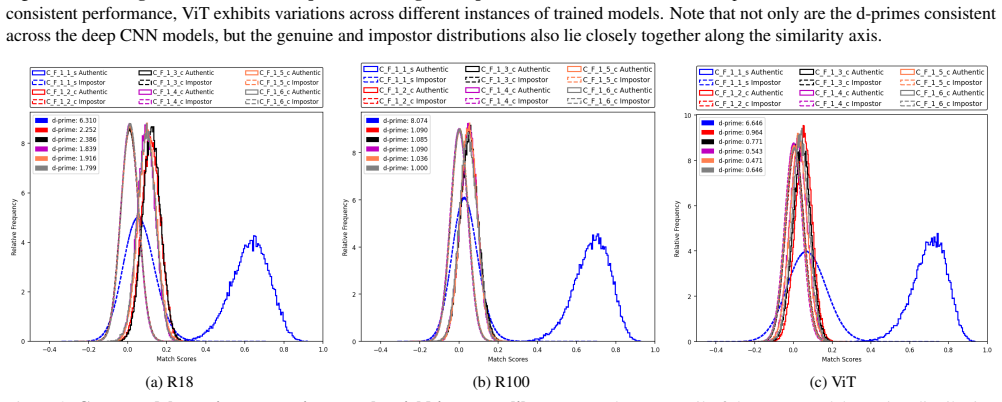
- Vision Transformer backbones are currently a poor fit for this scheme because their accuracy varies across training instances, although their cross-model incompatibility behavior is similar.
- The approach does not remove the need for presentation attack detection; the two defenses are complementary.
Reading between the lines
- If cross-instance incompatibility persists under fine-tuning from a shared checkpoint, a compromised template could be revoked by fine-tuning a new instance rather than training from scratch, which would substantially cut the computational cost of revocation; the paper only tests full retraining.
- The observed separation suggests a general phenomenon for over-parameterized networks: any architecture with training stochasticity that yields multiple local optima of equal loss may exhibit the same cross-instance embedding incompatibility, so the face-specific result may extend to iris or fingerprint CNNs.
- The paper's evidence is limited to two MORPH demographic groups with ten ResNet instances; before deployment, one would need to verify that the cross-model genuine distribution stays below the same-model impostor threshold across a much wider set of identities, poses, and image conditions, and to quantify the probability of a single identity violating the bound.
- A theory of embedding-space distances between independently trained instances could turn this empirical safety margin into a provable guarantee and would reveal the maximum number of usable instances before cross-model similarity begins to overlap the impostor range.
Editorial analysis
A structured set of objections, weighed in public.
Referee Report
Summary. The paper proposes a revocable biometric framework based on training multiple instances of the same deep CNN face matcher. The authors claim that instances trained identically have equivalent recognition accuracy but generate embeddings that are strongly incompatible across instances, so that a revoked template cannot match a re-enrolled template. They train ten instances each of ResNet-18, ResNet-100, and ViT with ArcFace on WebFace4M, report benchmark accuracy and d-prime, and present relationship matrices for two MORPH demographic groups (Caucasian Female and African-American Female) showing that the maximum cross-model genuine score lies below the same-model 1-in-10,000 FMR threshold. Based on this, they argue that ResNet-based face matchers inherently support unlimited template revocation, while ViT backbones are less suitable because of higher across-instance performance variation.
Significance. If the central claim holds, this is a practically and conceptually significant result: it offers a simple template-revocation mechanism that does not require explicit cancellable-transformation procedures, and it directly challenges the common view that compromised face templates are irreplaceable. The paper is transparent about training configurations, reports standard accuracy and d-prime metrics, and releases code, which are notable strengths. However, the security claim is an extreme-tail empirical assertion that is currently supported only by a finite set of model instances and two demographic groups; the significance is therefore conditional on the authors either supplying the missing statistical evidence or substantially narrowing the claim.
major comments (3)
- [Section 5, Figure 2 and Figure 3] The central security property—that a revoked template is useless against a re-enrolled template—is a claim about the upper tail of the cross-model genuine-score distribution. The evidence in Figure 2 is the observed maximum cross-model genuine score for each of 45 model pairs, restricted to the Caucasian Female and African-American Female MORPH groups. A maximum over a finite set of identities, images, and model pairs does not bound the population quantile corresponding to the 1-in-10,000 FMR threshold; an untested identity, image, or additional model pair could exceed it. The paper reports no confidence intervals, bootstrap estimates, or extreme-value analysis, and it does not state the number of identities or genuine pairs used to form each off-diagonal maximum. Without a distributional or confidence statement, the revocation guarantee is not established beyond the particular test set.
- [Section 3.3 and Section 6 (Conclusion)] The claims that revocation can be repeated "an unlimited number of times" and that deep CNN face matchers "inherently" support revocable templates go beyond the evidence. Only ten instances per backbone were trained, the cross-model security evaluation covers only two MORPH demographic groups, and the paper's own Future Work states that verifying other popular CNNs and determining the theoretical maximum number of equally accurate distinct models remain open questions. The conclusion should be limited to the empirically demonstrated regime (e.g., ten ResNet instances on the tested groups) unless additional scaling, theoretical, or statistical evidence is supplied.
- [Section 5, Table 1 and Figure 2] The revocation guarantee is asserted for enrolled identities generally, but the cross-model relationship matrices are provided only for Caucasian Female and African-American Female MORPH groups. Table 1 shows that same-model d-prime differs substantially across the four demographic groups (e.g., ResNet-100 AA M d-prime is 9.84 while AA F is 8.41), so the cross-model upper-tail behavior of the untested groups cannot be assumed to match the tested groups. The security claim should either be demonstrated for all demographic groups represented in Table 1 or explicitly restricted, with the restriction reflected in the abstract and conclusion.
minor comments (5)
- [Section 5, Figure 2 caption and body text] The caption states that the top diagonal item is the 1-in-10,000 FMR threshold and the bottom item is the d-prime, but the body text says the top value is the d-prime and the bottom value is the threshold; these should be reconciled.
- [Table 1] The numeric entries are not cleanly separated (e.g., "96.41±0.076.27±0.02"); use explicit column spacing or formatting so each value and its standard deviation is readable.
- [Section 6 (Conclusion)] The sentence "they can it revoked" contains a typo; it should read "they can have it revoked".
- [Title page / author affiliation] The affiliation contains a typo: "Florida Insitute of Technology" should be "Florida Institute of Technology".
- [Section 3.2 and Figure 3] Figure 3 uses six model instances while Section 5 and Figure 2 use ten; the paper should clarify why the numbers differ and confirm that the conclusions are consistent across both settings.
Circularity Check
No circularity: the paper's claims are empirical measurements of independently trained model instances, not fitted parameters, self-citations, or definitionally forced results.
full rationale
The paper's central derivation chain is: train multiple instances of the same backbone with identical settings, measure that accuracy and d-prime are consistent across instances, then measure that cross-model genuine cosine similarities fall below the same-model 1-in-10,000 FMR threshold. Each of these is a direct empirical observation reported from the trained models, not a quantity fitted to the claim being made. The 'equivalent recognition power' claim is supported by reported means and standard deviations, and the 'incompatible templates' claim is supported by score distributions and maximum cross-model genuine scores in Figures 2-3. No equation in the paper defines the predicted result in terms of the fitted inputs; the shared threshold is computed from same-model impostor scores and then compared with independently measured cross-model genuine scores. The 'unlimited number of models' statement is an extrapolation beyond the 10 tested instances, and the paper itself flags the theoretical upper limit as open future work, so it is a scaling claim rather than a circular derivation. There is no load-bearing self-citation, no imported uniqueness theorem, and no renaming of a known result as a new derivation. Therefore no significant circularity is present.
Assumptions & free parameters
assumptions (4)
- domain assumption Multiple training runs with identical configuration produce models with equivalent recognition accuracy and score distributions.
- domain assumption Cross-model genuine scores are uniformly below the same-model 1-in-10,000 FMR threshold for all identities, not just the tested groups.
- domain assumption A compromised template cannot be used to reconstruct the face or to derive a template valid for another model instance.
- domain assumption Re-enrollment images (archived or fresh) yield templates with the same accuracy as the original enrollment.
Cite this review
Pith. "Pith review of Deep CNN Face Matchers Inherently Support Revocable Biometric Templates." pith.science (2026). https://pith.science/paper/N53KQS5Q
@misc{pith2026250618731,
  author       = {Pith},
  title        = {Pith review of: Deep CNN Face Matchers Inherently Support Revocable Biometric Templates},
  year         = {2026},
  howpublished = {\url{https://pith.science/paper/N53KQS5Q}},
  note         = {Machine review of arXiv:2506.18731}
}
read the original abstract
One common critique of biometric authentication is that if an individual's biometric is compromised, then the individual has no recourse. The concept of revocable biometrics was developed to address this concern. A biometric scheme is revocable if an individual can have their current enrollment in the scheme revoked, so that the compromised biometric template becomes worthless, and the individual can re-enroll with a new template that has similar recognition power. We show that modern deep CNN face matchers inherently allow for a robust revocable biometric scheme. For a given state-of-the-art deep CNN backbone and training set, it is possible to generate an unlimited number of distinct face matcher models that have both (1) equivalent recognition power, and (2) strongly incompatible biometric templates. The equivalent recognition power extends to the point of generating impostor and genuine distributions that have the same shape and placement on the similarity dimension, meaning that the models can share a similarity threshold for a 1-in-10,000 false match rate. The biometric templates from different model instances are so strongly incompatible that the cross-instance similarity score for images of the same person is typically lower than the same-instance similarity score for images of different persons. That is, a stolen biometric template that is revoked is of less value in attempting to match the re-enrolled identity than the average impostor template. We also explore the feasibility of using a Vision Transformer (ViT) backbone-based face matcher in the revocable biometric system proposed in this work and demonstrate that it is less suitable compared to typical ResNet-based deep CNN backbones.
Figures


Figures from the paper (2 more)


Reference graph
Works this paper leans on
-
[1]
740 ILCS 14 (c) Public Act 95-994, effective October 3, 2008
Biometric Information Privacy Act (BIPA).https:// www.ilga.gov/legislation/ilcs/ilcs3.asp? ActID=3004&ChapterID=57. 740 ILCS 14 (c) Public Act 95-994, effective October 3, 2008. 1
work page 2008
-
[2]
Insightface: 2d and 3d face analysis project.https:// github.com/deepinsight/insightface/. 6
-
[3]
D. Achlioptas. Database-friendly random projections: Johnson-lindenstrauss with binary coins. InJournal of com- puter and System Sciences, volume 66, pages 671–687. El- sevier, 2003. 2
work page 2003
-
[4]
R. M. Bolle, J. H. Connell, and N. K. Ratha. Biometric perils and patches. InPattern recognition, volume 35, pages 2727–
-
[5]
T. Boult. Robust distance measures for face-recognition sup- porting revocable biometric tokens. InAutomatic Face and Gesture Recognition (AFGR), pages 560–566. IEEE, 2006. 2
work page 2006
-
[6]
T. E. Boult, W. J. Scheirer, and R. Woodworth. Revocable fingerprint biotokens: Accuracy and security analysis. In Computer Vision and Pattern Recognition (CVPR), pages 1–
-
[7]
S. Chikkerur, N. K. Ratha, J. H. Connell, and R. M. Bolle. Generating registration-free cancelable fingerprint templates. InInternational Conference on Biometrics: The- ory, Applications and Systems (BTAS), pages 1–6. IEEE,
- [8]
Show all 54 references
-
[9]
J. Daugman. How iris recognition works. InThe essential guide to image processing, pages 715–739. Elsevier, 2009. 3
2009
-
[10]
J. Deng, W. Dong, R. Socher, L.-J. Li, K. Li, and L. Fei- Fei. Imagenet: A large-scale hierarchical image database. InComputer Vision and Pattern Recognition (CVPR), pages 248–255. Ieee, 2009. 6
2009
-
[11]
J. Deng, J. Guo, E. Ververas, I. Kotsia, and S. Zafeiriou. Reti- naface: Single-shot multi-level face localisation in the wild. InComputer Vision and Pattern Recognition (CVPR), pages 5203–5212, 2020. 6
2020
-
[12]
K. He, X. Zhang, S. Ren, and J. Sun. Deep residual learn- ing for image recognition. InComputer Vision and Pattern Recognition (CVPR), pages 770–778, 2016. 6
2016
-
[13]
C. Hewage. Stolen fingerprints could spell the end of biomet- ric security – here’s how to save it — theconversation.com. https : / / theconversation . com / stolen - fingerprints - could - spell - the - end - of - biometric - security - heres - how - to - save - it-122001. [A...
2024
-
[14]
G. B. Huang, M. Mattar, T. Berg, and E. Learned-Miller. La- beled faces in the wild: A database forstudying face recog- nition in unconstrained environments. InWorkshop on faces in Real-Life Images: detection, alignment, and recognition,
-
[15]
Information tech- nology - security techniques - biometric information protec- tion
ISO/IEC JTC1 SC27 Security Techniques. Information tech- nology - security techniques - biometric information protec- tion. Technical Report ISO/IEC 24745:2011, ISO, 2011. 3
2011
-
[16]
A. T. B. Jin, D. N. C. Ling, and A. Goh. Biohashing: two factor authentication featuring fingerprint data and tokenised random number. InPattern recognition, volume 37, pages 2245–2255. Elsevier, 2004. 2
2004
-
[17]
Jin, M.-H
Z. Jin, M.-H. Lim, A. B. J. Teoh, and B.-M. Goi. A non- invertible randomized graph-based hamming embedding for generating cancelable fingerprint template. InPattern Recog- nition Letters, volume 42, pages 137–147. Elsevier, 2014. 2
2014
-
[18]
Kaur and P
H. Kaur and P. Khanna. Cancelable features using log-gabor filters for biometric authentication. InMultimedia Tools and Applications, volume 76, pages 4673–4694. Springer, 2017. 2
2017
-
[19]
Kim and K.-A
Y . Kim and K.-A. Toh. A method to enhance face biometric security. InInternational Conference on Biometrics: Theory, Applications and Systems (BTAS), pages 1–6. IEEE, 2007. 2
2007
-
[20]
Kong, K.-H
A. Kong, K.-H. Cheung, D. Zhang, M. Kamel, and J. You. An analysis of biohashing and its variants. InPattern recog- nition, volume 39, pages 1359–1368. Elsevier, 2006. 2
2006
-
[21]
D.-H. Lee, S. H. Lee, and N. I. Cho. Cancelable biomet- rics using noise embedding. InInternational Conference on Pattern Recognition (ICPR), pages 3390–3395. IEEE, 2018. 2
2018
-
[22]
Leng and J
L. Leng and J. Zhang. Palmhash code vs. palmphasor code. InNeurocomputing, volume 108, pages 1–12. Elsevier, 2013. 2
2013
-
[23]
Maiorana, P
E. Maiorana, P. Campisi, J. Fierrez, J. Ortega-Garcia, and A. Neri. Cancelable templates for sequence-based biometrics with application to on-line signature recognition. InIEEE Transactions on Systems, Man, and Cybernetics-Part A: Sys- tems and Humans, volume 40, pages 525–538...
2010
-
[24]
Manisha and N. Kumar. Cancelable biometrics: a compre- hensive survey. InArtificial Intelligence Review, volume 53, pages 3403–3446. Springer, 2020. 2
2020
-
[25]
Moschoglou, A
S. Moschoglou, A. Papaioannou, C. Sagonas, J. Deng, I. Kot- sia, and S. Zafeiriou. Agedb: the first manually collected, in-the-wild age database. InComputer Vision and Pattern Recognition Workshops (CVPRW), page 5, 2017. 3
2017
-
[26]
Mtibaa, D
A. Mtibaa, D. Petrovska-Delacr ´etaz, and A. B. Hamida. Can- celable speaker verification system based on binary gaussian mixtures. InInternational Conference on Advanced Tech- nologies for Signal and Image Processing (ATSIP), pages 1–
-
[27]
J. O’Toole. The Real Risks of Biometric Authentication - Spiceworks — spiceworks.com.https : / / www . spiceworks . com / it - security / identity - access - management / guest - article / the - real-risks-of-biometric-authentication/,
-
[28]
Paszke, S
A. Paszke, S. Gross, F. Massa, A. Lerer, J. Bradbury, G. Chanan, T. Killeen, Z. Lin, N. Gimelshein, L. Antiga, et al. Pytorch: An imperative style, high-performance deep learning library. InAdvances in Neural Information Process- ing Systems (NeurIPS), volume 32, 2019. 6
2019
-
[29]
V . M. Patel, N. K. Ratha, and R. Chellappa. Cancelable Bio- metrics: A review. InIEEE signal processing magazine, vol- ume 32, pages 54–65. IEEE, 2015. 2
2015
-
[30]
J. K. Pillai, V . M. Patel, R. Chellappa, and N. K. Ratha. Sectored random projections for cancelable iris biometrics. pages 1838–1841. IEEE, 2010. 2
2010
-
[31]
J. K. Pillai, V . M. Patel, R. Chellappa, and N. K. Ratha. Se- cure and robust iris recognition using random projections and sparse representations. InTransactions on Pattern Analysis and Machine Intelligence (T-PAMI), volume 33, pages 1877–
-
[32]
K. B. Raja, R. Raghavendra, and C. Busch. Manifold- structure preserving biometric templates-a preliminary study on fully cancelable smartphone biometric templates. InIn- ternational Conference on Multimedia & Expo Workshops (ICMEW), pages 1–7. IEEE, 2018. 2
2018
-
[33]
K. B. Raja, R. Raghavendra, and C. Busch. Towards pro- tected and cancelable multi-spectral face templates using feature fusion and kernalized hashing. InInternational Con- ference on Information Fusion (FUSION), pages 2098–2106. IEEE, 2018. 2
2018
-
[34]
N. K. Ratha, S. Chikkerur, J. H. Connell, and R. M. Bolle. Generating cancelable fingerprint templates. InTransactions on Pattern Analysis and Machine Intelligence (T-PAMI), vol- ume 29, pages 561–572. IEEE, 2007. 2
2007
-
[35]
N. K. Ratha, J. H. Connell, and R. M. Bolle. Enhancing secu- rity and privacy in biometrics-based authentication systems. InIBM systems Journal, volume 40, pages 614–634. IBM,
-
[36]
Rathgeb, F
C. Rathgeb, F. Breitinger, and C. Busch. Alignment-free can- celable iris biometric templates based on adaptive bloom fil- ters. InInternational Conference on Biometrics (ICB), pages 1–8. IEEE, 2013. 2
2013
-
[37]
Rathgeb, F
C. Rathgeb, F. Breitinger, C. Busch, and H. Baier. On appli- cation of bloom filters to iris biometrics. InIET Biometrics, volume 3, pages 207–218. Wiley Online Library, 2014. 2
2014
-
[38]
Rathgeb and C
C. Rathgeb and C. Busch. Cancelable multi-biometrics: Mixing iris-codes based on adaptive bloom filters. InCom- puters & Security, volume 42, pages 1–12. Elsevier, 2014. 2
2014
-
[39]
Saito, I
Y . Saito, I. Nakamura, S. Shiota, and H. Kiya. An efficient random unitary matrix for biometric template protection. In 2016 joint 8th international conference on soft computing and intelligent systems (SCIS) and 17th international sympo- sium on advanced intelligent systems ...
2016
-
[40]
Savvides, B
M. Savvides, B. V . Kumar, and P. K. Khosla. Cancelable bio- metric filters for face recognition. InInternational Confer- ence on Pattern Recognition (ICPR), volume 3, pages 922–
-
[41]
Sengupta, J
S. Sengupta, J. Cheng, C. Castillo, V . Patel, R. Chellappa, and D. Jacobs. Frontal to profile face verification in the wild. InWinter Conference on Applications of Computer Vision (WACV), February 2016. 3
2016
-
[42]
C. A. Sottile. As Biometric Scanning Use Grows, So Does Security Risk — nbcnews.com.https : / / www . nbcnews . com / mach / mach / biometric - scanning - use - grows - so - do - security - risks-ncna593161, 2016. [Accessed 19-09-2024]. 1
2016
-
[43]
Talreja, M
V . Talreja, M. C. Valenti, and N. M. Nasrabadi. Multibiomet- ric secure system based on deep learning. InIEEE Global conference on signal and information processing (global- SIP), pages 298–302. IEEE, 2017. 2
2017
-
[44]
A. B. Teoh, A. Goh, and D. C. Ngo. Random multispace quantization as an analytic mechanism for biohashing of biometric and random identity inputs. InTransactions on Pattern Analysis and Machine Intelligence (T-PAMI), vol- ume 28, pages 1892–1901. IEEE, 2006. 2
1901
-
[45]
A. B. Teoh, Y . W. Kuan, and S. Lee. Cancellable biomet- rics and annotations on biohash. InPattern recognition, vol- ume 41, pages 2034–2044. Elsevier, 2008. 2
2008
-
[46]
A. B. J. Teoh and C. T. Yuang. Cancelable biometrics real- ization with multispace random projections. InIEEE Trans- actions on Systems, Man, and Cybernetics, Part B (Cyber- netics), volume 37, pages 1096–1106. IEEE, 2007. 2
2007
-
[47]
Yalavarthi, A
B. Yalavarthi, A. R. Kaushik, A. Ross, V . Boddeti, and N. Ratha. Enhancing privacy in face analytics using fully ho- momorphic encryption. InarXiv preprint arXiv:2404.16255,
-
[48]
W. Yang, S. Wang, H. Cui, Z. Tang, and Y . Li. A review of homomorphic encryption for privacy-preserving biometrics. InSensors, volume 23, page 3566. MDPI, 2023. 2
2023
-
[49]
Zheng, X
J. Zheng, X. Li, and S. Lucey. Structured initialization for attention in vision transformers. InarXiv preprint arXiv:2404.01139, 2024. 4
2024 arXiv
-
[50]
Zheng and W
T. Zheng and W. Deng. Cross-pose lfw: A database for studying cross-pose face recognition in unconstrained en- vironments. Technical Report 18-01, Beijing University of Posts and Telecommunications, February 2018. 3
2018
-
[51]
Zheng, W
T. Zheng, W. Deng, and J. Hu. Cross-age lfw: A database for studying cross-age face recognition in unconstrained en- vironments. InarXiv preprint arXiv:1708.08197, 2017. 3
2017 arXiv
-
[52]
Z. Zhu, G. Huang, J. Deng, Y . Ye, J. Huang, X. Chen, J. Zhu, T. Yang, J. Lu, D. Du, et al. Webface260m: A benchmark unveiling the power of million-scale deep face recognition. InComputer Vision and Pattern Recognition (CVPR), pages 10492–10502, 2021. 6
2021
-
[53]
J. Zuo, N. K. Ratha, and J. H. Connell. Cancelable iris bio- metric. InInternational Conference on Pattern Recognition (ICPR), pages 1–4. IEEE, 2008. 2
2008
-
[2023]
[Accessed 19-09-2024]. 1
2024
Reviewed August 6, 2026 · model on record in the stance chip above.
Discussion (0). Sign in to comment.