REVIEW 2 major objections 5 minor 300 references
Automatic Depression Assessment using Machine Learning: A Comprehensive Survey
T0 review · 2 major / 5 minor · reviewed 2026-08-07 · deepseek-v4-flash
Pith's one-line read The paper claims to be the first comprehensive survey of machine-learning-based automatic depression assessment, spanning EEG and MRI as well as facial, body, audio, and language behaviours.
desk verdict A broad, useful ADA survey whose main overclaim—no existing interpretability work—contradicts its own citations, and whose search protocol needs one more pass before 'comprehensive' sticks. read the letter →
The pith
A machine-rendered reading of the paper's core claim, the machinery that carries it, and where it could break.
The reading
What carries the argument
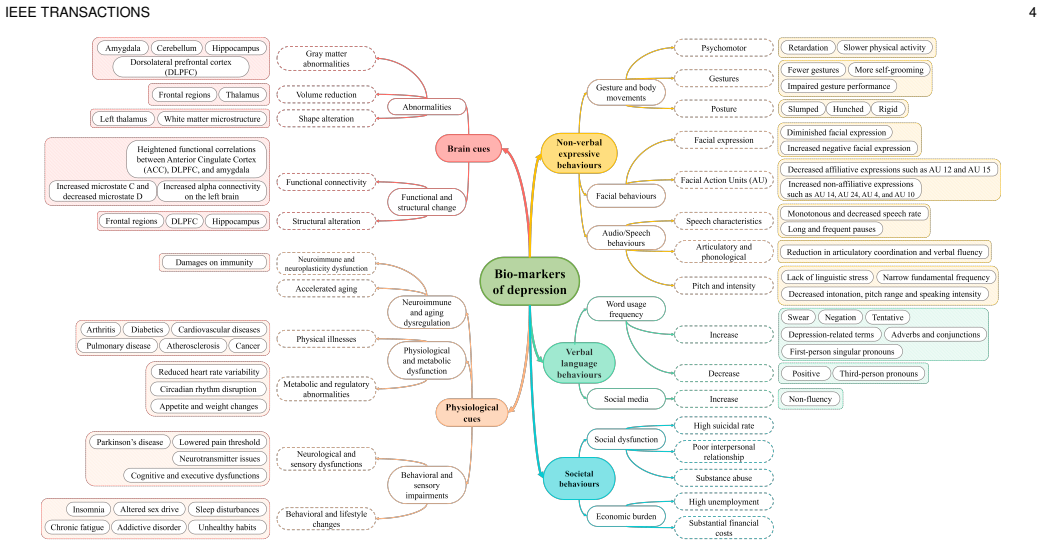
The organising device is a modality-by-modality taxonomy (EEG, MRI, facial/head, body, audio, language, and multimodal), each reviewed with its typical feature extractors and predictors. The survey is carried by a PRISMA-style systematic search across seven digital libraries that yielded 1,679 papers and 183 included studies, plus an evidence review (Sec. 2.2) that connects each modality to concrete depression biomarkers such as EEG alpha asymmetry, reduced positive facial expressions, monotonous speech, and increased first-person pronouns. This evidence base is what justifies treating the surveyed models as capturing real depression signals rather than dataset artefacts.
What would settle it
A reader could re-run the stated search across the same seven digital libraries (IEEE Explore, ACM Digital Library, Elsevier, Springer, ACL Anthology, IET, MIT Press) with the stated inclusion window of 2012-2024 and eligibility criteria, and check whether the 183 included papers match the yield; any significant set of qualifying peer-reviewed ADA papers that are missing would falsify the comprehensiveness claim.
Extended reading notes
Core claim
The central claim is that machine-learning-based depression assessment has become a genuinely multi-modal field, and that this is the first review to capture that breadth. The survey asserts that depression is expressed both internally, in brain structure and electrical activity, and externally, in the face, body, voice, and word choice, and that each modality has produced distinct technical pipelines—from hand-crafted features with classical regressors to CNNs, transformers, and graph networks. It further claims that the shared bottleneck across all modalities is data quality: public datasets are small, mostly under 200 participants, and depression labels come largely from self-report questionnaires rather than standardised clinical assessment, which limits both model performance and evaluation objectivity.
Load-bearing premise
The survey's claim to be comprehensive rests on the assumption that its literature search was exhaustive and that the 183 included papers fairly represent the 2012-2024 ADA literature; the full search queries and exclusion counts are only in the Supplementary Material, so a reader cannot independently reproduce the search.
Editorial extensions
If this is right
- The modality taxonomy and the 183-method table give researchers a direct way to spot underexplored areas, such as body-based ADA and privacy-preserving de-identified inputs.
- If the data bottleneck is as central as the survey argues, then better datasets—larger, clinically labelled, demographically diverse—matter more for ADA progress than new network architectures.
- The survey's review of competitions shows that de-identified facial primitives and audio features have been workable benchmarks since AVEC 2016, supporting privacy-preserving ADA as a practical default.
- The documented lack of interpretability and reproducibility in deep ADA models indicates that future evaluation should routinely report which behaviour cues drive predictions.
- The observation that most audio and language methods are fused with visual cues suggests that future ADA systems will be inherently multimodal, making fusion strategy and fairness across demographic groups core design issues.
Reading between the lines
- A testable extension of the survey's evidence review is whether behaviour-grounded hand-crafted features (e.g., spectral EEG features, AU 12/14 patterns, pause and pitch statistics, first-person pronouns) close the accuracy gap with end-to-end deep models on the same datasets.
- If label subjectivity is the key data problem, then a shared collection protocol using clinician-administered instruments rather than self-report scales would be a concrete improvement; models trained on such data could be tested for cross-site and cross-cultural generalisation.
- The paper's call for a common repository could be operationalised as a public leaderboard with fixed evaluation splits and fairness metrics, which would test whether reported accuracy differences between methods are stable or dataset-driven.
- The geographic concentration of publications suggests that the field's comparative results may be fragile; an independent multi-site re-evaluation of top-performing methods would settle whether current rankings reflect generalisable skill or dataset bias.
Editorial analysis
A structured set of objections, weighed in public.
Referee Report
Summary. The paper presents a survey of machine learning-based automatic depression assessment (ADA) methods, covering brain modalities (EEG, MRI), expressive modalities (face, body, audio, language), and multimodal combinations. It synthesizes 183 papers, reviews public datasets and AVEC challenge series, and discusses challenges and opportunities. The central claim is that this is the first comprehensive survey of ADA across both internal brain activities and external expressive behaviours.
Significance. If the survey is indeed comprehensive and accurate, it would be a valuable reference for a rapidly growing field: it aggregates 183 methods, organizes them by modality and ML approach, links depression biomarkers to computational features, and provides a central web repository. The paper also gives due attention to privacy, label quality, and fairness. However, its significance is conditional on the reproducibility of the search protocol and on the accuracy of its challenge statements, since the comprehensiveness claim is load-bearing.
major comments (2)
- [Section 6.1] The passage under 'Lack of interpretability and reproducibility' states that 'no existing work has investigated the interpretability, explainability, nor reproducibility of such models.' This is directly contradicted by several papers reviewed in this survey, including Ref. [33] (Gahalawat et al., 'Explainable depression detection via head motion patterns'), Ref. [201] (Zhou et al., 'Visually interpretable representation learning'), Ref. [282] (Kacem et al., 'interpretable representations of motion dynamics'), and Ref. [210] (Moreno et al., 'Expresso-ai: An explainable video-based deep learning model'). The overstatement weakens the credibility of the challenges discussion and should be corrected to a more precise formulation, e.g., that few existing works systematically evaluate interpretability and reproducibility.
- [Section 3] The central claim of being a 'comprehensive survey' rests on the exhaustiveness and representativeness of the literature search. However, the search databases listed (IEEE Xplore, ACM Digital Library, Elsevier, Springer, ACL Anthology, IET, MIT Press) omit PubMed/MEDLINE, Scopus, and Web of Science, which are the primary indexes for clinical EEG and MRI depression-classification studies. Since the exact search strings, PRISMA flow numbers, and exclusion counts are deferred to the Supplementary Material, and since Fig. 3 shows a flow diagram without stage-wise numbers in the main text, a reader cannot currently reproduce or audit the search. This leaves the 183-paper set potentially systematically skewed away from the very brain-imaging modalities the survey claims to cover. The authors should either justify the database choice, add the missing databases, or report the full search protocol and PRISMA counts in the main text or a clearly reproducible appendix.
minor comments (5)
- [Fig. 3] The figure caption says 'PRIMA Schema' but should read 'PRISMA Schema.'
- [Section 4.5.2] The phrase 'revealing subtle changes in energy overtime' should be 'revealing subtle changes in energy over time.'
- [Section 4.3.1] The word 'behavuours' in 'these behavuours are more prone to data privacy' is a typo and should be 'behaviours.'
- [Section 5.2] The text mentions 'DAIZ-WOZ depression dataset' twice; the correct acronym for the referenced dataset is DAIC-WOZ (Ref. [64]).
- [Section 6.1] In the same paragraph on reproducibility, the paper lists several open-source implementations ([20], [28], [42], [69], [203], [215]), which is useful; consider making this a separate concrete point in the future-directions section rather than embedding it in the challenge statement.
Circularity Check
No circularity: the survey synthesizes an external literature and makes no derivation whose conclusion is equivalent to its inputs.
full rationale
This paper is a literature survey with no fitted parameters, no prediction targets, and no derived equations, so the characteristic circularity patterns (self-definition, fitted input renamed as prediction, ansatz smuggled via citation, uniqueness imported from authors) do not apply. Its central claim is that it provides a comprehensive, multi-modal review of automatic depression assessment (ADA) work from 2012–2024, supported by a PRISMA-style search protocol in Section 3. The paper does cite prior work by its own authors (e.g., Song et al. [42], [214], Cheong et al. [244], [300], [302]), but these citations are used as ordinary entries in the surveyed literature, alongside numerous third-party papers, and are not invoked as the logical basis for any conclusion. The claim of comprehensiveness rests on the search procedure (databases queried, eligibility criteria, selection process), not on any self-referential argument; the absence of PubMed/Scopus or of full stage-wise PRISMA counts in the main text is a completeness and reproducibility concern, not a circularity one. Since the survey makes no derivation whose conclusion reduces to its inputs, the appropriate circularity score is 0.
Assumptions & free parameters
assumptions (3)
- domain assumption Depression is reflected in human brain and expressive behaviours (Section 2.2).
- domain assumption The 183 included papers are a representative sample of ADA research.
- domain assumption Self-reported depression severity scores (e.g., PHQ-8, BDI-II) are acceptable ground truth for evaluating ADA systems.
Cite this review
Pith. "Pith review of Automatic Depression Assessment using Machine Learning: A Comprehensive Survey." pith.science (2026). https://pith.science/paper/6FH4M7ZV
@misc{pith2026250618915,
  author       = {Pith},
  title        = {Pith review of: Automatic Depression Assessment using Machine Learning: A Comprehensive Survey},
  year         = {2026},
  howpublished = {\url{https://pith.science/paper/6FH4M7ZV}},
  note         = {Machine review of arXiv:2506.18915}
}
read the original abstract
Depression is a common mental illness across current human society. Traditional depression assessment relying on inventories and interviews with psychologists frequently suffer from subjective diagnosis results, slow and expensive diagnosis process as well as lack of human resources. Since there is a solid evidence that depression is reflected by various human internal brain activities and external expressive behaviours, early traditional machine learning (ML) and advanced deep learning (DL) models have been widely explored for human behaviour-based automatic depression assessment (ADA) since 2012. However, recent ADA surveys typically only focus on a limited number of human behaviour modalities. Despite being used as a theoretical basis for developing ADA approaches, existing ADA surveys lack a comprehensive review and summary of multi-modal depression-related human behaviours. To bridge this gap, this paper specifically summarises depression-related human behaviours across a range of modalities (e.g. the human brain, verbal language and non-verbal audio/facial/body behaviours). We focus on conducting an up-to-date and comprehensive survey of ML-based ADA approaches for learning depression cues from these behaviours as well as discussing and comparing their distinctive features and limitations. In addition, we also review existing ADA competitions and datasets, identify and discuss the main challenges and opportunities to provide further research directions for future ADA researchers.
Figures


Figures from the paper (1 more)

Reference graph
Works this paper leans on
-
[33]
Explainable depression detection via head motion patterns,
M. Gahalawat, R. Fernandez Rojas, T. Guha, R. Subramanian, and R. Goecke, “Explainable depression detection via head motion patterns,” in ICMI, 2023, pp. 261–270
2023
-
[210]
Expresso-ai: An explainable video-based deep learning models for depression diagnosis,
F. Moreno, S. Alghowinem, H. W. Park, and C. Breazeal, “Expresso-ai: An explainable video-based deep learning models for depression diagnosis,” in ACII. IEEE, 2023, pp. 1–8
2023
-
[201]
Visually interpretable representation learning for depression recognition from facial images,
X. Zhou, K. Jin, Y. Shang, and G. Guo, “Visually interpretable representation learning for depression recognition from facial images,” IEEE Transactions on Affective Computing, 2018
2018
-
[282]
Detecting depression severity by interpretable representations of motion dynamics,
A. Kacem, Z. Hammal, M. Daoudi, and J. Cohn, “Detecting depression severity by interpretable representations of motion dynamics,” in FG. IEEE, 2018, pp. 739–745
work page 2018
-
[1]
Depression in young people,
A. Thapar, O. Eyre, V . Patel, and D. Brent, “Depression in young people,” The Lancet, vol. 400, no. 10352, pp. 617–631, 2022
2022
-
[2]
Paral- imbic cortical thickness in first-episode depression: evidence for trait-related differences in mood regulation,
P . van Eijndhoven, G. van Wingen, M. Katzenbauer, W. Groen, R. Tepest, G. Fern ´andez, J. Buitelaar, and I. Tendolkar, “Paral- imbic cortical thickness in first-episode depression: evidence for trait-related differences in mood regulation,” American Journal of Psychiatry, vol. 170, no. 12, pp. 1477–1486, 2013
2013
-
[3]
Im- paired prefrontal–amygdala effective connectivity is responsible for the dysfunction of emotion process in major depressive dis- order: a dynamic causal modeling study on meg,
Q. Lu, H. Li, G. Luo, Y. Wang, H. Tang, L. Han, and Z. Yao, “Im- paired prefrontal–amygdala effective connectivity is responsible for the dysfunction of emotion process in major depressive dis- order: a dynamic causal modeling study on meg,” Neuroscience letters, vol. 523, no. 2, pp. 125–130, 2012
2012
-
[4]
Processing of facial emo- tion expression in major depression: a review,
C. Bourke, K. Douglas, and R. Porter, “Processing of facial emo- tion expression in major depression: a review,”Australian & New Zealand Journal of Psychiatry, vol. 44, no. 8, pp. 681–696, 2010
2010
Show all 300 references
-
[5]
Depression and the risk of coronary heart disease: a meta-analysis of prospective cohort studies,
Y. Gan, Y. Gong, X. Tong, H. Sun, Y. Cong, X. Dong, Y. Wang, X. Xu, X. Yin, J. Deng et al., “Depression and the risk of coronary heart disease: a meta-analysis of prospective cohort studies,” BMC psychiatry, vol. 14, no. 1, pp. 1–11, 2014
2014
-
[6]
The increasing burden of depression,
J.-P . L ´epine and M. Briley, “The increasing burden of depression,” Neuropsychiatric disease and treatment, vol. 7, no. sup1, pp. 3–7, 2011
2011
-
[7]
Chronic fatigue syndrome and depression: cause, effect, or covariate,
S. E. Abbey and P . E. Garfinkel, “Chronic fatigue syndrome and depression: cause, effect, or covariate,” Reviews of Infectious Diseases, vol. 13, no. Supplement 1, pp. S73–S83, 1991
1991
-
[8]
Depression and appetite,
E. Paykel, “Depression and appetite,” Journal of Psychosomatic Research, vol. 21, no. 5, pp. 401–407, 1977
1977
-
[9]
Insomnia and depression,
R. M. Benca and M. J. Peterson, “Insomnia and depression,” Sleep medicine, vol. 9, pp. S3–S9, 2008
2008
-
[10]
The diagnosis of depression: current and emerging methods,
K. M. Smith, P . F. Renshaw, and J. Bilello, “The diagnosis of depression: current and emerging methods,” Comprehensive psychiatry, vol. 54, no. 1, pp. 1–6, 2013
2013
-
[11]
A rating scale for depression. journal of neurol- ogy,
M. Hamilton, “A rating scale for depression. journal of neurol- ogy,” Neurosurgery and Psychiatry, vol. 23, pp. 56–62, 1960
1960
-
[12]
The phq-9: valid- ity of a brief depression severity measure,
K. Kroenke, R. L. Spitzer, and J. B. Williams, “The phq-9: valid- ity of a brief depression severity measure,” Journal of general internal medicine, vol. 16, no. 9, pp. 606–613, 2001
2001
-
[13]
Adolescent depression: diagnosis, treatment, and educational attainment,
J. M. Fletcher, “Adolescent depression: diagnosis, treatment, and educational attainment,” Health economics, vol. 17, no. 11, pp. 1215–1235, 2008
2008
-
[14]
Depression gets old fast: do stress and depression accelerate cell aging?
O. M. Wolkowitz, E. S. Epel, V . I. Reus, and S. H. Mellon, “Depression gets old fast: do stress and depression accelerate cell aging?” Depression and anxiety, vol. 27, no. 4, pp. 327–338, 2010
2010
-
[15]
Depression and obesity: evidence of shared biological mechanisms,
Y. Milaneschi, W. K. Simmons, E. F. van Rossum, and B. W. Penninx, “Depression and obesity: evidence of shared biological mechanisms,” Molecular psychiatry, vol. 24, no. 1, pp. 18–33, 2019
2019
-
[16]
Shared biological mechanisms of depression and obesity: focus on adipokines and lipokines,
X. Fu, Y. Wang, F. Zhao, R. Cui, W. Xie, Q. Liu, and W. Yang, “Shared biological mechanisms of depression and obesity: focus on adipokines and lipokines,” Aging (Albany NY), vol. 15, no. 12, p. 5917, 2023
2023
-
[17]
Major depression: an illness with objective physical signs,
R. K. Gupta, “Major depression: an illness with objective physical signs,” The World Journal of Biological Psychiatry, vol. 10, no. 3, pp. 196–201, 2009
2009
-
[18]
A study of the interaction between depressed patients and their spouses,
M. Hinchliffe, D. Hooper, F. J. Roberts, and P . W. Vaughan, “A study of the interaction between depressed patients and their spouses,” The British Journal of Psychiatry, vol. 126, no. 2, pp. 164–172, 1975
1975
-
[19]
From emotions to mood disorders: A survey on gait analysis methodology,
F. Deligianni, Y. Guo, and G.-Z. Yang, “From emotions to mood disorders: A survey on gait analysis methodology,” IEEE J-BHI, vol. 23, no. 6, pp. 2302–2316, 2019
2019
-
[20]
Reading between the frames: Multi- modal depression detection in videos from non-verbal cues,
D. Gimeno-G ´omez, A.-M. Bucur, A. Cosma, C.-D. Mart ´ınez- Hinarejos, and P . Rosso, “Reading between the frames: Multi- modal depression detection in videos from non-verbal cues,” in European Conference on Information Retrieval. Springer, 2024, pp. 191–209
2024
-
[21]
Mea- suring the rate of change of voice fundamental frequency in fluent speech during mental depression,
˚A. Nilsonne, J. Sundberg, S. Ternstr ¨om, and A. Askenfelt, “Mea- suring the rate of change of voice fundamental frequency in fluent speech during mental depression,” The Journal of the Acoustical Society of America, vol. 83, no. 2, pp. 716–728, 1988
1988
-
[22]
Linguistic in- quiry and word count: Liwc 2001,
J. W. Pennebaker, M. E. Francis, and R. J. Booth, “Linguistic in- quiry and word count: Liwc 2001,” Mahway: Lawrence Erlbaum Associates, vol. 71, no. 2001, p. 2001, 2001
2001
-
[23]
Vocal indicators of psychological stress,
H. Hollien, “Vocal indicators of psychological stress,” Annals of the New York Academy of Sciences, vol. 347, no. 1, pp. 47–72, 1980
1980
-
[24]
Ensemble cca for continuous emotion prediction,
H. Kaya, F. C ¸ illi, and A. A. Salah, “Ensemble cca for continuous emotion prediction,” in Proceedings of the 4th International Workshop on Audio/Visual Emotion Challenge, 2014, pp. 19–26
2014
-
[25]
Depression assessment by fusing high and low level features from audio, video, and text,
A. Pampouchidou, O. Simantiraki, A. Fazlollahi, M. Pediadi- tis, D. Manousos, A. Roniotis, G. Giannakakis, F. Meriaudeau, P . Simos, K. Marias et al., “Depression assessment by fusing high and low level features from audio, video, and text,” in Proceedings of the 6th Internati...
2016
-
[26]
End-to-end mul- timodal clinical depression recognition using deep neural networks: A comparative analysis,
M. Muzammel, H. Salam, and A. Othmani, “End-to-end mul- timodal clinical depression recognition using deep neural networks: A comparative analysis,” Computer Methods and Programs in Biomedicine, vol. 211, p. 106433, 2021
2021
-
[27]
Hique: Hierarchical question embedding network for multimodal depression detec- tion,
J. Jung, C. Kang, J. Yoon, S. Kim, and J. Han, “Hique: Hierarchical question embedding network for multimodal depression detec- tion,” in Proceedings of the 33rd ACM International Conference on Information and Knowledge Management, 2024, pp. 1049– 1059
2024
-
[28]
Two- stage temporal modelling framework for video-based depression recognition using graph representation,
J. Xu, H. Gunes, K. Kusumam, M. Valstar, and S. Song, “Two- stage temporal modelling framework for video-based depression recognition using graph representation,” IEEE Transactions on Affective Computing, 2024. IEEE TRANSACTIONS 19
2024
-
[29]
Multimodal spatiotemporal representation for automatic depression level de- tection,
M. Niu, J. Tao, B. Liu, J. Huang, and Z. Lian, “Multimodal spatiotemporal representation for automatic depression level de- tection,” IEEE Transactions on Affective Computing, 2020
2020
-
[30]
Depression detection from social media posts using emotion aware encoders and fuzzy based contrastive networks,
S. A. Khowaja, L. Nkenyereye, P . Khuwaja, H. Al Hamadi, and K. Dev, “Depression detection from social media posts using emotion aware encoders and fuzzy based contrastive networks,” IEEE Transactions on Fuzzy Systems, 2024
2024
-
[31]
Dep-former: Multimodal depression recognition based on facial expressions and audio features via emotional changes,
J. Ye, Y. Yu, L. Lu, H. Wang, Y. Zheng, Y. Liu, and Q. Wang, “Dep-former: Multimodal depression recognition based on facial expressions and audio features via emotional changes,” IEEE Transactions on Circuits and Systems for Video Technology, 2024
2024
-
[32]
A mul- timodal fusion model with multi-level attention mechanism for depression detection,
M. Fang, S. Peng, Y. Liang, C.-C. Hung, and S. Liu, “A mul- timodal fusion model with multi-level attention mechanism for depression detection,” Biomedical Signal Processing and Control, vol. 82, p. 104561, 2023
2023
-
[34]
Statistical, spectral and graph representations for video-based facial expression recogni- tion in children,
N. I. Abbasi, S. Song, and H. Gunes, “Statistical, spectral and graph representations for video-based facial expression recogni- tion in children,” in ICASSP. IEEE, 2022, pp. 1725–1729
2022
-
[35]
Integrat- ing deep facial priors into landmarks for privacy preserving mul- timodal depression recognition,
Y. Pan, Y. Shang, Z. Shao, T. Liu, G. Guo, and H. Ding, “Integrat- ing deep facial priors into landmarks for privacy preserving mul- timodal depression recognition,” IEEE Transactions on Affective Computing, 2023
2023
-
[36]
Topic modeling based multi-modal depression detection,
Y. Gong and C. Poellabauer, “Topic modeling based multi-modal depression detection,” in Proceedings of the 7th Workshop on Audio/Visual Emotion Challenge. ACM, 2017, pp. 69–76
2017
-
[37]
Multimodal fusion of bert-cnn and gated cnn representations for depression detection,
M. Rodrigues Makiuchi, T. Warnita, K. Uto, and K. Shinoda, “Multimodal fusion of bert-cnn and gated cnn representations for depression detection,” in Proceedings of the 9th International on Audio/Visual Emotion Challenge and Workshop, 2019, pp. 55–63
2019
-
[38]
Facialpulse: An efficient rnn-based de- pression detection via temporal facial landmarks,
R. Wang, J. Huang, J. Zhang, X. Liu, X. Zhang, Z. Liu, P . Zhao, S. Chen, and X. Sun, “Facialpulse: An efficient rnn-based de- pression detection via temporal facial landmarks,” in ACM Multimedia, 2024, pp. 311–320
2024
-
[39]
Social risk and depression: Evidence from manual and automatic facial expression analysis,
J. M. Girard, J. F. Cohn, M. H. Mahoor, S. Mavadati, and D. P . Rosenwald, “Social risk and depression: Evidence from manual and automatic facial expression analysis,” in FG. IEEE, 2013, pp. 1–8
2013
-
[40]
Cnn depression severity level estimation from upper body vs. face-only images,
D. Ahmad, R. Goecke, and J. Ireland, “Cnn depression severity level estimation from upper body vs. face-only images,” in ICPR. Springer, 2021, pp. 744–758
2021
-
[41]
Lqgdnet: A local quaternion and global deep network for facial depression recognition,
Y. Shang, Y. Pan, X. Jiang, Z. Shao, G. Guo, T. Liu, and H. Ding, “Lqgdnet: A local quaternion and global deep network for facial depression recognition,” IEEE Transactions on Affective Computing, vol. 14, no. 3, pp. 2557–2563, 2021
2021
-
[42]
Spectral repre- sentation of behaviour primitives for depression analysis,
S. Song, S. Jaiswal, L. Shen, and M. Valstar, “Spectral repre- sentation of behaviour primitives for depression analysis,” IEEE Transactions on Affective Computing, vol. 13, no. 2, pp. 829–844, 2022
2022
-
[43]
Mdn: A deep maximization-differentiation network for spatio-temporal de- pression detection,
W. C. de Melo, E. Granger, and M. B. Lopez, “Mdn: A deep maximization-differentiation network for spatio-temporal de- pression detection,” IEEE Transactions on Affective Computing, 2021
2021
-
[44]
A novel eeg-based graph convolution network for depression detection: incorporating secondary subject partitioning and attention mech- anism,
Z. Zhang, Q. Meng, L. Jin, H. Wang, and H. Hou, “A novel eeg-based graph convolution network for depression detection: incorporating secondary subject partitioning and attention mech- anism,” Expert Systems with Applications, vol. 239, p. 122356, 2024
2024
-
[45]
Depression recognition from eeg signals using an adaptive channel fusion method via improved focal loss,
J. Shen, Y. Zhang, H. Liang, Z. Zhao, K. Zhu, K. Qian, Q. Dong, X. Zhang, and B. Hu, “Depression recognition from eeg signals using an adaptive channel fusion method via improved focal loss,” IEEE J-BHI, vol. 27, no. 7, pp. 3234–3245, 2023
2023
-
[46]
Convolutional neural network– based deep learning model for predicting differential suicidality in depressive patients using brain generalized q-sampling imag- ing,
V . C.-H. Chen, F.-T. Wong, Y.-H. Tsai, M. T. Cheok, Y.-P . E. Chang, R. S. McIntyre, and J.-C. Weng, “Convolutional neural network– based deep learning model for predicting differential suicidality in depressive patients using brain generalized q-sampling imag- ing,” The Jour...
2021
-
[47]
Classification of major depressive disorder using an attention-guided unified deep convolutional neural network and individual structural covariance network,
J. Gao, M. Chen, D. Xiao, Y. Li, S. Zhu, Y. Li, X. Dai, F. Lu, Z. Wang, S. Cai et al., “Classification of major depressive disorder using an attention-guided unified deep convolutional neural network and individual structural covariance network,” Cerebral Cortex, vol. 33, no. ...
2023
-
[48]
Depression detection from smri and rs-fmri images using machine learning,
M. Mousavian, J. Chen, Z. Traylor, and S. Greening, “Depression detection from smri and rs-fmri images using machine learning,” Journal of Intelligent Information Systems, vol. 57, pp. 395–418, 2021
2021
-
[49]
Depression detection based on deep distribution learning,
W. C. De Melo, E. Granger, and A. Hadid, “Depression detection based on deep distribution learning,” in 2019 IEEE international conference on image processing (ICIP). IEEE, 2019, pp. 4544– 4548
2019
-
[50]
Classifying depression patients and normal subjects using machine learning techniques and nonlinear features from eeg signal,
B. Hosseinifard, M. H. Moradi, and R. Rostami, “Classifying depression patients and normal subjects using machine learning techniques and nonlinear features from eeg signal,” Computer methods and programs in biomedicine, vol. 109, no. 3, pp. 339– 345, 2013
2013
-
[51]
Deprnet: A deep convolution neural network frame- work for detecting depression using eeg,
A. Seal, R. Bajpai, J. Agnihotri, A. Yazidi, E. Herrera-Viedma, and O. Krejcar, “Deprnet: A deep convolution neural network frame- work for detecting depression using eeg,” IEEE Transactions on Instrumentation and Measurement, vol. 70, pp. 1–13, 2021
2021
-
[52]
Depcap: a smart healthcare framework for eeg based depres- sion detection using time-frequency response and deep neural network,
G. Sharma, A. M. Joshi, R. Gupta, and L. R. Cenkeramaddi, “Depcap: a smart healthcare framework for eeg based depres- sion detection using time-frequency response and deep neural network,” IEEE Access, vol. 11, pp. 52 327–52 338, 2023
2023
-
[53]
Achieving eeg- based depression recognition using decentralized-centralized structure,
X. Shao, M. Ying, J. Zhu, X. Li, and B. Hu, “Achieving eeg- based depression recognition using decentralized-centralized structure,” Biomedical Signal Processing and Control, vol. 95, p. 106402, 2024
2024
-
[54]
Gctnet: a graph convolutional transformer network for major depressive disorder detection based on eeg signals,
Y. Wang, Y. Peng, M. Han, X. Liu, H. Niu, J. Cheng, S. Chang, and T. Liu, “Gctnet: a graph convolutional transformer network for major depressive disorder detection based on eeg signals,” Journal of Neural Engineering, 2024
2024
-
[55]
Mast-gcn: Multi-scale adaptive spatial-temporal graph convolutional network for eeg- based depression recognition,
H. Lu, Z. You, Y. Guo, and X. Hu, “Mast-gcn: Multi-scale adaptive spatial-temporal graph convolutional network for eeg- based depression recognition,” IEEE Transactions on Affective Computing, 2024
2024
-
[56]
Gcns–fsmi: Eeg recognition of mental illness based on fine-grained signal features and graph mutual information maximization,
W. Li, H. Wang, and L. Zhuang, “Gcns–fsmi: Eeg recognition of mental illness based on fine-grained signal features and graph mutual information maximization,” Expert Systems With Applications, vol. 228, p. 120227, 2023
2023
-
[57]
Classification of recurrent major depressive disorder using a new time series feature extraction method through multisite rs-fmri data,
P . Dai, D. Lu, Y. Shi, Y. Zhou, T. Xiong, X. Zhou, Z. Chen, B. Zou, H. Tang, Z. Huang et al., “Classification of recurrent major depressive disorder using a new time series feature extraction method through multisite rs-fmri data,” Journal of Affective Disorders, vol. 339, pp...
2023
-
[58]
The classification of brain network for major depressive disorder patients based on deep graph con- volutional neural network,
M. Zhu, Y. Quan, and X. He, “The classification of brain network for major depressive disorder patients based on deep graph con- volutional neural network,” Frontiers in Human Neuroscience, vol. 17, p. 1094592, 2023
2023
-
[59]
Avec 2013: the continuous audio/visual emotion and depression recognition challenge,
M. Valstar, B. Schuller, K. Smith, F. Eyben, B. Jiang, S. Bilakhia, S. Schnieder, R. Cowie, and M. Pantic, “Avec 2013: the continuous audio/visual emotion and depression recognition challenge,” in Proceedings of the 3rd ACM international workshop on Audio/visual emotion challe...
2013
-
[60]
Avec 2014: 3d dimensional affect and depression recognition challenge,
M. Valstar, B. Schuller, K. Smith, T. Almaev, F. Eyben, J. Krajewski, R. Cowie, and M. Pantic, “Avec 2014: 3d dimensional affect and depression recognition challenge,” in Proceedings of the 4th international workshop on audio/visual emotion challenge, 2014, pp. 3–10
2014
-
[61]
Avec 2016: Depression, mood, and emotion recognition workshop and challenge,
M. Valstar, J. Gratch, B. Schuller, F. Ringeval, D. Lalanne, M. Tor- res Torres, S. Scherer, G. Stratou, R. Cowie, and M. Pantic, “Avec 2016: Depression, mood, and emotion recognition workshop and challenge,” in Proceedings of the 6th international workshop on audio/visual emo...
2016
-
[62]
Avec 2017: Real-life depression, and affect recognition workshop and challenge,
F. Ringeval, B. Schuller, M. Valstar, J. Gratch, R. Cowie, S. Scherer, S. Mozgai, N. Cummins, M. Schmitt, and M. Pantic, “Avec 2017: Real-life depression, and affect recognition workshop and challenge,” in Proceedings of the 7th Workshop on Audio/Visual Emotion Challenge, 2017...
2017
-
[63]
Avec 2019 workshop and challenge: State-of-mind, detecting depression with ai, and cross-cultural affect recognition,
F. Ringeval, B. Schuller, M. Valstar, N. Cummins, R. Cowie, L. Tavabi, M. Schmitt, S. Alisamir, S. Amiriparian, E.-M. Messner, S. Song, S. Liu, Z. Zhao, A. Mallol-Ragolta, Z. Ren, M. So- leymani, and M. Pantic, “Avec 2019 workshop and challenge: State-of-mind, detecting depres...
2019
-
[64]
The distress analysis interview corpus of human and computer interviews
J. Gratch, R. Artstein, G. M. Lucas, G. Stratou, S. Scherer, A. Nazarian, R. Wood, J. Boberg, D. DeVault, S. Marsella et al., IEEE TRANSACTIONS 20 “The distress analysis interview corpus of human and computer interviews.” in LREC. Reykjavik, 2014, pp. 3123–3128
2014
-
[65]
Semi-structural interview-based chinese multimodal de- pression corpus towards automatic preliminary screening of de- pressive disorders,
B. Zou, J. Han, Y. Wang, R. Liu, S. Zhao, L. Feng, X. Lyu, and H. Ma, “Semi-structural interview-based chinese multimodal de- pression corpus towards automatic preliminary screening of de- pressive disorders,” IEEE Transactions on Affective Computing, vol. 14, no. 4, pp. 2823–...
2022
-
[66]
Dynamic multi- modal measurement of depression severity using deep autoen- coding,
H. Dibeklio ˘glu, Z. Hammal, and J. F. Cohn, “Dynamic multi- modal measurement of depression severity using deep autoen- coding,” IEEE J-BHI, vol. 22, no. 2, pp. 525–536, 2018
2018
-
[67]
Look- ing at the body: Automatic analysis of body gestures and self-adaptors in psychological distress,
W. Lin, I. Orton, Q. Li, G. Pavarini, and M. Mahmoud, “Look- ing at the body: Automatic analysis of body gestures and self-adaptors in psychological distress,” IEEE Transactions on Affective Computing, vol. 14, no. 2, pp. 1175–1187, 2021
2021
-
[68]
D-vlog: Multimodal vlog dataset for depression detection,
J. Yoon, C. Kang, S. Kim, and J. Han, “D-vlog: Multimodal vlog dataset for depression detection,” in AAAI, vol. 36, no. 11, 2022, pp. 12 226–12 234
2022
-
[69]
Automatic depression detec- tion: An emotional audio-textual corpus and a gru/bilstm-based model,
Y. Shen, H. Yang, and L. Lin, “Automatic depression detec- tion: An emotional audio-textual corpus and a gru/bilstm-based model,” in ICASSP. IEEE, 2022, pp. 6247–6251
2022
-
[70]
A multi-modal open dataset for mental- disorder analysis,
H. Cai, Z. Yuan, Y. Gao, S. Sun, N. Li, F. Tian, H. Xiao, J. Li, Z. Yang, X. Li et al., “A multi-modal open dataset for mental- disorder analysis,” Scientific Data, vol. 9, no. 1, p. 178, 2022
2022
-
[71]
Machine learning in major depression: From classification to treatment outcome prediction,
S. Gao, V . D. Calhoun, and J. Sui, “Machine learning in major depression: From classification to treatment outcome prediction,” CNS neuroscience & therapeutics, vol. 24, no. 11, pp. 1037–1052, 2018
2018
-
[72]
Deep learning for depres- sion recognition with audiovisual cues: A review,
L. He, M. Niu, P . Tiwari, P . Marttinen, R. Su, J. Jiang, C. Guo, H. Wang, S. Ding, Z. Wang et al., “Deep learning for depres- sion recognition with audiovisual cues: A review,” Information Fusion, vol. 80, pp. 56–86, 2022
2022
-
[73]
Machine learning algorithms for depression: diagnosis, insights, and research directions,
S. Aleem, N. u. Huda, R. Amin, S. Khalid, S. S. Alshamrani, and A. Alshehri, “Machine learning algorithms for depression: diagnosis, insights, and research directions,” Electronics, vol. 11, no. 7, p. 1111, 2022
2022
-
[74]
Auto- matic depression recognition by intelligent speech signal pro- cessing: A systematic survey,
P . Wu, R. Wang, H. Lin, F. Zhang, J. Tu, and M. Sun, “Auto- matic depression recognition by intelligent speech signal pro- cessing: A systematic survey,” CAAI Transactions on Intelligence Technology, vol. 8, no. 3, pp. 701–711, 2023
2023
-
[75]
Deep learning and machine learning in psychiatry: a survey of current progress in depression detection, diagnosis and treatment,
M. Squires, X. Tao, S. Elangovan, R. Gururajan, X. Zhou, U. R. Acharya, and Y. Li, “Deep learning and machine learning in psychiatry: a survey of current progress in depression detection, diagnosis and treatment,” Brain Informatics, vol. 10, no. 1, p. 10, 2023
2023
-
[76]
Depression detection from social networks data based on machine learning and deep learning techniques: An interrogative survey,
K. M. Hasib, M. R. Islam, S. Sakib, M. A. Akbar, I. Razzak, and M. S. Alam, “Depression detection from social networks data based on machine learning and deep learning techniques: An interrogative survey,” IEEE Transactions on Computational Social Systems, vol. 10, no. 4, pp. ...
2023
-
[77]
Can’t shake that feeling: event-related fmri assessment of sustained amygdala activity in response to emotional infor- mation in depressed individuals,
G. J. Siegle, S. R. Steinhauer, M. E. Thase, V . A. Stenger, and C. S. Carter, “Can’t shake that feeling: event-related fmri assessment of sustained amygdala activity in response to emotional infor- mation in depressed individuals,” Biological psychiatry, vol. 51, no. 9, pp. 6...
2002
-
[78]
The thalamus is the causal hub of intervention in patients with major depressive disorder: Evidence from the granger causality analysis,
C. Yang, K. Xiao, Y. Ao, Q. Cui, X. Jing, and Y. Wang, “The thalamus is the causal hub of intervention in patients with major depressive disorder: Evidence from the granger causality analysis,” NeuroImage: Clinical, vol. 37, p. 103295, 2023
2023
-
[79]
Neuroplastic changes in depression: a role for the immune system,
H. Eyre and B. T. Baune, “Neuroplastic changes in depression: a role for the immune system,”Psychoneuroendocrinology, vol. 37, no. 9, pp. 1397–1416, 2012
2012
-
[80]
Illness, cytokines, and depression,
R. Yirmiya, Y. Pollak, M. Morag, A. Reichenberg, O. Barak, R. Avitsur, Y. Shavit, H. Ovadia, J. Weidenfeld, A. Morag et al., “Illness, cytokines, and depression,” Annals of the New York Academy of Sciences, vol. 917, no. 1, pp. 478–487, 2000
2000
-
[81]
The association of depres- sion and anxiety with medical symptom burden in patients with chronic medical illness,
W. Katon, E. H. Lin, and K. Kroenke, “The association of depres- sion and anxiety with medical symptom burden in patients with chronic medical illness,” General hospital psychiatry, vol. 29, no. 2, pp. 147–155, 2007
2007
-
[82]
Depressive behavior and vascular dysfunction: a link between clinical depression and vascular disease?
A. C. d’Audiffret, S. J. Frisbee, P . A. Stapleton, A. G. Goodwill, E. Isingrini, and J. C. Frisbee, “Depressive behavior and vascular dysfunction: a link between clinical depression and vascular disease?” Journal of applied physiology, vol. 108, no. 5, pp. 1041– 1051, 2010
2010
-
[83]
Early and late-onset effect of chronic stress on vascular function in mice: a possible model of the impact of depression on vascular disease in aging,
E. Isingrini, C. Belzung, A. d’Audiffret, and V . Camus, “Early and late-onset effect of chronic stress on vascular function in mice: a possible model of the impact of depression on vascular disease in aging,” The American Journal of Geriatric Psychiatry, vol. 19, no. 4, pp. 3...
2011
-
[84]
Stress, depression and parkinson’s disease,
A. M. Hemmerle, J. P . Herman, and K. B. Seroogy, “Stress, depression and parkinson’s disease,” Experimental neurology, vol. 233, no. 1, pp. 79–86, 2012
2012
-
[85]
Stress, de- pression, the immune system, and cancer,
E. M. V . Reiche, S. O. V . Nunes, and H. K. Morimoto, “Stress, de- pression, the immune system, and cancer,” The lancet oncology, vol. 5, no. 10, pp. 617–625, 2004
2004
-
[86]
Biobehavioral, immune, and health benefits following recurrence for psycholog- ical intervention participants,
B. L. Andersen, L. M. Thornton, C. L. Shapiro, W. B. Farrar, B. L. Mundy, H.-C. Yang, and W. E. Carson III, “Biobehavioral, immune, and health benefits following recurrence for psycholog- ical intervention participants,” Clinical Cancer Research, vol. 16, no. 12, pp. 3270–3278, 2010
2010
-
[87]
Depression as a predictor of disease progression and mortality in cancer patients: a meta-analysis,
J. R. Satin, W. Linden, and M. J. Phillips, “Depression as a predictor of disease progression and mortality in cancer patients: a meta-analysis,” Cancer, vol. 115, no. 22, pp. 5349–5361, 2009
2009
-
[88]
Prevention of suicidal behavior,
U. Hegerl, “Prevention of suicidal behavior,” Dialogues in clinical neuroscience, vol. 18, no. 2, pp. 183–190, 2016
2016
-
[89]
Prevalence of suicide attempt in individuals with major depressive disorder: a meta-analysis of observational surveys,
M. Dong, L.-N. Zeng, L. Lu, X.-H. Li, G. S. Ungvari, C. H. Ng, I. H. Chow, L. Zhang, Y. Zhou, and Y.-T. Xiang, “Prevalence of suicide attempt in individuals with major depressive disorder: a meta-analysis of observational surveys,” Psychological medicine, vol. 49, no. 10, pp. ...
2019
-
[90]
Predictors of suicidal ideation, suicide attempt and suicide death among people with major depressive disorder: A systematic review and meta-analysis of cohort studies,
X. Li, F. Mu, D. Liu, J. Zhu, S. Yue, M. Liu, Y. Liu, and J. Wang, “Predictors of suicidal ideation, suicide attempt and suicide death among people with major depressive disorder: A systematic review and meta-analysis of cohort studies,” Journal of affective disorders, vol. 30...
2022
-
[91]
Problematic interpersonal relation- ships at work and depression: a swedish prospective cohort study,
U. Stoetzer, G. Ahlberg, G. Johansson, P . Bergman, L. Hallsten, Y. Forsell, and I. Lundberg, “Problematic interpersonal relation- ships at work and depression: a swedish prospective cohort study,” Journal of occupational health, vol. 51, no. 2, pp. 144–151, 2009
2009
-
[92]
The social cost of depression: Investigating the impact of impaired social emotion regulation, social cognition, and interpersonal behavior on social function- ing,
A. Kupferberg and G. Hasler, “The social cost of depression: Investigating the impact of impaired social emotion regulation, social cognition, and interpersonal behavior on social function- ing,” Journal of Affective Disorders Reports, p. 100631, 2023
2023
-
[93]
Depression- related psychosocial variables: Are they specific to depression in adolescents?
P . M. Lewinsohn, I. H. Gotlib, and J. R. Seeley, “Depression- related psychosocial variables: Are they specific to depression in adolescents?” Journal of abnormal psychology, vol. 106, no. 3, p. 365, 1997
1997
-
[94]
Links between depression and substance abuse in adolescents: neurobiological mechanisms,
U. Rao, “Links between depression and substance abuse in adolescents: neurobiological mechanisms,” American journal of preventive medicine, vol. 31, no. 6, pp. 161–174, 2006
2006
-
[95]
Regional metabolic effects of fluoxetine in major depression: serial changes and relationship to clinical response,
H. S. Mayberg, S. K. Brannan, J. L. Tekell, J. A. Silva, R. K. Mahurin, S. McGinnis, and P . A. Jerabek, “Regional metabolic effects of fluoxetine in major depression: serial changes and relationship to clinical response,” Biological psychiatry, vol. 48, no. 8, pp. 830–843, 2000
2000
-
[96]
Co-altered functional networks and brain structure in unmedicated patients with bipolar and major depressive disorders,
H. He, J. Sui, Y. Du, Q. Yu, D. Lin, W. C. Drevets, J. B. Savitz, J. Yang, T. A. Victor, and V . D. Calhoun, “Co-altered functional networks and brain structure in unmedicated patients with bipolar and major depressive disorders,” Brain Structure and Function, vol. 222, pp. 40...
2017
-
[97]
Eeg alpha asymmetry, depression, and cognitive functioning,
I. H. Gotlib, “Eeg alpha asymmetry, depression, and cognitive functioning,” Cognition & Emotion, vol. 12, no. 3, pp. 449–478, 1998
1998
-
[98]
Neurophysiological correlates of depressive symp- toms in young adults: a quantitative eeg study,
P . F. Lee, D. P . X. Kan, P . Croarkin, C. K. Phang, and D. Doruk, “Neurophysiological correlates of depressive symp- toms in young adults: a quantitative eeg study,” Journal of Clinical Neuroscience, vol. 47, pp. 315–322, 2018
2018
-
[99]
Altered brain dynamics and their ability for major depression detection using eeg microstates analysis,
J. Li, N. Li, X. Shao, J. Chen, Y. Hao, X. Li, and B. Hu, “Altered brain dynamics and their ability for major depression detection using eeg microstates analysis,” IEEE transactions on affective computing, vol. 14, no. 3, pp. 2116–2126, 2021
2021
-
[100]
Sex differences in diencephalon serotonin transporter availability in major depression,
J. K. Staley, G. Sanacora, G. Tamagnan, P . K. Maciejewski, R. T. Malison, R. M. Berman, M. Vythilingam, A. Kugaya, R. M. Baldwin, J. P . Seibyl et al., “Sex differences in diencephalon serotonin transporter availability in major depression,”Biological psychiatry, vol. 59, no....
2006
-
[101]
Molecular aging of the brain, neuroplasticity, and vulnerability to depression and other brain-related disorders,
E. Sibille, “Molecular aging of the brain, neuroplasticity, and vulnerability to depression and other brain-related disorders,” Dialogues in clinical neuroscience, vol. 15, no. 1, pp. 53–65, 2013
2013
-
[102]
Major depressive disorder and accelerated cellular aging: results from a large psychiatric cohort study,
J. E. Verhoeven, D. R ´ev´esz, E. S. Epel, J. Lin, O. M. Wolkowitz, and B. W. Penninx, “Major depressive disorder and accelerated cellular aging: results from a large psychiatric cohort study,” Molecular psychiatry, vol. 19, no. 8, pp. 895–901, 2014. IEEE TRANSACTIONS 21
2014
-
[103]
Clinical and health services relationships between major depression, depressive symptoms, and general medical illness,
W. J. Katon, “Clinical and health services relationships between major depression, depressive symptoms, and general medical illness,” Biological psychiatry, vol. 54, no. 3, pp. 216–226, 2003
2003
-
[104]
Lin, H.-Y
H.-P . Lin, H.-Y. Lin, W.-L. Lin, and A. C.-W. Huang, “Effects of stress, depression, and their interaction on heart rate, skin con- ductance, finger temperature, and respiratory rate: sympathetic- parasympathetic hypothesis of stress and depression,” Journal of clinical psych...
2011
-
[105]
Perceived mood and skin body temperature rhythm in depression,
B. Barbini, F. Benedetti, C. Colombo, E. Guglielmo, E. Campori, and E. Smeraldi, “Perceived mood and skin body temperature rhythm in depression,” European archives of psychiatry and clinical neuroscience, vol. 248, pp. 157–160, 1998
1998
-
[106]
Clinical depression and weight change: a complex relation
J. Polivy and C. P . Herman, “Clinical depression and weight change: a complex relation.” Journal of Abnormal Psychology, vol. 85, no. 3, p. 338, 1976
1976
-
[107]
Treating depression and depression-like behavior with physical activity: an immune perspective,
H. A. Eyre, E. Papps, and B. T. Baune, “Treating depression and depression-like behavior with physical activity: an immune perspective,” Frontiers in psychiatry, vol. 4, p. 3, 2013
2013
-
[108]
Decrease in depression symptoms is associated with longer survival in patients with metastatic breast cancer: a secondary analysis,
J. Giese-Davis, K. Collie, K. M. Rancourt, E. Neri, H. C. Kraemer, and D. Spiegel, “Decrease in depression symptoms is associated with longer survival in patients with metastatic breast cancer: a secondary analysis,” Journal of clinical oncology, vol. 29, no. 4, p. 413, 2011
2011
-
[109]
The biology of depression in cancer and the relationship between depression and cancer progression,
J. L. Sotelo, D. Musselman, and C. Nemeroff, “The biology of depression in cancer and the relationship between depression and cancer progression,” International Review of Psychiatry, vol. 26, no. 1, pp. 16–30, 2014
2014
-
[110]
France and S
J. France and S. Kramer, Communication and mental illness: theoretical and practical approaches. Jessica Kingsley Publish- ers, 2001
2001
-
[111]
Hand gesture performance is impaired in major depressive disorder: a matter of working memory performance?
A. Pavlidou, P . V . Viher, H. Bachofner, F. Weiss, K. Stegmayer, S. A. Shankman, V . A. Mittal, and S. Walther, “Hand gesture performance is impaired in major depressive disorder: a matter of working memory performance?”Journal of affective disorders, vol. 292, pp. 81–88, 2021
2021
-
[112]
Towards automatic anal- ysis of gestures and body expressions in depression
M. Mahmoud and P . Robinson, “Towards automatic anal- ysis of gestures and body expressions in depression.” in PervasiveHealth, 2016, pp. 276–277
2016
-
[113]
Interpreting hand-over-face gestures,
——, “Interpreting hand-over-face gestures,” in ACII. Springer, 2011, pp. 248–255
2011
-
[114]
Facial expressivity in the course of schizophrenia and depression,
W. Gaebel and W. W ¨olwer, “Facial expressivity in the course of schizophrenia and depression,” European archives of psychiatry and clinical neuroscience, vol. 254, no. 5, pp. 335–342, 2004
2004
-
[115]
Can body expressions contribute to automatic depression analysis?
J. Joshi, R. Goecke, G. Parker, and M. Breakspear, “Can body expressions contribute to automatic depression analysis?” in FG. IEEE, 2013, pp. 1–7
2013
-
[116]
Ellgring, Non-verbal communication in depression
H. Ellgring, Non-verbal communication in depression. Cam- bridge University Press, 2007
2007
-
[117]
Detecting depression from facial actions and vocal prosody,
J. F. Cohn, T. S. Kruez, I. Matthews, Y. Yang, M. H. Nguyen, M. T. Padilla, F. Zhou, and F. De la Torre, “Detecting depression from facial actions and vocal prosody,” in ACII. IEEE, 2009, pp. 1–7
2009
-
[118]
Nonverbal social withdrawal in de- pression: Evidence from manual and automatic analyses,
J. M. Girard, J. F. Cohn, M. H. Mahoor, S. M. Mavadati, Z. Ham- mal, and D. P . Rosenwald, “Nonverbal social withdrawal in de- pression: Evidence from manual and automatic analyses,” Image and vision computing, vol. 32, no. 10, pp. 641–647, 2014
2014
-
[119]
Nonverbal cues for depression
P . Waxer, “Nonverbal cues for depression.” Journal of Abnormal Psychology, vol. 83, no. 3, p. 319, 1974
1974
-
[120]
Effect of experimentally induced stress on vocal parameters
F. J. Tolkmitt and K. R. Scherer, “Effect of experimentally induced stress on vocal parameters.” Journal of Experimental Psychology: Human Perception and Performance, vol. 12, no. 3, p. 302, 1986
1986
-
[121]
Emotional bias and inhibitory control processes in mania and depression,
F. Murphy, B. Sahakian, J. Rubinsztein, A. Michael, R. Rogers, T. Robbins, and E. Paykel, “Emotional bias and inhibitory control processes in mania and depression,” Psychological medicine, vol. 29, no. 6, pp. 1307–1321, 1999
1999
-
[122]
Voice acoustic parameters as predictors of depression,
W. J. Silva, L. Lopes, M. K. C. Galdino, and A. A. Almeida, “Voice acoustic parameters as predictors of depression,” Journal of Voice, 2021
2021
-
[123]
Vocal biomarkers of depression based on motor incoordination,
J. R. Williamson, T. F. Quatieri, B. S. Helfer, R. Horwitz, B. Yu, and D. D. Mehta, “Vocal biomarkers of depression based on motor incoordination,” in Proceedings of the 3rd ACM international workshop on Audio/visual emotion challenge, 2013, pp. 41–48
2013
-
[124]
Cortical haemodynamic response measured by functional near infrared spectroscopy during a verbal fluency task in patients with major depression and borderline personality disorder,
S. F. Husain, T.-B. Tang, R. Yu, W. W. Tam, B. Tran, T. T. Quek, S.-H. Hwang, C. W. Chang, C. S. Ho, and R. C. Ho, “Cortical haemodynamic response measured by functional near infrared spectroscopy during a verbal fluency task in patients with major depression and borderline pe...
2020
-
[125]
Vocal acoustic biomarkers of depression severity and treatment response,
J. C. Mundt, A. P . Vogel, D. E. Feltner, and W. R. Lenderking, “Vocal acoustic biomarkers of depression severity and treatment response,” Biological psychiatry, vol. 72, no. 7, pp. 580–587, 2012
2012
-
[126]
Kraepelin, Manic-depressive insanity and paranoia
E. Kraepelin, Manic-depressive insanity and paranoia. E. & S. Livingstone, 1921
1921
-
[127]
Verbal indicators of depression,
Z. Breznitz, “Verbal indicators of depression,” The Journal of general psychology, vol. 119, no. 4, pp. 351–363, 1992
1992
-
[128]
Recognizing depression from twitter activity,
S. Tsugawa, Y. Kikuchi, F. Kishino, K. Nakajima, Y. Itoh, and H. Ohsaki, “Recognizing depression from twitter activity,” Proceedings of the 33rd Annual ACM Conference on Human Factors in Computing Systems, 2015
2015
-
[129]
A depression detection model based on sentiment analysis in micro-blog social network,
X. Wang, C. Zhang, Y. Ji, L. Sun, L. Wu, and Z. Bao, “A depression detection model based on sentiment analysis in micro-blog social network,” in Trends and Applications in Knowledge Discovery and Data Mining: PAKDD 2013 International Workshops: DMApps, DANTH, QIMIE, BDM, CDA, ...
2013
-
[130]
Weintraub, Verbal behavior in everyday life
W. Weintraub, Verbal behavior in everyday life. Springer Pub- lishing Co, 1989
1989
-
[131]
Word use in the poetry of suicidal and nonsuicidal poets,
S. W. Stirman and J. W. Pennebaker, “Word use in the poetry of suicidal and nonsuicidal poets,”Psychosomatic medicine, vol. 63, no. 4, pp. 517–522, 2001
2001
-
[132]
Language use of de- pressed and depression-vulnerable college students,
S. Rude, E.-M. Gortner, and J. Pennebaker, “Language use of de- pressed and depression-vulnerable college students,” Cognition & Emotion, vol. 18, no. 8, pp. 1121–1133, 2004
2004
-
[133]
Predicting depression via social media,
M. De Choudhury, M. Gamon, S. Counts, and E. Horvitz, “Predicting depression via social media,” in Proceedings of the international AAAI conference on web and social media, vol. 7, no. 1, 2013, pp. 128–137
2013
-
[134]
Verbal and nonverbal correlates for depression: a review,
M. JH Balsters, E. J Krahmer, M. GJ Swerts, and A. JJM Vinger- hoets, “Verbal and nonverbal correlates for depression: a review,” Current Psychiatry Reviews, vol. 8, no. 3, pp. 227–234, 2012
2012
-
[135]
Social media as a measurement tool of depression in populations,
M. De Choudhury, S. Counts, and E. Horvitz, “Social media as a measurement tool of depression in populations,” in Proceedings of the 5th annual ACM web science conference, 2013, pp. 47–56
2013
-
[136]
A review of depression and suicide risk assess- ment using speech analysis,
N. Cummins, S. Scherer, J. Krajewski, S. Schnieder, J. Epps, and T. F. Quatieri, “A review of depression and suicide risk assess- ment using speech analysis,” Speech communication, vol. 71, pp. 10–49, 2015
2015
-
[137]
Beyond lda: Exploring super- vised topic modeling for depression-related language in twitter,
P . Resnik, W. Armstrong, L. M. B. Claudino, T. Nguyen, V .-A. Nguyen, and J. L. Boyd-Graber, “Beyond lda: Exploring super- vised topic modeling for depression-related language in twitter,” in CLPsych@HLT-NAACL, 2015
2015
-
[138]
The influence of depression symptoms on exploratory decision-making,
N. J. Blanco, A. R. Otto, W. T. Maddox, C. G. Beevers, and B. C. Love, “The influence of depression symptoms on exploratory decision-making,” Cognition, vol. 129, no. 3, pp. 563–568, 2013
2013
-
[139]
Cognitive impairment in major depression,
D. Marazziti, G. Consoli, M. Picchetti, M. Carlini, and L. Faravelli, “Cognitive impairment in major depression,” European journal of pharmacology, vol. 626, no. 1, pp. 83–86, 2010
2010
-
[140]
Mechanisms of memory disruption in depression,
D. G. Dillon and D. A. Pizzagalli, “Mechanisms of memory disruption in depression,” Trends in neurosciences, vol. 41, no. 3, pp. 137–149, 2018
2018
-
[141]
Recollection deficits in dysphoric mood: An effect of schematic models and executive mode?
C. Ramponi, P . Barnard, and I. Nimmo-Smith, “Recollection deficits in dysphoric mood: An effect of schematic models and executive mode?” Memory, vol. 12, no. 5, pp. 655–670, 2004
2004
-
[142]
Depression and memory impairment: a meta-analysis of the association, its pat- tern, and specificity
D. B. Burt, M. J. Zembar, and G. Niederehe, “Depression and memory impairment: a meta-analysis of the association, its pat- tern, and specificity.” Psychological bulletin, vol. 117, no. 2, p. 285, 1995
1995
-
[143]
Executive dysfunction and memory in older pa- tients with major and minor depression,
V . Elderkin-Thompson, J. Mintz, E. Haroon, H. Lavretsky, and A. Kumar, “Executive dysfunction and memory in older pa- tients with major and minor depression,” Archives of clinical neuropsychology, vol. 21, no. 7, pp. 669–676, 2006
2006
-
[144]
Prefrontal dysfunction in depressed patients performing a complex planning task: a study using positron emission tomography,
R. Elliott, S. Baker, R. Rogers, D. O’leary, E. Paykel, C. Frith, R. J. Dolan, and B. Sahakian, “Prefrontal dysfunction in depressed patients performing a complex planning task: a study using positron emission tomography,” Psychological medicine, vol. 27, no. 4, pp. 931–942, 1997
1997
-
[145]
Depressive symptoms are associ- ated with social isolation in face-to-face interaction networks,
T. Elmer and C. Stadtfeld, “Depressive symptoms are associ- ated with social isolation in face-to-face interaction networks,” Scientific reports, vol. 10, no. 1, p. 1444, 2020
2020
-
[146]
Preferred reporting items for systematic reviews and meta- analyses: the prisma statement,
D. Moher, A. Liberati, J. Tetzlaff, D. G. Altman, P . Group et al., “Preferred reporting items for systematic reviews and meta- analyses: the prisma statement,” International journal of surgery, vol. 8, no. 5, pp. 336–341, 2010. IEEE TRANSACTIONS 22
2010
-
[147]
A guide to systematic literature reviews,
A. Nightingale, “A guide to systematic literature reviews,” Surgery (Oxford), vol. 27, no. 9, pp. 381–384, 2009
2009
-
[148]
Data mining eeg signals in depression for their diagnostic value,
M. Mohammadi, F. Al-Azab, B. Raahemi, G. Richards, N. Ja- worska, D. Smith, S. de la Salle, P . Blier, and V . Knott, “Data mining eeg signals in depression for their diagnostic value,”BMC medical informatics and decision making, vol. 15, pp. 1–14, 2015
2015
-
[149]
An improved classification model for depression detection using eeg and eye tracking data,
J. Zhu, Z. Wang, T. Gong, S. Zeng, X. Li, B. Hu, J. Li, S. Sun, and L. Zhang, “An improved classification model for depression detection using eeg and eye tracking data,” IEEE transactions on nanobioscience, vol. 19, no. 3, pp. 527–537, 2020
2020
-
[150]
An optimal channel selection for eeg-based depression detection via kernel-target alignment,
J. Shen, X. Zhang, X. Huang, M. Wu, J. Gao, D. Lu, Z. Ding, and B. Hu, “An optimal channel selection for eeg-based depression detection via kernel-target alignment,” IEEE J-BHI, vol. 25, no. 7, pp. 2545–2556, 2020
2020
-
[151]
Multi- layer brain network combined with deep convolutional neural network for detecting major depressive disorder,
W. Dang, Z. Gao, X. Sun, R. Li, Q. Cai, and C. Grebogi, “Multi- layer brain network combined with deep convolutional neural network for detecting major depressive disorder,” Nonlinear Dynamics, vol. 102, no. 2, pp. 667–677, 2020
2020
-
[152]
Hybrideegnet: A convolutional neural network for eeg feature learning and depression discrimination,
Z. Wan, J. Huang, H. Zhang, H. Zhou, J. Yang, and N. Zhong, “Hybrideegnet: A convolutional neural network for eeg feature learning and depression discrimination,” IEEE Access, vol. 8, pp. 30 332–30 342, 2020
2020
-
[153]
Automated depression detec- tion using deep representation and sequence learning with eeg signals,
B. Ay, O. Yildirim, M. Talo, U. B. Baloglu, G. Aydin, S. D. Puthankattil, and U. R. Acharya, “Automated depression detec- tion using deep representation and sequence learning with eeg signals,” Journal of medical systems, vol. 43, pp. 1–12, 2019
2019
-
[154]
Lsdd-eegnet: An effi- cient end-to-end framework for eeg-based depression detection,
X. Song, D. Yan, L. Zhao, and L. Yang, “Lsdd-eegnet: An effi- cient end-to-end framework for eeg-based depression detection,” Biomedical Signal Processing and Control, vol. 75, p. 103612, 2022
2022
-
[155]
Efficacy of novel attention-based gated recurrent units transformer for depression detection using electroencephalogram signals,
N. P . Tigga and S. Garg, “Efficacy of novel attention-based gated recurrent units transformer for depression detection using electroencephalogram signals,” Health Information Science and Systems, vol. 11, no. 1, p. 1, 2022
2022
-
[156]
An on-board executable multi- feature transfer-enhanced fusion model for three-lead eeg sensor- assisted depression diagnosis,
F. Tian, H. Zhang, Y. Tan, L. Zhu, L. Shen, K. Qian, B. Hu, B. W. Schuller, and Y. Yamamoto, “An on-board executable multi- feature transfer-enhanced fusion model for three-lead eeg sensor- assisted depression diagnosis,” IEEE J-BHI, 2024
2024
-
[157]
A functional connectivity- based model with a lightweight attention mechanism for depres- sion recognition using eeg signals,
M. Ying, J. Zhu, X. Li, and B. Hu, “A functional connectivity- based model with a lightweight attention mechanism for depres- sion recognition using eeg signals,” IEEE Transactions on Neural Systems and Rehabilitation Engineering, 2024
2024
-
[158]
Identification of depression with a semi-supervised gcn based on eeg data,
D. Wang, C. Lei, X. Zhang, H. Wu, S. Zheng, J. Chao, and H. Peng, “Identification of depression with a semi-supervised gcn based on eeg data,” in 2021 BIBM. IEEE, 2021, pp. 2338–2345
2021
-
[159]
A systematic evaluation of machine learning–based biomarkers for major depressive disorder,
N. R. Winter, J. Blanke, R. Leenings, J. Ernsting, L. Fisch, K. Sarink, C. Barkhau, D. Emden, K. Thiel, K. Flinkenfl ¨ugel et al., “A systematic evaluation of machine learning–based biomarkers for major depressive disorder,” JAMA psychiatry, vol. 81, no. 4, pp. 386–395, 2024
2024
-
[160]
Temporal- adaptive graph convolutional network for automated identifica- tion of major depressive disorder using resting-state fmri,
D. Yao, J. Sui, E. Yang, P .-T. Yap, D. Shen, and M. Liu, “Temporal- adaptive graph convolutional network for automated identifica- tion of major depressive disorder using resting-state fmri,” in MLMI-W. Springer, 2020, pp. 1–10
2020
-
[161]
Voxelwise 3d convolutional and recurrent neural networks for epilepsy and depression diagnostics from structural and functional mri data,
M. Pominova, A. Artemov, M. Sharaev, E. Kondrateva, A. Bern- stein, and E. Burnaev, “Voxelwise 3d convolutional and recurrent neural networks for epilepsy and depression diagnostics from structural and functional mri data,” in 2018 IEEE International Conference on Data Mining ...
2018
-
[162]
Automatic diagnosis of late-life depression by 3d convolutional neural networks and cross-sample entropy analysis from resting-state fmri,
C. Lin, S.-H. Lee, C.-M. Huang, G.-Y. Chen, W. Chang, H.-L. Liu, S.-H. Ng, T. M.-C. Lee, and S.-C. Wu, “Automatic diagnosis of late-life depression by 3d convolutional neural networks and cross-sample entropy analysis from resting-state fmri,” Brain imaging and behavior, vol. ...
2023
-
[163]
Identifying resting-state effective connectivity abnormalities in drug-na¨ıve major depressive disorder diagnosis via graph con- volutional networks,
E. Jun, K.-S. Na, W. Kang, J. Lee, H.-I. Suk, and B.-J. Ham, “Identifying resting-state effective connectivity abnormalities in drug-na¨ıve major depressive disorder diagnosis via graph con- volutional networks,” Human Brain Mapping, vol. 41, no. 17, pp. 4997–5014, 2020
2020
-
[164]
Metric learning with spectral graph convolu- tions on brain connectivity networks,
S. I. Ktena, S. Parisot, E. Ferrante, M. Rajchl, M. Lee, B. Glocker, and D. Rueckert, “Metric learning with spectral graph convolu- tions on brain connectivity networks,” NeuroImage, vol. 169, pp. 431–442, 2018
2018
-
[165]
Unsupervised cross- domain functional mri adaptation for automated major depres- sive disorder identification,
Y. Fang, M. Wang, G. G. Potter, and M. Liu, “Unsupervised cross- domain functional mri adaptation for automated major depres- sive disorder identification,” Medical image analysis, vol. 84, p. 102707, 2023
2023
-
[166]
Using graph convolutional network to characterize individuals with major depressive disorder across multiple imaging sites,
K. Qin, D. Lei, W. H. Pinaya, N. Pan, W. Li, Z. Zhu, J. A. Sweeney, A. Mechelli, and Q. Gong, “Using graph convolutional network to characterize individuals with major depressive disorder across multiple imaging sites,” EBioMedicine, vol. 78, 2022
2022
-
[167]
Automatic prediction of de- pression and anxiety from behaviour and personality attributes,
S. Jaiswal, S. Song, and M. Valstar, “Automatic prediction of de- pression and anxiety from behaviour and personality attributes,” in ACII, 2019, pp. 1–7
2019
-
[168]
Automated diagnosis of major depressive disorder with multi-modal mris based on contrastive learning: a few-shot study,
T. Li, Y. Guo, Z. Zhao, M. Chen, Q. Lin, X. Hu, Z. Yao, and B. Hu, “Automated diagnosis of major depressive disorder with multi-modal mris based on contrastive learning: a few-shot study,” IEEE Transactions on Neural Systems and Rehabilitation Engineering, 2024
2024
-
[169]
Depression detection using atlas from fmri images,
M. Mousavian, J. Chen, and S. Greening, “Depression detection using atlas from fmri images,” in ICMLA. IEEE, 2020, pp. 1348– 1353
2020
-
[170]
Spatio-temporal graph convolutional network for diagnosis and treatment response prediction of major depressive disorder from functional connectivity,
Y. Kong, S. Gao, Y. Yue, Z. Hou, H. Shu, C. Xie, Z. Zhang, and Y. Yuan, “Spatio-temporal graph convolutional network for diagnosis and treatment response prediction of major depressive disorder from functional connectivity,” Human brain mapping, vol. 42, no. 12, pp. 3922–3933, 2021
2021
-
[171]
Detecting depression severity by interpretable representations of motion dynamics,
K. Anis, H. Zakia, D. Mohamed, and C. Jeffrey, “Detecting depression severity by interpretable representations of motion dynamics,” in FG 2018. IEEE, 2018, pp. 739–745
2018
-
[172]
Classifying depression severity in recovery from major depres- sive disorder via dynamic facial features,
S. Harati, A. Crowell, Y. Huang, H. Mayberg, and S. Nemati, “Classifying depression severity in recovery from major depres- sive disorder via dynamic facial features,” IEEE J-BHI, vol. 24, no. 3, pp. 815–824, 2019
2019
-
[173]
Trial selection tensor canonical correlation analysis (tstcca) for depression recognition with facial expression and pupil diameter,
M. Yang, Y. Wu, Y. Tao, X. Hu, and B. Hu, “Trial selection tensor canonical correlation analysis (tstcca) for depression recognition with facial expression and pupil diameter,” IEEE J-BHI, 2023
2023
-
[174]
Depression detection from eye blink features,
S. Al-gawwam and M. Benaissa, “Depression detection from eye blink features,” in 2018 IEEE international symposium on signal processing and information technology (ISSPIT). IEEE, 2018, pp. 388–392
2018
-
[175]
Clustering based on eye tracking data for depression recognition,
M. Yang, C. Cai, and B. Hu, “Clustering based on eye tracking data for depression recognition,” IEEE TCDS, vol. 15, no. 4, pp. 1754–1764, 2022
2022
-
[176]
Cross-cultural detection of depression from nonverbal behaviour,
S. Alghowinem, R. Goecke, J. F. Cohn, M. Wagner, G. Parker, and M. Breakspear, “Cross-cultural detection of depression from nonverbal behaviour,” in FG, vol. 1. IEEE, 2015, pp. 1–8
2015
-
[177]
A gait assessment framework for depression detection using kinect sensors,
T. Wang, C. Li, C. Wu, C. Zhao, J. Sun, H. Peng, X. Hu, and B. Hu, “A gait assessment framework for depression detection using kinect sensors,” IEEE Sensors Journal, vol. 21, no. 3, pp. 3260–3270, 2020
2020
-
[178]
Detecting depression through gait data: examining the contribution of gait features in recognizing depression,
Y. Wang, J. Wang, X. Liu, and T. Zhu, “Detecting depression through gait data: examining the contribution of gait features in recognizing depression,” Frontiers in psychiatry, vol. 12, p. 661213, 2021
2021
-
[179]
Neural-net classification for spatio-temporal descriptor based depression analysis,
J. Joshi, A. Dhall, R. Goecke, M. Breakspear, and G. Parker, “Neural-net classification for spatio-temporal descriptor based depression analysis,” in ICPR2012. IEEE, 2012, pp. 2634–2638
2012
-
[180]
Relative body parts movement for automatic depression analysis,
J. Joshi, A. Dhall, R. Goecke, and J. F. Cohn, “Relative body parts movement for automatic depression analysis,” in 2013 Humaine association conference on affective computing and intelligent interaction. IEEE, 2013, pp. 492–497
2013
-
[181]
Postgraduate student depression assessment by multimedia gait analysis,
H. Lu, S. Xu, X. Hu, E. Ngai, Y. Guo, W. Wang, and B. Hu, “Postgraduate student depression assessment by multimedia gait analysis,” IEEE MultiMedia, vol. 29, no. 2, pp. 56–65, 2022
2022
-
[182]
Automatic di- agnosis of depression based on facial expression information and deep convolutional neural network,
M. Li, Y. Wang, C. Yang, Z. Lu, and J. Chen, “Automatic di- agnosis of depression based on facial expression information and deep convolutional neural network,” IEEE Transactions on Computational Social Systems, 2024
2024
-
[183]
Sftnet: A microexpression-based method for depression detection,
X. Li, X. Yi, J. Ye, Y. Zheng, and Q. Wang, “Sftnet: A microexpression-based method for depression detection,” Computer Methods and Programs in Biomedicine, vol. 243, p. 107923, 2024
2024
-
[184]
Interpreting depression from question-wise long-term video recording of sds evaluation,
W. Xie, L. Liang, Y. Lu, C. Wang, J. Shen, H. Luo, and X. Liu, “Interpreting depression from question-wise long-term video recording of sds evaluation,” IEEE J-BHI, vol. 26, no. 2, pp. 865– 875, 2021
2021
-
[185]
Automatic depression detection via learning and fusing features from visual cues,
Y. Guo, C. Zhu, S. Hao, and R. Hong, “Automatic depression detection via learning and fusing features from visual cues,”IEEE transactions on computational social systems, vol. 10, no. 5, pp. 2806–2813, 2022. IEEE TRANSACTIONS 23
2022
-
[186]
Depressionmlp: A multi-layer perceptron architecture for automatic depression level prediction via facial keypoints and action units,
M. Niu, Y. Li, J. Tao, X. Zhou, and B. W. Schuller, “Depressionmlp: A multi-layer perceptron architecture for automatic depression level prediction via facial keypoints and action units,” IEEE Transactions on Circuits and Systems for Video Technology, 2024
2024
-
[187]
Automatic depression analysis using dynamic facial appearance descriptor and dirichlet process fisher encoding,
L. He, D. Jiang, and H. Sahli, “Automatic depression analysis using dynamic facial appearance descriptor and dirichlet process fisher encoding,” IEEE Transactions on Multimedia, 2018
2018
-
[188]
A multi-modal gait analysis-based detection system of the risk of depression,
W. Shao, Z. You, L. Liang, X. Hu, C. Li, W. Wang, and B. Hu, “A multi-modal gait analysis-based detection system of the risk of depression,” IEEE J-BHI, vol. 26, no. 10, pp. 4859–4868, 2021
2021
-
[189]
Depression and severity detection based on body kinematic features: using kinect recorded skeleton data of simple action,
Y. Yu, W. Li, Y. Zhao, J. Ye, Y. Zheng, X. Liu, and Q. Wang, “Depression and severity detection based on body kinematic features: using kinect recorded skeleton data of simple action,” Frontiers in Neurology, vol. 13, p. 905917, 2022
2022
-
[190]
Multimodal de- pression detection based on self-attention network with facial ex- pression and pupil,
X. Liu, H. Shen, H. Li, Y. Tao, and M. Yang, “Multimodal de- pression detection based on self-attention network with facial ex- pression and pupil,” IEEE Transactions on Computational Social Systems, 2024
2024
-
[191]
Low-rank constrained latent do- main adaptation co-regression for robust depression recogni- tion,
J. Tao, H. Xu, and J. Fu, “Low-rank constrained latent do- main adaptation co-regression for robust depression recogni- tion,” IEEE Access, vol. 7, pp. 145 406–145 425, 2019
2019
-
[192]
Encoding visual behaviors with attentive temporal convolution for depression prediction,
Z. Du, W. Li, D. Huang, and Y. Wang, “Encoding visual behaviors with attentive temporal convolution for depression prediction,” in FG. IEEE, 2019, pp. 1–7
2019
-
[193]
A temporally piece-wise fisher vector approach for depression analysis,
A. Dhall and R. Goecke, “A temporally piece-wise fisher vector approach for depression analysis,” in ACII. IEEE, 2015, pp. 255– 259
2015
-
[194]
Automated depression diagnosis based on facial dynamic analysis and sparse coding,
L. Wen, X. Li, G. Guo, and Y. Zhu, “Automated depression diagnosis based on facial dynamic analysis and sparse coding,” IEEE Transactions on Information Forensics and Security, vol. 10, no. 7, pp. 1432–1441, 2015
2015
-
[195]
Loss relaxation strategy for noisy facial video-based automatic depression recognition,
S. Song, Y. Luo, T. Tumer, C. Fu, M. Valstar, and H. Gunes, “Loss relaxation strategy for noisy facial video-based automatic depression recognition,” ACM Transactions on Computing for Healthcare, vol. 5, no. 2, pp. 1–24, 2024
2024
-
[196]
Dep- net: An automated industrial intelligent system using deep learn- ing for video-based depression analysis,
L. He, C. Guo, P . Tiwari, R. Su, H. M. Pandey, and W. Dang, “Dep- net: An automated industrial intelligent system using deep learn- ing for video-based depression analysis,” International Journal of Intelligent Systems, vol. 37, no. 7, pp. 3815–3835, 2022
2022
-
[197]
Pointtransform networks for automatic depression level prediction via facial keypoints,
M. Niu, M. Li, and C. Fu, “Pointtransform networks for automatic depression level prediction via facial keypoints,” Knowledge-Based Systems, vol. 297, p. 111951, 2024
2024
-
[198]
Measuring depression severity based on facial expression and body movement using deep convolutional neural network,
D. Liu, B. Liu, T. Lin, G. Liu, G. Yang, D. Qi, Y. Qiu, Y. Lu, Q. Yuan, S. C. Shuai et al., “Measuring depression severity based on facial expression and body movement using deep convolutional neural network,” Frontiers in psychiatry, vol. 13, p. 1017064, 2022
2022
-
[199]
A novel image-data- driven and frequency-based method for depression detection,
J. Zhao, L. Zhang, Y. Cui, J. Shi, and L. He, “A novel image-data- driven and frequency-based method for depression detection,” Biomedical Signal Processing and Control, vol. 86, p. 105248, 2023
2023
-
[200]
Depression severity prediction from facial expression based on the drr depressionnet network,
X. Li, W. Guo, and H. Yang, “Depression severity prediction from facial expression based on the drr depressionnet network,” in 2020 BIBM. IEEE, 2020, pp. 2757–2764
2020
-
[202]
Depression level prediction using deep spatiotemporal features and multilayer bi- ltsm,
M. A. Uddin, J. B. Joolee, and Y.-K. Lee, “Depression level prediction using deep spatiotemporal features and multilayer bi- ltsm,” IEEE Transactions on Affective Computing, 2020
2020
-
[203]
Spatial–temporal attention network for depression recognition from facial videos,
Y. Pan, Y. Shang, T. Liu, Z. Shao, G. Guo, H. Ding, and Q. Hu, “Spatial–temporal attention network for depression recognition from facial videos,” Expert Systems with Applications, vol. 237, p. 121410, 2024
2024
-
[204]
Video-based depression level analy- sis by encoding deep spatiotemporal features,
M. Al Jazaery and G. Guo, “Video-based depression level analy- sis by encoding deep spatiotemporal features,”IEEE Transactions on Affective Computing, 2018
2018
-
[205]
Sequential fusion of facial appearance and dynamics for depression recognition,
Q. Chen, I. Chaturvedi, S. Ji, and E. Cambria, “Sequential fusion of facial appearance and dynamics for depression recognition,” Pattern Recognition Letters, vol. 150, pp. 115–121, 2021
2021
-
[206]
Automated depression diagnosis based on deep networks to encode facial appearance and dynamics,
Y. Zhu, Y. Shang, Z. Shao, and G. Guo, “Automated depression diagnosis based on deep networks to encode facial appearance and dynamics,” IEEE Transactions on Affective Computing, vol. 9, no. 4, pp. 578–584, 2017
2017
-
[207]
Mtdan: A lightweight multi-scale temporal difference attention networks for automated video depression detection,
S. Zhang, X. Zhang, X. Zhao, J. Fang, M. Niu, Z. Zhao, J. Yu, and Q. Tian, “Mtdan: A lightweight multi-scale temporal difference attention networks for automated video depression detection,” IEEE Transactions on Affective Computing, 2023
2023
-
[208]
Depressformer: Leveraging video swin transformer and fine-grained local features for depression scale estimation,
L. He, Z. Li, P . Tiwari, C. Cao, J. Xue, F. Zhu, and D. Wu, “Depressformer: Leveraging video swin transformer and fine-grained local features for depression scale estimation,” Biomedical Signal Processing and Control, vol. 96, p. 106490, 2024
2024
-
[209]
Combining global and local convolutional 3d networks for detecting depression from facial expressions,
W. C. de Melo, E. Granger, and A. Hadid, “Combining global and local convolutional 3d networks for detecting depression from facial expressions,” in FG. IEEE, 2019, pp. 1–8
2019
-
[211]
Neural architec- ture searching for facial attributes-based depression recognition,
M. Chen, X. Xiao, B. Zhang, X. Liu, and R. Lu, “Neural architec- ture searching for facial attributes-based depression recognition,” in ICPR. IEEE, 2022, pp. 877–884
2022
-
[212]
Opticaldr: A deep optical imaging model for privacy-protective depression recognition,
Y. Pan, J. Jiang, K. Jiang, Z. Wu, K. Yu, and X. Liu, “Opticaldr: A deep optical imaging model for privacy-protective depression recognition,” in CVPR, 2024, pp. 1303–1312
2024
-
[213]
An im- proved global–local fusion network for depression detection telemedicine framework,
L. Zhang, J. Zhao, L. He, J. Jia, and X. Meng, “An im- proved global–local fusion network for depression detection telemedicine framework,” IEEE Internet of Things Journal, vol. 10, no. 22, pp. 20 230–20 240, 2023
2023
-
[214]
Human behaviour-based automatic depression analysis using hand-crafted statistics and deep learned spectral features,
S. Song, L. Shen, and M. Valstar, “Human behaviour-based automatic depression analysis using hand-crafted statistics and deep learned spectral features,” in FG, 2018, pp. 158–165
2018
-
[215]
Facepsy: An open-source affective mo- bile sensing system-analyzing facial behavior and head gesture for depression detection in naturalistic settings,
R. Islam and S. W. Bae, “Facepsy: An open-source affective mo- bile sensing system-analyzing facial behavior and head gesture for depression detection in naturalistic settings,” Proceedings of the ACM on Human-Computer Interaction, vol. 8, no. PACMHCI, pp. 1–32, 2024
2024
-
[216]
Critical analysis of the impact of glottal features in the classification of clinical depression in speech,
E. Moore II, M. A. Clements, J. W. Peifer, and L. Weisser, “Critical analysis of the impact of glottal features in the classification of clinical depression in speech,” IEEE transactions on biomedical engineering, vol. 55, no. 1, pp. 96–107, 2007
2007
-
[217]
Investigation of vocal jitter and glottal flow spectrum as possible cues for depression and near-term suicidal risk,
A. Ozdas, R. G. Shiavi, S. E. Silverman, M. K. Silverman, and D. M. Wilkes, “Investigation of vocal jitter and glottal flow spectrum as possible cues for depression and near-term suicidal risk,” IEEE transactions on Biomedical engineering, vol. 51, no. 9, pp. 1530–1540, 2004
2004
-
[218]
Automatic detec- tion of depression in speech using ensemble convolutional neural networks,
A. V ´azquez-Romero and A. Gallardo-Antol´ın, “Automatic detec- tion of depression in speech using ensemble convolutional neural networks,” Entropy, vol. 22, no. 6, p. 688, 2020
2020
-
[219]
Depaudionet: An efficient deep model for audio based depression classifi- cation,
X. Ma, H. Yang, Q. Chen, D. Huang, and Y. Wang, “Depaudionet: An efficient deep model for audio based depression classifi- cation,” in Proceedings of the 6th international workshop on audio/visual emotion challenge, 2016, pp. 35–42
2016
-
[220]
Depa: Self- supervised audio embedding for depression detection,
P . Zhang, M. Wu, H. Dinkel, and K. Yu, “Depa: Self- supervised audio embedding for depression detection,” in ACM Multimedia, 2021, pp. 135–143
2021
-
[221]
Mobile virtual assistant for multi-modal depression- level stratification,
E. H.-K. Wu, T.-Y. Gao, C.-R. Chung, C.-C. Chen, C.-F. Tsai, and S.-C. Yeh, “Mobile virtual assistant for multi-modal depression- level stratification,” IEEE Transactions on Affective Computing, 2024
2024
-
[222]
A random forest regression method with selected-text feature for depression assessment,
B. Sun, Y. Zhang, J. He, L. Yu, Q. Xu, D. Li, and Z. Wang, “A random forest regression method with selected-text feature for depression assessment,” in Proceedings of the 7th Workshop on Audio/Visual Emotion Challenge. ACM, 2017, pp. 61–68
2017
-
[223]
Automated depression analysis using con- volutional neural networks from speech,
L. He and C. Cao, “Automated depression analysis using con- volutional neural networks from speech,” Journal of biomedical informatics, vol. 83, pp. 103–111, 2018
2018
-
[224]
Detecting de- pression with audio/text sequence modeling of interviews
T. Al Hanai, M. M. Ghassemi, and J. R. Glass, “Detecting de- pression with audio/text sequence modeling of interviews.” in Interspeech, 2018, pp. 1716–1720
2018
-
[225]
Snore sound classifi- cation using image-based deep spectrum features,
S. Amiriparian, M. Gerczuk, S. Ottl, N. Cummins, M. Freitag, S. Pugachevskiy, A. Baird, and B. Schuller, “Snore sound classifi- cation using image-based deep spectrum features,” 2017
2017
-
[226]
Automatic assessment of depression from speech via a hierarchical attention transfer network and attention autoencoders,
Z. Zhao, Z. Bao, Z. Zhang, J. Deng, N. Cummins, H. Wang, J. Tao, and B. Schuller, “Automatic assessment of depression from speech via a hierarchical attention transfer network and attention autoencoders,” IEEE Journal of Selected Topicsin Signal Processing, vol. 14, no. 2, pp....
2019
-
[227]
Depression recognition using remote photoplethysmography from facial videos,
C. ´A. Casado, M. L. Ca ˜nellas, and M. B. L ´opez, “Depression recognition using remote photoplethysmography from facial videos,” IEEE Transactions on Affective Computing, vol. 14, no. 4, pp. 3305–3316, 2023
2023
-
[228]
Audio signal-based depression level prediction combining temporal and spectral features,
X. Fu, J. Li, H. Liu, M. Zhang, and G. Xin, “Audio signal-based depression level prediction combining temporal and spectral features,” in ICPR. IEEE, 2022, pp. 359–365. IEEE TRANSACTIONS 24
2022
-
[229]
Towards robust deep neural networks for affect and depression recognition from speech,
A. Othmani, D. Kadoch, K. Bentounes, E. Rejaibi, R. Alfred, and A. Hadid, “Towards robust deep neural networks for affect and depression recognition from speech,” in Pattern Recognition. ICPR International Workshops and Challenges: Virtual Event, January 10–15, 2021, Proceedin...
2021
-
[230]
Mfcc-based recurrent neural network for automatic clinical de- pression recognition and assessment from speech,
E. Rejaibi, A. Komaty, F. Meriaudeau, S. Agrebi, and A. Othmani, “Mfcc-based recurrent neural network for automatic clinical de- pression recognition and assessment from speech,” Biomedical Signal Processing and Control, vol. 71, p. 103107, 2022
2022
-
[231]
Audvowelconsnet: A phoneme-level based deep cnn architecture for clinical depression diagnosis,
M. Muzammel, H. Salam, Y. Hoffmann, M. Chetouani, and A. Othmani, “Audvowelconsnet: A phoneme-level based deep cnn architecture for clinical depression diagnosis,” Machine Learning with Applications, vol. 2, p. 100005, 2020
2020
-
[232]
Af- fective and content analysis of online depression communities,
T. Nguyen, D. Phung, B. Dao, S. Venkatesh, and M. Berk, “Af- fective and content analysis of online depression communities,” IEEE transactions on affective computing, vol. 5, no. 3, pp. 217– 226, 2014
2014
-
[233]
Depression detection via harvesting social media: A multimodal dictionary learning solution
G. Shen, J. Jia, L. Nie, F. Feng, C. Zhang, T. Hu, T.-S. Chua, W. Zhu et al., “Depression detection via harvesting social media: A multimodal dictionary learning solution.” in IJCAI, 2017, pp. 3838–3844
2017
-
[234]
Detection of depression-related posts in reddit social media forum,
M. M. Tadesse, H. Lin, B. Xu, and L. Yang, “Detection of depression-related posts in reddit social media forum,” IEEE Access, vol. 7, pp. 44 883–44 893, 2019
2019
-
[235]
Utilizing neural net- works and linguistic metadata for early detection of depression indications in text sequences,
M. Trotzek, S. Koitka, and C. M. Friedrich, “Utilizing neural net- works and linguistic metadata for early detection of depression indications in text sequences,” IEEE Transactions on Knowledge and Data Engineering, vol. 32, no. 3, pp. 588–601, 2018
2018
-
[236]
Longitudinal modeling of depression shifts using speech and language,
P . A. P ´erez-Toro, J. Dineley, A. Kaczkowska, P . Conde, Y. Zhang, F. Matcham, S. Siddi, J. M. Haro, S. Bruce, T. Wykes et al., “Longitudinal modeling of depression shifts using speech and language,” in ICASSP 2024-2024 IEEE International Conference on Acoustics, Speech and ...
2024
-
[237]
Using topic modeling to improve prediction of neuroticism and depression in college students,
P . Resnik, A. Garron, and R. Resnik, “Using topic modeling to improve prediction of neuroticism and depression in college students,” in Proceedings of the 2013 conference on empirical methods in natural language processing, 2013, pp. 1348–1353
2013
-
[238]
Designing a framework for assisting de- pression severity assessment from facial image analysis,
A. Pampouchidou, K. Marias, M. Tsiknakis, P . Simos, F. Yang, and F. Meriaudeau, “Designing a framework for assisting de- pression severity assessment from facial image analysis,” in 2015 IEEE international conference on signal and image processing applications (ICSIPA). IEEE,...
2015
-
[239]
Multimodal and multiresolution depression detec- tion from speech and facial landmark features,
M. Nasir, A. Jati, P . G. Shivakumar, S. Nallan Chakravarthula, and P . Georgiou, “Multimodal and multiresolution depression detec- tion from speech and facial landmark features,” in Proceedings of the 6th international workshop on audio/visual emotion challenge, 2016, pp. 43–50
2016
-
[240]
Model fusion for multimodal depression classification and level detection,
M. Senoussaoui, M. Sarria-Paja, J. F. Santos, and T. H. Falk, “Model fusion for multimodal depression classification and level detection,” in Proceedings of the 4th International Workshop on Audio/Visual Emotion Challenge. ACM, 2014, pp. 57–63
2014
-
[241]
Multimodal depression detection: fusion analysis of paralinguistic, head pose and eye gaze behav- iors,
S. Alghowinem, R. Goecke, M. Wagner, J. Epps, M. Hyett, G. Parker, and M. Breakspear, “Multimodal depression detection: fusion analysis of paralinguistic, head pose and eye gaze behav- iors,” IEEE Transactions on Affective Computing, vol. 9, no. 4, pp. 478–490, 2016
2016
-
[242]
A depression detection auxiliary decision system based on multi- modal feature-level fusion of eeg and speech,
Z. Ning, H. Hu, L. Yi, Z. Qie, A. Tolba, and X. Wang, “A depression detection auxiliary decision system based on multi- modal feature-level fusion of eeg and speech,” IEEE Transactions on Consumer Electronics, 2024
2024
-
[243]
Multi-modal depression detection based on emotional audio and evaluation text,
J. Ye, Y. Yu, Q. Wang, W. Li, H. Liang, Y. Zheng, and G. Fu, “Multi-modal depression detection based on emotional audio and evaluation text,” Journal of Affective Disorders, vol. 295, pp. 904–913, 2021
2021
-
[244]
Fairrefuse: Referee-guided fusion for multi-modal causal fairness in depression detection,
J. Cheong, S. Kalkan, and H. Gunes, “Fairrefuse: Referee-guided fusion for multi-modal causal fairness in depression detection,” 2024
2024
-
[245]
Multi-modal depression estimation based on sub-attentional fusion,
P .-C. Wei, K. Peng, A. Roitberg, K. Yang, J. Zhang, and R. Stiefelhagen, “Multi-modal depression estimation based on sub-attentional fusion,” in ECCV. Springer, 2022, pp. 623–639
2022
-
[246]
Two birds with one stone: Knowledge-embedded temporal convolutional trans- former for depression detection and emotion recognition,
W. Zheng, L. Yan, and F.-Y. Wang, “Two birds with one stone: Knowledge-embedded temporal convolutional trans- former for depression detection and emotion recognition,” IEEE Transactions on Affective Computing, vol. 14, no. 4, pp. 2595– 2613, 2023
2023
-
[247]
Multimodal physiological signals representation learning via multiscale contrasting for depression recognition,
K. Shao, R. Wang, Y. Hao, L. Hu, M. Chen, and H. Arno Jacob- sen, “Multimodal physiological signals representation learning via multiscale contrasting for depression recognition,” in ACM Multimedia, 2024, pp. 5692–5701
2024
-
[248]
Depmstat: Multimodal spatio-temporal attentional transformer for depression detec- tion,
Y. Tao, M. Yang, H. Li, Y. Wu, and B. Hu, “Depmstat: Multimodal spatio-temporal attentional transformer for depression detec- tion,” IEEE Transactions on Knowledge and Data Engineering, vol. 36, no. 7, pp. 2956–2966, 2024
2024
-
[249]
Small but fair! fairness for multimodal human-human and robot-human mental wellbeing coaching,
J. Cheong, M. Spital, and H. Gunes, “Small but fair! fairness for multimodal human-human and robot-human mental wellbeing coaching,” in arXiv preprint arXiv:2407.01562, 2024
2024 arXiv
-
[250]
Automatic depression scale prediction using facial expression dynamics and regression,
A. Jan, H. Meng, Y. F. A. Gaus, F. Zhang, and S. Turabzadeh, “Automatic depression scale prediction using facial expression dynamics and regression,” inProceedings of the 4th International Workshop on Audio/Visual Emotion Challenge, 2014, pp. 73–80
2014
-
[251]
Multimodal predic- tion of affective dimensions and depression in human-computer interactions,
R. Gupta, N. Malandrakis, B. Xiao, T. Guha, M. Van Segbroeck, M. Black, A. Potamianos, and S. Narayanan, “Multimodal predic- tion of affective dimensions and depression in human-computer interactions,” in Proceedings of the 4th International Workshop on Audio/Visual Emotion Ch...
2014
-
[252]
Depression recognition based on dynamic facial and vocal expression features using partial least square regression,
H. Meng, D. Huang, H. Wang, H. Yang, M. Ai-Shuraifi, and Y. Wang, “Depression recognition based on dynamic facial and vocal expression features using partial least square regression,” in Proceedings of the 3rd ACM international workshop on Audio/visual emotion challenge, 2013,...
2013
-
[253]
Inferring depression and affect from application dependent meta knowledge,
M. K ¨achele, M. Schels, and F. Schwenker, “Inferring depression and affect from application dependent meta knowledge,” in Proceedings of the 4th International Workshop on Audio/Visual Emotion Challenge, 2014, pp. 41–48
2014
-
[254]
Automatic depression recognition using cnn with attention mechanism from videos,
L. He, J. C.-W. Chan, and Z. Wang, “Automatic depression recognition using cnn with attention mechanism from videos,” Neurocomputing, vol. 422, pp. 165–175, 2021
2021
-
[255]
Reducing noisy an- notations for depression estimation from facial images,
L. He, P . Tiwari, C. Lv, W. Wu, and L. Guo, “Reducing noisy an- notations for depression estimation from facial images,” Neural Networks, vol. 153, pp. 120–129, 2022
2022
-
[256]
Predicting depression and emotions in the cross-roads of cultures, para-linguistics, and non-linguistics,
H. Kaya, D. Fedotov, D. Dresvyanskiy, M. Doyran, D. Mamon- tov, M. Markitantov, A. A. Akdag Salah, E. Kavcar, A. Karpov, and A. A. Salah, “Predicting depression and emotions in the cross-roads of cultures, para-linguistics, and non-linguistics,” in Proceedings of the 9th Inter...
2019
-
[257]
Using graph representation learning with schema encoders to measure the severity of de- pressive symptoms,
S. Hong, A. Cohn, and D. Hogg, “Using graph representation learning with schema encoders to measure the severity of de- pressive symptoms,” in The Tenth International Conference on Learning Representations. OpenReview, 2022
2022
-
[258]
Deep multi-modal network based automated depression severity estimation,
M. A. Uddin, J. B. Joolee, and K.-A. Sohn, “Deep multi-modal network based automated depression severity estimation,” IEEE transactions on affective computing, vol. 14, no. 3, pp. 2153–2167, 2022
2022
-
[259]
Parallel multiscale bridge fusion network for audio-visual automatic depression assessment,
M. Hu, L. Liu, X. Wang, Y. Tang, J. Yang, and N. An, “Parallel multiscale bridge fusion network for audio-visual automatic depression assessment,” IEEE Transactions on Computational Social Systems, 2024
2024
-
[260]
Cubemlp: An mlp-based model for multimodal sentiment analysis and depression estimation,
H. Sun, H. Wang, J. Liu, Y.-W. Chen, and L. Lin, “Cubemlp: An mlp-based model for multimodal sentiment analysis and depression estimation,” in ACM Multimedia, 2022, pp. 3722– 3729
2022
-
[261]
Tensorformer: A tensor- based multimodal transformer for multimodal sentiment anal- ysis and depression detection,
H. Sun, Y.-W. Chen, and L. Lin, “Tensorformer: A tensor- based multimodal transformer for multimodal sentiment anal- ysis and depression detection,” IEEE Transactions on Affective Computing, vol. 14, no. 4, pp. 2776–2786, 2022
2022
-
[262]
A multi-modal hier- archical recurrent neural network for depression detection,
S. Yin, C. Liang, H. Ding, and S. Wang, “A multi-modal hier- archical recurrent neural network for depression detection,” in Proceedings of the 9th International on Audio/Visual Emotion Challenge and Workshop, 2019, pp. 65–71
2019
-
[263]
Mddr: Multi-modal dual-attention aggregation for depression recognition,
W. Zhang, “Mddr: Multi-modal dual-attention aggregation for depression recognition,” in ACM Multimedia 2024
2024
-
[264]
Transformer-based multimodal feature enhancement networks for multimodal depression detection integrating video, audio and remote photoplethysmograph signals,
H. Fan, X. Zhang, Y. Xu, J. Fang, S. Zhang, X. Zhao, and J. Yu, “Transformer-based multimodal feature enhancement networks for multimodal depression detection integrating video, audio and remote photoplethysmograph signals,” Information Fusion, vol. 104, p. 102161, 2024
2024
-
[265]
Artificial in- telligent system for automatic depression level analysis through visual and vocal expressions,
A. Jan, H. Meng, Y. F. B. A. Gaus, and F. Zhang, “Artificial in- telligent system for automatic depression level analysis through visual and vocal expressions,” IEEE TCDS, vol. 10, no. 3, pp. 668– 680, 2017. IEEE TRANSACTIONS 25
2017
-
[266]
Multi-modal human behaviour graph representation learning for automatic depression assess- ment,
H. Shen, S. Song, and H. Gunes, “Multi-modal human behaviour graph representation learning for automatic depression assess- ment,” 2024
2024
-
[267]
De- cision tree based depression classification from audio video and language information,
L. Yang, D. Jiang, L. He, E. Pei, M. C. Oveneke, and H. Sahli, “De- cision tree based depression classification from audio video and language information,” in Proceedings of the 6th International Workshop on Audio/Visual Emotion Challenge. ACM, 2016, pp. 89–96
2016
-
[268]
Detect- ing depression using vocal, facial and semantic communication cues,
J. R. Williamson, E. Godoy, M. Cha, A. Schwarzentruber, P . Khor- rami, Y. Gwon, H.-T. Kung, C. Dagli, and T. F. Quatieri, “Detect- ing depression using vocal, facial and semantic communication cues,” in Proceedings of the 6th International Workshop on Audio/Visual Emotion Cha...
2016
-
[269]
Audiovisual behavior descriptors for depression assessment,
S. Scherer, G. Stratou, and L.-P . Morency, “Audiovisual behavior descriptors for depression assessment,” in ICMI, 2013, pp. 135– 140
2013
-
[270]
A novel multimodal depression diagnosis approach utilizing a new hybrid fusion method,
X. Zhang, B. Li, and G. Qi, “A novel multimodal depression diagnosis approach utilizing a new hybrid fusion method,” Biomedical Signal Processing and Control, vol. 96, p. 106552, 2024
2024
-
[271]
Semi-supervised do- main adaptation for major depressive disorder detection,
T. Chen, Y. Guo, S. Hao, and R. Hong, “Semi-supervised do- main adaptation for major depressive disorder detection,” IEEE Transactions on Multimedia, 2023
2023
-
[272]
Context-aware deep learning for multi-modal depression detection,
G. Lam, D. Huang, and W. Lin, “Context-aware deep learning for multi-modal depression detection,” ICASSP, pp. 3946–3950, 2019
2019
-
[273]
Multimodal sensing for de- pression risk detection: Integrating audio, video, and text data,
Z. Zhang, S. Zhang, D. Ni, Z. Wei, K. Yang, S. Jin, G. Huang, Z. Liang, L. Zhang, L. Li et al., “Multimodal sensing for de- pression risk detection: Integrating audio, video, and text data,” Sensors, vol. 24, no. 12, p. 3714, 2024
2024
-
[274]
Hybrid depression classification and estimation from audio video and text information,
L. Yang, H. Sahli, X. Xia, E. Pei, M. C. Oveneke, and D. Jiang, “Hybrid depression classification and estimation from audio video and text information,” in Proceedings of the 7th workshop on audio/visual emotion challenge, 2017, pp. 45–51
2017
-
[275]
Integrating deep and shallow models for multi-modal depression analysis—hybrid architec- tures,
L. Yang, D. Jiang, and H. Sahli, “Integrating deep and shallow models for multi-modal depression analysis—hybrid architec- tures,” IEEE Transactions on Affective Computing, 2018
2018
-
[276]
Measuring depression symptom severity from spoken language and 3d facial expressions,
A. Haque, M. Guo, A. S. Miner, and L. Fei-Fei, “Measuring depression symptom severity from spoken language and 3d facial expressions,” arXiv preprint arXiv:1811.08592, 2018
2018 arXiv
-
[277]
Machine learning fairness for depression detection using eeg data,
A. M. H. Kwok, J. Cheong, S. Kalkan, and H. Gunes, “Machine learning fairness for depression detection using eeg data,” 2025 IEEE ISBI, 2025
2025
-
[278]
Histograms of oriented gradients for human detection,
N. Dalal and B. Triggs, “Histograms of oriented gradients for human detection,” in CVPR, vol. 1. Ieee, 2005, pp. 886–893
2005
-
[279]
Blur insensitive texture classification using local phase quantization,
V . Ojansivu and J. Heikkil¨a, “Blur insensitive texture classification using local phase quantization,” in Image and Signal Processing: 3rd International Conference, ICISP 2008. Cherbourg-Octeville, France, July 1-3, 2008. Proceedings 3. Springer, 2008, pp. 236– 243
2008
-
[280]
Automatic behavior descriptors for psycho- logical disorder analysis,
S. Scherer, G. Stratou, M. Mahmoud, J. Boberg, J. Gratch, A. Rizzo, and L.-P . Morency, “Automatic behavior descriptors for psycho- logical disorder analysis,” in FG. IEEE, 2013, pp. 1–8
2013
-
[281]
Mlp-mixer: An all-mlp architecture for vision,
I. O. Tolstikhin, N. Houlsby, A. Kolesnikov, L. Beyer, X. Zhai, T. Unterthiner, J. Yung, A. Steiner, D. Keysers, J. Uszkoreit et al., “Mlp-mixer: An all-mlp architecture for vision,”NeurIPS, vol. 34, pp. 24 261–24 272, 2021
2021
-
[283]
Automatic assessment for severe self-reported depressive symptoms using speech cues,
J. Wang, K. Lv, C. Liu, X. Nie, D. Gowda, and S. Luan, “Automatic assessment for severe self-reported depressive symptoms using speech cues,” IEEE TCDS, vol. 13, no. 4, pp. 875–884, 2020
2020
-
[284]
Kalman-based autore- gressive moving average modeling and inference for formant and antiformant tracking,
D. D. Mehta, D. Rudoy, and P . J. Wolfe, “Kalman-based autore- gressive moving average modeling and inference for formant and antiformant tracking,” The Journal of the Acoustical Society of America, vol. 132, no. 3, pp. 1732–1746, 2012
2012
-
[285]
Speaker recognition from raw wave- form with sincnet,
M. Ravanelli and Y. Bengio, “Speaker recognition from raw wave- form with sincnet,” in 2018 IEEE spoken language technology workshop (SLT). IEEE, 2018, pp. 1021–1028
2018
-
[286]
Netvlad: Cnn architecture for weakly supervised place recog- nition,
R. Arandjelovic, P . Gronat, A. Torii, T. Pajdla, and J. Sivic, “Netvlad: Cnn architecture for weakly supervised place recog- nition,” in CVPR, 2016, pp. 5297–5307
2016
-
[287]
Switchboard: Telephone speech corpus for research and development,
J. J. Godfrey, E. C. Holliman, and J. McDaniel, “Switchboard: Telephone speech corpus for research and development,” in ICASSP, vol. 1. IEEE Computer Society, 1992, pp. 517–520
1992
-
[288]
The geneva minimalistic acoustic parameter set (gemaps) for voice research and affective computing,
F. Eyben, K. R. Scherer, B. W. Schuller, J. Sundberg, E. Andr ´e, C. Busso, L. Y. Devillers, J. Epps, P . Laukka, S. S. Narayanan et al., “The geneva minimalistic acoustic parameter set (gemaps) for voice research and affective computing,”IEEE transactions on affective computi...
2015
-
[289]
From adhd to sad: Analyzing the language of mental health on twitter through self-reported diagnoses,
G. Coppersmith, M. Dredze, C. Harman, and K. Hollingshead, “From adhd to sad: Analyzing the language of mental health on twitter through self-reported diagnoses,” in Proceedings of the 2nd workshop on computational linguistics and clinical psychology: from linguistic signal to...
2015
-
[290]
Char- acterizing and predicting postpartum depression from shared facebook data,
M. De Choudhury, S. Counts, E. J. Horvitz, and A. Hoff, “Char- acterizing and predicting postpartum depression from shared facebook data,” in Proceedings of the 17th ACM conference on Computer supported cooperative work & social computing, 2014, pp. 626–638
2014
-
[291]
Latent dirichlet alloca- tion,
D. M. Blei, A. Y. Ng, and M. I. Jordan, “Latent dirichlet alloca- tion,” JMLR, vol. 3, no. Jan, pp. 993–1022, 2003
2003
-
[292]
(2024) Doc2vec model
GENSIM. (2024) Doc2vec model
2024
-
[293]
Opensmile: the munich versatile and fast open-source audio feature extractor,
F. Eyben, M. W ¨ollmer, and B. Schuller, “Opensmile: the munich versatile and fast open-source audio feature extractor,” in ACM Multimedia, 2010, pp. 1459–1462
2010
-
[294]
Glove: Global vectors for word representation,
J. Pennington, R. Socher, and C. D. Manning, “Glove: Global vectors for word representation,” in EMNLP, 2014, pp. 1532– 1543
2014
-
[295]
Multi- level attention network using text, audio and video for de- pression prediction,
A. Ray, S. Kumar, R. Reddy, P . Mukherjee, and R. Garg, “Multi- level attention network using text, audio and video for de- pression prediction,” in Proceedings of the 9th international on audio/visual emotion challenge and workshop, 2019, pp. 81–88
2019
-
[296]
Sparse emotion dictionary and cwt spectrogram fusion with multi-head self-attention for depression recognition in parkinson’s disease patients,
J. Li, Y. Zhao, Y. Liu, H. Zhang, P . Shan, Y. Wu, W. Wang, and Y. Wang, “Sparse emotion dictionary and cwt spectrogram fusion with multi-head self-attention for depression recognition in parkinson’s disease patients,” IEEE Transactions on Affective Computing, 2024
2024
-
[297]
Openface: an open source facial behavior analysis toolkit,
T. Baltru ˇsaitis, P . Robinson, and L.-P . Morency, “Openface: an open source facial behavior analysis toolkit,” in WACV. IEEE, 2016, pp. 1–10
2016
-
[298]
A self-rating depression scale,
W. W. Zung, “A self-rating depression scale,” Archives of general psychiatry, vol. 12, no. 1, pp. 63–70, 1965
1965
-
[299]
Towards gender fairness for mental health prediction,
J. Cheong, S. Kuzucu, S. Kalkan, and H. Gunes, “Towards gender fairness for mental health prediction,” in IJCAI, 2023, pp. 5932– 5940
2023
-
[300]
The hitchhiker’s guide to bias and fairness in facial affective signal processing: Overview and techniques,
J. Cheong, S. Kalkan, and H. Gunes, “The hitchhiker’s guide to bias and fairness in facial affective signal processing: Overview and techniques,” IEEE SPM, vol. 38, no. 6, pp. 39–49, 2021
2021
Reviewed August 7, 2026 · model on record in the stance chip above.
Discussion (0). Sign in to comment.