REVIEW 5 major objections 5 minor 1 cited by
Da Yu: Towards USV-Based Image Captioning for Waterway Surveillance and Scene Understanding
T0 review · 5 major / 5 minor · reviewed 2026-08-06 · deepseek-v4-flash
Pith's one-line read The paper introduces WaterCaption, the first image-captioning dataset for waterway surveillance, and Da Yu, an edge-deployable multimodal language model whose Nano Transformer Adaptor produces state-of-the-art long captions at lower…
desk verdict A genuinely useful waterway captioning dataset, wrapped in a SOTA claim that the evidence doesn't yet support. read the letter →
The pith
A machine-rendered reading of the paper's core claim, the machinery that carries it, and where it could break.
The reading
What carries the argument
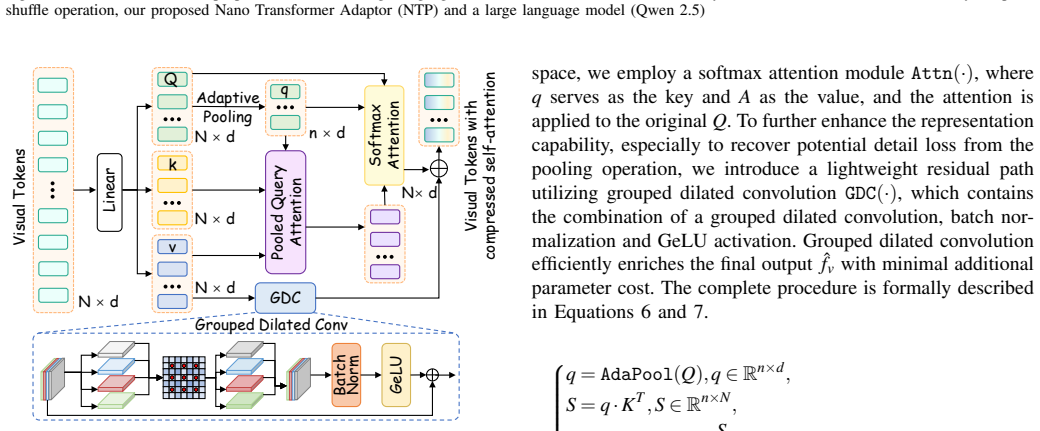
The load-bearing component is the Nano Transformer Adaptor (NTA), a vision-to-language projector designed for linear-complexity visual token fusion. Its Multi-Head Pooling Attention first pools the query sequence down to a smaller number of tokens, computes attention against the full keys and values, and then expands the pooled context back onto the original queries with a softmax attention step, while a grouped dilated convolution residual path restores high-frequency detail. This structure gives a global receptive field with O(N n d) complexity rather than O($N^{2}$ d), and the paper's ablations show that removing the dilated convolution, shrinking the pooled query size, or replacing pooling attention with vanilla cross-attention all hurt the balanced BLEU/METEOR/GPT-Score profile. Around the NTA, pixel-shuffle compresses visual tokens from MobileCLIP-B, and a two-stage training procedure first aligns modalities with a frozen visual encoder and frozen Qwen 2.5 LLM, then unfreezes the last visual block and the LLM for captioning.
What would settle it
Take 500 fresh waterway images from sources other than WaterScenes, such as new USV recordings with independent ground-truth scene checklists, and have human experts score Da Yu's captions against the seven key regions. If Da Yu-L does not outperform MobileVLM v2 and InternVL 2.5 on factual correctness, or if the WaterCaption ranking changes when GPT-Score is replaced by human verdicts, the claimed balance of performance and efficiency is not supported.
Extended reading notes
Core claim
The central claim is that a long-form image-captioning task can serve as the perceptual backbone for automated waterway monitoring, replacing fragmented detection outputs with structured, natural-language navigation logs. To make that claim testable, the authors construct WaterCaption, whose captions are organized around seven key semantic regions—waterway objects, buildings, weather, wave amplitude, shore condition, cleanliness, and ego-USV position—and are annotated by seven experts with LLM-assisted rewriting. The supporting engineering claim is that the Nano Transformer Adaptor eliminates the usual trade-off between global image context and local detail, delivering linear-complexity visual fusion with 4.81M parameters and 2.46 GFLOPs, and improves long-caption generation relative to MLP, LDP, LDPv2, and MWA adaptors. On the WaterCaption benchmark Da Yu-L reaches the highest scores across ROUGE, BLEU, METEOR, CIDEr, and GPT-Score, and the NTA also lifts MobileVLM v2 when dropped into that model, which the paper takes as evidence of portability. The inference claim is that the model runs on an NVIDIA Jetson Orin edge device, with Da Yu-S at 4.35 seconds per caption, inside the 8-second planning window.
Load-bearing premise
The load-bearing premise is that WaterCaption's human- and LLM-corrected captions are factually accurate enough to serve as ground truth, so the performance gap between Da Yu and other models is a real gain in scene understanding rather than an artifact of the benchmark or of the GPT-Score judge.
Editorial extensions
If this is right
- If the WaterCaption benchmark is adopted, long-text captioning quality becomes a measurable target for waterway perception rather than detection scores.
- An NTA-style projector could be dropped into other small MLLMs to get better long captions at lower parameter and FLOP counts, as the MobileVLM v2 porting experiment suggests.
- A USV carrying Da Yu could generate structured monitoring logs onboard within the 8-second response window required by inland navigation rules, without cloud round trips.
- The dataset forces models to describe seven distinct scene regions, so future waterway captioning systems can be audited region by region instead of by a single sentence.
Reading between the lines
- A testable extension would be to convert each caption into a structured checklist of the seven key elements and score factual agreement with the WaterScenes annotations, testing whether semantic quality goes beyond text overlap.
- Because GPT-Score is itself an LLM, the authors' reported margins between Da Yu and rivals may partly measure which model produces output that another LLM prefers; a human or rule-based factual-consistency judge could change the ranking.
- The NTA's pooling of queries to a fixed small set suggests a natural scaling path: keeping the pooled query size constant while increasing image resolution should keep adaptor cost bounded, which is exactly the regime USV cameras operate in.
- If WaterCaption's captions are treated as ground truth for training, any systematic annotation bias, such as under-reporting small floating debris in glare conditions, will be inherited by trained models; collecting independent images without WaterScenes labels would test how well the dataset transfers.
Editorial analysis
A structured set of objections, weighed in public.
Referee Report
Summary. The paper introduces WaterCaption, a new image-captioning dataset for waterway surveillance built on the WaterScenes dataset, with 20.2k/20,193 image-text pairs and long, multi-region captions covering seven domain key elements (waterway objects, weather, wave amplitude, shore condition, cleanliness, buildings, and ego-USV position). The paper also proposes Da Yu, a lightweight MLLM using a MobileCLIP-B visual encoder, a Qwen 2.5 language model, and a novel Nano Transformer Adaptor (NTA) that combines pooled-query attention with grouped dilated convolution. Experiments compare Da Yu with 15 models on WaterCaption, ablate the adaptor, report COCO generalization, and measure latency on a Jetson Orin platform. The central claims are that Da Yu achieves state-of-the-art captioning quality on WaterCaption and efficient edge deployment, and that NTA significantly improves long-form caption generation while using fewer parameters and FLOPs than compared adaptors.
Significance. If validated, WaterCaption would be a useful new benchmark for long-text, domain-specific image captioning, and NTA's efficiency results (4.81M parameters, 2.46G FLOPs, Table VII) are a plausible contribution to lightweight MLLM design. The paper honestly discloses several limitations in Section VI-A, and the qualitative case in Fig. 13 is a valuable stress test. The authors also release a project page. However, the headline claims are not yet supported by the evidence as presented: the benchmark is self-constructed with LLM-assisted annotations, the main semantic metric is an LLM judge whose reliability is acknowledged to be open, and no statistical uncertainty is reported for any experimental table. The dataset contribution itself may be valuable regardless of the model claims, but the current manuscript does not establish the claimed superiority of Da Yu or NTA.
major comments (5)
- [§III-A, §V-A, Table III] The state-of-the-art claim rests on a self-constructed benchmark whose reference captions were produced by seven annotators with ChatGPT-4o/DeepSeek-R1 rewriting and no independent factual verification against the WaterScenes structured labels (bounding boxes, drivable area, shoreline). Since every model is scored against these captions, any systematic annotation bias is inherited by all metrics. Please add a human-verified subset, a factual-consistency check against the WaterScenes labels, and inter-annotator agreement or verification statistics. This is essential to support the claim of 'surpassing state-of-the-art' on WaterCaption.
- [§V-B, Tables V and VI] The claimed advantage of NTA over MLP and LDPv2 is within likely noise. In Table V, NTA vs MLP shows BLEU-3 0.28 vs 0.29 (lower), ROUGH-L 0.38 vs 0.36, METEOR 0.46 vs 0.43, and GPT-Score 0.83 vs 0.81; NTA vs LDPv2 shows a METEOR tie at 0.46 and a GPT-Score tie at 0.83 vs 0.82. No confidence intervals, multiple seeds, or significance tests are reported in Tables III, V, VI, X, or XII. Please report at least 3 seeds with mean and standard deviation, and a paired significance test for the headline comparisons, before claiming that NTA 'significantly' improves long-form generation.
- [§VI-A, Fig. 13] GPT-Score is the main semantic metric, yet the authors state that 'the reliability of large language models in evaluation remains an open question,' and Fig. 13 shows a prediction receiving GPT-Score 0.92 while BLEU-3, CIDEr, and SPICE are near zero. The paper does not specify the GPT-Score prompt, the LLM version, the scoring scale, or the number of evaluation samples. Please provide a precise evaluation protocol, a correlation study with human judgments on a sample (ideally using the same expert annotators who built the dataset), and a separate report of cases where GPT-Score and lexical metrics diverge.
- [§V-B, Table X] The COCO generalization claim is not supported by the reported numbers. Da Yu-B (1.7B) matches InternVL 2.5 (1.9B) on BLEU-4 (0.43 vs 0.43) and edges CIDEr (1.41 vs 1.38) and SPICE (0.33 vs 0.32), a tie within likely noise at single-run precision. The COCO training/evaluation protocol is also underspecified: it is unclear whether all comparison models were trained under identical data splits, initialization, and checkpoint selection. Please clarify the protocol and report multi-run statistics before claiming robust generalization.
- [§III, Table I, Abstract] The dataset statistics are internally inconsistent. The Introduction and Abstract state 20,193 and '20.2k', while Section III states 20,247, and the sum of the reported train/validation/test splits (14,135 + 2,019 + 4,039) is 20,193. Additionally, 'Vocab Size 1.8M' in Table I cannot be a unique-vocabulary count for 20k captions of about 88 words each; it is likely the total number of tokens, in which case the column is mislabeled. Please correct these numbers and clarify the vocabulary definition.
minor comments (5)
- [Throughout] Typographical errors should be fixed: 'ROUGH' should be 'ROUGE' in Tables III–IV and the text, 'METROR' should be 'METEOR' in Table IV, 'MW A' should be 'MWA' in Tables V and VII, and Fig. 7's caption refers to 'NTP' where it should say 'NTA'.
- [§V-B] Several table/figure cross-references are wrong: the text says 'Table II' when referring to scenario results (should be Table IV), 'Table VII' when referring to adaptor performance (should be Table V), and 'Figure XI'/'Figure X' when referring to Tables XI/X. Please correct these references.
- [Eqs. (5)–(6)] The notation for the attention matrices is ambiguous: S is used as both q·K^T (an n×N matrix) and as the matrix in S/√d, and the sentence 'd represents the dimensionality of the attention components S, Q, and q' is incorrect because S has dimensions n×N, not d. Please introduce distinct symbols and clarify dimensions.
- [§III-A, Step 4] The annotation pipeline uses LLM rewriting (ChatGPT-4o and DeepSeek-R1) but it is not stated whether the LLMs had access to the WaterScenes structured labels or only the image. Please clarify, because this affects the factual-verification claim made in Step 5.
- [References] The GPT-Score metric is only cited to the DriveLM paper [55]; please provide a more direct reference for LLM-based caption evaluation or describe the scoring rubric in the paper.
Circularity Check
No equation-level circularity; the central claims rest on a self-constructed benchmark and an LLM-judge metric whose reliability the paper itself leaves open, but no prediction is fitted to its own target by construction.
full rationale
The paper does not derive any headline result from an equation that is defined in terms of that result, and it does not fit parameters to the test set and then rename them as predictions. The WaterCaption benchmark is constructed by the authors, and the main semantic metric, GPT-Score, is an LLM judge whose reliability is explicitly left open in Section VI-A: 'the reliability of large language models in evaluation remains an open question.' These are validity and generalizability concerns rather than circular reductions: model outputs are scored against held-out references, and GPT-Score is not a function of the proposed model's parameters. The dependency on WaterScenes [18], a dataset co-authored by members of this team, is a provenance dependency rather than a load-bearing self-citation used to forbid alternatives. External COCO evaluation (Table X) and standard n-gram metrics (Tables III and V) provide independent, if partial, grounding. Because no specific equation, fitted parameter, or uniqueness theorem is shown to reduce to its own input, the circularity score is low.
Assumptions & free parameters
free parameters (3)
- Pooled query size n in NTA =
12x12, i.e., n = 144
- Pixel shuffle rate r =
2
- Training schedule =
WaterCaption: 10 epochs, lr 4e-5, batch 32; COCO: 30 epochs, lr 1e-6 to 5e-7, batch 128
assumptions (6)
- standard math Standard attention, layer norm, and convolution primitives behave as specified in deep learning frameworks.
- domain assumption WaterScenes annotations are accurate enough to serve as reliable references for captions.
- domain assumption The seven key semantic regions are a complete and necessary description of a waterway scene.
- domain assumption LLM-assisted calibration plus expert consensus yields factually correct ground-truth captions.
- domain assumption GPT-Score is a reliable proxy for long-caption quality.
- domain assumption Pretrained MobileCLIP and Qwen 2.5 provide suitable priors for waterway captioning.
Cite this review
Pith. "Pith review of Da Yu: Towards USV-Based Image Captioning for Waterway Surveillance and Scene Understanding." pith.science (2026). https://pith.science/paper/HPN22PYW
@misc{pith2026250619288,
  author       = {Pith},
  title        = {Pith review of: Da Yu: Towards USV-Based Image Captioning for Waterway Surveillance and Scene Understanding},
  year         = {2026},
  howpublished = {\url{https://pith.science/paper/HPN22PYW}},
  note         = {Machine review of arXiv:2506.19288}
}
read the original abstract
Automated waterway environment perception is crucial for enabling unmanned surface vessels (USVs) to understand their surroundings and make informed decisions. Most existing waterway perception models primarily focus on instance-level object perception paradigms (e.g., detection, segmentation). However, due to the complexity of waterway environments, current perception datasets and models fail to achieve global semantic understanding of waterways, limiting large-scale monitoring and structured log generation. With the advancement of vision-language models (VLMs), we leverage image captioning to introduce WaterCaption, the first captioning dataset specifically designed for waterway environments. WaterCaption focuses on fine-grained, multi-region long-text descriptions, providing a new research direction for visual geo-understanding and spatial scene cognition. Exactly, it includes 20.2k image-text pair data with 1.8 million vocabulary size. Additionally, we propose Da Yu, an edge-deployable multi-modal large language model for USVs, where we propose a novel vision-to-language projector called Nano Transformer Adaptor (NTA). NTA effectively balances computational efficiency with the capacity for both global and fine-grained local modeling of visual features, thereby significantly enhancing the model's ability to generate long-form textual outputs. Da Yu achieves an optimal balance between performance and efficiency, surpassing state-of-the-art models on WaterCaption and several other captioning benchmarks.
Figures


Figures from the paper (8 more)




Forward citations
Cited by 1 Pith paper
-
Large Foundation Models for Trajectory Prediction in Autonomous Driving: A Comprehensive Survey
A structured survey of LLM-based trajectory prediction methods, organized into trajectory-language mapping, multimodal fusion, and constraint-based reasoning, with benchmarks, metrics, and future directions.
Reference graph
Works this paper leans on
-
[1]
A data set for airborne maritime surveillance environments,
R. Ribeiro, G. Cruz, J. Matos, and A. Bernardino, “A data set for airborne maritime surveillance environments,” IEEE Transactions on Circuits and Systems for Video Technology , vol. 29, no. 9, pp. 2720– 2732, 2017
work page 2017
-
[2]
R. Guan, S. Yao, K. L. Man, X. Zhu, Y . Yue, J. Smith, E. G. Lim, and Y . Yue, “Asy-vrnet: Waterway panoptic driving perception model based on asymmetric fair fusion of vision and 4d mmwave radar,” in 2024 IEEE/RSJ International Conference on Intelligent Robots and Systems (IROS). IEEE, 2024, pp. 12 479–12 486
work page 2024
-
[3]
Usvtrack: Usv-based 4d radar-camera tracking dataset for autonomous driving in inland waterways,
S. Yao, R. Guan, Y . Ni, Y . Yue, X. Zhu, and R. W. Liu, “Usvtrack: Usv-based 4d radar-camera tracking dataset for autonomous driving in inland waterways,” in IEEE/RSJ International Conference on Intelligent Robots and Systems (IROS), 2025 , 2025
work page 2025
-
[4]
Y . Cheng, M. Jiang, J. Zhu, and Y . Liu, “Are we ready for unmanned surface vehicles in inland waterways? the usvinland multisensor dataset and benchmark,” IEEE Robotics and Automation Letters , vol. 6, no. 2, pp. 3964–3970, 2021
work page 2021
-
[5]
R. Guan, S. Yao, X. Zhu, K. L. Man, E. G. Lim, J. Smith, Y . Yue, and Y . Yue, “Achelous: A fast unified water-surface panoptic perception framework based on fusion of monocular camera and 4d mmwave radar,” in 2023 IEEE 26th International Conference on Intelligent Transportation Systems (ITSC) . IEEE, 2023, pp. 182–188
work page 2023
-
[6]
R. Guan, H. Zhao, S. Yao, K. L. Man, X. Zhu, L. Yu, Y . Yue, J. Smith, E. G. Lim, W. Ding et al., “Achelous++: Power-oriented water- surface panoptic perception framework on edge devices based on vision- radar fusion and pruning of heterogeneous modalities,” arXiv preprint arXiv:2312.08851, 2023
arXiv 2023
-
[7]
Watervg: Waterway visual grounding based on text-guided vision and mmwave radar,
R. Guan, L. Jia, S. Yao, F. Yang, S. Xu, E. Purwanto, X. Zhu, K. L. Man, E. G. Lim, J. Smith et al., “Watervg: Waterway visual grounding based on text-guided vision and mmwave radar,” IEEE Transactions on Intelligent Transportation Systems, 2025
work page 2025
-
[8]
Microsoft coco captions: Data collection and evaluation server,
X. Chen, H. Fang, T.-Y . Lin, R. Vedantam, S. Gupta, P. Doll ´ar, and C. L. Zitnick, “Microsoft coco captions: Data collection and evaluation server,” arXiv preprint arXiv:1504.00325 , 2015
arXiv 2015
Show all 57 references
-
[9]
Flickr30k entities: Collecting region-to-phrase correspondences for richer image-to-sentence models,
B. A. Plummer, L. Wang, C. M. Cervantes, J. C. Caicedo, and J. Hocken- maier, “Flickr30k entities: Collecting region-to-phrase correspondences for richer image-to-sentence models,” in Proceedings of the IEEE international conference on computer vision , 2015, pp. 2641–2649
2015
-
[10]
Conceptual 12m: Pushing web-scale image-text pre-training to recognize long-tail visual concepts,
S. Changpinyo, P. Sharma, N. Ding, and R. Soricut, “Conceptual 12m: Pushing web-scale image-text pre-training to recognize long-tail visual concepts,” in Proceedings of the IEEE/CVF conference on computer vision and pattern recognition , 2021, pp. 3558–3568
2021
-
[11]
Im2text: Describing images using 1 million captioned photographs,
V . Ordonez, G. Kulkarni, and T. Berg, “Im2text: Describing images using 1 million captioned photographs,” Advances in neural information processing systems, vol. 24, 2011
2011
-
[12]
Vizwiz grand challenge: Answering visual questions from blind people,
D. Gurari, Q. Li, A. J. Stangl, A. Guo, C. Lin, K. Grauman, J. Luo, and J. P. Bigham, “Vizwiz grand challenge: Answering visual questions from blind people,” in Proceedings of the IEEE conference on computer vision and pattern recognition , 2018, pp. 3608–3617
2018
-
[13]
Learning deep represen- tations of fine-grained visual descriptions,
S. Reed, Z. Akata, H. Lee, and B. Schiele, “Learning deep represen- tations of fine-grained visual descriptions,” in Proceedings of the IEEE conference on computer vision and pattern recognition, 2016, pp. 49–58
2016
-
[14]
Fashion captioning: Towards generating accurate descrip- tions with semantic rewards,
X. Yang, H. Zhang, D. Jin, Y . Liu, C.-H. Wu, J. Tan, D. Xie, J. Wang, and X. Wang, “Fashion captioning: Towards generating accurate descrip- tions with semantic rewards,” in Computer Vision–ECCV 2020: 16th European Conference, Glasgow, UK, August 23–28, 2020, Proceedings, Par...
2020
-
[15]
Break- ingnews: Article annotation by image and text processing,
A. Ramisa, F. Yan, F. Moreno-Noguer, and K. Mikolajczyk, “Break- ingnews: Article annotation by image and text processing,” IEEE trans- actions on pattern analysis and machine intelligence , vol. 40, no. 5, pp. 1072–1085, 2017
2017
-
[16]
Textcaps: a dataset for image captioning with reading comprehension,
O. Sidorov, R. Hu, M. Rohrbach, and A. Singh, “Textcaps: a dataset for image captioning with reading comprehension,” in Computer Vision– ECCV 2020: 16th European Conference, Glasgow, UK, August 23–28, 2020, Proceedings, Part II 16 . Springer, 2020, pp. 742–758
2020
-
[17]
Deep learning approaches on image captioning: A review,
T. Ghandi, H. Pourreza, and H. Mahyar, “Deep learning approaches on image captioning: A review,” ACM Computing Surveys , vol. 56, no. 3, pp. 1–39, 2023
2023
-
[18]
Waterscenes: A multi-task 4d radar-camera fusion dataset and benchmarks for autonomous driving on water surfaces,
S. Yao, R. Guan, Z. Wu, Y . Ni, Z. Huang, R. W. Liu, Y . Yue, W. Ding, E. G. Lim, H. Seo et al. , “Waterscenes: A multi-task 4d radar-camera fusion dataset and benchmarks for autonomous driving on water surfaces,” IEEE Transactions on Intelligent Transportation Systems, 2024
2024
-
[19]
U. C. Guard, Navigation Rules and Regulations Handbook: Interna- tional—Inland. Simon and Schuster, 2018
2018
-
[20]
Mobilevlm v2: Faster and stronger baseline for vision language model,
X. Chu, L. Qiao, X. Zhang, S. Xu, F. Wei, Y . Yang, X. Sun, Y . Hu, X. Lin, B. Zhang et al. , “Mobilevlm v2: Faster and stronger baseline for vision language model,” arXiv preprint arXiv:2402.03766 , 2024
2024 arXiv
-
[21]
Learning transferable visual models from natural language supervision,
A. Radford, J. W. Kim, C. Hallacy, A. Ramesh, G. Goh, S. Agarwal, G. Sastry, A. Askell, P. Mishkin, J. Clark et al., “Learning transferable visual models from natural language supervision,” in International conference on machine learning . PmLR, 2021, pp. 8748–8763
2021
-
[22]
Align before fuse: Vision and language representation learning with momentum distillation,
J. Li, R. Selvaraju, A. Gotmare, S. Joty, C. Xiong, and S. C. H. Hoi, “Align before fuse: Vision and language representation learning with momentum distillation,” Advances in neural information processing systems, vol. 34, pp. 9694–9705, 2021
2021
-
[23]
Blip: Bootstrapping language-image pre-training for unified vision-language understanding and generation,
J. Li, D. Li, C. Xiong, and S. Hoi, “Blip: Bootstrapping language-image pre-training for unified vision-language understanding and generation,” in International conference on machine learning . PMLR, 2022, pp. 12 888–12 900
2022
-
[24]
Blip-2: Bootstrapping language- image pre-training with frozen image encoders and large language models,
J. Li, D. Li, S. Savarese, and S. Hoi, “Blip-2: Bootstrapping language- image pre-training with frozen image encoders and large language models,” in International conference on machine learning . PMLR, 2023, pp. 19 730–19 742
2023
-
[25]
Visual instruction tuning,
H. Liu, C. Li, Q. Wu, and Y . J. Lee, “Visual instruction tuning,” Advances in neural information processing systems, vol. 36, pp. 34 892– 34 916, 2023
2023
-
[26]
Qwen2. 5 technical report,
A. Yang, B. Yang, B. Zhang, B. Hui, B. Zheng, B. Yu, C. Li, D. Liu, F. Huang, H. Wei et al., “Qwen2. 5 technical report,” arXiv e-prints, pp. arXiv–2412, 2024
2024
-
[27]
Task-adaptive attention for image captioning,
C. Yan, Y . Hao, L. Li, J. Yin, A. Liu, Z. Mao, Z. Chen, and X. Gao, “Task-adaptive attention for image captioning,” IEEE Transactions on Circuits and Systems for Video technology , vol. 32, no. 1, pp. 43–51, 2021
2021
-
[28]
Vision-enhanced and consensus- aware transformer for image captioning,
S. Cao, G. An, Z. Zheng, and Z. Wang, “Vision-enhanced and consensus- aware transformer for image captioning,” IEEE Transactions on Circuits and Systems for Video Technology, vol. 32, no. 10, pp. 7005–7018, 2022
2022
-
[29]
Adaptive path selection for dynamic image captioning,
T. Xian, Z. Li, Z. Tang, and H. Ma, “Adaptive path selection for dynamic image captioning,” IEEE Transactions on Circuits and Systems for Video Technology, vol. 32, no. 9, pp. 5762–5775, 2022
2022
-
[30]
Double-stream position learning trans- JOURNAL OF LATEX CLASS FILES, VOL. 14, NO. 8, AUGUST 2015 14 former network for image captioning,
W. Jiang, W. Zhou, and H. Hu, “Double-stream position learning trans- JOURNAL OF LATEX CLASS FILES, VOL. 14, NO. 8, AUGUST 2015 14 former network for image captioning,” IEEE Transactions on Circuits and Systems for Video Technology, vol. 32, no. 11, pp. 7706–7718, 2022
2015
-
[31]
A comprehen- sive survey of 3d dense captioning: Localizing and describing objects in 3d scenes,
T. Yu, X. Lin, S. Wang, W. Sheng, Q. Huang, and J. Yu, “A comprehen- sive survey of 3d dense captioning: Localizing and describing objects in 3d scenes,” IEEE Transactions on Circuits and Systems for Video Technology, vol. 34, no. 3, pp. 1322–1338, 2023
2023
-
[32]
Spt: Spatial pyramid transformer for image captioning,
H. Zhang, P. Zeng, L. Gao, X. Lyu, J. Song, and H. T. Shen, “Spt: Spatial pyramid transformer for image captioning,” IEEE Transactions on Circuits and Systems for Video Technology, vol. 34, no. 6, pp. 4829– 4842, 2023
2023
-
[33]
Multimodal transformer with multi- view visual representation for image captioning,
J. Yu, J. Li, Z. Yu, and Q. Huang, “Multimodal transformer with multi- view visual representation for image captioning,” IEEE transactions on circuits and systems for video technology , vol. 30, no. 12, pp. 4467– 4480, 2019
2019
-
[34]
Mobilevlm: A vision-language model for better intra-and inter-ui understanding,
Q. Wu, W. Xu, W. Liu, T. Tan, J. Liu, A. Li, J. Luan, B. Wang, and S. Shang, “Mobilevlm: A vision-language model for better intra-and inter-ui understanding,” arXiv preprint arXiv:2409.14818 , 2024
2024 arXiv
-
[35]
Internvl: Scaling up vision foundation models and aligning for generic visual-linguistic tasks,
Z. Chen, J. Wu, W. Wang, W. Su, G. Chen, S. Xing, M. Zhong, Q. Zhang, X. Zhu, L. Lu et al. , “Internvl: Scaling up vision foundation models and aligning for generic visual-linguistic tasks,” in Proceedings of the IEEE/CVF conference on computer vision and pattern recognition, ...
2024
-
[36]
Minicpm-v: A gpt-4v level mllm on your phone,
Y . Yao, T. Yu, A. Zhang, C. Wang, J. Cui, H. Zhu, T. Cai, H. Li, W. Zhao, Z. He et al., “Minicpm-v: A gpt-4v level mllm on your phone,” arXiv preprint arXiv:2408.01800, 2024
2024 arXiv
-
[37]
Tinyllava: A framework of small-scale large multimodal models,
B. Zhou, Y . Hu, X. Weng, J. Jia, J. Luo, X. Liu, J. Wu, and L. Huang, “Tinyllava: A framework of small-scale large multimodal models,”arXiv preprint arXiv:2402.14289, 2024
2024 arXiv
-
[38]
Mask-vrdet: A robust riverway panoptic perception model based on dual graph fusion of vision and 4d mmwave radar,
R. Guan, S. Yao, L. Liu, X. Zhu, K. L. Man, Y . Yue, J. Smith, E. G. Lim, and Y . Yue, “Mask-vrdet: A robust riverway panoptic perception model based on dual graph fusion of vision and 4d mmwave radar,” Robotics and Autonomous Systems , vol. 171, p. 104572, 2024
2024
-
[39]
Nanomvg: Usv-centric low-power multi- task visual grounding based on prompt-guided camera and 4d mmwave radar,
R. Guan, J. Liu, L. Jia, H. Zhao, S. Yao, X. Zhu, K. L. Man, E. G. Lim, J. Smith, and Y . Yue, “Nanomvg: Usv-centric low-power multi- task visual grounding based on prompt-guided camera and 4d mmwave radar,” arXiv preprint arXiv:2408.17207 , 2024
2024 arXiv
-
[40]
Gpt-4 technical report,
J. Achiam, S. Adler, S. Agarwal, L. Ahmad, I. Akkaya, F. L. Aleman, D. Almeida, J. Altenschmidt, S. Altman, S. Anadkat et al. , “Gpt-4 technical report,” arXiv preprint arXiv:2303.08774 , 2023
2023 arXiv
-
[41]
Deepseek-v3 technical report,
A. Liu, B. Feng, B. Xue, B. Wang, B. Wu, C. Lu, C. Zhao, C. Deng, C. Zhang, C. Ruan et al., “Deepseek-v3 technical report,” arXiv preprint arXiv:2412.19437, 2024
2024 arXiv
-
[42]
Mobileclip: Fast image-text models through multi-modal reinforced training,
P. K. A. Vasu, H. Pouransari, F. Faghri, R. Vemulapalli, and O. Tuzel, “Mobileclip: Fast image-text models through multi-modal reinforced training,” in Proceedings of the IEEE/CVF Conference on Computer Vision and Pattern Recognition , 2024, pp. 15 963–15 974
2024
-
[43]
Coca: Contrastive captioners are image-text foundation models,
J. Yu, Z. Wang, V . Vasudevan, L. Yeung, M. Seyedhosseini, and Y . Wu, “Coca: Contrastive captioners are image-text foundation models,” Transactions on Machine Learning Research
-
[44]
Sigmoid loss for language image pre-training,
X. Zhai, B. Mustafa, A. Kolesnikov, and L. Beyer, “Sigmoid loss for language image pre-training,” in Proceedings of the IEEE/CVF international conference on computer vision , 2023, pp. 11 975–11 986
2023
-
[45]
Agent attention: On the integration of softmax and linear attention,
D. Han, T. Ye, Y . Han, Z. Xia, S. Pan, P. Wan, S. Song, and G. Huang, “Agent attention: On the integration of softmax and linear attention,” in European Conference on Computer Vision . Springer, 2024, pp. 124– 140
2024
-
[46]
Dual-level collaborative transformer for image captioning,
Y . Luo, J. Ji, X. Sun, L. Cao, Y . Wu, F. Huang, C.-W. Lin, and R. Ji, “Dual-level collaborative transformer for image captioning,” in Proceedings of the AAAI conference on artificial intelligence , vol. 35, no. 3, 2021, pp. 2286–2293
2021
-
[47]
Comprehending and ordering seman- tics for image captioning,
Y . Li, Y . Pan, T. Yao, and T. Mei, “Comprehending and ordering seman- tics for image captioning,” in Proceedings of the IEEE/CVF conference on computer vision and pattern recognition , 2022, pp. 17 990–17 999
2022
-
[48]
Oscar: Object-semantics aligned pre-training for vision-language tasks,
X. Li, X. Yin, C. Li, P. Zhang, X. Hu, L. Zhang, L. Wang, H. Hu, L. Dong, F. Wei et al., “Oscar: Object-semantics aligned pre-training for vision-language tasks,” in Computer Vision–ECCV 2020: 16th European Conference, Glasgow, UK, August 23–28, 2020, Proceedings, Part XXX
2020
-
[49]
Springer, 2020, pp. 121–137
2020
-
[50]
Qwen2. 5-vl technical report,
S. Bai, K. Chen, X. Liu, J. Wang, W. Ge, S. Song, K. Dang, P. Wang, S. Wang, J. Tang et al., “Qwen2. 5-vl technical report,” arXiv preprint arXiv:2502.13923, 2025
2025 arXiv
-
[51]
Multiway- adapater: Adapting large-scale multi-modal models for scalable image- text retrieval,
Z. Long, G. Killick, R. McCreadie, and G. A. Camarasa, “Multiway- adapater: Adapting large-scale multi-modal models for scalable image- text retrieval,” arXiv preprint arXiv:2309.01516 , 2023
2023 arXiv
-
[52]
Rouge: A package for automatic evaluation of summaries,
C.-Y . Lin, “Rouge: A package for automatic evaluation of summaries,” in Text summarization branches out , 2004, pp. 74–81
2004
-
[53]
Bleu: a method for automatic evaluation of machine translation,
K. Papineni, S. Roukos, T. Ward, and W.-J. Zhu, “Bleu: a method for automatic evaluation of machine translation,” in Proceedings of the 40th annual meeting of the Association for Computational Linguistics , 2002, pp. 311–318
2002
-
[54]
Lavie and A
A. Lavie and A. Agarwal, “Meteor,” 01 2007, pp. 228–231
2007
-
[55]
Cider: Consensus- based image description evaluation,
R. Vedantam, C. Lawrence Zitnick, and D. Parikh, “Cider: Consensus- based image description evaluation,” in Proceedings of the IEEE confer- ence on computer vision and pattern recognition , 2015, pp. 4566–4575
2015
-
[56]
Drivelm: Driving with graph visual question answering,
C. Sima, K. Renz, K. Chitta, L. Chen, H. Zhang, C. Xie, J. Beißwenger, P. Luo, A. Geiger, and H. Li, “Drivelm: Driving with graph visual question answering,” in European Conference on Computer Vision . Springer, 2024, pp. 256–274. Runwei Guan (Member, IEEE) is currently a rese...
2024
-
[96]
His accolades include Fellow of the AAAI, AAAS, IEEE, and CAAI, the Distinguished Scientist of the Association for Computing Machinery (ACM), and received highly recognized awards such as the 2023 ACM SIGKDD Service Award, the 2021 AAAI Best Paper Award and IEEE ICDM Best Pape...
2011
Reviewed August 6, 2026 · model on record in the stance chip above.
Discussion (0). Continue with ORCID to comment.