REVIEW 4 major objections 8 minor 39 references
Stylized Structural Patterns for Improved Neural Network Pre-training
T0 review · 4 major / 8 minor · reviewed 2026-08-15 · deepseek-v4-flash
Pith's one-line read Synthetic fractal images that absorb texture statistics from a small set of real photos come measurably closer to real-image data, improving pretraining for reconstruction, generation, and representation learning.
desk verdict A genuinely new synthetic-pre-training recipe with real empirical gains, but the central mechanism contains an encoder contradiction that must be resolved before the claimed explanation can be trusted. read the letter →
The pith
A machine-rendered reading of the paper's core claim, the machinery that carries it, and where it could break.
The reading
What carries the argument
The argument rides on two pieces. First, improved neural fractals: instead of the Mandelbrot recurrence $z_{n+1}=z_n^2+c$, a randomly initialized complex-valued neural network $g$ defines $z_{n+1}=g(z_n)+c$, and escape-time coloring plus variance-guided adaptive Monte Carlo sampling render each unique pattern quickly. Second, reverse stylization: texture-based style transfer, either Gatys Gram-matrix matching or neural-neighbor matching, is run with a real photo as the style and a fractal as the content, using an encoder pretrained on about 7,000 Unsplash images rather than ImageNet. The lowered KID between the resulting dataset and real images is presented as the measurable mechanism connecting the reduced domain gap to downstream pretraining performance.
What would settle it
Train the same reverse-stylization pipeline with a deliberately mismatched style set, such as only grayscale or only indoor images, and recompute KID to ImageNet plus the three downstream metrics. If KID stays near 0.120 and the downstream gains persist, representativeness of the style sample is not the deciding factor; if KID rises and the gains vanish, the premise is confirmed. A cheaper check is to ablate the style-set size, for example 7, 70, 700, and 7,000 images, and locate where the benefits actually appear.
Extended reading notes
Core claim
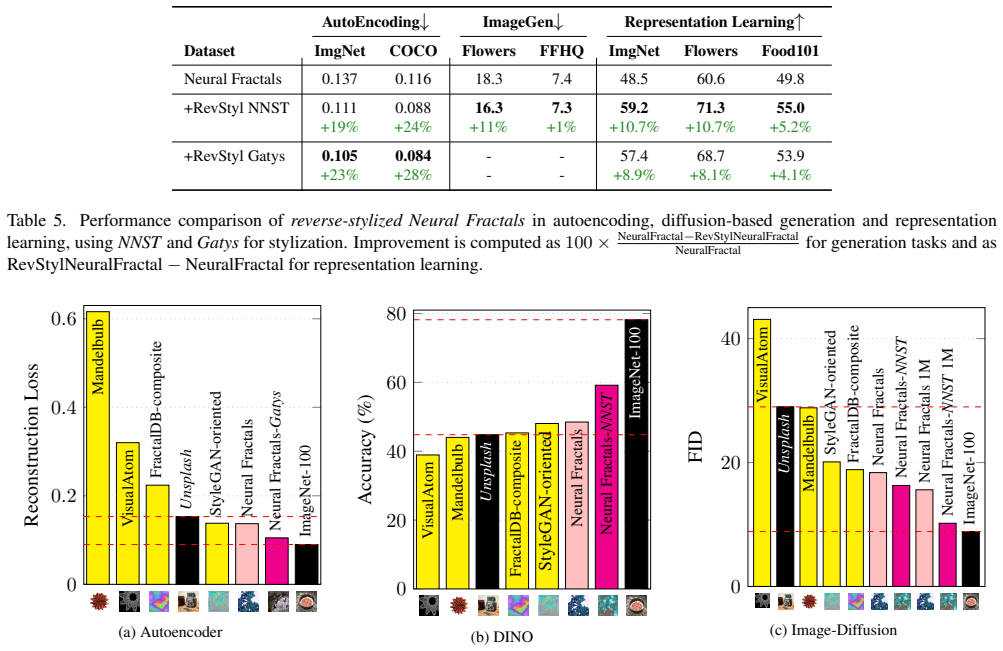
The paper claims that reverse stylization, running neural style transfer with real photos as the style source and synthetic fractals as content, transfers enough real-image texture and color statistics onto synthetic data to substantially close the distribution gap. In their measurements, the Kernel Inception Distance between the generated dataset and ImageNet drops from 0.162 for plain neural fractals to 0.120 for the stylized version, and networks trained on the stylized data match the attention behavior of ImageNet-trained networks more closely. Downstream, this yields about 20% lower autoencoder reconstruction loss, 11% lower FID after diffusion fine-tuning on Flowers, and 10.7 percentage points higher ImageNet-100 accuracy for a DINO-trained ViT-S relative to the same models trained on non-stylized neural fractals. The authors also report that reverse stylization improves every base synthetic dataset they tried, indicating that the mechanism is not specific to fractals.
Load-bearing premise
The load-bearing premise is that the texture and color statistics extracted from roughly 7,000 Unsplash photos are representative enough of the real-image domains, such as ImageNet, COCO, Flowers, and FFHQ, that transferring those statistics onto synthetic fractals actually narrows the gap; if this small sample carries the wrong statistics, the reported gains would shrink or reverse.
Editorial extensions
If this is right
- Autoencoder pretraining on reverse-stylized neural fractals reconstructs real images with about 20% lower loss than on plain neural fractals, making synthetic-only pretraining more viable for perceptual compression.
- Diffusion models pretrained on stylized fractals and fine-tuned on Flowers improve FID by about 11%, and scaling the stylized set to 1M images reduces FID by roughly another 30%.
- A DINO-trained ViT-S pretrained without labels on stylized fractals gains 10.7 percentage points of top-1 accuracy on ImageNet-100 over plain fractals, narrowing the gap toward models pretrained on curated real data.
- Reverse stylization improves all tested base synthetic datasets, so it should transfer to other procedural or noise-based data generators, not just fractals.
- Because the style-reference set is small and license-free, the method offers a path to pretraining corpora with fewer privacy and copyright constraints.
Reading between the lines
- If the gains are driven mainly by transferable texture statistics rather than content semantics, a stylization source could eventually be synthesized or learned, removing the need for any photographed reference set.
- The 7,000-image Unsplash set is generic; a natural test is whether a domain-matched style set, such as medical, satellite, or indoor images, is needed when the downstream target is a specialized domain.
- The appendix shows stylization helps weaker base datasets even more, which suggests reverse stylization could act as a drop-in improvement for future procedural data generators and may compound with dataset-scaling laws.
- The attention-map cosine-similarity results imply the benefit may extend beyond distribution matching into the inductive bias of the pretrained network, an effect worth checking across other architectures such as CNNs and larger vision transformers.
Signed reviews
Editorial analysis
A structured set of objections, weighed in public.
Referee Report
Summary. The paper proposes a two-step method for generating synthetic pretraining datasets. First, it introduces an improved neural fractal generator: a complex-valued MLP recursion with adaptive sampling, escape-time coloring, and automatic threshold adjustment. Second, it applies 'reverse stylization,' using neural style transfer to transfer visual features from a small set of 7,000 license-free Unsplash images onto the synthetic images. The authors evaluate the resulting datasets on a domain-gap measure (KID/FID vs. ImageNet) and on three downstream tasks: autoencoder reconstruction, EDM2 diffusion fine-tuning (Flowers, FFHQ), and DINO-based representation learning (ImageNet-100, Flowers, Food101). They report consistent improvements for stylized neural fractals over existing synthetic datasets, including roughly 19-24% lower autoencoder reconstruction loss, an 11% FID reduction on Flowers diffusion fine-tuning, and about 10.7 percentage points higher ImageNet-100 accuracy for a ViT-S trained with DINO.
Significance. If the results are reproducible, the paper offers a practical contribution to synthetic pretraining: it shows that a small, license-clean real-image set can be used to inject realistic visual statistics into synthetic data, narrowing the domain gap and improving performance on generative as well as discriminative downstream tasks. The evaluation is broad, covering multiple base synthetic datasets, three task families, and ablations such as dataset scaling, style-transfer algorithm choice, and a MixUp comparison. The reverse-stylization technique appears to generalize across all tested base datasets, which strengthens the claim that it is a general tool rather than a quirk of neural fractals. The paper does not ship code or release the datasets, however, and the central mechanism is undermined by internally contradictory statements about which feature encoder is used for the stylization step.
major comments (4)
- [Sec. 3.2 vs. Sec. 4.1] The specification of the feature encoder used for reverse stylization is contradictory. Section 3.2 states that the VGG network is replaced by 'an encoder network pre-trained on Unsplash to prevent any biases ... arising from using a network trained on large-scale real data,' while Section 4.1, in the autoencoder experiment, says 'Importantly, we also use its encoder as a VGG replacement to generate features for style transfer,' where 'its' refers to the autoencoder trained on synthetic data in that section. This is not a minor wording issue: the proposed mechanism for reducing the domain gap is that real-image statistics (from Unsplash) are transferred to synthetic images. If the encoder is instead an autoencoder trained on synthetic fractals, the claim that the improvement comes from transferring statistics learned on the 7k Unsplash images is unsupported. Please clarify which encoder was actually used for the stylization experiments. If it is the synthetic-trained autoencoder, revise the mechanism description and provide additional experiments that isolate the effect of encoder choice on the downstream results and on KID/FID.
- [Sec. 3.1 vs. Sec. 4.3 and Appendix] The neural fractal generator architecture is described inconsistently. Section 3.1 says 'We use a fully connected neural network with 6 hidden layers of 3 neurons each,' but Section 4.3 states 'we use a 3-layer, 6-neuron network,' and the supplementary material similarly reports 'a network with 3 layers and 6 neurons.' Since the network g in Eq. (1) determines the fractal structure of every rendered image, this discrepancy directly affects the reproducibility of the proposed synthetic dataset. Please correct the inconsistency and specify the precise architecture used to generate the reported 100K-image datasets.
- [Tables 1-6 (single-run results)] All experimental results are reported as single numbers with no error bars, standard deviations, or number of seeds. This is a particular concern because several claimed improvements are modest in magnitude (e.g., FID 18.3 to 16.3 on Flowers, DINO accuracy 48.5 to 59.2 on ImageNet-100). Without multiple seeds or variance estimates, it is impossible to determine whether the observed differences are statistically reliable or within training noise. Please provide results averaged over at least three seeds with standard deviations, or otherwise justify the stability of the single-run numbers, for the key comparisons in Tables 1, 3, 4, 5, and 6.
- [Sec. 4.3 'Domain Gap' and Table 10] The claim that reverse stylization reduces the domain gap is partly circular. The stylization objective—Gram-matrix matching of encoder features—explicitly aligns feature statistics of the synthetic images with those of the real Unsplash images, and the reported KID/FID are computed on Inception features. Although the evaluation target is ImageNet rather than Unsplash, the reduction in KID/FID is to a large degree the direct objective of the method, so it does not independently confirm that the method transfers useful visual information. The authors should either frame the KID/FID result as a sanity check rather than as evidence, or include a control experiment (for example, stylizing with an encoder trained on random images, or matching random feature statistics) to demonstrate that the KID reduction is not a trivial consequence of matching features.
minor comments (8)
- [Sec. 4.1 vs. Appendix Sec. 8] The number of training iterations for the autoencoder is inconsistent: Section 4.1 says 'We train the network for 1M iterations,' while the supplementary material says 'We train the AE ... for 1.5M iterations.' Please align these numbers.
- [Sec. 4.1 vs. Appendix Sec. 8] The DINO training length is inconsistent: the main text states 'We train the encoder for 1000 epochs,' but the appendix specifies 200 epochs for the ViT-S encoder. Please reconcile.
- [Table 3 vs. Table 6] The Flowers FID for the 100K non-stylized neural fractal dataset is 18.3 in Table 3 and 18.4 in Table 6; please correct the discrepancy.
- [Abstract and Table 5] The abstract says 'over a 10% improvement' in ImageNet-100 accuracy, but Table 5 reports a +10.7 percentage-point increase (48.5 to 59.2). Please state whether this is a relative improvement or a percentage-point difference to avoid ambiguity.
- [Sec. 4.3] The text says KID was chosen because it 'has the ability to report confidence intervals,' but no confidence intervals are reported anywhere in the paper; either provide them or remove this justification.
- [Table 1 and App. Sec. 9] The attention-map cosine similarity metric is not defined: the paper does not specify which layer or attention head is used, how attention maps are extracted, or how similarity is averaged over images. Please provide a precise definition in the main text or appendix so that the numbers in Table 1 are reproducible.
- [Throughout] There are several typographical errors and inconsistent terminology, including 'signficant' (Sec. 2.2), 'generate generate' (Sec. 3.2), 'peform' (Sec. 4.3), 'pipline' (appendix), and the alternation between 'ImageNet-100' and 'ImageNet-100k.' Please proofread and standardize.
- [Sec. 3.2] The statement that Unsplash images are 'license-free' should be qualified: the Unsplash License permits use but imposes conditions (e.g., no compilation of the images to replicate a similar service). Please verify and describe the license terms more precisely.
Circularity Check
Domain-gap evidence is partly by construction and the stylization encoder is described inconsistently, but the downstream pre-training results are external and not fitted.
-
self definitional
[Section 3.2 (reverse stylization definition) and Section 4.3 (domain-gap ablation)]
"We, however, are interested in creating synthetic datasets with visual features that resemble real datasets, to bridge the domain gap. ... Table 1 shows that reverse stylization reduces the domain gap significantly, as evidenced by both the improved alignment of attention maps with the ImageNet-trained network and the lower KID score, indicating closer distributional similarity."
Reverse stylization is defined as transferring visual features from a small set of real images onto synthetic images, and each stylized sample is generated by matching feature statistics of a randomly chosen real Unsplash image. Reporting a lower KID/FID to real data as evidence of success is therefore largely a restatement of the construction: the stylized images were built to be closer to real-image statistics, so a reduced distributional gap to real images is an expected consequence rather than an independent confirmation of the mechanism. The downstream autoencoder, diffusion, and DINO results are external and not fitted to KID, so the circularity is partial rather than total.
-
other
[Section 3.2 vs. Section 4.1 (encoder used for style transfer)]
"Note that both stylization algorithms originally use features derived from a VGG network (trained on ImageNet). Therefore, we replace it with an encoder network pre-trained on Unsplash to prevent any biases in results arising from using a network trained on large-scale real data. ... Importantly, we also use its encoder as a VGG replacement to generate features for style transfer."
The paper names two different encoders for the same reverse-stylization step. Section 3.2 says the VGG network is replaced by an encoder pre-trained on the real Unsplash set, while Section 4.1 says the encoder of the autoencoder trained on synthetic data is used as the VGG replacement. If the latter is the actual implementation, the stylized training set was generated using the same model family that is later evaluated for reconstruction; the claimed transfer of real-image statistics is not established, and the 20% reconstruction gain cannot be cleanly attributed to the real-data mechanism. This contradiction sits in the load-bearing derivation of the paper's central claim, even though the downstream evaluation itself is on external real datasets.
full rationale
The paper's headline downstream results are not circular: the autoencoder is evaluated on ImageNet and COCO validation sets, the diffusion model on Flowers and FFHQ FID, and the representation-learning model on ImageNet-100/Flowers/Food101 accuracy. None of these metrics is used as a loss or selection criterion for reverse stylization, and no parameter is fitted to them. However, two issues limit the self-containedness of the claimed derivation. First, the paper presents the reduced KID/FID domain gap as evidence that reverse stylization works, but reverse stylization is defined as making synthetic images resemble real images; a drop in a distributional distance to real data is largely an expected consequence of the construction rather than an independent test. Second, the paper contradicts itself about the encoder used for style transfer: Section 3.2 says it is pre-trained on Unsplash, while Section 4.1 says it is the autoencoder encoder trained on synthetic data. This contradiction undermines the mechanism by which real-image statistics are said to enter the stylized dataset. The paper itself concedes in the limitations that 'The exact effect of this real dataset on final results is not clear at the moment.' There is no load-bearing self-citation chain or imported uniqueness theorem. Weighing the external downstream results against the partly self-definitional domain-gap evidence and the internal contradiction, the appropriate circularity score is 4.
Assumptions & free parameters
free parameters (6)
- Neural fractal MLP architecture =
6 hidden layers of 3 neurons (Sec 3.1); later 3 layers of 6 neurons (Sec 4.3)
- Threshold adjustment ratio =
40% of |z| values below threshold; threshold multiplied by 1.1 per iteration
- Pixel exclusion threshold =
max standard deviation < 0.025 across any channel
- Unsplash real-image sample size =
approximately 7,000 images
- Adaptive sampling parameters =
box filter kernel size 5; variance stopping criterion not specified numerically
- Style transfer algorithms and settings =
Gatys and NNST; no iteration count or learning rate given
assumptions (5)
- standard math Standard deep learning assumptions: SGD training, architecture choices from cited works perform as reported
- domain assumption Gram-matrix style transfer transfers the visual features that matter for downstream tasks
- domain assumption An encoder trained on 7k Unsplash images is a suitable feature extractor for stylization without biasing results
- domain assumption KID/FID between synthetic and ImageNet is a valid proxy for pre-training quality
- domain assumption Randomly initialized complex-weight MLPs produce structurally diverse and useful fractal patterns
Cite this review
Pith. "Pith review of Stylized Structural Patterns for Improved Neural Network Pre-training." pith.science (2026). https://pith.science/paper/FWIJWBBA
@misc{pith2026250619465,
  author       = {Pith},
  title        = {Pith review of: Stylized Structural Patterns for Improved Neural Network Pre-training},
  year         = {2026},
  howpublished = {\url{https://pith.science/paper/FWIJWBBA}},
  note         = {Machine review of arXiv:2506.19465}
}
read the original abstract
Modern deep learning models in computer vision require large datasets of real images, which are difficult to curate and pose privacy and legal concerns, limiting their commercial use. Recent works suggest synthetic data as an alternative, yet models trained with it often underperform. This paper proposes a two-step approach to bridge this gap. First, we propose an improved neural fractal formulation through which we introduce a new class of synthetic data. Second, we propose reverse stylization, a technique that transfers visual features from a small, license-free set of real images onto synthetic datasets, enhancing their effectiveness. We analyze the domain gap between our synthetic datasets and real images using Kernel Inception Distance (KID) and show that our method achieves a significantly lower distributional gap compared to existing synthetic datasets. Furthermore, our experiments across different tasks demonstrate the practical impact of this reduced gap. We show that pretraining the EDM2 diffusion model on our synthetic dataset leads to an 11% reduction in FID during image generation, compared to models trained on existing synthetic datasets, and a 20% decrease in autoencoder reconstruction error, indicating improved performance in data representation. Furthermore, a ViT-S model trained for classification on this synthetic data achieves over a 10% improvement in ImageNet-100 accuracy. Our work opens up exciting possibilities for training practical models when sufficiently large real training sets are not available.
Figures


Figures from the paper (14 more)




Reference graph
Works this paper leans on
-
[1]
Autoencoder configuration file (kl-f4), 2023
Stability AI. Autoencoder configuration file (kl-f4), 2023. Accessed: Nov. 15, 2024. 11
work page 2023
-
[2]
Improving fractal pre- training
Connor Anderson and Ryan Farrell. Improving fractal pre- training. In Proceedings of the IEEE/CVF Winter Confer- ence on Applications of Computer Vision, pages 1300–1309,
-
[3]
Neuralfractal - a visual exploration of neu- ral dynamical systems
Amirabbas Asadi. Neuralfractal - a visual exploration of neu- ral dynamical systems. https://amirabbasasadi. github.io/neural-fractal/, 2021. (Last accessed on September 2024). 2, 3, 4
work page 2021
-
[4]
Learning to see by looking at noise
Manel Baradad, Jonas Wulff, Tongzhou Wang, Phillip Isola, and Antonio Torralba. Learning to see by looking at noise. In Advances in Neural Information Processing Systems , 2021. 1, 2, 4, 5
work page 2021
-
[5]
Procedural image programs for representation learning
Manel Baradad, Richard Chen, Jonas Wulff, Tongzhou Wang, Rogerio Feris, Antonio Torralba, and Phillip Isola. Procedural image programs for representation learning. Ad- vances in Neural Information Processing Systems, 35:6450– 6462, 2022. 1, 2, 6
work page 2022
-
[6]
Mikołaj Bi ´nkowski, Danica J Sutherland, Michael Arbel, and Arthur Gretton. Demystifying mmd gans. arXiv preprint arXiv:1801.01401, 2018. 7
arXiv 2018
-
[7]
The design and evolution of disney’s hyperion renderer
Brent Burley, Yining Karl Li, Felix Hecht, Bruce Meyer, and Matthew Hill. The design and evolution of disney’s hyperion renderer. ACM Transactions on Graphics (TOG) , 37(3):1– 22, 2018. 4
work page 2018
-
[8]
Im- age neural style transfer: A review
Qiang Cai, Mengxu Ma, Chen Wang, and Haisheng Li. Im- age neural style transfer: A review. Computers and Electri- cal Engineering, 108:108723, 2023. 3
work page 2023
Show all 39 references
-
[9]
Emerg- ing properties in self-supervised vision transformers
Mathilde Caron, Hugo Touvron, Ishan Misra, Herv ´e J´egou, Julien Mairal, Piotr Bojanowski, and Armand Joulin. Emerg- ing properties in self-supervised vision transformers. In Pro- ceedings of the IEEE/CVF international conference on com- puter vision, pages 9650–9660, 2021. 6, 12
2021
-
[10]
Pre-training vision models with mandelbulb variations
Benjamin Naoto Chiche, Yuto Horikawa, and Ryo Fujita. Pre-training vision models with mandelbulb variations. In Proceedings of the IEEE/CVF Conference on Computer Vi- sion and Pattern Recognition, pages 22062–22071, 2024. 4, 6
2024
-
[11]
Imagenet: A large-scale hierarchical image database
Jia Deng, Wei Dong, Richard Socher, Li-Jia Li, Kai Li, and Li Fei-Fei. Imagenet: A large-scale hierarchical image database. In 2009 IEEE conference on computer vision and pattern recognition, pages 248–255. Ieee, 2009. 1, 2, 5
2009
-
[12]
An image is worth 16x16 words: Trans- formers for image recognition at scale
Alexey Dosovitskiy, Lucas Beyer, Alexander Kolesnikov, Dirk Weissenborn, Xiaohua Zhai, Thomas Unterthiner, Mostafa Dehghani, Matthias Minderer, Georg Heigold, Syl- vain Gelly, et al. An image is worth 16x16 words: Trans- formers for image recognition at scale. arXiv preprint a...
2010 arXiv
-
[13]
A neural algorithm of artistic style
Leon A Gatys, Alexander S Ecker, and Matthias Bethge. A neural algorithm of artistic style. arXiv preprint arXiv:1508.06576, 2015. 3, 5
2015 arXiv
-
[14]
9 amazing fractals found in nature
Shea Gunther. 9 amazing fractals found in nature. https: / / www . treehugger . com / amazing - fractals - found-in-nature-4868776 , 2024. (Last accessed on September 2024). 2
2024
-
[15]
Diffusion- enhanced patchmatch: A framework for arbitrary style trans- fer with diffusion models
Mark Hamazaspyan and Shant Navasardyan. Diffusion- enhanced patchmatch: A framework for arbitrary style trans- fer with diffusion models. In Proceedings of the IEEE/CVF Conference on Computer Vision and Pattern Recognition , pages 797–805, 2023. 3 9
2023
-
[16]
Neural style transfer: A review
Yongcheng Jing, Yezhou Yang, Zunlei Feng, Jingwen Ye, Yizhou Yu, and Mingli Song. Neural style transfer: A review. IEEE transactions on visualization and computer graphics , 26(11):3365–3385, 2019. 3, 9
2019
-
[17]
Analyzing and improving the training dynamics of diffusion models
Tero Karras, Miika Aittala, Jaakko Lehtinen, Janne Hellsten, Timo Aila, and Samuli Laine. Analyzing and improving the training dynamics of diffusion models. In Proceedings of the IEEE/CVF Conference on Computer Vision and Pattern Recognition, pages 24174–24184, 2024. 2, 6, 11, 12, 15
2024
-
[18]
Pre-training without natural images
Hirokatsu Kataoka, Kazushige Okayasu, Asato Matsumoto, Eisuke Yamagata, Ryosuke Yamada, Nakamasa Inoue, Akio Nakamura, and Yutaka Satoh. Pre-training without natural images. In Proceedings of the Asian Conference on Com- puter Vision, 2020. 1, 2, 5
2020
-
[19]
Re- placing labeled real-image datasets with auto-generated con- tours
Hirokatsu Kataoka, Ryo Hayamizu, Ryosuke Yamada, Kodai Nakashima, Sora Takashima, Xinyu Zhang, Edgar Josafat Martinez-Noriega, Nakamasa Inoue, and Rio Yokota. Re- placing labeled real-image datasets with auto-generated con- tours. In Proceedings of the IEEE/CVF Conference on C...
-
[20]
Neural neighbor style transfer
Nicholas Kolkin, Michal Kucera, Sylvain Paris, Daniel Sykora, Eli Shechtman, and Greg Shakhnarovich. Neural neighbor style transfer. arXiv e-prints, pages arXiv–2203,
-
[21]
Mi- crosoft coco: Common objects in context
Tsung-Yi Lin, Michael Maire, Serge Belongie, Lubomir Bourdev, Ross Girshick, James Hays, Pietro Perona, Deva Ramanan, Piotr Doll ´ar, and C Lawrence Zitnick. Mi- crosoft coco: Common objects in context. arXiv preprint arXiv:1405.0312, 2014. 6
2014 arXiv
-
[22]
The fractal geometry of nature/revised and enlarged edition
Benoit B Mandelbrot. The fractal geometry of nature/revised and enlarged edition. New York, 1983. 2, 4
1983
-
[23]
Can vi- sion transformers learn without natural images? In Proceed- ings of the AAAI Conference on Artificial Intelligence, pages 1990–1998, 2022
Kodai Nakashima, Hirokatsu Kataoka, Asato Matsumoto, Kenji Iwata, Nakamasa Inoue, and Yutaka Satoh. Can vi- sion transformers learn without natural images? In Proceed- ings of the AAAI Conference on Artificial Intelligence, pages 1990–1998, 2022. 2
1990
-
[24]
High-resolution image synthesis with latent diffusion models
Robin Rombach, Andreas Blattmann, Dominik Lorenz, Patrick Esser, and Bj ¨orn Ommer. High-resolution image synthesis with latent diffusion models. In Proceedings of the IEEE/CVF conference on computer vision and pattern recognition, pages 10684–10695, 2022. 2, 3, 6, 15
2022
-
[25]
Diff-nst: Diffusion interleaving for deformable neural style transfer
Dan Ruta, Gemma Canet Tarr´es, Andrew Gilbert, Eli Shecht- man, Nicholas Kolkin, and John Collomosse. Diff-nst: Diffusion interleaving for deformable neural style transfer. arXiv preprint arXiv:2307.04157, 2023. 3
2023 arXiv
-
[26]
No training, no problem: Rethinking classifier-free guidance for diffusion models
Seyedmorteza Sadat, Manuel Kansy, Otmar Hilliges, and Romann M Weber. No training, no problem: Rethinking classifier-free guidance for diffusion models. arXiv preprint arXiv:2407.02687, 2024. 6
2024 arXiv
-
[27]
Segrcdb: Seman- tic segmentation via formula-driven supervised learning
Risa Shinoda, Ryo Hayamizu, Kodai Nakashima, Nakamasa Inoue, Rio Yokota, and Hirokatsu Kataoka. Segrcdb: Seman- tic segmentation via formula-driven supervised learning. In Proceedings of the IEEE/CVF International Conference on Computer Vision, pages 20054–20063, 2023. 2
2023
-
[28]
Visual atoms: Pre-training vision transformers with sinusoidal waves
Sora Takashima, Ryo Hayamizu, Nakamasa Inoue, Hi- rokatsu Kataoka, and Rio Yokota. Visual atoms: Pre-training vision transformers with sinusoidal waves. InProceedings of the IEEE/CVF Conference on Computer Vision and Pattern Recognition, pages 18579–18588, 2023. 2, 4, 6, 16
2023
-
[29]
Common techniques for generating fractals, 2024
Wikipedia contributors. Common techniques for generating fractals, 2024. (Last accessed on September 2024). 2
2024
-
[30]
mixup: Beyond empirical risk minimization
Hongyi Zhang. mixup: Beyond empirical risk minimization. arXiv preprint arXiv:1710.09412, 2017. 8
2017 arXiv
-
[31]
The unreasonable effectiveness of deep features as a perceptual metric
Richard Zhang, Phillip Isola, Alexei A Efros, Eli Shecht- man, and Oliver Wang. The unreasonable effectiveness of deep features as a perceptual metric. In Proceedings of the IEEE conference on computer vision and pattern recogni- tion, pages 586–595, 2018. 6
2018
-
[32]
Inversion-based style transfer with diffusion models
Yuxin Zhang, Nisha Huang, Fan Tang, Haibin Huang, Chongyang Ma, Weiming Dong, and Changsheng Xu. Inversion-based style transfer with diffusion models. In Pro- ceedings of the IEEE/CVF conference on computer vision and pattern recognition, pages 10146–10156, 2023. 3
2023
-
[33]
Places: A 10 million image database for scene recognition
Bolei Zhou, Agata Lapedriza, Aditya Khosla, Aude Oliva, and Antonio Torralba. Places: A 10 million image database for scene recognition. IEEE transactions on pattern analysis and machine intelligence, 40(6):1452–1464, 2017. 2 10 Stylized Structural Patterns for Improved Neural...
2017
-
[34]
Neural Fractal Generation In this section, we provide the pseudocode for the coloring and adaptive sampling algorithms. Algorithm 1: Dynamic Threshold Adjustment Input: z (first pass data from the rendering), ratio (desired proportion), τinit (initial threshold) Initialization...
-
[34]
Neural Fractal Generation In this section, we provide the pseudocode for the coloring and adaptive sampling algorithms. Algorithm 1: Dynamic Threshold Adjustment Input:z (first pass data from the rendering),ratio (desired proportion),τinit (initial threshold) Initialization: τ...
-
[35]
The latent space of AE has 4 channels as in [1]
Hyperparameters AutoEncoder: We train the stable diffusion autoencoder (AE) following the hyperparameters in [1]. The latent space of AE has 4 channels as in [1]. We train the AE with images of resolution 128 × 128 and a batch size of 8. We use the Adam optimizer with the lear...
-
[35]
The latent space of AE has 4 channels as in [1]
Hyperparameters AutoEncoder: We train the stable diffusion autoencoder (AE) following the hyperparameters in [1]. The latent space of AE has 4 channels as in [1]. We train the AE with images of resolution 128× 128 and a batch size of 8. We use the Adam optimizer with the learn...
-
[36]
Additional Results Impact of Network Architecture on Neural Fractal: We experiment with networks of varying complexity for neu- ral fractal generation. Increasing the complexity of the net- work tends to increase the frequency of the output image (see Figure 8), making renderi...
-
[36]
Additional Results Impact of Network Architecture on Neural Fractal: We experiment with networks of varying complexity for neu- ral fractal generation. Increasing the complexity of the net- work tends to increase the frequency of the output image (see Figure 8), making renderi...
Reviewed August 15, 2026 · model on record in the stance chip above.
Discussion (0). Continue with ORCID to comment.