REVIEW 3 major objections 4 minor 36 references
PEVLM: Parallel Encoding for Vision-Language Models
T0 review · 3 major / 4 minor · reviewed 2026-08-15 · deepseek-v4-flash
Pith's one-line read PEVLM cuts long-video VLM attention from quadratic to linear cost without fine-tuning, keeping 99.57% to 104.80% of full-attention accuracy across three models and four benchmarks.
desk verdict Useful VLM-specific parallel encoding recipe with a broad empirical sweep, but the complexity claims are overstated and the paper needs revision. read the letter →
The pith
A machine-rendered reading of the paper's core claim, the machinery that carries it, and where it could break.
The reading
What carries the argument
The central mechanism is the PEVLM attention mask combined with a position-embedding scheme. The video is split by frame boundaries into a Sink Block (system prompt plus the first 16 frames), multiple Context Blocks covering the remaining frames, and an unsegmented Question Block containing the trailing text. Each context block attends to its own tokens plus the sink block, and the question block attends to all tokens; sequential position embeddings are kept exactly as in full attention. This keeps softmax denominators small while preserving temporal position signals, and the shared sink captures the early-frame attention sinks. The total operation count is 2H($S^{2}$ + $Q^{2}$ + N $B^{2}$ + QS + N QB + N SB), which simplifies to O(L) for fixed block sizes.
What would settle it
Inspect attention maps of long videos and identify cases where the highest-attention visual tokens occur after frame 16, such as a video with a long static introduction followed by sudden salient action; run PEVLM on those videos and compare accuracy to full attention. If accuracy drops sharply and grows with sink size, the fixed-sink assumption fails.
Extended reading notes
Core claim
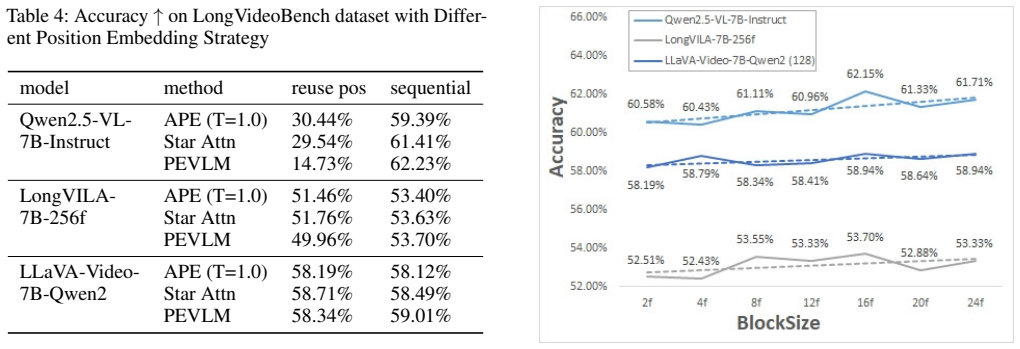
PEVLM's central claim is that parallel encoding can be made to match full attention for VLMs by aligning three things: block boundaries with video frame boundaries, a shared sink block that includes both the system prompt and initial frames, and sequential position embeddings rather than reused positions. The paper argues that prior LLM parallel-encoding methods fail on VLMs because they reuse position IDs, which breaks temporal and spatial position information, especially in models like Qwen2.5-VL with 3D rotary position embeddings, and because their sink blocks omit early visual tokens that act as attention sinks. With these fixes, attention complexity drops from O((T × N)^2) to O(T × N)$, and the experiments show accuracy at or above full attention in several long-context settings.
Load-bearing premise
The method assumes that the system prompt plus the first 16 video frames always contain the tokens that dominate attention for every video and model; if a video's high-attention tokens appear in later frames, PEVLM removes all cross-block attention and cannot recover that information.
Editorial extensions
If this is right
- PEVLM can be applied to already-trained VLMs at inference time with no fine-tuning, so deploying it requires only a change to the attention mask and position-embedding handling.
- At roughly 100k-token video prefill, the attention layer reaches up to 7.47x speedup and the end-to-end LLM speedup is about 2.58x, with larger sink or context blocks trading speed for accuracy.
- Under fixed latency budgets, PEVLM keeps accuracy high where full attention collapses, making long-video question answering feasible on resource-limited hardware.
- Because PEVLM preserves full-attention position embeddings, it inherits the model's trained context-length limit and does not extend context capacity, as the paper notes for LongVILA-256f.
- In some long-context configurations PEVLM exceeds full-attention accuracy, which the paper attributes to shorter softmax horizons producing sharper, more reliable attention distributions.
Reading between the lines
- The fixed choice of 16 frames for the sink block is not content-adaptive; a dynamic sink that grows when early attention is diffuse or shrinks for short videos would likely improve the accuracy-efficiency frontier beyond the tested configurations.
- The same frame-aligned sink with sequential positions should transfer to streaming video: if each new sliding window reuses the sink and only processes new frames, inference cost could scale with newly arrived frames rather than the full history, a direction the paper lists as future work.
- The paper's explanation that shorter softmax horizons can beat full attention suggests PEVLM-style parallelism may combine with retrieval or chunked reasoning to improve long-video QA, not merely accelerate it, but this remains an inference from the paper's preliminary analysis.
Signed reviews
Editorial analysis
A structured set of objections, weighed in public.
Referee Report
Summary. The paper proposes PEVLM, a fine-tuning-free parallel encoding scheme for vision-language models that targets the prefilling stage of long-video inference. The video is partitioned into a shared sink block, frame-aligned context blocks, and a question block, while sequential position embeddings are preserved. The authors report that PEVLM reaches 99.57%–104.80% of Full-Attention accuracy across Qwen2.5-VL, LongVILA, and LLaVA-Video on MVBench, EgoSchema, VideoMME, and LongVideoBench, with up to 7.47x attention speedup and a 40% end-to-end latency reduction over Full-Attention.
Significance. If the efficiency and accuracy claims are made precise, PEVLM is a practically attractive contribution: it is training-free, architecture-agnostic, and addresses a real VLM-specific issue, namely that attention sinks extend into early video frames and that reusing position embeddings disrupts temporal reasoning. The evaluation across three backbones and four benchmarks is broad, and the attention-distribution analysis provides a plausible motivation for the design. However, the central advertised complexity reduction is currently not stated consistently with the method's own hyperparameters, and the empirical accuracy claims are weakened by tuning on the test benchmarks. The core idea is worth publishing after the complexity claim is corrected and the evaluation protocol is clarified.
major comments (3)
- [Formulations, Eq. (4)] Equation (4) is inconsistent with the rest of the paper. As written, Attn_ci = f(Q_ci, K_{s+c0+...+c_{i-1}}, V_{s+c0+...+c_{i-1}}) makes the i-th context block attend to the sink and all earlier context blocks, which yields cumulative KV prefixes and a Θ(L^2) cost when summed over i. This contradicts Equation (8), the mask shown in Figure 2, and the claimed O(L) complexity. The key-value subscript should presumably be the sink plus the current context block only. Since no code is released, this equation is the only precise specification of the mask, so it must be fixed or the measured implementation must be described exactly.
- [Parallel Encoding / Experimental Setup (block size by frames)] The claimed reduction from O((T×N)^2) to O(T×N) is not supported by the stated hyperparameters. Equation (8) gives O(L) only if S and B are fixed token counts independent of L. In the experiments, S and B are set to 16 frames, i.e., S = Θ(N) and B = Θ(N) tokens when N is the tokens-per-frame count. With M = T/16 blocks, the total prefill cost is Θ(T·N^2), not Θ(T·N). The actual saving relative to Full-Attention is a factor Θ(T), not Θ(T·N). If the authors intend N to be a model-specific constant and only T to grow, then the complexity statement should be written in terms of T alone, or in terms of L with the per-frame token count fixed; the current abstract-level statement is misleading.
- [Experiments, Figures 6–7 and Table 2] The sink-block and context-block sizes are selected using the same benchmarks that produce the headline accuracy numbers, and Table 2 further selects the sink configuration for each latency budget. No held-out validation or tuning protocol is reported, so the 99.57%–104.80% accuracy ratios may partly reflect selection on the test set. The authors should report a validation-based tuning procedure or, failing that, show that the accuracy conclusions are stable across a range of sink/block sizes rather than only at the selected configuration.
minor comments (4)
- [Notation, Eq. (6)] The symbol N is used both for tokens per frame in the abstract and for the number of context blocks in Equations (6) and (10). Using M for the block count would remove an avoidable source of confusion, especially given the complexity discussion.
- [Performance Evaluation, Figures 4–5] The runtime measurements are reported without error bars or the number of repeated runs, and absolute attention times are not given. Since some reported accuracy differences are small, the paper should also state whether the benchmark evaluations use a single pass per example and whether multiple runs were averaged.
- [Observations, Figure 1] The attention-weight distributions are described only qualitatively and the moving-average window is not specified. Reporting the window length and the aggregation procedure would make the observations reproducible.
- [General presentation] There are several typos and clarity issues, including 'Quesion Block' in the Partitioning Strategy and Figure 2, 'promots' in the contributions list, and 'resuing' in the observations section. These should be corrected in a revision.
Circularity Check
No significant circularity: reported accuracy and speedups are external measured results; only mild selection of hyperparameters on evaluation benchmarks.
full rationale
PEVLM's central claims are empirical evaluations on external benchmarks (MVBench, EgoSchema, VideoMME, LongVideoBench) and measured latency on H20 hardware, not predictions derived from fitted constants. The design choices (sink includes early frames, sequential position embeddings) are motivated by attention-weight analyses in the paper and by external citations, and the ablations test each component against measured accuracy rather than defining accuracy in terms of the component. Equations (3)-(5) merely describe the attention mask; no equation defines the target accuracy in terms of sink/block-size choices. The closest concern is hyperparameter selection: sink and context block sizes (16 frames) and the 20-second-latency configuration (sys+2f vs sys+16f) are chosen using the same benchmarks, which introduces selection bias but not construction-level circularity. The complexity derivation in Eqs. (8)-(10) is questionable because block sizes are set in frames rather than tokens, so the advertised O(T×N) does not follow rigorously; however, that is a correctness and asymptotic-analysis concern, not a circular reduction of the result to its inputs. No load-bearing self-citation chain or imported uniqueness theorem appears; prior methods such as APE, Star Attention, and Block Attention are cited as external baselines. The paper is otherwise self-contained against external evaluation benchmarks, so the circularity score is low.
Assumptions & free parameters
free parameters (3)
- Sink block size (frames) =
16 frames (roughly 4k tokens) for main experiments; system prompt + 2 frames for the 20s latency setting
- Context block size (frames) =
16 frames (roughly 4k tokens for Qwen2.5-VL and LongVILA; about 3k tokens for LLaVA-Video)
- Baseline context block size (tokens) =
4096 tokens for all methods
assumptions (5)
- standard math Standard softmax attention (Equation 1) is the operation being optimized, and the operation count in Equations 6-10 counts dense matrix multiplications only, ignoring implementation overhead such as FlashAttention and memory transfer.
- domain assumption Attention sinks in VLMs are concentrated in the system prompt and early video frames, so a fixed sink block of the first few frames can capture the high-attention tokens for all inputs.
- domain assumption Preserving sequential position embeddings in parallel encoding yields an attention weight distribution close to Full-Attention, unlike reusing position embeddings.
- domain assumption Reducing the number of tokens in each softmax can maintain or improve accuracy in long contexts because softmax reliability degrades beyond the training horizon.
- domain assumption Video frames are natural segmentation boundaries, and dividing by frames instead of tokens preserves the spatial integrity of boundary frames.
Cite this review
Pith. "Pith review of PEVLM: Parallel Encoding for Vision-Language Models." pith.science (2026). https://pith.science/paper/32RKI6PK
@misc{pith2026250619651,
  author       = {Pith},
  title        = {Pith review of: PEVLM: Parallel Encoding for Vision-Language Models},
  year         = {2026},
  howpublished = {\url{https://pith.science/paper/32RKI6PK}},
  note         = {Machine review of arXiv:2506.19651}
}
abstract
Vision-Language Models (VLMs) have demonstrated strong capabilities in multimodal understanding and generation tasks. However, their application to long video understanding remains hindered by the quadratic complexity of standard attention mechanisms. In this work, we introduce \textbf{PEVLM}, a fine-tuning-free parallel encoding method designed to enhance the prefilling efficiency of VLMs in long video scenarios. PEVLM partitions the input video into context blocks with a shared sink block, while preserving sequential position embeddings to align the attention weight distribution with that of Full-Attention. This design reduces attention complexity from $O((T \times N)^2)$ to $O(T \times N)$ where $T$ is the number of frames and $N$ the number of tokens per frame, without sacrificing accuracy. Extensive experiments across multiple state-of-the-art models and benchmarks demonstrate that PEVLM consistently outperforms existing parallel encoding approaches, achieving up to \textbf{7.47x} speedup in attention computation and reducing end-to-end latency by \textbf{40\%}. Remarkably, PEVLM not only maintains high accuracy, but in some settings even surpasses Full-Attention performance. Under strict latency constraints, it achieves substantial gains, improving accuracy from \textbf{23.26\%} to \textbf{61.03\%}. These results underscore the effectiveness of PEVLM for low-latency, long-context video understanding, making it a promising solution for real-world applications.
Figures


Figures from the paper (4 more)



Reference graph
Works this paper leans on
- [1]
-
[2]
Bai, S.; Chen, K.; Liu, X.; Wang, J.; Ge, W.; Song, S.; Dang, K.; Wang, P.; Wang, S.; Tang, J.; Zhong, H.; Zhu, Y.; Yang, M.; Li, Z.; Wan, J.; Wang, P.; Ding, W.; Fu, Z.; Xu, Y.; Ye, J.; Zhang, X.; Xie, T.; Cheng, Z.; Zhang, H.; Yang, Z.; Xu, H.; and Lin, J. 2025. Qwen2.5-VL Technical Report. arXiv:2502.13923
arXiv 2025
-
[3]
Beltagy, I.; Peters, M. E.; and Cohan, A. 2020. Longformer: The Long-Document Transformer. arXiv preprint
work page 2020
-
[4]
Black, M.; Lee, K.; et al. 2024. Humanoid robots learn from multimodal web data with VLMs. arXiv preprint arXiv:2403.00001
arXiv 2024
-
[5]
Cheang, L.; Huang, X.; et al. 2024. Robot Agents with Long-Horizon Multimodal Memory. arXiv preprint arXiv:2402.01234
arXiv 2024
-
[6]
Chen, Y.; Xue, F.; Li, D.; Hu, Q.; Zhu, L.; Li, X.; Fang, Y.; Tang, H.; Yang, S.; Liu, Z.; He, E.; Yin, H.; Molchanov, P.; Kautz, J.; Fan, L.; Zhu, Y.; Lu, Y.; and Han, S. 2024. LongVILA: Scaling Long-Context Visual Language Models for Long Videos. arXiv:2408.10188
arXiv 2024
-
[7]
Fu, C.; Dai, Y.; Luo, Y.; Li, L.; Ren, S.; Zhang, R.; Wang, Z.; Zhou, C.; Shen, Y.; Zhang, M.; et al. 2024. Video-MME: The First-Ever Comprehensive Evaluation Benchmark of Multi-modal LLMs in Video Analysis. arXiv preprint arXiv:2405.21075
arXiv 2024
-
[8]
Gao, L.; Lin, C.; et al. 2024. Perception and Planning with Long Context VLMs. arXiv preprint arXiv:2403.07698
arXiv 2024
Show all 36 references
-
[9]
Guu, K.; et al. 2020. Retrieval-Augmented Language Model Pretraining. In ICML
2020
-
[10]
Hu, Y.; Wu, Z.; et al. 2023. DriveVLM: Adaptive Vision-Language Modeling for Autonomous Driving. arXiv preprint arXiv:2311.09876
2023 arXiv
-
[11]
Kang, S.; Kim, J.; Kim, J.; and Hwang, S. J. 2025. See What You Are Told: Visual Attention Sink in Large Multimodal Models. arXiv:2503.03321
2025 arXiv
-
[12]
Lab, M.-H.; and AI, M. 2023. StreamingLLM: Enabling Infinite-Length Generation with Attention Sinks. arXiv preprint arXiv:2309.17453
2023 arXiv
-
[13]
Li*, B.; Zhang*, P.; Zhang*, K.; Pu*, F.; Du, X.; Dong, Y.; Liu, H.; Zhang, Y.; Zhang, G.; Li, C.; and Liu, Z. 2024. LMMs-Eval: Accelerating the Development of Large Multimoal Models
2024
-
[14]
Li, K.; Wang, Y.; He, Y.; Li, Y.; Wang, Y.; Liu, Y.; Wang, Z.; Xu, J.; Chen, G.; Luo, P.; Wang, L.; and Qiao, Y. 2024 a . MVBench: A Comprehensive Multi-modal Video Understanding Benchmark. arXiv:2311.17005
2024 arXiv
-
[15]
Li, X.; Yin, X.; Li, C.; Hu, X.; Zhang, P.; Zhang, L.; Wang, L.; Hu, H.; Dong, L.; Wei, F.; et al. 2020. Oscar: Object-semantics aligned pre-training for vision-language tasks. In ECCV
2020
-
[16]
Li, Z.; Zhang, Y.; Pan, T.; Sun, Y.; Duan, Z.; Fang, J.; Han, R.; Wang, Z.; and Wang, J. 2024 b . FocusLLM: Precise Understanding of Long Context by Dynamic Condensing. arXiv:2408.11745
2024 arXiv
-
[17]
F.; Lin, K.; Hewitt, J.; Paranjape, A.; Bevilacqua, M.; Petroni, F.; and Liang, P
Liu, N. F.; Lin, K.; Hewitt, J.; Paranjape, A.; Bevilacqua, M.; Petroni, F.; and Liang, P. 2023. Lost in the Middle: How Language Models Use Long Contexts. Transactions of the Association for Computational Linguistics, 12: 157--173
2023
-
[18]
Liu, X.; Zhang, W.; et al. 2024. BMed-VL: A Vision-Language Model for Multimodal Biomedical Reasoning. arXiv preprint arXiv:2401.04512
2024 arXiv
-
[19]
Liu, Y.; et al. 2024. Star Attention: Sparse Approximation Strategies for Efficient Long-Context Modeling. arXiv preprint
2024
-
[20]
Y.; Yang, Z.; Zhou, X.; Zhang, M.; and Qiu, J
Lu, E.; Jiang, Z.; Liu, J.; Du, Y.; Jiang, T.; Hong, C.; Liu, S.; He, W.; Yuan, E.; Wang, Y.; Huang, Z.; Yuan, H.; Xu, S.; Xu, X.; Lai, G.; Chen, Y.; Zheng, H.; Yan, J.; Su, J.; Wu, Y.; Zhang, N. Y.; Yang, Z.; Zhou, X.; Zhang, M.; and Qiu, J. 2025. MoBA: Mixture of Block Atten...
2025 arXiv
-
[21]
Lu, S.; Wang, H.; Rong, Y.; Chen, Z.; and Tang, Y. 2024. TurboRAG: Accelerating Retrieval-Augmented Generation with Precomputed KV Caches for Chunked Text. arXiv:2410.07590
2024 arXiv
-
[22]
Ma, D.; Wang, Y.; and Tian, L. 2025. Block-Attention for Efficient Prefilling. arXiv:2409.15355
2025 arXiv
-
[23]
Mangalam, K.; Akshulakov, R.; and Malik, J. 2023. EgoSchema: A Diagnostic Benchmark for Very Long-form Video Language Understanding. In Oh, A.; Naumann, T.; Globerson, A.; Saenko, K.; Hardt, M.; and Levine, S., eds., Advances in Neural Information Processing Systems, volume 36...
2023
-
[24]
Prasad, R.; Singh, A.; et al. 2024. Embodied VLMs for instruction following in robotics. In Proceedings of the IEEE/CVF Conference on Computer Vision and Pattern Recognition (CVPR)
2024
-
[25]
Radford, A.; et al. 2021. Learning Transferable Visual Models From Natural Language Supervision. In ICML
2021
-
[26]
Ratner, N.; Levine, Y.; Belinkov, Y.; Ram, O.; Magar, I.; Abend, O.; Karpas, E.; Shashua, A.; Leyton-Brown, K.; and Shoham, Y. 2023. Parallel Context Windows for Large Language Models. arXiv:2212.10947
2023 arXiv
-
[27]
Z.; and Liu, Z
Sun, M.; Chen, X.; Kolter, J. Z.; and Liu, Z. 2024. Massive Activations in Large Language Models. arXiv:2402.17762
2024 arXiv
-
[28]
Vaswani, A.; et al. 2017. Attention is All You Need. In NeurIPS
2017
-
[29]
Veličković, P.; Perivolaropoulos, C.; Barbero, F.; and Pascanu, R. 2025. Softmax is not Enough (for Sharp Size Generalisation). arXiv:2410.01104
2025 arXiv
-
[30]
Wang, M.; Zhao, T.; et al. 2024. Cascaded Multimodal Transformers for Driving Video Analysis. arXiv preprint arXiv:2401.05678
2024 arXiv
-
[31]
Yang, X.; Chen, T.; and Chen, B. 2025. APE : Faster and Longer Context-Augmented Generation via Adaptive Parallel Encoding. In The Thirteenth International Conference on Learning Representations
2025
-
[32]
Yen, H.; Gao, T.; and Chen, D. 2024. Long-Context Language Modeling with Parallel Context Encoding. arXiv:2402.16617
2024 arXiv
-
[33]
X.; Wang, L.; Xiao, Z.; Wang, Y.; Ruan, C.; Zhang, M.; Liang, W.; and Zeng, W
Yuan, J.; Gao, H.; Dai, D.; Luo, J.; Zhao, L.; Zhang, Z.; Xie, Z.; Wei, Y. X.; Wang, L.; Xiao, Z.; Wang, Y.; Ruan, C.; Zhang, M.; Liang, W.; and Zeng, W. 2025. Native Sparse Attention: Hardware-Aligned and Natively Trainable Sparse Attention. arXiv:2502.11089
2025 arXiv
-
[34]
Zhang, T.; and Wang, K. 2024. LongVideoBench: Evaluating long video understanding for VLMs. In Conference on Neural Information Processing Systems (NeurIPS)
2024
-
[35]
Zhang, Y.; Wu, J.; Li, W.; Li, B.; Ma, Z.; Liu, Z.; and Li, C. 2024. Video Instruction Tuning With Synthetic Data. arXiv:2410.02713
2024 arXiv
-
[36]
Zhu, D.; Ding, X.; Wang, J.; Yang, L.; and Hu, X. 2023. MiniGPT-4: Enhancing Vision-Language Understanding with GPT-4 Level Capabilities. arXiv preprint arXiv:2304.10592
2023 arXiv
Reviewed August 15, 2026 · model on record in the stance chip above.
Discussion (0). Continue with ORCID to comment.