REVIEW 4 major objections 4 minor 37 references
Extreme Learning Machines for Exoplanet Simulations: A Faster, Lightweight Alternative to Deep Learning
T0 review · 4 major / 4 minor · reviewed 2026-08-15 · deepseek-v4-flash
Pith's one-line read A single extreme learning machine trained on 10,000 samples—0.28% of the benchmark's data—beats a bi-directional recurrent neural network at emulating Venus radiative transfer while training roughly 100,000 times faster.
desk verdict A useful empirical benchmark of ELMs on two exoplanet emulation tasks, but the headline sample-efficiency claim is undercut by an internal inconsistency: the text reports a 5,000-sample result that the figures and tables don't contain. read the letter →
The pith
A machine-rendered reading of the paper's core claim, the machinery that carries it, and where it could break.
The reading
What carries the argument
The paper's central object is the extreme learning machine: a single hidden-layer feedforward network in which the input-to-hidden weights $W$ and biases $b$ are sampled from a fixed distribution and never updated, the hidden activation matrix is $H = g(XW^\top + b)$, and the only fitted parameters are the output weights $\beta = (H^\top H + \alpha I)^{-1} H^\top \hat{Y}$, a Tikhonov-regularised least-squares solve with $\alpha = 10^{-9}$. This closed-form solve is the whole engine of the speed gain: because the loss is a convex least-squares problem in $\beta$, training is one matrix inversion-like step instead of thousands of gradient-descent iterations, which is why an ELM fits in 0.45 s on one CPU core while a recurrent network needs days. The second mechanism is ensembling: for the image task, diversity is created solely by drawing the frozen weights with different random seeds, and averaging 50 such predictors recovers the accuracy a single ELM lacks. A matched 15-predictor comparison shows both CNN and ELM ensembles improve with size, with ELM ensembles improving faster early on but never matching the CNN predictor-for-predictor.
What would settle it
Retrain the same BIRNN architecture on the full 3,584,000-sample OASIS set with a GPU-optimal batch size (the paper flags its own 512-sample choice as likely suboptimal) and validation-based early stopping, and compare its test MSE with the 10,000-sample ELM's $(2.00 \pm 0.01) \times 10^{-5}$; if the re-tuned network matches or beats that error, the accuracy and sample-efficiency claims collapse even though the training-time advantage stands, and an analogous retraining of the CNN with batch size 32–64 would test whether the ensemble's 20% edge is likewise a benchmark-tuning artefact.
Extended reading notes
Core claim
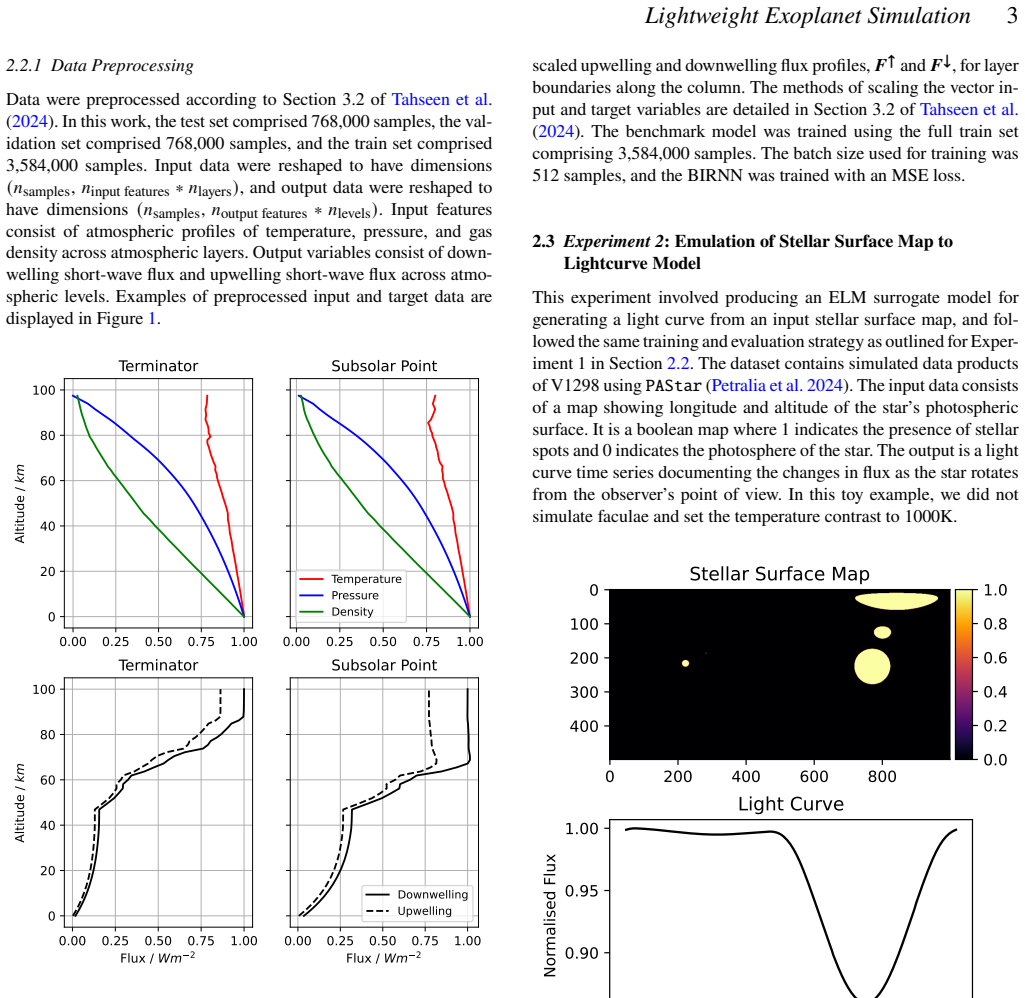
The central discovery is that a network that never backpropagates can match or beat purpose-built deep-learning surrogates in exoplanet simulation tasks, provided the data regime suits it. For the radiative-transfer task, the grid-optimised ELM (1,000 hidden neurons, Gaussian activation, normally distributed frozen weights) trained on 10,000 samples reaches a test MSE of $(2.00 \pm 0.01) \times 10^{-5}$, versus $1.28 \times 10^{-4}$ for the BIRNN trained on 3,584,000 samples, in 0.45 seconds of single-CPU training time against 146,716 seconds, with prediction time dropping from 41.78 s to 1.14 s on the 768,000-sample validation set. For the image task, the best single ELM is an order of magnitude worse than the CNN, but averaging 50 ELMs that differ only in the random seed of their frozen weights yields a test MSE of $3.4 \times 10^{-7}$, about 20% below the CNN's $4.2 \times 10^{-7}$, while cutting training time from 151,414 s to 9,216 s and raising prediction time from 393 s to 2,694 s. The authors explain the contrast through dimensionality and data structure: when the sample count far exceeds the input dimension and the geometry is sequential, random projections capture the relevant structure, so the closed-form least-squares fit is enough; when the input is a high-dimensional image whose spatial layout is destroyed by flattening, many random projections must be averaged to approach convolutional performance.
Load-bearing premise
The load-bearing premise is that the benchmark deep networks are competently tuned representatives of their model classes: the BIRNN was taken from the authors' earlier work without re-tuning, the CNN's grid search is conceded to possibly miss the optimum, and batch sizes and CPU/GPU conditions differed across models, so if the benchmarks are under-tuned, the headline speed and accuracy gaps are overstated.
Editorial extensions
If this is right
- For low-dimensional sequential emulation tasks like atmospheric radiative transfer, ELM surrogates can cut the required simulation data by more than 99% and training time by five orders of magnitude, bringing surrogate training onto a single CPU core for research groups without GPU clusters.
- For image-based emulation, an ensemble of 50 ELMs offers a 16.4-fold reduction in training time with roughly 20% lower test error than the CNN, but with 6.9-fold slower predictions; the trade favours ELMs when the training budget dominates and predictions can be parallelised across CPU cores.
- ELM viability tracks the ratio of sample count to input dimensionality and whether the data's geometry survives a random projection: flattening image data disrupts spatial dependencies, which is why single ELMs fail on images and succeed on sequential profiles.
- Because ELM accuracy varies little with the random seed (0.59% coefficient of variation in Experiment 1, 2.68% in Experiment 2), a handful of initialisations, or a small ensemble, is a cheap route to stable predictions.
- The minimal training cost enables integrating surrogate training directly into simulation runtime and makes retraining cheap when model or data drift occurs, as the paper's conclusions note.
Reading between the lines
- A deployment the authors do not spell out is a continuously retrained radiation scheme inside the OASIS model itself: with sub-second training and inference on one CPU core, the ELM could be refit every simulation epoch, turning model drift from a hazard into a non-issue.
- Because the paper fixes the ELM training set at 10,000 samples yet shows validation MSE still falling through 70,000, mapping where the error curve actually flattens would pin down the true minimum simulation budget for this task—a concrete stopping rule the paper leaves implicit.
- The paper's own suggestion that the CNN would pull ahead on more realistic images is directly testable: rerun Experiment 2 with PAStar maps that include faculae and a range of temperature contrasts, and check whether the 50-ELM ensemble's 20% edge survives.
- The matched 15-predictor comparison implies that a small ELM ensemble would also improve the already-winning Experiment 1 result, since the paper shows ELM ensembles gain fastest with the first few members; the authors did not run that test because the single ELM had already won.
Signed reviews
Editorial analysis
A structured set of objections, weighed in public.
Referee Report
Summary. The paper evaluates Extreme Learning Machines (ELMs) as low-cost surrogate models for two exoplanet-simulation tasks: (i) emulating two-stream radiative transfer in a Venus GCM (sequential, low-dimensional inputs, large training set) and (ii) mapping stellar surface maps to light curves (image inputs, high-dimensional, small training set). The authors benchmark ELMs against a BIRNN from prior work, a custom CNN, and a three-layer DNN. They report that a single ELM trained on 10,000 samples (0.28% of the BIRNN training set) achieves lower test MSE and much lower training/prediction times than the BIRNN, and that an ensemble of 50 ELMs matches or slightly beats the CNN on the image task with 16.4x less training time but 6.9x more prediction time. The paper includes grid searches over activation functions, hidden sizes, weight initializations, and training-set sizes, and it discusses limitations in Section 5.9.
Significance. If the reported gains hold, the paper would provide a useful practical result: a simple, gradient-free surrogate model that can be trained on a CPU in seconds while matching or beating deep-learning benchmarks on certain exoplanet simulation tasks, with substantial sample-efficiency benefits in the low-dimensional sequential setting. Strengths include the systematic hyperparameter grid, evaluation across multiple metrics (MSE, MAE, MAPE), explicit attention to sample efficiency, and an unusually candid Limitations section. However, the headline numbers are undermined by internal inconsistencies and by comparison protocols that mix CPU and GPU, different batch sizes, and single-run benchmarks. The paper's central empirical claims are defensible in principle but need correction and stronger statistical grounding before publication.
major comments (4)
- [Section 5.5 vs. Figure 3 and Table 3] The sample-efficiency claim is internally inconsistent. Section 5.5 states that "an ELM trained with 5,000 samples (0.14% of the data used by the BIRNN) achieved approximately a six-fold reduction in validation MSE," citing Figure 3. However, Figure 3's x-axis begins at 10,000 samples, no 5,000-sample point is plotted, and Table 3 reports the Experiment 1 ELM as using 10,000 samples (0.28%). The abstract and conclusion likewise rest on 0.28%. Either the 5,000-sample result is real and the most sample-efficient configuration is omitted from the figures and tables, or the text overstates sample efficiency by a factor of two. A similar issue appears in Experiment 2: Section 5.5 says an ensemble trained on 5,000 examples (78% of the full training set) marginally outperformed the CNN, but Figure 5 shows points at 3,000, 4,000, and 6,000 samples with no 5,000-point visible. These discrepancies must be resolved because the sample-efficiency claim is a central contribution of the paper.
- [Abstract vs. Section 5.6 and Table 4] The abstract's training-time and prediction-time ratios do not match the paper's own reported comparison. The abstract claims a "100,000× faster training time" and "40× faster prediction speed" for Experiment 1. Section 5.6 reports a ">300,000× reduction in training time" for CPU-to-CPU comparison, and the ratio from Table 4 (146,716.66 s / 0.45 s) is ≈326,000. The abstract's 100,000× figure matches instead the GPU-trained BIRNN time from Table D1 (46,154.8 s) divided by the CPU ELM time (0.45 s), i.e., a GPU-vs-CPU comparison. For prediction, Table 4 gives 41.78 s / 1.14 s ≈ 36.6× and Section 5.7 states "36× reduction," not 40×. These inconsistencies in the headline efficiency numbers need to be corrected, and the hardware basis of every timing comparison should be stated explicitly wherever speedups are quoted.
- [Tables 4 and 5; Section 5.9] The benchmark comparison does not currently support the strength of the accuracy and speed claims. The BIRNN and CNN results in Tables 4 and 5 are single runs with no standard deviation or seed variation, whereas the ELM results are reported with standard deviations over random initializations. Without a distribution of BIRNN/CNN results, the claimed MSE improvements (2.00e-5 vs. 1.28e-4; 3.4e-7 vs. 4.2e-7) cannot be assessed for statistical significance. Training-time comparisons are also confounded by different batch sizes (BIRNN 512, DNN 1024, CNN 64, DNN 8) and by the use of CPU for ELMs versus GPU for some benchmarks in the abstract's 100,000× figure. Section 5.9 acknowledges these issues, but the abstract and conclusions present the speedups as unconditional. The paper should either provide matched-condition benchmark runs with uncertainty or substantially soften the comparative claims.
- [Section 5.7 vs. Table 4] The measurement basis for prediction time is described inconsistently. Table 4's caption states that prediction time was measured on the validation set of 768,000 samples, while Section 5.7 says the BIRNN and ELM prediction times were "both measured on one CPU core for 50,000 samples." This discrepancy affects the interpretability of the reported prediction-time ratios and must be reconciled.
minor comments (4)
- [Appendix F] The caption of Figures F1 and F3 contains a typo: "acorss" should be "across."
- [Data Availability] The Data Availability statement says the data were "generated by the methods outlined in Section 2" but does not provide access to the data or the code. For an empirical machine-learning paper, releasing the data-generation scripts and training/evaluation code would greatly aid reproducibility; at minimum, a link to a public repository should be added if the authors can share it.
- [Section 5.3] The ratios σ/μ = 0.59% (Experiment 1) and 2.68% (Experiment 2) are quoted without confidence intervals; given that these are based on 100 or 1000 random seeds, a brief statement about the number of seeds and the stability of the estimate would be helpful.
- [Table 1] The CNN architecture table would benefit from stating the kernel size and stride for the convolutional layers explicitly, since Appendix A2 mentions kernel size 3 but the table does not list it.
Circularity Check
No circularity: ELM results are empirical out-of-sample comparisons against pre-existing benchmarks.
full rationale
The paper's central claims are empirical: ELM models are fitted on training subsets via the closed-form ridge solution (Eq. 5), and performance is measured by MSE, MAE and MAPE on held-out validation and test sets (Eqs. 6-8). Hyperparameter selection on a validation grid is standard model selection, not a fitted-input-called-prediction loop, because the reported test errors are computed on data not used for fitting or selection. The BIRNN benchmark is taken from the authors' prior work Tahseen et al. (2024), but that prior model is used only as an external comparison target; its outputs do not enter the ELM training or validation, and no uniqueness or ansatz argument is imported from the citation. The abstract's 0.28% sample-efficiency claim is an empirical observation about the number of training examples used in Table 3/Table 4, not a consequence of the ELM equations. Section 5.5's assertion that an ELM trained with 5,000 samples achieved approximately a six-fold reduction in validation MSE is not supported by Figure 3, whose x-axis starts at 10,000, nor by Tables 3 or 4; this is an internal consistency and reproducibility concern, not a circularity, because the claim does not reduce to the method's inputs by construction. Therefore no circular step is identifiable.
Assumptions & free parameters
free parameters (7)
- ELM architecture choices (Experiment 1) =
hidden=1000, Gaussian activation, normal init
- ELM architecture choices (Experiment 2) =
hidden=2500, Softplus activation, uniform init
- ELM training subset size (Experiment 1) =
10,000 samples (0.28% of full training set)
- Ensemble size (Experiment 2) =
50 predictors
- Tikhonov regularization alpha =
1e-9
- BIRNN benchmark configuration (Experiment 1) =
Architecture from Tahseen et al. 2024, batch size 512
- CNN benchmark architecture (Experiment 2) =
Filters 4,4,8,8; kernel 3; no padding; 49.4M params; batch size 64
assumptions (4)
- standard math The Moore-Penrose pseudoinverse and Tikhonov regularized least squares in Equation 5 produce the output weights for the ELM.
- domain assumption The 10,000-sample random subset used for ELM training in Experiment 1 is representative of the full OASIS simulation output distribution.
- domain assumption The OASIS two-stream radiative transfer outputs and PAStar stellar surface maps are valid surrogate training targets.
- domain assumption The BIRNN and CNN benchmarks are sufficiently optimized to fairly represent gradient-based deep learning on these tasks.
Cite this review
Pith. "Pith review of Extreme Learning Machines for Exoplanet Simulations: A Faster, Lightweight Alternative to Deep Learning." pith.science (2026). https://pith.science/paper/53XIYCJH
@misc{pith2026250619679,
  author       = {Pith},
  title        = {Pith review of: Extreme Learning Machines for Exoplanet Simulations: A Faster, Lightweight Alternative to Deep Learning},
  year         = {2026},
  howpublished = {\url{https://pith.science/paper/53XIYCJH}},
  note         = {Machine review of arXiv:2506.19679}
}
abstract
Increasing resolution and coverage of astrophysical and climate data necessitates increasingly sophisticated models, often pushing the limits of computational feasibility. While emulation methods can reduce calculation costs, the neural architectures typically used--optimised via gradient descent--are themselves computationally expensive to train, particularly in terms of data generation requirements. This paper investigates the utility of the Extreme Learning Machine (ELM) as a lightweight, non-gradient-based machine learning algorithm for accelerating complex physical models. We evaluate ELM surrogate models in two test cases with different data structures: (i) sequentially-structured data, and (ii) image-structured data. For test case (i), where the number of samples $N$ >> the dimensionality of input data $d$, ELMs achieve remarkable efficiency, offering a 100,000$\times$ faster training time and a 40$\times$ faster prediction speed compared to a Bi-Directional Recurrent Neural Network (BIRNN), whilst improving upon BIRNN test performance. For test case (ii), characterised by $d >> N$ and image-based inputs, a single ELM was insufficient, but an ensemble of 50 individual ELM predictors achieves comparable accuracy to a benchmark Convolutional Neural Network (CNN), with a 16.4$\times$ reduction in training time, though costing a 6.9$\times$ increase in prediction time. We find different sample efficiency characteristics between the test cases: in test case (i) individual ELMs demonstrate superior sample efficiency, requiring only 0.28% of the training dataset compared to the benchmark BIRNN, while in test case (ii) the ensemble approach requires 78% of the data used by the CNN to achieve comparable results--representing a trade-off between sample efficiency and model complexity.
Figures


Figures from the paper (5 more)


Reference graph
Works this paper leans on
-
[1]
Akusok, A., Björk, K.-M., Miche, Y., & Lendasse, A., 2015. High- Performance Extreme Learning Machines : A Complete Toolbox for Big Data Applications , IEEE Access\/ , 3 , 1011--1025
work page 2015
-
[2]
Candes, E. J. & Tao, T., 2006. Near- Optimal Signal Recovery From Random Projections : Universal Encoding Strategies ?, IEEE Transactions on Information Theory\/ , 52 (12), 5406--5425
work page 2006
-
[3]
Cobb, A. D., Himes, M. D., Soboczenski, F., Zorzan, S., O’Beirne, M. D., Güneş Baydin, A., Gal, Y., Domagal-Goldman, S. D., Arney, G. N., Angerhausen, D., & II, . N. F. A. T., 2019. An Ensemble of Bayesian Neural Networks for Exoplanetary Atmospheric Retrieval , The Astronomical Journal\/ , 158 (1), 33
work page 2019
-
[4]
Conceicao, M., Krone-Martins, A., Silva, A. d., & Moline, A., 2024. Fast emulation of cosmological density fields based on dimensionality reduction and supervised machine learning, Astronomy & Astrophysics\/ , 681 , A123
work page 2024
-
[5]
Deng, W., Zheng, Q., & Chen, L., 2009. Regularized Extreme Learning Machine , 2009 IEEE Symposium on Computational Intelligence and Data Mining\/ , pp. 389--395
work page 2009
-
[6]
Guillot, T., 2010. On the radiative equilibrium of irradiated planetary atmospheres, Astronomy & Astrophysics\/ , 520 , A27
work page 2010
-
[7]
Hicks, W. M., Norman, M. L., Wells, A. I., & Bordner, J. O., 2024. Galaxies and Their Environment at \ z rsim 10\ -- I : Primordial Chemical Enrichment , Accretion , Cooling , and Virialization of Gas in Dark Matter Halos , ADS Bibcode: 2024arXiv240720429H
work page 2024
-
[8]
Himes, M. D., Harrington, J., Cobb, A. D., Baydin, A. G., Soboczenski, F., O’Beirne, M. D., Zorzan, S., Wright, D. C., Scheffer, Z., Domagal-Goldman, S. D., & Arney, G. N., 2022. Accurate Machine -learning Atmospheric Retrieval via a Neural -network Surrogate Model for Radiative Transfer , The Planetary Science Journal\/ , 3 (4), 91
work page 2022
Show all 37 references
-
[9]
D., Harrington, J., & Baydin, A
Himes, M. D., Harrington, J., & Baydin, A. G., 2023. Towards 3D Retrieval of Exoplanet Atmospheres : Assessing Thermochemical Equilibrium Estimation Methods , arXiv:2304.00073 [astro-ph]
2023 arXiv
-
[10]
S., Hirai, Y., Saitoh, T
Hirashima, K., Moriwaki, K., Fujii, M. S., Hirai, Y., Saitoh, T. R., Makino, J., & Ho, S., 2023. Surrogate Modeling for Computationally Expensive Simulations of Supernovae in High - Resolution Galaxy Simulations , arXiv:2311.08460 [astro-ph]
2023 arXiv
-
[11]
Trends in extreme learning machines: A review, Neural Networks\/ , 61 , 32--48
Huang, G., Huang, G.-B., Song, S., & You, K., 2015. Trends in extreme learning machines: A review, Neural Networks\/ , 61 , 32--48
2015
-
[12]
Extreme learning machine: A new learning scheme of feedforward neural networks, vol
Huang, G.-B., Zhu, Q.-Y., & Siew, C., 2004. Extreme learning machine: A new learning scheme of feedforward neural networks, vol. 2, pp. 985--990 vol.2
2004
-
[13]
Extreme learning machine: Theory and applications, Neurocomputing\/ , 70 (1), 489--501
Huang, G.-B., Zhu, Q.-Y., & Siew, C.-K., 2006. Extreme learning machine: Theory and applications, Neurocomputing\/ , 70 (1), 489--501
2006
-
[14]
T., Harrison, I., Calabrese, E., Mancini, A
Jense, H. T., Harrison, I., Calabrese, E., Mancini, A. S., Bolliet, B., Dunkley, J., & Hill, J. C., 2024. A complete framework for cosmological emulation and inference with CosmoPower , arXiv:2405.07903 [astro-ph]
2024 arXiv
-
[15]
E., 2012
Krizhevsky, A., Sutskever, I., & Hinton, G. E., 2012. ImageNet Classification with Deep Convolutional Neural Networks , in Advances in Neural Information Processing Systems \/ , vol. 25, Curran Associates, Inc
2012
-
[16]
C., & Huang, G.-B., 2009
Lan, Y., Soh, Y. C., & Huang, G.-B., 2009. Ensemble of online sequential extreme learning machine, Neurocomputing\/ , 72 (13), 3391--3395
2009
-
[17]
& Wang, H., 2010
Liu, N. & Wang, H., 2010. Ensemble Based Extreme Learning Machine , IEEE Signal Processing Letters\/ , 17 (8), 754--757
2010
-
[18]
& Kosturek, M., 2021
Markowska-Kaczmar, U. & Kosturek, M., 2021. Extreme learning machine versus classical feedforward network, Neural Computing and Applications\/ , 33 (22), 15121--15144
2021
-
[19]
T., Matcheva, K., & Roman, A., 2022
Matchev, K. T., Matcheva, K., & Roman, A., 2022. Analytical Modeling of Exoplanet Transit Spectroscopy with Dimensional Analysis and Symbolic Regression , The Astrophysical Journal\/ , 930 (1), 33
2022
-
[20]
D., Tissera, M
McDonnell, M. D., Tissera, M. D., Vladusich, T., van Schaik, A., & Tapson, J., 2015. Fast, simple and accurate handwritten digit classification by training shallow neural network classifiers with the 'extreme learning machine' algorithm, PLOS ONE\/ , 10 (8), e0134254, arXiv:14...
2015 arXiv
-
[21]
A new fast and flexible radiative transfer method for Venus general circulation models, Planetary and Space Science\/ , 105
Mendonca, J., Read, P., Wilson, C., & Lee, C., 2014. A new fast and flexible radiative transfer method for Venus general circulation models, Planetary and Space Science\/ , 105
2014
-
[22]
M., Read, P
Mendonca, J. M., Read, P. L., Wilson, C. F., & Lee, C., 2015. A new, fast and flexible radiative transfer method for Venus general circulation models, Planetary and Space Science\/ , 105 , 80--93
2015
-
[23]
Mendonça, J. M. & Buchhave, L. A., 2020. Modelling the 3D Climate of Venus with OASIS , arXiv:2002.09506
2020 arXiv
-
[24]
Supervised machine learning for analysing spectra of exoplanetary atmospheres, Nature Astronomy\/ , 2 , 719--724, ADS Bibcode: 2018NatAs...2..719M
Márquez-Neila, P., Fisher, C., Sznitman, R., & Heng, K., 2018. Supervised machine learning for analysing spectra of exoplanetary atmospheres, Nature Astronomy\/ , 2 , 719--724, ADS Bibcode: 2018NatAs...2..719M
2018
-
[25]
A Fast and Accurate Online Sequential Learning Algorithm for Feedforward Networks , IEEE Transactions on Neural Networks\/ , 17 (6), 1411--1423
Nan-Ying Liang , Guang-Bin Huang , Saratchandran, P., & Sundararajan, N., 2006. A Fast and Accurate Online Sequential Learning Algorithm for Feedforward Networks , IEEE Transactions on Neural Networks\/ , 17 (6), 1411--1423
2006
-
[26]
J., 1994
Pao, Y.-H., Park, G.-H., & Sobajic, D. J., 1994. Learning and generalization characteristics of the random vector functional-link net, Neurocomputing\/ , 6 (2), 163--180
1994
-
[27]
PAStar : a model for stellar surface from the Sun to active stars, arXiv:2412.10035 [astro-ph] version: 1
Petralia, A., Maldonado, J., & Micela, G., 2024. PAStar : a model for stellar surface from the Sun to active stars, arXiv:2412.10035 [astro-ph] version: 1
2024 arXiv
-
[28]
Strong biases in retrieved atmospheric composition caused by day-night chemical heterogeneities, Astronomy and Astrophysics\/ , 636 , A66, ADS Bibcode: 2020A&A...636A..66P
Pluriel, W., Zingales, T., Leconte, J., & Parmentier, V., 2020. Strong biases in retrieved atmospheric composition caused by day-night chemical heterogeneities, Astronomy and Astrophysics\/ , 636 , A66, ADS Bibcode: 2020A&A...636A..66P
2020
-
[29]
Rink, K., Bachhar, R., Islam, T., Rifat, N. E. M., Gonzalez-Quesada, K., Field, S. E., Khanna, G., Hughes, S. A., & Varma, V., 2024. Gravitational wave surrogate model for spinning, intermediate mass ratio binaries based on perturbation theory and numerical relativity, arXiv:2...
2024 arXiv
-
[30]
& Rosasco, L., 2017
Rudi, A. & Rosasco, L., 2017. Generalization Properties of Learning with Random Features , in Advances in Neural Information Processing Systems \/ , vol. 30, Curran Associates, Inc
2017
-
[31]
Feedforward neural networks with random weights, in Proceedings., 11th IAPR International Conference on Pattern Recognition
Schmidt, W., Kraaijveld, M., & Duin, R., 1992. Feedforward neural networks with random weights, in Proceedings., 11th IAPR International Conference on Pattern Recognition . Vol . II . Conference B : Pattern Recognition Methodology and Systems \/ , pp. 1--4
1992
-
[32]
An OS - ELM based distributed ensemble classification framework in P2P networks, Neurocomputing\/ , 74 (16), 2438--2443
Sun, Y., Yuan, Y., & Wang, G., 2011. An OS - ELM based distributed ensemble classification framework in P2P networks, Neurocomputing\/ , 74 (16), 2438--2443
2011
-
[33]
Tahseen, T. P. A., Mendonça, J. M., Yip, K. H., & Waldmann, I. P., 2024. Enhancing 3D planetary atmosphere simulations with a surrogate radiative transfer model, Monthly Notices of the Royal Astronomical Society\/ , p. stae2461
2024
-
[34]
Exploring Pathways to More Accurate Machine Learning Emulation of Atmospheric Radiative Transfer , Journal of Advances in Modeling Earth Systems\/ , 14 (4), e2021MS002875
Ukkonen, P., 2022. Exploring Pathways to More Accurate Machine Learning Emulation of Atmospheric Radiative Transfer , Journal of Advances in Modeling Earth Systems\/ , 14 (4), e2021MS002875
2022
-
[35]
B., Forestano, R
Unlu, E. B., Forestano, R. T., Matchev, K. T., & Matcheva, K., 2023. Reproducing Bayesian Posterior Distributions for Exoplanet Atmospheric Parameter Retrievals with a Machine Learning Surrogate Model , arXiv:2310.10521 [astro-ph, physics:physics] version: 1
2023 arXiv
-
[36]
, " * write output.state after.block = add.period write newline
ENTRY address author booktitle chapter edition editor howpublished institution journal key month note number organization pages publisher school series title type volume year label extra.label sort.label short.list INTEGERS output.state before.all mid.sentence after.sentence a...
-
[37]
write newline
" write newline "" before.all 'output.state := FUNCTION n.dashify 't := "" t empty not t #1 #1 substring "-" = t #1 #2 substring "--" = not "--" * t #2 global.max substring 't := t #1 #1 substring "-" = "-" * t #2 global.max substring 't := while if t #1 #1 substring * t #2 gl...
Reviewed August 15, 2026 · model on record in the stance chip above.
Discussion (0). Continue with ORCID to comment.