REVIEW 5 major objections 6 minor 1 cited by
HiWave: Training-Free High-Resolution Image Generation via Wavelet-Based Diffusion Sampling
T0 review · 5 major / 6 minor · reviewed 2026-08-06 · deepseek-v4-flash
Pith's one-line read HiWave claims that wavelet-domain frequency splitting lets a 1024x1024-trained diffusion model generate coherent, detailed 4096x4096 images without retraining or architecture changes.
desk verdict A solid, well-ablated method paper: the wavelet-domain CFG variant is genuinely new and the user study is convincing, but the quantitative metrics don't back the superiority claim and the code isn't out yet. read the letter →
The pith
A machine-rendered reading of the paper's core claim, the machinery that carries it, and where it could break.
The reading
What carries the argument
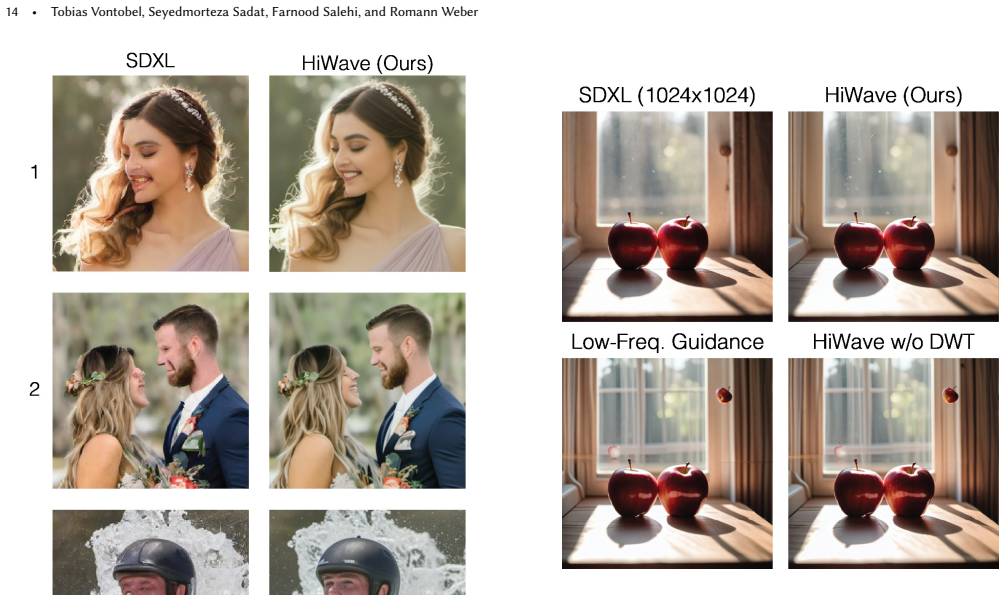
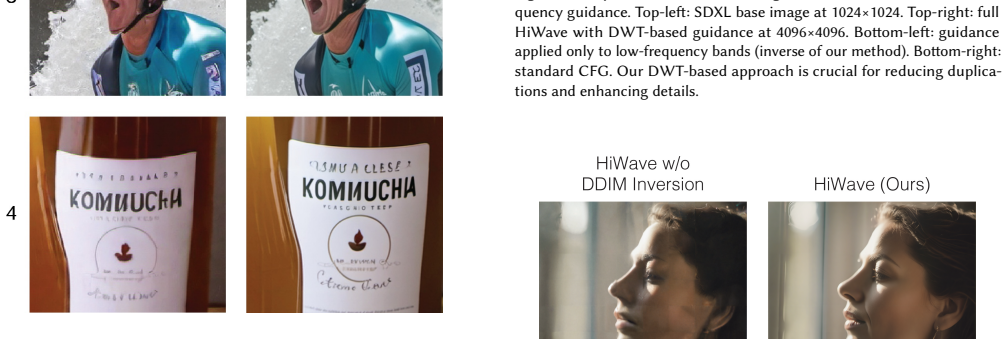
The central mechanism is a discrete wavelet transform (DWT) decomposition of the conditional and unconditional denoiser predictions, reassembled by a modified classifier-free guidance rule. The low-frequency subband is taken directly from the conditional prediction to preserve structure, while the horizontal, vertical, and diagonal high-frequency subbands are guided with strength $w_d = 7.5$; the inverse DWT reconstructs the final guided denoiser output. The method uses the sym4 wavelet. This frequency-split guidance is what stops patch-wise generation from duplicating objects, and the paper's ablations show that standard CFG or low-frequency-only guidance both reintroduce duplication.
What would settle it
Generate a 4096x4096 image with a different latent VAE or a newer diffusion checkpoint using the same HiWave pipeline; if the decoded output shows structural corruption, seams, or new artifacts in regions where the low-frequency band was swapped, the frequency-separation assumption fails. A more direct test is comparing the DWT of the final decoded HiWave image against the DWT of the base image's decoded latent: if the base structure is not preserved in the low band, or if high-frequency guidance injects unrealistic energy, the central mechanism is not doing the claimed work.
Extended reading notes
Core claim
The central claim is that latent-space frequency separation is enough to solve the resolution generalization problem: the low-frequency wavelet band of the denoiser's conditional prediction carries the base image's global layout, so pinning it prevents duplication and incoherence, while the high-frequency bands carry texture and can be safely amplified with a guidance strength of $w_d = 7.5$. Combined with patch-wise DDIM inversion to give each patch a coherent noise initialization and early skip residuals, this lets a 1024-trained SDXL produce artifact-free 4096x4096 images. The paper reports a user preference of 81.2% over Pixelsmith and shows the same recipe scaling to 8192x8192.
Load-bearing premise
The method assumes that in the VAE latent space, low-frequency wavelet coefficients of the denoiser output correspond to the final image's global structure and high-frequency coefficients to safe detail, so swapping the low band and guiding the high bands improves the decoded image rather than corrupting it.
Editorial extensions
If this is right
- SDXL-class models can serve 4K and 8K pipelines without custom high-resolution training, cutting the compute cost for studio-scale output.
- Progressive multistep upscaling (1024 to 2048 to 4096) becomes the recommended operating mode, since the paper's one-shot 4096 variant is visibly less detailed.
- Because DDIM inversion anchors sampling to an input image, the pipeline can upscale natural photographs zero-shot, not just AI-generated base images.
- The frequency-aware guidance recipe can be layered onto any latent diffusion checkpoint without architectural changes, as long as the latent VAE behaves consistently under the wavelet split.
Reading between the lines
- The method's success hinges on VAE decoders behaving approximately linearly across wavelet bands in latent space; if a future VAE mixes frequency content nonlinearly, the hard low-frequency swap may need to be softened or learned.
- Because the reported FID, CLIP, and HPS-v2 scores fail to detect the duplication artifacts HiWave removes, this work is an argument that 4K evaluation should measure full-resolution structural duplication rather than downsampled feature distances.
- A testable extension is applying the same wavelet guidance to video diffusion or transformer-based image models, where patch duplication would show up as temporal flicker or repeated objects across frames.
Editorial analysis
A structured set of objections, weighed in public.
Referee Report
Summary. The paper proposes HiWave, a training-free, zero-shot pipeline for generating ultra-high-resolution images (up to 4096x4096 and 8192x8192) from pretrained diffusion models without retraining or architectural changes. The method first generates a base image at the model's native resolution, upscales it in image space, and then applies a patch-wise DDIM inversion to obtain initial noise latents. During sampling, a wavelet-based detail enhancer (Section 4.3, Eqs. 6-10) replaces the low-frequency subband of the CFG output with the conditional prediction's low-frequency subband while extrapolating high-frequency subbands with a modified guidance strength. Skip residuals (Eq. 11) are mixed in during early denoising to preserve global structure. The method is evaluated on Stable Diffusion XL against Pixelsmith and HiDiffusion, with qualitative comparisons, a user study (81.2% preference over Pixelsmith across 548 ratings), ablations, and additional experiments including real-image upscaling and 8K generation.
Significance. If the results hold, HiWave is a practically useful contribution: it is simple, training-free, and claims to reduce duplication artifacts that plague patch-based high-resolution methods while preserving global structure. The human study is substantial (548 ratings, 81.2% preference) and the ablation suite (Figs. 11-13) demonstrates that each component contributes on SDXL. However, the paper's central claim of 'superior perceptual quality' rests largely on the user study because the quantitative metrics in Table 1 often favor Pixelsmith (e.g., FID 62.55 vs 64.73 at 4096). The method's core assumption that latent-space wavelet subbands correspond to decoded-image structure (Section 4.3) is not directly verified and is only tested on SDXL. These issues, together with an inconsistency in the skip-residual timing description, require attention before the claims can be fully accepted.
major comments (5)
- [Appendix A, Table 1] The quantitative results do not support the claim of 'comparable or superior performance' stated in the appendix. At 4096x4096, Pixelsmith achieves better FID (62.55 vs 64.73), lower KID (0.002373 vs 0.003241), higher IS (19.43 vs 18.77), and higher HPS-v2 (0.2598 vs 0.2585); at 2048x2048, Pixelsmith also wins on FID, KID, LPIPS, and HPS-v2. HiWave is better only on CLIP (slightly) and LPIPS at 4096. Since the paper argues these metrics are unreliable at high resolution, please either present Table 1 as purely informational without claiming superiority, or add a more careful analysis of which differences are meaningful and why the human study should override them.
- [Section 4.3, Eqs. (6)-(10)] The central design assumes that applying a discrete wavelet transform to the latent-space denoiser outputs separates perceptual structure from texture in the final decoded image. This assumption is not established. The VAE decoder is nonlinear and mixes frequencies, so the hard swap of D_L_c(z_t) in Eq. (6) may not preserve global structure, and the high-frequency guidance in Eqs. (7)-(9) could amplify artifacts. The ablations in Fig. 11 show the components matter on SDXL but do not verify the assumed frequency-structure correspondence. Please provide a direct test of this mapping (e.g., compare wavelet subbands of the decoded image with those of the latent prediction) or, at minimum, apply HiWave to a second latent diffusion model (e.g., SD 1.5/2.1) to demonstrate generality. If no such evidence can be provided, explicitly state this as a limitation.
- [Section 4.4, Eq. (11)] The description of the skip-residual timing is internally inconsistent. The text says skip residuals are 'only used during the initial denoising phase' and are applied 'up to time step 15 (out of 50)', but Eq. (11) applies them when t < τ, which for τ=15 corresponds to t = 1...14, i.e., the late stage of denoising if t decreases from 50 to 0. Furthermore, the weight c1 = ((1+cos((T-t)/T*π))/2)^α equals 1 at t=T and 0 at t=0, so early in sampling z_hat ≈ z_t, not a mix with the inverted latent. Please clarify the time indexing (whether steps are counted forward or backward) and align the equation with the prose, since this directly affects understanding of the method's mechanism.
- [Section 5.4] The user study reports 81.2% overall preference, but no statistical significance test or confidence intervals are given. With 548 evaluations across 32 pairs, some pairs are near chance (e.g., Q30 at 50/50 in Fig. 15), and the per-pair sample sizes are small (~17 per pair). Please report the number of participants, whether they were experts, and per-pair binomial tests or confidence intervals to show that the overall aggregate preference is statistically significant and that the result is not driven by a few outlier pairs.
- [Section 5.1 vs Appendix B, Table 2] There is a hardware inconsistency in the evaluation setup. Section 5.1 states that all experiments were conducted on a single RTX 4090 GPU with 24GB of VRAM, while Appendix B, Table 2 reports inference times on an RTX 3090 GPU and notes OOM on that GPU for FouriScale. Please clarify which GPU was used for the runtime measurements and whether the quantitative results and qualitative examples were also produced on the RTX 4090. This matters for reproducibility and for the OOM claims.
minor comments (6)
- [Figure 17 caption] The caption contains a typo: 'Furthe comparison' should be 'Further comparison'.
- [References] The reference 'Demofusion' (Du et al.) should be capitalized as 'DemoFusion' to match the in-text usage and the paper title.
- [Section 4.3] The sentence 'We argue that low-frequency components typically capture structural coherence...' is presented as a justification but is really an assumption. Consider hedging it as an empirical assumption and noting that it is tested only indirectly.
- [Eq. (11)] The formula for c1 is typeset ambiguously as '((1+cos( T−t/ T π))/2)^α'; it should be written as ((1+cos(((T−t)/T)*π))/2)^α to avoid confusion about which quantity is divided by T.
- [Table 1] The resolution labels '10242', '20482', and '40962' should be typeset as superscripts (1024², 2048², 4096²) for readability.
- [General] The paper describes the method as fully 'training-free', but several hyperparameters are hand-tuned (w_d = 7.5, τ, α, wavelet family, patch overlap). A short note on how these were selected and their sensitivity would improve reproducibility.
Circularity Check
No circularity found: HiWave is an empirical sampling recipe evaluated against external baselines, and its central claims do not reduce to its inputs by construction.
full rationale
HiWave's derivation chain is a constructive sampling procedure, not a fitted prediction. The base image is generated by a pretrained SDXL model, upscaled in the image domain, encoded into latent space, and inverted with patch-wise DDIM inversion (Eq. 3). The DWT guidance in Eqs. 4-10 is a deterministic transformation of the conditional and unconditional denoiser outputs: the low-frequency subband is hard-swapped to the conditional prediction and the high-frequency subbands are extrapolated with a fixed guidance strength w_d=7.5. These equations are the method's definition, not quantities derived from the evaluation data. The paper's central claim of improved fidelity and coherence is supported by external evidence: a blind user study with 548 evaluations across 32 image pairs, where HiWave was preferred over Pixelsmith in 81.2% of comparisons, plus qualitative comparisons against Pixelsmith and HiDiffusion and component ablations in Figures 11-13. No parameter is fitted to the user-study outcomes and then renamed as a prediction. The self-citations to Sadat et al. (2024, 2025) appear only in the background discussion of classifier-free guidance side effects such as oversaturation and reduced diversity; they are not load-bearing for the HiWave mechanism. The premise that latent-space wavelet subbands correspond to perceptual structure and texture is an empirical assumption, and the paper validates it only on SDXL; if the VAE decoder mixes frequency bands nonlinearly, the method could fail or introduce artifacts. That is a correctness and generalization risk, not a circularity. No uniqueness theorem is imported from the authors, no ansatz is smuggled in via citation, and no known result is renamed. The derivation is therefore self-contained against external benchmarks, and the circularity burden is not met.
Assumptions & free parameters
free parameters (6)
- detail guidance strength w_d =
7.5
- skip residual threshold tau =
15 (2048) and 30 (4096)
- cosine decay exponent alpha =
not reported
- patch overlap =
50%
- wavelet family =
sym4
- progressive upscaling schedule =
1024 -> 2048 -> 4096
assumptions (4)
- domain assumption Low-frequency wavelet subbands of the denoiser output encode global structure, while high-frequency subbands encode fine detail.
- domain assumption DDIM-inverted patch noise retains the spatial layout of the base image and is consistent across neighboring patches.
- domain assumption Pretrained SDXL contains high-frequency priors sufficient to synthesize detail beyond its training resolution.
- domain assumption Upscaling in image space avoids VAE scaling artifacts that appear in latent-space upscaling.
Cite this review
Pith. "Pith review of HiWave: Training-Free High-Resolution Image Generation via Wavelet-Based Diffusion Sampling." pith.science (2026). https://pith.science/paper/Z3ZZ5F5C
@misc{pith2026250620452,
  author       = {Pith},
  title        = {Pith review of: HiWave: Training-Free High-Resolution Image Generation via Wavelet-Based Diffusion Sampling},
  year         = {2026},
  howpublished = {\url{https://pith.science/paper/Z3ZZ5F5C}},
  note         = {Machine review of arXiv:2506.20452}
}
read the original abstract
Diffusion models have emerged as the leading approach for image synthesis, demonstrating exceptional photorealism and diversity. However, training diffusion models at high resolutions remains computationally prohibitive, and existing zero-shot generation techniques for synthesizing images beyond training resolutions often produce artifacts, including object duplication and spatial incoherence. In this paper, we introduce HiWave, a training-free, zero-shot approach that substantially enhances visual fidelity and structural coherence in ultra-high-resolution image synthesis using pretrained diffusion models. Our method employs a two-stage pipeline: generating a base image from the pretrained model followed by a patch-wise DDIM inversion step and a novel wavelet-based detail enhancer module. Specifically, we first utilize inversion methods to derive initial noise vectors that preserve global coherence from the base image. Subsequently, during sampling, our wavelet-domain detail enhancer retains low-frequency components from the base image to ensure structural consistency, while selectively guiding high-frequency components to enrich fine details and textures. Extensive evaluations using Stable Diffusion XL demonstrate that HiWave effectively mitigates common visual artifacts seen in prior methods, achieving superior perceptual quality. A user study confirmed HiWave's performance, where it was preferred over the state-of-the-art alternative in more than 80% of comparisons, highlighting its effectiveness for high-quality, ultra-high-resolution image synthesis without requiring retraining or architectural modifications.
Figures


Figures from the paper (13 more)




Forward citations
Cited by 1 Pith paper
-
Phase-Aligned RoPE for Mixed-Resolution Diffusion Transformer
Expressing all RoPE positions on the query's grid ('one attention, one scale') plus a small boundary content-exchange step restores mixed-resolution diffusion generation that naive position interpolation destroys.
Reference graph
Works this paper leans on
-
[2016]
InProceedings of the IEEE conference on computer vision and pattern recognition
Rethinking the inception architecture for computer vision. InProceedings of the IEEE conference on computer vision and pattern recognition. 2818–2826. Guy Tevet, Sigal Raab, Brian Gordon, Yonatan Shafir, Daniel Cohen-Or, and Amit Haim Bermano. 2023. Human Motion Diffusion Model. (2023). https://openreview.net/ pdf?id=SJ1kSyO2jwu Athanasios Tragakis, Marco...
arXiv 2023
-
[2022]
High-Resolution Image Synthesis with Latent Diffusion Models. InIEEE/CVF Conference on Computer Vision and Pattern Recognition, CVPR 2022, New Orleans, LA, USA, June 18-24, 2022. IEEE, 10674–10685. doi:10.1109/CVPR52688.2022.01042 Seyedmorteza Sadat, Jakob Buhmann, Derek Bradley, Otmar Hilliges, and Romann M. Weber. 2024. CADS: Unleashing the Diversity of...
arXiv 2022
-
[2024]
In Proceedings of the IEEE/CVF Conference on Computer Vision and Pattern Recognition
Demofusion: Democratising high-resolution image generation with no. In Proceedings of the IEEE/CVF Conference on Computer Vision and Pattern Recognition. 6159–6168. Patrick Esser, Sumith Kulal, Andreas Blattmann, Rahim Entezari, Jonas Müller, Harry Saini, Yam Levi, Dominik Lorenz, Axel Sauer, Frederic Boesel, et al . 2024. Scal- ing rectified flow transfo...
arXiv 2023
Reviewed August 6, 2026 · model on record in the stance chip above.
Discussion (0). Sign in to comment.