REVIEW 2 major objections 4 minor 12 references
Hyperspherical Variational Autoencoders Using Efficient Spherical Cauchy Distribution
T0 review · 2 major / 4 minor · reviewed 2026-08-06 · deepseek-v4-flash
Pith's one-line read This paper proposes spherical Cauchy latent variables for hyperspherical variational autoencoders, with an exact differentiable Möbius reparameterization and a numerically stable, Bessel-free KL divergence to the uniform spherical prior.
desk verdict The KL theory holds up, but the paper's central reparameterization formula is wrong as printed and needs correction before this can be trusted. read the letter →
The pith
A machine-rendered reading of the paper's core claim, the machinery that carries it, and where it could break.
The reading
What carries the argument
The central object is the spherical Cauchy family $\operatorname{spCauchy}_d(\mu,\rho)$ with density $((1-\rho^2)/\|x-\rho\mu\|^2)^{d-1}$ with respect to uniform measure on $S^{d-1}$. It carries the argument because it is simultaneously exactly reparameterizable, via a differentiable Möbius map applied to uniform sphere samples, and analytically tractable for the KL term. The KL analysis is organized around the one-dimensional core $J_d(z)=\int_0^1 \frac{t^{d-2}}{1-t}[1-((1-z)/(1-zt))^{(d-1)/2}]\,dt$ with $z=4\rho/(1+\rho)^2$; its series, integral, asymptotic, and bracketed surrogate forms give the stable evaluators. A separate mechanism, the concentration map $\kappa(\rho)=2(d-1)\rho/(1-\rho)^2$, matches spCauchy's local tangent-space curvature to that of vMF, letting the heavy-tailed family inherit vMF's local geometry in the concentrated limit.
What would settle it
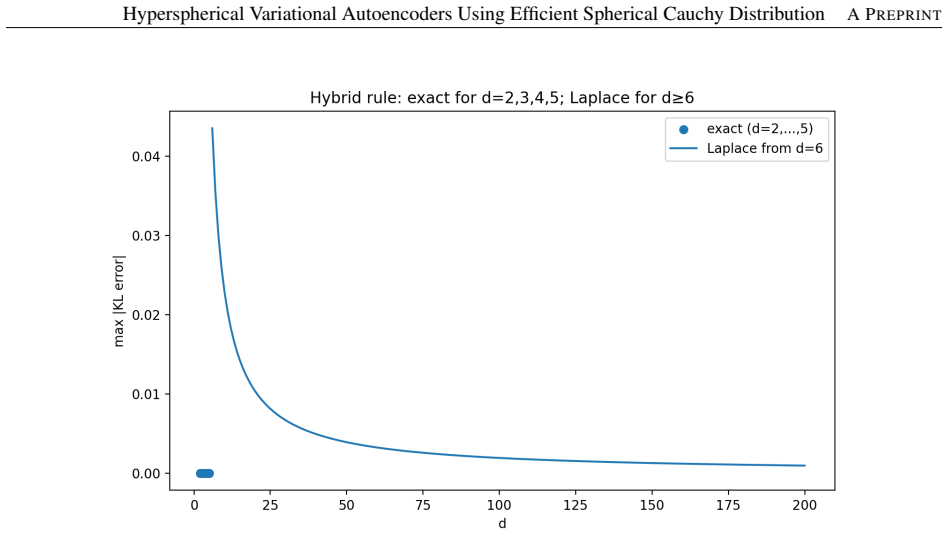
Evaluate the claimed KL formula in a regime that is not covered by the exact low-dimensional cases, e.g. $d=6, \rho=0.99$, by high-precision numerical integration of $KL=\int q\log(q/\upsilon_d)\,d\upsilon_d$, and compare with the paper's series and hybrid surrogate whose stated worst-case error is about $0.0436$; a disagreement beyond that bound would refute the central claims.
Extended reading notes
Core claim
On its own terms, the paper's central claim is that the spherical Cauchy family $\operatorname{spCauchy}_d(\mu,\rho)$ should replace the von Mises-Fisher distribution as the practical latent distribution for hyperspherical VAEs. The construction is intrinsic to the sphere: samples are drawn uniformly on $S^{d-1}$ and then warped by the deterministic, differentiable Möbius map $y=(1-\rho^2)\frac{x+\rho\mu}{1+2\rho x^\top\mu+\rho^2}+\rho\mu$, so the reparameterization trick needs no rejection sampling. The KL divergence to the uniform prior is reduced to a rapidly converging series in $z(\rho)=4\rho/(1+\rho)^2$, equivalently to a one-dimensional integral that remains bounded as the dimension grows, with a high-concentration asymptotic and bracketed closed-form surrogates. In the high-concentration limit, spCauchy and vMF have identical quadratic log-density curvature at the mode under the map $\kappa(\rho)=2(d-1)\rho/(1-\rho)^2$, so the local geometry of vMF is preserved while the global tails remain heavier through the stereographic link to Student-$t$ distributions.
Load-bearing premise
The load-bearing premise is the distributional identity that the Möbius transformation of a uniform sphere sample produces exactly the spherical Cauchy density $((1-\rho^2)/\|x-\rho\mu\|^2)^{d-1}$ on $S^{d-1}$; all sampling, reparameterization, and KL formulas collapse if that identity is wrong.
Editorial extensions
If this is right
- The spCauchy latent layer remains finite and differentiable across the full tested dimension range (up to $d=2048$) where the official vMF implementation fails in the paper's benchmark, so Bessel-free evaluation widens the usable regime of spherical latent models.
- Under the concentration map $\kappa(\rho)=2(d-1)\rho/(1-\rho)^2$, local quadratic approximations to the vMF posterior carry over to spCauchy in the high-concentration limit, so Laplace-style analyses do not need to be re-derived.
- Because the KL to the uniform prior grows linearly in dimension for fixed $\rho$, the same $\rho$ is more informative in higher dimensions; practical comparisons across latent dimensions should expect smaller learned $\rho$ for larger $d$.
- The hybrid KL evaluator is exact for $d=2,3,4,5$ and asymptotically exact for larger $d$, with worst-case absolute error about $0.0436$, making the latent objective stable in extreme concentration regimes.
Reading between the lines
- Because spCauchy maps to a multivariate Student-$t$ distribution under stereographic projection, the latent posterior is heavy-tailed in a way Gaussian and vMF priors are not; this suggests the family may absorb outlier codes that would otherwise inflate the KL, a robustness property the paper motivates but does not directly measure.
- The explicit $\rho \leftrightarrow \kappa$ matching map gives a drop-in recipe for upgrading existing vMF-based hyperspherical VAEs: keep the architecture, replace the sampler and KL term, and rescale concentrations by $\rho_{\text{match}}(d,\kappa)$; a direct vMF-to-spCauchy ablation across several tasks would test how much of the reported gain comes from the distribution rather than from the num
- The monotonicity results for the KL core in dimension suggest a scaling-law question the paper leaves open: whether optimally learned concentration follows a predictable curve in $d$, which could be used to set KL weights or priors without retuning.
- The MNIST and ZINC results are consistent with a broader hypothesis the paper does not claim: spCauchy latents may reduce posterior collapse in high-dimensional sequence VAEs as effectively as vMF while being cheaper; this is testable on standard text-VAE benchmarks.
Editorial analysis
A structured set of objections, weighed in public.
Referee Report
Summary. The paper proposes replacing von Mises-Fisher latent variables with spherical Cauchy (spCauchy) latent variables in hyperspherical VAEs. The main claims are that spCauchy admits an exact differentiable reparameterization via a Möbius transformation of uniform sphere samples, that its KL divergence to the uniform prior has a rapidly convergent series, a stable quadrature form, and high-concentration asymptotics, and that in the high-concentration limit spCauchy matches the local tangent-space geometry of vMF under an explicit concentration mapping. The authors also prove monotonicity and bracket results for the KL core, give closed-form surrogates with error control, and report benchmarks showing stable and faster latent-layer evaluation than vMF baselines on CPU and GPU, together with MNIST and ZINC-250k experiments.
Significance. If the mathematical content is correct, the paper makes a useful contribution: it provides a heavy-tailed spherical latent family with closed-form KL evaluation, explicit sampling, and local vMF-like geometry, avoiding Bessel-function ratios. The derivations appear self-contained and checkable, and strengths include explicit asymptotic expansions, exact low-dimensional closed forms for d=2,...,5, and an open-source implementation. The central weakness is that the displayed Möbius sampler in §4.1 is not norm-preserving, and because the exact reparameterization is a core claimed contribution, this must be corrected and verified in the released code before the paper can be accepted.
major comments (2)
- [§4.1] The displayed Möbius transformation is not a map from S^{d-1} to itself. As written, Y = ((1-ρ²)x + ρμ)/(1 + 2ρxᵀμ + ρ²) + ρμ. For d=3, μ=(1,0,0), ρ=0.5, and x=μ, the output has Euclidean norm approximately 1.0556, so it does not lie on S^{d-1}. The correct Möbius map, obtained by conjugating a boundary dilation under stereographic projection, is Y = ((1-ρ²)x + 2ρ(1+ρxᵀμ)μ)/(1 + ρ² + 2ρxᵀμ). Since the exact differentiable reparameterization is a central claim of the paper and is used in all experiments, this error is load-bearing. The manuscript must state the corrected formula, and the released code must be checked against it; if the code currently matches the displayed formula, the empirical results would need to be rerun with a valid sampler.
- [Appendix B.2] The KL-evaluator accuracy comparison is not an independent validation for d≥6 in the high-concentration regime. The reference for d≥6 is the authors' own 'combined' evaluator, which switches to the asymptotic formula for ρ>0.9, and hybrid is forced to win for d≤5 because it is exact there. The reported preferred-method counts and relative errors are therefore implementation diagnostics rather than ground-truth checks. This limitation is acknowledged in the appendix, but the main text presents the stability of the KL evaluators as a practical advantage; please either add an independent high-precision oracle for d≥6 or soften the corresponding claim in the main text.
minor comments (4)
- [§4.1] After correcting the Möbius formula, the text should explicitly state that Y has unit norm for all x∈S^{d-1}, since this is the property that makes the sampling scheme a reparameterization on the sphere.
- [§5.1 / Figure 3] The x-axis of Figure 3 is described as 'latent dimension d', but for spherical models the ambient dimension is d+1 while the sphere is S^{d-1}. Please clarify whether the reported dimensions refer to the ambient space or to the sphere dimension, and align the notation with Table 1.
- [Appendix B.2] The statement that the exact series evaluator has 'mean relative error of order one on this grid' should be clarified: it is unclear whether this is driven by near-zero reference KL values or by a few difficult high-ρ/d configurations, and the normalization used for relative error should be stated.
- [§4.3, Proposition 2] The observation that a fixed ρ corresponds to a larger KL for larger d is useful, but the wording 'the same numerical value of ρ corresponds to a more informative posterior in higher dimension' should be explicitly framed as a statement about the KL-scale, not about the information content of the distribution itself.
Circularity Check
No significant circularity: the spCauchy derivation is self-contained from externally cited distributional facts; self-citations are background-only.
full rationale
The paper's central claims—the spCauchy density and Möbius sampling construction—are imported from Kato and McCullagh (2020), an external source, and the KL divergence, integral representation, asymptotics, monotonicity, and bracket results are then derived from that density using standard DLMF hypergeometric and digamma identities. No fitted constants enter these formulas: the KL series (Theorem 1), quadrature form (Proposition 1), high-concentration offset (Proposition 3), and the bracketing envelopes (Proposition 4) are analytic consequences of the stated density. The concentration-matching map in Theorem 2 is explicitly constructed so that the quadratic log-density coefficients agree, so it is a parameter-matching statement rather than a fitted prediction. The hybrid KL surrogate is an approximation with a published error bound, not a fitted quantity validated only on the paper's own outputs. Self-citations to Hornik and Grün (2014a,b) and Sablica et al. (2025) appear only in background remarks about vMF evaluation and directional-data applications; they are not used to justify the paper's own theorems or to foreclose alternatives. The empirical benchmarks compare against external vMF implementations and are falsifiable. The apparent norm-preservation issue in the displayed Möbius formula of Section 4.1 is a correctness concern, not a circularity, and does not change this verdict.
Assumptions & free parameters
assumptions (7)
- domain assumption The spherical Cauchy density on S^{d-1} with parameters (μ,ρ) is ((1-ρ^2)/||x-ρμ||^2)^{d-1} with respect to the uniform measure, and Möbius-transforming uniform samples yields this distribution.
- standard math Euler integral and Pfaff transformation identities for the Gauss hypergeometric function.
- standard math Digamma integral representation ψ(b+k)-ψ(b) = ∫_0^1 (1-t^k)/(1-t) t^{b-1} dt.
- standard math Dominated convergence and differentiation under the integral sign.
- standard math Frullani's integral formula.
- domain assumption Uniform distribution on the hypersphere is a valid reference prior for the latent code.
- domain assumption The VAE reparameterization-gradient framework is valid.
Cite this review
Pith. "Pith review of Hyperspherical Variational Autoencoders Using Efficient Spherical Cauchy Distribution." pith.science (2026). https://pith.science/paper/WTNL4XH7
@misc{pith2026250621278,
  author       = {Pith},
  title        = {Pith review of: Hyperspherical Variational Autoencoders Using Efficient Spherical Cauchy Distribution},
  year         = {2026},
  howpublished = {\url{https://pith.science/paper/WTNL4XH7}},
  note         = {Machine review of arXiv:2506.21278}
}
read the original abstract
We propose spherical Cauchy (spCauchy) latent variables for variational autoencoders on hyperspherical latent spaces. The spCauchy family has heavy-tailed global behavior and admits an exact differentiable reparameterization by applying a M\"obius transformation to uniform samples on the sphere. We show that, in the high-concentration limit, spCauchy recovers the local tangent-space geometry of the von Mises-Fisher (vMF) distribution under an explicit concentration parameter mapping, while avoiding the high-order Bessel-function evaluations required by vMF implementations. For training, the Kullback-Leibler divergence to a uniform spherical prior admits rapidly convergent series, stable quadrature, and high-concentration asymptotic forms. We further establish monotonicity of the concentration-dependent KL core and derive analytic brackets with closed-form surrogates and error control, supporting stable approximation in extreme regimes. Stress-test benchmarks show that the resulting latent-layer objective remains stable and faster to evaluate than vMF baselines on CPU and GPU. Experiments on image and molecular sequence data demonstrate that spCauchy-VAEs provide a robust and scalable alternative for generative modeling with hyperspherical latent representations.
Figures


Figures from the paper (13 more)


Reference graph
Works this paper leans on
-
[2]
Hence, by monotonicity, for alld≥3, −1− log(1−z) z =J 3(z)≤J d(z)≤log 1−z/2 1−z
By Proposition 5, J3(z) =−1− log(1−z) z . Hence, by monotonicity, for alld≥3, −1− log(1−z) z =J 3(z)≤J d(z)≤log 1−z/2 1−z . Addinglog(1−z)gives the equivalent bounds forH d. B Latent-layer benchmark details This appendix documents the latent-layer benchmark underlying Section 5.1. The benchmark separates three compo- nents. The KL evaluator accuracy for s...
-
[3]
The main text uses only the total runtime figure, but the decomposition confirms that the advantage of spCauchy is not confined to a single 30 Hyperspherical Variational Autoencoders Using Efficient Spherical Cauchy DistributionA PREPRINT phase of the latent-layer computation. In particular, both spcauchy_combined and spcauchy_hybrid remain stable over th...
-
[9]
URLhttps://proceedings.mlr.press/v84/tomczak18a.html. Jiacheng Xu and Greg Durrett. Spherical latent spaces for stable variational autoencoders.arXiv preprint arXiv:1808.10805,
-
[10]
Spherical Latent Spaces for Stable Variational Autoencoders
doi: 10.48550/arXiv.1808.10805. A Proofs Proof of Theorem
-
[2017]
URL https: //proceedings.mlr.press/v54/naesseth17a.html
doi: 10.48550/arXiv.1610.05683. URL https: //proceedings.mlr.press/v54/naesseth17a.html. Lukas Sablica, Kurt Hornik, and Bettina Grün. circlus: An R package for circular and spherical clustering using Poisson kernel-based and spherical Cauchy distribution.Austrian Journal of Statistics, 54(3):27–42,
-
[2018]
Tim R Davidson, Jakub M Tomczak, and Efstratios Gavves
doi: 10.48550/arXiv.1804.00891. Tim R Davidson, Jakub M Tomczak, and Efstratios Gavves. Increasing expressivity of a hyperspherical vae.arXiv preprint arXiv:1910.02912,
-
[2019]
DLMF.NIST Digital Library of Mathematical Functions
doi: 10.48550/arXiv.1910.02912. DLMF.NIST Digital Library of Mathematical Functions. https://dlmf.nist.gov/, Release 1.2.4 of 2025-03-15. URL https://dlmf.nist.gov/. F. W. J. Olver, A. B. Olde Daalhuis, D. W. Lozier, B. I. Schneider, R. F. Boisvert, C. W. Clark, B. R. Miller, B. V . Saunders, H. S. Cohl, and M. A. McClain, eds. Kurt Hornik and Bettina Grü...
-
[2020]
doi: 10.3150/20-bej1222. 18 Hyperspherical Variational Autoencoders Using Efficient Spherical Cauchy DistributionA PREPRINT Figure 8: Representative geodesic interpolation in the spCauchy-128 latent space on ZINC-250k. The displayed path corresponds to a held-out endpoint pair with cosine similarity 0.315. The full 11-step interpolation path contains 6/11...
Show all 12 references
- [2021]
- [2022]
-
[2023]
Tim R Davidson, Luca Falorsi, Nicola De Cao, Thomas Kipf, and Jakub M Tomczak
URLhttp://jmlr.org/papers/v24/22-1160.html. Tim R Davidson, Luca Falorsi, Nicola De Cao, Thomas Kipf, and Jakub M Tomczak. Hyperspherical variational auto-encoders.arXiv preprint arXiv:1804.00891,
-
[2025]
Tyler R Scott, Andrew C Gallagher, and Michael C Mozer
doi: 10.17713/ajs.v54i3.2061. Tyler R Scott, Andrew C Gallagher, and Michael C Mozer. von mises-fisher loss: An exploration of embedding geometries for supervised learning. InProceedings of the IEEE/CVF International Conference on Computer Vision, pages 10612–10622,
Reviewed August 6, 2026 · model on record in the stance chip above.
Discussion (0). Sign in to comment.