REVIEW 3 major objections 4 minor 42 references
Infrared foundations for quantum geometry I: Catalogue of totally symmetric rank-three field theories
T0 review · 3 major / 4 minor · reviewed 2026-08-06 · deepseek-v4-flash
Pith's one-line read For a totally symmetric rank-three tensor field on flat space, all parity-conserving quadratic models fixed by a gauge symmetry form a finite catalogue, and exactly five of them are ghost- and tachyon-free.
desk verdict Useful catalogue and a genuinely new algorithm, but the 'all linear models' headline overstates the proven scope: quadratic deconfliction branches are excluded without a proof that they are sterile. read the letter →
The pith
A machine-rendered reading of the paper's core claim, the machinery that carries it, and where it could break.
The reading
What carries the argument
The load-bearing object is the wave operator $O(k)$ of the theory in momentum space, together with its pseudodeterminant $\det \tilde O(k)$, where $\tilde O = O + \sum_i v^{(i)} v^{(i)\dagger}$ is built by adding the gauge null vectors. The coefficients $X^{(n)}$ of the pseudodeterminant are polynomials in the couplings, and every zero of these coefficients signals the emergence of a new gauge symmetry; the algorithm partitions the coefficients into linear and non-linear parts, solves the linear system, factorizes the remaining polynomials, and follows each branch until it reaches models defined entirely by linear constraints. The spectrum and unitarity of each branch are then computed in the spin-parity basis by the spectral-analysis software, with a helicity extension used to identify which sectors the massless poles belong to. This combination turns finding the gauge symmetry into a tractable linear-algebra search rather than an ansatz-driven guess.
What would settle it
Construct a parity-conserving quadratic action for the totally symmetric rank-three field whose gauge symmetry is enforced by a quadratic deconfliction constraint or by an inherently non-linear constraint on the couplings, compute its full propagator, and check for positive-definite residues and non-negative mass squares; a ghost- and tachyon-free example outside Table II would refute the claim that exactly five unitary models exist.
Extended reading notes
Core claim
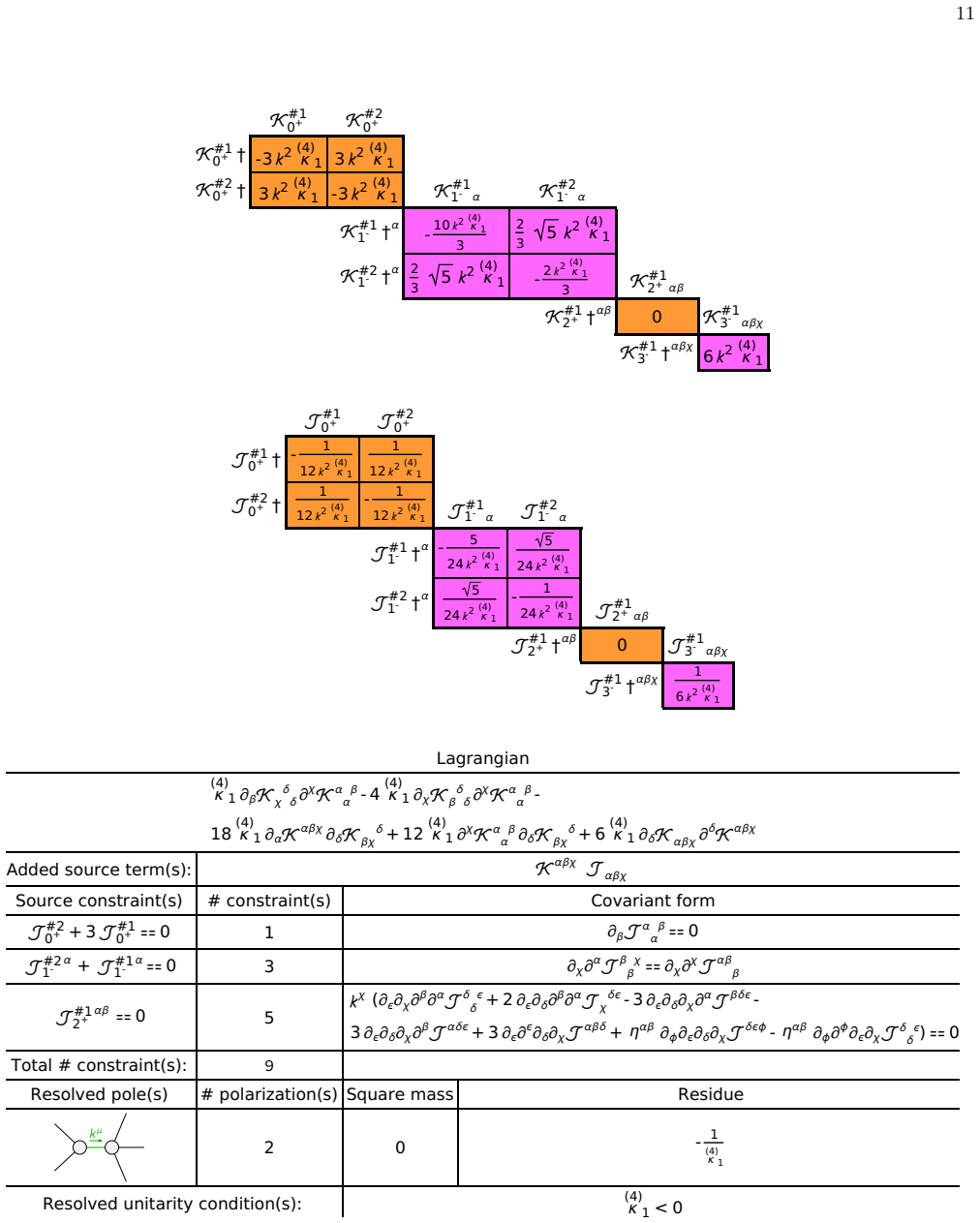
The central claim is that for a totally symmetric rank-three field $K_{\alpha\beta\gamma}$ with the most general parity-conserving quadratic Lagrangian, imposing any gauge symmetry reduces the theory to one of the listed branches, and among all such branches exactly five models — E1, E2, E6, F2, F4 — are unitary. In these models the spectrum contains a massless spin-one particle, a massless spin-three particle, or both; E2 is the unique model that propagates both simultaneously, and it does so without needing the tracelessness that previous simultaneous-propagation constructions required. The paper further identifies E6 as a superposition of the non-propagating model F1 with the spin-three theory F4, and verifies that the catalogue reproduces the standard Maxwell-type spin-one and the standard massless spin-three theory as special cases. The method is exhaustive within its stated limits: it searches directly in the Wigner decomposition of the field, requires no ansatz for the gauge transformation, and handles free and non-free symmetries on the same footing.
Load-bearing premise
The exhaustive list of five unitary models assumes that every relevant gauge symmetry appears as a zero of the pseudodeterminant coefficients, and that no additional unitary model hides in the excluded parity-violating or non-linear-deconfliction branches.
Editorial extensions
If this is right
- If the catalogue is complete, E1 and F2 are the only unitary spin-one models and F4 the only unitary spin-three model, while E6 is a harmless superposition of F4 with the non-propagating model F1.
- The unitary models are the only ones among the 23 that are stable against radiative corrections, because their healthy spectra are enforced by gauge symmetry rather than by tuned couplings.
- E2 shows that simultaneous massless spin-one and spin-three propagation is possible with unconstrained fields, so tracelessness is not necessary for this phenomenon.
- Because the algorithm requires no ansatz for the gauge transformation, the same pipeline can catalogue symmetric quadratic theories for other fields, including parity-violating theories.
Reading between the lines
- A natural extension is to rerun the same search with parity-violating operators included; the paper says its methods are unchanged, so the five-model list would likely grow, and the spin-one/spin-three exclusivity may be a parity-conserving artifact.
- The paper's gauge-symmetry selection principle suggests a bootstrap interpretation: any ghost-free quadratic model outside the catalogue either requires tuning that radiative corrections will destroy or must come from a non-linear deconfliction constraint, a branch explicitly excluded.
- The same algorithm applied to rank-two or mixed-symmetry fields could produce analogous foundational catalogues for torsion or metric-affine gravity, where totally symmetric rank-three tensors have been proposed as dynamical connection pieces.
Editorial analysis
A structured set of objections, weighed in public.
Referee Report
Summary. The paper claims to systematically catalogue all parity-conserving quadratic gauge-symmetric models for a totally symmetric rank-three tensor field on flat spacetime, using an algorithmic 'symmetric recursion' combined with the PSALTer particle-spectroscopy code. It identifies 23 symmetric models descending from the most general quadratic theory Lℵ, and finds exactly five unitary ones (E1, E2, E6, F2, F4), which propagate massless spin-1, spin-3, or both. The models F2 and F4 are identified with previously known Maxwell-like and Fronsdal theories, and E2 is presented as an unconstrained realisation of the Campoleoni–Francia model. The central claim is exhaustiveness: 'all linear models' defined by gauge symmetry. The paper is explicit that the algorithm considers only constraints linear in the couplings, dropping parity-violating operators and quadratic deconfliction constraints.
Significance. If the exhaustiveness claim is accepted, the paper establishes a sharp result: among all parity-conserving, gauge-symmetric quadratic actions for a totally symmetric rank-three field, only two particle species (massless spin-1 and spin-3) can propagate unitarily, and the five models E1, E2, E6, F2, F4 are the complete list. The work is valuable for its computational method: the recursion is grounded in Wigner decompositions and is implemented with the publicly available PSALTer software, and the five unitary models are supported by explicit spectrographs. The connections to Fronsdal theory and to Campoleoni–Francia provide external anchors, and the unconstrained realisation E2 is a new contribution. However, the exhaustiveness result is only as strong as the completeness of the algorithmic search, and the paper itself identifies excluded branches, so the significance of the 'catalogue' depends on resolving whether the stated scope of the abstract matches the proven scope.
major comments (3)
- [Section II, 'Symmetric recursion'; Section III, 'Further work'] The central exhaustiveness claim is not established because the recursion explicitly discards models defined by quadratic deconfliction constraints. In Section II the system {X^(n)} is partitioned into linear {L^(n)} and nonlinear {N^(n)} parts, the linear subsystem is solved, and only factorable linear branches are followed; Section III states that 'symmetric models deriving from quadratic deconfliction constraints are not considered here.' The reassurance that such cases are 'only relevant for the reduction steps concerning the models B1, B2 and ℵ itself' is asserted without proof. Moreover, the fact that E1 is a unitary descendant of the /reve-marked B1 branch shows that non-unitarity of a parent does not exclude unitary models on excluded branches. The abstract's 'all linear models' is therefore stronger than what the body proves, and the paper should either prove that no additional unitary models arise from quadratic-constraint branches or explicitly restrict the claim to linear-constraint-defined models.
- [Abstract and Section I, 'In this letter'] The phrase 'all linear models' is ambiguous and overbroad on the natural reading. The paper also neglects parity-violating operators, which Section I admits is 'somewhat arbitrary.' While the abstract does include the qualifier 'without parity violation,' the body's broader framing in Section I ('the most general theory ... built from the relevant and marginal quadratic operators') suggests that the catalogue aims at full generality within the class of gauge-symmetric models. The manuscript should state unambiguously that the catalogue is complete only within the class of parity-conserving quadratic actions whose gauge symmetries are enforced by linear constraints on the couplings, and the abstract should mirror this scope.
- [Section II, 'Symmetric recursion' and Figure 3] The completeness of the recursion itself needs a more rigorous justification. The text asserts that solving {L^(n)=0}, then factorising the remaining N^(n) and re-solving linear factors, 'ideally' leaves models defined by linear constraints, and that 'inherently non-linear models are relatively few.' No proof is given that every gauge symmetry corresponds to a zero of the pseudodeterminant coefficients X^(n), nor that the linear-factorisation step does not miss branches that become accessible only after imposing nonlinear relations among couplings. This is load-bearing for 'we systematically obtain all linear models,' so the paper should either supply a completeness argument or weaken the conclusion to a statement about the models found by this particular algorithm.
minor comments (4)
- [Figure 4 and Table II] The catalogue graph in Figure 4 is not readable in the provided text (only the row 'Bi Ci Di Ei Fi' appears), and the symbols used in Table II (e.g., '/reve', '/', '○␣') are not defined in the main text; they appear to denote inconsistent, consistent, and empty spectra, respectively. Please define these explicitly and ensure the figure is legible in the published version.
- [Section III, 'Spin one and spin three'] The statement that E2 reduces to the Campoleoni–Francia model under the traceless condition K^α_{βα} ≡ 0 would benefit from a brief equation showing the field redefinition, since the equivalence is a key validation of the new model.
- [Throughout] Minor typographical and formatting issues include 'polology' (likely 'pole-ology'), inconsistent use of bold/italic for tensor indices in the PSALTer output, and the unresolved-pole presentation in Fig. 2 where 'Resolved unitarity condition(s): (Demonstrably impossible)' is not explained. These do not affect the substance.
- [References] The paper cites several of the authors' own prior works (Refs. [1], [21], [22]) but the new models are anchored to Fronsdal [24] and Campoleoni–Francia [23]. It would strengthen the presentation to add a sentence in the introduction distinguishing the new algorithm from the ansatz-based analysis of Ref. [1], rather than only in the abstract.
Circularity Check
No circularity: every model in the catalogue is computed from a stated general ansatz and benchmarked against external anchor models; the sole in-body caveat narrows exhaustiveness but is not a circular step.
full rationale
Walking the derivation chain, the paper starts from the most general quadratic parity-even Lagrangian Lℵ (Eq. 3), forms pseudodeterminant coefficients X^(n), partitions them into linear and nonlinear parts (Eq. 10), solves the linear system, factorizes residual nonlinear constraints, and reads off gauge symmetries as null eigenvectors of the wave operator. The spectra are then computed by PSALTer in JP blocks and cross-checked by an explicit helicity decomposition. Nothing in this chain is defined in terms of the claimed output: the gauge symmetries are derived from the wave operator, not assumed; the five unitary models are selected by computing poles and residues, not by tuning couplings to produce a desired spectrum. External anchors support the reading: F4 'aligns exactly with Fronsdal’s formulation for massless J = 3 particle propagation [24]', E2 'establishes an equivalence with their approach' to Campoleoni–Francia, and F2 is a prior Maxwell-type model. These identifications occur after the catalogue is generated and are not used to build it. The only limitation passage is the final paragraph: 'since our algorithm only deals with conditions linear in the coefficients, symmetric models deriving from quadratic deconfliction constraints are not considered here. However, such special cases are only relevant for the reduction steps concerning the models B1, B2 and ℵ itself.' This narrows the proven meaning of 'all linear models' but is an honest scope statement, not a circular rescue: the quadratic-deconfliction branches are excluded, and the paper does not later re-import them under a different name. The self-citations to PSALTer [21,22] and to the authors' prior analysis [1] are tool citations and consistency checks; PSALTer is code-reproduced, and the central conclusions are independently benchmarked against Fronsdal and Campoleoni–Francia. No fitted parameter is relabeled as a prediction, no uniqueness theorem is imported from the authors' earlier work, and no ansatz is smuggled in via citation. I therefore find no significant circularity.
Assumptions & free parameters
free parameters (1)
- Quadratic EFT couplings of Lℵ (2κ1, 2κ2, 4κ1,...,4κ7) =
not fitted
assumptions (4)
- domain assumption Gauge symmetries are necessary to protect a quadratic EFT against radiative destabilisation.
- domain assumption Parity-violating operators can be neglected without changing the physics of the catalogue.
- ad hoc to paper The symmetric recursion enumerates all gauge-symmetric models relevant to the classification.
- domain assumption PSALTer correctly computes wave-operator blocks, pseudoinverses, poles, and residues.
Cite this review
Pith. "Pith review of Infrared foundations for quantum geometry I: Catalogue of totally symmetric rank-three field theories." pith.science (2026). https://pith.science/paper/7TEH2PW4
@misc{pith2026250621662,
  author       = {Pith},
  title        = {Pith review of: Infrared foundations for quantum geometry I: Catalogue of totally symmetric rank-three field theories},
  year         = {2026},
  howpublished = {\url{https://pith.science/paper/7TEH2PW4}},
  note         = {Machine review of arXiv:2506.21662}
}
read the original abstract
We systematically obtain all linear models which propagate a totally symmetric rank-three field without parity violation on a flat background. Each such model is defined exclusively by its gauge symmetry, a necessary property of effective field theories in the infrared limit. By comparison, models obtained by other means (tuning couplings or cherry-picking operators) may be unstable against radiative corrections. For each model, we compute the spectrum of massless and massive particles, and the no-ghost-no-tachyon constraints on the couplings. We conclude that foundational models exist which can propagate one massless particle of spin one or spin three in isolation, or both particles simultaneously, generalising the model of Campoleoni and Francia. Our algorithm for detecting symmetric models is grounded in particle physics methods, being based directly on the Wigner decomposition of the field. Compared to our recent analysis of the totally symmetric rank-three field (whose results we confirm and extend) our new algorithm does not require an ansatz for the symmetry transformation, and is not restricted to so-called 'free' symmetries.
Figures


Figures from the paper (6 more)


Reference graph
Works this paper leans on
-
[1]
3-#1 αβχ 3-#1 †αβχ 2 κ (4) 7+κ (2) 1 0+ #1 0+ #2 0+ #1†3 ϒ1+ϒ4 2 3 Det (0+) -ϒ3 2-2 κ (2) 2 2 Det (0+) 0+ #2†-ϒ3 2-2 κ (2) 2 2 Det(0+) ϒ1+ϒ2 2 Det (0+) 1-#1 α 1-#2 α 1-#1 †α ϒ8+ϒ9 2 3 Det (1-) - 5 ϒ7 2-2 5 κ (2) 2 6 Det (1-) 1-#2 †α- 5 ϒ7 2-2 5 κ (2) 2 6 Det (1-) ϒ5+ϒ6 2 3 Det (1-) 2+ #1 αβ 2+ #1 †αβ 1 Det(2+) 3-#1 αβχ 3-#1 †αβχ 1 ...
-
[2]
1 3(ϒ8 +ϒ 9 2) 2+ #1 αβ 2+ #1 †αβ1 3(ϒ10 2 + 3κ (2)
-
[3]
+κ(4) 4 && ϒ4 ⩵3κ (4) 1 + 3κ (4) 2 +κ (4) 3 + 3κ (4) 7 &&ϒ 5 ⩵3κ (2) 1 +κ (2) 2 &&ϒ 6 ⩵ κ (4) 2 + 2κ (4) 3 +κ (4) 4 + 3κ (4) 7 && ϒ7 ⩵2κ (4) 2 +κ (4) 4 &&ϒ 8 ⩵3κ (2) 1 + 5κ (2) 2 &&ϒ 9 ⩵5κ (4) 2 + 3κ (4) 7 &&ϒ 10 ⩵ κ (4) 3 + 3κ (4) 7 && Det (0+)⩵ 1 12 4 (16κ (4) 1 κ (4) 3 + 16κ (4) 2 κ (4) 3 + 4κ (4) 3 2 + 4κ (4) 3 κ (4) 4 - 3κ (4) 4 2 + 4 (6κ (4) 1 + 6κ...
-
[4]
+ 1 3 2 (6κ (4) 1 κ (2) 1 + 6κ (4) 2 κ (2) 1 + 4κ (4) 3 κ (2) 1 + 3κ (4) 4 κ (2) 1 + 6κ (4) 7 κ (2) 1 + 4κ (4) 3 κ (2) 2 + 6κ (4) 7 κ (2)
-
[5]
&& Det (1-)⩵ 1 36 4 (-5κ (4) 4 2 + 12κ (4) 7 (2κ (4) 3 +κ (4) 4 + 3κ (4)
- [6]
-
[7]
+ 8κ (4) 2 (5κ (4) 3 + 9κ (4) 7)) +κ (2) 1 (κ (2) 1 + 2κ (2)
-
[8]
+ 1 92 (3 (6κ (4) 2 + 2κ (4) 3 +κ (4) 4 + 6κ (4) 7)κ (2) 1 + 2 (5κ (4) 3 + 9κ (4) 7)κ (2)
Show all 42 references
-
[9]
&& Det (2+)⩵ 2 ( κ (4) 3 3+κ (4)
-
[10]
+κ (2) 1 Lagrangian κ(2) 1 αβχ αβχ +κ(2) 2 α β α χ β χ +κ(4) 1 ∂β δ χ δ ∂χ α β α + κ (4) 2 ∂χ δ β δ ∂χ α β α +κ (4) 3 ∂α αβχ ∂δ δ βχ +κ (4) 4 ∂χ α β α ∂δ δ βχ +κ (4) 7 ∂δ αβχ ∂δ αβχ Addedsource term(s): αβχ αβχ Unresolved pole(s) #d.o.f. Pole str...
-
[11]
+ 4 2 (6κ (4) 1κ (2) 1+ 6κ (4) 2κ (2) 1+ 4κ (4) 3κ (2) 1+ 3κ (4) 4κ (2) 1+ 6κ (4) 7κ (2) 1+ 4κ (4) 3κ (2) 2+ 6κ (4) 7κ (2) 2) 6 4 (-5κ (4) 4 2 + 12κ (4) 7 (2κ (4) 3 +κ (4) 4 + 3κ (4)
-
[12]
+ 8κ (4) 2 (5κ (4) 3 + 9κ (4) 7)) + 36κ (2) 1 (κ (2) 1 + 2κ (2)
-
[13]
Output generated by PSALTer
+ 4 2 (3 (6κ (4) 2 + 2κ (4) 3 +κ (4) 4 + 6κ (4) 7)κ (2) 1 + 2 (5κ (4) 3 + 9κ (4) 7)κ (2) 2) Resolvedpole(s) # polarization(s)Squaremass Residue 5 -3 κ (2) 1 κ (4) 3+3 κ (4) 7 3 κ (4) 3+3 κ (4) 7 7 - κ (2) 1 κ (4) 7 -1 κ (4) 7 Resolvedunitaritycondition(s): (Demonstrablyimposs...
-
[14]
These are illustrated in Fig. 4. The notation allocates a letter to signify the number of constraints (whereB sig- nifies two constraints, C signifies three constraints, and so on) and a subscript to distinguish different models. The full details of these models are provided i...
-
[15]
1-#1 α 1-#2 α 1-#1†α- ϒ4 2 3 Det (1-) 5 ϒ3 2 3 Det (1-) 1-#2†α 5 ϒ3 2 3 Det(1-) ϒ2 2 3 Det (1-) 2+ #1 αβ 2+ #1 †αβ 0 3-#1 αβχ 3-#1 †αβχ- 1 2 2 ( κ (4) 1+ κ (4) 2) Abbreviationsused inmatrices ϒ1 ⩵ κ(4) 1 +κ(4) 2 &&ϒ 2 ⩵2κ(4) 1 + 3κ(4) 2 &&ϒ 3 ⩵2κ(4) 1 +κ(4) 2 && ϒ...
-
[16]
(4κ (4) 1 +κ (4) 2) Lagrangian κ (4) 1 ∂β δ χ δ ∂χ α β α +κ (4) 2 ∂χ δ β δ ∂χ α β α + 6κ (4) 1 ∂α αβχ ∂δ δ βχ + 6κ (4) 2 ∂α αβχ ∂δ δ βχ- 4κ (4) 1 ∂χ α β α ∂δ δ βχ- 4κ (4) 2 ∂χ α β α ∂δ δ βχ- 2κ (4) 1 ∂δ αβχ∂δ αβχ - 2κ (4) 2 ∂δ αβχ∂δ αβχ Addedsou...
-
[17]
Output generated by PSALTer
|| (κ (4) 2 > 0 &&κ (4) 1 > - κ (4) 2 4) Figure 6. Output generated by PSALTer. The spectrograph of E2, as defined in Table II. All notation is defined in Table I and Fig. 2. This is a generalisation of the model found in [23], to which it reduces under the assumption Kα β α ≡...
2020
-
[18]
Barker, C
W. Barker, C. Marzo, and A. Santoni, Can metric-affine gravity be saved?, (2025), arXiv:2505.23894 [hep-th]
2025
-
[19]
Georgi, Effective field theory, Ann
H. Georgi, Effective field theory, Ann. Rev. Nucl. Part. Sci. 43, 209 (1993)
1993
-
[20]
C. P. Burgess, Introduction to Effective Field Theory, Ann. Rev. Nucl. Part. Sci. 57, 329 (2007), arXiv:hep- th/0701053
2007
-
[21]
Bijnens, Chiral perturbation theory beyond one loop, Prog
J. Bijnens, Chiral perturbation theory beyond one loop, Prog. Part. Nucl. Phys. 58, 521 (2007), arXiv:hep- ph/0604043
2007
-
[22]
A. V. Manohar, Effective field theories, Lect. Notes Phys. 479, 311 (1997), arXiv:hep-ph/9606222
1997 arXiv
-
[23]
Pich, Chiral perturbation theory, Rept
A. Pich, Chiral perturbation theory, Rept. Prog. Phys. 58, 563 (1995), arXiv:hep-ph/9502366
1995 arXiv
-
[24]
Ecker, Chiral perturbation theory, Prog
G. Ecker, Chiral perturbation theory, Prog. Part. Nucl. Phys. 35, 1 (1995), arXiv:hep-ph/9501357
1995 arXiv
-
[25]
Dobado and M
A. Dobado and M. J. Herrero, Phenomenological La- grangian Approach to the Symmetry Breaking Sector of the Standard Model, Phys. Lett. B 228, 495 (1989)
1989
-
[26]
Dobado, M
A. Dobado, M. J. Herrero, and T. N. Truong, Study of the Strongly Interacting Higgs Sector, Phys. Lett. B235, 129 (1990)
1990
-
[27]
Weinberg, Phenomenological Lagrangians, Physica A 96, 327 (1979)
S. Weinberg, Phenomenological Lagrangians, Physica A 96, 327 (1979)
1979
-
[28]
S. R. Coleman, J. Wess, and B. Zumino, Structure of phenomenological Lagrangians. 1., Phys. Rev. 177, 2239 (1969)
1969
-
[29]
C. G. Callan, Jr., S. R. Coleman, J. Wess, and B. Zu- mino, Structure of phenomenological Lagrangians. 2., Phys. Rev. 177, 2247 (1969)
1969
-
[30]
Baldazzi, O
A. Baldazzi, O. Melichev, and R. Percacci, Metric-Affine Gravity as an effective field theory, Annals Phys. 438, 168757 (2022), arXiv:2112.10193 [gr-qc]
2022 arXiv
-
[31]
Martini, G
R. Martini, G. Paci, and D. Sauro, Radiative correc- tions to the R and R 2 invariants from torsion fluctu- ations on maximally symmetric spaces, JHEP 12, 138, arXiv:2312.16681 [gr-qc]
-
[32]
Sauro and O
D. Sauro and O. Zanusso, The origin of Weyl gauging in metric-affine theories, Class. Quant. Grav. 39, 185001 13 (2022), arXiv:2203.08692 [hep-th]
2022 arXiv
-
[33]
Sauro, Hidden gauge invariances of torsion theories: closed algebras and absence of ghosts, arXiv preprint (2024), arXiv:2412.07854 [hep-th]
D. Sauro, Hidden gauge invariances of torsion theories: closed algebras and absence of ghosts, arXiv preprint (2024), arXiv:2412.07854 [hep-th]
2024
-
[34]
Melichev and R
O. Melichev and R. Percacci, On the renormalization of Poincar´ e gauge theories, arXiv preprint (2023), arXiv:2307.02336 [hep-th]
2023 arXiv
-
[35]
Melichev, Quadratic gravity with propagating tor- sion and asymptotic freedom, arXiv preprint (2025), arXiv:2504.13090 [hep-th]
O. Melichev, Quadratic gravity with propagating tor- sion and asymptotic freedom, arXiv preprint (2025), arXiv:2504.13090 [hep-th]
2025 arXiv
-
[36]
Iosifidis, On a torsion/curvature analogue of dual con- nections and statistical manifolds, J
D. Iosifidis, On a torsion/curvature analogue of dual con- nections and statistical manifolds, J. Geom. Phys. 196, 105064 (2024), arXiv:2303.13259 [math.DG]
2024 arXiv
-
[37]
Barker, G
W. Barker, G. K. Karananas, and H. Tu, The par- ticle spectra of parity-violating theories: A less radi- cal approach and an upgrade of P SALT er, (2025), arXiv:2506.02111 [hep-th]
2025 arXiv
-
[38]
Barker, C
W. Barker, C. Marzo, and C. Rigouzzo, PSALTer: Parti- cle Spectrum for Any Tensor Lagrangian, arXiv preprint (2024), arXiv:2406.09500 [hep-th]
2024 arXiv
-
[39]
Campoleoni and D
A. Campoleoni and D. Francia, Maxwell-like Lagrangians for higher spins, JHEP 03, 168, arXiv:1206.5877 [hep-th]
-
[40]
Fronsdal, Massless Fields with Integer Spin, Phys
C. Fronsdal, Massless Fields with Integer Spin, Phys. Rev. D 18, 3624 (1978)
1978
-
[41]
Boulanger, T
N. Boulanger, T. Damour, L. Gualtieri, and M. Hen- neaux, Inconsistency of interacting, multigraviton the- ories, Nucl. Phys. B 597, 127 (2001), arXiv:hep- th/0007220
2001
-
[42]
Bekaert, N
X. Bekaert, N. Boulanger, and S. Leclercq, Strong ob- struction of the Berends-Burgers-van Dam spin-3 vertex, J. Phys. A 43, 185401 (2010), arXiv:1002.0289 [hep-th]. A CA T ALOGUE In this appendix we provide Table II, which contains full definitions of all the models in Fig. 4...
2010 arXiv
Reviewed August 6, 2026 · model on record in the stance chip above.
Discussion (0). Sign in to comment.