REVIEW 2 major objections 5 minor 2 cited by
TanDiT: Tangent-Plane Diffusion Transformer for High-Quality 360{\deg} Panorama Generation
T0 review · 2 major / 5 minor · reviewed 2026-08-06 · deepseek-v4-flash
Pith's one-line read TanDiT generates high-quality 360° panoramas by producing a dense grid of tangent-plane perspective views in a single diffusion pass, then refining the reprojected panorama with a pretrained network for seamless, arbitrary-resolution…
desk verdict A well-ablated panorama generation system with a plausible tangent-plane grid design; the SOTA claim is real but leans on self-designed metrics and an under-checked refinement step. read the letter →
The pith
A machine-rendered reading of the paper's core claim, the machinery that carries it, and where it could break.
The reading
What carries the argument
The load-bearing object is the tangent-plane grid: 18 perspective views of the sphere obtained by gnomonic projection, each resized to $192\times192$ pixels and packed into a $576\times1152$ serpentine layout so that views that are neighbors on the sphere, with deliberate overlap, remain neighbors in the grid. A pretrained diffusion transformer (Stable Diffusion 3.5-Large, LoRA-fine-tuned) denoises the entire grid in one loop, so the same attention mechanism that models spatial proximity in ordinary images is what enforces coherence across views. The second mechanism is the equirectangular-conditioned refinement: the reprojected panorama's latent $z_{\mathrm{pano}}$ is perturbed with noise at timestep $\approx 800$ and denoised by the pretrained model under the same prompt, with circular padding of the horizontal edges at every step, plus latent rotation, to fix left-right loop consistency, and patched denoising of $1024\times1024$ squares for high resolution. The two metrics, TangentIS and TangentFID, compute Inception Score and FID on each of the 18 tangent views and aggregate with $\mu - 1.96\,\sigma/\sqrt{18}$ and $\mu + 1.96\,\sigma/\sqrt{18}$, respectively, so a model must be consistent across the whole sphere, poles included, to score well.
What would settle it
Fix a prompt set, then sweep the refinement timestep below roughly 700 and above roughly 900 while measuring two things directly: seam visibility near tangent-view boundaries and at the left-right edge (for example, with the paper's own Discontinuity Score), and layout preservation (for example, whether recognizable objects keep their positions between the pre- and post-refinement panoramas). If no timestep simultaneously removes the seams and preserves the layout, the refinement mechanism fails. A second test counts repeated or duplicated content across the $1024\times1024$ denoising patches, since the paper itself shows a 'two moons' artifact, and checks how often patched refinement produces such repetitions on dense prompts at 2K and 4K.
Extended reading notes
Core claim
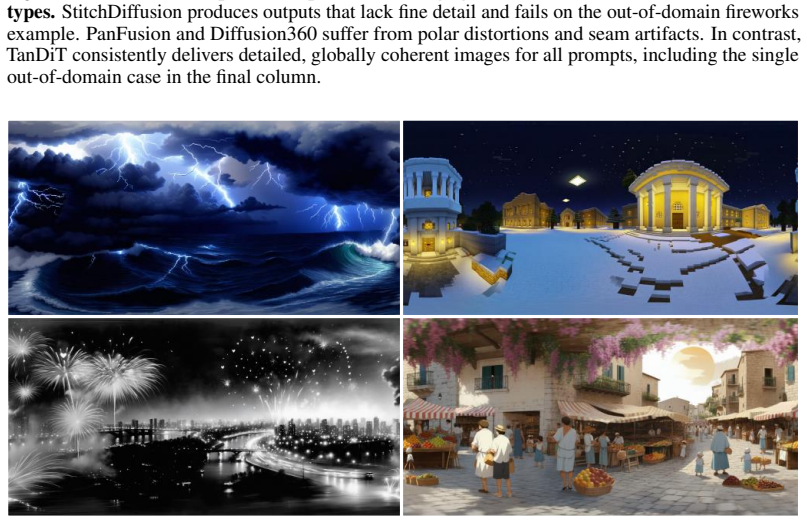
The central claim is that a single diffusion transformer, fine-tuned to denoise a structured grid of 18 tangent-plane views, can synthesize a complete 360° scene in one pass with better coherence than multi-branch, stitching, or blending methods, and that this is the only current approach that combines tangent-plane representations, consistency-aware generation, and arbitrary resolution support in a single diffusion loop. Tangent planes are perspective views extracted by gnomonic projection, which preserves straight lines and keeps distortion low; neighboring views overlap, and the serpentine grid layout keeps sphere-adjacent views grid-adjacent so attention can propagate local context across them. At inference the generated grid is reprojected to an equirectangular panorama (with optional per-view super-resolution), its latent is noised at a high timestep of roughly 800 and re-denoised by a pretrained diffusion transformer conditioned on the text prompt, and circular padding plus patched denoising over $1024\times1024$ tiles deliver loop consistency and resolutions up to $4096\times2048$. On the evaluation side, the paper argues that standard metrics misjudge panoramas because the Inception network and CLIP expect perspective images, and it proposes TangentIS and TangentFID, which score each tangent view separately and aggregate with the lower or upper 95% confidence bound over the 18 views, so that failure in polar regions cannot be masked by strong equatorial regions.
Load-bearing premise
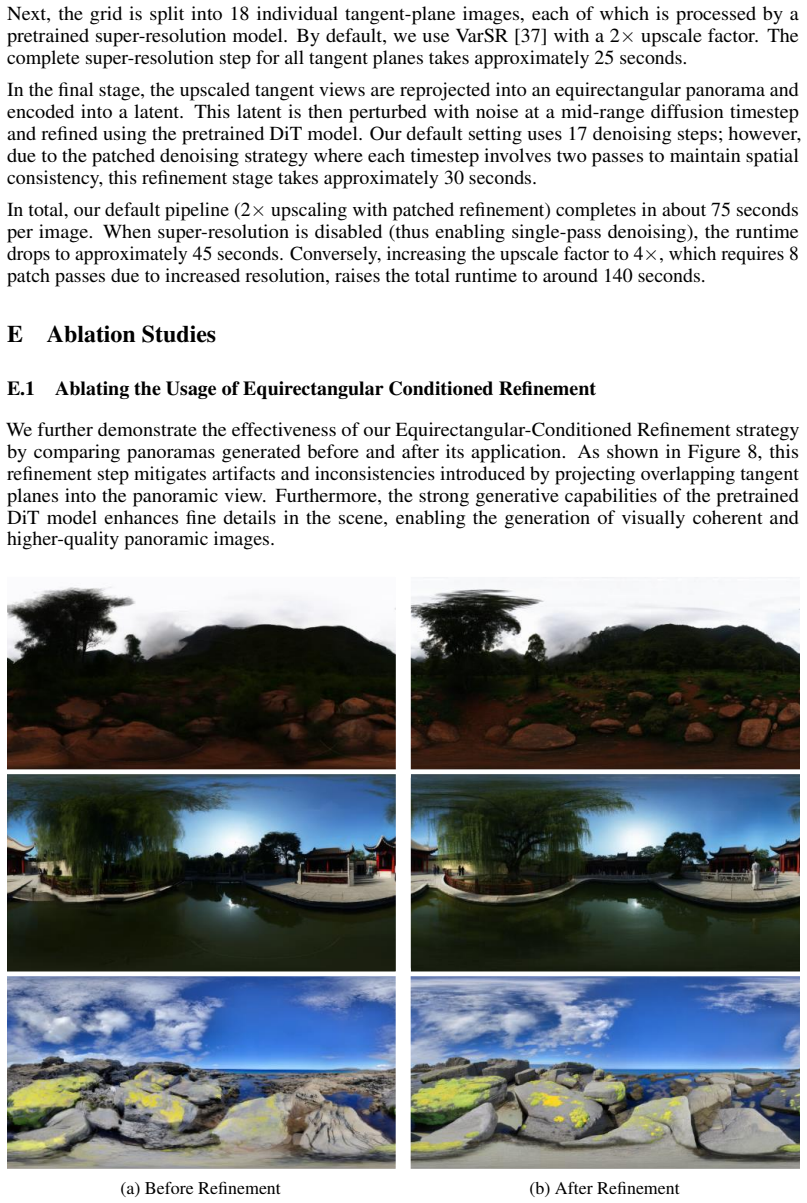
The load-bearing premise is that the refinement stage can wash out seams and mismatches between tangent views by adding noise at a high timestep ($\approx 800$) to the reprojected panorama's latent and denoising it with a pretrained model, without disturbing the global scene layout or the prompt's content; the paper's own appendix shows the first stage alone produces visible artifacts, so if that balance between artifact removal and layout preservation fails, the coherence and quality claims collapse.
Editorial extensions
If this is right
- Panorama generation inherits the quality and style range of front-line text-to-image diffusion transformers, because the model denoises undistorted perspective views rather than a warped sphere.
- A single joint denoising pass over the tangent grid replaces multi-branch or iterative stitching pipelines, which the paper argues is what removes polar distortions and seam artifacts.
- The same trained weights produce arbitrary output resolutions: per-view super-resolution plus patched refinement reaches at least $4096\times2048$ without retraining.
- Evaluating on tangent views rather than the equirectangular image or cubemap changes rankings among methods; the paper shows OmniFID can rate an inconsistent, unrefined first stage above the full refined pipeline, while the proposed metrics penalize exactly that.
- The released captions, metrics, and evaluation scripts give the field a common benchmark, so future panorama generators can be compared on identical prompts and settings.
Reading between the lines
- The joint grid-generation recipe is a template beyond panoramas: any output that is a set of correlated views, such as multi-view imagery, video, or light fields, could be arranged as a serpentine latent grid and generated in one diffusion pass, with the grid layout serving as the geometry that the transformer's attention consumes.
- Because the refinement stage is model-agnostic and needs only a pretrained diffusion model plus circular padding, a direct transfer test would be to run it on other generators' outputs, for example PanFusion or Diffusion360 panoramas, and measure whether TangentIS and TangentFID improve; if it does, the refinement, not the tangent grid, is the load-bearing contribution for consistency.
- The confidence-bound aggregation trick is separable from both metrics: the same recipe, per-view scores on tangent planes aggregated by confidence bound, could be applied to CLIP score, FAED, or future quality measures to build a family of panorama-aware metrics without redesigning each base metric.
Editorial analysis
A structured set of objections, weighed in public.
Referee Report
Summary. This paper introduces TanDiT, a method for text-conditioned 360° panorama generation. It decomposes a panorama into an 18-view tangent-plane grid, trains a single diffusion transformer (LoRA-fine-tuned Stable Diffusion 3.5 Large) to generate the entire grid in one denoising pass, and then applies per-view super-resolution, an equirectangular-conditioned refinement pass with a pretrained SD3 model, circular padding, and patched denoising to harmonize seams and enable high-resolution output. The paper also proposes two new evaluation metrics (TangentIS and TangentFID), a benchmark with newly captioned datasets, and a user study. The central claim is that TanDiT achieves state-of-the-art quality and consistency in 360° panorama generation.
Significance. If the results hold, TanDiT offers a practically useful unified pipeline for 360° generation, with the tangent-plane representation reducing distortion and the refinement stage improving coherence. The paper's strengths are its extensive ablations (grid ordering, number of planes, refinement timestep, super-resolution, control experiments with pretrained SD3), a user study, and a concrete release plan for code, captions, and evaluation scripts. The proposed metrics and benchmark could become a community resource, but their value depends on external validation. The main risk is that the consistency claim rests on a refinement stage whose layout-preservation behavior is not directly measured; this, together with the validation of the new metrics, is the load-bearing point that needs strengthening.
major comments (2)
- [Section 3.3, Appendix E.4, Appendix I] The claim in Section 3.3 that the refinement step 'wash[es] out high-frequency mismatches while preserving the scene’s overall layout' is not directly tested. Since the first stage alone is admitted to produce visible inconsistencies (Appendix B.3, Fig. 6), the consistency and state-of-the-art claims rest entirely on this refinement. Table 5 reports only aggregate metrics; no layout-preservation check (e.g., correspondence, depth, or structural similarity between the intermediate ERP and the final output) is provided. Appendix E.4 shows that t≈900 degrades panorama-specific metrics, and Appendix I documents duplicate content (two moons) from patched denoising, demonstrating that layout/semantics can change. The authors should add a direct layout-preservation evaluation and an analysis of when the balance between artifact removal and layout preservation fails, or temper the claim accordingly.
- [Section 4.2, Tables 2, 5, 8, 9] TangentIS and TangentFID (Section 4.2) are introduced and used both for hyperparameter selection (grid ordering in Table 8, number of planes in Table 9, refinement timestep in Table 5) and as primary evidence for state-of-the-art performance in Table 2. No external validation of these metrics is provided: there is no demonstration that they correlate with human judgments (the user study in Section 5.2 is a single overall preference, not a per-metric validation), no error bars, and no sensitivity analysis. Figure 6 is a single anecdotal example. Since the method's components were tuned on these metrics, the state-of-the-art claim is vulnerable to circularity. Please validate the metrics against human preference (e.g., using the user-study data) and report confidence intervals or multiple-seed results for all metrics.
minor comments (5)
- [Section 5.1, Table 2] The sentence 'our model achieves the best or second-best accuracy in most metrics' is inaccurate; on KID, IS, CS, and OmniFID the model is not in the top two. Please revise the sentence and add a sentence explaining the OmniFID result in light of the paper's critique of that metric.
- [Section 5.2] The phrase 'with p < 0.05 according to the Wilson interval' conflates a confidence interval with a hypothesis test; please either report a test statistic or state that the 95% Wilson intervals for all comparisons exclude 50%.
- [Throughout] There are several typos: 'opposite opposite' in Section 2, 'seperately' in Section 3.3, 'seperate' in Appendix E.2, 'inbold' in Table 3 caption, and 'desinging' in Section 3.2.
- [Table 1] The '#' column for TanDiT reads '1/2'; please clarify its meaning (one generation pass plus one refinement pass?) and define what 'Consistent' means for the full pipeline, since the first stage alone is not consistent (Appendix B.3).
- [Section 4.2] The upper 95% confidence bound for TangentFID is mentioned but not defined; please provide the formula, analogous to Eq. (6) for TangentIS.
Circularity Check
No circular derivation chain: TanDiT's SOTA claim is backed by external metrics and a user study; the author-proposed metrics and design tuning raise only a mild self-referential benchmarking concern, not circularity.
full rationale
The central claim that TanDiT achieves state-of-the-art panorama generation is supported by standard external metrics (FID, KID, IS, CLIP Score, FAED, OmniFID, DS) and a 38-participant 2AFC user study (Section 5.2, Appendix H), not by a fitted parameter renamed as a prediction. The proposed TangentIS and TangentFID are defined on tangent views extracted from the final equirectangular image (Section 4.2, Appendix B.3), not on the model's internal grid, so they are an evaluation instrument rather than part of the generative derivation. Some design choices, such as grid ordering and the refinement timestep, were selected using these and other panoramic metrics (Appendix E.4, E.7, Tables 5 and 8), which is normal hyperparameter selection rather than a construction-level equivalence; the paper does not claim those tuning results as independent predictions. The refinement step's premise that high-timestep noise at Thigh≈800 washes out seams while preserving layout (Eq. 3) is an empirical assumption with explicit trade-off evidence in Table 5 and qualitative figures, not a circular definition. The admitted limitations, including duplicate-content artifacts from patched denoising (Appendix I, Figure 19) and the absence of an explicit cross-view consistency mechanism (Conclusion), are correctness and robustness concerns, not evidence that the derivation reduces to its inputs. The paper contains no load-bearing self-citation or imported uniqueness theorem: its citations to prior work such as MakeAnything [24] are external and used for grid-layout inspiration. Overall, the claimed method and its evaluation remain self-contained, with no step where an output is equivalent to an input by construction.
Assumptions & free parameters
free parameters (6)
- Number of tangent planes =
18
- Refinement noise timestep (Thigh) =
~800
- Grid ordering =
custom (polar rows top, equator middle)
- Super-resolution scale =
2x
- Guidance scale =
7.0
- Number of denoising steps =
28 first stage, 17 refinement
assumptions (6)
- standard math Gnomonic projection formulas map sphere points to tangent planes (Eqs. 7-9).
- domain assumption The VAE latent space preserves spatial structure so that adjacent tangent views in the grid remain locally related in latent space.
- domain assumption 18 tangent views with overlap allow near-lossless reprojection to an equirectangular panorama.
- domain assumption LLava-OneVision captions accurately describe the training images.
- domain assumption The refinement step with noise at timestep about 800 preserves scene layout while removing seams.
- domain assumption TangentIS and TangentFID are valid proxies for panoramic image quality.
Cite this review
Pith. "Pith review of TanDiT: Tangent-Plane Diffusion Transformer for High-Quality 360{\deg} Panorama Generation." pith.science (2026). https://pith.science/paper/BPRZFE5S
@misc{pith2026250621681,
  author       = {Pith},
  title        = {Pith review of: TanDiT: Tangent-Plane Diffusion Transformer for High-Quality 360\deg Panorama Generation},
  year         = {2026},
  howpublished = {\url{https://pith.science/paper/BPRZFE5S}},
  note         = {Machine review of arXiv:2506.21681}
}
abstract
Recent advances in image generation have led to remarkable improvements in synthesizing perspective images. However, these models still struggle with panoramic image generation due to unique challenges, including varying levels of geometric distortion and the requirement for seamless loop-consistency. To address these issues while leveraging the strengths of the existing models, we introduce TanDiT, a method that synthesizes panoramic scenes by generating grids of tangent-plane images covering the entire 360$^\circ$ view. Unlike previous methods relying on multiple diffusion branches, TanDiT utilizes a unified diffusion model trained to produce these tangent-plane images simultaneously within a single denoising iteration. Furthermore, we propose a model-agnostic post-processing step specifically designed to enhance global coherence across the generated panoramas. To accurately assess panoramic image quality, we also present two specialized metrics, TangentIS and TangentFID, and provide a comprehensive benchmark comprising captioned panoramic datasets and standardized evaluation scripts. Extensive experiments demonstrate that our method generalizes effectively beyond its training data, robustly interprets detailed and complex text prompts, and seamlessly integrates with various generative models to yield high-quality, diverse panoramic images.
Figures


Figures from the paper (17 more)





Forward citations
Cited by 2 Pith papers
-
360Anything: Geometry-Free Lifting of Images and Videos to 360{\deg}
360Anything lifts perspective images and videos to 360° panoramas with a diffusion transformer and sequence concatenation, requiring no camera metadata at test time.
-
Gimbal360: Canonicalizing Planar Diffusion for Spherical Panorama Completion
Gimbal360 completes 360° panoramas from unposed perspective images by rigidly auto-leveling inputs and training diffusion with a Siamese shift-equivariance loss to preserve ERP seam continuity.
Reference graph
Works this paper leans on
-
[1]
High- resolution image synthesis with latent diffusion models
Robin Rombach, Andreas Blattmann, Dominik Lorenz, Patrick Esser, and Björn Ommer. High- resolution image synthesis with latent diffusion models. In Proc. IEEE/CVF Conference on Computer Vision and Pattern Recognition (CVPR), 2022
work page 2022
-
[2]
Hierarchical text-conditional image generation with CLIP latents
Aditya Ramesh, Prafulla Dhariwal, Alex Nichol, Casey Chu, and Mark Chen. Hierarchical text-conditional image generation with CLIP latents. arXiv preprint arXiv:2204.06125, 2022
arXiv 2022
-
[3]
Scaling rectified flow transformers for high-resolution image synthesis
Patrick Esser, Sumith Kulal, Andreas Blattmann, Rahim Entezari, Jonas Müller, Harry Saini, Yam Levi, Dominik Lorenz, Axel Sauer, Frederic Boesel, Dustin Podell, Tim Dockhorn, Zion English, Kyle Lacey, Alex Goodwin, Yannik Marek, and Robin Rombach. Scaling rectified flow transformers for high-resolution image synthesis. In Proc. International Conference on...
work page 2024
-
[4]
Black Forest Labs. Flux. https://github.com/black-forest-labs/flux , 2024
2024
-
[5]
MultiDiffusion: Fusing diffusion paths for controlled image generation
Omer Bar-Tal, Lior Yariv, Yaron Lipman, and Tali Dekel. MultiDiffusion: Fusing diffusion paths for controlled image generation. In Proc. International Conference on Machine Learning (ICML), 2023
work page 2023
-
[6]
Customizing 360-degree panoramas through text-to-image diffusion models
Hai Wang, Xiaoyu Xiang, Yuchen Fan, and Jing-Hao Xue. Customizing 360-degree panoramas through text-to-image diffusion models. In Proc. IEEE/CVF Winter Conference on Applications of Computer Vision (WACV), pages 4921–4931, 2023
work page 2023
-
[7]
Phung, Wanli Ouyang, and Jianfei Cai
Cheng Zhang, Qianyi Wu, Camilo Cruz Gambardella, Xiaoshui Huang, Dinh Q. Phung, Wanli Ouyang, and Jianfei Cai. Taming stable diffusion for text to 360° panorama image generation. In Proc. IEEE/CVF Conference on Computer Vision and Pattern Recognition (CVPR), pages 6347–6357, 2024
work page 2024
-
[8]
Diffusion360: Seamless 360 de- gree panoramic image generation based on diffusion models
Mengyang Feng, Jinlin Liu, Miaomiao Cui, and Xuansong Xie. Diffusion360: Seamless 360 de- gree panoramic image generation based on diffusion models. arXiv preprint arXiv:2311.13141, 2023
arXiv 2023
Show all 39 references
-
[9]
360-degree panorama generation from few unregistered NFoV images
Jiong-Qi Wang, Ziyu Chen, Jun Ling, Rong Xie, and Li Song. 360-degree panorama generation from few unregistered NFoV images. Proc. ACM International Conference on Multimedia (ACM MM), 2023
2023
-
[10]
MVDiffusion: Enabling holistic multi-view image generation with correspondence-aware diffusion
Shitao Tang, Fuyang Zhang, Jiacheng Chen, Peng Wang, and Yasutaka Furukawa. MVDiffusion: Enabling holistic multi-view image generation with correspondence-aware diffusion. In Proc. Conference on Neural Information Processing Systems (NeurIPS), 2023
2023
-
[11]
Curved Diffusion: A generative model with optical geometry control
Andrey V oynov, Amir Hertz, Moab Arar, Shlomi Fruchter, and Daniel Cohen-Or. Curved Diffusion: A generative model with optical geometry control. In Proc. European Conference on Computer Vision (ECCV), 2023
2023
-
[12]
Aoming Liu, Zhong Li, Zhang Chen, Nannan Li, Yi Xu, and Bryan A. Plummer. Panofree: Tuning-free holistic multi-view image generation with cross-view self-guidance. In Proc. European Conference on Computer Vision (ECCV), 2024. 10
2024
-
[13]
CubeDiff: Repurposing diffusion-based image models for panorama generation
Nikolai Kalischek, Michael Oechsle, Fabian Manhardt, Philipp Henzler, Konrad Schindler, and Federico Tombari. CubeDiff: Repurposing diffusion-based image models for panorama generation. In Proc. International Conference on Learning Representations (ICLR), 2025
2025
-
[14]
360DVD: Controllable panorama video generation with 360-degree video diffusion model
Qian Wang, Weiqi Li, Chong Mou, Xinhua Cheng, and Jian Zhang. 360DVD: Controllable panorama video generation with 360-degree video diffusion model. In Proc. IEEE/CVF Conference on Computer Vision and Pattern Recognition (CVPR), 2024
2024
-
[15]
4K4DGen: Panoramic 4D generation at 4K resolution
Renjie Li, Panwang Pan, Bangbang Yang, Dejia Xu, Shijie Zhou, Xuanyang Zhang, Zeming Li, Achuta Kadambi, Zhangyang Wang, Zhengzhong Tu, and Zhiwen Fan. 4K4DGen: Panoramic 4D generation at 4K resolution. arXiv preprint arXiv:2406.13527, 2024
2024 arXiv
-
[16]
SphereD- iff: Tuning-free omnidirectional panoramic image and video generation via spherical latent representation
Minho Park, Taewoong Kang, Jooyeol Yun, Sungwon Hwang, and Jaegul Choo. SphereD- iff: Tuning-free omnidirectional panoramic image and video generation via spherical latent representation. arXiv preprint arXiv:2504.14396, 2025
2025
-
[17]
Denoising diffusion probabilistic models
Jonathan Ho, Ajay Jain, and Pieter Abbeel. Denoising diffusion probabilistic models. In Proc. Conference on Neural Information Processing Systems (NeurIPS), 2020
2020
-
[18]
Deep unsuper- vised learning using nonequilibrium thermodynamics
Jascha Sohl-Dickstein, Eric Weiss, Niru Maheswaranathan, and Surya Ganguli. Deep unsuper- vised learning using nonequilibrium thermodynamics. In Proc. International Conference on Machine Learning (ICML), 2015
2015
-
[19]
Auto-encoding variational bayes
Diederik P Kingma and Max Welling. Auto-encoding variational bayes. arXiv preprint arXiv:1312.6114, 2022
2022 arXiv
-
[20]
Yaron Lipman, Ricky T. Q. Chen, Heli Ben-Hamu, Maximilian Nickel, and Matt Le. Flow matching for generative modeling. In Proc. International Conference on Learning Representa- tions (ICLR), 2023
2023
-
[21]
Flow straight and fast: Learning to generate and transfer data with rectified flow
Xingchao Liu, Chengyue Gong, and Qiang Liu. Flow straight and fast: Learning to generate and transfer data with rectified flow. In Proc. International Conference on Learning Representations (ICLR), 2023
2023
-
[22]
U-net25: Convolutional networks for biomedical image segmentation
Olaf Ronneberger, Philipp Fischer, and Thomas Brox. U-net25: Convolutional networks for biomedical image segmentation. In Proc. International Conference on Medical Image Computing and Computer Assisted Intervention (MICCAI), 2015
2015
-
[23]
Scalable diffusion models with transformers
William Peebles and Saining Xie. Scalable diffusion models with transformers. In Proc. International Conference on Learning Representations (ICLR), 2023
2023
-
[24]
MakeAnything: Harnessing diffusion trans- formers for multi-domain procedural sequence generation
Yiren Song, Cheng Liu, and Mike Zheng Shou. MakeAnything: Harnessing diffusion trans- formers for multi-domain procedural sequence generation. arXiv preprint arXiv:2502.01572, 2025
2025 arXiv
-
[25]
Matterport3D: Learning from RGB-D data in indoor environments
Angel Chang, Angela Dai, Thomas Funkhouser, Maciej Halber, Matthias Nießner, Manolis Savva, Shuran Song, Andy Zeng, and Yinda Zhang. Matterport3D: Learning from RGB-D data in indoor environments. In Proc. International Conference on 3D Vision (3DV), 2017
2017
-
[26]
polyhaven.com. HDRIs. https://polyhaven.com/hdris, 2025. Accessed: 2025-03
2025
-
[27]
NTIRE 2023 challenge on 360° omnidirectional image and video super-resolution: Datasets, methods and results
Mingdeng Cao, Chong Mou, Fanghua Yu, Xintao Wang, Yinqiang Zheng, Jian Zhang, Chao Dong, Gen Li, Ying Shan, Radu Timofte, Xiaopeng Sun, Weiqi Li, Zhenyu Zhang, Xuhan Sheng, Bin Chen, Haoyu Ma, Ming Cheng, Shijie Zhao, Wanwan Cui, Tianyu Xu, Chunyang Li, Long Bao, Heng Sun, Hua...
2023
-
[28]
LLaV A-OneVision: Easy visual task transfer
Bo Li, Yuanhan Zhang, Dong Guo, Renrui Zhang, Feng Li, Hao Zhang, Kaichen Zhang, Peiyuan Zhang, Yanwei Li, Ziwei Liu, and Chunyuan Li. LLaV A-OneVision: Easy visual task transfer. Transactions on Machine Learning Research, 2025. ISSN 2835-8856
2025
-
[29]
Stone, Peter Albert, Amjad Almahairi, Yasmine Babaei, Niko lay Bashlykov, Soumya Batra, Prajjwal Bhargava, Shruti Bhosale, Daniel M
Hugo Touvron, Louis Martin, Kevin R. Stone, Peter Albert, Amjad Almahairi, Yasmine Babaei, Niko lay Bashlykov, Soumya Batra, Prajjwal Bhargava, Shruti Bhosale, Daniel M. Bikel, Lukas Blecher, Cris tian Cantón Ferrer, Moya Chen, Guillem Cucurull, David Esiobu, Jude Fernandes, J...
2023 arXiv
-
[30]
Learning transferable visual models from natural language supervision
Alec Radford, Jong Wook Kim, Chris Hallacy, Aditya Ramesh, Gabriel Goh, Sandhini Agar- wal, Girish Sastry, Amanda Askell, Pamela Mishkin, Jack Clark, Gretchen Krueger, and Ilya Sutskever. Learning transferable visual models from natural language supervision. In Proc. Internati...
2021
-
[31]
Omnifusion: 360 monocular depth estimation via geometry-aware fusion
Yuyan Li, Yuliang Guo, Zhixin Yan, Xinyu Huang, Ye Duan, and Liu Ren. Omnifusion: 360 monocular depth estimation via geometry-aware fusion. In Proc. IEEE/CVF Conference on Computer Vision and Pattern Recognition (CVPR), 2022
2022
-
[32]
Goodfellow, Wojciech Zaremba, Vicki Cheung, Alec Radford, and Xi Chen
Tim Salimans, Ian J. Goodfellow, Wojciech Zaremba, Vicki Cheung, Alec Radford, and Xi Chen. Improved techniques for training GANs. In Proc. Conference on Neural Information Processing Systems (NeurIPS), 2016
2016
-
[33]
GANs trained by a two time-scale update rule converge to a local nash equilibrium
Martin Heusel, Hubert Ramsauer, Thomas Unterthiner, Bernhard Nessler, and Sepp Hochreiter. GANs trained by a two time-scale update rule converge to a local nash equilibrium. In Proc. Conference on Neural Information Processing Systems (NeurIPS), 2017
2017
-
[34]
Geometry fidelity for spherical images
Anders Christensen, Nooshin Mojab, Khushman Patel, Karan Ahuja, Zeynep Akata, Ole Winther, Mar González-Franco, and Andrea Colaço. Geometry fidelity for spherical images. In Proc. European Conference on Computer Vision (ECCV), 2024
2024
-
[35]
Buzuti and C.E.P
Lucas F. Buzuti and C.E.P. Thomaz. Fréchet autoencoder distance: A new approach for evaluation of generative adversarial networks. Comput. Vis. Image Underst., 235:103768, 2023
2023
-
[36]
John P. Snyder. Map Projections - A Working Manual, 1987
1987
-
[37]
Visual autoregressive modeling for image super-resolution, 2025
Yunpeng Qu, Kun Yuan, Jinhua Hao, Kai Zhao, Qizhi Xie, Ming Sun, and Chao Zhou. Visual autoregressive modeling for image super-resolution, 2025. URL https://arxiv.org/abs/ 2501.18993
2025 arXiv
-
[38]
Hu, Yelong Shen, Phillip Wallis, Zeyuan Allen-Zhu, Yuanzhi Li, Shean Wang, Lu Wang, and Weizhu Chen
Edward J. Hu, Yelong Shen, Phillip Wallis, Zeyuan Allen-Zhu, Yuanzhi Li, Shean Wang, Lu Wang, and Weizhu Chen. Lora: Low-rank adaptation of large language models, 2021. URL https://arxiv.org/abs/2106.09685
2021 arXiv
-
[39]
A panoramic image of
Ilya Loshchilov and Frank Hutter. Decoupled weight decay regularization, 2019. URL https: //arxiv.org/abs/1711.05101. 12 Appendix A Contributions Core Contributors • Hakan Çapuk: Trained the model, developed and tested many ideas for types of train- ing/inference, developed th...
2019 arXiv
Reviewed August 6, 2026 · model on record in the stance chip above.
Discussion (0). Sign in to comment.