REVIEW 3 major objections 3 minor 58 references
Complete insensitivity to ab initio data -- A new perspective on modeling collision-induced absorption of noble gas atoms
T0 review · 3 major / 3 minor · reviewed 2026-08-06 · deepseek-v4-flash
Pith's one-line read The paper claims that collision-induced absorption spectra of noble-gas pairs are largely insensitive to the quality of ab initio potential and dipole surfaces, with even the cheapest calculations accurate to about 10% at room temperature…
desk verdict A genuinely useful sensitivity analysis of CIA spectra to ab initio quality, but the 'never contribute' long-range claim and the 'complete insensitivity' framing outrun the evidence. read the letter →
The pith
A machine-rendered reading of the paper's core claim, the machinery that carries it, and where it could break.
The reading
What carries the argument
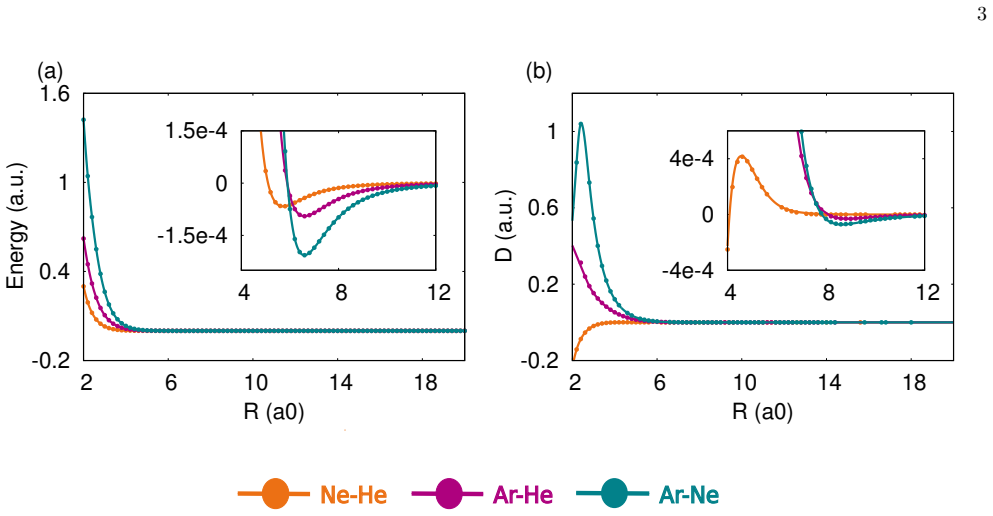
The machinery is the induced dipole surface $D(R)$ together with the classical phase-space integrand $F(R)=4\pi R^2\exp[-V(R)/k_\mathrm{B}T]D^2(R)$ (Eq. 4), which identifies the internuclear distances that actually contribute to the integrated absorption at a given temperature. The line shape itself is computed from quantum scattering wavefunctions (Eqs. 1–3), and an approximate hard-sphere/Fourier model (Eq. 7) is used to attribute spectral features to the shape of the dipole function. The zero crossing of the He–Ne dipole at $R\approx 4.2\,a_0$ plays the pivotal role: because the integrand samples this region at room temperature, the Fourier transform of the dipole produces a dip and double-peak structure that a single exponential cannot capture.
What would settle it
Recompute the full quantum spectrum including bound-bound and bound-free transitions and set $D(R)=0$ for $R>8\,a_0$; if the spectrum changes measurably, then long-range van der Waals dipoles do contribute, falsifying the central claim. A complementary experimental check is to look for the predicted dip in the room-temperature He–Ne spectrum between 200 and 600 cm−1.
Extended reading notes
Core claim
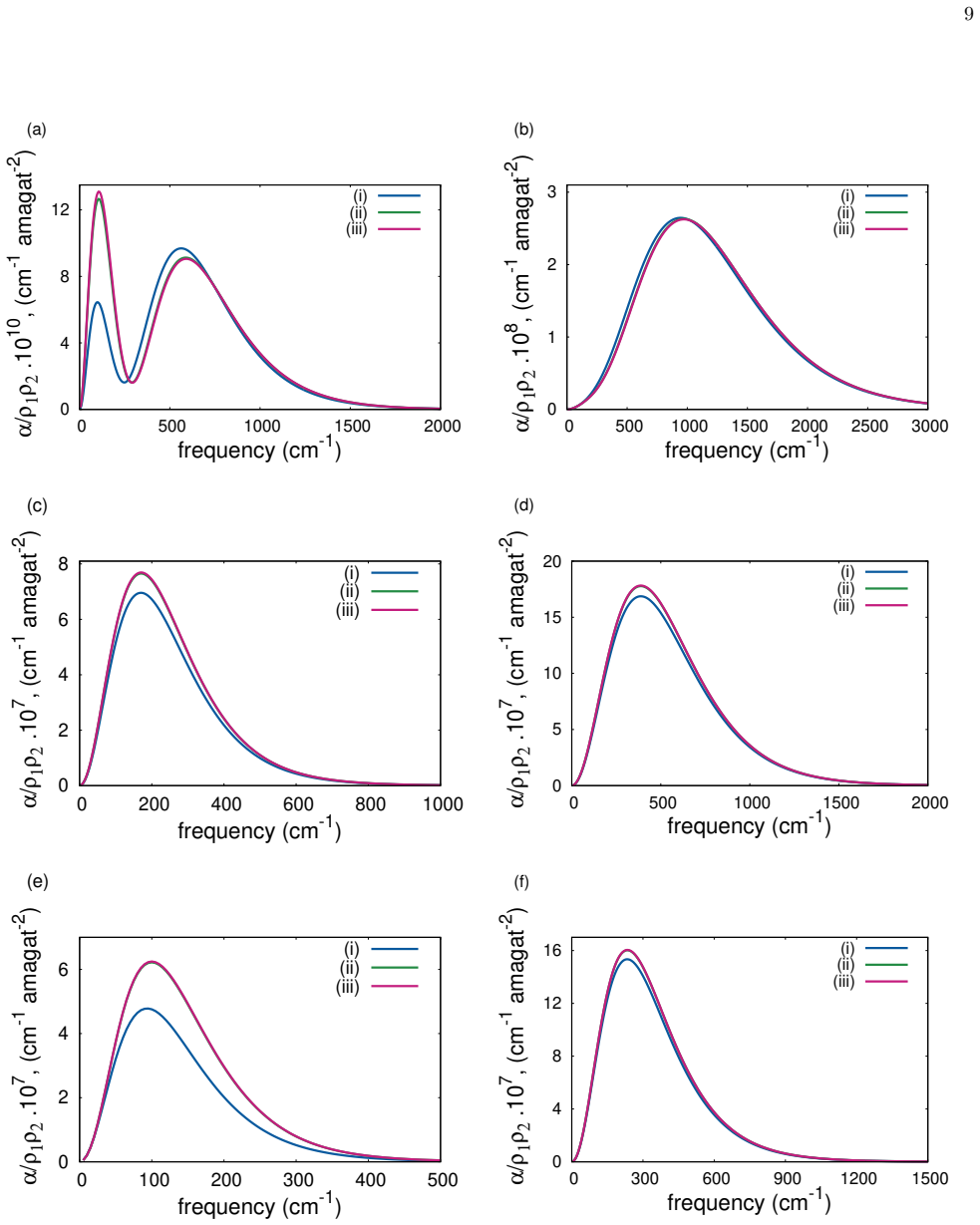
The central claim is that for the three noble-gas heterodimers, CIA spectra are largely insensitive to the chosen ab initio method and basis set: replacing the recommended CCSD(T)/CBS surfaces with the much cheaper CCSD(T)/AVTZ surfaces changes the integrated intensity by up to about 10% at 295 K, with the dipole surface responsible for most of that variation, and the differences shrink as temperature rises to 2000 K. The paper explains this through the classical phase-space integrand, which shows that the integrated intensity is dominated by a narrow window of internuclear separations — a few bohr wide, around 3–5 $a_0$ — set by the trade-off between the decay of the squared dipole and the Boltzmann suppression of the repulsive wall. Consequently, the long-range region, where the induced dipole is governed by van der Waals interactions at $R\gtrsim 8\,a_0$, never contributes to the spectra at any temperature studied. For He–Ne, the dipole function changes sign near $R=4.2\,a_0$, producing a previously unreported double-peak absorption feature that is reproduced by a double-exponential dipole model but not by a single-exponential one; a hard-sphere/Fourier analysis shows the feature is a direct consequence of the dipole's non-monotonic shape. This is taken as evidence that long-range van der Waals data are irrelevant for these spectra, and that short-range interactions are the controlling factor for astronomical CIA modeling.
Load-bearing premise
The claim that long-range van der Waals dipoles 'never contribute' rests on the assumption that the classical phase-space integrand $F(R)$ faithfully represents the internuclear distances sampled by the quantum spectrum, including the bound states and near-threshold states that are excluded from the line-shape calculations; if those quantum states sample distances beyond 8 $a_0$, the conclusion would fail.
Editorial extensions
If this is right
- CIA opacities for He–Ne, Ar–He, and Ar–Ne can be computed with low-level ab initio surfaces and still be roughly 10% accurate at room temperature, and better at higher T, so astronomical models do not have to wait for CBS-quality surfaces.
- The long-range van der Waals region of the induced dipole can be excluded from future electronic-structure calculations for these systems, since it never contributes to the spectrum.
- Short-range dipole models need to be flexible enough to capture zero crossings and other non-monotonic features; single-exponential models will fail for systems like He–Ne.
- As temperature rises, the spectra probe shorter internuclear distances on the repulsive wall, so high-temperature CIA modeling depends on accurate short-range repulsion.
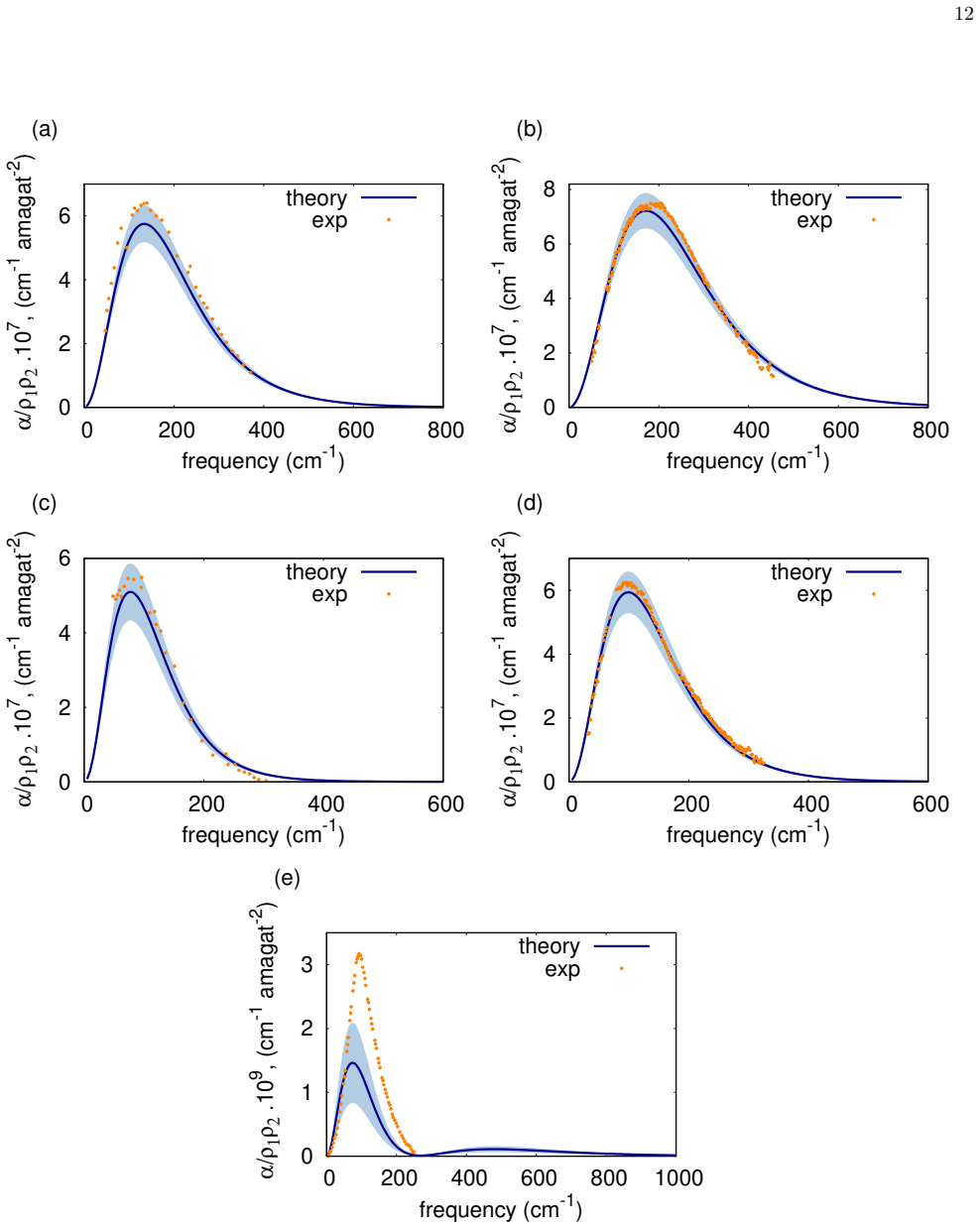
- For Ar–He and Ar–Ne, the computed spectra match experiment within the estimated uncertainty, so these calculations can directly supply absorption coefficients for atmosphere models over an expanded temperature range.
Reading between the lines
- The 'never contribute' conclusion may not carry over to other collisional pairs (e.g., H2–H2 or H2–rare-gas systems) where lighter masses and deeper potentials let bound states sample much larger distances; a similar F(R) diagnostic should be checked case by case.
- The insensitivity to the long-range dipole suggests that the main source of error in CIA theory is the functional form of the short-range dipole, so experimental tests of predicted features (like the He–Ne dip) would provide a sharper benchmark than global intensity comparisons.
- The same F(R) analysis could be used in reverse: given a target temperature and desired accuracy, one could determine the smallest ab initio grid and the largest R that needs to be computed, saving cost for high-throughput opacity databases.
- If the double-peak in He–Ne is confirmed, it would indicate that current spectral databases based on older single-exponential models may have systematic shape errors in the 200–600 cm−1 region for light gas pairs.
Editorial analysis
A structured set of objections, weighed in public.
Referee Report
Summary. The paper reports a systematic study of how the accuracy of collision-induced absorption (CIA) spectra of the noble-gas pairs Ne–He, Ar–He, and Ar–Ne depends on the quality of the underlying ab initio potential energy and induced dipole surfaces. Spectra are computed at the CCSD, CCSD(T), and estimated FCI levels with basis sets up to CBS, and the sensitivity of the spectra to the PES and IDS is quantified. The authors find that the spectra are rather insensitive to the ab initio level, with worst-case integrated-intensity differences around 10% at room temperature and smaller at high temperature, and they report a previously unnoticed double-peak structure in the Ne–He spectrum. They also argue, based on a classical phase-space integrand, that long-range van der Waals induced dipoles never contribute to the spectra. The calculated Ar–He and Ar–Ne spectra agree with experiment within estimated error bars, while the Ne–He 77 K measurement disagrees by about a factor of two.
Significance. If the central claim is correct, the paper provides an important practical message: quantitatively predictive CIA spectra for noble-gas mixtures can be obtained from relatively inexpensive electronic-structure data, and effort invested in very accurate long-range surfaces may be less important than usually assumed. The systematic convergence study is a useful contribution, the calculations are carried out without fitted parameters in the main spectral predictions, and the agreement with experiment for Ar–He and Ar–Ne lends credibility to the computational approach. However, the paper's strongest claim—that the absorption spectrum is 'never' sensitive to van der Waals distances—is not fully supported by the evidence presented, and the error-bar estimate is based on integrated intensities rather than on frequency-resolved spectral features.
major comments (3)
- [Section IV, Eq. (4), Fig. 6; Abstract; Conclusions] The claim that long-range van der Waals induced dipoles 'never contribute' rests on the classical phase-space integrand F(R) of Eq. (4), which bounds only the frequency-integrated intensity. That integrand does not directly constrain how the intensity is distributed in frequency: a small but long-ranged dipole tail can produce a narrow, low-frequency feature whose peak is noticeable even though its integrated area is small. Because the line-shape calculations explicitly exclude bound-bound transitions (Section VI) and the near-threshold bound states are dismissed as 'not expected to contribute significantly' without a demonstrated calculation (Section II), the 'never' conclusion is stronger than the evidence supports. I recommend either computing the spectra with the IDS truncated or replaced by its long-range asymptotic form beyond 8 a0 and comparing the full frequency-resolved spectra, or restricting the claim to the integrated intensity of the free-free and bound-free contributions.
- [Section IV, paragraph beginning 'We then estimate a theoretical error bar'] The approximately 10% insensitivity estimate is based on the relative difference in integrated intensities, which is then applied as an overall multiplicative scaling of the spectrum. This implicitly assumes that all uncertainty manifests as an overall intensity scale factor. It does not bound frequency-dependent shape errors, including the position and depth of the Ne–He dip that is a central new prediction. Since the paper's headline quantitative claim is about spectral accuracy, the error analysis should also report a frequency-resolved metric, such as the maximum relative difference per frequency bin between spectra computed with different PES/IDS levels.
- [Section VI, Fig. 8(e)] The Ne–He 77 K spectrum disagrees with the experimental measurement by roughly a factor of two, outside the paper's own conservative error bars. The manuscript suggests that the experimental data may be unreliable, but it does not quantitatively rule out missing physics in the calculation. In particular, Ne–He has one bound state, and bound-bound contributions are excluded from the line-shape calculation; at 77 K these could contribute at low frequencies. A quantitative estimate of the bound-bound contribution, or a discussion of why it is negligible, is needed before the conclusion that the spectrum is insensitive to ab initio data can be considered fully supported for this system.
minor comments (3)
- [Title and captions] The title has a missing space: 'insensitivity toab initio data' should be 'insensitivity to ab initio data'. In addition, the Table III and Table IV captions contain the typo 'basis stes' for 'basis sets'.
- [Section IV, text near Fig. 2 and Table I] The text states that 'the change in IDS caused a difference of around 10% at the frequency with maximum intensity,' while Table I reports relative differences in integrated intensity. Please clarify which metric is used in each comparison so the reader can properly interpret the convergence tables.
- [Eq. (5)] The notation for the soft-sphere approximation uses |kBT, 0> and |kBT + ħω, 0> as if kBT were a wavefunction label. It would be clearer to define the collision energy explicitly, e.g., E = kBT, and write |E, 0> and |E + ħω, 0>.
Circularity Check
No circularity: spectra are computed directly from independently calculated PES and IDS surfaces, and the sensitivity estimates are honest method-to-method comparisons.
full rationale
The paper's central claims rest on direct electronic-structure and scattering calculations rather than on fitted parameters or self-cited uniqueness theorems. PESs and IDSs are computed in MOLPRO at multiple levels of theory and basis sets, and CIA spectra are then obtained from the standard quantum expression in Eqs. (1)-(3) with no adjustable parameters. The sensitivity conclusions are based on comparing spectra computed with CCSD(T)/CBS against spectra computed with lower-level methods or smaller basis sets; this is a straightforward error-propagation study, not a prediction of data that were used as input. The 'long-range van der Waals dipoles never contribute' conclusion is drawn from the classical phase-space integrand F(R) in Eq. (4), which is an independent sum-rule approximation rather than a restatement of the conclusion. The double-exponential dipole model is fitted to the same ab initio dipole that produces the double-peak feature, but it is used only as an explanatory diagnostic of the line shape, not as an independent source of prediction. The few self-citations (e.g., Ref. [44] for the propagation method and Ref. [8] for HITRAN needs) are to standard techniques and data infrastructure and are not load-bearing for the paper's claims. The possible omission of bound-bound transitions is a scope or correctness concern about how broadly the 'never contribute' statement applies, not a circularity of the derivation. No fitted input is renamed as a prediction, and no uniqueness result is imported from the authors' prior work to force the conclusions. The derivation chain is therefore self-contained for what it actually computes.
Assumptions & free parameters
free parameters (3)
- double-exponential dipole fit parameters (A, B, alpha, beta) =
not reported numerically; fitted to log D(R) in regions R=2-3.6 a0 and 4.7-6 a0
- single-exponential dipole fit parameters (A, alpha) =
not reported numerically; fit to the longer-range exponential in R=4.7-6 a0
- hard-sphere radius a =
classical turning point at collision energy kBT
assumptions (6)
- standard math First-order time-dependent perturbation theory for the radiation-matter coupling.
- domain assumption Born-Oppenheimer separation of electronic and nuclear motion.
- domain assumption The classical phase-space integral, Eq. (4), is a valid sum rule for the spectral density and identifies the internuclear distances that contribute to the spectrum.
- domain assumption RKHS interpolation and extrapolation of the ab initio grid accurately represents the true PES and IDS.
- domain assumption CBS extrapolation Ec(ζ)=Ec(∞)+cζ^-3 for the correlation energy.
- domain assumption Finite-field dipole values at field strength ±0.0002 a.u. are converged.
Cite this review
Pith. "Pith review of Complete insensitivity to ab initio data -- A new perspective on modeling collision-induced absorption of noble gas atoms." pith.science (2026). https://pith.science/paper/GNAZGEFG
@misc{pith2026250622029,
  author       = {Pith},
  title        = {Pith review of: Complete insensitivity to ab initio data -- A new perspective on modeling collision-induced absorption of noble gas atoms},
  year         = {2026},
  howpublished = {\url{https://pith.science/paper/GNAZGEFG}},
  note         = {Machine review of arXiv:2506.22029}
}
read the original abstract
In this study, we systematically investigate how the accuracy of CIA spectra depends on the quality of the ab initio data used. We evaluate quantitatively the impact of different quantum chemical methods and basis sets on spectral features, finding that even the lowest-level calculations are accurate to approximately 10 % at room temperature, and better at higher temperatures. This study also reveals a previously unreported double-peak structure for the He-Ne complex, which cannot be described by simple but commonly used single-exponential models for the short-range dipole. Our analysis shows that the range of internuclear distances relevant for CIA spectra varies with temperature, with short-range interactions becoming increasingly important at high temperatures. The long-range van der Waals induced dipoles never contribute. These findings provide new insights into the temperature-dependent behavior of CIA spectra and emphasize the importance of accurate modeling of short-range interactions for reliable astronomical modeling.
Figures


Figures from the paper (7 more)




Reference graph
Works this paper leans on
- [1]
-
[2]
Z. J. Kiss and H. L. Welsh, Phys. Rev. Lett.2, 166 (1959). 9 0 4 8 12 0 500 1000 1500 2000 (a) α /ρ 1ρ 2 .1010, (cm-1 amagat-2) frequency (cm-1) (i) (ii) (iii) 0 1 2 3 0 500 1000 1500 2000 2500 3000 (b) α /ρ 1ρ 2 .108, (cm-1 amagat-2) frequency (cm-1) (i) (ii) (iii) 0 2 4 6 8 0 200 400 600 800 1000 (c) α /ρ 1ρ 2 .107, (cm-1 amagat-2) frequency (cm-1) (i) ...
work page 1959
- [3]
-
[4]
M. Abel and L. Frommhold, Canadian Journal of Physics 91, 857 (2013), https://doi.org/10.1139/cjp-2012-0532
-
[5]
Z. Slanina and A. A. Vigasin, Molecular Complexes in Earth’s, Planetary Cometary and Interstellar Atmo- spheres (World Scientific, 1998). Ne–He Ar–He Ar–Ne CCSD 9.74% 9.66% 12.84% CCSD(T) 0.61% 0.51% 0.46% TABLE V. Relative difference between integrated intensity of spectra calculated using the CCSD and CCSD(T) methods compared to the estimated FCI limit ...
work page 1998
-
[6]
C. Camy-Peyret and A. A. Vigasin, Weakly interacting molecular pairs: unconventional absorbers of radiation in the atmosphere, Vol. 27 (Springer Science & Business Media, 2003)
work page 2003
-
[7]
C. Richard, I. E. Gordon, L. S. Rothman, M. Abel, L. Frommhold, M. Gustafsson, J.-M. Hartmann, C. Her- mans, W. J. Lafferty, G. S. Orton,et al., Journal of Quan- titative Spectroscopy and Radiative Transfer 113, 1276 (2012)
work page 2012
-
[8]
T. Karman, I. E. Gordon, A. van der Avoird, Y. I. Baranov, C. Boulet, B. J. Drouin, G. C. Groenenboom, M. Gustafsson, J.-M. Hartmann, R. L. Kurucz, L. S. Rothman, K. Sun, K. Sung, R. Thalman, H. Tran, E. H. Wishnow, R. Wordsworth, A. A. Vigasin, R. Volkamer, and W. J. van der Zande, Icarus 328, 160 (2019)
work page 2019
Show all 58 references
-
[9]
El-Kader, Journal of Quantitative Spectroscopy and Radiative Transfer 112, 1533 (2011)
M. El-Kader, Journal of Quantitative Spectroscopy and Radiative Transfer 112, 1533 (2011)
2011
-
[10]
El-Kader, S
M. El-Kader, S. Mostafa, T. Bancewicz, and G. Maroulis, Chemical Physics 440, 127 (2014)
2014
-
[11]
El-Kader, G
M. El-Kader, G. Maroulis, and E. Bich, Chemical Physics 403, 37 (2012)
2012
-
[12]
Borysow, M
A. Borysow, M. Moraldi, and L. Frommhold, Journal of Quantitative Spectroscopy and Radiative Transfer 31, 235 (1984)
1984
-
[13]
Meyer and L
W. Meyer and L. Frommhold, The Journal of Chemical Physics 143, 114313 (2015)
2015
-
[14]
Fakhardji, P
W. Fakhardji, P. Szab´ o, M. El-Kader, A. Haskopoulos, G. Maroulis, and M. Gustafsson, The Journal of Chem- ical Physics 151 (2019)
2019
-
[15]
M. G. Aleksandra Borysow, Molecular physics 93, 1007 (1998)
1998
-
[16]
J. E. Bohr and K. L. C. Hunt, J. Chem. Phys. 86, 5441 (1987)
1987
-
[17]
J. E. Bohr and K. L. C. Hunt, J. Chem. Phys. 87, 3821 (1987)
1987
-
[18]
Fowler, Chemical physics 143, 447 (1990)
P. Fowler, Chemical physics 143, 447 (1990)
1990
-
[19]
T. G. Heijmen, R. Moszynski, P. E. Wormer, and A. Van Der Avoird, Mol. Phys. 89, 81 (1996)
1996
-
[20]
Meyer and L
W. Meyer and L. Frommhold, Theoretica chimica acta 88, 201 (1994)
1994
-
[21]
D. M. Bishop and J. Pipin, J. Chem. Phys. 98, 4003 (1993)
1993
-
[22]
Fowler, Chem
P. Fowler, Chem. Phys. Letters 171, 277 (1990)
1990
-
[23]
Galatry and T
L. Galatry and T. Gharbi, Chemical Physics Letters 75, 427 (1980)
1980
-
[24]
W. B. Brown and D. Whisnant, Molecular Physics 25, 1385 (1973)
1973
-
[25]
Whisnant and W
D. Whisnant and W. Byers Browns, Molecular Physics 26, 1105 (1973)
1973
-
[26]
Matcha and R
R. Matcha and R. Nesbet, Physical Review 160, 72 (1967)
1967
-
[27]
Lacey and W
A. Lacey and W. B. Brown, Molecular Physics 27, 1013 (1974)
1974
-
[28]
Birnbaum, M
G. Birnbaum, M. Krauss, and L. Frommhold, The Jour- nal of chemical physics 80, 2669 (1984)
1984
-
[29]
Meyer and L
W. Meyer and L. Frommhold, Physical Review A 33, 3807 (1986)
1986
-
[30]
McQuarrie and R
D. McQuarrie and R. Bernstein, The Journal of Chemical Physics 49, 1958 (1968)
1968
-
[31]
Meyer and L
W. Meyer and L. Frommhold, The Journal of Chemical Physics 143 (2015)
2015
-
[32]
El-Kader and G
M. El-Kader and G. Maroulis, Journal of Computational Methods in Sciences and Engineering 21, 577 (2021)
2021
-
[33]
Werner and P
molpro15, MOLPRO is a package of ab initio programs written by H.-J. Werner and P. J. Knowles, with contri- butions from J. Alml¨ of, R. D. Amos, A. Berning, D. L. Cooper, M. J. O. Deegan, A. J. Dobbyn, F. Eckert, S. T. Elbert, C. Hampel, R. Lindh, A. W. Lloyd, W. Meyer, A. Ni...
-
[34]
Fern´ andez and H
B. Fern´ andez and H. Koch, The Journal of chemical physics 109, 10255 (1998)
1998
-
[35]
S. F. Boys and F. Bernardi, Molecular physics 19, 553 (1970)
1970
-
[36]
Halkier, T
A. Halkier, T. Helgaker, P. Jørgensen, W. Klopper, H. Koch, J. Olsen, and A. K. Wilson, Chemical Physics Letters 286, 243 (1998)
1998
-
[37]
Ho and H
T.-S. Ho and H. Rabitz, The Journal of chemical physics 104, 2584 (1996). 14
1996
-
[38]
S. M. Cybulski and R. R. Toczy lowski, The Journal of Chemical Physics 111, 10520 (1999)
1999
-
[39]
L´ opez Cacheiro, B
J. L´ opez Cacheiro, B. Fern´ andez, D. Marchesan, S. Co- riani, C. H¨ attig, and A. Rizzo, Molecular Physics 102, 101 (2004)
2004
-
[40]
G. C. Groenenboom and D. T. Colbert, The Journal of chemical physics 99, 9681 (1993)
1993
-
[41]
Tang and J
K. Tang and J. P. Toennies, The Journal of chemical physics 80, 3726 (1984)
1984
-
[42]
Hunt, Chemical Physics Letters 70, 336 (1980)
K. Hunt, Chemical Physics Letters 70, 336 (1980)
1980
-
[43]
Collision-induced absorption in gases,
L. Frommhold, “Collision-induced absorption in gases,” (Cambridge University Press, 1994) p. x–xii
1994
-
[44]
Karman, A
T. Karman, A. van der Avoird, and G. C. Groenenboom, The Journal of Chemical Physics 142 (2015)
2015
-
[45]
Johnson, The Journal of Chemical Physics 69, 4678 (1978)
B. Johnson, The Journal of Chemical Physics 69, 4678 (1978)
1978
-
[46]
Buryak, S
I. Buryak, S. Lokshtanov, and A. Vigasin, The Journal of Chemical Physics 137 (2012)
2012
-
[47]
D. Z. Goodson, The Journal of chemical physics 116, 6948 (2002)
2002
-
[48]
H. B. Levine and G. Birnbaum, Physical Review 154, 86 (1967)
1967
-
[49]
Marteau, J
P. Marteau, J. Obriot, and F. Fondere, Canadian journal of physics 64, 822 (1986)
1986
-
[50]
Sharma and R
R. Sharma and R. Hart, Chemical Physics Letters 27, 589 (1974)
1974
-
[51]
Tanimoto, Progress of Theoretical Physics 33, 585 (1965)
O. Tanimoto, Progress of Theoretical Physics 33, 585 (1965)
1965
-
[52]
D. R. Bosomworth and H. P. Gush, Canadian Journal of Physics 43, 751 (1965), https://doi.org/10.1139/p65- 074
1965 doi
-
[53]
Bosomworth and H
D. Bosomworth and H. Gush, Canadian Journal of Physics 43, 729 (1965)
1965
-
[54]
Bukhtoyarova and M
V. Bukhtoyarova and M. Tonkov, Optics and Spec- troscopy 43, 27 (1977)
1977
-
[55]
Bukhtoyarova and M
V. Bukhtoyarova and M. Tonkov, Optics and Spec- troscopy 43, 133 (1977)
1977
-
[56]
Bukhtoyarova and M
V. Bukhtoyarova and M. Tonkov, Optics and Spec- troscopy 42, 14 (1977)
1977
-
[57]
H. B. Levine, Physical Review 160, 159 (1967)
1967
-
[58]
Vigasin, Journal of Molecular Spectroscopy 224, 185 (2004)
A. Vigasin, Journal of Molecular Spectroscopy 224, 185 (2004)
2004
Reviewed August 6, 2026 · model on record in the stance chip above.
Discussion (0). Continue with ORCID to comment.