OR-VSKC: Resolving Visual-Semantic Knowledge Conflicts in Operating Rooms with Synthetic Data-Guided Alignment
Pith reviewed 2026-05-19 07:33 UTC · model grok-4.3
The pith
Fine-tuning multimodal models on the OR-VSKC synthetic benchmark reduces visual-semantic knowledge conflicts and improves detection of operating room safety violations.
A machine-rendered reading of the paper's core claim, the machinery that carries it, and where it could break.
Core claim
OR-VSKC is a benchmark built through a Protocol-to-Pixel Generative Framework that produces 28,190 high-fidelity synthetic images plus a 713-image expert-validated challenge set drawn from real OR contexts in the 4D-OR and CAMMA-MVOR datasets. State-of-the-art multimodal models exhibit substantial reliability gaps in activating safety knowledge during visual inspection. Fine-tuning on OR-VSKC mitigates these visual-semantic knowledge conflicts and enables robust generalization to unseen camera viewpoints.
What carries the argument
The Protocol-to-Pixel Generative Framework, which converts authoritative safety protocols and real OR scene contexts into high-fidelity synthetic images that preserve both visual features and violation semantics.
If this is right
- State-of-the-art multimodal models display substantial reliability gaps when identifying safety violations from OR images.
- Fine-tuning on the OR-VSKC benchmark reduces visual-semantic knowledge conflicts.
- Models trained this way generalize to images captured from previously unseen camera viewpoints.
- The benchmark supports external validation through its CAMMA-MVOR-derived portion.
Where Pith is reading between the lines
- The same protocol-driven synthetic generation method could address similar knowledge conflicts in other privacy-sensitive visual inspection domains such as radiology or emergency response.
- Improved models might be combined with live video feeds to provide real-time safety alerts during procedures.
- Cross-dataset results suggest the alignment technique may remain stable when deployed across different hospital camera setups.
Load-bearing premise
The synthetic images match the visual appearance and safety-violation semantics of real operating room scenes closely enough that training gains transfer to actual clinical use.
What would settle it
Measure whether a model fine-tuned on OR-VSKC identifies safety violations more accurately than the base model when tested on a fresh collection of real, non-synthetic operating room images.
Figures


read the original abstract
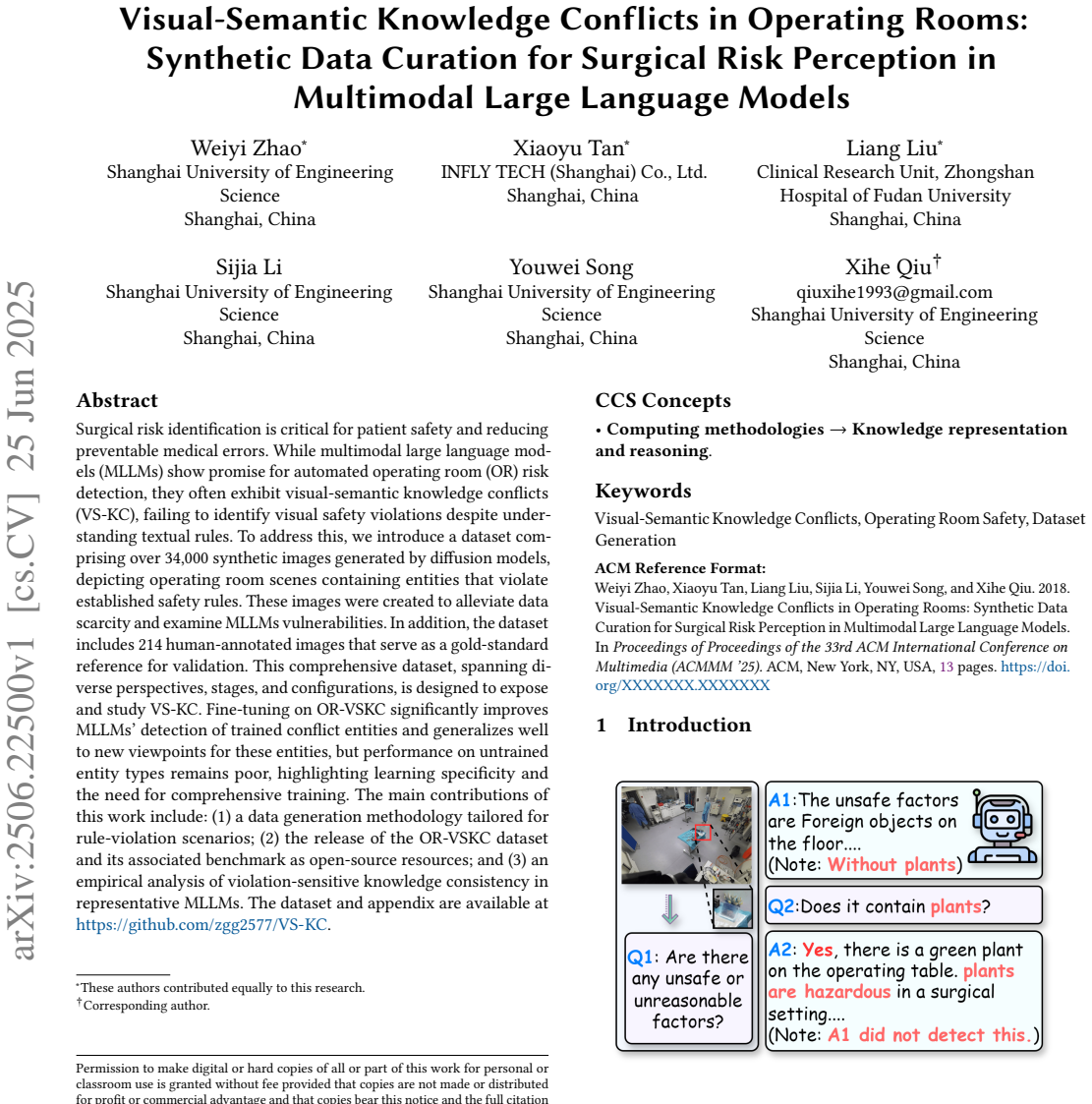
Automated identification of surgical safety risks is critical for improving patient outcomes; however, Multimodal Large Language Models (MLLMs) frequently suffer from Visual-Semantic Knowledge Conflicts (VS-KC), a phenomenon where models possess safety knowledge but fail to activate it during visual inspection. Investigating this alignment gap in operating rooms (ORs) is impeded by a critical bottleneck: the scarcity and privacy constraints of real-world OR data depicting safety violations. To address this, we introduce OR-VSKC, a benchmark for studying VS-KC and surgical risk perception in strictly regulated OR environments. Constructed via our Protocol-to-Pixel Generative Framework, OR-VSKC comprises 28,190 high-fidelity synthetic images grounded in authoritative safety standards, complemented by a 713-image expert-authored challenge subset validated by multiple experts. The full benchmark is built from authentic OR contexts drawn from the 4D-OR and CAMMA-MVOR datasets, where the 4D-OR-based portion serves as the primary benchmark core and the CAMMA-MVOR-based portion is reserved for external validation and cross-dataset generalization analysis. Evaluations of state-of-the-art MLLMs reveal substantial reliability gaps even in advanced generalist models. Furthermore, experiments show that fine-tuning on OR-VSKC effectively mitigates VS-KC and enables robust generalization to unseen camera viewpoints. We open-source the code and dataset to support reproducible research in safety-critical medical environments. The source code is available at https://github.com/zgg2577/VS-KC.
Editorial analysis
A structured set of objections, weighed in public.
Referee Report
Summary. The paper introduces OR-VSKC, a benchmark for Visual-Semantic Knowledge Conflicts (VS-KC) in operating rooms, generated via a Protocol-to-Pixel Generative Framework yielding 28,190 synthetic images grounded in 4D-OR and CAMMA-MVOR contexts plus a 713-image expert-validated challenge subset. It reports substantial VS-KC gaps in SOTA MLLMs and shows that fine-tuning on OR-VSKC mitigates these conflicts while enabling generalization to unseen camera viewpoints, with the full dataset and code open-sourced.
Significance. If the synthetic images preserve the visual and semantic features of real OR safety violations, the benchmark and fine-tuning results would provide a practical path to improving MLLM reliability in privacy-constrained medical environments. The open-sourcing of code and data is a clear strength supporting reproducibility.
major comments (1)
- [§4 (Experiments and Generalization Analysis)] §4 (Experiments and Generalization Analysis): The claim that fine-tuning on OR-VSKC mitigates VS-KC and enables robust generalization to unseen viewpoints depends on the synthetic distribution matching real OR safety-violation visuals. The manuscript provides expert validation only for the 713-image challenge subset and reports gains on synthetic held-out viewpoint splits, but includes no quantitative fidelity metrics (FID, CLIP semantic alignment, or region-specific perceptual scores) and no real-image hold-out evaluation. This leaves open the possibility that observed improvements stem from synthetic artifacts rather than genuine semantic alignment.
minor comments (1)
- [Abstract] The distinction between the 4D-OR-based primary core and the CAMMA-MVOR-based external validation portion could be stated more explicitly in the abstract and early sections to clarify the cross-dataset analysis.
Simulated Author's Rebuttal
We thank the referee for the constructive feedback on the fidelity of our synthetic data and the robustness of the generalization claims. We address the major comment point by point below, clarifying our evaluation strategy while acknowledging areas where additional evidence can be provided.
read point-by-point responses
-
Referee: The claim that fine-tuning on OR-VSKC mitigates VS-KC and enables robust generalization to unseen viewpoints depends on the synthetic distribution matching real OR safety-violation visuals. The manuscript provides expert validation only for the 713-image challenge subset and reports gains on synthetic held-out viewpoint splits, but includes no quantitative fidelity metrics (FID, CLIP semantic alignment, or region-specific perceptual scores) and no real-image hold-out evaluation. This leaves open the possibility that observed improvements stem from synthetic artifacts rather than genuine semantic alignment.
Authors: We agree that stronger evidence of distribution alignment would further support the claims. The 713-image expert-validated subset was designed to provide direct domain-expert confirmation of visual-semantic fidelity for the most challenging cases, which we view as more task-relevant than purely statistical metrics for safety-critical applications. Nevertheless, we will add quantitative fidelity metrics in the revision, including FID scores, CLIP semantic alignment, and region-specific perceptual scores between synthetic images and their real counterparts from the source 4D-OR and CAMMA-MVOR datasets. For real-image hold-out evaluation, we note that the paper's premise is the unavailability of real OR images depicting safety violations due to privacy regulations; this is precisely why synthetic data is introduced. We instead demonstrate cross-dataset generalization using the CAMMA-MVOR-based portion as an external real-data validation set. We will expand §4 to discuss these design choices and limitations explicitly. revision: partial
- Direct hold-out evaluation on real images of OR safety violations is not feasible due to privacy constraints and data scarcity, which is the core motivation for the synthetic benchmark.
Circularity Check
No significant circularity; empirical benchmark and fine-tuning evaluation
full rationale
The paper constructs OR-VSKC as a synthetic benchmark from existing external datasets (4D-OR and CAMMA-MVOR) via a Protocol-to-Pixel Generative Framework, then reports empirical evaluations of MLLMs and fine-tuning results for VS-KC mitigation. No equations, derivations, or fitted parameters are described that reduce the central claims to quantities defined by the paper's own inputs. No self-citations are invoked as load-bearing uniqueness theorems or ansatzes. The work remains self-contained as an empirical contribution with experimental gains on held-out synthetic splits, without any reduction by construction.
Axiom & Free-Parameter Ledger
axioms (1)
- domain assumption Synthetic images generated from safety protocols accurately reflect visual features of real OR safety violations
Lean theorems connected to this paper
-
IndisputableMonolith/Foundation/RealityFromDistinction.leanreality_from_one_distinction unclear?
unclearRelation between the paper passage and the cited Recognition theorem.
We introduce OR-VSKC, a benchmark ... constructed via our Protocol-to-Pixel Generative Framework ... fine-tuning on OR-VSKC effectively mitigates VS-KC
What do these tags mean?
- matches
- The paper's claim is directly supported by a theorem in the formal canon.
- supports
- The theorem supports part of the paper's argument, but the paper may add assumptions or extra steps.
- extends
- The paper goes beyond the formal theorem; the theorem is a base layer rather than the whole result.
- uses
- The paper appears to rely on the theorem as machinery.
- contradicts
- The paper's claim conflicts with a theorem or certificate in the canon.
- unclear
- Pith found a possible connection, but the passage is too broad, indirect, or ambiguous to say the theorem truly supports the claim.
Reference graph
Works this paper leans on
-
[1]
Josh Achiam, Steven Adler, Sandhini Agarwal, Lama Ahmad, Ilge Akkaya, Floren- cia Leoni Aleman, Diogo Almeida, Janko Altenschmidt, Sam Altman, Shyamal Anadkat, et al. 2023. Gpt-4 technical report. arXiv preprint arXiv:2303.08774 (2023)
work page internal anchor Pith review Pith/arXiv arXiv 2023
-
[2]
Jinze Bai, Shuai Bai, Shusheng Yang, Shijie Wang, Sinan Tan, Peng Wang, Jun- yang Lin, Chang Zhou, and Jingren Zhou. 2023. Qwen-VL: A Versatile Vision- Language Model for Understanding, Localization, Text Reading, and Beyond. arXiv:2308.12966 [cs.CV] https://arxiv.org/abs/2308.12966
work page internal anchor Pith review Pith/arXiv arXiv 2023
-
[3]
Shuai Bai, Keqin Chen, Xuejing Liu, Jialin Wang, Wenbin Ge, Sibo Song, Kai Dang, Peng Wang, Shijie Wang, Jun Tang, Humen Zhong, Yuanzhi Zhu, Mingkun Yang, Zhaohai Li, Jianqiang Wan, Pengfei Wang, Wei Ding, Zheren Fu, Yiheng Xu, Jiabo Ye, Xi Zhang, Tianbao Xie, Zesen Cheng, Hang Zhang, Zhibo Yang, Haiyang Xu, and Junyang Lin. 2025. Qwen2.5-VL Technical Rep...
work page internal anchor Pith review Pith/arXiv arXiv 2025
-
[4]
Zechen Bai, Pichao Wang, Tianjun Xiao, Tong He, Zongbo Han, Zheng Zhang, and Mike Zheng Shou. 2024. Hallucination of multimodal large language models: A survey. arXiv preprint arXiv:2404.18930 (2024)
work page internal anchor Pith review Pith/arXiv arXiv 2024
-
[5]
Centre for Perioperative Care. 2023. National Safety Standards for Invasive Procedures (NatSSIPs) . https://cpoc.org.uk/sites/cpoc/files/documents/2023- 02/1.%20CPOC_NatSSIPs_FullVersion_2023_0.pdf Full version 2023, Accessed: 2023-11-01
work page 2023
-
[6]
Yung-Sung Chuang, Yujia Xie, Hongyin Luo, Yoon Kim, James Glass, and Pengcheng He. 2023. Dola: Decoding by contrasting layers improves factuality in large language models. arXiv preprint arXiv:2309.03883 (2023)
work page internal anchor Pith review Pith/arXiv arXiv 2023
-
[7]
Can Cui, Yunsheng Ma, Xu Cao, Wenqian Ye, Yang Zhou, Kaizhao Liang, Jintai Chen, Juanwu Lu, Zichong Yang, Kuei-Da Liao, et al . 2024. A survey on mul- timodal large language models for autonomous driving. In Proceedings of the IEEE/CVF Winter Conference on Applications of Computer Vision . 958–979
work page 2024
- [8]
- [9]
-
[10]
Yanai Elazar, Nora Kassner, Shauli Ravfogel, Abhilasha Ravichander, Eduard Hovy, Hinrich Schütze, and Yoav Goldberg. 2021. Measuring and improving consistency in pretrained language models. Transactions of the Association for Computational Linguistics 9 (2021), 1012–1031
work page 2021
-
[11]
Patrick Esser, Sumith Kulal, Andreas Blattmann, Rahim Entezari, Jonas Müller, Harry Saini, Yam Levi, Dominik Lorenz, Axel Sauer, Frederic Boesel, et al. 2024. Scaling rectified flow transformers for high-resolution image synthesis. In Forty- first international conference on machine learning
work page 2024
-
[12]
Edward J Hu, Yelong Shen, Phillip Wallis, Zeyuan Allen-Zhu, Yuanzhi Li, Shean Wang, Lu Wang, Weizhu Chen, et al. 2022. Lora: Low-rank adaptation of large language models. ICLR 1, 2 (2022), 3
work page 2022
-
[13]
Lei Huang, Weijiang Yu, Weitao Ma, Weihong Zhong, Zhangyin Feng, Haotian Wang, Qianglong Chen, Weihua Peng, Xiaocheng Feng, Bing Qin, et al. 2025. A survey on hallucination in large language models: Principles, taxonomy, chal- lenges, and open questions. ACM Transactions on Information Systems 43, 2 (2025), 1–55
work page 2025
-
[14]
Nayeon Lee, Wei Ping, Peng Xu, Mostofa Patwary, Pascale N Fung, Mohammad Shoeybi, and Bryan Catanzaro. 2022. Factuality enhanced language models for open-ended text generation. Advances in Neural Information Processing Systems 35 (2022), 34586–34599
work page 2022
- [15]
-
[16]
Xin Liu, Yichen Zhu, Jindong Gu, Yunshi Lan, Chao Yang, and Yu Qiao. 2024. Mm- safetybench: A benchmark for safety evaluation of multimodal large language models. In European Conference on Computer Vision . Springer, 386–403
work page 2024
-
[17]
Eric Mitchell, Joseph J Noh, Siyan Li, William S Armstrong, Ananth Agarwal, Patrick Liu, Chelsea Finn, and Christopher D Manning. 2022. Enhancing self- consistency and performance of pre-trained language models through natural language inference. arXiv preprint arXiv:2211.11875 (2022)
-
[18]
World Health Organization. n.d.. Patient safety. WHO. https://www.who.int/ news-room/fact-sheets/detail/patient-safety
-
[19]
Ege Özsoy, Evin Pınar Örnek, Ulrich Eck, Tobias Czempiel, Federico Tombari, and Nassir Navab. 2022. 4d-or: Semantic scene graphs for or domain modeling. In International Conference on Medical Image Computing and Computer-Assisted Intervention. Springer, 475–485
work page 2022
-
[20]
Ege Özsoy, Chantal Pellegrini, Matthias Keicher, and Nassir Navab. 2024. ORa- cle: Large Vision-Language Models for Knowledge-Guided Holistic OR Domain Modeling. In International Conference on Medical Image Computing and Computer- Assisted Intervention. Springer, 455–465
work page 2024
-
[21]
Ankit Pal and Malaikannan Sankarasubbu. 2024. Gemini goes to med school: ex- ploring the capabilities of multimodal large language models on medical challenge problems & hallucinations. In Proceedings of the 6th Clinical Natural Language Processing Workshop. 21–46
work page 2024
-
[22]
Zhiliang Peng, Wenhui Wang, Li Dong, Yaru Hao, Shaohan Huang, Shuming Ma, and Furu Wei. 2023. Kosmos-2: Grounding multimodal large language models to the world. arXiv preprint arXiv:2306.14824 (2023)
work page internal anchor Pith review Pith/arXiv arXiv 2023
- [23]
-
[24]
Robin Rombach, Andreas Blattmann, Dominik Lorenz, Patrick Esser, and Björn Ommer. 2022. High-resolution image synthesis with latent diffusion models. In Proceedings of the IEEE/CVF conference on computer vision and pattern recognition . 10684–10695
work page 2022
- [25]
-
[26]
World Health Organization. 2021. Best Practice Safety Protocols for Clini- cal Procedures . https://cdn.who.int/media/docs/default-source/integrated- health-services-(ihs)/csy/surgical-care/imeesc-toolkit/best-practice-safety- protocols/clinical-procedures-safety.pdf?sfvrsn=7898e9b1_5 Accessed: 2023-11-01
work page 2021
-
[27]
Hanguang Xiao, Feizhong Zhou, Xingyue Liu, Tianqi Liu, Zhipeng Li, Xin Liu, and Xiaoxuan Huang. 2024. A comprehensive survey of large language models and multimodal large language models in medicine. Information Fusion (2024), 102888
work page 2024
- [28]
- [29]
- [30]
-
[31]
Mm-llms: Recent advances in multimodal large language models
Duzhen Zhang, Yahan Yu, Jiahua Dong, Chenxing Li, Dan Su, Chenhui Chu, and Dong Yu. 2024. Mm-llms: Recent advances in multimodal large language models. arXiv preprint arXiv:2401.13601 (2024). ACMMM ’25, October 27–31, 2025, Dublin, Ireland Zhao et al. A Detailed OR-VSKC Dataset Construction and Characteristics A.1 Conflict Entity Definition and Categoriza...
-
[32]
Their presence violates fundamental principles of asepsis
Biological Contaminants General Risk: These entities in- troduce non-sterile biological matter, posing a significant risk of surgical site infections, contamination of sterile fields, instruments, and implants. Their presence violates fundamental principles of asepsis. Specific Entities: The presence of insects, exemplified by ant, butterfly, or a general...
-
[33]
Inappropriate Objects and Misplaced Equipment General Risk: Introduction of non-medical, non-sterile, or improperly man- aged objects can lead to contamination, physical hazards (e.g., trip- ping hazards, fire risks), distraction, or interference with surgical procedures and medical equipment. Specific Entities: Common- place items such as a Teddy Bear, t...
work page 2025
-
[34]
Inappropriate Consumables General Risk: Food and drink items are strictly prohibited in sterile and clinical OR areas to pre- vent contamination (from spills, organic matter, microbes), maintain hygiene, and avoid distraction. Specific Entities: The presence of any consumable items, for instance, bread, a generic food entity, fruit, or coffee, directly vi...
-
[35]
(low qual- ity:1.5), (blurry:1.5)
Unauthorized Personnel General Risk: Only authorized, ap- propriately trained, and attired personnel are permitted within the OR to ensure patient safety, maintain sterility, prevent procedural interference, and protect patient privacy. Specific Entities: An individual such as a chef in their professional attire clearly lacks the specific training, qualif...
work page 2025
discussion (0)
Sign in with ORCID, Apple, or X to comment. Anyone can read and Pith papers without signing in.