REVIEW 2 major objections 4 minor 84 references
Protein Drift-Diffusion in Membranes with Non-equilibrium Fluctuations arising from Gradients in Concentration or Temperature
T0 review · 2 major / 4 minor · reviewed 2026-08-06 · deepseek-v4-flash
Pith's one-line read A hybrid stochastic model whose noises are derived from the dissipative operators themselves gives self-consistent protein drift-diffusion coupled to fluctuating concentration and temperature fields.
desk verdict A novel SELM extension to thermal and concentration gradients, but the key GENERIC operator in Appendix A contradicts the stated membrane-temperature equation, so the fluctuation-dissipation claim does not hold as printed. read the letter →
The pith
A machine-rendered reading of the paper's core claim, the machinery that carries it, and where it could break.
The reading
What carries the argument
The load-bearing object is a set of three dissipative operators, $K^{(1)}$, $K^{(2)}$, $K^{(3)}$, together with the fluctuation-dissipation relation $B^{(j)}B^{(j),T} = 2k_B K^{(j)}$ that derives the stochastic driving fields from them. $K^{(1)}$ encodes the protein's overdamped motion and its thermal exchange with the interface; $K^{(2)}$ encodes diffusion of the concentration field, thermal conduction in the membrane, and their coupling; $K^{(3)}$ encodes heat exchange between the protein, the interface, and the membrane. Because each noise term is built from the same operator that gives the corresponding deterministic term, the fluctuations and the dissipation stay in balance even when the fields are spatially varying. On the numerical side, the machinery is completed by a finite-volume discretization with the discrete gradient being the negative adjoint of the discrete divergence, and by a two-stage stochastic integrator that reuses the same Wiener increments in both stages so the noise-induced drift is handled consistently.
What would settle it
Use the paper's own operator recipe: combine the three dissipative operators $K^{(1)}$, $K^{(2)}$, $K^{(3)}$ to compute the deterministic dynamics they imply, and check term by term whether those dynamics match the governing equations; if any term of the concentration or membrane-temperature equation fails to reappear, the fluctuation amplitudes are inconsistent with the modeled dynamics. A complementary experimental falsifier would be to place a well-characterized Brownian particle in a steady, known temperature gradient, measure its position and local temperature increments, and compare their covariance with the prediction forced by $B^{(j)}B^{(j),T} = 2k_B K^{(j)}$.
Extended reading notes
Core claim
On the paper's own terms, the discovery is a way of writing the protein-membrane system in which the statistics of every fluctuation is forced to match the physics of the corresponding dissipation. The model has five state components: the protein position $X$, the concentration field $q$, the protein temperature $\theta_P$, the interfacial temperature $\theta_I$, and the membrane temperature field $\theta_C$. The protein moves by overdamped Langevin dynamics with a mobility $M_{XX}$; the concentration field obeys a fluctuating advection-diffusion equation driven by the protein's chemical potential; and the temperature variables satisfy heat-exchange equations whose deterministic terms include mechanical work done by the protein and chemical fluxes. The noise amplitudes in all of these are obtained from the relation $B^{(j)}B^{(j),T} = 2k_B K^{(j)}$, where the $K^{(j)}$ are the operators describing the irreversible exchanges, which is what makes the model self-consistent rather than a set of equations with ad hoc noises. The paper then demonstrates the scheme on concentration-gradient-driven positioning, thermal-gradient sensing under fluctuations, and hot Brownian motion in energy wells, reporting that stronger external heating reduces well-escape times and that the escape time becomes dominated by how quickly the particle heats up once heating is strong.
Load-bearing premise
The entire derivation rests on the claim that the three dissipative operators written in the appendix are exactly the irreversible parts of the governing equations; the paper asserts this correspondence rather than demonstrating it step by step, so if any operator is mis-specified the noise it generates would not match the dynamics it is meant to model.
Editorial extensions
If this is right
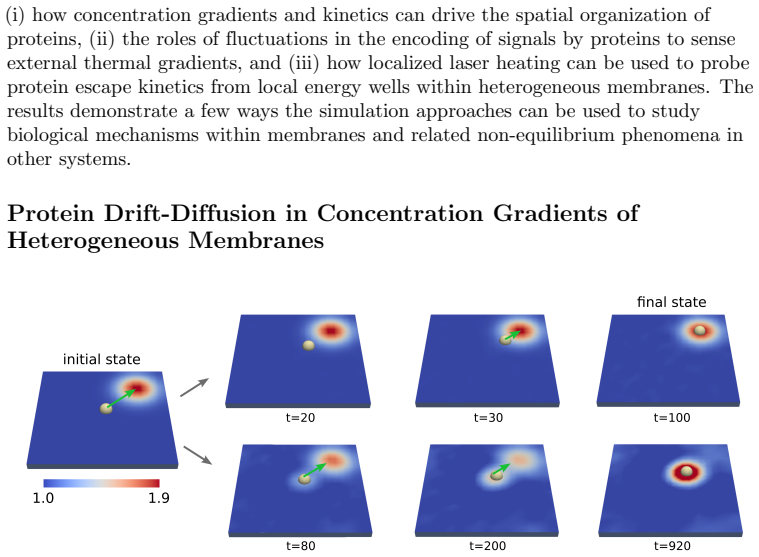
- Protein positioning in a concentration gradient is controlled by the ratio of the signaling molecule's diffusion time scale to the protein's motion time scale: fast-diffusing signals migrate to the protein, slow ones let the protein move to the signal, and intermediate cases meet between the two starting points.
- An array of thermal-sensing proteins can recover a spatial temperature gradient that is hidden by fluctuations, provided downstream reaction chemistry time-averages the local temperature signal; too much filtering suppresses the resolvable gradient while too little leaves noise, so sensing involves a real trade-off.
- Localized heating in an energy well reduces protein escape times, and when heating is strong the escape kinetics become controlled by how quickly the particle heats to the point where $k_B T$ is comparable to the barrier height, with only weak dependence on well depth.
- Because the protein, concentration, and temperature fields evolve together, the method can capture effects that reduced single-particle descriptions miss, such as a hot protein locally heating membrane regions it has visited and thereby altering its own later escape kinetics.
- The same construction is intended to transfer to other biological systems and soft materials where particle drift-diffusion couples to energy and mass exchange, not just to the membrane-protein examples used for demonstration.
Reading between the lines
- The covariance check reported for one parameter set could be turned into a quantitative test of the central claim by comparing the joint position-temperature covariance of a hot Brownian particle against experiments with independently measured mobilities and thermal conductivities.
- The framework extends naturally to reaction-driven heating: making the heat source in the temperature equations depend on a local reaction rate would cover catalytic enzymes and self-thermophoretic particles without changing the operator-based derivation of the noises.
- Because the paper notes that mean-square displacement is an ambiguous descriptor out of equilibrium, a useful follow-up would be to convert the first-passage escape times into a position-dependent renormalized diffusivity and test whether that diffusivity carries memory from the particle's heating history.
- If the correspondence between the dissipative operators and the deterministic equations were checked automatically during model construction, the same recipe could be applied to other soft-matter systems, such as active fluids or curved membranes, with noises obtained from the relation $B^{(j)}B^{(j),T} = 2k_B K^{(j)}$ each time.
Signed reviews
Editorial analysis
A structured set of objections, weighed in public.
Referee Report
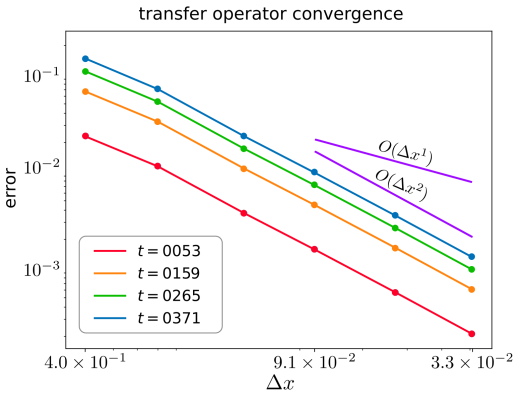
Summary. The manuscript develops a GENERIC-based stochastic hybrid model that couples a discrete protein position X to a fluctuating concentration field q and three temperature variables (protein temperature θP, membrane temperature field θC, and interfacial temperature θI). Fluctuations are generated from dissipative operators K^(j) via the fluctuation-dissipation relation B^(j)B^(j),T = 2kB K^(j), with analytic factorizations for efficient sampling. The numerical discretization is tested with a heat-equation convergence study (second-order) and a covariance test (error 6.8e-9). Three applications are presented: protein localization in concentration gradients, thermal-gradient sensing with a temporal filter, and escape kinetics from energy wells under local heating that yields hot Brownian motion.
Significance. If the construction were internally consistent, the framework would be a valuable contribution to non-equilibrium membrane simulation: it couples particle and field fluctuations while preserving a GENERIC structure, and the numerical validation is strong (second-order convergence; covariance error 6.8e-9), with the methodology described in sufficient detail to be reproduced. The applications are plausible demonstrations of the intended physics, but they are qualitative rather than quantitative biological predictions. The paper's central claim of self-consistency is, however, not supported by the printed equations because the dissipative operator K^(2) does not match the deterministic dynamics of Eq. (3); this must be resolved before the manuscript can be assessed.
major comments (2)
- [Appendix A, Eq. (31) vs Eq. (3)] Direct substitution of K^(2) from Eq. (31) and DS from Eq. (15) into Eq. (6) gives, for the θC component, +c0 ∇Φ : ¯κ ∇q / cC and c0 q ¯κ |∇Φ|^2 / (cC θC), with ¯κ = θC/γ. Equation (3) instead has −c0 ∇Φ : ¯κ ∇q / cC and c0^2 |∇Φ|^2 / (γ cC). The concentration-coupling term has the opposite sign and the mechanical-heating term differs by a factor c0/q. Because the stochastic fields are defined through B^(j)B^(j),T = 2kB K^(j) in Eq. (7), the simulated fluctuations are consistent with a deterministic model different from Eqs. (1)–(4). This contradicts the statement that Appendix A provides the operators for the model in equations 1–3 and undermines the central self-consistency claim.
- [Appendix C, Figs. 9–10] The numerical validation does not test the mapping from K^(j) to Eqs. (1)–(4). Figure 9 verifies second-order convergence for the scalar heat equation only, and Figure 10 verifies that the sampled increments reproduce the covariance 2kB K^(j) of the discretized operators. Neither test can detect a sign or factor error in K^(2) itself. Once the inconsistency in Major Comment 1 is resolved, the authors should add a direct comparison between Σ_j K^(j) DS and the deterministic right-hand sides of Eqs. (1)–(4).
minor comments (4)
- [Results, Figs. 4 and 8] Figures 4 and 8 do not report error bars or the number of independent realizations; for stochastic simulations these are needed to judge whether the reported differences (e.g., in escape times) are statistically significant.
- [Appendix B, Eq. (39)] Equation (39) reads h(2) = R1ξ1, which appears to be a typo for h(2) = R^(2)ξ^(2); please correct this to avoid confusion with h(1) in Eq. (37).
- [Appendix A, Eq. (31)] The block notation in Eq. (31) is ambiguous: the θC,θC entry appears to combine the operator −∇·(κ0θC^2∇)/cC with a multiplication by θC, and the □ convention for operator action is not defined precisely; please specify exactly how each block acts on the entropy-gradient input fields.
- [Abstract] There are minor grammatical errors (e.g., 'phenomena arises' in the Abstract) that should be corrected during copyediting.
Circularity Check
No significant circularity: the GENERIC construction fixes fluctuations from the dissipative operators by fluctuation-dissipation balance, and the application studies are model demonstrations rather than predictions fitted to data.
full rationale
I walked the derivation chain in arXiv:2506.22695. The model is stated first as equations (1)-(4), with the fluctuation fields left unspecified. The paper then introduces the GENERIC reformulation (6), specifies dissipative operators K^(j) in Appendix A, and defines the stochastic driving fields through B^(j)B^(j),T = 2kB K^(j) in equation (7). This is the standard fluctuation-dissipation construction: the noise is chosen so that the fluctuations are consistent with the chosen dissipative dynamics. No parameter is fitted to a dataset and then relabeled as a prediction; the three application studies (concentration-gradient localization, thermal-gradient sensing, and hot Brownian motion in energy wells) are demonstrations of the model's qualitative behavior, not empirical predictions extracted from the model's inputs. The self-citations in the paper are to the authors' prior numerical methods, such as SELM [48,49] and finite-volume discretizations [43,60]; these are used as computational tools and are not invoked as load-bearing evidence for the central physical claim, and no uniqueness theorem from the authors' prior work is imported to force a choice. A separate concern, outside the circularity category, is that direct substitution of K^(2) from equation (31) into equation (6) with the entropy derivative (15) does not appear to reproduce the deterministic terms of equation (3): the sign of the cross-coupling term and the factor in the mechanical-heating term differ. If correct, this would undermine the claimed self-consistency of the model, but it is an internal-consistency or correctness issue rather than a circular reduction, since the claimed result is not equivalent by construction to an input. Therefore no circular step can be exhibited, and the circularity score is 0.
Assumptions & free parameters
free parameters (7)
- Coupling strength k1 =
1.1
- Kernel width σ0 =
0.2 (also 0.1 for TRP sensing)
- Response filter rate λ =
1e4 with β0 = 1/3
- Energy well depth c2 =
1.5e-4
- Heating amplitude c3 =
varied 0 to 10
- Protein drag γp and thermal parameters (Tables 1-3) =
see Tables 1, 2, 3
- Baseline temperature θ0 =
3.0
assumptions (5)
- domain assumption GENERIC framework of Öttinger is a valid description of the non-equilibrium system.
- domain assumption Entropy forms S(1)=cP ln θP, S(2)=−∫c0 q ln q dx + ∫cC ln θC dV, S(3)=cI ln θI.
- standard math Fluctuation-dissipation relation B(j)B(j),T = 2kB K(j) holds with these operators.
- domain assumption Membrane is flat and static, with periodic boundary conditions.
- domain assumption Hydrodynamic couplings are captured by the mobility tensor MXX; solvent momentum is neglected.
invented entities (1)
-
Interfacial lipid region with temperature θI
Cite this review
Pith. "Pith review of Protein Drift-Diffusion in Membranes with Non-equilibrium Fluctuations arising from Gradients in Concentration or Temperature." pith.science (2026). https://pith.science/paper/MRPI5CB6
@misc{pith2026250622695,
  author       = {Pith},
  title        = {Pith review of: Protein Drift-Diffusion in Membranes with Non-equilibrium Fluctuations arising from Gradients in Concentration or Temperature},
  year         = {2026},
  howpublished = {\url{https://pith.science/paper/MRPI5CB6}},
  note         = {Machine review of arXiv:2506.22695}
}
read the original abstract
We investigate proteins within heterogeneous cell membranes where non-equilibrium phenomena arises from spatial variations in concentration and temperature. We develop simulation methods building on non-equilibrium statistical mechanics to obtain stochastic hybrid continuum-discrete descriptions which track individual protein dynamics, spatially varying concentration fluctuations, and thermal exchanges. We investigate biological mechanisms for protein positioning and patterning within membranes and factors in thermal gradient sensing. We also study the kinetics of Brownian motion of particles with temperature variations within energy landscapes arising from heterogeneous microstructures within membranes. The introduced approaches provide self-consistent models for studying biophysical mechanisms involving the drift-diffusion dynamics of individual proteins and energy exchanges and fluctuations between the thermal and mechanical parts of the system. The methods also can be used for studying related non-equilibrium effects in other biological systems and soft materials.
Figures


Figures from the paper (7 more)



Reference graph
Works this paper leans on
-
[1]
Molecular Biology of the Cell
Alberts B, Johnson A, Lewis J, Raff M, Roberts K, Walker P. Molecular Biology of the Cell. Garland Publishing; 2002
2002
-
[2]
The Fluid Mosaic Model of the Structure of Cell Membranes: Cell membranes are viewed as two-dimensional solutions of oriented globular proteins and lipids
Singer SJ, Nicolson GL. The Fluid Mosaic Model of the Structure of Cell Membranes: Cell membranes are viewed as two-dimensional solutions of oriented globular proteins and lipids. Science. 1972;175(4023):720–731
1972
-
[3]
The basic structure and dynamics of cell membranes: An update of the Singer–Nicolson model
Go˜ ni FM. The basic structure and dynamics of cell membranes: An update of the Singer–Nicolson model. Biochimica et Biophysica Acta (BBA)-Biomembranes. 2014;1838(6):1467–1476
2014
-
[4]
Review of eukaryote cellular membrane lipid composition, with special attention to the fatty acids
Ali O, Szab´ o A. Review of eukaryote cellular membrane lipid composition, with special attention to the fatty acids. International journal of molecular sciences. 2023;24(21):15693
2023
-
[5]
The structural role of cholesterol in cell membranes: from condensed bilayers to lipid rafts
Krause MR, Regen SL. The structural role of cholesterol in cell membranes: from condensed bilayers to lipid rafts. Accounts of chemical research. 2014;47(12):3512–3521
work page 2014
-
[6]
Nicolson GL, de Mattos GF. The Fluid–Mosaic model of cell membranes: a brief introduction, historical features, some general principles, and its adaptation to current information. Biochimica et Biophysica Acta (BBA)-Biomembranes. 2023;1865(4):184135
work page 2023
-
[7]
Biomembrane lipids: When physics and chemistry join to shape biological activity
Ramos-Mart ´ ın F, D’Amelio N. Biomembrane lipids: When physics and chemistry join to shape biological activity. Biochimie. 2022;203:118–138
work page 2022
-
[8]
Membrane lipids and cell signaling
Sunshine H, Iruela-Arispe ML. Membrane lipids and cell signaling. Current opinion in lipidology. 2017;28(5):408–413
work page 2017
Show all 84 references
-
[9]
Lipid raft facilitated receptor organization and signaling: a functional rheostat in embryonic development, stem cell biology and cancer
Roy A, Patra SK. Lipid raft facilitated receptor organization and signaling: a functional rheostat in embryonic development, stem cell biology and cancer. Stem cell reviews and reports. 2023;19(1):2–25
2023
-
[10]
Quantitative microscopy: protein dynamics and membrane organisation
Owen DM, Williamson D, Rentero C, Gaus K. Quantitative microscopy: protein dynamics and membrane organisation. Traffic. 2009;10(8):962–971
2009
-
[11]
The nonequilibrium thermodynamics of small systems
Bustamante C, Liphardt J, Ritort F. The nonequilibrium thermodynamics of small systems. Physics today. 2005;58(7):43–48
2005
-
[12]
Nonequilibrium physics in biology
Fang X, Kruse K, Lu T, Wang J. Nonequilibrium physics in biology. Reviews of Modern Physics. 2019;91(4):045004
2019
-
[13]
Nonequilibrium thermodynamics in cell biology: Extending equilibrium formalism to cover living systems
Fang X, Wang J. Nonequilibrium thermodynamics in cell biology: Extending equilibrium formalism to cover living systems. Annual review of biophysics. 2020;49(1):227–246
2020
-
[14]
Broken detailed balance and non-equilibrium dynamics in living systems: a review
Gnesotto FS, Mura F, Gladrow J, Broedersz CP. Broken detailed balance and non-equilibrium dynamics in living systems: a review. Reports on Progress in Physics. 2018;81(6):066601
2018
-
[15]
Broken detailed balance at mesoscopic scales in active biological systems
Battle C, Broedersz CP, Fakhri N, Geyer VF, Howard J, Schmidt CF, et al. Broken detailed balance at mesoscopic scales in active biological systems. Science. 2016;352(6285):604–607. 18/28
2016
-
[16]
A Brownian dynamics model of kinesin in three dimensions incorporating the force-extension profile of the coiled-coil cargo tether
Atzberger PJ, Peskin CS. A Brownian dynamics model of kinesin in three dimensions incorporating the force-extension profile of the coiled-coil cargo tether. Bulletin of mathematical biology. 2006;68:131–160
2006
-
[17]
Coordinated hydrolysis explains the mechanical behavior of kinesin
Peskin CS, Oster G. Coordinated hydrolysis explains the mechanical behavior of kinesin. Biophysical journal. 1995;68(4 Suppl):202S
1995
-
[18]
Motor proteins
Sweeney HL, Holzbaur EL. Motor proteins. Cold Spring Harbor Perspectives in Biology. 2018;10(5):a021931
2018
-
[19]
Transient heat release during induced mitochondrial proton uncoupling
Rajagopal MC, Brown JW, Gelda D, Valavala KV, Wang H, Llano DA, et al. Transient heat release during induced mitochondrial proton uncoupling. Communications biology. 2019;2(1):279
2019
-
[20]
Hot mitochondria? PLoS biology
Lane N. Hot mitochondria? PLoS biology. 2018;16(1):e2005113
2018
-
[21]
The hot mitochondrion paradox: reconciling theory and experiment
Fahimi P, Matta CF. The hot mitochondrion paradox: reconciling theory and experiment. Trends in Chemistry. 2022;4(2):96–110
2022
-
[22]
Mechanisms for the facilitated diffusion of substrates across cell membranes
Carruthers A. Mechanisms for the facilitated diffusion of substrates across cell membranes. Biochemistry. 1991;30(16):3898–3906
1991
-
[23]
Cell motility driven by actin polymerization
Mogilner A, Oster G. Cell motility driven by actin polymerization. Biophysical journal. 1996;71(6):3030–3045
1996
-
[24]
Cell mechanics and the cytoskeleton
Fletcher DA, Mullins RD. Cell mechanics and the cytoskeleton. Nature. 2010;463(7280):485–492
2010
-
[25]
Heterogeneity of cell membrane structure studied by single molecule tracking
Mashanov GI, Nenasheva TA, Mashanova A, Lape R, Birdsall NJ, Sivilotti L, et al. Heterogeneity of cell membrane structure studied by single molecule tracking. Faraday Discussions. 2021;232:358–374
2021
-
[26]
Heterogeneous nanoscopic lipid diffusion in the live cell membrane and its dependency on cholesterol
Chai YJ, Cheng CY, Liao YH, Lin CH, Hsieh CL. Heterogeneous nanoscopic lipid diffusion in the live cell membrane and its dependency on cholesterol. Biophysical Journal. 2022;121(16):3146–3161
2022
-
[27]
Protein crowding in lipid bilayers gives rise to non-Gaussian anomalous lateral diffusion of phospholipids and proteins
Jeon JH, Javanainen M, Martinez-Seara H, Metzler R, Vattulainen I. Protein crowding in lipid bilayers gives rise to non-Gaussian anomalous lateral diffusion of phospholipids and proteins. Physical Review X. 2016;6(2):021006
2016
-
[28]
Dynamic heterogeneity and non-Gaussian statistics for acetylcholine receptors on live cell membrane
He W, Song H, Su Y, Geng L, Ackerson BJ, Peng H, et al. Dynamic heterogeneity and non-Gaussian statistics for acetylcholine receptors on live cell membrane. Nature communications. 2016;7(1):11701
2016
-
[29]
Heterogeneous biological membranes regulate protein partitioning via fluctuating diffusivity
Sakamoto K, Akimoto T, Muramatsu M, Sansom MS, Metzler R, Yamamoto E. Heterogeneous biological membranes regulate protein partitioning via fluctuating diffusivity. PNAS nexus. 2023;2(8):pgad258
2023
-
[30]
Protein concentration gradients and switching diffusions
Bressloff PC, Lawley SD, Murphy P. Protein concentration gradients and switching diffusions. Physical Review E. 2019;99(3):032409
2019
-
[31]
Heat-mediated optical manipulation
Chen Z, Li J, Zheng Y. Heat-mediated optical manipulation. Chemical reviews. 2021;122(3):3122–3179
2021
-
[32]
Theory of hot Brownian motion
Rings D, Selmke M, Cichos F, Kroy K. Theory of hot Brownian motion. Soft Matter. 2011;7(7):3441–3452
2011
-
[33]
Thermophoresis: moving particles with thermal gradients
Piazza R. Thermophoresis: moving particles with thermal gradients. Soft Matter. 2008;4(9):1740–1744. 19/28
2008
-
[34]
Thermal-driven domain and cargo transport in lipid membranes
Talbot EL, Parolini L, Kotar J, Di Michele L, Cicuta P. Thermal-driven domain and cargo transport in lipid membranes. Proceedings of the National Academy of Sciences. 2017;114(5):846–851
2017
-
[35]
Cell membrane thermal gradients induced by electromagnetic fields
Garner AL, Deminsky M, Bogdan Neculaes V, Chashihin V, Knizhnik A, Potapkin B. Cell membrane thermal gradients induced by electromagnetic fields. Journal of Applied Physics. 2013;113(21)
2013
-
[36]
Active motion of a Janus particle by self-thermophoresis in a defocused laser beam
Jiang HR, Yoshinaga N, Sano M. Active motion of a Janus particle by self-thermophoresis in a defocused laser beam. Physical review letters. 2010;105(26):268302
2010
-
[37]
Effect of temperature on the nanomechanics of lipid bilayers studied by force spectroscopy
Garcia-Manyes S, Oncins G, Sanz F. Effect of temperature on the nanomechanics of lipid bilayers studied by force spectroscopy. Biophysical journal. 2005;89(6):4261–4274
2005
-
[38]
Accelerated Stokesian dynamics: Brownian motion
Banchio AJ, Brady JF. Accelerated Stokesian dynamics: Brownian motion. Journal of Chemical Physics. 2003;118(22):10323–10332–
2003
-
[39]
Dynamics of Proteins and Nucleic Acids
McCammon JA, Harvey SC. Dynamics of Proteins and Nucleic Acids. Cambridge University Press; 1988. Available from: https://books.google.com/books?id=OXDS3Oq2QYIC
1988
-
[40]
Soft matter physics
Doi M. Soft matter physics. Oxford University Press; 2013
2013
-
[41]
Multiscale modeling of emergent materials: biological and soft matter
Murtola T, Bunker A, Vattulainen I, Deserno M, Karttunen M. Multiscale modeling of emergent materials: biological and soft matter. Physical Chemistry Chemical Physics. 2009;11(12):1869–1892
2009
-
[42]
Perspective: Coarse-grained models for biomolecular systems
Noid WG. Perspective: Coarse-grained models for biomolecular systems. The Journal of chemical physics. 2013;139(9)
2013
-
[43]
A stochastic immersed boundary method for fluid-structure dynamics at microscopic length scales
Atzberger PJ, Kramer PR, Peskin CS. A stochastic immersed boundary method for fluid-structure dynamics at microscopic length scales. Journal of Computational Physics. 2007;224(2):1255–1292–
2007
-
[44]
Hydrodynamic coupling of particle inclusions embedded in curved lipid bilayer membranes
Sigurdsson JK, Atzberger PJ. Hydrodynamic coupling of particle inclusions embedded in curved lipid bilayer membranes. Soft Matter. 2016;12:6685–6707. doi:10.1039/C6SM00194G
2016 doi
-
[45]
A finite element method for stochastic diffusion equations using fluctuating hydrodynamics
Mart ´ ınez-Lera P, De Corato M. A finite element method for stochastic diffusion equations using fluctuating hydrodynamics. Journal of Computational Physics. 2024;510:113098
2024
-
[46]
Finite element formulation of fluctuating hydrodynamics for fluids filled with rigid particles using boundary fitted meshes
De Corato M, Slot J, H¨ utter M, D’Avino G, Maffettone PL, Hulsen MA. Finite element formulation of fluctuating hydrodynamics for fluids filled with rigid particles using boundary fitted meshes. Journal of Computational Physics. 2016;316:632–651
2016
-
[47]
Surface fluctuating hydrodynamics methods for the drift-diffusion dynamics of particles and microstructures within curved fluid interfaces
Rower DA, Padidar M, Atzberger PJ. Surface fluctuating hydrodynamics methods for the drift-diffusion dynamics of particles and microstructures within curved fluid interfaces. Journal of Computational Physics. 2022;455:110994
2022
-
[48]
Stochastic Eulerian Lagrangian methods for fluid-structure interactions with thermal fluctuations
Atzberger PJ. Stochastic Eulerian Lagrangian methods for fluid-structure interactions with thermal fluctuations. Journal of Computational Physics. 2011;230(8):2821–2837. 20/28
2011
-
[49]
Stochastic reductions for inertial fluid-structure interactions subject to thermal fluctuations
Tabak G, Atzberger PJ. Stochastic reductions for inertial fluid-structure interactions subject to thermal fluctuations. SIAM Journal on Applied Mathematics. 2015;75(4):1884–1914
2015
-
[50]
The soret effect in liquid mixtures–a review
K¨ ohler W, Morozov KI. The soret effect in liquid mixtures–a review. Journal of Non-Equilibrium Thermodynamics. 2016;41(3):151–197
2016
-
[51]
Hot brownian motion
Rings D, Schachoff R, Selmke M, Cichos F, Kroy K. Hot brownian motion. Physical review letters. 2010;105(9):090604
2010
-
[52]
Hot Brownian motion and photophoretic self-propulsion
Schachoff R, Selmke M, Bregulla A, Cichos F, Rings D, Chakraborty D, et al. Hot Brownian motion and photophoretic self-propulsion. Diffusion Fundamentals. 2015;23
2015
-
[53]
Generalised Einstein relation for hot Brownian motion
Chakraborty D, Gnann MV, Rings D, Glaser J, Otto F, Cichos F, et al. Generalised Einstein relation for hot Brownian motion. Europhysics Letters. 2011;96(6):60009
2011
-
[54]
Orientational dynamics of a heated Janus particle
Chakraborty D. Orientational dynamics of a heated Janus particle. The Journal of Chemical Physics. 2018;149(17)
2018
-
[55]
Rotational hot Brownian motion
Rings D, Chakraborty D, Kroy K. Rotational hot Brownian motion. New Journal of Physics. 2012;14(5):053012
2012
-
[56]
Out-of-equilibrium mechanochemistry and self-organization of fluid membranes interacting with curved proteins
Tozzi C, Walani N, Arroyo M. Out-of-equilibrium mechanochemistry and self-organization of fluid membranes interacting with curved proteins. New journal of physics. 2019;21(9):093004
2019
-
[57]
Hybrid continuum-particle method for fluctuating lipid bilayer membranes with diffusing protein inclusions
Sigurdsson JK, Brown FL, Atzberger PJ. Hybrid continuum-particle method for fluctuating lipid bilayer membranes with diffusing protein inclusions. Journal of Computational Physics. 2013;252:65–85
2013
-
[58]
A note on the correspondence of an immersed boundary method incorporating thermal fluctuations with Stokesian–Brownian dynamics
Atzberger PJ. A note on the correspondence of an immersed boundary method incorporating thermal fluctuations with Stokesian–Brownian dynamics. Physica D: Nonlinear Phenomena. 2007;226(2):144–150
2007
-
[59]
A Modern Course in Statistical Physics
Reichl LE. A Modern Course in Statistical Physics. Jon Wiley and Sons Inc
-
[60]
Spatially Adaptive Stochastic Numerical Methods for Intrinsic Fluctuations in Reaction-Diffusion Systems
Atzberger PJ. Spatially Adaptive Stochastic Numerical Methods for Intrinsic Fluctuations in Reaction-Diffusion Systems. Journal of Computational Physics. 2010;229:3474–3501
2010
-
[61]
Dynamics and thermodynamics of complex fluids
Grmela M, ¨Ottinger HC. Dynamics and thermodynamics of complex fluids. I. Development of a general formalism. Physical Review E. 1997;56(6):6620
1997
-
[62]
Fluctuation-dissipation theorem, kinetic stochastic integral and efficient simulations
H¨ utter M,¨Ottinger HC. Fluctuation-dissipation theorem, kinetic stochastic integral and efficient simulations. Journal of the Chemical Society, Faraday Transactions. 1998;94(10):1403–1405
1998
-
[63]
Stochastic Differential Equations: An Introduction
Oksendal B. Stochastic Differential Equations: An Introduction. Springer; 2000
2000
-
[64]
Handbook of stochastic methods
Gardiner CW. Handbook of stochastic methods. Series in Synergetics. Springer; 1985
1985
-
[65]
Numerical solution of stochastic differential equations
Kloeden PE, Platen E. Numerical solution of stochastic differential equations. Springer-Verlag; 1992. 21/28
1992
-
[66]
Numerical Linear Algebra
Trefethen LN, Bau D. Numerical Linear Algebra. Society for Industrial and Applied Mathematics; 1997
1997
-
[67]
Brownian motion in thin sheets of viscous fluid
Saffman PG. Brownian motion in thin sheets of viscous fluid. J Fluid Mech. 1976;73:593–602
1976
-
[68]
Molecular sensors for temperature detection during behavioral thermoregulation in turtle embryos
Ye YZ, Zhang H, Li J, Lai R, Yang S, Du WG. Molecular sensors for temperature detection during behavioral thermoregulation in turtle embryos. Current Biology. 2021;31(14):2995–3003
2021
-
[69]
Directional bleb formation in spherical cells under temperature gradient
Oyama K, Arai T, Isaka A, Sekiguchi T, Itoh H, Seto Y, et al. Directional bleb formation in spherical cells under temperature gradient. Biophysical Journal. 2015;109(2):355–364
2015
-
[70]
Implication of thermal signaling in neuronal differentiation revealed by manipulation and measurement of intracellular temperature
Chuma S, Kiyosue K, Akiyama T, Kinoshita M, Shimazaki Y, Uchiyama S, et al. Implication of thermal signaling in neuronal differentiation revealed by manipulation and measurement of intracellular temperature. Nature Communications. 2024;15(1):3473
2024
-
[71]
Intracellular thermometry uncovers spontaneous thermogenesis and associated thermal signaling
Okabe K, Uchiyama S. Intracellular thermometry uncovers spontaneous thermogenesis and associated thermal signaling. Communications Biology. 2021;4(1):1377
2021
-
[72]
Exploring the Frontiers of Cell Temperature Measurement and Thermogenesis
Zhu H, Xu H, Zhang Y, Brodsk` y J, Gablech I, Korabeˇ cn´ a M, et al. Exploring the Frontiers of Cell Temperature Measurement and Thermogenesis. Advanced Science. 2025;12(1):2402135
2025
-
[73]
A mechanism for precision-sensing via a gradient-sensing pathway: a model of Escherichia coli thermotaxis
Jiang L, Ouyang Q, Tu Y. A mechanism for precision-sensing via a gradient-sensing pathway: a model of Escherichia coli thermotaxis. Biophysical journal. 2009;97(1):74–82
2009
-
[74]
The capsaicin receptor: a heat-activated ion channel in the pain pathway
Caterina MJ, Schumacher MA, Tominaga M, Rosen TA, Levine JD, Julius D. The capsaicin receptor: a heat-activated ion channel in the pain pathway. Nature. 1997;389(6653):816–824
1997
-
[75]
Molecular sensors and modulators of thermoreception
Zhang X. Molecular sensors and modulators of thermoreception. Channels. 2015;9(2):73–81
2015
-
[76]
Human Transient Receptor Potential Ankyrin 1 Channel: Structure, Function, and Physiology
Vlachova V, Barvik I, Zimova L. Human Transient Receptor Potential Ankyrin 1 Channel: Structure, Function, and Physiology. Macromolecular Protein Complexes V: Structure and Function. 2024; p. 207–244
2024
-
[77]
Sensing temperature
Sengupta P, Garrity P. Sensing temperature. Current Biology. 2013;23(8):R304–R307
2013
-
[78]
Signaling mechanisms for chemotaxis
Wang Y, Chen CL, Iijima M. Signaling mechanisms for chemotaxis. Development, growth & differentiation. 2011;53(4):495–502
2011
-
[79]
Network motifs: theory and experimental approaches
Alon U. Network motifs: theory and experimental approaches. Nature Reviews Genetics. 2007;8(6):450–461
2007
-
[80]
Stochastic reduction method for biological chemical kinetics using time-scale separation
Pahlajani CD, Atzberger PJ, Khammash M. Stochastic reduction method for biological chemical kinetics using time-scale separation. Journal of theoretical biology. 2011;272(1):96–112
2011
-
[81]
Gradient sensing during chemotaxis
Jin T. Gradient sensing during chemotaxis. Current opinion in cell biology. 2013;25(5):532–537. 22/28
2013
-
[82]
The heat released during catalytic turnover enhances the diffusion of an enzyme
Riedel C, Gabizon R, Wilson CA, Hamadani K, Tsekouras K, Marqusee S, et al. The heat released during catalytic turnover enhances the diffusion of an enzyme. Nature. 2015;517(7533):227–230
2015
-
[83]
Stochastic processes
Ross SM. Stochastic processes. John Wiley & Sons; 1995. Appendix A Irreversible Operators K (j) and Stochastic Driving Fields g(j) for Fluctuations of the Membrane-Protein System For our protein-membrane model in equation 1, we can express the irreversible processes in the dyn...
1995
-
[1997]
Available from: https://onlinelibrary.wiley.com/doi/book/10.1002/9783527690497
Reviewed August 6, 2026 · model on record in the stance chip above.
Discussion (0). Continue with ORCID to comment.