REVIEW 3 major objections 6 minor 24 references
Optimal observables for (non-)equilibrium quantum metrology from the master equation
T0 review · 3 major / 6 minor · reviewed 2026-08-06 · deepseek-v4-flash
Pith's one-line read The paper constructs the symmetric logarithmic derivative directly from the master equation, via the linear system $\sum_i M_{ji} c_i = D_j$, without first solving for the density matrix.
desk verdict The Schwarz-mixed-derivative bridge to the SLD is a genuinely new technique and the equilibrium validation is clean, but the transient construction drops the time derivative of the SLD and is not established. read the letter →
The pith
A machine-rendered reading of the paper's core claim, the machinery that carries it, and where it could break.
The reading
What carries the argument
The key machinery is the mixed-partial-derivative identity (Schwarz's theorem), used as a bridge between dynamics and parameter sensitivity, combined with a fixed operator-basis expansion $\hat{\Lambda}_\theta = \sum_i c_i \hat{A}_i$. Inserting the expansion into the $\theta$-derivative of the master equation and tracing against test operators $\hat{A}_j$ produces the linear system of Eq. (10); the Caldeira-Leggett generator, Weyl-symbol correspondences (an operator-ordering bookkeeping device), and Wick factorization for Gaussian states supply the expectation values that fill $M$ and $D$.
What would settle it
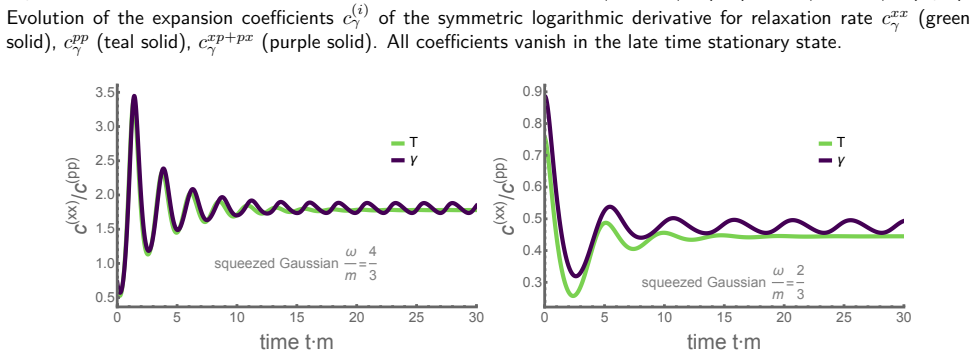
Numerically solve the Caldeira-Leggett master equation for the squeezed Gaussian initial state used in Section 4, reconstruct $\hat{\rho}(t,T)$ on a fine grid, solve Eq. (1) for the exact time-dependent $\hat{\Lambda}_T(t)$, and expand it in the same five-operator basis. If the resulting coefficients disagree with the $c_T^{(i)}(t)$ shown in Fig. 1 in the transient regime beyond numerical error, the dropped $\partial_t \hat{\Lambda}$ terms are significant; if they agree, the time-independent-SLD ansatz is validated.
Extended reading notes
Core claim
The discovery is a constructive route to the SLD that bypasses the density matrix. Starting from a linear master equation $\partial_t \hat{\rho} = \mathcal{L}[\theta]\hat{\rho}$ and the mixed-derivative identity $\partial_\theta \partial_t \hat{\rho} = \partial_t \partial_\theta \hat{\rho}$, the paper rewrites the implicit Lyapunov equation for $\hat{\Lambda}_\theta$ as a linear system $\sum_i M_{ji} c_i = D_j$. The matrix $M$ is built from expectation values of operator bilinears generated by $\mathcal{L}$, and the source vector $D$ from the explicit $\theta$-dependence of the generator; solving it gives the coefficients of $\hat{\Lambda}_\theta = \sum_i c_i \hat{A}_i$. In the Caldeira-Leggett model the method reproduces the known equilibrium temperature SLD, and in a squeezed Gaussian state it yields time-dependent SLDs for both temperature and relaxation rate, with the temperature Fisher information growing toward its late-time maximum while the relaxation-rate Fisher information decays to zero.
Load-bearing premise
The construction assumes the optimal-observable operator itself does not change with time when the parameter derivatives are taken, even though the paper applies it to transient regimes where the operator's expansion coefficients are time dependent; if the SLD genuinely varies during the evolution, the central linear system misses terms.
Editorial extensions
If this is right
- The symmetric logarithmic derivative becomes computable for transient, driven, or strongly coupled probes from the master-equation generator plus evolving expectation values, without solving for $\hat{\rho}(t,\theta)$.
- In the Caldeira-Leggett steady state the construction reproduces the known temperature SLD and shows that the anticommutator $\{\hat{x},\hat{p}\}$ must be retained in the basis even where its expectation value vanishes.
- For a squeezed Gaussian state, the temperature-SLD coefficients evolve in time and asymptote to their equilibrium values, meaning the optimal temperature estimator is a time-dependent weighted combination of position and momentum variances.
- The relaxation-rate SLD is intrinsically non-equilibrium: its quantum Fisher information decays to zero at late times, while the temperature quantum Fisher information grows to its steady-state maximum.
- The same linear system works for any environmental parameter appearing in a linear master equation, with different parameters entering through different source vectors $D_j$.
Reading between the lines
- Extension: because the method needs only expectation values of a chosen operator basis, it can be paired with any numerical solver that propagates those values, which would extend it beyond Gaussian states to lattice or tensor-network simulations.
- Extension: in a multi-parameter setting the same matrix $M$ can be reused with different source vectors $D_j$, suggesting a practical route to joint estimation of temperature and relaxation rate, although multi-parameter bounds are not derived in the paper.
- Extension: a direct numerical computation of the exact time-dependent SLD for the same squeezed state would quantify how much the time-independence assumption used in Appendix A affects the transient coefficients.
Signed reviews
Editorial analysis
A structured set of objections, weighed in public.
Referee Report
Summary. The manuscript proposes a method to construct the symmetric logarithmic derivative (SLD) for an environmental parameter θ directly from a master equation of an open quantum system, without solving for the full density matrix. The technique expands the SLD in a fixed operator basis, uses the equality of mixed partial derivatives (Schwarz's theorem) to relate ∂θ∂tρ and ∂t∂θρ, and reduces the problem to a linear system for the expansion coefficients, Eq. (10). The method is tested in two applications: the equilibrium steady state of Caldeira–Leggett quantum Brownian motion, where the known temperature SLD of Ref. [13] is reproduced, and a non-equilibrium squeezed Gaussian state, for which SLDs for temperature and for the relaxation rate are constructed using time-dependent expectation values from the Ehrenfest equations. The paper concludes that its approach enables optimal-observable construction in transient and non-equilibrium regimes.
Significance. If the proposed construction were valid, it would be a practical tool for quantum metrology in open systems, where SLDs are usually obtained from explicit density matrices. The equilibrium validation in Sec. 3 is a useful consistency check and the published Mathematica scripts (Ref. [24]) support reproducibility. However, the central novelty—the transient and non-equilibrium construction—rests on a derivation that explicitly assumes a time-independent SLD, which is inconsistent with the time-dependent coefficients shown in the paper's own figures. The non-equilibrium results are not benchmarked against any independent computation, and the assertion that the Caldeira–Leggett master equation has no closed-form solution in that regime is incorrect. The main claim is therefore not established.
major comments (3)
- [Section 2 and Appendix A, Eq. (41)] The derivation of the linear system (10) drops the terms (1/2)(∂tΛ ρ + ρ ∂tΛ) in Eq. (41), with the explicit justification 'excluding a time dependence of the SLD operator'. In the non-equilibrium application, however, the coefficients c_i(t) shown in Figs. 1–4 are time-dependent while the basis operators A_i are time-independent, so Λ(t) must itself be time-dependent. The linear system (10) therefore does not follow from the master equation in the transient regime, and the paper's primary claim of constructing optimal observables out of equilibrium is unsupported. The equilibrium validation in Sec. 3 is consistent because the steady-state SLD is time-independent, but it cannot license the transient construction, for which no error estimate or independent benchmark is provided.
- [Section 4, beginning of Sec. 4] The paper states that 'there does not exist a closed form explicit solution of the density matrix to the CL master equation in this regime', but the Caldeira–Leggett master equation for a harmonic oscillator with Gaussian initial states admits analytic solutions, e.g., the Wigner-function solutions in Refs. [23] and [16], which the paper itself cites. This makes the claimed novelty of the non-equilibrium application questionable and, more importantly, means that an independent benchmark for the transient SLD is available but has not been used. Without such a benchmark, the coefficients in Figs. 1–3 and the QFI in Fig. 4 are uncontrolled.
- [Section 2 (method's scope) and Section 4 (Ehrenfest equations)] The claim that the approach 'does not rely on the explicit solution of the master equation' is overstated. In Sec. 4, the matrices M and D are evaluated using time-dependent expectation values obtained from the Ehrenfest equations (35)–(37). For the harmonic Caldeira–Leggett model these equations close exactly, but for a general master equation the required moment hierarchy will generally not close, and the paper does not discuss how the necessary expectation values are to be obtained in such cases. The generality claimed in the introduction and Sec. 2 is therefore not supported beyond the specific Gaussian examples treated.
minor comments (6)
- [Eq. (19)] The expression '⟨p^4⟩ = 3⟨p^2⟩' is missing the exponent on the right-hand side and should read '⟨p^4⟩ = 3⟨p^2⟩^2'.
- [Introduction, last paragraph] There is a typo: 'valubale' should be 'valuable'.
- [Section 3, first paragraph] The phrase 'They key relation' should be 'The key relation'.
- [Figure 3 caption] The caption refers to 'blue solid' and 'orange solid' lines, but the text preceding the figure describes 'green solid' and 'purple solid' for the same ratios; the colors should be made consistent.
- [Throughout] The theorem is usually attributed as 'Schwarz's theorem' (with one 't'), while the paper repeatedly writes 'Schwartz'; this should be corrected.
- [Eq. (3)] The susceptibility χ_T(ˆx^2) is written twice in the text; the second instance should be χ_T(ˆp^2).
Circularity Check
No significant circularity: the SLD construction is algebraic from the master equation and is checked against the independent result of Ref. [13]; the authors' self-citations are not load-bearing.
full rationale
The derivation chain leading to the linear system Eq. (10) is algebraic and self-contained: it uses only the master equation (Eq. (6)), the SLD definition (Eq. (1)), Schwarz's theorem (Eq. (7)), and an explicit operator-basis ansatz (Eq. (8)); no parameter is fitted to the target SLD and no output quantity is defined in terms of itself. The equilibrium validation in Sec. 3 is a genuine external benchmark: the coefficients obtained from Eqs. (13)-(14) with the CL steady-state expectation values are compared with the independent closed-form SLD of Ref. [13] (Eqs. (24)-(25)), with the small difference attributed to a stated Markovian correction. The authors' own prior work (Refs. [8], [10], [11], [24]) appears only as motivation or numerical reproducibility support, not as a load-bearing premise of the central derivation. The one flagged concern is Appendix A, where Eq. (41) drops the terms proportional to ∂tΛ with the justification 'excluding a time dependence of the SLD operator', while Sec. 4 plots time-dependent coefficients c_i(t); this is an internal consistency and validity defect for the transient claim, but it is not circular reasoning because the time-dependent coefficients are not fitted to, or defined by, the target SLD. The non-equilibrium output is not externally benchmarked, so independent support for that regime is absent, but that is a correctness risk rather than circularity.
Assumptions & free parameters
free parameters (1)
- Initial squeezed-state conditions =
⟨x²⟩⟨p²⟩ = 1, ⟨{x,p}⟩ = 1 (unit values)
assumptions (4)
- standard math Schwarz's theorem: ∂θ∂t ρ = ∂t∂θ ρ
- domain assumption Wick factorization for Gaussian states
- domain assumption Truncated operator basis {x, p, x², p², {x,p}} closes the problem
- ad hoc to paper The SLD is time-independent (∂tΛ = 0) in the derivation of Eq. (10)
Cite this review
Pith. "Pith review of Optimal observables for (non-)equilibrium quantum metrology from the master equation." pith.science (2026). https://pith.science/paper/CEMOFNUT
@misc{pith2026250623600,
  author       = {Pith},
  title        = {Pith review of: Optimal observables for (non-)equilibrium quantum metrology from the master equation},
  year         = {2026},
  howpublished = {\url{https://pith.science/paper/CEMOFNUT}},
  note         = {Machine review of arXiv:2506.23600}
}
read the original abstract
We demonstrate how observables with optimal sensitivity to environmental properties can be constructed explicitly from the master equation of an open-quantum system. Our approach does not rely on the explicit solution of the master equation. This makes the symmetric logarithmic derivative (SLD), the operator of optimal sensitivity and key quantity in quantum metrology, available to a large class of systems of interest, both in and out-of-equilibrium. We validate our approach by reproducing the SLD for temperature in quantum Brownian motion and demonstrate its versatility by constructing the optimal observable for the non-equilibrium relaxation rate.
Figures


Figures from the paper (1 more)

Reference graph
Works this paper leans on
-
[13]
Using Polarons for sub-nK Quantum Nondemolition Thermometry in a Bose-Einstein Condensate
Mohammad Mehboudi, Aniello Lampo, Christos Charalambous, Luis A. Correa, Miguel ´Angel Garc ´ ıa-March, and Maciej Lewenstein. “Using Polarons for sub-nK Quantum Nondemolition Thermometry in a Bose-Einstein Condensate”. Physical Re- view Letters 122, 030403 (2019)
work page 2019
-
[24]
url: https:// doi.org/10.5281/zenodo.15770098
Alexander Rothkopf (2025). url: https:// doi.org/10.5281/zenodo.15770098. A Sketch of the derivation of the system matrix M ˆx ˆp ˆx2 ˆxˆp ˆp2 ˆpˆx ˆx2 ˆx3 W (ˆx2 ˆp)+iˆx ˆx4 W (ˆx3 ˆp)+ 3i 2 ˆx W (ˆx2 ˆp2)+2iW (ˆxˆp)− 1 2 W (ˆx3 ˆp)+i 2 ˆx ˆxˆp W (ˆx2 ˆp) W (ˆxˆp2)+iˆp W (ˆx3 ˆp)−i 2 ˆx2 W (ˆx2 ˆp2)+iW (ˆxˆp) W (ˆxˆp3)+ 3i 2 ˆp2 W (ˆx2 ˆp2)+ 1 2 ˆp2 W (ˆ...
-
[23]
JL Garcia-Palacios and D Zueco. “The caldeira–leggett quantum master equation 10 in wigner phase space: continued-fraction solution and application to brownian mo- tion in periodic potentials”. Journal of Physics A: Mathematical and General 37, 10735 (2004)
work page 2004
-
[16]
Positivity violations of the density operator in the caldeira-leggett mas- ter equation
G´ abor Homa, J´ ozsef Zsolt Bern´ ad, and L´ aszl´ o Lisztes. “Positivity violations of the density operator in the caldeira-leggett mas- ter equation”. The European Physical Jour- nal D 73, 1–13 (2019)
work page 2019
-
[1]
Review: Quantum metrol- ogy and sensing with many-body systems
Victor Montenegro, Chiranjib Mukhopad- hyay, Rozhin Yousefjani, Saubhik Sarkar, Utkarsh Mishra, Matteo G. A. Paris, and Abolfazl Bayat. “Review: Quantum metrol- ogy and sensing with many-body systems”. Physics Reports 1134, 1–62 (2025)
work page 2025
-
[2]
Quantum estima- tion for quantum technology
Matteo G. A. Paris. “Quantum estima- tion for quantum technology”. International Journal of Quantum Information 07, 125– 137 (2009). 9
work page 2009
-
[3]
Quantum detection and estimation theory
Carl W. Helstrom. “Quantum detection and estimation theory”. Journal of Statistical Physics 1, 231–252 (1969)
work page 1969
-
[4]
Probabilistic and sta- tistical aspects of quantum theory
Alexander S Holevo. “Probabilistic and sta- tistical aspects of quantum theory”. Vol- ume 1. Springer Science & Business Media. (2011)
work page 2011
Show all 24 references
-
[5]
Statistical distance and the geometry of quantum states
Samuel L. Braunstein and Carlton M. Caves. “Statistical distance and the geometry of quantum states”. Physical Review Letters 72, 3439–3443 (1994)
1994
-
[6]
Thermometry of Gaussian quantum sys- tems using Gaussian measurements
Marina F. B. Cenni, Ludovico Lami, An- tonio Acin, and Mohammad Mehboudi. “Thermometry of Gaussian quantum sys- tems using Gaussian measurements”. Quan- tum 6, 743 (2022). arXiv:2110.02098
2022 arXiv
-
[7]
The theory of open quantum sys- tems
Heinz-Peter Breuer and Francesco Petruc- cione. “The theory of open quantum sys- tems”. OUP Oxford. (2002)
2002
-
[8]
Stochastic potential and quantum decoherence of heavy quarkonium in the quark-gluon plasma
Yukinao Akamatsu and Alexander Rothkopf. “Stochastic potential and quantum decoherence of heavy quarkonium in the quark-gluon plasma”. Phys. Rev. D 85, 105011 (2012). arXiv:1110.1203
2012 arXiv
-
[9]
Quarkonium sup- pression in heavy-ion collisions: an open quantum system approach
Nora Brambilla, Miguel A. Escobedo, Joan Soto, and Antonio Vairo. “Quarkonium sup- pression in heavy-ion collisions: an open quantum system approach”. Phys. Rev. D 96, 034021 (2017). arXiv:1612.07248
2017 arXiv
-
[10]
Quantum Brownian motion of a heavy quark pair in the quark-gluon plasma
Takahiro Miura, Yukinao Akamatsu, Masayuki Asakawa, and Alexander Rothkopf. “Quantum Brownian motion of a heavy quark pair in the quark-gluon plasma”. Phys. Rev. D 101, 034011 (2020). arXiv:1908.06293
2020 arXiv
-
[11]
Trace pre- serving quantum dynamics using a novel reparametrization-neutral summation-by- parts difference operator
Oskar ˚Alund, Yukinao Akamatsu, Fredrik Laur´ en, Takahiro Miura, Jan Nordstr¨ om, and Alexander Rothkopf. “Trace pre- serving quantum dynamics using a novel reparametrization-neutral summation-by- parts difference operator”. J. Comput. Phys. 425, 109917 (2021). arXiv:2004.04406
2021 arXiv
-
[12]
Fundamental lim- its on low-temperature quantum thermom- etry with finite resolution
Patrick P. Potts, Jonatan Bohr Brask, and Nicolas Brunner. “Fundamental lim- its on low-temperature quantum thermom- etry with finite resolution”. Quantum 3, 161 (2019)
2019
-
[14]
In Situ Ther- mometry of a Cold Fermi Gas via Dephas- ing Impurities
Mark T. Mitchison, Thom´ as Fogarty, Gia- como Guarnieri, Steve Campbell, Thomas Busch, and John Goold. “In Situ Ther- mometry of a Cold Fermi Gas via Dephas- ing Impurities”. Phys. Rev. Lett. 125, 080402 (2020)
2020
-
[15]
Regularity of solutions to quantum master equations: A stochastic approach
Carlos M. Mora. “Regularity of solutions to quantum master equations: A stochastic approach”. The Annals of Probability 41, 1978–2012 (2013)
2013
-
[17]
On the theory of the brownian mo- tion
George E Uhlenbeck and Leonard S Orn- stein. “On the theory of the brownian mo- tion”. Physical review 36, 823 (1930)
1930
-
[18]
Stochastic processes: From applications to theory
Pierre Del Moral and Spiridon Penev. “Stochastic processes: From applications to theory”. Chapman and Hall/CRC. (2017)
2017
-
[19]
Path in- tegral approach to quantum Brownian mo- tion
A. O. Caldeira and A. J. Leggett. “Path in- tegral approach to quantum Brownian mo- tion”. Physica A: Statistical Mechanics and its Applications 121, 587–616 (1983)
1983
-
[20]
Influence of damping on quantum interference: An ex- actly soluble model
A. O. Caldeira and A. J. Leggett. “Influence of damping on quantum interference: An ex- actly soluble model”. Physical Review A 31, 1059–1066 (1985)
1985
-
[21]
On the Function in Quantum Mechanics which Corresponds to a Given Function in Classical Mechanics
Neal H. McCoy. “On the Function in Quantum Mechanics which Corresponds to a Given Function in Classical Mechanics”. Proceedings of the National Academy of Sci- ences of the United States of America 18, 674–676 (1932). url: https://www.jstor. org/stable/85974
1932
-
[22]
The evaluation of the collision matrix
Gian-Carlo Wick. “The evaluation of the collision matrix”. Physical review 80, 268 (1950)
1950
Reviewed August 6, 2026 · model on record in the stance chip above.
Discussion (0). Continue with ORCID to comment.