REVIEW 4 major objections 6 minor 1 cited by
Investigating Stochastic Methods for Prosody Modeling in Speech Synthesis
T0 review · 4 major / 6 minor · reviewed 2026-08-06 · deepseek-v4-flash
Pith's one-line read Rectified flows give the best prosody trade-off in TTS, claim authors
desk verdict Useful empirical comparison of stochastic prosody predictors, but the headline trade-off claim lacks significance tests on diversity ratings. read the letter →
The pith
A machine-rendered reading of the paper's core claim, the machinery that carries it, and where it could break.
The reading
What carries the argument
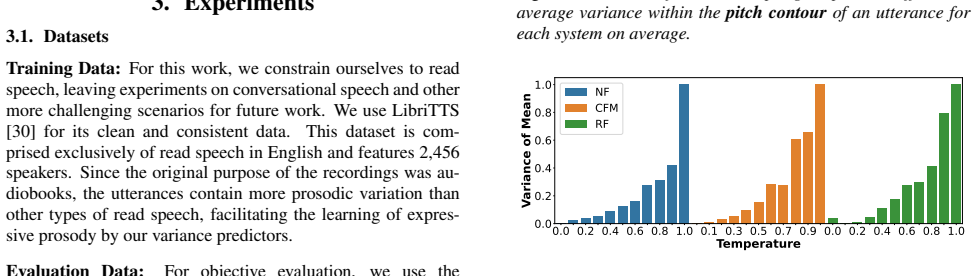
The central object is a probabilistic variance predictor that treats the mapping from an encoded phoneme sequence to a prosodic contour as a transport problem between a Gaussian noise distribution and the distribution of valid contours, rather than predicting a single averaged contour. Three transport mechanisms are compared: Normalizing Flows (invertible transformations applied in one step), Conditional Flow Matching (a time-dependent vector field trained with a flow-matching objective to approximate an optimal-transport path), and Rectified Flows (the same vector-field approach, but with a ReFlow post-training stage that replaces arbitrary noise–data couplings with deterministic ones, straightening the learned paths). During inference the noise is scaled by a sampling temperature before the flow is solved, which is the mechanism that makes the variance of generated contours controllable. A secondary mechanism is the cascaded predictor structure, energy → pitch → duration, where each predictor is conditioned on previously predicted prosodic features; this ordering outperforms joint prediction for duration, and the order of pitch and energy has negligible impact.
What would settle it
Re-running the listening study with more speakers, more sentences, and a different rater pool could refute the ranking if Rectified Flow at temperature 0.8 is no longer judged as diverse as the CFM baseline at equal naturalness; specifically, if CFM at 0.8 is rated as diverse and natural as RF 0.8, the paper's central trade-off claim fails. A second, more direct check is to measure whether the cloned human prosody matches the original recordings' pitch, energy, and duration distributions; a mismatch there would weaken the human baseline itself.
Extended reading notes
Core claim
On the paper's own terms, the discovery is that explicit prosody prediction need not sacrifice expressivity for controllability. A prosody predictor trained as a Rectified Flow — a flow that is post-trained with the ReFlow procedure to couple noise and data deterministically and straighten the transport path — produces pitch, energy, and duration contours whose naturalness is indistinguishable from human recordings while the diversity across repeated takes of the same sentence approaches the human range. The evidence is a combination of objective Jensen–Shannon divergence comparisons between predicted and human contour distributions and a rated listening study. The rated study also reveals that naturalness and diversity are inversely related even for human recordings, so the trade-off is inherent to the task rather than a model defect. The paper concludes that Rectified Flows offer the best overall performance for prosody modeling among the studied approaches, with sampling temperature as the effective control over the naturalness–diversity trade-off.
Load-bearing premise
The comparison rests on the assumption that the prosody-cloning procedure used for the human baseline recreates the exact prosody of a human recording in a synthetic voice without introducing audible artifacts, so that ratings of the cloned samples reflect prosody alone.
Editorial extensions
If this is right
- A TTS system with an RF prosody predictor can produce multiple takes of the same sentence that sound like a human speaker saying it differently, with a single temperature knob controlling how different the takes are.
- Cascading the predictors (energy → pitch → duration) is preferable to predicting all three jointly, at least for duration; the order of pitch and energy can be chosen freely without hurting quality.
- The inverse naturalness–diversity relationship appears even in human recordings, so no model is expected to maximize both simultaneously; the practical target is a controllable point on the trade-off curve.
- Because temperature scaling produces a near-logarithmic variance response, the user-facing control can be made intuitive by exposing a log-temperature dial rather than a raw temperature.
Reading between the lines
- The same cascade-plus-RF recipe could plausibly be carried over to conversational and spontaneous speech, where the one-to-many prosody problem is more acute; the paper limits its experiments to read speech and does not test this.
- The observed unimodality and narrower spread of the synthetic contour distributions suggest that scaling up the prosody predictor's capacity, or using a more structured noise prior, might close the remaining diversity gap to human bimodal distributions.
- The prosody-cloning evaluation protocol could serve as a general harness for comparing any stochastic prosody generator, since it isolates prosody as the only variable while holding voice and audio quality fixed.
- A calibrated perceptual diversity scale, built from the temperature–variance mapping the paper reports, could turn the raw sampling temperature into a user-friendly setting for content producers.
Editorial analysis
A structured set of objections, weighed in public.
Referee Report
Summary. The paper compares stochastic prosody predictors (Normalizing Flows, Conditional Flow Matching, Rectified Flows) against a deterministic baseline and human recordings in an explicit prosody modeling pipeline for TTS. The authors evaluate cascaded versus joint prediction of pitch, energy, and duration, the effect of predictor order, and the effect of sampling temperature on prosodic variance. Subjective ratings from 40 crowd-sourced raters measure naturalness and diversity of prosody across eight conditions. The main claims are that cascaded prediction benefits duration modeling, that sampling temperature steers prosodic diversity, that naturalness and diversity are inversely related, and that Rectified Flows at temperature 0.8 provide the most favorable naturalness–diversity trade-off. The paper provides open-source code and uses public datasets (LibriTTS, RAVDESS, ADEPT).
Significance. If the central claims hold, the paper provides a practically useful comparison for TTS systems that need explicit, controllable prosody: it identifies Rectified Flows as a strong stochastic predictor and demonstrates a temperature-based control mechanism for diversity. The subjective evaluation is thoughtfully designed, notably using prosody cloning to isolate prosody from voice and audio-quality differences, and the naturalness ratings are analyzed with non-parametric significance tests. The paper also contributes open-source code and a reproducible experimental pipeline, which strengthens its value for the community. However, the headline trade-off claim is currently supported only by a descriptive comparison of boxplot medians, because diversity ratings are not significance-tested, and the objective temperature-variance analysis lacks uncertainty quantification. These gaps mean the significance of the central conclusion remains partly unsubstantiated.
major comments (4)
- [§3.4, Figures 5–6] The central claim that the RF model at temperature 0.8 offers the most favorable naturalness–diversity trade-off is not statistically supported. The authors report Kruskal-Wallis and Dunn posthoc tests only for naturalness ratings (Figure 5), stating that RF 0.4, CFM 0.4, and the deterministic baseline tie for best naturalness and that RF 0.8 is on par with the human baseline. No equivalent significance test is reported for the diversity ratings in Figure 6. The assertion that RF 0.8 produces the highest diversity after the human baseline is therefore based on an untested ordering of boxplot medians, and the joint trade-off claim would require comparing RF 0.8 against other stochastic systems at comparable diversity while confirming its naturalness is not significantly worse. Please add significance testing for diversity ratings and a formal or at least clearly defined comparison for the trade-off claim.
- [§3.3, Table 1] Table 1 reports Jensen–Shannon divergences without variance, confidence intervals, or any significance test, yet the text states that the difference between cascade and joint prediction is 'not significant' for pitch and energy and that ordering differences are 'never significant.' No statistical procedure is described for these conclusions. Since the cascade configuration is adopted for all subsequent experiments based on this finding, the claim that only duration prediction requires prior knowledge of other prosodic variables should be supported by an explicit test, for example a bootstrap over utterances or a repeated-generation experiment with reported intervals.
- [§3.3, Figures 2–3] The claim that sampling temperature effectively controls prosodic variance rests on visual inspection of curves without error bars or uncertainty estimates. Figure 2 and Figure 3 show averages over 200 utterances, but no measure of variability across utterances or across random seeds is provided, so the reader cannot judge whether the monotonic trends are stable or whether differences between NF, CFM, and RF are meaningful. Please add confidence intervals or error bars, and ideally a quantitative measure such as the correlation between temperature and variance, to support the controllability claim.
- [Abstract and §4] The abstract states that 'stochastic methods produce natural prosody on par with human speakers,' which is broader than the reported evidence: the significance tests identify only RF at 0.8 as statistically on par with the human baseline, and other stochastic conditions may be worse. Section 4 similarly concludes that 'Rectified Flows offer the best overall performance' without qualifying that this conclusion depends on the unsupported trade-off analysis. Please temper these statements to match the statistical findings, or add the missing analyses that would justify them.
minor comments (6)
- [§2.4, Eq. (1)] The notation in Equation (1) is inconsistent with standard flow-matching conventions: in the usual CFM formulation x1 denotes the data sample and x0 the noise, whereas the text says x1 is sampled from the noise distribution and x is an observation in data space. Please align the notation with the cited flow-matching literature to avoid confusion.
- [§3.3, Figure 4] The caption of Figure 4 says the orange distribution is from the CFM system, but the surrounding text says the synthetic distribution is generated with the RF-based model at temperature 0.8. This inconsistency should be corrected.
- [§3.4] The phrase 'exact prosody cloning' from [26] is asserted without any validation in this paper's setup. A sentence acknowledging this reliance on the prior method, or a brief perceptual check, would strengthen the interpretation of the human baseline.
- [§3.3] The statement 'We verified these results in informal listening tests' is vague; please describe the informal tests or remove the reference to them.
- [Throughout] The term 'Kruskall-Wallis' is misspelled; the correct spelling is 'Kruskal-Wallis.'
- [§3.3, Figures 2–3] The axis label 'Variance of Mean' is ambiguous; please clarify that it denotes the variance across utterances of the per-utterance mean pitch or duration.
Circularity Check
No significant circularity: the paper is an empirical method comparison with external human ratings and public datasets; self-citations are infrastructure, not load-bearing derivations.
full rationale
The paper does not claim a first-principles derivation; it reports an empirical comparison. The central claims (cascading over joint prediction, temperature controlling variance, RF providing the best naturalness-diversity trade-off) are tested against objective JS divergences on RAVDESS and subjective Likert ratings from 40 crowd workers on ADEPT-based stimuli. No parameter is fitted to the evaluation data and then renamed a prediction. The self-citations to the ToucanTTS pipeline ([22,23]) and exact prosody cloning ([26]) are used as infrastructure: the prosody-cloning step creates the human baseline by transferring human prosody into a synthetic voice, but the paper's target result is the relative ranking of Normalizing Flow, Conditional Flow Matching, Rectified Flow, and a deterministic baseline, not whether cloning preserves prosody. Even if cloning fidelity were questionable, that would be a stimulus-validity limitation, not a case of the conclusion being identical to its input by construction. The temperature-variance relationship is empirically measured (Figures 2-3), not assumed as a definition. The lack of significance tests on diversity ratings in Section 3.4 is a statistical-reporting weakness, but it is not circularity: an unsupported ranking is not the same as a ranking forced by definition or by a self-citation chain. Under the requirement to exhibit a specific reduction, no circular step can be quoted.
Assumptions & free parameters
free parameters (1)
- Sampling temperature =
0.4 and 0.8; values above 1.0 excluded after informal listening
assumptions (5)
- domain assumption Utterance-level normalization of pitch and energy makes contours speaker-independent.
- domain assumption Prosody cloning preserves the exact prosody of human recordings while removing voice and audio quality differences.
- domain assumption The CFM PostNet with sampling temperature 0.0 during inference contributes no variance.
- domain assumption Likert ratings from 40 crowd raters on three-audio clips measure prosodic naturalness and diversity as intended.
- domain assumption Gaussian KDE with default bandwidth gives reliable JS divergence estimates for prosody distributions.
Cite this review
Pith. "Pith review of Investigating Stochastic Methods for Prosody Modeling in Speech Synthesis." pith.science (2026). https://pith.science/paper/ICTRYB6B
@misc{pith2026250700227,
  author       = {Pith},
  title        = {Pith review of: Investigating Stochastic Methods for Prosody Modeling in Speech Synthesis},
  year         = {2026},
  howpublished = {\url{https://pith.science/paper/ICTRYB6B}},
  note         = {Machine review of arXiv:2507.00227}
}
read the original abstract
While generative methods have progressed rapidly in recent years, generating expressive prosody for an utterance remains a challenging task in text-to-speech synthesis. This is particularly true for systems that model prosody explicitly through parameters such as pitch, energy, and duration, which is commonly done for the sake of interpretability and controllability. In this work, we investigate the effectiveness of stochastic methods for this task, including Normalizing Flows, Conditional Flow Matching, and Rectified Flows. We compare these methods to a traditional deterministic baseline, as well as to real human realizations. Our extensive subjective and objective evaluations demonstrate that stochastic methods produce natural prosody on par with human speakers by capturing the variability inherent in human speech. Further, they open up additional controllability options by allowing the sampling temperature to be tuned.
Figures


Figures from the paper (2 more)


Forward citations
Cited by 1 Pith paper
-
Bridging the Stability-Expressivity Gap: Synthetic Data Scaling and Preference Alignment for Low-Resource Spoken Language Models
Synthetic data for low-resource spoken language models creates a Stability-Expressivity Gap that DGSA and TDSC self-alignment close, enabling SOTA Thai TTS and first Lao zero-shot voice cloning.
Reference graph
Works this paper leans on
-
[1]
Investigating Stochastic Methods for Prosody Modeling in Speech Synthesis
Introduction In recent years, text-to-speech (TTS) systems have made sig- nificant advancements in expressivity and naturalness, closing the gap to human speech in multiple instances [1–4]. How- ever, there remains an inherent trade-off between controllability and expressivity. While modern language modeling approaches to TTS have demonstrated impressive ...
work page Pith review arXiv 2025
-
[2]
Methods 2.1. Overall Pipeline The pipeline follows the architecture of ToucanTTS [22,23] due to its modularity and open-source implementation. It builds on FastSpeech 2 [12, 13] and incorporates several key improve- ments, such as the use of articulatory features as the input representation [24] and a Conformer-based encoder and de- coder [25]. Similar to...
-
[3]
Experiments 3.1. Datasets Training Data: For this work, we constrain ourselves to read speech, leaving experiments on conversational speech and other more challenging scenarios for future work. We use LibriTTS
-
[4]
Conclusion This paper presents a thorough comparison between different stochastic methods for pitch, energy, and duration modeling against a deterministic and a human baseline. Experimental re- sults show that modeling prosodic parameters in a cascading manner yields better performance than modeling them jointly, but different ordering has no significant ...
-
[5]
Better speech synthesis through scaling,
J. Betker, “Better speech synthesis through scaling,” arXiv:2305.07243, 2023
arXiv 2023
-
[6]
Neural Codec Language Models are Zero-Shot Text to Speech Synthesizers,
C. Wang, S. Chen, Y . Wu, Z. Zhang, L. Zhou, S. Liu, Z. Chen, Y . Liu, H. Wang, J. Li, L. He, S. Zhao, and F. Wei, “Neural Codec Language Models are Zero-Shot Text to Speech Synthesizers,” arXiv:2301.02111, 2023
arXiv 2023
-
[7]
Naturalspeech: End-to-end text-to- speech synthesis with human-level quality,
X. Tan, J. Chen, H. Liu, J. Cong, C. Zhang, Y . Liu, X. Wang, Y . Leng, Y . Yi, L. Heet al., “Naturalspeech: End-to-end text-to- speech synthesis with human-level quality,” IEEE Transactions on Pattern Analysis and Machine Intelligence, 2024
work page 2024
-
[8]
The models were trained for 100k steps with a batch size of 32, which allowed all models to converge
For the combined approach, the hyperparameters are scaled up such that the amount of parameters in the model stays con- stant. The models were trained for 100k steps with a batch size of 32, which allowed all models to converge. The RF model was trained for an additional 10k steps with the ReFlow stage. This does not require training data, so all models s...
Show all 43 references
-
[9]
DelightfulTTS 2: End-to-end speech synthesis with adversarial vector-quantized auto-encoders,
Y . Liu, R. Xue, L. He, X. Tan, and S. Zhao, “DelightfulTTS 2: End-to-end speech synthesis with adversarial vector-quantized auto-encoders,” arXiv:2207.04646, 2022
2022 arXiv
-
[10]
NaturalSpeech 2: Latent Diffusion Models are Natural and Zero-Shot Speech and Singing Synthesizers,
K. Shen, Z. Ju, X. Tan, Y . Liu, Y . Leng, L. He, T. Qin, S. Zhao, and J. Bian, “NaturalSpeech 2: Latent Diffusion Models are Natural and Zero-Shot Speech and Singing Synthesizers,” in The Twelfth International Conference on Learning Representations, 2023
2023
-
[11]
DelightfulTTS: The Microsoft Speech Synthesis System for Blizzard Challenge 2021,
Y . Liu, Z. Xu, G. Wang, K. Chen, B. Li et al., “DelightfulTTS: The Microsoft Speech Synthesis System for Blizzard Challenge 2021,” Blizzard Challenge Workshop, vol. 2021, 2021
2021
-
[12]
FastSpeech: fast, robust and controllable text to speech,
Y . Ren, Y . Ruan, X. Tan, T. Qin, S. Zhao, Z. Zhao, and T.-Y . Liu, “FastSpeech: fast, robust and controllable text to speech,” in Advances in Neural Information Processing Systems , vol. 32, 2019, pp. 3171–3180
2019
-
[13]
A vector quantized approach for text to speech synthesis on real-world spontaneous speech,
L.-W. Chen, S. Watanabe, and A. Rudnicky, “A vector quantized approach for text to speech synthesis on real-world spontaneous speech,” in AAAI Conference on Artificial Intelligence , vol. 37, 2023, pp. 12 644–12 652
2023
-
[14]
Prosody Is Not Identity: A Speaker Anonymization Approach Using Prosody Cloning,
S. Meyer, F. Lux, J. Koch, P. Denisov, P. Tilli, and N. T. Vu, “Prosody Is Not Identity: A Speaker Anonymization Approach Using Prosody Cloning,” in International Conference on Acous- tics, Speech and Signal Processing. IEEE, 2023, pp. 1–5
2023
-
[15]
PoeticTTS - Control- lable Poetry Reading for Literary Studies,
J. Koch, F. Lux, N. Schauffler, T. Bernhart, F. Dieterle, J. Kuhn, S. Richter, G. Viehhauser, and N. T. Vu, “PoeticTTS - Control- lable Poetry Reading for Literary Studies,” in Interspeech, 2022
2022
-
[16]
Asvspoof 5: Design, collection and validation of resources for spoofing, deepfake, and adversarial attack detection using crowdsourced speech,
X. Wang, H. Delgado, H. Tak, J.-w. Jung, H.-j. Shim, M. Todisco, I. Kukanov, X. Liu, M. Sahidullah, T. Kinnunenet al., “Asvspoof 5: Design, collection and validation of resources for spoofing, deepfake, and adversarial attack detection using crowdsourced speech,” arXiv preprin...
2025 arXiv
-
[17]
Towards controllable speech synthesis in the era of large language models: A survey,
T. Xie, Y . Rong, P. Zhang, and L. Liu, “Towards controllable speech synthesis in the era of large language models: A survey,” arXiv:2412.06602, 2024
2024 arXiv
-
[18]
Rectified flow: A marginal preserving approach to opti- mal transport,
Q. Liu, “Rectified flow: A marginal preserving approach to opti- mal transport,” 2022
2022
-
[19]
FastSpeech 2: Fast and High-Quality End-to-End Text to Speech,
Y . Ren, C. Hu, X. Tan, T. Qin, S. Zhaoet al., “FastSpeech 2: Fast and High-Quality End-to-End Text to Speech,” in International Conference on Learning Representations, 2020
2020
-
[20]
FastPitch: Parallel text-to-speech with pitch pre- diction,
A. Ła ´ncucki, “FastPitch: Parallel text-to-speech with pitch pre- diction,” in International Conference on Acoustics, Speech and Signal Processing. IEEE, 2021, pp. 6588–6592
2021
-
[21]
Variational inference with normal- izing flows,
D. Rezende and S. Mohamed, “Variational inference with normal- izing flows,” in International Conference on Machine Learning . PMLR, 2015, pp. 1530–1538
2015
-
[22]
Flow Matching for Generative Modeling,
Y . Lipman, R. T. Chen, H. Ben-Hamu, M. Nickel, and M. Le, “Flow Matching for Generative Modeling,” inThe Eleventh Inter- national Conference on Learning Representations, 2023
2023
-
[23]
Flow Straight and Fast: Learning to Generate and Transfer Data with Rectified Flow,
X. Liu, C. Gong, and Q. Liu, “Flow Straight and Fast: Learning to Generate and Transfer Data with Rectified Flow,” inThe Eleventh International Conference on Learning Representations, 2022
2022
-
[24]
Language-Agnostic Meta-Learning for Low-Resource Text-to-Speech with Articulatory Features,
F. Lux and N. T. Vu, “Language-Agnostic Meta-Learning for Low-Resource Text-to-Speech with Articulatory Features,” inAn- nual Meeting of the Association for Computational Linguistics , 2022, pp. 6858–6868
2022
-
[25]
Conditional variational autoencoder with adversarial learning for end-to-end text-to-speech,
J. Kim, J. Kong, and J. Son, “Conditional variational autoencoder with adversarial learning for end-to-end text-to-speech,” in Inter- national Conference on Machine Learning . PMLR, 2021, pp. 5530–5540
2021
-
[26]
Varianceflow: High-quality and controllable text-to-speech using variance information via nor- malizing flow,
Y . Lee, J. Yang, and K. Jung, “Varianceflow: High-quality and controllable text-to-speech using variance information via nor- malizing flow,” in International Conference on Acoustics, Speech and Signal Processing . IEEE, 2022, pp. 7477–7481
2022
-
[27]
Should you use a probabilistic duration model in tts? probably! especially for spontaneous speech,
S. Mehta, H. Lameris, R. Punmiya, J. Beskow, ´E. Sz ´ekely, and G. E. Henter, “Should you use a probabilistic duration model in tts? probably! especially for spontaneous speech,” arXiv preprint arXiv:2406.05401, 2024
2024 arXiv
-
[28]
The IMS Toucan system for the Blizzard Challenge 2023,
F. Lux, J. Koch, S. Meyer, T. Bott, N. Schauffler, P. Denisov, A. Schweitzer, and N. T. Vu, “The IMS Toucan system for the Blizzard Challenge 2023,” inBlizzard Challenge Workshop, 2023
2023
-
[29]
Meta Learning Text-to-Speech Synthesis in over 7000 Languages,
F. Lux, S. Meyer, L. Behringer, F. Zalkow, P. Do, M. Coler, E. A. P. Habets, and N. T. Vu, “Meta Learning Text-to-Speech Synthesis in over 7000 Languages,” in Interspeech, 2024
2024
-
[30]
This dataset is com- prised exclusively of read speech in English and features 2,456 speakers
for its clean and consistent data. This dataset is com- prised exclusively of read speech in English and features 2,456 speakers. Since the original purpose of the recordings was au- diobooks, the utterances contain more prosodic variation than other types of read speech, faci...
-
[31]
Con- former: Convolution-augmented Transformer for Speech Recog- nition,
A. Gulati, J. Qin, C.-C. Chiu, N. Parmar, Y . Zhang et al., “Con- former: Convolution-augmented Transformer for Speech Recog- nition,” Interspeech, pp. 5036–5040, 2020
2020
-
[32]
Exact Prosody Cloning in Zero- Shot Multispeaker Text-to-Speech,
F. Lux, J. Koch, and N. T. Vu, “Exact Prosody Cloning in Zero- Shot Multispeaker Text-to-Speech,” in IEEE Spoken Language Technology Workshop, 2023, pp. 962–969
2023
-
[33]
ECAPA- TDNN: Emphasized Channel Attention, Propagation and Ag- gregation in TDNN Based Speaker Verification,
B. Desplanques, J. Thienpondt, and K. Demuynck, “ECAPA- TDNN: Emphasized Channel Attention, Propagation and Ag- gregation in TDNN Based Speaker Verification,” in Interspeech. ISCA, 2020, pp. 3830–3834
2020
-
[34]
SpeechBrain: A General-Purpose Speech Toolkit,
M. Ravanelli, T. Parcollet, P. Plantinga, A. Rouhe, S. Cor- nell et al. , “SpeechBrain: A General-Purpose Speech Toolkit,” arXiv:2106.04624, 2021
2021 arXiv
-
[35]
Matcha-TTS: A fast TTS architecture with conditional flow matching,
S. Mehta, R. Tu, J. Beskow, ´E. Sz ´ekely, and G. E. Henter, “Matcha-TTS: A fast TTS architecture with conditional flow matching,” in International Conference on Acoustics, Speech and Signal Processing. IEEE, 2024, pp. 11 341–11 345
2024
-
[36]
Lib- riTTS: A Corpus Derived from LibriSpeech for Text-to-Speech,
H. Zen, V . Dang, R. Clark, Y . Zhang, R. J. Weiss et al., “Lib- riTTS: A Corpus Derived from LibriSpeech for Text-to-Speech,” in Interspeech. ISCA, 2019, pp. 1526–1530
2019
-
[37]
The Ryerson Audio-Visual Database of Emotional Speech and Song (RA VDESS): A dy- namic, multimodal set of facial and vocal expressions in North American English,
S. R. Livingstone and F. A. Russo, “The Ryerson Audio-Visual Database of Emotional Speech and Song (RA VDESS): A dy- namic, multimodal set of facial and vocal expressions in North American English,” PloS one, vol. 13, no. 5, 2018
2018
-
[38]
ADEPT: A Dataset for Evaluating Prosody Transfer,
A. Torresquintero, T. H. Teh, C. G. Wallis, M. Staib, D. S. R. Mo- han et al., “ADEPT: A Dataset for Evaluating Prosody Transfer,” in Interspeech. ISCA, 2021, pp. 3880–3884
2021
-
[39]
Scalable diffusion models with transform- ers,
W. Peebles and S. Xie, “Scalable diffusion models with transform- ers,” in Proceedings of the IEEE/CVF International Conference on Computer Vision, 2023, pp. 4195–4205
2023
-
[40]
Divergence measures based on the shannon entropy,
J. Lin, “Divergence measures based on the shannon entropy,” IEEE Transactions on Information theory, vol. 37, no. 1, pp. 145– 151, 1991
1991
-
[41]
On information and sufficiency,
S. Kullback and R. A. Leibler, “On information and sufficiency,” The Annals of Mathematical Statistics , vol. 22, no. 1, pp. 79–86, 1951
1951
-
[42]
Use of ranks in one-criterion variance analysis,
W. H. Kruskal and W. A. Wallis, “Use of ranks in one-criterion variance analysis,” Journal of the American statistical Associa- tion, vol. 47, no. 260, pp. 583–621, 1952
1952
-
[43]
Multiple comparisons using rank sums,
O. J. Dunn, “Multiple comparisons using rank sums,” Technomet- rics, vol. 6, no. 3, pp. 241–252, 1964
1964
Reviewed August 6, 2026 · model on record in the stance chip above.
Discussion (0). Sign in to comment.