REVIEW 3 major objections 5 minor 34 references
Synthetic data that steadies low-resource spoken language models also flattens their prosody once the synthetic share grows large; self-alignment can restore both accuracy and expressivity.
Reviewed by Pith at T0; open to challenge. T0 means a machine referee read the full paper against a public rubric. the ladder, T0–T4 →
T0 review · grok-4.5
2026-07-12 23:21 UTC pith:AFR62CZK
load-bearing objection Solid empirical paper: synthetic scaling really does trade stability for expressivity in low-resource SLMs, and the two self-alignment fixes work on Thai/Lao. the 3 major comments →
Bridging the Stability-Expressivity Gap: Synthetic Data Scaling and Preference Alignment for Low-Resource Spoken Language Models
The pith
A machine-rendered reading of the paper's core claim, the machinery that carries it, and where it could break.
Core claim
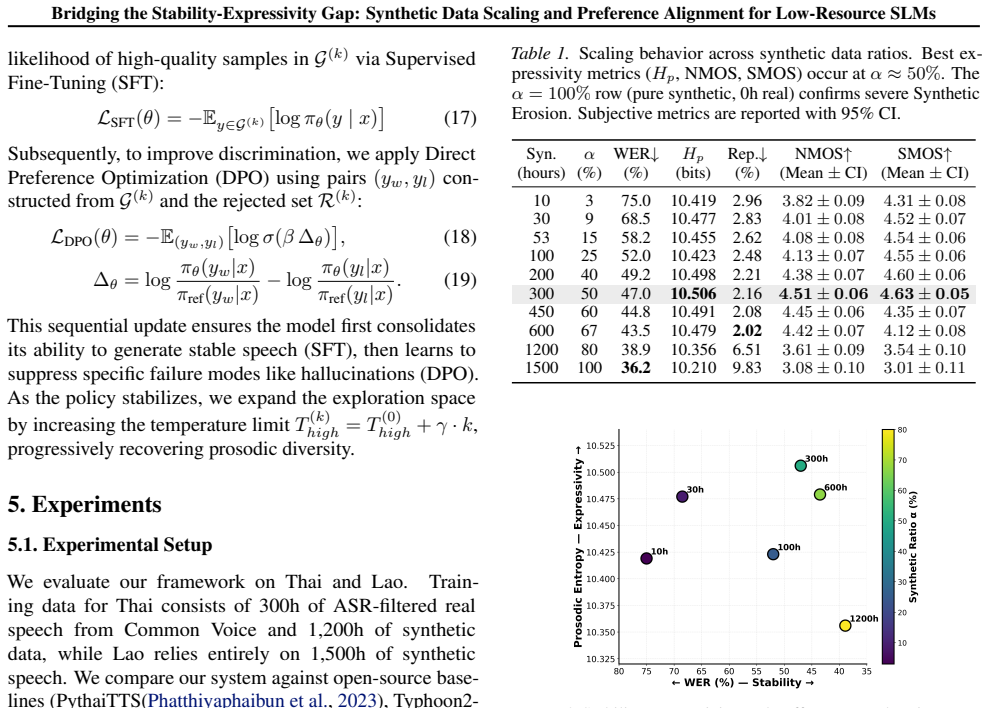
When Spoken Language Models for low-resource languages are scaled with synthetic speech, phonetic accuracy improves monotonically with the synthetic ratio, yet token-level prosodic entropy, naturalness MOS and speaker similarity peak near a 50 percent synthetic mix and then collapse—Synthetic Erosion. Two self-alignment methods that generate their own preference pairs without human labels, Disentanglement-Guided Self-Alignment and Temperature-Driven Self-Critique, recover expressivity while preserving the phonetic gains, yielding systems that surpass commercial baselines on Thai and enable the first zero-shot voice cloning for Lao.
What carries the argument
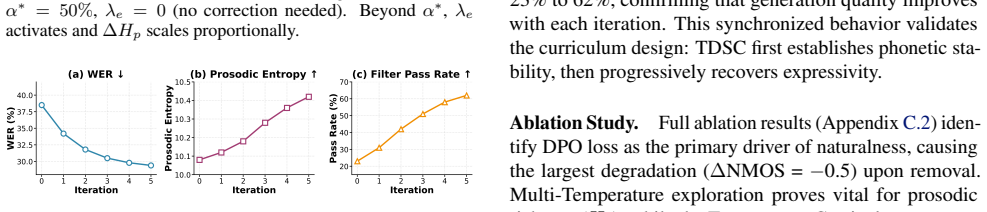
The Stability-Expressivity Gap (Synthetic Erosion), diagnosed by token entropy of the autoregressive speech tokens; Disentanglement-Guided Self-Alignment (DGSA), which builds preference pairs by toggling style tokens while holding timbre fixed; and Temperature-Driven Self-Critique (TDSC), which generates candidates across temperatures and filters them with ASR-based criteria for iterative self-refinement.
Load-bearing premise
The central claim rests on treating the entropy of discrete speech tokens as a reliable proxy for how expressive the speech sounds to listeners, and on automatic speech recognizers being accurate enough both to filter synthetic data and to judge the model’s own outputs.
What would settle it
Train the same backbone with fixed real data while sweeping the synthetic ratio from near zero to one hundred percent; if prosodic entropy, naturalness MOS and speaker MOS keep rising or stay flat past the fifty-percent point instead of peaking and collapsing, Synthetic Erosion does not hold.
If this is right
- Synthetic ratio should be treated as a tunable hyperparameter, not “more is always better,” with corrective alignment applied once the critical mix is exceeded.
- Flow-Matching architectures that already separate prosody from timbre can construct preference pairs for free by re-synthesizing the same content with and without style tokens.
- Any language that has even a usable ASR system can bootstrap high-quality TTS and zero-shot cloning from purely synthetic data via temperature-driven self-critique.
- Commercial-grade synthesis and voice cloning become feasible for Thai and Lao without collecting massive new native speech corpora.
- The same non-monotonic erosion pattern is expected whenever low-entropy teacher speech dominates training of generative speech models.
Where Pith is reading between the lines
- The mixture-entropy argument may apply to other generative domains (music, video) that mix real data with deterministic synthetic teachers.
- If token entropy reliably tracks perceived prosody, it can serve as an online training monitor that automatically triggers expressivity recovery.
- Replacing the ASR judge in TDSC with unsupervised or cross-lingual recognition would extend the pure-synthetic pipeline to languages that still lack any baseline recognizer.
- Dual-objective preference alignment that isolates distinct failure modes may generalize to any generative architecture with factorized latent controls.
Editorial analysis
A structured set of objections, weighed in public.
Referee Report
Summary. The paper characterizes a Stability-Expressivity Gap (Synthetic Erosion) that arises when scaling Spoken Language Models for low-resource languages with synthetic data: phonetic stability (WER) improves monotonically with synthetic ratio α while prosodic metrics (token entropy Hp, NMOS, SMOS) peak near α≈50% and then collapse. It proposes two self-alignment methods that exploit Flow-Matching SLM architecture—Disentanglement-Guided Self-Alignment (DGSA) for languages with limited real speech (Thai) via prosody-timbre style toggling and dual DPO objectives, and Temperature-Driven Self-Critique (TDSC) for extreme scarcity (Lao) via multi-temperature candidate generation, ASR filtering, and iterative SFT+DPO. Experiments on Thai (mixed real+synthetic) and Lao (pure synthetic) report recovery of both axes, outperformance of open-source and commercial baselines (ElevenLabs, Gemini, Azure) on standard TTS and zero-shot cloning, and the first Lao zero-shot voice cloning system.
Significance. If the empirical pattern and recovery methods hold, the work supplies a practical, annotation-light pathway for high-fidelity SLM synthesis in the long tail of languages, where synthetic data is already the default. The systematic multi-metric scaling study (Table 1, Figs. 1/4), controlled validation that Hp tracks acoustic and perceptual prosody under matched WER (Table 2), clean stage separation of SFT from preference alignment, dual-objective ablations, TDSC iteration dynamics, and statistical reporting (95% CIs, paired t-tests) are concrete strengths. Enabling zero-shot Lao cloning and competitive or superior commercial results on Thai further raise the applied value for linguistic inclusion. The mixture-entropy argument is only qualitative intuition and is not required for the claims.
major comments (3)
- [§5.4 Table 4 vs §5.5 Table 5 / Table 6] Section 5.4 Table 4 reports TDSC Lao NMOS = 3.94 ± 0.07 (and the surrounding text states a rise from 3.1 to 3.9), while Section 5.5 Table 5 and the accompanying prose claim NMOS = 4.53 ± 0.06 and superiority over Gemini Flash (4.12). Table 6 reverts to 3.94. These mutually inconsistent numbers for the identical system and metric directly underwrite the SOTA and commercial-outperformance claims; they must be reconciled with a single evaluation protocol before the central results can be trusted.
- [§4 / §5.4 / Limitations] The load-bearing diagnostic and filtering role of ASR (Whisper-large-v3 for Thai; Dolphin-small at the paper’s own 21.5% WER for Lao) is acknowledged in Limitations but under-analyzed for TDSC. Because TDSC constructs both the accepted set G and the preference pairs (yw, yl) solely from this judge (Eq. 16 and surrounding text), residual ASR error can systematically bias the preference signal toward ASR-friendly rather than human-preferred prosody. A sensitivity study (e.g., injecting controlled ASR noise or reporting inter-ASR agreement) is needed to confirm that the reported gains are not artifacts of the judge.
- [§2 / §3 Eqs. (13)–(14) / §5.2] Hp is introduced as an architecture-justified proxy for prosodic diversity (Section 2) and is validated under matched-WER conditions (Table 2). However, the dynamic weight schedule of DGSA (Eqs. 13–14) and the temperature curriculum of TDSC both treat the location of the Hp peak (α*≈50%) as a transferable constant. Because α* is read off the same Thai scaling curve that is later used for evaluation, a modest leave-one-ratio-out or cross-language check would strengthen the claim that the schedule is not over-fit to the demonstration data.
minor comments (5)
- [Figure 1 / Figure 4] Figure 1 and Figure 4 are informative but the axis labels and legend fonts become hard to read at print scale; consider enlarging or splitting the multi-metric panel.
- [§4 / Appendix E] The definition of repetition rate (k=4 consecutive identical tokens) appears only in Appendix E; a one-sentence pointer in the main text near Eq. (16) would help readers.
- [§5.1 / Appendix D] Commercial API versions and the exact freeze date (25 Jan 2025) are given in Appendix D; a short footnote in Section 5.1 would improve reproducibility without forcing readers into the appendix.
- [Throughout] Minor typographic inconsistencies appear (e.g., “CosyV oice” vs “CosyVoice”, occasional missing spaces after citations). A final proof-reading pass would clean them.
- [§5.2] The pure-synthetic Lao baseline (Table 1 α=100% and Table 4 SFT) is useful cross-language corroboration of Synthetic Erosion; a single sentence in Section 5.2 explicitly linking the two would tighten the narrative.
Circularity Check
No significant circularity: empirical scaling curves and self-alignment methods are self-contained against external benchmarks and independent acoustic/human metrics.
full rationale
The paper's central claims (non-monotonic Stability-Expressivity Gap under synthetic ratio α, Synthetic Erosion beyond α≈50%, and recovery via DGSA/TDSC) rest on direct experimental measurements (Table 1, Figures 1/4, controlled Hp study in Table 2, ablations in Tables 3/7, TDSC dynamics in Figure 6/Table 4) rather than any closed-form derivation that reduces to its own inputs. The mixture-entropy argument (Appendix B, Lemmas B.1–B.2) is classical Shannon entropy concavity applied only as qualitative intuition for the observed two-phase pattern; it is explicitly non-load-bearing and does not force the empirical α* or the methods. Hp is introduced as a diagnostic proxy justified by the external CosyVoice/Vevo architectural separation of AR tokens (prosody) from Flow-Matching (timbre), then independently validated against F0 statistics, energy variation, and human MOS on matched-WER pairs (Table 2); it is not defined circularly from the target MOS. DGSA constructs preference pairs by toggling the style token while freezing timbre embeddings (Eqs. 6–9), then applies standard DPO; the pairs are generated from a frozen SFT checkpoint and never re-enter the SFT objective. TDSC uses an external ASR judge (Whisper/Dolphin) plus length/repetition filters to accept/reject multi-temperature candidates before SFT+DPO; this is iterative self-improvement with an external filter, not pure self-reward or a fitted constant renamed as prediction. α*=0.5 is an observed empirical heuristic from the scaling curve, not a uniqueness theorem or self-citation chain. No self-definitional equations, no fitted-input-called-prediction, and no load-bearing uniqueness imported from overlapping authors appear. Mild self-improvement loop risk exists in TDSC but does not reduce the reported Thai/Lao gains (vs. ElevenLabs/Gemini) to construction. Score 1 reflects only the ordinary use of the demonstration curve to set the scheduling threshold.
Axiom & Free-Parameter Ledger
free parameters (4)
- critical synthetic ratio α* =
0.5
- TDSC temperature set and curriculum =
{0.7, 1.0, 0.8+0.1k}
- ASR filtering thresholds (τw, τr, γmin, γmax) =
τw=40%/50%, τr=10%, γ=[0.5,2.0]
- DPO β and DGSA λe/λs schedule =
β=0.1; λe linear in α above 0.5
axioms (4)
- domain assumption In Flow-Matching SLMs the autoregressive tokens primarily encode content+prosody while the flow-matching decoder controls timbre via independent embeddings (prosody-timbre separation).
- standard math Shannon entropy of a mixture distribution is strictly concave when the component distributions differ, implying a unique maximizer α*.
- domain assumption A usable (even moderate-accuracy) ASR system exists for the target language and can serve as both data filter and TDSC judge.
- domain assumption External deterministic TTS engines produce lower-entropy token distributions than human speech (H(psyn)<H(preal)).
invented entities (4)
-
Stability-Expressivity Gap / Synthetic Erosion
independent evidence
-
Disentanglement-Guided Self-Alignment (DGSA)
independent evidence
-
Temperature-Driven Self-Critique (TDSC)
independent evidence
-
Prosodic Entropy Hp
independent evidence
read the original abstract
Spoken Language Models (SLMs) have emerged as a promising paradigm for speech synthesis by bypassing explicit grapheme-to-phoneme pipelines. However, their effectiveness in low-resource languages remains fundamentally limited by the scarcity of transcribed speech. In practice, synthetic data has become the primary strategy for scaling SLMs in such settings, providing reliable phonetic supervision when real data is insufficient. In this work, we show that this reliance introduces a fundamental trade-off, which we term the Stability-Expressivity Gap: while synthetic data improves phonetic accuracy, it progressively suppresses prosodic variability, ultimately leading to a collapse of expressivity (Synthetic Erosion). To bridge this gap, we propose two self-alignment frameworks. Disentanglement-Guided Self-Alignment (DGSA) recovers expressivity for complex languages by exploiting prosody-timbre separation. For regimes where authentic references are exceptionally limited, Temperature-Driven Self-Critique (TDSC) stabilizes generation through automated exploration and filtering. Our approach outperforms strong commercial systems, including ElevenLabs and Gemini Pro, and enables the first zero-shot voice cloning capability for Lao.
Figures



Reference graph
Works this paper leans on
-
[1]
C., Dale, D., Dong, N., Duquenne, P.-A., Elsahar, H., Gong, H., Heffernan, K., Hoffman, J., et al
Barrault, L., Chung, Y .-A., Meglioli, M. C., Dale, D., Dong, N., Duquenne, P.-A., Elsahar, H., Gong, H., Heffernan, K., Hoffman, J., et al. Seamlessm4t: Massively multilin- gual & multimodal machine translation.arXiv preprint arXiv:2308.11596,
-
[2]
Tts- transducer: End-to-end speech synthesis with neural transducer
Bataev, V ., Ghosh, S., Lavrukhin, V ., and Li, J. Tts- transducer: End-to-end speech synthesis with neural transducer. InICASSP 2025-2025 IEEE International Conference on Acoustics, Speech and Signal Processing (ICASSP), pp. 1–5. IEEE,
2025
-
[3]
Scaling low- resource mt via synthetic data generation with llms.arXiv preprint arXiv:2505.14423,
de Gibert, O., Attieh, J., Vahtola, T., Aulamo, M., Li, Z., V´azquez, R., Hu, T., and Tiedemann, J. Scaling low- resource mt via synthetic data generation with llms.arXiv preprint arXiv:2505.14423,
-
[4]
and Yu, K
Du, C. and Yu, K. Speaker augmentation for low resource speech recognition. InICASSP 2020-2020 IEEE Inter- national Conference on Acoustics, Speech and Signal Processing (ICASSP), pp. 7719–7723. IEEE,
2020
-
[5]
Du, Z., Wang, Y ., Chen, Q., Shi, X., Lv, X., Zhao, T., Gao, Z., Yang, Y ., Gao, C., Wang, H., et al. Cosyvoice 2: Scalable streaming speech synthesis with large language models.arXiv preprint arXiv:2412.10117,
-
[6]
Gao, X., Zhang, C., Chen, Y ., Zhang, H., and Chen, N. F. Emo-dpo: Controllable emotional speech synthe- sis through direct preference optimization. InICASSP 2025-2025 IEEE International Conference on Acoustics, Speech and Signal Processing (ICASSP), pp. 1–5. IEEE,
2025
-
[7]
Surveying the technology support of languages
Gr¨utzner-Zahn, A., Gaspari, F., Giagkou, M., Hegele, S., Way, A., and Rehm, G. Surveying the technology support of languages. InProceedings of the Second International Workshop Towards Digital Language Equality (TDLE): Focusing on Sustainability@ LREC-COLING 2024, pp. 1–17,
2024
-
[8]
Guan, W., Niu, Z., Jiang, Z., Wang, K., Chen, P., Hong, Q., Li, L., and Chen, X. Univoice: Unifying autoregres- sive asr and flow-matching based tts with large language models.arXiv preprint arXiv:2510.04593,
-
[9]
Low-resource expressive text-to- speech using data augmentation
10 Bridging the Stability-Expressivity Gap: Synthetic Data Scaling and Preference Alignment for Low-Resource SLMs Huybrechts, G., Merritt, T., Comini, G., Perz, B., Shah, R., and Lorenzo-Trueba, J. Low-resource expressive text-to- speech using data augmentation. InICASSP 2021-2021 IEEE International Conference on Acoustics, Speech and Signal Processing (I...
2021
-
[10]
J., Cao, Y ., Chiu, C.-C., Ari, N., Laurenzo, S., and Wu, Y
Jia, Y ., Johnson, M., Macherey, W., Weiss, R. J., Cao, Y ., Chiu, C.-C., Ari, N., Laurenzo, S., and Wu, Y . Leveraging weakly supervised data to improve end-to-end speech- to-text translation. InICASSP 2019-2019 IEEE Inter- national Conference on Acoustics, Speech and Signal Processing (ICASSP), pp. 7180–7184. IEEE,
2019
-
[11]
Ju, Z., Wang, Y ., Shen, K., Tan, X., Xin, D., Yang, D., Liu, Y ., Leng, Y ., Song, K., Tang, S., et al. Naturalspeech 3: Zero-shot speech synthesis with factorized codec and dif- fusion models.arXiv preprint arXiv:2403.03100,
-
[12]
Self-training for end- to-end speech recognition
Kahn, J., Lee, A., and Hannun, A. Self-training for end- to-end speech recognition. InICASSP 2020-2020 IEEE International Conference on Acoustics, Speech and Sig- nal Processing (ICASSP), pp. 7084–7088. IEEE,
2020
-
[13]
Parameter-efficient fine-tuning for low-resource text-to-speech via cross- lingual continual learning
Kwon, K.-J., So, J.-H., and Lee, S.-H. Parameter-efficient fine-tuning for low-resource text-to-speech via cross- lingual continual learning. InProc. Interspeech, volume 2025, pp. 1613–1617,
2025
-
[14]
Li, T., Ge, W., Wang, Z., Cui, Z., Ma, Y ., Gao, Y ., Deng, C., Zhang, S., and Feng, J. Disco-speech: Controllable zero-shot speech generation with a disentangled speech codec.arXiv preprint arXiv:2512.13251,
-
[15]
Lao-english code-switched speech synthesis via neural codec language modeling
Liu, Y ., Wang, L., Gao, S., Yu, Z., Dong, L., and Tian, T. Lao-english code-switched speech synthesis via neural codec language modeling. InChina National Confer- ence on Chinese Computational Linguistics, pp. 105–118. Springer, 2025a. Liu, Z., Jia, D., Wang, X., Du, C., Wang, S., Chen, Z., and Li, H. Direct preference optimization for speech autoregres-...
-
[16]
Mayer, P., Lux, F., P´erez-Gonz´alez-de Martos, A., Elizarova, A., Vanderlyn, L., V¨ath, D., and Vu, N. T. Investigating stochastic methods for prosody modeling in speech syn- thesis.arXiv preprint arXiv:2507.00227,
-
[17]
McGiff, J. and Nikolov, N. S. Overcoming data scarcity in generative language modelling for low-resource languages: A systematic review.arXiv preprint arXiv:2505.04531,
-
[18]
Mehta, S., Tu, R., Beskow, J., Sz´ekely, ´E., and Henter, G. E. Matcha-tts: A fast tts architecture with conditional flow matching. InICASSP 2024-2024 IEEE International Conference on Acoustics, Speech and Signal Processing (ICASSP), pp. 11341–11345. IEEE,
2024
-
[19]
Meng, Y ., Li, J., Lin, G., Pu, Y ., Wang, G., Du, H., Shao, Z., Huang, Y ., Li, K., and Zhang, W.-Q. Dolphin: A large- scale automatic speech recognition model for eastern languages.arXiv preprint arXiv:2503.20212,
-
[20]
Is synthetic data truly effective for training speech language models? InProc
Mizumoto, T., Kojima, A., Fujita, Y ., Liu, L., and Sudo, Y . Is synthetic data truly effective for training speech language models? InProc. Interspeech 2025, pp. 1808– 1812,
2025
-
[21]
11 Bridging the Stability-Expressivity Gap: Synthetic Data Scaling and Preference Alignment for Low-Resource SLMs Peng, P., Li, S.-W., Mohamed, A., and Harwath, D. V oices- tar: Robust zero-shot autoregressive tts with duration con- trol and extrapolation.arXiv preprint arXiv:2505.19462,
-
[22]
Pythainlp: Thai natural language processing in python.arXiv preprint arXiv:2312.04649,
Phatthiyaphaibun, W., Chaovavanich, K., Polpanumas, C., Suriyawongkul, A., Lowphansirikul, L., Chormai, P., Limkonchotiwat, P., Suntorntip, T., and Udomcharoen- chaikit, C. Pythainlp: Thai natural language processing in python.arXiv preprint arXiv:2312.04649,
-
[23]
Pipatanakul, K., Manakul, P., Nitarach, N., Sirichote- dumrong, W., Nonesung, S., Jaknamon, T., Pengpun, P., Taveekitworachai, P., Na-Thalang, A., Sripaisarn- mongkol, S., et al. Typhoon 2: A family of open text and multimodal thai large language models.arXiv preprint arXiv:2412.13702,
-
[24]
M., Rath, S
Ragni, A., Knill, K. M., Rath, S. P., and Gales, M. J. Data augmentation for low resource languages. InINTER- SPEECH 2014: 15th annual conference of the inter- national speech communication association, pp. 810–
2014
-
[25]
Encoding of lexical tone in self-supervised models of spoken language
Shen, G., Watkins, M., Alishahi, A., Bisazza, A., and Chrupała, G. Encoding of lexical tone in self-supervised models of spoken language. InProceedings of the 2024 Conference of the North American Chapter of the Associ- ation for Computational Linguistics: Human Language Technologies (Volume 1: Long Papers), pp. 4250–4261,
2024
-
[26]
V ., Montalan, J
Susanto, Y ., Hulagadri, A. V ., Montalan, J. R., Ngui, J. G., Yong, X., Leong, W. Q., Rengarajan, H., Limkonchotiwat, P., Mai, Y ., and Tjhi, W. C. Sea-helm: Southeast asian holistic evaluation of language models. InFindings of the Association for Computational Linguistics: ACL 2025, pp. 12308–12336,
2025
-
[27]
Neural codec language models are zero-shot text to speech synthesizers
Wang, C., Chen, S., Wu, Y ., Zhang, Z., Zhou, L., Liu, S., Chen, Z., Liu, Y ., Wang, H., Li, J., et al. Neural codec language models are zero-shot text to speech synthesizers. arXiv preprint arXiv:2301.02111,
-
[28]
Wang, L., Shi, X., Li, G., Li, J., Zhang, X., Dong, Y ., Jiao, W., and Mei, H. Theoretical proof that auto-regressive language models collapse when real-world data is a finite set.arXiv preprint arXiv:2412.14872,
-
[29]
Zhang, D., Li, Z., Li, S., Zhang, X., Wang, P., Zhou, Y ., and Qiu, X. Speechalign: Aligning speech generation to human preferences.Advances in Neural Information Processing Systems, 37:50343–50360, 2024a. Zhang, J., Zhang, X., Yang, J., Wang, Y ., Fan, F., and Wu, Z. Multi-metric preference alignment for generative speech restoration.arXiv preprint arXiv...
-
[30]
Zheng, J. and Maleki, F. Selective classifier-free guid- ance for zero-shot text-to-speech.arXiv preprint arXiv:2509.19668,
-
[31]
H., Yip, J
Zhou, K., Zhao, S., Ma, Y ., Zhang, C., Wang, H., Ng, D., Ni, C., Nguyen, T. H., Yip, J. Q., and Ma, B. Phonetic enhanced language modeling for text-to-speech synthesis. InProc. Interspeech 2024, pp. 3440–3444, 2024a. Zhou, Z., Liu, J., Shao, J., Yue, X., Yang, C., Ouyang, W., and Qiao, Y . Beyond one-preference-fits-all alignment: Multi-objective direct ...
2024
-
[32]
demonstrates that well-designed SLM architectures can decouplewhat to speak(linguistic content),how to speak(prosody, including pitch, rhythm, and emphasis), andwho speaks(speaker timbre)(Zhang et al., 2025b; Du et al., 2024). Specifically, the autoregressive transformer generates discrete tokens that encode content and prosodic style, while the Flow-Matc...
2024
-
[33]
Table 11.General training hyperparameters across different stages
This rigorous configuration ensures that the model bootstraps from high-fidelity data while maintaining sufficient diversity. Table 11.General training hyperparameters across different stages. Hyperparameter SFT DGSA TDSC Learning Rate1×10 −5 1×10 −6 1×10 −5 Total Steps / Iterations 38k 10k 5 iter. Batch Size Dynamic (max 2,000 frames/GPU) Optimizer AdamW...
2025
-
[34]
Similarly, for Lao, we address its scriptio continua nature by employing the laonlp4 library for linguistic normalization and word segmentation
engine for word segmentation prior to calculating the Levenshtein distance. Similarly, for Lao, we address its scriptio continua nature by employing the laonlp4 library for linguistic normalization and word segmentation. The ASR backbone for Lao is Dolphin-small (Meng et al., 2025), chosen for its superior performance on Southeast Asian tonal phonology co...
2025
discussion (0)
Sign in with ORCID, Apple, or X to comment. Anyone can read and Pith papers without signing in.