REVIEW 2 major objections 4 minor 59 references
Static disorder-induced renormalization of polariton group velocity
T0 review · 2 major / 4 minor · reviewed 2026-08-06 · deepseek-v4-flash
Pith's one-line read Static disorder alone can account for only a minor fraction of the polariton slowdown reported in recent experiments, with phonon-assisted scattering the likely dominant mechanism.
desk verdict Static disorder, applied to 2D microcavity polaritons, is shown to be a minor cause of observed slowdown; the paper's quantitative 'appreciable slowing' claims sit outside its own stated validity regime, but the weak-disorder analytics and the central conclusion hold up. read the letter →
The pith
A machine-rendered reading of the paper's core claim, the machinery that carries it, and where it could break.
The reading
What carries the argument
The load-bearing object is the nonperturbative effective-medium dispersion relation for complex polariton energies in a Gaussian disorder bath: $E_P(q)-E_C(q,m) = (\Omega_R^2/4)\int dE'\,\rho(E')/(E_P(q)-E')$, rewritten with the scaled complementary error function for numerical stability. Its real part supplies the renormalized dispersion whose derivative gives the group velocity, while its imaginary part gives the resonance-scattering lifetime and the momentum broadening $\delta_q$ that marks the regime of validity. The weak-disorder limit of the same equation reduces to a quadratic dispersion with a disorder-enhanced Rabi splitting, yielding closed-form insight into why lower polaritons are redshifted and upper polaritons blueshifted with wave-vector-dependent magnitude. Every numerical result and the perturbative interpretation in the paper follows from this single equation.
What would settle it
Simulate the real-space motion of a polariton wavepacket in a disordered microcavity by solving the full disordered microscopic model for the same $\sigma/\Omega_R$ values and compare its centroid velocity with $\hbar^{-1}\partial_q \mathrm{Re}[E_P(q)]$; a mismatch in the $\delta_q/q<1$ regime would invalidate the central method. On the experimental side, measuring low-temperature group velocities in two samples with identical Rabi splitting but different inhomogeneous broadening would directly test whether static disorder controls the slowdown.
Extended reading notes
Core claim
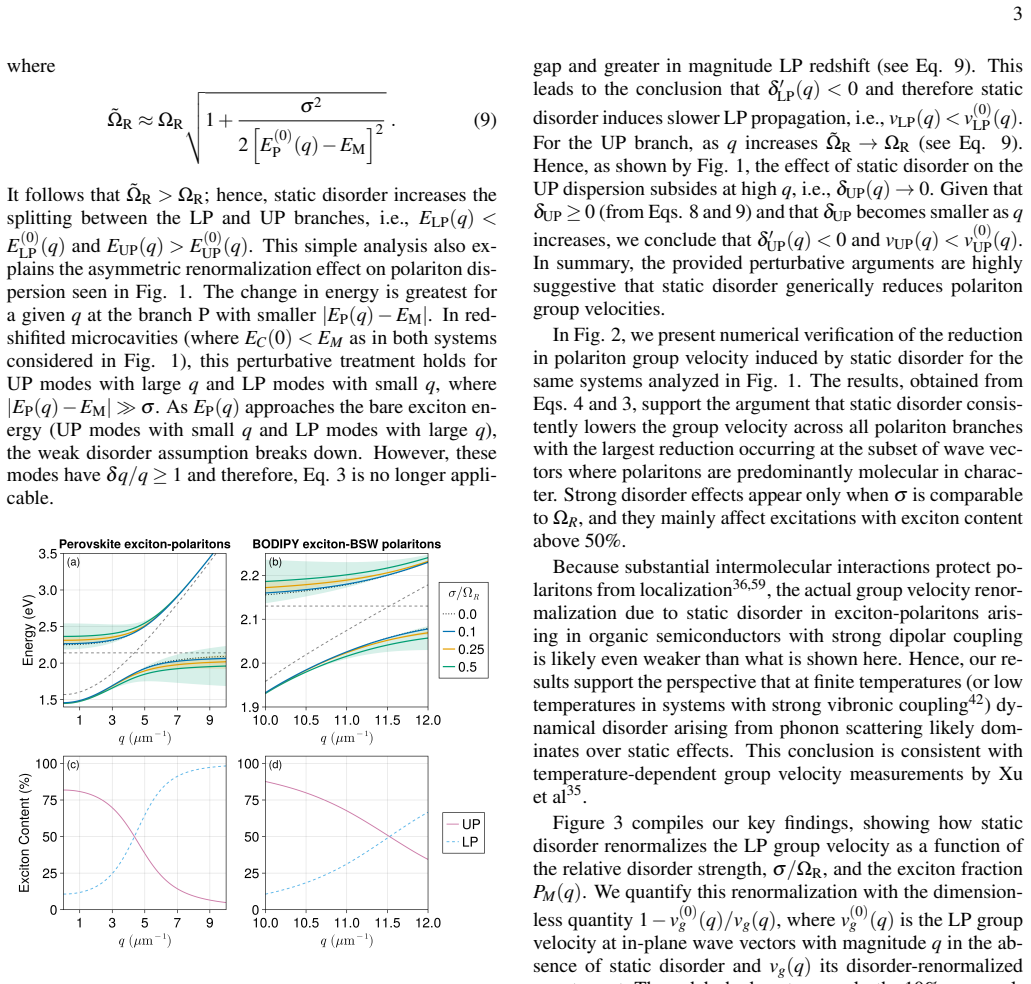
The central claim is that static energetic disorder renormalizes the polariton dispersion in a way that always lowers the group velocity on both branches, with the size of the effect controlled by the ratio of the inhomogeneous broadening $\sigma$ to the Rabi splitting $\Omega_R$ and by the exciton content of the mode. Solving the effective-medium dispersion relation with a Gaussian exciton density of states gives complex polariton energies $E_P(q)$; the paper identifies the renormalized group velocity as $v_g(q)=\hbar^{-1}\partial_q \mathrm{Re}[E_P(q)]$ and the disorder-induced momentum broadening as $\delta_q = \mathrm{Im}[E_P(q)]/(\hbar v_g(q))$, with the method valid while $\delta_q/q<1$. A weak-disorder expansion shows the effective Rabi splitting grows to $\tilde{\Omega}_R \approx \Omega_R\sqrt{1+\sigma^2/(2[E_P^{(0)}(q)-E_M]^2)}$, pushing the lower polariton down and the upper polariton up with wave-vector-dependent strength, which is why both group velocities drop. Applied to perovskite microcavities and to BODIPY exciton-surface-wave polaritons under the parameters used in the recent experiments, the predicted slowdown is small except at high exciton content and large $\sigma/\Omega_R$, leading the paper to attribute most of the experimentally observed slowdown to dynamical, phonon-assisted disorder.
Load-bearing premise
The method assumes that a polariton still travels with a well-defined direction and speed, so that its velocity is just the slope of the energy curve; the paper's own validity check says this stops holding exactly in the strongly excitonic regime where the biggest slowdowns are predicted.
Editorial extensions
If this is right
- Static disorder can be set aside as the dominant explanation for the polariton slowdown observed in perovskite and BODIPY surface-wave microcavities; phonon-assisted scattering is the more likely cause.
- The renormalization is selective: lower-polariton velocities drop most at large in-plane wave vectors where exciton content is high, upper-polariton velocities drop most near zero wave vector, and both effects become significant only as $\sigma$ approaches $\Omega_R/2$.
- The method offers a parameter-only route to predict disorder-renormalized group velocities from independently measurable quantities, so the same comparison can be extended to any new strongly coupled microcavity material.
- At low temperature, where phonon populations are frozen out, static disorder should become the dominant slowdown mechanism in materials with weak vibronic coupling and strong inhomogeneous broadening.
Reading between the lines
- The paper's largest predicted slowdowns sit in the $\delta_q/q \ge 1$ regime where the group-velocity formula is declared invalid, so the true transport speed in those modes may differ from the derivative of the renormalized dispersion; a wavepacket simulation on a disordered lattice would settle the size and direction of that difference.
- The 10%-renormalization boundary shown in the paper, approximately $P_M(q) \propto (\sigma/\Omega_R)^{-1}$, can be read as a design rule: for a given disorder strength, keep the exciton content below that line to keep static-disorder velocity loss under 10%.
- If static disorder is genuinely minor in typical samples, existing datasets should show polariton velocities correlating with temperature and vibronic coupling strength but not with sample-to-sample inhomogeneous linewidth; re-analyzing published ultrafast microscopy data along those lines is a direct extension.
Editorial analysis
A structured set of objections, weighed in public.
Referee Report
Summary. The manuscript develops a nonperturbative scheme, based on the effective-medium dispersion relation of Litinskaya and Reineker, to compute how static Gaussian energetic disorder renormalizes the complex energies and group velocities of microcavity exciton-polaritons. The authors solve the resulting integral equation numerically and also derive a weak-disorder perturbative expansion. Using parameters from perovskite microcavity (Xu et al.) and BODIPY-BSW (Balasubrahmanyam et al.) experiments, they find that static disorder lowers the LP branch and raises the UP branch, reducing group velocities in both branches, with appreciable reductions only for strongly excitonic modes when the disorder width approaches half the Rabi splitting. The paper concludes that static disorder accounts for at most a minor fraction of the experimentally observed slowdown and that dynamical (phonon-assisted) disorder is the dominant mechanism.
Significance. The paper addresses a timely question in polariton transport: whether static energetic disorder can explain the slow propagation observed in molecular microcavities. Its strengths are the minimal parameter set, the absence of any fitted target quantities, and the internal consistency between the numerical solution and the perturbative expansion. The conclusion that static disorder plays a minor role for the specific perovskite parameters (σ/ΩR < 0.235) is well supported and lives in the regime where the group velocity definition is valid. However, the more dramatic quantitative claims of appreciable slowdown, emphasized in the abstract and Fig. 3, are made in a regime where the paper's own validity criterion δq/q < 1 is violated, so the strength of the central claim is not fully established by the present evidence.
major comments (2)
- [Results and Discussion (Eqs. 4–5, Fig. 3)] The paper defines the renormalized group velocity as ħ⁻¹∂Re[EP(q)]/∂q and states that this is valid only when the disorder-induced broadening satisfies δq/q < 1. It then acknowledges that in LP modes at large q and UP modes at small q, δq/q ≥ 1 and the estimate is no longer applicable. Yet Fig. 3 presents quantitative velocity renormalizations exceeding 10% in exactly that regime, and the abstract's emphasis on σ/ΩR approaching 0.5 refers to conditions where many high-exciton modes fall outside the validity domain. The claim that static disorder can appreciably slow polaritons therefore rests on extrapolating Eq. (4) beyond its stated range. To support the quantitative message, the authors should either restrict the strong-renormalization claims to the δq/q < 1 region (where the effect is modest) or provide an independent check, such as wavepacket-propagation simulations or a spectral-function-based transport velocity, demonstrating that ∂Re[EP]/∂q remains the physical group velocity in the strongly broadened regime.
- [Results and Discussion (Eqs. 8–9)] The perturbative argument leading to the conclusion that both vLP(q) < vLP⁽⁰⁾(q) and vUP(q) < vUP⁽⁰⁾(q) is presented as a derivation, but the reasoning for the UP branch is not pointwise: from δUP(q) ≥ 0 and δUP(q) → 0 as q → ∞, one can only infer that the derivative δ'UP(q) is negative on average, not at every q. Since the universal slowdown is a central claim, the authors should either quantify the derivative from Eq. (9) explicitly or clearly label this as a qualitative trend that is verified numerically in Fig. 2 rather than a proof.
minor comments (4)
- [Results and Discussion (after Eq. 5)] The sentence 'these modes have δq/q ≥ 1 and therefore, Eq. 3 is no longer applicable' appears to contain a typo: Eq. (3) is the exact equation used to compute the complex energies and remains applicable for any δq. The statement likely refers to Eq. (4), the group-velocity definition, and should be corrected for clarity.
- [Fig. 3] The quantity PM(q), labeled 'exciton content' or 'exciton fraction', is used to define the axes of Fig. 3 and the crossover relation PM ∝ (σ/ΩR)⁻¹, but it is never defined explicitly in the text. Please state whether it is computed from the bare (σ = 0) Hopfield coefficients or from the renormalized dispersion, and specify the formula used.
- [Introduction and Methods] The introduction cites Ref. 44 and 45 as previous works showing that static disorder can slow polariton transport in one-dimensional wires; briefly stating the difference between those results and the present higher-dimensional calculation would help the reader understand the novelty.
- [Data Availability] The statement 'data available from the corresponding author upon reasonable request' is acceptable, but depositing the numerical data underlying Figs. 1–3 in a repository would improve reproducibility.
Circularity Check
No circularity: the renormalized group velocity is computed from an external effective-medium equation with experimental parameters; the conclusion is conditional and not equivalent to its inputs.
full rationale
The derivation chain is Eq. (3), the Litinskaya–Reineker effective medium relation with Gaussian disorder, solved numerically for Re[EP(q)], followed by Eq. (4), vg(q) = hbar^-1 d Re[EP(q)]/dq, as the definition of the renormalized group velocity. The paper states the method 'depends only on measurable parameters: the mean exciton energy and its variance, the microcavity dispersion, and the Rabi splitting,' and the parameter values are taken from external experiments (Refs. 34 and 35). The velocity renormalization 1 - vg^(0)/vg is therefore computed, not fitted to any experimental slowdown. The weak-disorder analysis (Eqs. 6–9) is an asymptotic expansion of the same Eq. (3), not an additional fitted input. The self-citations (Refs. 44, 45, 56) are used for context and for stating the validity condition δq/q < 1; they do not inject the target result, and the central computation rests on external Refs. 50 and 51. The paper explicitly flags its own validity boundary: 'the blue dotted contour signals the onset of substantial wave vector broadening, δq/q > 1, beyond which q is unlikely to be an approximately conserved quantity' and 'these modes have δq/q >= 1 and therefore, Eq. 3 is no longer applicable.' That is an acknowledged domain-of-applicability limitation, not a circular reduction. The main quantitative conclusion for perovskite parameters (static disorder explains at most a minor fraction of the observed slowdown) lies in the valid regime. Score 1 reflects only the presence of non-load-bearing self-citations, not any circularity in the central derivation.
Assumptions & free parameters
free parameters (1)
- Gaussian disorder width parameter sigma =
5-10 meV for perovskite (Ref. 57); scanned as sigma/Omega_R = 0.1, 0.25, 0.5; not directly measured for the BODIPY…
assumptions (5)
- domain assumption Effective-medium dispersion relation Eq. (1) exactly captures polariton energies under static disorder in a large, homogeneous molecular ensemble.
- domain assumption Exciton static disorder is a Gaussian distribution rho(E) with variance sigma^2/2 (Eq. 2).
- domain assumption Group velocity equals hbar^-1 d Re[EP(q)]/dq and is physically meaningful only if the spectral function is narrow, delta_q/q < 1 (Eqs. 4-5).
- domain assumption Perfectly reflective mirrors and an isotropic, homogeneous molecular ensemble.
- standard math Asymptotic expansion of erfc (Eq. 6) and weak-disorder expansion around EP^(0)(q) are valid in the perturbative regime.
Cite this review
Pith. "Pith review of Static disorder-induced renormalization of polariton group velocity." pith.science (2026). https://pith.science/paper/T7FRGL3X
@misc{pith2026250700918,
  author       = {Pith},
  title        = {Pith review of: Static disorder-induced renormalization of polariton group velocity},
  year         = {2026},
  howpublished = {\url{https://pith.science/paper/T7FRGL3X}},
  note         = {Machine review of arXiv:2507.00918}
}
read the original abstract
Molecular exciton-polaritons exhibit long-range, ultrafast propagation, yet recent experiments have reported far slower propagation than expected. In this work, we implement a nonperturbative approach to quantify how static energetic disorder renormalizes polariton group velocity in strongly coupled microcavities. The method requires no exact diagonalization or master equation propagation, and depends only on measurable parameters: the mean exciton energy and its variance, the microcavity dispersion, and the Rabi splitting. Using parameters corresponding to recently probed organic microcavities, we show that exciton inhomogeneous broadening slows both lower and upper polaritons, particularly when the mean exciton energy fluctuation approaches the collective light-matter coupling strength. A detailed discussion and interpretation of these results is provided using perturbation theory in the limit of weak resonance scattering. Overall, our results support the view that exciton-phonon interactions likely dominate the recent experimental observations of polariton slowdown in disordered media.
Figures


Reference graph
Works this paper leans on
-
[1]
Hopfield ,\ @noop journal journal Phys
author author J. Hopfield ,\ @noop journal journal Phys. Rev. \ volume 112 ,\ pages 1555 ( year 1958 ) NoStop
work page 1958
-
[2]
author author V. Agranovich \ and\ author A. Rukhadze ,\ @noop journal journal Sov. Phys. JETP \ volume 35 ( year 1959 ) NoStop
work page 1959
-
[3]
author author D. G. \ Lidzey , author D. Bradley , author M. Skolnick , author T. Virgili , author S. Walker , \ and\ author D. Whittaker ,\ @noop journal journal Nature \ volume 395 ,\ pages 53 ( year 1998 ) NoStop
work page 1998
-
[4]
author author V. M. \ Agranovich , author M. Litinskaia , \ and\ author D. G. \ Lidzey ,\ @noop journal journal Phys. Rev. B \ volume 67 ,\ pages 085311 ( year 2003 ) NoStop
work page 2003
-
[5]
author author T. W. \ Ebbesen ,\ @noop journal journal Acc. Chem. Res. \ volume 49 ,\ pages 2403 ( year 2016 ) NoStop
work page 2016
-
[6]
author author D. Basko , author F. Bassani , author G. C. \ La Rocca , \ and\ author V. Agranovich ,\ @noop journal journal Phys. Rev. B \ volume 62 ,\ pages 15962 ( year 2000 ) NoStop
work page 2000
-
[7]
author author D. M. \ Coles , author N. Somaschi , author P. Michetti , author C. Clark , author P. G. \ Lagoudakis , author P. G. \ Savvidis , \ and\ author D. G. \ Lidzey ,\ @noop journal journal Nat. Mater. \ volume 13 ,\ pages 712 ( year 2014 ) NoStop
work page 2014
-
[8]
author author J. Schachenmayer , author C. Genes , author E. Tignone , \ and\ author G. Pupillo ,\ @noop journal journal Phys. Rev. Lett. \ volume 114 ,\ pages 196403 ( year 2015 ) NoStop
work page 2015
Show all 59 references
-
[9]
Feist \ and\ author F
author author J. Feist \ and\ author F. J. \ Garcia-Vidal ,\ @noop journal journal Phys. Rev. Lett. \ volume 114 ,\ pages 196402 ( year 2015 ) NoStop
2015
-
[10]
Zhong , author T
author author X. Zhong , author T. Chervy , author L. Zhang , author A. Thomas , author J. George , author C. Genet , author J. A. \ Hutchison , \ and\ author T. W. \ Ebbesen ,\ @noop journal journal Angew. Chem., Int. Ed. Engl. \ volume 56 ,\ pages 9034 ( year 2017 ) NoStop
2017
-
[11]
author author D. M. \ Myers , author S. Mukherjee , author J. Beaumariage , author D. W. \ Snoke , author M. Steger , author L. N. \ Pfeiffer , \ and\ author K. West ,\ @noop journal journal Phys. Rev. B \ volume 98 ( year 2018 ) NoStop
2018
-
[12]
Sch\" a fer , author M
author author C. Sch\" a fer , author M. Ruggenthaler , author H. Appel , \ and\ author A. Rubio ,\ @noop journal journal Proc. Natl. Acad. Sci. \ volume 116 ,\ pages 4883–4892 ( year 2019 ) NoStop
2019
-
[13]
Hou , author M
author author S. Hou , author M. Khatoniar , author K. Ding , author Y. Qu , author A. Napolov , author V. M. \ Menon , \ and\ author S. R. \ Forrest ,\ @noop journal journal Adv. Mater. \ volume 32 ,\ pages 2002127 ( year 2020 ) NoStop
2020
-
[14]
u ller , author S. Sch\
author author T. Botzung , author D. Hagenm\" u ller , author S. Sch\" u tz , author J. Dubail , author G. Pupillo , \ and\ author J. Schachenmayer ,\ @noop journal journal Phys. Rev. B \ volume 102 ( year 2020 ) NoStop
2020
-
[15]
\ Wei , author M.-W
author author Y.-C. \ Wei , author M.-W. \ Lee , author P.-T. \ Chou , author G. D. \ Scholes , author G. C. \ Schatz , \ and\ author L.-Y. \ Hsu ,\ 10.1021/acs.jpcc.1c04623 journal journal J. Phys. Chem. C \ volume 125 ,\ pages 18119 ( year 2021 ) NoStop
-
[16]
Guo , author B
author author Q. Guo , author B. Wu , author R. Du , author J. Ji , author K. Wu , author Y. Li , author Z. Shi , author S. Zhang , \ and\ author H. Xu ,\ 10.1021/acsphotonics.2c00652 journal journal ACS Photonics \ volume 9 ,\ pages 2817 ( year 2022 ) NoStop
-
[17]
author author T. F. \ Allard \ and\ author G. Weick ,\ @noop journal journal Phys. Rev. B \ volume 106 ,\ pages 245424 ( year 2022 ) NoStop
2022
-
[18]
Nosrati , author F
author author S. Nosrati , author F. Wackenhut , author C. Kertzscher , author M. Brecht , \ and\ author A. J. \ Meixner ,\ 10.1021/acs.jpcc.3c02566 journal journal J. Phys. Chem. C \ volume 127 ,\ pages 12152 ( year 2023 ) NoStop
2023 doi
-
[19]
Engelhardt \ and\ author J
author author G. Engelhardt \ and\ author J. Cao ,\ @noop journal journal Phys. Rev. Lett. \ volume 130 ,\ pages 213602 ( year 2023 ) NoStop
2023
-
[20]
Sáez-Blázquez , author J
author author R. Sáez-Blázquez , author J. Feist , author A. I. \ Fernández-Domínguez , \ and\ author F. J. \ García-Vidal ,\ @noop journal journal Phys. Rev. B \ volume 97 ( year 2018 ) NoStop
2018
-
[21]
Xiang , author R
author author B. Xiang , author R. F. \ Ribeiro , author M. Du , author L. Chen , author Z. Yang , author J. Wang , author J. Yuen-Zhou , \ and\ author W. Xiong ,\ 10.1126/science.aba3544 journal journal Science \ volume 368 ,\ pages 665 ( year 2020 ) NoStop
-
[22]
author author T. E. \ Li , author A. Nitzan , \ and\ author J. E. \ Subotnik ,\ @noop journal journal Angew. Chem. \ volume 133 ,\ pages 15661 ( year 2021 ) NoStop
2021
-
[23]
author author V. C. \ Nikolis , author A. Mischok , author B. Siegmund , author J. Kublitski , author X. Jia , author J. Benduhn , author U. H\" o rmann , author D. Neher , author M. C. \ Gather , author D. Spoltore , \ and\ author K. Vandewal ,\ @noop journal journal Nat. Com...
2019
-
[24]
Wang , author M
author author M. Wang , author M. Hertzog , \ and\ author K. B\" o rjesson ,\ @noop journal journal Nat. Commun. \ volume 12 ( year 2021 ) NoStop
2021
-
[25]
Sandik , author J
author author G. Sandik , author J. Feist , author F. J. \ García-Vidal , \ and\ author T. Schwartz ,\ 10.1038/s41563-024-01962-5 journal journal Nat. Mater. \ volume 24 ,\ pages 344–355 ( year 2024 ) NoStop
2024 doi
-
[26]
Zhu , author J
author author T. Zhu , author J. M. \ Snaider , author L. Yuan , \ and\ author L. Huang ,\ @noop journal journal Annu. Rev. Phys. Chem. \ volume 70 ,\ pages 219 ( year 2019 ) NoStop
2019
-
[27]
author author N. S. \ Ginsberg \ and\ author W. A. \ Tisdale ,\ @noop journal journal Annu. Rev. Phys. Chem. \ volume 71 ,\ pages 1 ( year 2020 ) NoStop
2020
-
[28]
author author R. F. \ Ribeiro , author L. A. \ Mart \' nez-Mart \' nez , author M. Du , author J. Campos-Gonzalez-Angulo , \ and\ author J. Yuen-Zhou ,\ @noop journal journal Chem. Sci. \ volume 9 ,\ pages 6325 ( year 2018 ) NoStop
2018
-
[29]
Herrera \ and\ author J
author author F. Herrera \ and\ author J. Owrutsky ,\ @noop journal journal J. Chem. Phys. \ volume 152 ( year 2020 ) NoStop
2020
-
[30]
Kavokin , author J
author author A. Kavokin , author J. J. \ Baumberg , author G. Malpuech , \ and\ author F. P. \ Laussy ,\ @noop title Microcavities \ ( publisher Oxford university press ,\ year 2017 ) NoStop
2017
-
[31]
author author D. J. \ Tibben , author G. O. \ Bonin , author I. Cho , author G. Lakhwani , author J. Hutchison , \ and\ author D. E. \ G \' o mez ,\ 10.1021/acs.chemrev.2c00702 journal journal Chem. Rev. \ volume 123 ,\ pages 8044 ( year 2023 ) NoStop
-
[32]
Zhou , author H.-T
author author Z. Zhou , author H.-T. \ Chen , author M. Sukharev , author J. E. \ Subotnik , \ and\ author A. Nitzan ,\ @noop journal journal Phys. Rev. A \ volume 109 ,\ pages 033717 ( year 2024 ) NoStop
2024
-
[33]
Pandya , author A
author author R. Pandya , author A. Ashoka , author K. Georgiou , author J. Sung , author R. Jayaprakash , author S. Renken , author L. Gai , author Z. Shen , author A. Rao , \ and\ author A. J. \ Musser ,\ @noop journal journal Adv. Sci. \ volume 9 ,\ pages 2105569 ( year 202...
2022
-
[34]
Balasubrahmaniyam , author A
author author M. Balasubrahmaniyam , author A. Simkhovich , author A. Golombek , author G. Sandik , author G. Ankonina , \ and\ author T. Schwartz ,\ @noop journal journal Nat. Mater. \ volume 22 ,\ pages 338 ( year 2023 ) NoStop
2023
-
[35]
Xu , author A
author author D. Xu , author A. Mandal , author J. M. \ Baxter , author S.-W. \ Cheng , author I. Lee , author H. Su , author S. Liu , author D. R. \ Reichman , \ and\ author M. Delor ,\ @noop journal journal Nat. Commun. \ volume 14 ,\ pages 3881 ( year 2023 ) NoStop
2023
-
[36]
Hong , author D
author author Y. Hong , author D. Xu , \ and\ author M. Delor ,\ @noop journal journal arXiv:2506.08770 \ ( year 2025 ) NoStop
2025
-
[37]
Sokolovskii , author R
author author I. Sokolovskii , author R. H. \ Tichauer , author D. Morozov , author J. Feist , \ and\ author G. Groenhof ,\ @noop journal journal Nat. Commun. \ volume 14 ,\ pages 6613 ( year 2023 ) NoStop
2023
-
[38]
Blackham , author A
author author L. Blackham , author A. Manjalingal , author S. R. \ Koshkaki , \ and\ author A. Mandal ,\ @noop journal journal arXiv:2501.16622 \ ( year 2025 ) NoStop
2025
-
[39]
Sokolovskii , author Y
author author I. Sokolovskii , author Y. Luo , \ and\ author G. Groenhof ,\ @noop journal journal J. Phys. Chem. Lett. \ volume 16 ,\ pages 6719 ( year 2024 ) NoStop
2024
-
[40]
author author B. X. \ Chng , author M. E. \ Mondal , author W. Ying , \ and\ author P. Huo ,\ @noop journal journal Nano Lett. \ ( year 2025 ) NoStop
2025
-
[41]
@noop journal journal arXiv:2411.08288 \ ( year 2025 ) NoStop
2025 arXiv
-
[42]
Krupp , author G
author author N. Krupp , author G. Groenhof , \ and\ author O. Vendrell ,\ @noop journal journal arXiv:2410.23739 \ ( year 2024 ) NoStop
2024 arXiv
-
[43]
author author J. M. \ Ziman ,\ @noop title Models of disorder: the theoretical physics of homogeneously disordered systems \ ( publisher Cambridge university press ,\ year 1979 ) NoStop
1979
-
[44]
author author G. J. \ Aroeira , author K. T. \ Kairys , \ and\ author R. F. \ Ribeiro ,\ @noop journal journal J. Phys. Chem. Lett. \ volume 14 ,\ pages 5681 ( year 2023 ) NoStop
2023
-
[45]
author author G. J. \ Aroeira , author K. T. \ Kairys , \ and\ author R. F. \ Ribeiro ,\ @noop journal journal Nanophotonics \ volume 13 ,\ pages 2553 ( year 2024 ) NoStop
2024
-
[46]
author author N. F. \ Mott \ and\ author W. Twose ,\ @noop journal journal Adv. Phys. \ volume 10 ,\ pages 107 ( year 1961 ) NoStop
1961
-
[47]
Ishii ,\ @noop journal journal Prog
author author K. Ishii ,\ @noop journal journal Prog. Theor. Phys. Suppl. \ volume 53 ,\ pages 77 ( year 1973 ) NoStop
1973
-
[48]
Abrahams , author P
author author E. Abrahams , author P. W. \ Anderson , author D. C. \ Licciardello , \ and\ author T. V. \ Ramakrishnan ,\ @noop journal journal Phys. Rev. Lett. \ volume 42 ,\ pages 673 ( year 1979 ) NoStop
1979
-
[49]
Ping ,\ @noop journal journal Introduction to Wave Scattering, Localization and Mesoscopic Phenomena \ ,\ pages 297 ( year 2006 ) NoStop
author author S. Ping ,\ @noop journal journal Introduction to Wave Scattering, Localization and Mesoscopic Phenomena \ ,\ pages 297 ( year 2006 ) NoStop
2006
-
[50]
Litinskaya \ and\ author P
author author M. Litinskaya \ and\ author P. Reineker ,\ @noop journal journal Phys. Rev. B \ volume 74 ,\ pages 165320 ( year 2006 ) NoStop
2006
-
[51]
Litinskaya ,\ @noop journal journal Phys
author author M. Litinskaya ,\ @noop journal journal Phys. Lett. A \ volume 372 ,\ pages 3898 ( year 2008 ) NoStop
2008
-
[52]
Abramowitz \ and\ author I
author author M. Abramowitz \ and\ author I. A. \ Stegun ,\ @noop title Handbook of mathematical functions: with formulas, graphs, and mathematical tables ,\ Vol. volume 55 \ ( publisher Courier Corporation ,\ year 1965 ) NoStop
1965
-
[53]
Hopfield ,\ @noop journal journal Phys
author author J. Hopfield ,\ @noop journal journal Phys. Rev. \ volume 182 ,\ pages 945 ( year 1969 ) NoStop
1969
-
[54]
Lagendijk \ and\ author B
author author A. Lagendijk \ and\ author B. A. \ Van Tiggelen ,\ @noop journal journal Physics Reports \ volume 270 ,\ pages 143 ( year 1996 ) NoStop
1996
-
[55]
Litinskaia , author V
author author M. Litinskaia , author V. Agranovich , \ and\ author G. C. \ La Rocca ,\ @noop journal journal Phys. Status Solidi A \ volume 190 ,\ pages 395 ( year 2002 ) NoStop
2002
-
[56]
Suyabatmaz \ and\ author R
author author E. Suyabatmaz \ and\ author R. F. \ Ribeiro ,\ @noop journal journal J. Chem. Phys. \ volume 159 ( year 2023 ) NoStop
2023
-
[57]
author author A. R. \ Srimath Kandada , author H. Li , author E. R. \ Bittner , \ and\ author C. Silva-Acu \ n a ,\ @noop journal journal J. Phys. Chem. C \ volume 126 ,\ pages 5378 ( year 2022 ) NoStop
2022
-
[58]
author author G. B. \ Arfken , author H. J. \ Weber , \ and\ author F. E. \ Harris ,\ @noop title Mathematical methods for physicists: a comprehensive guide \ ( publisher Academic press ,\ year 2011 ) NoStop
2011
-
[59]
author author N. C. \ Bradbury , author R. F. \ Ribeiro , author J. R. \ Caram , \ and\ author D. Neuhauser ,\ @noop journal journal Phys. Rev. B \ volume 109 ,\ pages L241303 ( year 2024 ) NoStop
2024
Reviewed August 6, 2026 · model on record in the stance chip above.
Discussion (0). Continue with ORCID to comment.