REVIEW 4 major objections 4 minor 56 references
LOMS.cz: A computational platform for high-throughput Classical and Combinatorial Judd-Ofelt analysis and rare-earth spectroscopy
T0 review · 4 major / 4 minor · reviewed 2026-08-06 · deepseek-v4-flash
Pith's one-line read LOMS.cz claims to fully automate Judd-Ofelt analysis for rare-earth materials, from absorption spectra to predicted radiative lifetimes, and validates the pipeline by reproducing published parameters for nine lanthanide dopants.
desk verdict A genuinely useful, well-validated web platform and database for Judd-Ofelt analysis, but the printed uncertainty formula in Eqs. 14 is wrong and the 'experimentally validated' label oversells the data. read the letter →
The pith
A machine-rendered reading of the paper's core claim, the machinery that carries it, and where it could break.
The reading
What carries the argument
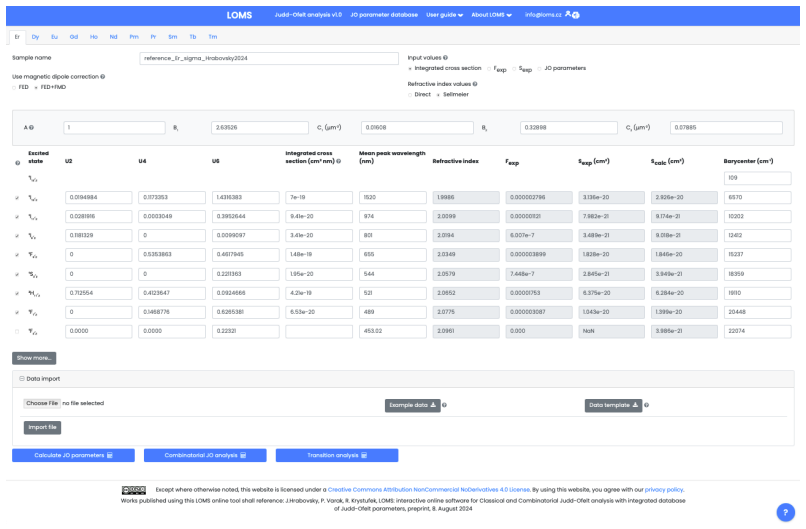
The engine is the classic Judd-Ofelt linear least-squares fit: experimental line strengths $S_{\mathrm{exp}}(J\to J')$ obtained from integrated absorption cross sections (Eq. 22) are equated to the theoretical electric-dipole line strength $S_{\mathrm{ED}} = \sum_{i=2,4,6}\Omega_i\,|U^{(i)}|^2$ (plus a magnetic-dipole term where relevant), and the three $\Omega_i$ are adjusted by least squares. The load-bearing inputs are the host-insensitive reduced squared matrix elements $U^{(2)}, U^{(4)}, U^{(6)}$, the mean wavelengths, refractive indices, and barycenters. C-JO carries each possible $r$-subset of the $N_B$ observed bands through the same fit (Eq. 24), discards combinations that give negative $\Omega_i$ values, applies a box/whisker outlier cut, and reports medians of $\Omega_i$ and min/max radiative lifetimes over the surviving subsets. Uncertainty estimates for each $\Omega_i$ come from the diagonal of the inverse normal matrix multiplied by the RMS residual, following the error theory cited in the paper.
What would settle it
Take a doped crystal with an independently measured fluorescence lifetime and a known Stokes shift between absorption and emission; compute $\Omega_i$ and $\tau_{\mathrm{JO}}^r$ with LOMS.cz using absorption mean wavelengths as barycenters, and compare the predicted $\tau_{\mathrm{JO}}^r$ to the measured lifetime. If the $\lambda^{-3}$ dependence of $A(J',J)$ makes the predicted lifetime deviate by more than the reported uncertainty on a host where emission is red-shifted from absorption, the claim that the default barycenter convention yields reliable radiative properties fails.
Extended reading notes
Core claim
The paper's central claim is that LOMS.cz can fully automate the entire computational JO workflow and that Combinatorial Judd-Ofelt analysis systematically identifies optimal absorption band combinations for reliable parameter extraction. The authors validate the claim by recomputing JO parameters and radiative lifetimes for Er$^{3+}$ in tellurite glass, Dy$^{3+}$ in YVO$_4$ and $\alpha$-KGd(WO$_4$)$_2$, Ho$^{3+}$ in LiYF$_4$ and YAG, Nd$^{3+}$ in Y$_2$O$_3$, Pm$^{3+}$ in lead phosphate glass, Pr$^{3+}$ in RbPb$_2$Cl$_5$, Tb$^{3+}$ in LiTbF$_4$, Sm$^{3+}$ in Sr$_2$SiO$_4$ and TeO$_2$BiCl$_3$, and Tm$^{3+}$ in germanate glass and S-FAP, finding agreement with published values. In the main Er example, LOMS.cz returns $\Omega_2 = 7.66\times10^{-20}$ cm$^2$, $\Omega_4 = 1.51\times10^{-20}$ cm$^2$, and $\Omega_6 = 2.21\times10^{-20}$ cm$^2$, matching the JOFwin2011 comparison values to three significant figures, and the radiative lifetimes agree with the reference to within rounding. The paper further claims that the integrated database enables direct comparison between computed and empirical results and that the proposed output format fills a long-standing reporting gap.
Load-bearing premise
The load-bearing premise is that the tabulated reduced squared matrix elements $U^{(2)}, U^{(4)}, U^{(6)}$ taken from a single reference template, the recommended practice of using absorption mean wavelengths as emission barycenters, and the user-supplied integrated absorption cross sections are accurate; if any of these are wrong, every computed $\Omega_i$ and every derived lifetime shifts.
Editorial extensions
If this is right
- With a single set of inputs in four accepted formats, researchers can now obtain $\Omega_2$, $\Omega_4$, $\Omega_6$, transition probabilities $A(J',J)$, branching ratios $\beta$, radiative lifetimes $\tau_{\mathrm{JO}}^r$, and per-parameter uncertainties without hand-coding the fit.
- C-JO removes the arbitrary choice of which absorption bands to include: the box-plot reduced median is reported alongside the full-set fit, so the stability of the parameters under band selection becomes visible.
- The over-1200-record database covering 12 RE$^{3+}$ ions and more than 550 hosts lets a user query published JO parameters for the same ion and host and compare against a new computation, turning JO analysis into a screening tool rather than a one-off calculation.
- The standardized reporting format (manifolds, matrix element sources, refractive index model, magnetic-dipole contribution, uncertainties) gives later readers the information needed to reproduce any reported parameter set.
- If the validation across nine lanthanide dopants holds, the platform should be able to predict radiative lifetimes for new rare-earth-doped hosts from absorption measurements alone, flagging promising emission properties before extensive experimental characterization.
Reading between the lines
- If C-JO medians are as stable as the examples suggest, the same sweep could serve as a retrospective audit: legacy papers that report only a full-set fit could be re-analyzed from their tabulated absorption bands, and cases where the full-set value falls outside the box-plot reduced range would indicate a hypersensitive or misassigned transition.
- The paper's recommendation to use absorption mean wavelengths as emission barycenters has a testable consequence: because $A(J',J)$ scales as $\lambda^{-3}$, a systematic Stokes shift between absorption and emission will bias predicted lifetimes; comparing platform predictions against measured fluorescence lifetimes on a Stokes-shifted host would quantify that bias.
- The database's growth toward many hosts per ion would allow a statistical mapping of $\Omega_2$, $\Omega_4$, $\Omega_6$ against host properties such as polarizability, covalency, or site symmetry, which the current paper does not attempt; such a map would make the database predictive rather than merely comparative.
- Nothing in the paper prevents the same combinatorial machinery from being applied to emission-based JO parametrizations, so the C-JO logic could generalize beyond absorption-band selection to the analysis tools already used for Eu$^{3+}$ emission spectra.
Editorial analysis
A structured set of objections, weighed in public.
Referee Report
Summary. The manuscript presents LOMS.cz, an open-source web platform for Judd-Ofelt (JO) analysis of trivalent rare-earth spectroscopy. It implements classical JO fitting from absorption cross sections, oscillator strengths, or line strengths; computes transition probabilities, branching ratios, and radiative lifetimes; introduces Combinatorial JO (C-JO) analysis that enumerates all subsets of observed manifolds and uses box-plot outlier rejection to identify stable parameter sets; and provides a curated database of more than 1200 JO parameter records. The workflow and GUI are described in detail, with template files, CSV import/export, and a proposed standardized reporting format. Technical validation reproduces published values of Ω₂, Ω₄, Ω₆ and radiative lifetimes for Er, Dy, Ho, Nd, Pm, Pr, Tb, Sm, and Tm systems, generally within a few percent.
Significance. The platform addresses a real reproducibility gap in rare-earth spectroscopy, where JO calculations are frequently performed with inconsistent conventions and unclear reporting. The paper's strengths are its openly available code, standardized input templates, detailed worked examples, and validation against independent literature values (Walsh, Cavalli, Kaminskii, Shinn, and others), which support the reliability of the core fitting and radiative-property engine. If the uncertainty-quantification issue described below is corrected, LOMS.cz would be a valuable community resource. However, the advertised 'detailed uncertainty quantification' is not supported by the equations as printed, and the validation scope is narrower than the conclusion claims, so the manuscript needs revision before the central claims can be accepted as stated.
major comments (4)
- [Error evaluation of Judd-Ofelt analysis, Eqs. (14a)–(14b)] The printed formulas ΔΩ_i = √(f_ii·RMS_f) and ΔΩ_i = √(S_ii·RMS_S) are not the standard least-squares standard errors. For the linear model in Eqs. (16)–(17), the parameter covariance is RMS²·(uᵀu)⁻¹ = RMS²·F, so the correct standard error is ΔΩ_i = RMS_f·√(f_ii) (or RMS_S·√(S_ii)). As printed, the uncertainty is understated by a factor of 1/√(RMS): for typical oscillator-strength fits with RMS_f ≈ 10⁻⁷, the quoted uncertainties are about 3000× too small, and for line-strength fits with RMS_S in cm², Eq. (14b) is also dimensionally inconsistent. Because the GUI and CSV export explicitly report ΔΩ₂, ΔΩ₄, and ΔΩ₆, and the paper advertises 'detailed uncertainty quantification' and 'reliable parameter extraction,' this is a load-bearing error. Please correct the equations, or if the software internally uses the correct covariance formula, state this explicitly and reconcile the text.
- [Technical Validation and Conclusion] The conclusion states that LOMS.cz was 'extensively validated across diverse rare-earth systems including all spectroscopically active RE ions in various host matrices.' Table 3 validates nine ions (Er, Dy, Ho, Nd, Pm, Pr, Tb, Sm, Tm); Eu and Gd are absent, and Yb is not amenable to JO analysis because it has only one 4f–4f transition. The claim should be narrowed to the nine tested lanthanides, or the missing ions should be validated.
- [Combinatorial Judd-Ofelt theory and Evaluation protocol] The claim that C-JO 'systematically identifies optimal absorption band combinations' rests on the box-plot whisker criterion for outlier exclusion, but this criterion is presented as an ad hoc statistical choice and is not validated against an independent measure of parameter quality. The Median BP values in Table 3 sometimes differ markedly from the full-set values (e.g., Tb³⁺ in LiTbF₄: Ω₂ median 1.07 vs. full-set 1.50 vs. Median BP 1.52; Sm³⁺ in TeO₂BiCl₃: Ω₂ median BP 0.96 vs. full-set 0.48), and no external metric such as comparison with measured radiative lifetimes is used to demonstrate that the box-plot-reduced combinations are indeed more reliable. Please provide a concrete test of the 'optimal' claim or soften it.
- [Data Records and Code availability] The abstract describes a 'dynamically expanding database of experimentally validated parameters' and the conclusion refers to 'experimental validation through its integrated database,' but the Code availability section explicitly states that 'their factual accuracy has not been further independently verified.' These statements are inconsistent. The database is a curated literature compilation, not an independently validated set; please qualify the validation claim to avoid overstating the evidence.
minor comments (4)
- [Combinatorial Judd-Ofelt theory, Eq. (24)] The number of combinations for NB = 5 is given as 5 in one passage and 6 in another; the correct value is C(5,4) + C(5,5) = 6, as stated later in the Technical Validation section.
- [Judd-Ofelt theory: Experimental practice, Eq. (23)] The expression labeled λ_H appears to be the reciprocal of a weighted mean, and the distinction between harmonic and weighted mean definitions is not clearly explained; please clarify the definitions and notation.
- [Throughout] Several typographical errors should be corrected: 'experiemntal' (Introduction), 'Figsahere' (Figures 10 and 11 captions), 'structrures' (CSV output section), and 'aquisition' (Author contributions).
- [Data Records] The text states that the database contains data for '12 RE3+ ions,' but the list that follows contains 11 template ions (Pr, Nd, Pm, Sm, Eu, Gd, Tb, Dy, Ho, Er, Tm); please reconcile this number.
Circularity Check
No significant circularity: the JO workflow is a standard forward calculation benchmarked against external literature; the only mild issue is a non-load-bearing self-citation to the authors' own Ref. 33 for the C-JO method and main example.
full rationale
Walking the derivation chain: the JO parameters are obtained from a standard least-squares fit of measured oscillator strengths/linestrengths (Eqs. 4/22) to the theoretical expressions (Eqs. 2/8); the radiative probabilities, branching ratios, and lifetimes are then computed forward from the fitted parameters via Eqs. 5, 10, 11. No fitted quantity is used to predict itself. The C-JO algorithm enumerates all manifold combinations (Eq. 24) and summarizes the distribution by median/box-plots; its 'optimal' value is a statistical summary of the fits, not a value derived from the claimed output, so the prediction is not forced by construction. The main worked example (TZB:Er) is a code-to-code consistency check against the authors' own Ref. 33 and against Walsh's JOFwin2011; this is a benchmark, not an independent prediction. However, Table 3 also validates against external literature (Cavalli, Kaminskii, Walsh, Shinn, Merkle, Vasyliev, etc.), so the core workflow is externally benchmarked. The one self-citation that is present, Ref. 33 as the source of the C-JO/box-whisker method and as the main example, is provenance rather than a load-bearing uniqueness argument: the method is re-demonstrated here on independent datasets. Inputs inherited from Walsh's JOFwin2011 templates and the database's 'factual accuracy has not been further independently verified' caveat are data-quality limitations, not circularity. The printed uncertainty expression (Eqs. 14a/14b) is dimensionally suspect, since the covariance identity requires RMS times the square root of the diagonal of the inverse normal matrix, but that is a correctness/error issue, not a circular reduction.
Assumptions & free parameters
assumptions (5)
- domain assumption JO theory: three phenomenological parameters Omega2, Omega4, Omega6 fully describe electric-dipole 4f-4f transition intensities.
- domain assumption Reduced squared matrix elements U^(2), U^(4), U^(6) are host-independent and the tabulated values in the LOMS templates are correct.
- domain assumption The user's measured absorption bands are correctly assigned to specific J to J' transitions and integrated cross-sections are free of baseline errors.
- ad hoc to paper C-JO outlier exclusion via box-plot whiskers identifies 'optimal' band combinations.
- ad hoc to paper Barycenter can be set to absorption mean wavelength without introducing large bias in A(J',J), beta, and tau.
Cite this review
Pith. "Pith review of LOMS.cz: A computational platform for high-throughput Classical and Combinatorial Judd-Ofelt analysis and rare-earth spectroscopy." pith.science (2026). https://pith.science/paper/IVOIBOZT
@misc{pith2026250701218,
  author       = {Pith},
  title        = {Pith review of: LOMS.cz: A computational platform for high-throughput Classical and Combinatorial Judd-Ofelt analysis and rare-earth spectroscopy},
  year         = {2026},
  howpublished = {\url{https://pith.science/paper/IVOIBOZT}},
  note         = {Machine review of arXiv:2507.01218}
}
abstract
We present LOMS.cz (Luminescence, Optical and Magneto-optical Software), an open-source computational platform that addresses the long-standing challenge of standardizing Judd-Ofelt (JO) calculations in rare-earth spectroscopy. Despite JO theory's six-decade history as the fundamental framework for understanding $4f\leftrightarrow4f$ transitions, the field lacks standardized computational methodologies for precise and reproducible parameter determination. LOMS integrates three key innovations: (1) automated computation of JO parameters, transition probabilities, branching ratios, and theoretical radiative lifetimes, (2) a dynamically expanding database of experimentally validated parameters enabling direct comparison between computed and empirical results, and (3) a novel Combinatorial JO (C-JO) analysis algorithm that systematically identifies optimal absorption band combinations to ensure reliable parameter extraction. As a proof-of-concept, we demonstrate how this computational framework enables rapid screening of spectroscopic parameters, allowing researchers to predict optical properties with enhanced reliability. By combining automated analysis with experimental validation through its integrated database, LOMS.cz establishes a standardized platform for accelerating the discovery and optimization of rare-earth-based photonic and optoelectronic materials.
Figures


Figures from the paper (10 more)



Reference graph
Works this paper leans on
-
[1]
The fascination of the rare earths—then, now and in the future
Wybourne, B. The fascination of the rare earths—then, now and in the future. J. Alloy. Compd. 380, 96–100, 10.1016/j. jallcom.2004.03.034 (2004)
doi:10.1016/j 2004
-
[2]
Judd-Ofelt theory: principles and practices
Walsh, B. Judd-Ofelt theory: principles and practices. Di Bartolo, B., F orte, O. (eds) Adv. Spectrosc. for Lasers Sens. 10.1007/1-4020-4789-4_21 (2006)
-
[3]
Zhou, B., Li, Z. & Chen, C. Global potential of rare earth resources and rare earth demand from clean technologies. Minerals 7, 10.3390/min7110203 (2017)
-
[4]
Liu, G. & (eds), B. J. Spectroscopic Properties of Rare Earths in Optical Materials (Springer, 2005)
work page 2005
-
[5]
Zhou, B., Li, Z., Zhao, Y ., Zhang, C. & Wei, Y . Rare earth elements supply vs. clean energy technologies: new problems to be solve. Gospodarka Surowcami Miner. - Miner. Resour. Manag. 32, 10.1515/gospo-2016-0039 (2016)
-
[6]
Gutfleisch, O. et al. Magnetic materials and devices for the 21st century: Stronger, lighter, and more energy efficient. Adv. Mater .23, 821–842, 10.1002/adma.201002180 (2011)
-
[7]
Sagawa, M., Fujimura, S., Togawa, N., Yamamoto, H. & Matsuura, Y . New material for permanent magnets on a base of Nd and Fe (invited). J. Appl. Phys. 55, 2083–2087, 10.1063/1.333572 (1984)
doi:10.1063/1.333572 1984
-
[8]
Dong, H. et al. Lanthanide nanoparticles: From design toward bioimaging and therapy. Chem. Rev. 115, 10725–10815, 10.1021/acs.chemrev.5b00091 (2015)
Show all 56 references
-
[9]
Zhou, J., Liu, Z. & Li, F. Upconversion nanophosphors for small-animal imaging. Chem. Soc. Rev. 41, 1323–1349, 10.1039/C1CS15187H (2012)
2012 doi
-
[10]
Collaboration on Rare Earth Elements
HCSS/TNO. Collaboration on Rare Earth Elements. An analysis of potentials for collaboration with Japan on Rare Earths (The Hague Centre for Strategic Studies and TNO: The Hague, Netherlands, 2012)
2012
-
[11]
Rare earth elements supply restrictions: Market failures, not scarcity, hamper their current use in high-tech applications
Tukker, A. Rare earth elements supply restrictions: Market failures, not scarcity, hamper their current use in high-tech applications. Environ. Sci. & Technol. 48, 9973–9974, 10.1021/es503548f (2014)
2014 doi
-
[12]
& Kramer, K
Hehlen, M., Brik, M. & Kramer, K. 50th anniversary of the Judd–Ofelt theory: An experimentalist’s view of the formalism and its application. J. Lumin. 136, 221–239, 10.1016/j.jlumin.2012.10.035 (2013)
2013 doi
-
[13]
& Dramicanin, M
Ciric, A., Marciniak, L. & Dramicanin, M. Self-referenced method for the Judd–Ofelt parametrisation of the Eu3+ excitation spectrum. Sci Rep 12, 563, 10.1038/s41598-021-04651-4 (2022)
2022 doi
-
[14]
Optical absorption intensities of rare-earth ions
Judd, B. Optical absorption intensities of rare-earth ions. Phys. Rev. 127, 750–761, 10.1103/PhysRev.127.750 (1962)
1962 doi
-
[15]
Intensities of Crystal Spectra of Rare-Earth Ions
Ofelt, G. Intensities of Crystal Spectra of Rare-Earth Ions. The J. Chem. Phys. 37, 511–520, 10.1063/1.1701366 (1962)
1962 doi
-
[16]
& Auzel, F
Goldner, P. & Auzel, F. Application of standard and modified Judd–Ofelt theories to a praseodymium-doped fluorozirconate glass. J. Appl. Phys. 79, 7972–7977, 10.1063/1.362347 (1996)
1996 doi
-
[17]
Judd-Ofelt Theory — The Golden (and the Only One) Theoretical Tool of f-Electron Spectroscopy , chap
Smentek, L. Judd-Ofelt Theory — The Golden (and the Only One) Theoretical Tool of f-Electron Spectroscopy , chap. 10 (John Wiley & Sons, Ltd, 2015)
2015
-
[18]
& Blasse, G
Sytsma, J., Imbusch, G. & Blasse, G. The spectroscopy of Gd 3+ in yttriumoxychloride: Judd–Ofelt parameters from emission data. J. Chem. Phys. 91, 1456–1461, 10.1063/1.457106 (1989)
1989 doi
-
[19]
& Binnemans, K
Görller-Walrand, C. & Binnemans, K. Chapter 167 spectral intensities of f-f transitions. In Handbook on the Physics and Chemistry of Rare Earths, 101–264, 10.1016/S0168-1273(98)25006-9 (Elsevier, 1998)
1998 doi
-
[20]
& Dramicanin, M
Ciric, A., Stojadinovic, S. & Dramicanin, M. An extension of the judd-ofelt theory to the field of lanthanide thermometry. J. Lumin. 216, 116749, 10.1016/j.jlumin.2019.116749 (2019)
2019
-
[21]
& Dramicanin, M
Ciric, A., Stojadinovic, S. & Dramicanin, M. Approximate prediction of the cie coordinates of lanthanide-doped materials from the judd-ofelt intensity parameters. J. Lumin. 213, 395–400, 10.1016/j.jlumin.2019.05.052 (2019)
2019 doi
-
[22]
& Dramicanin, M
Ciric, A., Stojadinovic, S., Sekulic, M. & Dramicanin, M. JOES: An application software for Judd-Ofelt analysis from Eu3+ emission spectra. J. Lumin. 205, 10.1016/j.jlumin.2018.09.048 (2019)
2019 doi
-
[23]
& Freire, R
Dutra, J., Bispo, T. & Freire, R. LUMPAC lanthanide luminescence software: Efficient and user friendly. J. Comput. Chem. 35, 10.1002/jcc.23542 (2014)
2014 doi
-
[24]
Moura Jr., R. et al. (INVITED) JOYSpectra: A web platform for luminescence of lanthanides. J. Comput. Chem. 11, 10.1016/j.omx.2021.100080 (2021)
2021
-
[25]
& Veis, M
Hrabovský, J., Kuˇcera, M., Paloušová, L., Bi, L. & Veis, M. Optical characterization of Y3Al5O12 and Lu3Al5O12 single crystals. Opt. Mater . Express11, 1218–1223, 10.1364/OME.417670 (2021). 27/29
2021 doi
-
[26]
Hrabovský, J. et al. Rapid and precise large area mapping of rare-earth doping homogeneity in luminescent materials. Commun Mater 5, 251, 10.1038/s43246-024-00679-x (2024)
2024 doi
-
[27]
& Crosswhite, H
Dieke, G. & Crosswhite, H. The spectra of the doubly and triply ionized rare earths. Appl. Opt. 2, 675–686, 10.1364/AO.2. 000675 (1963)
1963 doi
-
[28]
& Burdick, G
Peijzel, P., Meijerink, A., Wegh, R., Reid, M. & Burdick, G. A complete 4fn energy level diagram for all trivalent lanthanide ions. J. Sol. State Chem. 178, 448–453, 10.1016/j.jssc.2004.07.046 (2005)
2005 doi
-
[29]
The puzzle of rare-earth spectra in solids
Vleck, J. The puzzle of rare-earth spectra in solids. J. Phys. Chem. 41, 67–80, 10.1021/j150379a006 (1937)
1937 doi
-
[30]
& Hoogschagen, J
Broer, L., Gorter, C. & Hoogschagen, J. On the intensities and the multipole character in the spectra of the rare earth ions. Physica 11, 231–250, 10.1016/S0031-8914(45)80009-5 (1945)
1945 doi
-
[31]
Optical properties of glasses, in
Edgar, A. Optical properties of glasses, in. J. Singh (Ed.), Optical Properties of Condensed Matter and Applications (John Wiley & Sons, 2006)
2006
-
[32]
Spectroscopic properties of Rare Earths (Wiley (New York), 1965)
Wybourne, B. Spectroscopic properties of Rare Earths (Wiley (New York), 1965)
1965
-
[33]
Hrabovsky, J. et al. Classical and combinatorial Judd–Ofelt analysis of spectroscopic properties in Er-doped materials: TeO2-ZnO-BaO:Er3+: glasses. J. Phys. Photonics 7, 025006, 10.1088/2515-7647/adb115 (2025)
2025 doi
-
[34]
& Rajnak, K
Carnall, W., Fields, P. & Rajnak, K. Electronic energy levels in the trivalent lanthanide aquo ions. I. Pr3+, Nd3+, Pm3+, Sm3+, Dy3+, Ho3+, Er3+, and Tm3+. J. Chem. Phys. 49, 4424–4442, 10.1063/1.1669893 (1968)
1968 doi
-
[35]
Error evaluation of Judd-Ofelt spectroscopic analysis
Zhang, Y .et al. Error evaluation of Judd-Ofelt spectroscopic analysis. Spectrochim. Acta A Mol. Biomol. Spectrosc. 239, 118536, 10.1016/j.saa.2020.118536 (2020)
2020
-
[36]
Afef, B. et al. Green and near-infrared emission of Er 3+ doped PZS and PZC glasses. J. Lumin. 194, 706–712, 10.1016/j.jlumin.2017.09.040 (2018)
2018 doi
-
[37]
& Marimuthu, K
Karthikeyan, P., Suthanthirakumar, P., Vijayakumar, R. & Marimuthu, K. Structural and luminescence behaviour of Er3+ doped telluro-fluoroborate glasses. J. Mol. Struct. 1083, 268–277, 10.1016/j.molstruc.2014.12.003 (2015)
2015 doi
-
[38]
& Marimuthu, K
Mariyappan, M., Arunkumar, S. & Marimuthu, K. Judd-Ofelt analysis and NIR luminescence investigations on Er3+ ions doped B2O3–Bi2O3–Li2O–K2O glasses for photonic applications. Phys. B Condens. Matter 572, 27–35, 10.1016/j.physb. 2019.07.036 (2019)
2019 doi
-
[39]
& Wagner, T
Aoki, T., Strizik, L., Hrabovsky, J. & Wagner, T. Quadrature frequency resolved spectroscopy of upconversion photolumi- nescence in GeGaS:Er3+; II. elucidating excitation mechanisms of red emission besides green emission. J. Mater . Sci.: Mater . Electron.28, 7077–7082, 10.100...
2017 doi
-
[40]
Bureau, B. et al. Chalcogenide glass fibers for infrared sensing and space optics. Fiber Integr . Opt.28, 65–80, 10.1080/ 01468030802272542 (2009)
2009
-
[41]
Chalcogenide glasses: a review of their preparation, properties and applications
Seddon, A. Chalcogenide glasses: a review of their preparation, properties and applications. J. Non Cryst. Solids 184, 44–50, 10.1016/0022-3093(94)00686-5 (1995)
1995 doi
-
[42]
Refractiveindex.info database of optical constants
Polyanskiy, M. Refractiveindex.info database of optical constants. Sci data 11, 10.1038/s41597-023-02898-2 (2024)
2024 doi
-
[43]
& Krystufek, R
Hrabovsky, J., Varak, P. & Krystufek, R. LOMS.cz: interactive online software for Classical and Combinatorial Judd-Ofelt analysis with integrated database of Judd-Ofelt parameters. Figshare 10.6084/m9.figshare.c.7904465 (2024)
2024 doi
-
[44]
Merkle, L. D. & Dubinskii, M. Pr:RbPb 2Cl5: temperature dependent spectra, dynamics and three-for-one excitation. Opt. Express 25, 19780, 10.1364/OE.25.019780 (2017)
2017 doi
-
[45]
Walsh, B. M. et al. Spectroscopic characterization of Nd:Y2O3: application toward a differential absorption lidar system for remote sensing of ozone. J. Opt. Soc. Am. B 19, 2893, 10.1364/JOSAB.19.002893 (2002)
2002 doi
-
[46]
D., Krupke, W
Shinn, M. D., Krupke, W. F., Solarz, R. W. & Kirchoff, T. A. Spectroscopic and laser properties of Pm3+. IEEE J. Quantum Electron. 24, 1100–1108, 10.1109/3.232 (1988)
1988 doi
-
[47]
Manjunath, C. et al. Optical absorption intensity analysis using judd-ofelt theory and photoluminescence investigation of orange-red Sr2SiO4: Sm3+ nanopigments. Dye. Pigment. 148, 118–129, 10.1016/j.dyepig.2017.08.036 (2018)
2018 doi
-
[48]
Boudchicha, N. et al. Judd-Ofelt analysis and spectroscopy study of tellurite glasses doped with rare-earth (Nd3+, Sm3+, Dy3+, and Er3+). Mater. (Basel) 16, 6832, 10.3390/ma16216832 (2023)
2023 doi
-
[49]
G., Sugahara, Y
Vasyliev, V ., Villora, E. G., Sugahara, Y . & Shimamura, K. Judd-Ofelt analysis and emission quantum efficiency of Tb-fluoride single crystals: LiTbF4 and Tb0.81Ca0.19F42.81. J. Appl. Phys. 113, 203508, 10.1063/1.4807649 (2013). 28/29
2013 doi
-
[50]
& Speghini, A
Cavalli, E., Bettinelli, M., Belletti, A. & Speghini, A. Optical spectra of yttrium phosphate and yttrium vanadate single crystals activated with Dy3+. J. Alloy. Compd. 341, 107–110, 10.1016/S0925-8388(02)00079-8 (2002)
2002 doi
-
[51]
Kaminskii, A. et al. Optical spectroscopy and visible stimulated emission of Dy3+ ions in monoclinic α−KY(WO4)2 and α−KGd(WO4)2 crystals. Phys. Rev. B Condens. Matter 65, 10.1103/PhysRevB.65.125108 (2002)
2002 doi
-
[52]
& Barnes, N
Walsh, B., Grew, G. & Barnes, N. Energy levels and intensity parameters of ions in Y3Al5O12 and Lu3Al5O12. J. Phys. Chem. Solids 67, 1567–1582, 10.1016/j.jpcs.2006.01.123 (2006)
2006 doi
-
[53]
M., Barnes, N
Walsh, B. M., Barnes, N. P. & Di Bartolo, B. Branching ratios, cross sections, and radiative lifetimes of rare earth ions in solids: Application to Tm3+ and Ho3+ ions in LiYF4. J. Appl. Phys. 83, 2772–2787, 10.1063/1.367037 (1998)
1998 doi
-
[54]
Strizik, L. et al. Green, red and near-infrared photon up-conversion in Ga–Ge–Sb–S:Er3+ amorphous chalcogenides. J. Lumin. 147, 209–215, 10.1016/j.jlumin.2013.11.021 (2014)
2014 doi
-
[55]
M., Barnes, N
Walsh, B. M., Barnes, N. P., Reichle, D. J. & Jiang, S. Optical properties of Tm3+ ions in alkali germanate glass. J. Non Cryst. Solids 352, 5344–5352, 10.1016/j.jnoncrysol.2006.08.029 (2006)
2006 doi
-
[56]
Bonner, C. et al. A spectroscopic and Judd–Ofelt analysis of the relaxation dynamics of Tm3+ in the fluorapatites, FAP, S-FAP, and B-FAP. Opt. Mater . (Amst.)20, 1–12, 10.1016/S0925-3467(02)00005-8 (2002). 29/29
2002 doi
Reviewed August 6, 2026 · model on record in the stance chip above.
Discussion (0). Sign in to comment.