REVIEW 2 major objections 6 minor 3 cited by
Stochastic inflation as an open quantum system
T0 review · 2 major / 6 minor · reviewed 2026-08-06 · deepseek-v4-flash
Pith's one-line read The paper derives stochastic inflation as an open quantum system, tracing out short-wavelength modes to obtain a Lindblad master equation whose diagonal part reproduces and extends the standard stochastic-inflation Fokker-Planck equation.
desk verdict A solid, genuinely new computation of higher-order diffusion in stochastic inflation, but the central Lindblad-equation claim is asserted rather than derived and needs a real proof or a softer claim. read the letter →
The pith
A machine-rendered reading of the paper's core claim, the machinery that carries it, and where it could break.
The reading
What carries the argument
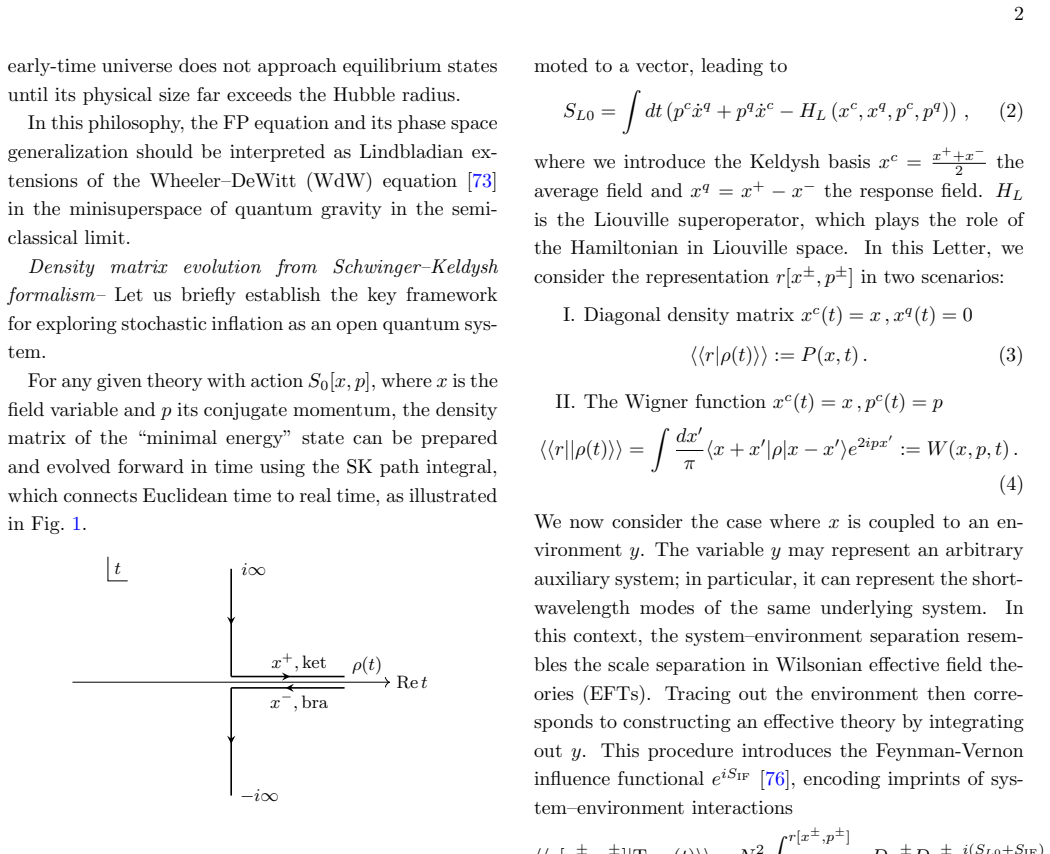
The load-bearing object is the Schwinger-Keldysh (closed-time-path) path integral for the inflaton, together with a step-function separation $\phi_e(k,t)=\theta(k-\varepsilon a_0 H_0)\,\phi(k,t)$ that marks short-wavelength modes as the environment. That separation is what makes the reduced dynamics Markovian: projecting the environment's response to equal times in the de Sitter vacuum makes the noise white, turning the integrated-out modes into a local influence functional. The influence functional contains the quadratic operators $(\dot{\phi}_s^q)^2$, $\dot{\phi}_s^q \phi_s^q$, and $(\phi_s^q)^2$; their coefficients $C_1,C_2,C_3$ are computed from Feynman diagrams with virtual short modes, and they feed directly into the Liouville Hamiltonian whose saddle-point evaluation yields the Fokker-Planck and Lindblad equations.
What would settle it
Evaluate the reduced dynamics with a smooth coarse-graining window instead of the step function, at fixed $\varepsilon$, and examine the $\varepsilon\to 0$ limit: if nonlocal memory terms coupling $\phi_s$ at different times survive, the sharp cutoff is the source of the Lindblad form rather than an innocent limit. A second concrete check is to measure the Wigner function's negativity for super-Hubble modes: the paper's coefficients make phase-space decoherence vanish at this order, so this framework predicts that momentum-space quantumness outlasts field-basis decoherence.
Extended reading notes
Core claim
Starting from the full inflaton action in a slow-roll background, the paper splits the field into a zero-mode system and an environment of short-wavelength modes using a sharp comoving-momentum cutoff. The Schwinger-Keldysh path integral over the environment produces an influence functional with three quadratic quantum operators whose coefficients are the diffusion functions $C_1(\phi), C_2(\phi), C_3(\phi)$ in Eq. (15); these are computed diagrammatically from short-mode propagators. The resulting master equation in phase space, Eq. (19), is a Lindblad equation whose jump operator is a linear combination of the momentum and the field with coefficients determined by the potential. Projecting onto diagonal field states gives the Fokker-Planck equation (18), which at linear order in $v$ matches the original stochastic-inflation result and reproduces the known higher-order result for a quartic potential. In the global slicing of de Sitter space the same tracing procedure gives a Fokker-Planck equation whose diffusion coefficient carries explicit factors of $a$, so the distribution has no stationary solution until $aH \gg 1$.
Load-bearing premise
The assumption that a sharp boundary can be drawn between long and short wavelengths and that the short modes respond and decay so fast that their only net effect is instantaneous random kicks without memory; the paper notes that softer boundary functions give colored noise and memory effects, which would break the Lindblad form.
Editorial extensions
If this is right
- The classic stochastic-inflation Fokker-Planck equation becomes the diagonal projection of a Lindblad master equation, so its noise amplitude is no longer an input but a computed quantity $H_0^3/8\pi^2$ (with corrections).
- Higher-order slow-roll corrections to the probability current and to momentum correlations are fixed by $C_1,C_2,C_3$, so they are predictions of the microphysical theory rather than free parameters.
- Because $C_3>0$, the inflaton decoheres in the field basis, while the vanishing determinant of the diffusion matrix means phase-space (momentum) decoherence is absent at this order; this is a specific statement about when the universe becomes classical.
- In global de Sitter slicing, no equilibrium distribution exists before $aH\gg 1$; the early closed universe is genuinely out of equilibrium and only relaxes toward the flat-slice Fokker-Planck equilibrium at very late times.
Reading between the lines
- One could test the Markovian idealization by replacing the step window with a smooth filter at fixed $\varepsilon$ and checking whether the reduced dynamics still converges to a Lindblad equation; if memory terms survive in the $\varepsilon\to 0$ limit, the Lindblad structure is an artifact of the sharp cutoff.
- The same tracing procedure could be applied to tensor perturbations or to other gauges; the analogue of $C_3$ would predict a specific decoherence rate for the gravitational-wave background from inflation.
- The global-slicing result suggests that the Hartle-Hawking probability distribution is not the stationary state of early-time stochastic dynamics, which would affect how probabilities are assigned in quantum cosmology and eternal inflation.
Editorial analysis
A structured set of objections, weighed in public.
Referee Report
Summary. The paper proposes a first-principles derivation of Starobinsky's stochastic inflation as an open quantum system. Using the Schwinger–Keldysh formalism, the author traces out short-wavelength modes and derives an effective action for the long-wavelength inflaton, with diffusion coefficients C1, C2, C3 computed from Feynman diagrams up to second order in the slow-roll potential. The paper then writes master equations for the Fokker–Planck diagonal density matrix and for the Wigner function, claims the Wigner master equation is a Lindblad equation, and extends the formalism to global de Sitter, where the associated Fokker–Planck equation is claimed to have no equilibrium until aH ≫ 1. The diagrammatic computation in the Supplemental Material is detailed and reproduces the known Starobinsky and Gorbenko–Senatore limits.
Significance. If the Lindblad identification can be rigorously established, this would be a valuable derivation of stochastic inflation from QFT in curved space, going beyond a postulated Langevin equation. The paper's strengths include a concrete Schwinger–Keldysh computation, explicit Feynman rules, diffusion coefficients computed without fitted parameters, and consistency checks against known results. The global-slicing extension is also interesting. However, the central structural claim—that the Wigner master equation is literally a Lindblad equation—is currently asserted rather than proved, and the derivation of the Wigner equation itself has an operator-ordering gap. These issues are load-bearing because the title and abstract foreground the Lindblad structure.
major comments (2)
- [§ Wigner function and the Lindblad equation, Eq. (19) and Eq. (7)] The passage from Eq. (7) and Eq. (16) to Eq. (19) is not derived, and the natural substitution p_q = −i∂_φ, φ_q = i∂_Π in Eq. (16) produces C1 ∂_φ² W − a³ C2 ∂_φ∂_Π W + a⁶ C3 ∂_Π² W, not the derivative-of-coefficient form ∂_φ²(C1 W) − a³ ∂_φ∂_Π(C2 W) + a⁶ ∂_Π²(C3 W). The difference, e.g. 2C1' ∂_φ W + C1'' W, is of the same order as the higher-order slow-roll corrections the paper claims to keep. The authors should either specify the operator-ordering prescription that leads to Eq. (19) or prove that the extra terms are higher order and are consistently dropped.
- [§ Wigner function and the Lindblad equation, Eq. (20)] The statement 'We can show (19) is equivalent to projecting the Lindblad equation...' is not supported by a proof in the main text or in the Supplemental Material. Since the jump operator L in Eq. (20) is Hermitian and φ-dependent (through α and β), the exact Wigner transform of −(γ/2)[L,[L,ρ]] contains additional terms proportional to A A' p ∂_φ∂_Π W and (A'² − AA'') p ∂_Π W with A = 1+α, plus derivatives of coefficients, none of which appear in Eq. (19). These terms are not manifestly negligible in the slow-roll/V expansion used. Because the paper's headline claim is that the master equation is a Lindblad equation, the equivalence must be demonstrated explicitly, or the claim must be weakened to a stated approximation with a controlled truncation.
minor comments (6)
- [Supplemental Eq. (40)] The third line of Eq. (40) defines C3 but is labelled C2; this typo should be fixed.
- [Main text after Eq. (15)] The sentence 'C is can also be obtained...' is grammatically incomplete; it should read 'C_i can also be obtained...'.
- [§ Generalization to global slicing, Eq. (21)] The claim that the global-slicing Fokker–Planck equation has no equilibrium solutions until aH ≫ 1 is not demonstrated; since both drift and diffusion depend on a, a short proof that no a-independent solution P(φ) exists would make the claim rigorous.
- [Footnote 1] The paper correctly notes that other coarse-graining functions introduce colored noise and non-Markovian memory; this means the Lindblad structure is tied to the step-function idealization. This limitation should be stated more prominently in the main text near Eq. (10).
- [Eq. (15)] The symbol 'log' in Eq. (15) denotes the constant log(ε/2) − ψ(3/2), which is confusing; using a different symbol such as L would avoid confusion with the logarithm function.
- [Supplemental §3] The statement 'we verified that the equations are consistent' is not supported by any displayed computation; given that this consistency is part of the justification for the deviation-from-dS shift, the verification should either be shown or the claim softened.
Circularity Check
No significant circularity: diffusion coefficients are computed from SK diagrams, Starobinsky matching is a consistency check, and self-citations are not load-bearing; the Lindblad identification is an unproved assertion but not a circular reduction.
full rationale
The central derivation is self-contained. The effective action (11) and diffusion coefficients (15) are computed from explicit Schwinger-Keldysh Feynman diagrams, not fitted to the quantities later predicted. The Fokker-Planck equation (18) follows from the master equation via the saddle-point evaluation (17) and the replacement rules (7); recovering Starobinsky's leading-order result is a consistency check against an external benchmark, not an input. The global-slicing FP equation (21) is a new derivation using the same machinery with global modes, and its late-time limit agrees with flat slicing. Self-citations ([74], [107]) concern the SK-geometry interpretation and mode functions and are not load-bearing for the diffusion or master-equation derivation. The 'Lindblad equation' claim in Eq. (20) is asserted with 'We can show' and the Supplemental Material does not display the Wigner transform of the proposed jump operator; this is a rigor/correctness gap concerning operator ordering, but it is not circularity, because Eq. (19) was obtained from the computed effective Hamiltonian rather than from the Lindblad form.
Assumptions & free parameters
free parameters (1)
- IR cutoff ε =
ε → 0 (infrared regulator)
assumptions (5)
- domain assumption Bunch-Davies vacuum as the initial state
- domain assumption Semiclassical gravity with a fixed classical background and only linear a_q retained
- domain assumption Born approximation (weak system-environment coupling, perturbative in v'')
- domain assumption Secular approximation and time multipole expansion
- domain assumption Step-function Markovian coarse-graining
Cite this review
Pith. "Pith review of Stochastic inflation as an open quantum system." pith.science (2026). https://pith.science/paper/J2ECFNAO
@misc{pith2026250702070,
  author       = {Pith},
  title        = {Pith review of: Stochastic inflation as an open quantum system},
  year         = {2026},
  howpublished = {\url{https://pith.science/paper/J2ECFNAO}},
  note         = {Machine review of arXiv:2507.02070}
}
abstract
We reinterpret Starobinsky's stochastic inflation as an open quantum system, where short-wavelength modes act as the environment for long-wavelength modes. Using the Schwinger-Keldysh formalism, we systematically trace out the environment and derive an effective theory for the reduced density matrix, including deviations from exact de Sitter. The resulting master equation is a Lindblad equation, which reduces to a Fokker-Planck equation for the diagonal elements up to higher orders in the slow-roll expansion, while also yielding a more complete equation in phase space. Finally, we extend the formalism to global de Sitter, for which the associated Fokker-Planck equation lacks equilibrium solutions until the late-time regime $aH \gg 1$.
Figures
Forward citations
Cited by 3 Pith papers
-
Stochastic inflation from a non-equilibrium renormalization group
Stochastic inflation is the leading infrared limit of a coarse-grained Schwinger–Keldysh effective theory, and the same Fokker–Planck dynamics follows from a Polchinski-type renormalization-group flow for the reduced ...
-
Confronting infrared divergences in de Sitter: loops, logarithms and the stochastic formalism
The authors show that loop corrections do not alter tree-level time dependence in de Sitter correlators, so secular growth is a regularization artifact, not a physical effect.
-
Leading Logarithm Quantum Gravity II
The paper derives the leading-logarithm equations of motion for pure quantum gravity in accelerating spacetimes, whose solutions are claimed to re-sum all perturbative leading logarithms to all orders.
Reference graph
Works this paper leans on
-
[1]
we con- sider two standard assumptions commonly used in open quantum systems [69]: (1) the Born approximation, and (2) the secular approximation
Assumptions and Feynman rules–We now detail the approximations entering the EFT (11). we con- sider two standard assumptions commonly used in open quantum systems [69]: (1) the Born approximation, and (2) the secular approximation. The Born approxi- mation assumes weak system–environment coupling, al- lowing a perturbative expansion in terms of Feynman di...
-
[2]
potential
Feynman diagrams and diffusion coefficients–For example, if we consider an exact dSa 0 =e H0t, the low- lying relevant diagrams that generate the diffusion up to v2 are: 3 This structure is known as the open EFT of cosmology [61–63, 78, 79]. It also suggests that the universe can be modeled as hydrodynamical system by following the logic of [80, 81]. 5 q ...
-
[3]
Fokker-Planck equation–For diagonal density ma- trix, we evaluate the Hamiltonian at the saddle point on the time surface where we evaluate the density matrix, including the deviation from exact dS. In the slow-roll limit we findϕ q sad = Πq sad = 0, δ=v r +O(v 2 r ) and Πc sad =− a3 3H(ϕ c) v′ r(ϕc) + v′ r(ϕc)v′′ r (ϕc) (3H(ϕ c))2 +O(v 3) ! , (17) whereH...
-
[4]
We first consider exact dS
Wigner function and the Lindblad equation–We now consider the Wigner function, which encodes the de- coherence8. We first consider exact dS. Using (7) and (16) yields ∂tW(ϕ,Π, t) =−a −3Π∂ϕW(ϕ,Π, t) +a3v′ r(ϕ)∂ΠW(ϕ,Π, t) +∂ 2 ϕ (C1(ϕ)W(ϕ,Π, t))−a 3∂ϕ∂Π (C2(ϕ)W(ϕ,Π, t)) +a6∂2 Π (C3(ϕ)W(ϕ,Π, t)).(19) We show in Supplemental Material that (19) implies FP equa...
-
[5]
Kamenev,Field theory of non-equilibrium systems (Cambridge University Press, 2023)
A. Kamenev,Field theory of non-equilibrium systems (Cambridge University Press, 2023)
2023
-
[6]
L. M. Sieberer, M. Buchhold, and S. Diehl, Rept. 10 Clarifying this interpretation may require a deeper understand- ing of the Hilbert space in quantum cosmology. See, e.g., [92–97] for recent progress. 11 Similar conclusions can be reached in the context of gravitational wave physics, where the EFTs describing wave emission and tidal deformations are als...
arXiv 2016
-
[7]
L. M. Sieberer, M. Buchhold, J. Marino, and S. Diehl, Rev. Mod. Phys.97, 025004 (2025), arXiv:2312.03073 [cond-mat.stat-mech]
arXiv 2025
-
[8]
Breuer and F
H.-P. Breuer and F. Petruccione,The theory of open quantum systems(OUP Oxford, 2002)
2002
Show all 127 references
-
[9]
Rotter and J
I. Rotter and J. Bird, Reports on Progress in Physics 78, 114001 (2015)
2015
-
[10]
De Vega and D
I. De Vega and D. Alonso, Reviews of Modern Physics 89, 015001 (2017)
2017
-
[11]
A. A. Starobinsky, Lect. Notes Phys.246, 107 (1986). 8
1986
-
[12]
V. F. Mukhanov, H. A. Feldman, and R. H. Branden- berger, Phys. Rept.215, 203 (1992)
1992
-
[13]
J. M. Maldacena, JHEP05, 013 (2003), arXiv:astro- ph/0210603
2003
-
[14]
Acquaviva, N
V. Acquaviva, N. Bartolo, S. Matarrese, and A. Riotto, Nucl. Phys. B667, 119 (2003), arXiv:astro-ph/0209156
2003 arXiv
- [15]
-
[16]
Baumann, inTheoretical Advanced Study Institute in Elementary Particle Physics: Physics of the Large and the Small(2011) pp
D. Baumann, inTheoretical Advanced Study Institute in Elementary Particle Physics: Physics of the Large and the Small(2011) pp. 523–686, arXiv:0907.5424 [hep-th]
2011 arXiv
-
[17]
Wang, Communications in Theoretical Physics62, 109 (2014)
Y. Wang, Communications in Theoretical Physics62, 109 (2014)
2014
-
[18]
A. D. Linde, Phys. Lett. B175, 395 (1986)
1986
-
[19]
A. S. Goncharov, A. D. Linde, and V. F. Mukhanov, Int. J. Mod. Phys. A2, 561 (1987)
1987
-
[20]
A. H. Guth, J. Phys. A40, 6811 (2007), arXiv:hep- th/0702178
2007
-
[21]
Creminelli, S
P. Creminelli, S. Dubovsky, A. Nicolis, L. Senatore, and M. Zaldarriaga, JHEP09, 036 (2008), arXiv:0802.1067 [hep-th]
2008 arXiv
-
[22]
A. A. Starobinsky and J. Yokoyama, Phys. Rev. D50, 6357 (1994), arXiv:astro-ph/9407016
1994 arXiv
-
[23]
Miji´ c, Physical Review D42, 2469 (1990)
M. Miji´ c, Physical Review D42, 2469 (1990)
1990
-
[24]
A. D. Linde and A. Mezhlumian, Phys. Lett. B307, 25 (1993), arXiv:gr-qc/9304015
1993 arXiv
-
[25]
A. D. Linde, D. A. Linde, and A. Mezhlumian, Phys. Rev. D49, 1783 (1994), arXiv:gr-qc/9306035
1994 arXiv
-
[26]
A. J. Tolley and M. Wyman, JCAP04, 028 (2008), arXiv:0801.1854 [hep-th]
2008 arXiv
-
[27]
N. C. Tsamis and R. P. Woodard, Nuclear Physics B 724, 295 (2005)
2005
- [28]
-
[29]
R. P. Woodard, (2025), arXiv:2501.15843 [gr-qc]
2025 arXiv
-
[30]
Rey, Nuclear Physics B284, 706 (1987)
S.-J. Rey, Nuclear Physics B284, 706 (1987)
1987
-
[31]
Nambu and M
Y. Nambu and M. Sasaki, Physics Letters B205, 441 (1988)
1988
-
[32]
Nambu and M
Y. Nambu and M. Sasaki, Physics Letters B219, 240 (1989)
1989
-
[33]
H. E. Kandrup, Physical Review D39, 2245 (1989)
1989
-
[34]
Habib, Physical Review D46, 2408 (1992)
S. Habib, Physical Review D46, 2408 (1992)
1992
-
[35]
Enqvist, S
K. Enqvist, S. Nurmi, D. Podolsky, and G. I. Rigopou- los, JCAP04, 025 (2008), arXiv:0802.0395 [astro-ph]
2008 arXiv
- [36]
-
[37]
Calzetta and B
E. Calzetta and B. L. Hu, Phys. Rev. D49, 6636 (1994), arXiv:gr-qc/9312036
1994 arXiv
-
[38]
Perreault Levasseur, Phys
L. Perreault Levasseur, Phys. Rev. D88, 083537 (2013), arXiv:1304.6408 [hep-th]
2013 arXiv
-
[39]
Fujita, M
T. Fujita, M. Kawasaki, Y. Tada, and T. Takesako, JCAP12, 036 (2013), arXiv:1308.4754 [astro-ph.CO]
2013 arXiv
-
[40]
Fujita, M
T. Fujita, M. Kawasaki, and Y. Tada, JCAP10, 030 (2014), arXiv:1405.2187 [astro-ph.CO]
2014 arXiv
-
[41]
Perreault Levasseur and E
L. Perreault Levasseur and E. McDonough, Phys. Rev. D91, 063513 (2015), arXiv:1409.7399 [hep-th]
2015 arXiv
-
[42]
Vennin and A
V. Vennin and A. A. Starobinsky, Eur. Phys. J. C75, 413 (2015), arXiv:1506.04732 [hep-th]
2015 arXiv
-
[43]
Firouzjahi, A
H. Firouzjahi, A. Nassiri-Rad, and M. Noorbala, JCAP 01, 040 (2019), arXiv:1811.02175 [hep-th]
2019 arXiv
-
[44]
Pinol, S
L. Pinol, S. Renaux-Petel, and Y. Tada, Class. Quant. Grav.36, 07LT01 (2019), arXiv:1806.10126 [gr-qc]
2019 arXiv
-
[45]
Firouzjahi, A
H. Firouzjahi, A. Nassiri-Rad, and M. Noorbala, Phys. Rev. D102, 123504 (2020), arXiv:2009.04680 [hep-th]
2020 arXiv
-
[46]
Pattison, V
C. Pattison, V. Vennin, D. Wands, and H. Assadullahi, JCAP04, 080 (2021), arXiv:2101.05741 [astro-ph.CO]
2021 arXiv
-
[47]
Cruces and C
D. Cruces and C. Germani, Phys. Rev. D105, 023533 (2022), arXiv:2107.12735 [gr-qc]
2022 arXiv
-
[48]
Cohen, D
T. Cohen, D. Green, A. Premkumar, and A. Ridgway, Journal of High Energy Physics2021, 1 (2021)
2021
-
[49]
Aldabergenov, D
Y. Aldabergenov, D. Ding, W. Lin, and Y. Wan, (2025), arXiv:2506.21423 [gr-qc]
2025 arXiv
-
[50]
Morikawa, Physical Review D42, 1027 (1990)
M. Morikawa, Physical Review D42, 1027 (1990)
1990
-
[51]
Hosoya, M
A. Hosoya, M. Morikawa, and K. Nakayama, Interna- tional Journal of Modern Physics A4, 2613 (1989)
1989
-
[52]
Collins, R
H. Collins, R. Holman, and T. Vardanyan, JHEP11, 065 (2017), arXiv:1706.07805 [hep-th]
2017 arXiv
-
[53]
J. O. Andersen, M. Eriksson, and A. Tranberg, JHEP 02, 121 (2022), arXiv:2111.14503 [hep-ph]
2022 arXiv
- [54]
- [55]
-
[56]
Miyachi, J
T. Miyachi, J. Soda, and J. Tokuda, Universe10, 292 (2024), arXiv:2309.07440 [hep-th]
2024 arXiv
-
[57]
Pinol, S
L. Pinol, S. Renaux-Petel, and Y. Tada, JCAP04, 048 (2021), arXiv:2008.07497 [astro-ph.CO]
2021 arXiv
-
[58]
Cruces, Universe8, 334 (2022), arXiv:2203.13852 [gr- qc]
D. Cruces, Universe8, 334 (2022), arXiv:2203.13852 [gr- qc]
2022 arXiv
-
[59]
Schwinger, Journal of Mathematical Physics2, 407 (1961)
J. Schwinger, Journal of Mathematical Physics2, 407 (1961)
1961
-
[60]
Massignan, A
P. Massignan, A. Lampo, J. Wehr, and M. Lewenstein, Physical Review A91, 033627 (2015)
2015
-
[61]
Maniscalco, J
S. Maniscalco, J. Piilo, F. Intravaia, F. Petruccione, and A. Messina, Physical Review A—Atomic, Molec- ular, and Optical Physics70, 032113 (2004)
2004
-
[62]
Lampo, S
A. Lampo, S. H. Lim, J. Wehr, P. Massignan, and M. Lewenstein, Physical Review A94, 042123 (2016)
2016
-
[63]
C. P. Burgess, R. Holman, and D. Hoover, Phys. Rev. D77, 063534 (2008), arXiv:astro-ph/0601646
2008 arXiv
-
[64]
A. J. Tolley and M. Wyman, JCAP10, 006 (2009), arXiv:0809.1100 [hep-th]. 9
2009 arXiv
-
[65]
C. P. Burgess, R. Holman, G. Tasinato, and M. Williams, JHEP03, 090 (2015), arXiv:1408.5002 [hep-th]
2015 arXiv
-
[66]
S. A. Salcedo, T. Colas, and E. Pajer, JHEP10, 248 (2024), arXiv:2404.15416 [hep-th]
2024 arXiv
-
[67]
Colas, in58th Rencontres de Moriond on Cosmology (2024) arXiv:2405.09639 [astro-ph.CO]
T. Colas, in58th Rencontres de Moriond on Cosmology (2024) arXiv:2405.09639 [astro-ph.CO]
2024 arXiv
-
[68]
Shandera, N
S. Shandera, N. Agarwal, and A. Kamal, Phys. Rev. D 98, 083535 (2018), arXiv:1708.00493 [hep-th]
2018 arXiv
-
[69]
Daddi Hammou and N
A. Daddi Hammou and N. Bartolo, JCAP04, 055 (2023), arXiv:2211.07598 [astro-ph.CO]
2023 arXiv
-
[70]
de Kruijf and N
J. de Kruijf and N. Bartolo, JCAP11, 041 (2024), arXiv:2408.02563 [astro-ph.CO]
2024 arXiv
- [71]
-
[72]
L. V. Keldysh, inSelected Papers of Leonid V Keldysh (World Scientific, 2024) pp. 47–55
2024
-
[73]
Manzano, Aip advances10(2020)
D. Manzano, Aip advances10(2020)
2020
-
[74]
J. B. Hartle and S. W. Hawking, Physical Review D28, 2960 (1983)
1983
- [75]
-
[76]
Maldacena, (2024), arXiv:2403.10510 [hep-th]
J. Maldacena, (2024), arXiv:2403.10510 [hep-th]
2024 arXiv
-
[77]
B. S. DeWitt, Physical Review160, 1113 (1967)
1967
-
[78]
Ivo, Y.-Z
V. Ivo, Y.-Z. Li, and J. Maldacena, JHEP02, 124 (2025), arXiv:2409.14218 [hep-th]
2025 arXiv
-
[79]
T. S. Bunch and P. C. Davies, Proceedings of the Royal Society of London. A. Mathematical and Physical Sci- ences360, 117 (1978)
1978
-
[80]
R. P. Feynman and F. L. Vernon Jr, Annals of physics 24, 118 (1963)
1963
-
[81]
Winitzki and A
S. Winitzki and A. Vilenkin, Phys. Rev. D61, 084008 (2000), arXiv:gr-qc/9911029
2000 arXiv
-
[82]
Lopez Nacir, R
D. Lopez Nacir, R. A. Porto, L. Senatore, and M. Zal- darriaga, JHEP01, 075 (2012), arXiv:1109.4192 [hep- th]
2012 arXiv
-
[83]
S. A. Salcedo, T. Colas, L. Dufner, and E. Pajer, (2025), arXiv:2507.03103 [hep-th]
2025
- [84]
-
[85]
Z.-L. Zhou, M. Hippert, N. Mullins, and J. Noronha, (2025), arXiv:2506.06618 [cond-mat.stat-mech]
2025
-
[86]
Morikawa, Progress of theoretical physics77, 1163 (1987)
M. Morikawa, Progress of theoretical physics77, 1163 (1987)
1987
-
[87]
Lombardo and F
F. Lombardo and F. D. Mazzitelli, Phys. Rev. D53, 2001 (1996), arXiv:hep-th/9508052
1996 arXiv
- [88]
- [89]
-
[90]
F. C. Lombardo, Braz. J. Phys.35, 391 (2005), arXiv:gr- qc/0412069
2005
-
[91]
F. C. Lombardo and D. Lopez Nacir, Phys. Rev. D72, 063506 (2005), arXiv:gr-qc/0506051
2005 arXiv
-
[92]
C´ espedes, A.-C
S. C´ espedes, A.-C. Davis, and D.-G. Wang, JHEP04, 004 (2024), arXiv:2311.17990 [hep-th]
2024 arXiv
-
[93]
Heemskerk and J
I. Heemskerk and J. Polchinski, JHEP06, 031 (2011), arXiv:1010.1264 [hep-th]
2011 arXiv
-
[94]
Fumagalli, V
A. Fumagalli, V. Gorbenko, and J. Kames-King, JHEP 05, 074 (2025), arXiv:2408.08351 [hep-th]
2025 arXiv
-
[95]
Mirbabayi, JCAP12, 006 (2020), arXiv:1911.00564 [hep-th]
M. Mirbabayi, JCAP12, 006 (2020), arXiv:1911.00564 [hep-th]
2020 arXiv
-
[96]
Chandrasekaran, R
V. Chandrasekaran, R. Longo, G. Penington, and E. Witten, JHEP02, 082 (2023), arXiv:2206.10780 [hep-th]
2023 arXiv
-
[97]
Witten, JHEP03, 077 (2024), arXiv:2308.03663 [hep-th]
E. Witten, JHEP03, 077 (2024), arXiv:2308.03663 [hep-th]
2024 arXiv
- [98]
-
[99]
Kudler-Flam, S
J. Kudler-Flam, S. Leutheusser, and G. Satishchan- dran, (2024), arXiv:2406.01669 [hep-th]
2024 arXiv
-
[100]
Kudler-Flam, K
J. Kudler-Flam, K. Prabhu, and G. Satishchandran, (2025), arXiv:2503.19957 [hep-th]
2025 arXiv
- [101]
-
[102]
W. D. Goldberger and A. Ross, Phys. Rev. D81, 124015 (2010), arXiv:0912.4254 [gr-qc]
2010 arXiv
-
[103]
M. V. S. Saketh, Z. Zhou, and M. M. Ivanov, Phys. Rev. D109, 064058 (2024), arXiv:2307.10391 [hep-th]
2024 arXiv
-
[104]
M. M. Ivanov, Y.-Z. Li, J. Parra-Martinez, and Z. Zhou, Phys. Rev. Lett.132, 131401 (2024), [Erratum: Phys.Rev.Lett. 134, 159901 (2025)], arXiv:2401.08752 [hep-th]
2024 arXiv
-
[105]
Glazer, A
D. Glazer, A. Joyce, M. J. Rodriguez, L. Santoni, A. R. Solomon, and L. F. Temoche, (2024), arXiv:2412.21090 [hep-th]
2024 arXiv
-
[106]
Caron-Huot, M
S. Caron-Huot, M. Correia, G. Isabella, and M. Solon, (2025), arXiv:2503.13593 [hep-th]
2025 arXiv
-
[107]
Baidya, C
A. Baidya, C. Jana, R. Loganayagam, and A. Rudra, JHEP11, 204 (2017), arXiv:1704.08335 [hep-th]
2017 arXiv
-
[108]
K.-S. Kim, A. Mitra, D. Mukherjee, and S. Ryu, Phys. Rev. D111, 086021 (2025), arXiv:2404.09122 [hep-th]
2025 arXiv
-
[109]
Bloch, J
I. Bloch, J. Dalibard, and W. Zwerger, Reviews of mod- ern physics80, 885 (2008)
2008
-
[110]
Bloch, J
I. Bloch, J. Dalibard, and S. Nascimbene, Nature Physics8, 267 (2012)
2012
-
[111]
Liu and Y.-Z
J. Liu and Y.-Z. Li, Phys. Rev. D104, 086013 (2021), arXiv:2009.10921 [quant-ph]
2021 arXiv
-
[112]
Pattison, V
C. Pattison, V. Vennin, H. Assadullahi, and D. Wands, JCAP10, 046 (2017), arXiv:1707.00537 [hep-th]
2017 arXiv
- [113]
- [114]
-
[115]
C. Jana, R. Loganayagam, and M. Rangamani, JHEP 07, 242 (2020), arXiv:2004.02888 [hep-th]
2020 arXiv
-
[116]
Y. Chen, V. Gorbenko, and J. Maldacena, JHEP02, 009 (2021), arXiv:2007.16091 [hep-th]
2021 arXiv
-
[117]
Coleman, Nuclear Physics B307, 867 (1988)
S. Coleman, Nuclear Physics B307, 867 (1988)
1988
-
[118]
S. B. Giddings and A. Strominger, Nuclear Physics B 306, 890 (1988)
1988
-
[119]
S. B. Giddings and A. Strominger, Nuclear Physics B 307, 854 (1988)
1988
-
[120]
Chandra, S
J. Chandra, S. Collier, T. Hartman, and A. Maloney, JHEP12, 069 (2022), arXiv:2203.06511 [hep-th]. Supplemental Material
2022 arXiv
-
[121]
EMERGENCE OF TIME IN SEMI-CLASSICAL GRA VITY In this material, we provide a more detailed discussion of the emergence of time in semi-classical gravity using the Schwinger–Keldysh (SK) formalism. We consider slow-roll inflationary modelS=S grav +S ϕ Sgrav = 1 16πG Z d4x√−gR−2 ...
-
[122]
for an illustration. The Hamiltonian constraint for the Liouvelle superoperator is (HL,grav +H L,ϕ +H L,res)ρ(a ±, ϕ±) = 0,(26) where the Liouvelle Hamiltonian for the semi-classical gravity is: HL,grav =− pc apq a 6ac →H L,gravρ=−i˙a c∂ac ρ .(27) The classical time flow for t...
-
[123]
COMPUT A TIONS OF DIFFUSION COEFFICIENTS In this material, we provide more details to deriving the diffusion coefficients in the effective theory of long wave- length modes, see eq. (15). We consider the Bunch-Davis vacuum, where inflationary modes are solved by the wave equat...
-
[124]
We only consider the leading order deviation
EFFECTS FROM DEVIA TING AN EXACT DS In this material, we present the details of incorporating the effects of a background that deviates from exact dS space. We only consider the leading order deviation. To consider a dynamicala c, which deviates froma c 0 =e H0t by back-reacti...
-
[125]
Note that Π c 0 is determined by the equations because, in the semi-classical limit, the density matrix is concentrated near the momentum equilibrium. We find, for example, Πc 0 =−a 3 0v′ r(ϕc), H(ϕ c) =H 0 + vr(ϕc) 6H0 + 6H 2 0 ( ˙ϕc)2 −v r(ϕc)2 72H 3 0 +· · ·, ˙ϕc =− v′ r(ϕc...
-
[126]
overdamping
PLA Y WITH MASTER EQUA TIONS 4.1. Equilibrium states of F okker-Planck equation In this material, we solve the equilibrium state of FP equation in (18). For simplicity, we ignore the renormalization effectsv r =v. The equilibrium state is a steady state∂ tPwithout any flow of ...
-
[127]
conformal time
DET AILS IN GLOBAL SLICING In this material, we provide more details of stochastic inflation in global slicing and derive its Fokker-Planck equation. The global coordinate is ds2 =−dτ 2 +a 2(τ)d d−1Ω2 3 , a= cosh(H0τ) H0 .(69) It is useful to define “conformal time” cosh(H 0τ)...
Reviewed August 6, 2026 · model on record in the stance chip above.
Discussion (0). Sign in to comment.