REVIEW 4 major objections 5 minor 5 cited by
Axion USR Inflation
T0 review · 4 major / 5 minor · reviewed 2026-08-06 · deepseek-v4-flash
Pith's one-line read An axion inflation model with an intermediate ultra slow-roll phase produces two peaks in the primordial curvature power spectrum, because the USR onset shuts off gauge-field production.
desk verdict Plausible new mechanism with a defensible qualitative picture, but the quantitative claims rest on an unchecked source truncation and unreported auxiliary functions; worth refereeing after the draft is finished. read the letter →
The pith
A machine-rendered reading of the paper's core claim, the machinery that carries it, and where it could break.
The reading
What carries the argument
The load-bearing object is the instability parameter $\xi \equiv |\tilde{\alpha}|\sqrt{\epsilon/2}$, which controls the tachyonic growth of one polarization of the gauge field and hence the strength of the inverse-decay source. During the USR phase $\epsilon$ falls off so quickly that $\xi$ decays exponentially, which effectively truncates the source integral at the onset of USR and shifts the lower bounds of the integrals $I_1$ and $I_2$ entering the effective function $f_2(\xi_k)$. The second essential piece is the gluing of perturbation mode functions across the two instantaneous transitions, controlled by the sharpness parameter $h$; this fixes the coefficients $\alpha_k^{(3)}$ and $\beta_k^{(3)}$ that appear in both the vacuum and sourced power spectra and determines the dip location and the relaxation to the final slow-roll attractor. The power spectrum formula combines the USR-amplified vacuum contribution with the gauge-sourced term proportional to $e^{4\pi\xi_k}f_2(\xi_k)$, while the bispectrum is built from a convolution integral $f_3$ over the same sourced mode functions.
What would settle it
Recompute the curvature power spectrum of the same model with a full numerical evolution of the gauge mode functions through the USR and second slow-roll phases instead of imposing the $\Theta(\tau_i-\tau')$ cutoff; if the first peak's amplitude or the extracted index $m$ at $\tilde{\alpha}=25$ changes appreciably, the central claim is refuted. A lattice simulation of axion-$U(1)$ inflation with an inflection-point potential could provide that check directly.
Extended reading notes
Core claim
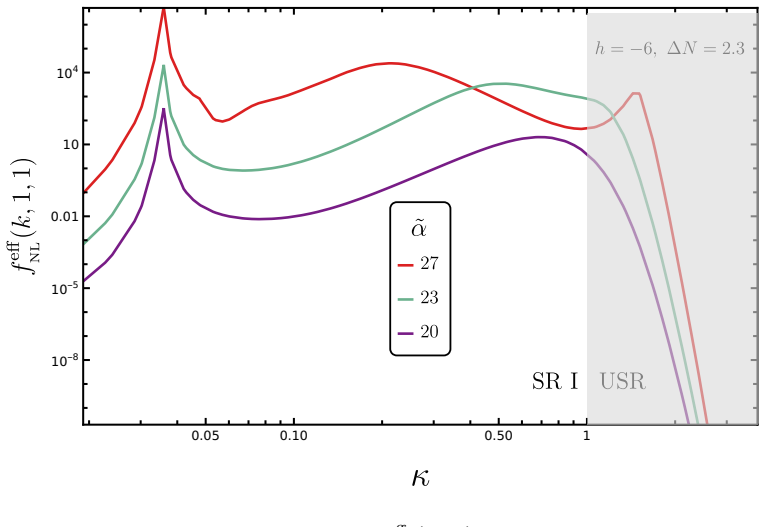
The paper's central claim is that the gauge-field source for curvature perturbations in the three-stage SR-USR-SR axion setup is active only during the first slow-roll stage. When USR begins, $\epsilon(\tau) \propto \tau^6$ drives $\xi \propto \sqrt{\epsilon} \propto e^{-3\Delta N}$ down rapidly, so tachyonic gauge-field production and the inverse-decay process $A+A\to\delta\phi$ are effectively switched off, and the source can be parametrized as $J_k(\tau') \propto \Theta(\tau_i-\tau')$. The total power spectrum is then $\mathcal{P}_{\mathcal{R}}(k) = \mathcal{P}_{\rm CMB}(\xi_{\rm CMB}/\xi_i)^2 e^{6\Delta N}(36/h^2)|\alpha_k^{(3)}+\beta_k^{(3)}|^2 + \mathcal{P}_{\rm CMB} f_2(\xi_k) e^{4\pi\xi_k}$, with the gauge-field piece peaking at the wavenumber that exits around the USR onset. The paper shows that this spectrum has a dip at $-k_d\tau_i = \sqrt{5h/(4(h-6))}\,e^{-3\Delta N/2}$, followed by the universal $k^4$ growth, then a steeper $k^m$ growth with $m>4$ before the first peak, and a second USR-induced peak after it. It also computes the bispectrum and finds a non-Gaussianity parameter that peaks near the dip and can develop multiple peaks, with the local USR contribution $f_{\rm NL}^{\rm USR}=5h^2/(h-6)^2$ adding incoherently to the gauge-field contribution.
Load-bearing premise
The quantitative two-peak shape and the steep slope $m$ rest on the assumption that once the ultra slow-roll phase begins, the gauge field stops sourcing inflaton perturbations immediately, with no remaining production during the later slow-roll stage.
Editorial extensions
If this is right
- The power spectrum in this model has two separate peaks: the gauge-induced peak at $\kappa=1$, the scale exiting at the USR onset, and the standard USR peak at $\kappa>1$; for couplings $20<\tilde{\alpha}<27$ the first peak can be larger than the second.
- Between the dip and the first peak, the spectrum scales as $\mathcal{P}_{\mathcal{R}}\propto k^m$ with $m>4$, reaching $m\simeq 8.6$ in the plotted example and increasing with $\tilde{\alpha}$, which is steeper than the universal $k^4$ growth of ordinary USR models.
- Because $\xi$ decays during USR, the backreaction parameters $\Omega_{\rm em}$ and $S_{\rm em}$ remain small, so this setup avoids the strong-backreaction and oscillatory regime that limits conventional axion inflation.
- The total bispectrum is the sum of a local USR contribution and a gauge-induced contribution with non-trivial shape; the effective $f_{\rm NL}$ peaks near the dip in the power spectrum and can have multiple peaks as $\tilde{\alpha}$ increases.
- The double-peaked, steeply rising spectrum is a candidate source for primordial black hole formation and induced gravitational waves, with an additional chiral gravitational wave component coming from the gauge sector.
Reading between the lines
- Extension: relaxing the instantaneous SR1-to-USR and USR-to-SR2 transitions to smooth ones would likely smooth the first peak and reduce the slope $m$, since the sharpness parameter $h$ already controls the dip and post-USR relaxation.
- Extension: the location of the first peak at $\kappa=1$ ties the peak scale to the position of the USR episode, so detecting a primordial black hole or gravitational wave signal from this model would directly probe the inflection-point scale of the axion potential.
- Extension: the steep index $m>4$ makes the primordial black hole abundance extremely sensitive to the coupling $\tilde{\alpha}$, a sensitivity the paper does not quantify.
- Extension: the gauge-induced $f_{\rm NL}$ near the dip implies that primordial black hole formation in this model proceeds under strongly non-Gaussian, scale-dependent statistics; whether that enhances or suppresses the abundance relative to Gaussian estimates is not computed here.
Editorial analysis
A structured set of objections, weighed in public.
Referee Report
Summary. The paper studies a three-stage SR-USR-SR axion-inflation model with a Chern-Simons coupling to a U(1) gauge field. During the first slow-roll stage the instability parameter xi grows and tachyonic gauge-field production enhances curvature perturbations through inverse decay; once the USR phase starts, epsilon and hence xi ~ sqrt(epsilon) fall sharply, so gauge production is claimed to terminate efficiently. The authors compute the vacuum and sourced contributions to the curvature perturbation by piecing together mode functions across instantaneous transitions, and obtain a power spectrum with two peaks: a sourced peak near the start of USR and a standard USR peak, separated by a dip, with an intermediate steep scaling P_R ~ k^m with m > 4. They also present a bispectrum calculation and plots of the effective f_NL for the equilateral configuration.
Significance. If the central quantitative claims are confirmed, the model is interesting phenomenologically: it provides a concrete mechanism in which the USR phase not only enhances the vacuum curvature perturbation but also cuts off axion-gauge production, yielding a double-peaked power spectrum with a steep k^m region relevant for primordial black hole and induced gravitational wave studies. The qualitative two-peak picture follows cleanly from xi ~ sqrt(epsilon) falling during USR, and the background construction, backreaction checks, and mode-matching strategy are standard. The paper gives explicit parameter choices and analytic mode functions, and the claims are genuine consequences rather than being forced by construction. However, the quantitative results—m ~ 8.6, the first-peak amplitude, and the f_NL peaks—depend on matching coefficients and auxiliary functions that the manuscript does not report, so these numbers cannot currently be verified from the text.
major comments (4)
- [Section 4.2, Eqs. (4.27)-(4.30)] The central quantitative claim rests on the source truncation J_k(tau') proportional to Theta(tau_i - tau') introduced in Eq. (4.29). The justification given is qualitative: xi falls exponentially during USR and previously produced gauge fields dilute. But gauge modes amplified before tau_i have non-vanishing amplitudes after tau_i, and whether their continued inverse-decay contribution is negligible requires the matched coefficients c_2,3 and d_2,3 of Eqs. (3.9)-(3.10), which the manuscript explicitly does not report. Because the first-peak amplitude, the dip shape, the extracted slope m, and the f_NL peaks all depend on this cutoff, the quantitative signatures are currently supported by an assertion rather than by the matched solutions the paper derives. Please either report the matched coefficients and quantify the residual source for tau' > tau_i, or perform a numerical integration with the full gauge mode functions to validate the truncation.
- [Section 5, Eq. (5.11) and Figs. 7-9] The functions F_1(h,z_i,z_e) and F_2(h,z_i,z_e) in Eq. (5.11) are said to be 'too complicated to be insightful' and are not given. Since f_2(xi_k) in Eqs. (5.6), (5.14), and (5.19) is evaluated with these functions, the reported values of m ~ 8.6, the peak amplitudes, and the dip-to-peak ratios in Figs. 7-10 cannot be independently reproduced or checked. This is load-bearing for the paper's main quantitative claim. Please provide explicit formulas for F_1 and F_2, or an ancillary file with the numerical routines and benchmark values for the integrals in Eqs. (5.12)-(5.15).
- [Section 6, Eqs. (6.8)-(6.14)] The bispectrum formula (6.8) assumes the same xi_k for all three external momenta, which is only strictly valid for equilateral configurations. The paper acknowledges that only the equilateral shape is plotted because other shapes are numerically expensive, but the abstract and conclusions advertise 'non-trivial shapes and multiple peaks.' The multiple-peak claim is therefore demonstrated only for the equilateral configuration; please either state this limitation explicitly in the abstract and conclusions, or provide at least one representative non-equilateral shape to support the claim of non-trivial shape dependence.
- [Section 7, Summary] The summary states 'this can reach to m approx 8.6 for tilde alpha = 27', whereas Fig. 7 and the text in Section 5 report m approx 8.6 for tilde alpha = 25. This inconsistency affects the paper's headline number and must be corrected.
minor comments (5)
- [Section 5 and 6, editorial] The manuscript contains several draft artifacts, including duplicated figure captions and an inserted note 'CHECK and COMPARE above with (5.36)' in Section 5. These should be removed before submission.
- [Eq. (5.10)] The variable y in I(y, |r|, |r - k_hat|) is not explicitly defined; from the usage in Eq. (5.6) it is xi_k. Please state this after Eq. (5.10).
- [Eq. (4.32)] The approximate gauge mode function is stated to be valid for (8 xi_k)^{-1} less than about z less than about 2 xi_k, but the subsequent momentum integrals in Eqs. (4.39) and (5.6) are not restricted to this range. A brief comment on why the dominant contribution comes from this window would help.
- [Fig. 8 caption] The caption says the power spectrum exceeds unity for tilde alpha > 27 and perturbativity breaks down; the same statement appears in the text, but the figure itself does not show the breakdown. This is fine, but the reader should be told explicitly that the curve is intended to be extrapolated.
- [References] Reference [21] is cited for the dip formula Eq. (5.20); since that formula is used to locate the f_NL peak, please confirm that the cited derivation is consistent with the instantaneous-transition conventions used here.
Circularity Check
No significant circularity: the two-peak spectrum and k^m scaling are computed consequences of the SR1-USR-SR2 axion-gauge setup, not re-statements of its inputs.
full rationale
The paper's derivation chain is self-contained in the relevant sense: the model inputs are the potential parameters, the coupling tilde-alpha, the piecewise slow-roll parameter epsilon(tau), and the sharpness parameter h. From these inputs, the gauge mode functions are matched across the SR1-USR-SR2 boundaries, the sourced inflaton perturbation is computed through the retarded Green function, and the total power spectrum (5.19) is assembled from the vacuum contribution (5.4) and the inverse-decay contribution (5.14). The claimed features, namely the first peak at kappa = 1 and the steep intermediate scaling P_R proportional to k^m with m > 4, are numerical and analytical consequences of these expressions, not quantities that were defined into existence or fitted from the target data. The truncation J_k(tau') proportional to Theta(tau_i - tau') in Eq. (4.29) is a modeling assumption justified by the exponential falloff of the instability parameter during USR; it is a physical approximation that shapes the quantitative result, but it is not the result itself and it is not derived from the two-peak claim. The paper does cite the authors' own prior work for the USR matching coefficients (Eqs. 4.21-4.22, citing [72]) and for the USR non-Gaussianity formula (Eq. 6.7, citing [13,72]), and these citations are load-bearing in the sense of supplying standard USR machinery. However, the explicit formulas are stated in the paper, the cited results are independent published derivations, and they do not contain or assume the gauge-field-induced first peak or the extracted slope m. No uniqueness theorem from the authors is invoked to forbid alternatives, and no ansatz is smuggled in via self-citation. The main weakness, namely that the matched gauge-mode coefficients c_2,3 and d_2,3 and the functions F_1, F_2 are reported as 'too complicated to be useful' and omitted, is a reproducibility and verification concern, not circularity. The central claim therefore has independent content and is not forced by construction.
Assumptions & free parameters
free parameters (7)
- V0 =
4e-10 M_Pl^4
- nu =
sqrt(0.108) M_Pl
- lambda =
1.4349
- initial field value phi_i =
3.614 M_Pl
- tilde alpha (alpha/f_a) =
20 < tilde alpha < 27 (scanned)
- sharpness parameter h =
-6 or -12 in figures
- USR duration Delta N =
2.3 or 2.7 e-folds in figures
assumptions (8)
- ad hoc to paper Instantaneous transitions between SR1, USR, and SR2 phases.
- domain assumption Sharp transition with |h|>1 so the system quickly reaches the SR2 attractor.
- domain assumption Negligible backreaction conditions Omega_em << 1 and S_em << 1.
- ad hoc to paper The gauge field source for inflaton perturbations is truncated at the start of USR, J_k ∝ Θ(τ_i-τ').
- domain assumption Gauge mode approximation (4.32) valid for 8ξ^-1 ≲ z ≲ 2ξ.
- standard math Bunch-Davies initial condition and negligible inflaton mass V_ϕϕ << H^2.
- domain assumption Common ξ_k for all three external momenta in the bispectrum calculation.
- domain assumption Mean-field approximation for gauge field sources on the homogeneous background.
Cite this review
Pith. "Pith review of Axion USR Inflation." pith.science (2026). https://pith.science/paper/4PW5DXML
@misc{pith2026250702685,
  author       = {Pith},
  title        = {Pith review of: Axion USR Inflation},
  year         = {2026},
  howpublished = {\url{https://pith.science/paper/4PW5DXML}},
  note         = {Machine review of arXiv:2507.02685}
}
abstract
We consider a model of inflation in which the inflaton field is a rolling axion with a potential which is flat enough to support an intermediate phase of USR inflation. Because of the Chern-Simons interaction, one polarization of the gauge field experiences the tachyonic growth during the first slow-roll stage, inducing large corrections in curvature perturbations via the inverse decay effect. A non-trivial feature of our setup is that once the system enters the USR phase, the instability parameter falls off rapidly, terminating the gauge field production efficiently. Consequently, the power spectrum involves two separate peaks, the first peak is induced by the gauge field particles production while the second peak is due to standard USR mechanism. We show that the power spectrum at the intermediate scales develops strong scale-dependence $\propto k^m$ with the index $m >4$. Calculating the bispectrum, we demonstrate that non-Gaussianities with non-trivial shapes and multiple peaks are generated in this setup.
Figures


Figures from the paper (8 more)



Forward citations
Cited by 5 Pith papers
-
Gravitational waves from axion inflation in the gradient expansion formalism. Part I. Pure axion inflation
In pure axion inflation, detectable gravitational wave signals arise only in parameter regions with strong backreaction that violate the upper bound on ΔN_eff.
-
Superhorizon curvature perturbations in hybrid inflation revisited
Hybrid inflation's waterfall tachyonic instability grows isocurvature modes that convert to curvature perturbations at the field-space turn, yielding a k^{3}-peaked spectrum with always-positive f_NL that enhances PBH...
-
Axion Inflation from Heavy-Fermion One-Loop Effects
One-loop integration of a heavy fermion with inflaton-dependent mass in axion inflation generates localized gauge-field production and a detectable chiral gravitational-wave signal in the deci-hertz range.
-
Chiral gravitational waves from multi-phase magnetogenesis
Multi-phase inflation with chiral vector interactions generates amplified primordial magnetic fields that induce a detectable circularly polarized gravitational-wave background.
-
Superhorizon curvature perturbations in hybrid inflation revisited
Hybrid inflation produces enhanced curvature perturbations with a broad power spectrum peak featuring k^3 infrared growth and positive f_NL fixed by tachyonic waterfall geometry, potentially accounting for PBH dark ma...
Reference graph
Works this paper leans on
-
[1]
Akrami et al., Planck 2018 results
Planck collaboration, Y. Akrami et al., Planck 2018 results. X. Constraints on inflation , Astron. Astrophys. 641 (2020) A10, [ 1807.06211]
arXiv 2020
-
[2]
WMAP collaboration, E. Komatsu et al., Seven-Year Wilkinson Microwave Anisotropy Probe (WMAP) Observations: Cosmological Interpretation , Astrophys. J. Suppl. 192 (2011) 18, [1001.4538]
arXiv 2011
-
[3]
J. M. Maldacena, Non-Gaussian features of primordial fluctuations in single field inflationary models, JHEP 05 (2003) 013, [ astro-ph/0210603]
arXiv 2003
-
[4]
W. H. Kinney, Horizon crossing and inflation with large eta , Phys. Rev. D 72 (2005) 023515, [gr-qc/0503017]
arXiv 2005
-
[5]
M. H. Namjoo, H. Firouzjahi and M. Sasaki, Violation of non-Gaussianity consistency relation in a single field inflationary model , EPL 101 (2013) 39001, [ 1210.3692]
arXiv 2013
- [6]
-
[7]
M. J. P. Morse and W. H. Kinney, Large-η constant-roll inflation is never an attractor , Phys. Rev. D 97 (2018) 123519, [ 1804.01927]
arXiv 2018
-
[8]
Dimopoulos, Ultra slow-roll inflation demystified , Phys
K. Dimopoulos, Ultra slow-roll inflation demystified , Phys. Lett. B 775 (2017) 262–265, [1707.05644]
arXiv 2017
Show all 97 references
-
[9]
X. Chen, H. Firouzjahi, M. H. Namjoo and M. Sasaki, Fluid Inflation , JCAP 09 (2013) 012, [1306.2901]
2013 arXiv
-
[10]
X. Chen, H. Firouzjahi, M. H. Namjoo and M. Sasaki, A Single Field Inflation Model with Large Local Non-Gaussianity, EPL 102 (2013) 59001, [ 1301.5699]
2013 arXiv
-
[11]
X. Chen, H. Firouzjahi, E. Komatsu, M. H. Namjoo and M. Sasaki, In-in and δN calculations of the bispectrum from non-attractor single-field inflation , JCAP 12 (2013) 039, [ 1308.5341]
2013 arXiv
-
[12]
Akhshik, H
M. Akhshik, H. Firouzjahi and S. Jazayeri, Cosmological Perturbations and the Weinberg Theorem, JCAP 12 (2015) 027, [ 1508.03293]. 30
2015 arXiv
-
[13]
Y.-F. Cai, X. Chen, M. H. Namjoo, M. Sasaki, D.-G. Wang and Z. Wang, Revisiting non-Gaussianity from non-attractor inflation models , JCAP 05 (2018) 012, [ 1712.09998]
2018 arXiv
-
[14]
Mooij and G
S. Mooij and G. A. Palma, Consistently violating the non-Gaussian consistency relation , JCAP 11 (2015) 025, [ 1502.03458]
2015 arXiv
-
[15]
Bravo, S
R. Bravo, S. Mooij, G. A. Palma and B. Pradenas, A generalized non-Gaussian consistency relation for single field inflation , JCAP 05 (2018) 024, [ 1711.02680]
2018 arXiv
-
[16]
Pi and M
S. Pi and M. Sasaki, Logarithmic Duality of the Curvature Perturbation , Phys. Rev. Lett. 131 (2023) 011002, [ 2211.13932]
2023 arXiv
-
[17]
Ivanov, P
P. Ivanov, P. Naselsky and I. Novikov, Inflation and primordial black holes as dark matter , Phys. Rev. D 50 (1994) 7173–7178
1994
-
[18]
Garcia-Bellido and E
J. Garcia-Bellido and E. Ruiz Morales, Primordial black holes from single field models of inflation, Phys. Dark Univ. 18 (2017) 47–54, [ 1702.03901]
2017 arXiv
-
[19]
Germani and T
C. Germani and T. Prokopec, On primordial black holes from an inflection point , Phys. Dark Univ. 18 (2017) 6–10, [ 1706.04226]
2017 arXiv
-
[20]
Biagetti, G
M. Biagetti, G. Franciolini, A. Kehagias and A. Riotto, Primordial Black Holes from Inflation and Quantum Diffusion , JCAP 07 (2018) 032, [ 1804.07124]
2018 arXiv
-
[21]
Firouzjahi and A
H. Firouzjahi and A. Talebian, Induced gravitational waves from ultra slow-roll inflation and pulsar timing arrays observations , JCAP 10 (2023) 032, [ 2307.03164]
2023 arXiv
-
[22]
M. Y. Khlopov, Primordial Black Holes , Res. Astron. Astrophys. 10 (2010) 495–528, [0801.0116]
2010 arXiv
-
[23]
¨Ozsoy and G
O. ¨Ozsoy and G. Tasinato, Inflation and Primordial Black Holes , Universe 9 (2023) 203, [2301.03600]
2023 arXiv
-
[24]
C. T. Byrnes and P. S. Cole, Lecture notes on inflation and primordial black holes , 12, 2021, 2112.05716
2021 arXiv
- [25]
-
[26]
Pi, Non-Gaussianities in primordial black hole formation and induced gravitational waves , 2404.06151
S. Pi, Non-Gaussianities in primordial black hole formation and induced gravitational waves , 2404.06151
-
[27]
Freese, J
K. Freese, J. A. Frieman and A. V. Olinto, Natural inflation with pseudo - Nambu-Goldstone bosons, Phys. Rev. Lett. 65 (1990) 3233–3236
1990
-
[28]
F. C. Adams, J. R. Bond, K. Freese, J. A. Frieman and A. V. Olinto, Natural inflation: Particle physics models, power law spectra for large scale structure, and constraints from COBE, Phys. Rev. D 47 (1993) 426–455, [ hep-ph/9207245]
1993 arXiv
-
[29]
J. E. Kim, H. P. Nilles and M. Peloso, Completing natural inflation , JCAP 01 (2005) 005, [hep-ph/0409138]. 31
2005 arXiv
-
[30]
Dimopoulos, S
S. Dimopoulos, S. Kachru, J. McGreevy and J. G. Wacker, N-flation, JCAP 08 (2008) 003, [hep-th/0507205]
2008 arXiv
-
[31]
Easther and L
R. Easther and L. McAllister, Random matrices and the spectrum of N-flation , JCAP 05 (2006) 018, [ hep-th/0512102]
2006 arXiv
-
[32]
McAllister, E
L. McAllister, E. Silverstein and A. Westphal, Gravity Waves and Linear Inflation from Axion Monodromy, Phys. Rev. D 82 (2010) 046003, [ 0808.0706]
2010 arXiv
-
[33]
Kaloper and L
N. Kaloper and L. Sorbo, A Natural Framework for Chaotic Inflation , Phys. Rev. Lett. 102 (2009) 121301, [ 0811.1989]
2009 arXiv
-
[34]
Flauger, L
R. Flauger, L. McAllister, E. Pajer, A. Westphal and G. Xu, Oscillations in the CMB from Axion Monodromy Inflation , JCAP 06 (2010) 009, [ 0907.2916]
2010 arXiv
-
[35]
Arkani-Hamed, H.-C
N. Arkani-Hamed, H.-C. Cheng, P. Creminelli and L. Randall, Extra natural inflation , Phys. Rev. Lett. 90 (2003) 221302, [ hep-th/0301218]
2003 arXiv
-
[36]
R. D. Peccei and H. R. Quinn, CP Conservation in the Presence of Instantons , Phys. Rev. Lett. 38 (1977) 1440–1443
1977
-
[37]
Weinberg, A New Light Boson? , Phys
S. Weinberg, A New Light Boson? , Phys. Rev. Lett. 40 (1978) 223–226
1978
-
[38]
Wilczek, Problem of Strong P and T Invariance in the Presence of Instantons , Phys
F. Wilczek, Problem of Strong P and T Invariance in the Presence of Instantons , Phys. Rev. Lett. 40 (1978) 279–282
1978
-
[39]
Preskill, M
J. Preskill, M. B. Wise and F. Wilczek, Cosmology of the Invisible Axion , Phys. Lett. B 120 (1983) 127–132
1983
-
[40]
L. F. Abbott and P. Sikivie, A Cosmological Bound on the Invisible Axion , Phys. Lett. B 120 (1983) 133–136
1983
-
[41]
Dine and W
M. Dine and W. Fischler, The Not So Harmless Axion , Phys. Lett. B 120 (1983) 137–141
1983
-
[42]
Sikivie, Experimental Tests of the Invisible Axion , Phys
P. Sikivie, Experimental Tests of the Invisible Axion , Phys. Rev. Lett. 51 (1983) 1415–1417
1983
-
[43]
K. Choi, S. H. Im and C. Sub Shin, Recent Progress in the Physics of Axions and Axion-Like Particles, Ann. Rev. Nucl. Part. Sci. 71 (2021) 225–252, [ 2012.05029]
2021 arXiv
-
[44]
L. Hui, J. P. Ostriker, S. Tremaine and E. Witten, Ultralight scalars as cosmological dark matter, Phys. Rev. D 95 (2017) 043541, [ 1610.08297]
2017 arXiv
-
[45]
C. B. Adams et al., Axion Dark Matter , in Snowmass 2021 , 3, 2022, 2203.14923
2021 arXiv
-
[46]
M. M. Anber and L. Sorbo, N-flationary magnetic fields , JCAP 10 (2006) 018, [astro-ph/0606534]
2006 arXiv
-
[47]
M. M. Anber and L. Sorbo, Naturally inflating on steep potentials through electromagnetic dissipation, Phys. Rev. D 81 (2010) 043534, [ 0908.4089]
2010 arXiv
-
[48]
M. M. Anber and L. Sorbo, Non-Gaussianities and chiral gravitational waves in natural steep inflation, Phys. Rev. D 85 (2012) 123537, [ 1203.5849]. 32
2012 arXiv
-
[49]
Barnaby and M
N. Barnaby and M. Peloso, Large Nongaussianity in Axion Inflation , Phys. Rev. Lett. 106 (2011) 181301, [ 1011.1500]
2011 arXiv
-
[50]
Barnaby, R
N. Barnaby, R. Namba and M. Peloso, Phenomenology of a Pseudo-Scalar Inflaton: Naturally Large Nongaussianity, JCAP 04 (2011) 009, [ 1102.4333]
2011 arXiv
-
[51]
Barnaby, E
N. Barnaby, E. Pajer and M. Peloso, Gauge Field Production in Axion Inflation: Consequences for Monodromy, non-Gaussianity in the CMB, and Gravitational Waves at Interferometers, Phys. Rev. D 85 (2012) 023525, [ 1110.3327]
2012 arXiv
-
[52]
Peloso, L
M. Peloso, L. Sorbo and C. Unal, Rolling axions during inflation: perturbativity and signatures, JCAP 09 (2016) 001, [ 1606.00459]
2016 arXiv
-
[53]
P. D. Meerburg and E. Pajer, Observational Constraints on Gauge Field Production in Axion Inflation, JCAP 02 (2013) 017, [ 1203.6076]
2013 arXiv
-
[54]
Durrer, R
R. Durrer, R. von Eckardstein, D. Garg, K. Schmitz, O. Sobol and S. Vilchinskii, Scalar perturbations from inflation in the presence of gauge fields , Phys. Rev. D 110 (2024) 043533, [2404.19694]
2024 arXiv
-
[55]
Linde, S
A. Linde, S. Mooij and E. Pajer, Gauge field production in supergravity inflation: Local non-Gaussianity and primordial black holes , Phys. Rev. D 87 (2013) 103506, [ 1212.1693]
2013 arXiv
-
[56]
Bugaev and P
E. Bugaev and P. Klimai, Axion inflation with gauge field production and primordial black holes, Phys. Rev. D 90 (2014) 103501, [ 1312.7435]
2014 arXiv
-
[57]
Talebian, A
A. Talebian, A. Nassiri-Rad and H. Firouzjahi, Stochastic effects in axion inflation and primordial black hole formation , Phys. Rev. D 105 (2022) 103516, [ 2202.02062]
2022 arXiv
-
[58]
Talebian, S
A. Talebian, S. A. Hosseini Mansoori and H. Firouzjahi, Inflation from Multiple Pseudo-scalar Fields: Primordial Black Hole Dark Matter and Gravitational Waves , Astrophys. J. 948 (2023) 48, [ 2210.13822]
2023 arXiv
-
[59]
J. L. Cook and L. Sorbo, Particle production during inflation and gravitational waves detectable by ground-based interferometers, Phys. Rev. D 85 (2012) 023534, [ 1109.0022]
2012 arXiv
-
[60]
Domcke, M
V. Domcke, M. Pieroni and P. Bin´ etruy,Primordial gravitational waves for universality classes of pseudoscalar inflation , JCAP 06 (2016) 031, [ 1603.01287]
2016 arXiv
-
[61]
Sorbo, Parity violation in the Cosmic Microwave Background from a pseudoscalar inflaton , JCAP 06 (2011) 003, [ 1101.1525]
L. Sorbo, Parity violation in the Cosmic Microwave Background from a pseudoscalar inflaton , JCAP 06 (2011) 003, [ 1101.1525]
2011 arXiv
-
[62]
Barnaby, J
N. Barnaby, J. Moxon, R. Namba, M. Peloso, G. Shiu and P. Zhou, Gravity waves and non-Gaussian features from particle production in a sector gravitationally coupled to the inflaton, Phys. Rev. D 86 (2012) 103508, [ 1206.6117]
2012 arXiv
-
[63]
Namba, M
R. Namba, M. Peloso, M. Shiraishi, L. Sorbo and C. Unal, Scale-dependent gravitational waves from a rolling axion , JCAP 01 (2016) 041, [ 1509.07521]. 33
2016 arXiv
-
[64]
Garcia-Bellido, M
J. Garcia-Bellido, M. Peloso and C. Unal, Gravitational waves at interferometer scales and primordial black holes in axion inflation , JCAP 12 (2016) 031, [ 1610.03763]
2016 arXiv
-
[65]
Obata and J
I. Obata and J. Soda, Oscillating Chiral Tensor Spectrum from Axionic Inflation , Phys. Rev. D 94 (2016) 044062, [ 1607.01847]
2016 arXiv
-
[66]
Dimastrogiovanni, M
E. Dimastrogiovanni, M. Fasiello and T. Fujita, Primordial Gravitational Waves from Axion-Gauge Fields Dynamics , JCAP 01 (2017) 019, [ 1608.04216]
2017 arXiv
-
[67]
Dimastrogiovanni, M
E. Dimastrogiovanni, M. Fasiello, R. J. Hardwick, H. Assadullahi, K. Koyama and D. Wands, Non-Gaussianity from Axion-Gauge Fields Interactions during Inflation , JCAP 11 (2018) 029, [1806.05474]
2018 arXiv
-
[68]
M. A. Gorji, S. A. Hosseini Mansoori and H. Firouzjahi, Inflation with multiple vector fields and non-Gaussianities , JCAP 11 (2020) 041, [ 2008.08195]
2020 arXiv
-
[69]
Salehian, M
B. Salehian, M. A. Gorji, S. Mukohyama and H. Firouzjahi, Analytic study of dark photon and gravitational wave production from axion , JHEP 05 (2021) 043, [ 2007.08148]
2021 arXiv
-
[70]
Talebian, A
A. Talebian, A. Nassiri-Rad and H. Firouzjahi, Revisiting magnetogenesis during inflation , Phys. Rev. D 102 (2020) 103508, [ 2007.11066]
2020 arXiv
-
[71]
Brandenburg, O
A. Brandenburg, O. Iarygina, E. I. Sfakianakis and R. Sharma, Magnetogenesis from axion-SU(2) inflation , JCAP 12 (2024) 057, [ 2408.17413]
2024 arXiv
-
[72]
Firouzjahi, One-loop corrections in power spectrum in single field inflation , JCAP 10 (2023) 006, [ 2303.12025]
H. Firouzjahi, One-loop corrections in power spectrum in single field inflation , JCAP 10 (2023) 006, [ 2303.12025]
2023 arXiv
-
[73]
Firouzjahi, Revisiting loop corrections in single field ultraslow-roll inflation , Phys
H. Firouzjahi, Revisiting loop corrections in single field ultraslow-roll inflation , Phys. Rev. D 109 (2024) 043514, [ 2311.04080]
2024 arXiv
-
[74]
Talebian, A
A. Talebian, A. Nassiri-Rad and H. Firouzjahi, Stochastic Effects in Anisotropic Inflation , Phys. Rev. D 101 (2020) 023524, [ 1909.12773]
2020 arXiv
-
[75]
Talebian, A
A. Talebian, A. Nassiri-Rad and H. Firouzjahi, Primordial helical magnetic fields from inflation?, Phys. Rev. D 105 (2022) 023528, [ 2111.02147]
2022 arXiv
-
[76]
H. V. Ragavendra, P. Saha, L. Sriramkumar and J. Silk, Primordial black holes and secondary gravitational waves from ultraslow roll and punctuated inflation , Phys. Rev. D 103 (2021) 083510, [2008.12202]
2021 arXiv
-
[77]
Taoso and A
M. Taoso and A. Urbano, Non-gaussianities for primordial black hole formation , JCAP 08 (2021) 016, [ 2102.03610]
2021 arXiv
-
[78]
Cheng, D.-S
S.-L. Cheng, D.-S. Lee and K.-W. Ng, Power spectrum of primordial perturbations during ultra-slow-roll inflation with back reaction effects , Phys. Lett. B 827 (2022) 136956, [2106.09275]
2022 arXiv
-
[79]
Iacconi, D
L. Iacconi, D. Mulryne and D. Seery, Loop corrections in the separate universe picture , JCAP 06 (2024) 062, [ 2312.12424]. 34
2024 arXiv
-
[80]
Yang, Y.-X
W. Yang, Y.-X. Kang, A. Ali, T.-T. Sui, C.-H. Wu and Y.-P. Hu, Primordial black holes and secondary gravitational waves from the inflation potential with a tiny Lorentz function bump , 2403.15979
-
[81]
Franciolini, A
G. Franciolini, A. Iovino, Junior., M. Taoso and A. Urbano, Perturbativity in the presence of ultraslow-roll dynamics, Phys. Rev. D 109 (2024) 123550, [ 2305.03491]
2024 arXiv
-
[82]
F. L. Bezrukov and M. Shaposhnikov, The Standard Model Higgs boson as the inflaton , Phys. Lett. B 659 (2008) 703–706, [ 0710.3755]
2008 arXiv
-
[83]
Garcia-Bellido, D
J. Garcia-Bellido, D. G. Figueroa and J. Rubio, Preheating in the Standard Model with the Higgs-Inflaton coupled to gravity , Phys. Rev. D 79 (2009) 063531, [ 0812.4624]
2009 arXiv
-
[84]
Caravano, E
A. Caravano, E. Komatsu, K. D. Lozanov and J. Weller, Lattice simulations of axion-U(1) inflation, Phys. Rev. D 108 (2023) 043504, [ 2204.12874]
2023 arXiv
-
[85]
Cheng, W
S.-L. Cheng, W. Lee and K.-W. Ng, Numerical study of pseudoscalar inflation with an axion-gauge field coupling , Phys. Rev. D 93 (2016) 063510, [ 1508.00251]
2016 arXiv
-
[86]
Domcke, V
V. Domcke, V. Guidetti, Y. Welling and A. Westphal, Resonant backreaction in axion inflation, JCAP 09 (2020) 009, [ 2002.02952]
2020 arXiv
-
[87]
Peloso and L
M. Peloso and L. Sorbo, Instability in axion inflation with strong backreaction from gauge modes, JCAP 01 (2023) 038, [ 2209.08131]
2023 arXiv
-
[88]
Kristiano and J
J. Kristiano and J. Yokoyama, Constraining Primordial Black Hole Formation from Single-Field Inflation , Phys. Rev. Lett. 132 (2024) 221003, [ 2211.03395]
2024 arXiv
-
[89]
C. T. Byrnes, P. S. Cole and S. P. Patil, Steepest growth of the power spectrum and primordial black holes , JCAP 06 (2019) 028, [ 1811.11158]
2019 arXiv
-
[90]
P. S. Cole, A. D. Gow, C. T. Byrnes and S. P. Patil, Smooth vs instant inflationary transitions: steepest growth re-examined and primordial black holes , JCAP 05 (2024) 022, [ 2204.07573]
2024 arXiv
-
[91]
Carrilho, K
P. Carrilho, K. A. Malik and D. J. Mulryne, Dissecting the growth of the power spectrum for primordial black holes , Phys. Rev. D 100 (2019) 103529, [ 1907.05237]
2019 arXiv
-
[92]
¨Ozsoy and G
O. ¨Ozsoy and G. Tasinato, Consistency conditions and primordial black holes in single field inflation, Phys. Rev. D 105 (2022) 023524, [ 2111.02432]
2022 arXiv
-
[93]
Pi and J
S. Pi and J. Wang, Primordial black hole formation in Starobinsky’s linear potential model , JCAP 06 (2023) 018, [ 2209.14183]
2023 arXiv
-
[94]
Briaud, A
V. Briaud, A. Karam, N. Koivunen, E. Tomberg, H. Veerm¨ ae and V. Vennin, How deep is the dip and how tall are the wiggles in inflationary power spectra? , JCAP 05 (2025) 097, [2501.14681]
2025 arXiv
-
[95]
Cai, X.-H
Y.-F. Cai, X.-H. Ma, M. Sasaki, D.-G. Wang and Z. Zhou, Highly non-Gaussian tails and primordial black holes from single-field inflation , JCAP 12 (2022) 034, [ 2207.11910]. 35
2022 arXiv
-
[96]
Firouzjahi and A
H. Firouzjahi and A. Riotto, Sign of non-Gaussianity and the primordial black holes abundance, Phys. Rev. D 108 (2023) 123504, [ 2309.10536]
2023 arXiv
-
[97]
M. H. Namjoo and B. Nikbakht, Non-Gaussianity consistency relations and their consequences for the peaks, JCAP 08 (2024) 005, [ 2401.12958]. 36
2024 arXiv
Reviewed August 6, 2026 · model on record in the stance chip above.
Discussion (0). Sign in to comment.