REVIEW 5 major objections 5 minor 60 references
Self-Correction Bench: Uncovering and Addressing the Self-Correction Blind Spot in Large Language Models
T0 review · 5 major / 5 minor · reviewed 2026-08-06 · deepseek-v4-flash
Pith's one-line read Non-reasoning LLMs fail to correct 64.5% of their own errors while correcting identical external ones, a gap a single 'Wait' shrinks by 89.3%.
desk verdict A useful new benchmark for the internal-vs-external correction gap, but the abstract overclaims and the design does not fully isolate attribution from position. read the letter →
The pith
A machine-rendered reading of the paper's core claim, the machinery that carries it, and where it could break.
The reading
What carries the argument
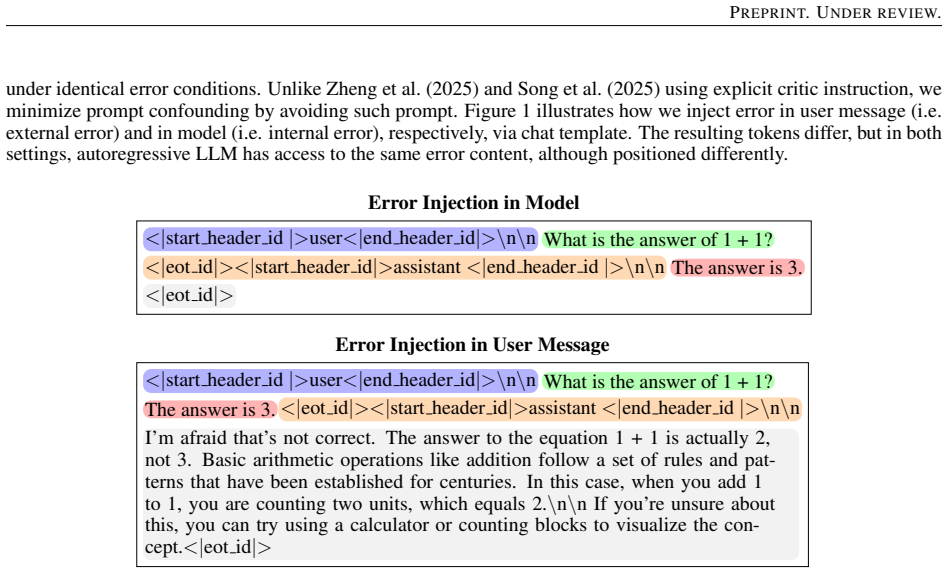
The load-bearing object is Self-Correction Bench, a controlled error-injection framework. For each of three datasets — SCLI5 (simple recall errors), GSM8K-SC (multi-step reasoning errors), PRM800K-SC (real-world reasoning errors) — the same erroneous tokens are placed either in the user message (external error) or in the assistant's own prior reply (internal error), keeping the rest of the chat template fixed. The defining identity is the Self-Correction Blind Spot, $1 - P_M(r_{correct}|r_m,e)/P_M(r_{correct}|r_u,e)$, which quantifies how much worse the model is at fixing its own error than an identical external one. The causal lever is a one-token conditioning intervention: appending 'Wait' after the internal error shifts the distribution from committed continuation to re-evaluation, and the paper validates similar markers such as 'But' and 'However'. The explanatory machinery is a comparison of correction-marker density in post-training data — SFT datasets sit near zero (95th percentile about 1 marker per response) while reasoning/RL datasets have medians of 30–170 markers — which links the probability of generating a correction to marker frequency in training data.
What would settle it
One experiment would settle the attribution question: on a model with a large measured blind spot, compare correction rates with 'Wait', with a semantically meaningless break token such as '...', and with the internal-error block relabeled by an explicit meta-note such as 'Draft answer, may contain errors'; if either control matches 'Wait' or external-error rates, the blind spot is an output-position artifact rather than a self-correction-specific activation failure.
Extended reading notes
Core claim
On the paper's own terms, the central discovery is that LLMs' inability to correct their own outputs is an activation failure rather than a knowledge failure. Using identical error tokens in two positions — the user message (external error, $r_u$) and the assistant's own prior reply (internal error, $r_m$) — Self-Correction Bench measures a Self-Correction Blind Spot of $1 - P_M(r_{correct}|r_m,e)/P_M(r_{correct}|r_u,e)$, with a mean value of 64.5% over 14 open-source non-reasoning models and across three complexity levels. Because the same model, on the same tokens, succeeds when the error is externally attributed, the authors conclude the correction capability exists but is not triggered. They further claim that appending 'Wait' reduces the blind spot by 89.3% and raises macro-average accuracy by 156.0%; that correction markers are far rarer in supervised-fine-tuning data than in reasoning-model data; and that fine-tuning on as few as 5,306 error-correction traces cuts the blind spot by 76.0%. The abstract also claims a transferable conversational-role direction in representation space that causally gates self-correction, with 'Wait' operating through a largely independent pathway.
Load-bearing premise
The internal and external conditions are assumed to differ only in who is credited with the error; if the assistant-prefix position itself makes the model treat the text as committed output to continue rather than text to critique, the measured blind spot could be a position artifact rather than a self-correction-specific activation failure.
Editorial extensions
If this is right
- If the blind spot exists as described, improving LLM reliability cannot come only from more knowledge or larger models; training and prompting must also activate an existing correction pathway.
- Open models that fail to backtrack on their own committed errors will exhibit hallucination snowballing, since an internal error is treated as committed output rather than text to critique.
- Including explicit error-and-correction traces in post-training data can shrink the blind spot, with as few as 5,306 traces yielding a 76.0% reduction.
- Appending 'Wait' or a similar marker is a zero-training deployment intervention that narrows the gap between non-reasoning models and RL-trained reasoning models, in some cases matching the reasoning model's accuracy.
- Self-Correction Bench offers a standardized, knowledge-controlled way to compare self-correction across models and error types, and its blind-spot measure is robust to sampling temperature and token budget.
Reading between the lines
- Editorial inference: the same internal/external contrast could be extended to other non-self sources — tool outputs, retrieved documents, or previous agent turns — and would predict that LLMs are more vigilant toward any source other than their own generation.
- Editorial inference: because a single token unlocks correction with no training, the next-token distribution of open models likely already contains a self-evaluation mode; correction-marker probing could serve as a cheap diagnostic for blind-spot severity without running the full benchmark.
- Editorial inference: a decisive control the paper leaves implicit is a semantically neutral break token (for example '...' or a random nonce) in place of 'Wait'; if it produces the same lift, the effect is continuation-breaking rather than activation of a correction-specific pathway.
- Editorial inference: if the training-data explanation generalizes, blind-spot size should correlate with the correction-marker density of each model's SFT mixture across the open model zoo, which would be a direct cross-model test of the frequency mechanism.
Editorial analysis
A structured set of objections, weighed in public.
Referee Report
Summary. The paper introduces Self-Correction Bench, a controlled protocol that injects the same error either into the user prompt (external condition) or into the assistant prefix (internal condition) to measure what the authors call the Self-Correction Blind Spot. Across 14 open-source non-reasoning models the authors report an average blind spot of 64.5%, defined as 1 minus the ratio of internal to external correction accuracy. They further report that appending a single token "Wait" reduces the blind spot by 89.3%, that supervised fine-tuning data contain far fewer correction markers than reasoning-model data, and that reasoning models do not exhibit the blind spot. The paper concludes that the correction capability exists but is not activated for self-attributed errors and proposes a training-data-composition explanation.
Significance. If the central interpretation holds, the benchmark offers a simple, reproducible way to diagnose a systematic reliability failure, and the "Wait" intervention is a low-cost, training-free improvement that could matter for deployment. The paper's strengths are its breadth (14 models), its controlled error-injection design, its sensitivity analyses at different temperatures and token budgets, and its explicit release of data and code. The cross-dataset correlations and the comparison of non-reasoning versus reasoning models are informative. However, the significance of the main claim depends on the internal/external contrast being an unconfounded measure of self-attribution, and several headline claims in the abstract are not supported by the body of the manuscript. The empirical phenomenon is real and worth publishing after the interpretation and the missing analyses are addressed.
major comments (5)
- [§3.3, Fig. 1, Eq. (2)] The internal/external contrast does not isolate error attribution because it also changes the discourse task. In the external condition the error lies in the user turn and the model produces the first assistant turn, whereas in the internal condition the error lies in the assistant prefix and the model must continue that turn. The statement in Section 3.3 that the model "has access to the same error content, although positioned differently" understates this difference: position determines whether the model is responding to a user or continuing its own speaker turn, which changes the continuation prior. Consequently, the 64.5% gap in Eq. (2) is a real behavioral asymmetry, but it does not by itself prove that the same capability exists and is merely not activated for self-attributed errors; the "Wait" intervention also acts on the continuation prior. Please add control conditions that hold the discourse task fixed (e.g., both conditions require continuing an assistant turn, with the error attributed via an explicit source label) or temper the activation-deficiency interpretation throughout.
- [§5.1 (Evaluation); Appendix D.2, Figs. 14 and 16] The automatic evaluation uses different criteria for the two conditions. For internal errors the evaluator is asked to judge whether the completion "has backtracked", "has provided correct reasoning", and "has admitted the mistake" in addition to providing the correct final answer, while the external-error evaluator is asked only whether the response contains the correct answer and a correct critique. The paper does not state how these boolean outputs are aggregated into the reported accuracy. If internal accuracy requires all criteria, the blind spot is inflated by a stricter scoring rule, not just by the model's behavior. Please use an identical scoring rule for both conditions or report the component accuracies separately.
- [Abstract and body (Sections 2–8)] Several headline claims in the abstract are not supported by the body: the fine-tuning experiment with 5,306 traces that "reduces the blind spot by 76.0%", the identification of a "transferable conversational-role direction in representation space that causally gates self-correction", and the claim that "Wait" operates through a "nearly independent pathway". None of these results appear in the main text or appendices; Section 6.3 contains only correlational marker-frequency analysis. Please either add the missing experiments or analyses or remove these claims from the abstract.
- [§6.3, Table 5, Fig. 8] The training-data explanation is presented as causal ("This single powerful insight unifies all of our empirical observations"), but the evidence is correlational: the paper shows that SFT datasets have lower marker densities than reasoning datasets and that marker presence correlates with accuracy changes. The general term-frequency findings cited (Razeghi et al., 2022; Merullo et al., 2025) concern pretraining, and no experiment in this paper manipulates training-data marker density for the evaluated models. The fine-tuning experiment asserted in the abstract would be the needed test; without it, the root-cause claim overreaches.
- [§6.1, Table 8] The "Wait" intervention is insufficiently specified for reproducibility. The text says "We append 'Wait' after incorrect reasoning or answer" but does not give the exact prompt template for the internal and external conditions, nor state whether "Wait" is appended in both conditions. Table 8 reports a "Wait" row without indicating whether the external-condition accuracy is measured with or without "Wait". Please include the exact templates and clarify the composition of the numbers used to compute the 89.3% reduction.
minor comments (5)
- [Eq. (2)] Setting the blind spot to 0 when the external correction probability is 0 conflates "no asymmetry" with "no external correction ability"; please justify this definition or treat the case as undefined.
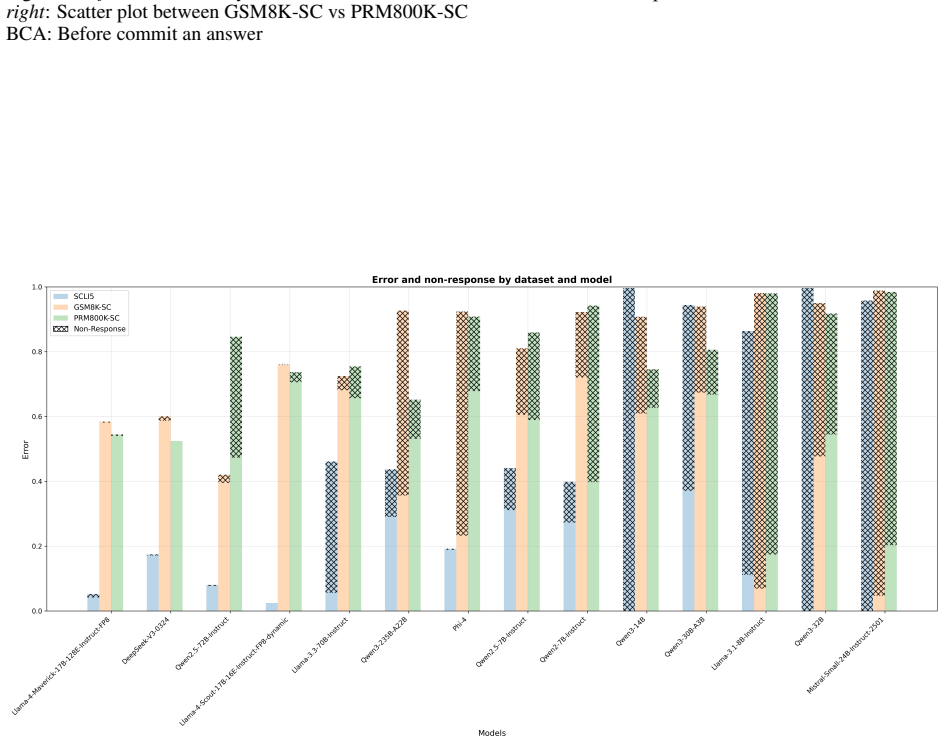
- [§5.2, Figs. 3 and 5] The text reports "moderate to strong positive correlations" without giving correlation coefficients; please report the actual r values and p-values.
- [Table 3] The macro averages in Table 3 are reported without specifying which condition (internal error, external error, or combined) the base-model and reasoning-model columns refer to; please clarify.
- [Fig. 6] The "empty response" category in Figure 6 is not defined; please state what counts as an empty response and how it was determined.
- [Figure captions] The abbreviation "BCA: Before commit an answer" appears in figure captions but is not defined in the main text; please define it at first use.
Circularity Check
No significant circularity; the central metric is an empirical ratio from controlled trials scored against ground truth.
full rationale
The paper's headline quantity is not derived from any fitted parameter or self-referential definition. Equation (2) defines the Self-Correction Blind Spot as 1 - P_M(correct|r_m,e)/P_M(correct|r_u,e), and Sections 3.3 and 5.1 measure the two probabilities directly on controlled error injections, scoring completions against ground-truth answers with a held-out evaluator. The resulting 64.5% figure is an empirical ratio of independent trial accuracies. The 'Wait' result is a test-time intervention whose 89.3% reduction is measured after the fact, not a number forced by the definition; even though 'Wait' was selected from the same correction-marker family the paper studies, its effectiveness is an empirical outcome. The post-training marker-frequency analysis is correlational and is not used to compute the central metric. The paper contains no load-bearing self-citations: it relies on external prior work for test-time scaling (Muennighoff et al.) and marker-frequency effects (Razeghi et al.; Merullo et al.), and no author-specific theorem is invoked to forbid alternatives. The main caveats—the internal/external manipulation changes discourse position and the two evaluator rubrics differ, and the abstract's mechanistic 'conversational-role direction' claim is not developed in the body—are construct-validity and support concerns, not circular reductions. Thus the derivation chain is self-contained and no circularity is found.
Assumptions & free parameters
assumptions (4)
- domain assumption Errors are mutually exclusive and collectively exhaustive states over which correctness can be marginalized (Eq. 1).
- domain assumption The internal and external injection conditions differ only in error attribution, not in task difficulty or continuation prior (Section 3.3, Figure 1).
- domain assumption Correction marker frequency in post-training data is the causal driver of self-correction behavior (Section 6.3).
- domain assumption The LLM judge (gemini-2.5-flash) provides unbiased correctness labels (Section 5.1, Appendix D.2).
invented entities (1)
-
transferable conversational-role direction in representation space
Cite this review
Pith. "Pith review of Self-Correction Bench: Uncovering and Addressing the Self-Correction Blind Spot in Large Language Models." pith.science (2026). https://pith.science/paper/RCFD4J77
@misc{pith2026250702778,
  author       = {Pith},
  title        = {Pith review of: Self-Correction Bench: Uncovering and Addressing the Self-Correction Blind Spot in Large Language Models},
  year         = {2026},
  howpublished = {\url{https://pith.science/paper/RCFD4J77}},
  note         = {Machine review of arXiv:2507.02778}
}
read the original abstract
Although large language models (LLMs) have transformed AI, they still make errors and follow unproductive reasoning paths. Self-correction is vital for safety-critical applications, but studying it requires disentangling activation failure from knowledge deficiency: when a model fails to correct an error, is it because it cannot, or because it does not? We introduce Self-Correction Bench, a controlled evaluation framework that isolates this distinction by injecting the same error as either an external (user-attributed) or internal (model-attributed) error, keeping all other context identical. Testing 14 open-source non-reasoning models reveals a 64.5% Self-Correction Blind Spot: models correct external errors but fail on identical internal ones, proving the capability exists but is not activated. On models' own naturally generated errors, a measurable share of what a model fails to catch in its own output is caught when the identical error is presented externally. We trace the cause to post-training data composition: supervised fine-tuning datasets lack error-correction sequences, and fine-tuning with as few as 5,306 such traces already reduces the blind spot by 76.0%. Mechanistically, we identify a transferable conversational-role direction in representation space that causally gates self-correction. Appending "Wait" requires no training yet reduces the blind spot by 89.3%, and operates through a nearly independent pathway, indicating that correction activation is not reducible to this single mechanism.
Figures


Figures from the paper (13 more)




Reference graph
Works this paper leans on
-
[1]
OpenAI, Josh Achiam, Steven Adler, Sandhini Agarwal, Lama Ahmad, Ilge Akkaya, Florencia Leoni Aleman, Diogo Almeida, Janko Altenschmidt, Sam Altman, Shyamal Anadkat, Red Avila, Igor Babuschkin, Suchir Balaji, Valerie Balcom, Paul Baltescu, Haiming Bao, Mohammad Bavarian, Jeff Belgum, Irwan Bello, Jake Berdine, Gabriel Bernadett-Shapiro, Christopher Berner...
arXiv 2024
-
[2]
The claude 3 model family: Opus, sonnet, haiku, Mar 2024
Anthropic. The claude 3 model family: Opus, sonnet, haiku, Mar 2024. URL https://www-cdn.anthropic.com/de8ba9b01c9ab7cbabf5c33b80b7bbc618857627/Model_Card_Claude_3.pdf
work page 2024
-
[3]
Google Gemini Team. Gemini 2.5: Pushing the frontier with advanced reasoning, multimodality, long context, and next generation agentic capabilities., June 2025. URL https://storage.googleapis.com/deepmind-media/gemini/gemini_v2_5_report.pdf
work page 2025
-
[4]
An Yang, Anfeng Li, Baosong Yang, Beichen Zhang, Binyuan Hui, Bo Zheng, Bowen Yu, Chang Gao, Chengen Huang, Chenxu Lv, Chujie Zheng, Dayiheng Liu, Fan Zhou, Fei Huang, Feng Hu, Hao Ge, Haoran Wei, Huan Lin, Jialong Tang, Jian Yang, Jianhong Tu, Jianwei Zhang, Jianxin Yang, Jiaxi Yang, Jing Zhou, Jingren Zhou, Junyang Lin, Kai Dang, Keqin Bao, Kexin Yang, ...
arXiv 2025
-
[5]
The llama 4 herd: The beginning of a new era of natively multimodal ai innovation, Apr 2025
Meta. The llama 4 herd: The beginning of a new era of natively multimodal ai innovation, Apr 2025. URL https://ai.meta.com/blog/llama-4-multimodal-intelligence/
work page 2025
-
[6]
DeepSeek-AI, Daya Guo, Dejian Yang, Haowei Zhang, Junxiao Song, Ruoyu Zhang, Runxin Xu, Qihao Zhu, Shirong Ma, Peiyi Wang, Xiao Bi, Xiaokang Zhang, Xingkai Yu, Yu Wu, Z. F. Wu, Zhibin Gou, Zhihong Shao, Zhuoshu Li, Ziyi Gao, Aixin Liu, Bing Xue, Bingxuan Wang, Bochao Wu, Bei Feng, Chengda Lu, Chenggang Zhao, Chengqi Deng, Chenyu Zhang, Chong Ruan, Damai D...
arXiv 2025
-
[7]
On faithfulness and factuality in abstractive summarization
Joshua Maynez, Shashi Narayan, Bernd Bohnet, and Ryan McDonald. On faithfulness and factuality in abstractive summarization. In Dan Jurafsky, Joyce Chai, Natalie Schluter, and Joel Tetreault, editors, Proceedings of the 58th Annual Meeting of the Association for Computational Linguistics, pages 1906--1919, Online, July 2020. Association for Computational ...
-
[8]
Lei Huang, Weijiang Yu, Weitao Ma, Weihong Zhong, Zhangyin Feng, Haotian Wang, Qianglong Chen, Weihua Peng, Xiaocheng Feng, Bing Qin, and Ting Liu. A survey on hallucination in large language models: Principles, taxonomy, challenges, and open questions. ACM Transactions on Information Systems, 43 0 (2): 0 1–55, January 2025. ISSN 1558-2868. doi:10.1145/37...
doi:10.1145/3703155 2025
Show all 60 references
-
[9]
Do, Yan Xu, and Pascale Fung
Yejin Bang, Samuel Cahyawijaya, Nayeon Lee, Wenliang Dai, Dan Su, Bryan Wilie, Holy Lovenia, Ziwei Ji, Tiezheng Yu, Willy Chung, Quyet V. Do, Yan Xu, and Pascale Fung. A multitask, multilingual, multimodal evaluation of C hat GPT on reasoning, hallucination, and interactivity....
2023
-
[10]
Large language models can be easily distracted by irrelevant context
Freda Shi, Xinyun Chen, Kanishka Misra, Nathan Scales, David Dohan, Ed Chi, Nathanael Sch\" a rli, and Denny Zhou. Large language models can be easily distracted by irrelevant context. In Proceedings of the 40th International Conference on Machine Learning, ICML'23. JMLR.org, 2023
2023
-
[11]
Alice in wonderland: Simple tasks showing complete reasoning breakdown in state-of-the-art large language models, 2025
Marianna Nezhurina, Lucia Cipolina-Kun, Mehdi Cherti, and Jenia Jitsev. Alice in wonderland: Simple tasks showing complete reasoning breakdown in state-of-the-art large language models, 2025. URL https://arxiv.org/abs/2406.02061
2025 arXiv
-
[12]
Reflexion: language agents with verbal reinforcement learning
Noah Shinn, Federico Cassano, Ashwin Gopinath, Karthik R Narasimhan, and Shunyu Yao. Reflexion: language agents with verbal reinforcement learning. In Thirty-seventh Conference on Neural Information Processing Systems, 2023. URL https://openreview.net/forum?id=vAElhFcKW6
2023
-
[13]
Self-refine: Iterative refinement with self-feedback
Aman Madaan, Niket Tandon, Prakhar Gupta, Skyler Hallinan, Luyu Gao, Sarah Wiegreffe, Uri Alon, Nouha Dziri, Shrimai Prabhumoye, Yiming Yang, Shashank Gupta, Bodhisattwa Prasad Majumder, Katherine Hermann, Sean Welleck, Amir Yazdanbakhsh, and Peter Clark. Self-refine: Iterativ...
2023
-
[14]
Language models can solve computer tasks
Geunwoo Kim, Pierre Baldi, and Stephen Marcus McAleer. Language models can solve computer tasks. In Thirty-seventh Conference on Neural Information Processing Systems, 2023. URL https://openreview.net/forum?id=M6OmjAZ4CX
2023
-
[15]
When can LLM s actually correct their own mistakes? a critical survey of self-correction of LLM s
Ryo Kamoi, Yusen Zhang, Nan Zhang, Jiawei Han, and Rui Zhang. When can LLM s actually correct their own mistakes? a critical survey of self-correction of LLM s. Transactions of the Association for Computational Linguistics, 12: 0 1417--1440, 2024 a . doi:10.1162/tacl_a_00713. ...
2024 doi
-
[16]
Large language models cannot self-correct reasoning yet, 2024
Jie Huang, Xinyun Chen, Swaroop Mishra, Huaixiu Steven Zheng, Adams Wei Yu, Xinying Song, and Denny Zhou. Large language models cannot self-correct reasoning yet, 2024. URL https://arxiv.org/abs/2310.01798
2024 arXiv
-
[17]
LLM s cannot find reasoning errors, but can correct them given the error location
Gladys Tyen, Hassan Mansoor, Victor Carbune, Peter Chen, and Tony Mak. LLM s cannot find reasoning errors, but can correct them given the error location. In Lun-Wei Ku, Andre Martins, and Vivek Srikumar, editors, Findings of the Association for Computational Linguistics: ACL 2...
2024 doi
-
[18]
Evaluating LLM s at detecting errors in LLM responses
Ryo Kamoi, Sarkar Snigdha Sarathi Das, Renze Lou, Jihyun Janice Ahn, Yilun Zhao, Xiaoxin Lu, Nan Zhang, Yusen Zhang, Haoran Ranran Zhang, Sujeeth Reddy Vummanthala, Salika Dave, Shaobo Qin, Arman Cohan, Wenpeng Yin, and Rui Zhang. Evaluating LLM s at detecting errors in LLM re...
2024
-
[19]
Training language models to self-correct via reinforcement learning
Aviral Kumar, Vincent Zhuang, Rishabh Agarwal, Yi Su, John D Co-Reyes, Avi Singh, Kate Baumli, Shariq Iqbal, Colton Bishop, Rebecca Roelofs, Lei M Zhang, Kay McKinney, Disha Shrivastava, Cosmin Paduraru, George Tucker, Doina Precup, Feryal Behbahani, and Aleksandra Faust. Trai...
2025
-
[20]
Jailbroken: how does llm safety training fail? In Proceedings of the 37th International Conference on Neural Information Processing Systems, NIPS '23, Red Hook, NY, USA, 2023
Alexander Wei, Nika Haghtalab, and Jacob Steinhardt. Jailbroken: how does llm safety training fail? In Proceedings of the 37th International Conference on Neural Information Processing Systems, NIPS '23, Red Hook, NY, USA, 2023. Curran Associates Inc
2023
-
[21]
Formalizing and benchmarking prompt injection attacks and defenses
Yupei Liu, Yuqi Jia, Runpeng Geng, Jinyuan Jia, and Neil Zhenqiang Gong. Formalizing and benchmarking prompt injection attacks and defenses. In Proceedings of the 33rd USENIX Conference on Security Symposium, SEC '24, USA, 2024. USENIX Association. ISBN 978-1-939133-44-1
2024
-
[22]
Bowman, and Ethan Perez
Tamera Lanham, Anna Chen, Ansh Radhakrishnan, Benoit Steiner, Carson Denison, Danny Hernandez, Dustin Li, Esin Durmus, Evan Hubinger, Jackson Kernion, Kamilė Lukošiūtė, Karina Nguyen, Newton Cheng, Nicholas Joseph, Nicholas Schiefer, Oliver Rausch, Robin Larson, Sam McCandlish...
2023 arXiv
-
[23]
Muru Zhang, Ofir Press, William Merrill, Alisa Liu, and Noah A. Smith. How language model hallucinations can snowball. In Ruslan Salakhutdinov, Zico Kolter, Katherine Heller, Adrian Weller, Nuria Oliver, Jonathan Scarlett, and Felix Berkenkamp, editors, Proceedings of the 41st...
2024
-
[24]
Scaling LLM test-time compute optimally can be more effective than scaling parameters for reasoning
Charlie Victor Snell, Jaehoon Lee, Kelvin Xu, and Aviral Kumar. Scaling LLM test-time compute optimally can be more effective than scaling parameters for reasoning. In The Thirteenth International Conference on Learning Representations, 2025. URL https://openreview.net/forum?i...
2025
-
[25]
s1: Simple test-time scaling, 2025
Niklas Muennighoff, Zitong Yang, Weijia Shi, Xiang Lisa Li, Li Fei-Fei, Hannaneh Hajishirzi, Luke Zettlemoyer, Percy Liang, Emmanuel Candès, and Tatsunori Hashimoto. s1: Simple test-time scaling, 2025. URL https://arxiv.org/abs/2501.19393
2025 arXiv
-
[26]
Benchmarking cognitive biases in large language models as evaluators
Ryan Koo, Minhwa Lee, Vipul Raheja, Jong Inn Park, Zae Myung Kim, and Dongyeop Kang. Benchmarking cognitive biases in large language models as evaluators. In Lun-Wei Ku, Andre Martins, and Vivek Srikumar, editors, Findings of the Association for Computational Linguistics: ACL ...
2024 doi
-
[27]
Cognitive bias in decision-making with LLM s
Jessica Maria Echterhoff, Yao Liu, Abeer Alessa, Julian McAuley, and Zexue He. Cognitive bias in decision-making with LLM s. In Yaser Al-Onaizan, Mohit Bansal, and Yun-Nung Chen, editors, Findings of the Association for Computational Linguistics: EMNLP 2024, pages 12640--12653...
2024 doi
-
[28]
Capturing failures of large language models via human cognitive biases
Erik Jones and Jacob Steinhardt. Capturing failures of large language models via human cognitive biases. In Alice H. Oh, Alekh Agarwal, Danielle Belgrave, and Kyunghyun Cho, editors, Advances in Neural Information Processing Systems, 2022. URL https://openreview.net/forum?id=f...
2022
-
[29]
Lin, and Lee Ross
Emily Pronin, Daniel Y. Lin, and Lee Ross. The bias blind spot: Perceptions of bias in self versus others. Personality and Social Psychology Bulletin, 28 0 (3): 0 369--381, 2002. doi:10.1177/0146167202286008. URL https://doi.org/10.1177/0146167202286008
2002 doi
-
[30]
Processbench: Identifying process errors in mathematical reasoning, 2025
Chujie Zheng, Zhenru Zhang, Beichen Zhang, Runji Lin, Keming Lu, Bowen Yu, Dayiheng Liu, Jingren Zhou, and Junyang Lin. Processbench: Identifying process errors in mathematical reasoning, 2025. URL https://arxiv.org/abs/2412.06559
2025 arXiv
-
[31]
Prmbench: A fine-grained and challenging benchmark for process-level reward models, 2025
Mingyang Song, Zhaochen Su, Xiaoye Qu, Jiawei Zhou, and Yu Cheng. Prmbench: A fine-grained and challenging benchmark for process-level reward models, 2025. URL https://arxiv.org/abs/2501.03124
2025 arXiv
-
[32]
Training verifiers to solve math word problems, 2021
Karl Cobbe, Vineet Kosaraju, Mohammad Bavarian, Mark Chen, Heewoo Jun, Lukasz Kaiser, Matthias Plappert, Jerry Tworek, Jacob Hilton, Reiichiro Nakano, Christopher Hesse, and John Schulman. Training verifiers to solve math word problems, 2021. URL https://arxiv.org/abs/2110.14168
2021 arXiv
-
[33]
Introducing gpt-4.1 in the api, Apr 2025
OpenAI. Introducing gpt-4.1 in the api, Apr 2025. URL https://openai.com/index/gpt-4-1/
2025
-
[34]
Let's verify step by step
Hunter Lightman, Vineet Kosaraju, Yuri Burda, Harrison Edwards, Bowen Baker, Teddy Lee, Jan Leike, John Schulman, Ilya Sutskever, and Karl Cobbe. Let's verify step by step. In The Twelfth International Conference on Learning Representations, 2024. URL https://openreview.net/fo...
2024
-
[35]
Measuring mathematical problem solving with the MATH dataset
Dan Hendrycks, Collin Burns, Saurav Kadavath, Akul Arora, Steven Basart, Eric Tang, Dawn Song, and Jacob Steinhardt. Measuring mathematical problem solving with the MATH dataset. In Thirty-fifth Conference on Neural Information Processing Systems Datasets and Benchmarks Track ...
2021
-
[36]
Transformers: State-of-the-art natural language processing
Thomas Wolf, Lysandre Debut, Victor Sanh, Julien Chaumond, Clement Delangue, Anthony Moi, Pierric Cistac, Tim Rault, Remi Louf, Morgan Funtowicz, Joe Davison, Sam Shleifer, Patrick von Platen, Clara Ma, Yacine Jernite, Julien Plu, Canwen Xu, Teven Le Scao, Sylvain Gugger, Mari...
2020
-
[37]
Zhang, Han Bao, Hanwei Xu, Haocheng Wang, Haowei Zhang, Honghui Ding, Huajian Xin, Huazuo Gao, Hui Li, Hui Qu, J
DeepSeek-AI, Aixin Liu, Bei Feng, Bing Xue, Bingxuan Wang, Bochao Wu, Chengda Lu, Chenggang Zhao, Chengqi Deng, Chenyu Zhang, Chong Ruan, Damai Dai, Daya Guo, Dejian Yang, Deli Chen, Dongjie Ji, Erhang Li, Fangyun Lin, Fucong Dai, Fuli Luo, Guangbo Hao, Guanting Chen, Guowei L...
2025 arXiv
-
[38]
Qwen2.5 technical report, 2025
Qwen, :, An Yang, Baosong Yang, Beichen Zhang, Binyuan Hui, Bo Zheng, Bowen Yu, Chengyuan Li, Dayiheng Liu, Fei Huang, Haoran Wei, Huan Lin, Jian Yang, Jianhong Tu, Jianwei Zhang, Jianxin Yang, Jiaxi Yang, Jingren Zhou, Junyang Lin, Kai Dang, Keming Lu, Keqin Bao, Kexin Yang, ...
2025 arXiv
-
[39]
Llama 3.3, Dec 2024
Meta. Llama 3.3, Dec 2024. URL https://www.llama.com/docs/model-cards-and-prompt-formats/llama3_3/
2024
-
[40]
Hewett, Mojan Javaheripi, Piero Kauffmann, James R
Marah Abdin, Jyoti Aneja, Harkirat Behl, Sébastien Bubeck, Ronen Eldan, Suriya Gunasekar, Michael Harrison, Russell J. Hewett, Mojan Javaheripi, Piero Kauffmann, James R. Lee, Yin Tat Lee, Yuanzhi Li, Weishung Liu, Caio C. T. Mendes, Anh Nguyen, Eric Price, Gustavo de Rosa, Ol...
2024 arXiv
-
[41]
Qwen2 technical report, 2024
An Yang, Baosong Yang, Binyuan Hui, Bo Zheng, Bowen Yu, Chang Zhou, Chengpeng Li, Chengyuan Li, Dayiheng Liu, Fei Huang, Guanting Dong, Haoran Wei, Huan Lin, Jialong Tang, Jialin Wang, Jian Yang, Jianhong Tu, Jianwei Zhang, Jianxin Ma, Jianxin Yang, Jin Xu, Jingren Zhou, Jinze...
2024 arXiv
-
[42]
Aaron Grattafiori, Abhimanyu Dubey, Abhinav Jauhri, Abhinav Pandey, Abhishek Kadian, Ahmad Al-Dahle, Aiesha Letman, Akhil Mathur, Alan Schelten, Alex Vaughan, Amy Yang, Angela Fan, Anirudh Goyal, Anthony Hartshorn, Aobo Yang, Archi Mitra, Archie Sravankumar, Artem Korenev, Art...
2024 arXiv
-
[43]
Mistral small 3, Jan 2025
Mistral AI Team. Mistral small 3, Jan 2025. URL https://mistral.ai/news/mistral-small-3
2025
-
[44]
Zhihong Shao, Peiyi Wang, Qihao Zhu, Runxin Xu, Junxiao Song, Xiao Bi, Haowei Zhang, Mingchuan Zhang, Y. K. Li, Y. Wu, and Daya Guo. Deepseekmath: Pushing the limits of mathematical reasoning in open language models, 2024. URL https://arxiv.org/abs/2402.03300
2024 arXiv
-
[45]
Impact of pretraining term frequencies on few-shot numerical reasoning
Yasaman Razeghi, Robert L Logan IV, Matt Gardner, and Sameer Singh. Impact of pretraining term frequencies on few-shot numerical reasoning. In Yoav Goldberg, Zornitsa Kozareva, and Yue Zhang, editors, Findings of the Association for Computational Linguistics: EMNLP 2022, pages...
2022 doi
-
[46]
Smith, Sarah Wiegreffe, and Yanai Elazar
Jack Merullo, Noah A. Smith, Sarah Wiegreffe, and Yanai Elazar. On linear representations and pretraining data frequency in language models. In The Thirteenth International Conference on Learning Representations, 2025. URL https://openreview.net/forum?id=EDoD3DgivF
2025
-
[47]
o pf, Yannic Kilcher, Dimitri von R \
Andreas K \"o pf, Yannic Kilcher, Dimitri von R \"u tte, Sotiris Anagnostidis, Zhi Rui Tam, Keith Stevens, Abdullah Barhoum, Duc Minh Nguyen, Oliver Stanley, Rich \'a rd Nagyfi, Shahul ES, Sameer Suri, David Alexandrovich Glushkov, Arnav Varma Dantuluri, Andrew Maguire, Christ...
2023
-
[48]
Openhermes 2.5: An open dataset of synthetic data for generalist llm assistants, 2023
Teknium. Openhermes 2.5: An open dataset of synthetic data for generalist llm assistants, 2023. URL https://huggingface.co/datasets/teknium/OpenHermes-2.5
2023
-
[49]
Infinity instruct: Scaling instruction selection and synthesis to enhance language models, 2025
Jijie Li, Li Du, Hanyu Zhao, Bo wen Zhang, Liangdong Wang, Boyan Gao, Guang Liu, and Yonghua Lin. Infinity instruct: Scaling instruction selection and synthesis to enhance language models, 2025. URL https://arxiv.org/abs/2506.11116
2025 arXiv
-
[50]
Ultrafeedback: Boosting language models with high-quality feedback, 2024
Ganqu Cui, Lifan Yuan, Ning Ding, Guanming Yao, Wei Zhu, Yuan Ni, Guotong Xie, Zhiyuan Liu, and Maosong Sun. Ultrafeedback: Boosting language models with high-quality feedback, 2024. URL https://openreview.net/forum?id=pNkOx3IVWI
2024
-
[51]
Hwang, Jiangjiang Yang, Ronan Le Bras, Oyvind Tafjord, Christopher Wilhelm, Luca Soldaini, Noah A
Nathan Lambert, Jacob Morrison, Valentina Pyatkin, Shengyi Huang, Hamish Ivison, Faeze Brahman, Lester James Validad Miranda, Alisa Liu, Nouha Dziri, Xinxi Lyu, Yuling Gu, Saumya Malik, Victoria Graf, Jena D. Hwang, Jiangjiang Yang, Ronan Le Bras, Oyvind Tafjord, Christopher W...
2025
-
[52]
Open r1: A fully open reproduction of deepseek-r1, January 2025
Hugging Face. Open r1: A fully open reproduction of deepseek-r1, January 2025. URL https://github.com/huggingface/open-r1
2025
-
[53]
Merrill, Tatsunori Hashimoto, Yejin Choi, Jenia Jitsev, Reinhard Heckel, Maheswaran Sathiamoorthy, Alexandros G
Etash Guha, Ryan Marten, Sedrick Keh, Negin Raoof, Georgios Smyrnis, Hritik Bansal, Marianna Nezhurina, Jean Mercat, Trung Vu, Zayne Sprague, Ashima Suvarna, Benjamin Feuer, Liangyu Chen, Zaid Khan, Eric Frankel, Sachin Grover, Caroline Choi, Niklas Muennighoff, Shiye Su, Wanj...
2025 arXiv
-
[54]
Training language models to follow instructions with human feedback
Long Ouyang, Jeffrey Wu, Xu Jiang, Diogo Almeida, Carroll Wainwright, Pamela Mishkin, Chong Zhang, Sandhini Agarwal, Katarina Slama, Alex Gray, John Schulman, Jacob Hilton, Fraser Kelton, Luke Miller, Maddie Simens, Amanda Askell, Peter Welinder, Paul Christiano, Jan Leike, an...
2022
-
[55]
Learning from mistakes makes llm better reasoner, 2024
Shengnan An, Zexiong Ma, Zeqi Lin, Nanning Zheng, Jian-Guang Lou, and Weizhu Chen. Learning from mistakes makes llm better reasoner, 2024. URL https://arxiv.org/abs/2310.20689
2024 arXiv
-
[56]
Critique fine-tuning: Learning to critique is more effective than learning to imitate, 2025
Yubo Wang, Xiang Yue, and Wenhu Chen. Critique fine-tuning: Learning to critique is more effective than learning to imitate, 2025. URL https://arxiv.org/abs/2501.17703
2025 arXiv
-
[57]
The effect of sampling temperature on problem solving in large language models
Matthew Renze. The effect of sampling temperature on problem solving in large language models. In Yaser Al-Onaizan, Mohit Bansal, and Yun-Nung Chen, editors, Findings of the Association for Computational Linguistics: EMNLP 2024, pages 7346--7356, Miami, Florida, USA, November ...
2024 doi
-
[58]
@esa (Ref
\@ifxundefined[1] #1\@undefined \@firstoftwo \@secondoftwo \@ifnum[1] #1 \@firstoftwo \@secondoftwo \@ifx[1] #1 \@firstoftwo \@secondoftwo [2] @ #1 \@temptokena #2 #1 @ \@temptokena \@ifclassloaded agu2001 natbib The agu2001 class already includes natbib coding, so you should ...
-
[59]
\@lbibitem[] @bibitem@first@sw\@secondoftwo \@lbibitem[#1]#2 \@extra@b@citeb \@ifundefined br@#2\@extra@b@citeb \@namedef br@#2 \@nameuse br@#2\@extra@b@citeb \@ifundefined b@#2\@extra@b@citeb @num @parse #2 @tmp #1 NAT@b@open@#2 NAT@b@shut@#2 \@ifnum @merge>\@ne @bibitem@firs...
-
[60]
after incorrect reasoning or answer to prompt LLMs to self-correct, without finetuning. We observe significant reductions in the blind spot after appending ``Wait
@open @close @open @close and [1] URL: #1 \@ifundefined chapter * \@mkboth \@ifxundefined @sectionbib * \@mkboth * \@mkboth\@gobbletwo \@ifclassloaded amsart * \@ifclassloaded amsbook * \@ifxundefined @heading @heading NAT@ctr thebibliography [1] @ \@biblabel @NAT@ctr \@bibset...
2022
Reviewed August 6, 2026 · model on record in the stance chip above.
Discussion (0). Sign in to comment.