REVIEW 3 major objections 5 minor 49 references
Towards a Comparative Framework for Compositional AI Models
T0 review · 3 major / 5 minor · reviewed 2026-08-06 · deepseek-v4-flash
Pith's one-line read The paper defines compositionality relative to a chosen syntax and uses closure-based tests to show that quantum-circuit and neural DisCoCirc models differ mainly on systematicity.
desk verdict A clean categorical framework for compositionality and a new neural DisCoCirc model, but the headline quantum-vs-neural systematicity gap lacks error bars and rests on a validation scheme that leaks test-distribution data into model selection. read the letter →
The pith
A machine-rendered reading of the paper's core claim, the machinery that carries it, and where it could break.
The reading
What carries the argument
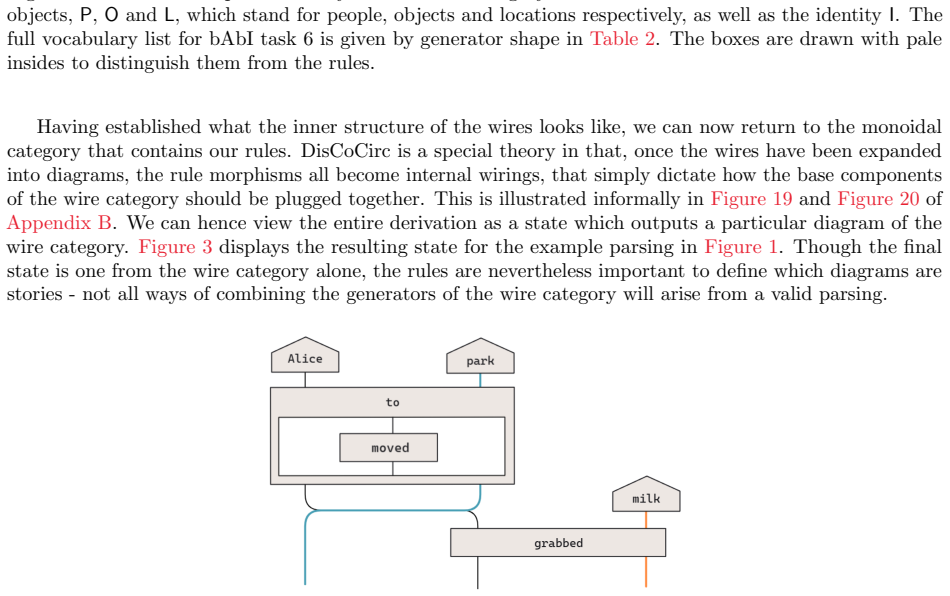
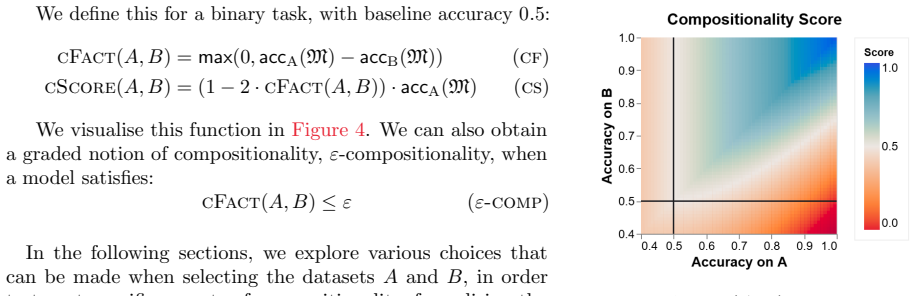
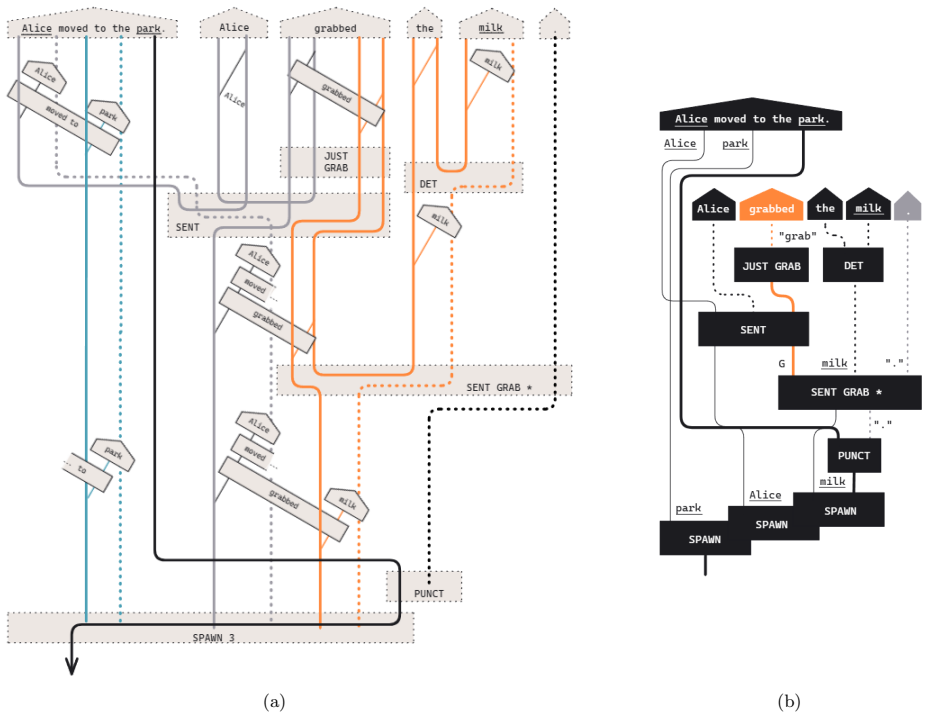
The machinery has three parts. (1) A categorical scaffolding: a language is packaged as a category whose morphisms are stories, a syntax is a functor $e : \Sigma_L \to \mathbf{S}_G$ into a monoidal category of diagrams, and a model is an interpretation functor; a model is syntactically compositional when it factors as $e;g$ and semantically compositional when such a $g$ exists without being specified. The compositional closure $\Sigma^*$ of a training set $\Sigma$ is the set of stories whose diagrams use only the generators appearing in $\Sigma$. (2) A quantitative core: the compositionality factor $\mathrm{cFact}(A,B)=\max(0,\mathrm{acc}_A(M)-\mathrm{acc}_B(M))$ and the compositionality score $\mathrm{cScore}(A,B)=(1-2\,\mathrm{cFact}(A,B))\cdot \mathrm{acc}_A(M)$, which penalise any accuracy lost in moving from a base set $A$ to a harder set $B$. (3) Four closure-based tests — productivity (longer concatenated stories), substitutivity (replacing fragments by synonyms), systematicity (recombining typed fragments), and overgeneralisation (training with corrupted labels) — each defined by a specific choice of $B$ as a closure of $A$. For DisCoCirc, the grammar supplies the syntax, the Sandwich expansion turns higher-order frames into plain boxes, and the two semantic categories are quantum circuits (tensor product) and differentiable functions (direct sum), so the same diagrams can be evaluated in either model.
What would settle it
Re-run the systematicity comparison on a bAbI-6-style task in which object locations matter (the paper notes such a rule can be added) and see whether the quantum-versus-neural gap of at least 10% persists; if the gap disappears, the reported difference is an artifact of the task rather than of the architectures.
Extended reading notes
Core claim
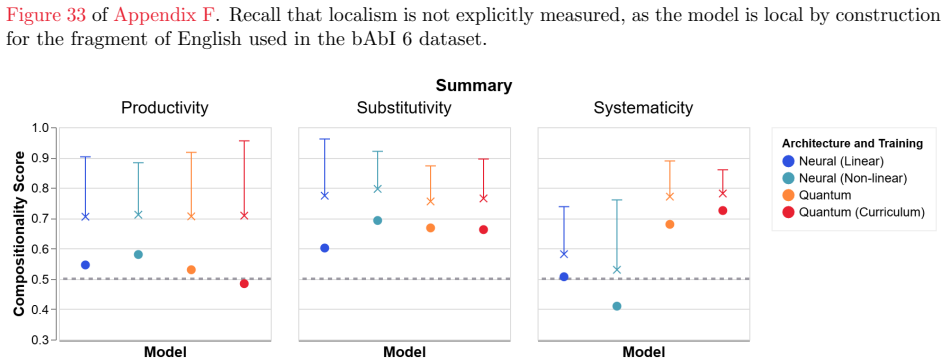
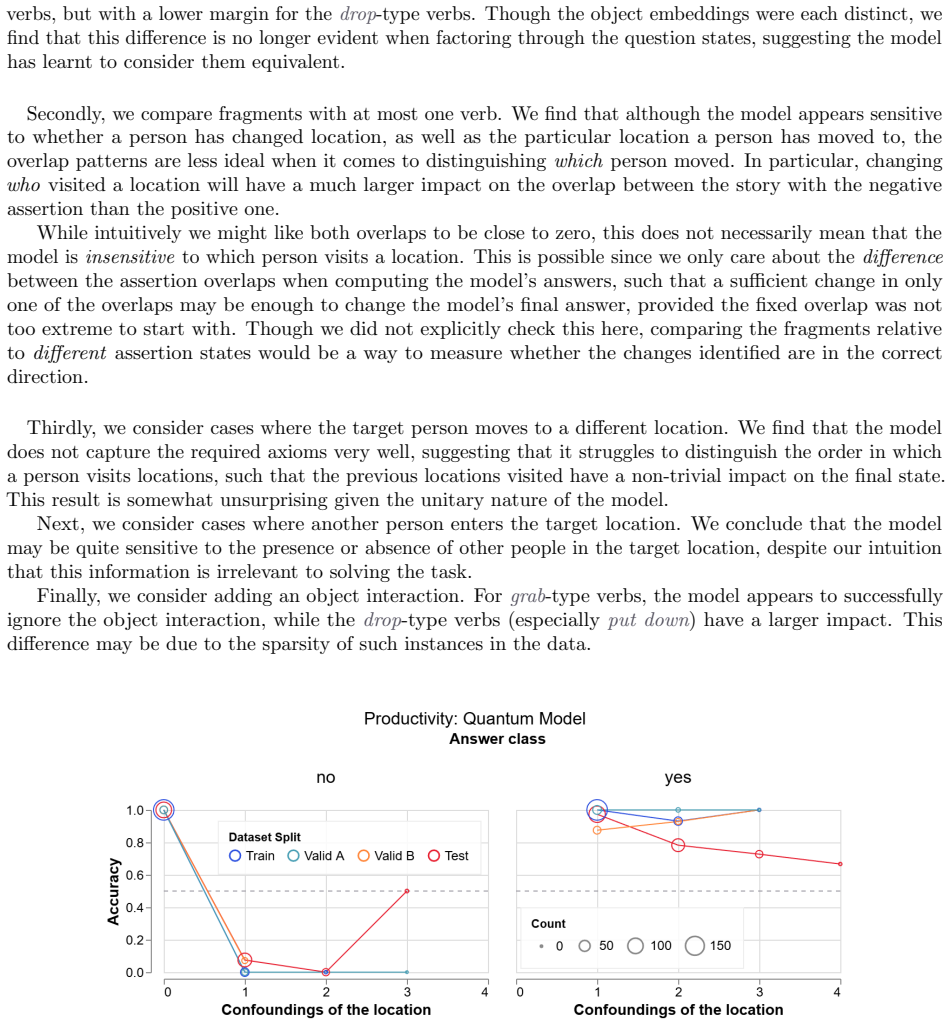
On its own terms, the paper's central claim is that compositionality is a relational property — a model is compositional relative to a syntax, not absolutely — and that this relational notion can be operationalised as measurable generalisation. A syntax is a functor from stories to a diagram category; a model is syntactically compositional if it factors through that syntax, and semantically compositional if such a factorisation merely exists. The paper turns the four aspects of compositionality into concrete datasets by defining the compositional closure of a training set under each aspect, and measuring the accuracy drop between the base set and its closure. Under this measurement, the quantum and neural DisCoCirc models achieve near-parity on productivity and substitutivity — within 5% — but the systematicity task separates them by at least 10%, with the non-linear neural model overfitting the training data and decaying to chance on the test set. Separately, the paper claims that syntactically compositional models can be interpreted by comparing assertion-relative overlaps of diagram fragments, and it uses this to show that the quantum productivity model has learned to answer 'Is somebody in the park?' rather than 'Is Andrew in the park?', which explains its accuracy loss on longer stories.
Load-bearing premise
The load-bearing premise is that the restricted bAbI 6 fragment and its question-answering task really are compositional under the paper's chosen syntax, so that the train and test splits generated from that syntax have a non-vacuous compositional closure; if the syntax does not match the task's true structure, the reported scores measure something other than compositional generalisation.
Editorial extensions
If this is right
- Compositionality scores can drive model selection: the Valid AB validation scheme picks models by an estimated compositionality score rather than raw validation accuracy, and it selects models with less overfitting between train and test.
- Systematicity is the discriminating test among the four aspects; if the result is correct, a benchmark that only measures productivity and substitutivity would miss the main architectural difference.
- Neural networks can be treated as compositional DisCoCirc models: the direct-sum category of differentiable functions supports the same grammar pipeline and reaches comparable accuracy on two of the three main tasks.
- Interpretation does not require visualising individual boxes; assertion-relative diagram fragments can explain a model's failure mode, and the paper states this approach extends to models with many qubits per noun and to neural architectures.
- On overgeneralisation, quantum models follow the compositional rule for corruption levels up to 30% before overfitting, while the neural model overfits uncorrupted samples too, indicating different inductive biases toward rules versus exceptions.
Reading between the lines
- Editorial inference: because the framework relativises compositionality to a syntax, applying it to unrestricted natural language would require a syntax that the paper itself argues is unavailable; in practice the tests will measure restricted fragments, not English as a whole.
- Editorial inference: the systematicity gap may be rooted in unitarity — reversible quantum circuits preserve distinctions that non-linear feed-forward networks can collapse — but the paper does not test this explanation.
- Editorial inference: the interpretability result suggests a portable diagnostic for any QA model on this task: check whether it answers the existential question 'Is somebody in X?' instead of the targeted 'Is P in X?'; the paper demonstrates this only for the quantum model.
- Editorial inference: the same closure-based tests could in principle be applied to transformer-based language models once a syntax for the fragment is fixed, since the categorical definitions do not constrain the model class.
Editorial analysis
A structured set of objections, weighed in public.
Referee Report
Summary. The paper develops a category-theoretic framework for defining compositional generalisation and compositional interpretability, building on the DisCoCirc architecture. It adapts four tests from Hupkes et al. (productivity, systematicity, substitutivity, overgeneralisation) and introduces the cFact and cScore metrics. These are applied to compare quantum-circuit and classical neural-network DisCoCirc models on a synthetic extension of bAbI task 6. The headline empirical claim is that quantum and neural models score within 5% on productivity and substitutivity but differ by at least 10% on systematicity, with neural models more prone to overfitting. A separate interpretability analysis of a trained quantum productivity model concludes that the model approximates the question 'Is somebody in the park?' rather than the intended per-person question.
Significance. If the empirical comparison were established, the paper would provide a useful comparative benchmark and evidence that tensor-product and direct-sum semantic categories lead to different compositional-generalisation behaviour in DisCoCirc models. The categorical formalisation is a genuine contribution, and the interpretability analysis (Section 5, Appendix G) is a strength: it yields a falsifiable, mechanistic explanation of the productivity failure that is consistent with Figure 12. The paper is also honest about its scope, acknowledging in Section 2.3 that unrestricted English and QA are unlikely to be compositional and that it works in a restricted 'safe corner', and in Section 6 that this is a preliminary investigation. However, the headline quantitative difference currently rests on single selected runs with a validation scheme that leaks test-distribution information, so the main empirical claim is not yet established at the claimed precision.
major comments (3)
- [Section 4.3 / Figure 7] The central claim that quantum and neural models differ by at least 10% on systematicity is based on one selected model per architecture, as stated in Section 3.4 ('We train a model each for the quantum, Linear and non-linear neural models'). The only cross-validation analysis is for the productivity task (Section 4.1.1, Figure 8), which shows substantial split-to-split variation for the quantum model. No equivalent variance analysis is reported for systematicity or substitutivity, so the reported 10-point gap cannot be distinguished from run-to-run noise. Please provide multiple seeds or folds with confidence intervals for all four tasks, or explicitly reframe the systematicity comparison as a single-run observation.
- [Section 3.4 / Appendix E.1-E.2] The Valid AB validation scheme includes a subset of the test distribution in the validation set and uses a compositionality-score proxy computed on those test-like examples for model selection. This leaks test-distribution information into model choice, which can bias the selected model's absolute scores and, because only one model per architecture is selected, the cross-architecture gap. Appendix E.2 itself reports that the Comp AB and Comp All estimates are 'very volatile' and that selection tends to work only when the true score is above 0.60. This undercuts the reliability of the Figure 7 scores. Please evaluate final models on a genuinely held-out test set that is never used for selection, or use a nested validation procedure that accounts for selection variability.
- [Section 2.2, Eqs. (cf)-(cs)] The text says the metric is defined 'for a binary task, with baseline accuracy 0.5', but the baseline does not appear in the equations for cFact or cScore as written. Appendix C.2 reports that the systematicity dataset has a majority-class baseline of 51.6%, not 50%. It should be clarified whether and how the 0.5 baseline enters the score, and whether the reported systematicity scores are adjusted for the actual dataset baseline. This matters because the size of the reported systematicity gap could be sensitive to the baseline convention.
minor comments (5)
- [Abstract] The phrases 'within 5%' and 'at least 10%' refer to point estimates from single selected runs; consider adding a qualifier such as 'in this preliminary single-run evaluation' to avoid overprecision.
- [Section 2.1 / Figure 3 caption] There are typos: 'Futher examples' should be 'Further examples', and the Figure 3 caption reads 'Notice the the hole'.
- [Section 4.1.1 / Figure 8] The cross-validation figure is informative, but the main text should state explicitly that no cross-validation was performed for systematicity or substitutivity; currently this is only inferable from Section 3.4.
- [Section 5.2 / Figure 12] The conclusion that the model answers 'Is somebody in the park?' would be strengthened by reporting the full confusion matrix or by showing accuracy separately for 'yes' and 'no' targets with and without confounders; the appendix provides details, but a sentence in the main text would help.
- [Appendix C.3 / Appendix D.2 / Table 2] Minor typographical issues: 'repesents' should be 'represents' in Appendix C.3, 'proudctivity' should be 'productivity' in Appendix D.2, and the Table 2 header contains an extra space in 'V ocabulary'.
Circularity Check
No significant circularity: the metric definitions and empirical comparison are self-contained; the only passage that raises a 'by definition' concern is explicitly flagged and neutralized by an assumption about task labels, not a hidden reduction.
full rationale
The derivation chain in this paper is a sequence of stipulated definitions (cFact, cScore, epsilon-properties, closures) followed by empirical measurements; no parameter is fitted and then renamed as a prediction, and no claimed result is equal to an input by construction. The central behavioural comparison (quantum vs neural systematicity gap) is an observed outcome that could have gone either way. The self-citations to Duneau et al. (2024) supply the quantum ansatz and the seed of the test adaptation, but the formal categorical definitions, the neural implementations, and the experiments are carried out here; no uniqueness theorem or prior result is invoked to forbid alternatives or to force the reported gap. The paper itself flags the one near-circular concern in Section 2.2.3: 'The notion seems to presuppose a syntactically compositional interpretation in order to determine which atoms are synonyms in the first place, which would make the interpretation substitutive by definition.' The paper then neutralizes this by assuming the task labels factor as ∇ = e∇ ; g and defining synonyms from that fixed g, while testing a separate model M against those classes. That is an explicit assumption about the task, not a reduction of the test to itself. Similarly, the Valid AB validation scheme includes test-distribution examples in model selection; this is a disclosed selection-bias/leakage limitation, but it is not circularity because the reported scores are not logically forced by the definitions. Overall, the paper is self-contained against external benchmarks and no circular step is present.
Assumptions & free parameters
free parameters (2)
- Neural hyperparameters per task =
Linear/Linear/Hidden(1); dims 36/12/2; lr 4.97e-3/5.0e-3/50e-3; batch 16/4/1
- Quantum epoch cap =
20-75 epochs, 40-60 in cross-validation
assumptions (3)
- domain assumption A restricted sub-language of English and the bAbI-style QA task are compositional relative to the chosen syntax e∇
- domain assumption The bAbI 6 grammar rules are the correct syntax, and any multiple derivations are equivalent
- domain assumption The overlap between a story circuit and an assertion circuit correctly scores answer candidates
Cite this review
Pith. "Pith review of Towards a Comparative Framework for Compositional AI Models." pith.science (2026). https://pith.science/paper/45OW6EZ5
@misc{pith2026250702940,
  author       = {Pith},
  title        = {Pith review of: Towards a Comparative Framework for Compositional AI Models},
  year         = {2026},
  howpublished = {\url{https://pith.science/paper/45OW6EZ5}},
  note         = {Machine review of arXiv:2507.02940}
}
read the original abstract
The DisCoCirc framework for natural language processing allows the construction of compositional models of text, by combining units for individual words together according to the grammatical structure of the text. The compositional nature of a model can give rise to two things: compositional generalisation -- the ability of a model to generalise outside its training distribution by learning compositional rules underpinning the entire data distribution -- and compositional interpretability -- making sense of how the model works by inspecting its modular components in isolation, as well as the processes through which these components are combined. We present these notions in a framework-agnostic way using the language of category theory, and adapt a series of tests for compositional generalisation to this setting. Applying this to the DisCoCirc framework, we consider how well a selection of models can learn to compositionally generalise. We compare both quantum circuit based models, as well as classical neural networks, on a dataset derived from one of the bAbI tasks, extended to test a series of aspects of compositionality. Both architectures score within 5% of one another on the productivity and substitutivity tasks, but differ by at least 10% for the systematicity task, and exhibit different trends on the overgeneralisation tasks. Overall, we find the neural models are more prone to overfitting the Train data. Additionally, we demonstrate how to interpret a compositional model on one of the trained models. By considering how the model components interact with one another, we explain how the model behaves.
Figures


Figures from the paper (41 more)








Reference graph
Works this paper leans on
-
[1]
S. Alouneh, S. Abed, M. H. Al Shayeji, and R. Mesleh. A comprehensive study and analysis on SAT -solvers: advances, usages and achievements. Artificial Intelligence Review, 52 0 (4): 0 2575--2601, Dec. 2019. ISSN 1573-7462. doi:10.1007/s10462-018-9628-0. URL https://doi.org/10.1007/s10462-018-9628-0
-
[2]
K. Arkoudas. GPT -4 Can 't Reason . ArXiv, 2023. doi:10.48550/ARXIV.2308.03762. URL https://arxiv.org/abs/2308.03762. Publisher: arXiv Version Number: 2
- [3]
-
[4]
H. Barendregt and H. Geuvers. Chapter 18 - Proof - Assistants Using Dependent Type Systems . In A. Robinson and A. Voronkov, editors, Handbook of Automated Reasoning , Handbook of Automated Reasoning , pages 1149--1238. North-Holland, Amsterdam, Jan. 2001. ISBN 978-0-444-50813-3. doi:10.1016/B978-044450813-3/50020-5. URL https://www.sciencedirect.com/scie...
-
[5]
A. R. Barron. Approximation and estimation bounds for artificial neural networks. Machine Learning, 14 0 (1): 0 115--133, Jan. 1994. ISSN 1573-0565. doi:10.1007/BF00993164. URL https://doi.org/10.1007/BF00993164
-
[6]
S. Bubeck, V. Chandrasekaran, R. Eldan, J. Gehrke, E. Horvitz, E. Kamar, P. Lee, Y. T. Lee, Y. Li, S. Lundberg, H. Nori, H. Palangi, M. T. Ribeiro, and Y. Zhang. Sparks of Artificial General Intelligence : Early experiments with GPT -4, Apr. 2023. URL http://arxiv.org/abs/2303.12712. arXiv:2303.12712 [cs]
arXiv 2023
-
[7]
N. Chomsky. Aspects of the Theory of Syntax. The MIT Press, 50 edition, 1965. ISBN 9780262527408. URL http://www.jstor.org/stable/j.ctt17kk81z
work page 1965
-
[8]
B. Coecke. The Mathematics of Text Structure . arXiv:1904.03478 [quant-ph], Feb. 2020. URL http://arxiv.org/abs/1904.03478. arXiv: 1904.03478
arXiv 1904
Show all 49 references
-
[9]
Coecke and A
B. Coecke and A. Kissinger. Picturing Quantum Processes : A First Course in Quantum Theory and Diagrammatic Reasoning . Cambridge University Press, Cambridge, 2017. ISBN 978-1-316-21931-7. doi:10.1017/9781316219317. URL http://ebooks.cambridge.org/ref/id/CBO9781316219317
2017 doi
-
[10]
Coecke, M
B. Coecke, M. Sadrzadeh, and S. Clark. Mathematical Foundations for a Compositional Distributional Model of Meaning . arXiv:1003.4394 [cs, math], Mar. 2010. URL http://arxiv.org/abs/1003.4394. arXiv: 1003.4394
2010 arXiv
-
[11]
Coecke, G
B. Coecke, G. de Felice, K. Meichanetzidis, and A. Toumi. Foundations for near-term quantum natural language processing, 2020
2020
-
[12]
Duneau, S
T. Duneau, S. Bruhn, G. Matos, T. Laakkonen, K. Saiti, A. Pearson, K. Meichanetzidis, and B. Coecke. Scalable and interpretable quantum natural language processing: an implementation on trapped ions, Sept. 2024. URL http://arxiv.org/abs/2409.08777. arXiv:2409.08777
2024 arXiv
-
[13]
Dziri, X
N. Dziri, X. Lu, M. Sclar, X. L. Li, L. Jiang, B. Y. Lin, P. West, C. Bhagavatula, R. L. Bras, J. D. Hwang, S. Sanyal, S. Welleck, X. Ren, A. Ettinger, Z. Harchaoui, and Y. Choi. Faith and Fate : Limits of Transformers on Compositionality , Oct. 2023. URL http://arxiv.org/abs/...
2023 arXiv
-
[14]
Eldan and O
R. Eldan and O. Shamir. The Power of Depth for Feedforward Neural Networks , May 2016. URL http://arxiv.org/abs/1512.03965. arXiv:1512.03965
2016 arXiv
-
[15]
Ax - adaptive experimentation platform
Facebook. Ax - adaptive experimentation platform. https://github.com/facebook/Ax, 2023
2023
- [16]
-
[17]
J. A. Fodor and Z. W. Pylyshyn. Connectionism and cognitive architecture: A critical analysis. Cognition, 28 0 (1): 0 3--71, Mar. 1988. ISSN 0010-0277. doi:10.1016/0010-0277(88)90031-5. URL https://www.sciencedirect.com/science/article/pii/0010027788900315
1988
-
[18]
Glasser, R
I. Glasser, R. Sweke, N. Pancotti, J. Eisert, and J. Cirac. Expressive power of tensor-network factorizations for probabilistic modeling, with applications from hidden Markov models to quantum machine learning. In Neural Information Processing Systems, July 2019. URL https://w...
2019
-
[19]
R. F. Hadley. Systematicity in Connectionist Language Learning . Mind & Language, 9 0 (3): 0 247--272, 1994. ISSN 1468-0017. doi:10.1111/j.1468-0017.1994.tb00225.x. URL https://onlinelibrary.wiley.com/doi/abs/10.1111/j.1468-0017.1994.tb00225.x. \_eprint: https://onlinelibrary....
1994
-
[20]
Hupkes, V
D. Hupkes, V. Dankers, M. Mul, and E. Bruni. Compositionality decomposed: how do neural networks generalise?, Feb. 2020. URL http://arxiv.org/abs/1908.08351. arXiv:1908.08351 [cs, stat]
2020 arXiv
-
[21]
Johnson and Journal of Philosophy, Inc
K. Johnson and Journal of Philosophy, Inc. On the Systematicity of Language and Thought :. Journal of Philosophy, 101 0 (3): 0 111--139, 2004. ISSN 0022-362X. doi:10.5840/jphil2004101321. URL http://www.pdcnet.org/oom/service?url_ver=Z39.88-2004&rft_val_fmt=&rft.imuse_id=jphil...
2004 doi
-
[22]
Kartsaklis, I
D. Kartsaklis, I. Fan, R. Yeung, A. Pearson, R. Lorenz, A. Toumi, G. de Felice, K. Meichanetzidis, S. Clark, and B. Coecke. lambeq: An efficient high-level python library for quantum N L P . arXiv:2110.04236, 2021
2021 arXiv
-
[23]
Karttunen
L. Karttunen. Discourse Referents . In International Conference on Computational Linguistics COLING 1969: Preprint No . 70 , Sånga Säby, Sweden, Sept. 1969. URL https://aclanthology.org/C69-7001
1969
-
[24]
D. P. Kingma and J. Ba. Adam: A method for stochastic optimization. In Y. Bengio and Y. LeCun, editors, 3rd International Conference on Learning Representations, ICLR 2015, San Diego, CA, USA, May 7-9, 2015, Conference Track Proceedings , 2015. URL http://arxiv.org/abs/1412.6980
2015 arXiv
-
[25]
Krawchuk, N
C. Krawchuk, N. Khatri, N. J. Ortega, and D. Kartsaklis. Efficient Generation of Parameterised Quantum Circuits from Large Texts , May 2025. URL http://arxiv.org/abs/2505.13208. arXiv:2505.13208 [quant-ph]
2025 arXiv
-
[26]
Laakkonen, K
T. Laakkonen, K. Meichanetzidis, and B. Coecke. Quantum Algorithms for Compositional Text Processing . Electronic Proceedings in Theoretical Computer Science, 406: 0 162--196, Aug. 2024. ISSN 2075-2180. doi:10.4204/EPTCS.406.8. URL http://arxiv.org/abs/2408.06061. arXiv:2408.0...
2024 arXiv
-
[27]
J. Lambek. Pregroups and natural language processing. The Mathematical Intelligencer, 28 0 (2): 0 41--48, Mar. 2006. ISSN 0343-6993. doi:10.1007/BF02987155. URL https://doi.org/10.1007/BF02987155
2006 doi
-
[28]
Leinster
T. Leinster. Higher Operads , Higher Categories , May 2003. URL http://arxiv.org/abs/math/0305049. arXiv:math/0305049
2003 arXiv
-
[29]
J. Liu, R. A. Shaikh, B. Rodatz, R. Yeung, and B. Coecke. A Pipeline For Discourse Circuits From CCG , Nov. 2023. URL http://arxiv.org/abs/2311.17892. arXiv:2311.17892 [cs]
2023 arXiv
-
[30]
Lorenz, A
R. Lorenz, A. Pearson, K. Meichanetzidis, D. Kartsaklis, and B. Coecke. Qnlp in practice: Running compositional models of meaning on a quantum computer. Journal of Artificial Intelligence Research, 76: 0 1305--1342, 04 2023. doi:10.1613/jair.1.14329
2023 doi
-
[31]
Mirzadeh, K
I. Mirzadeh, K. Alizadeh, H. Shahrokhi, O. Tuzel, S. Bengio, and M. Farajtabar. GSM - Symbolic : Understanding the Limitations of Mathematical Reasoning in Large Language Models , Oct. 2024. URL http://arxiv.org/abs/2410.05229. arXiv:2410.05229 [cs]
2024 arXiv
-
[32]
Achiam, S
OpenAI, J. Achiam, S. Adler, S. Agarwal, L. Ahmad, I. Akkaya, F. L. Aleman, D. Almeida, J. Altenschmidt, S. Altman, S. Anadkat, R. Avila, I. Babuschkin, S. Balaji, V. Balcom, P. Baltescu, H. Bao, M. Bavarian, J. Belgum, I. Bello, J. Berdine, G. Bernadett-Shapiro, C. Berner, L....
2024 arXiv
-
[33]
B. Partee. Compositionality. Varieties of formal semantics, Jan. 1984. URL https://www.academia.edu/3187795/Compositionality
1984
-
[34]
Paszke, S
A. Paszke, S. Gross, F. Massa, A. Lerer, J. Bradbury, G. Chanan, T. Killeen, Z. Lin, N. Gimelshein, L. Antiga, A. Desmaison, A. Kopf, E. Yang, Z. DeVito, M. Raison, A. Tejani, S. Chilamkurthy, B. Steiner, L. Fang, J. Bai, and S. Chintala. PyTorch: An Imperative Style, High-Per...
2019
-
[35]
Pelletier
F. Pelletier. The Principle of Semantic Compositionality . Topoi, 13: 0 11--24, Mar. 1994. doi:10.1007/BF00763644
1994 doi
-
[36]
M. Pentus. Lambek grammars are context free. In [1993] Proceedings Eighth Annual IEEE Symposium on Logic in Computer Science , pages 429--433, June 1993. doi:10.1109/LICS.1993.287565
1993
-
[37]
Roberts, A
C. Roberts, A. Milsted, M. Ganahl, A. Zalcman, B. Fontaine, Y. Zou, J. Hidary, G. Vidal, and S. Leichenauer. Tensornetwork: A library for physics and machine learning. arXiv:1905.01330, 2019
1905 arXiv
-
[38]
C. Rudin. Stop explaining black box machine learning models for high stakes decisions and use interpretable models instead. Nature Machine Intelligence, 1 0 (5): 0 206--215, May 2019. ISSN 2522-5839. doi:10.1038/s42256-019-0048-x. URL https://www.nature.com/articles/s42256-019...
2019 doi
-
[39]
Selinger
P. Selinger. A survey of graphical languages for monoidal categories. In B. Coecke, editor, New Structures for Physics, Lecture Notes in Physics, pages 275--337. Springer-Verlag, 2011. a rXiv:0908.3347
2011 arXiv
-
[40]
S. Sim, P. D. Johnson, and A. Aspuru‐Guzik. Expressibility and entangling capability of parameterized quantum circuits for hybrid quantum‐classical algorithms. Advanced Quantum Technologies, 2 0 (12), Oct. 2019. ISSN 2511-9044. doi:10.1002/qute.201900070. URL http://dx.doi.org...
2019 doi
-
[41]
Surace and L
J. Surace and L. Tagliacozzo. Fermionic Gaussian states: an introduction to numerical approaches. SciPost Physics Lecture Notes, page 54, May 2022. ISSN 2590-1990. doi:10.21468/SciPostPhysLectNotes.54. URL http://arxiv.org/abs/2111.08343. arXiv:2111.08343 [quant-ph]
2022 arXiv
-
[42]
Z. G. Szabó. The case for compositionality. In W. Hinzen, E. Machery, and M. Werning, editors, The Oxford Handbook of Compositionality , page 0. Oxford University Press, Feb. 2012. ISBN 978-0-19-954107-2. doi:10.1093/oxfordhb/9780199541072.013.0003. URL https://doi.org/10.1093...
2012
-
[43]
Tamari, K
R. Tamari, K. Richardson, A. Sar-Shalom, N. Kahlon, N. Liu, R. Tsarfaty, and D. Shahaf. Dyna- bAbI : unlocking bAbI 's potential with dynamic synthetic benchmarking, Nov. 2021. URL http://arxiv.org/abs/2112.00086. arXiv:2112.00086
2021 arXiv
-
[44]
Touvron, T
H. Touvron, T. Lavril, G. Izacard, X. Martinet, M.-A. Lachaux, T. Lacroix, B. Rozière, N. Goyal, E. Hambro, F. Azhar, A. Rodriguez, A. Joulin, E. Grave, and G. Lample. LLaMA : Open and Efficient Foundation Language Models , Feb. 2023. URL http://arxiv.org/abs/2302.13971. arXiv...
2023 arXiv
-
[45]
S. Tull, R. Lorenz, S. Clark, I. Khan, and B. Coecke. Towards Compositional Interpretability for XAI , June 2024. URL http://arxiv.org/abs/2406.17583. arXiv:2406.17583 [cs, math]
2024 arXiv
-
[46]
Vilone and L
G. Vilone and L. Longo. Notions of explainability and evaluation approaches for explainable artificial intelligence. Information Fusion, 76: 0 89--106, Dec. 2021. ISSN 1566-2535. doi:10.1016/j.inffus.2021.05.009. URL https://www.sciencedirect.com/science/article/pii/S1566253521001093
2021 doi
-
[47]
Weston, A
J. Weston, A. Bordes, S. Chopra, A. M. Rush, B. van Merriënboer, A. Joulin, and T. Mikolov. Towards A I -complete question answering: A set of prerequisite toy tasks. arXiv:1502.05698, 2015
2015 arXiv
-
[48]
Yahya, K
M. Yahya, K. Berberich, S. Elbassuoni, M. Ramanath, V. Tresp, and G. Weikum. Natural Language Questions for the Web of Data . In J. Tsujii, J. Henderson, and M. Paşca, editors, Proceedings of the 2012 Joint Conference on Empirical Methods in Natural Language Processing and Com...
2012
-
[49]
Zeng and B
W. Zeng and B. Coecke. Quantum algorithms for compositional natural language processing. Electronic Proceedings in Theoretical Computer Science, 221: 0 67–75, Aug. 2016. ISSN 2075-2180. doi:10.4204/eptcs.221.8. URL http://dx.doi.org/10.4204/EPTCS.221.8
2016 doi
Reviewed August 6, 2026 · model on record in the stance chip above.
Discussion (0). Sign in to comment.