REVIEW 4 major objections 4 minor 1 cited by
Stability and Criticality Behaviors of Accelerating Charged AdS Black Holes in Rainbow Gravity
T0 review · 4 major / 4 minor · reviewed 2026-08-06 · deepseek-v4-flash
Pith's one-line read Accelerating charged AdS black holes in rainbow gravity show a Van der Waals-like phase transition with a charge-independent critical ratio.
desk verdict The paper's central criticality claim is unsupported by internal algebraic errors; a desk reject despite a novel spacetime combination. read the letter →
The pith
A machine-rendered reading of the paper's core claim, the machinery that carries it, and where it could break.
The reading
What carries the argument
The object carrying the argument is the pressure equation of state $P(r_h, T; Q, A, \varepsilon)$ obtained by interpreting the cosmological constant as pressure, together with the constraint $A r_h = a$ used to reduce the two variables (acceleration and horizon radius) to one. The critical point is located from the standard inflection conditions on $P$ as a function of $r_h$, which yield $P_c$, $T_c$, and $r_c = \sqrt{6} Q$; the identity $\chi = P_c r_c / T_c$ then strips out the charge. The rainbow functions $H(\varepsilon)$ and $F(\varepsilon)$ enter as multiplicative factors that survive in the ratio, while the acceleration enters only through the constant $a = A r_h$.
What would settle it
Recompute the inflection conditions $dP/dr_h = 0$ and $d^2P/dr_h^2 = 0$ while keeping $A$ fixed rather than imposing $Ar_h = a$; if the resulting $P_c$, $T_c$, and $r_c$ depend on $Q$, or if no real solution exists, the charge-independent ratio fails. Alternatively, test the swallow-tail Gibbs free energy for $a = \varepsilon = 0$ against the known charged-AdS result; a mismatch would invalidate the recovered $3/8$ limit.
Extended reading notes
Core claim
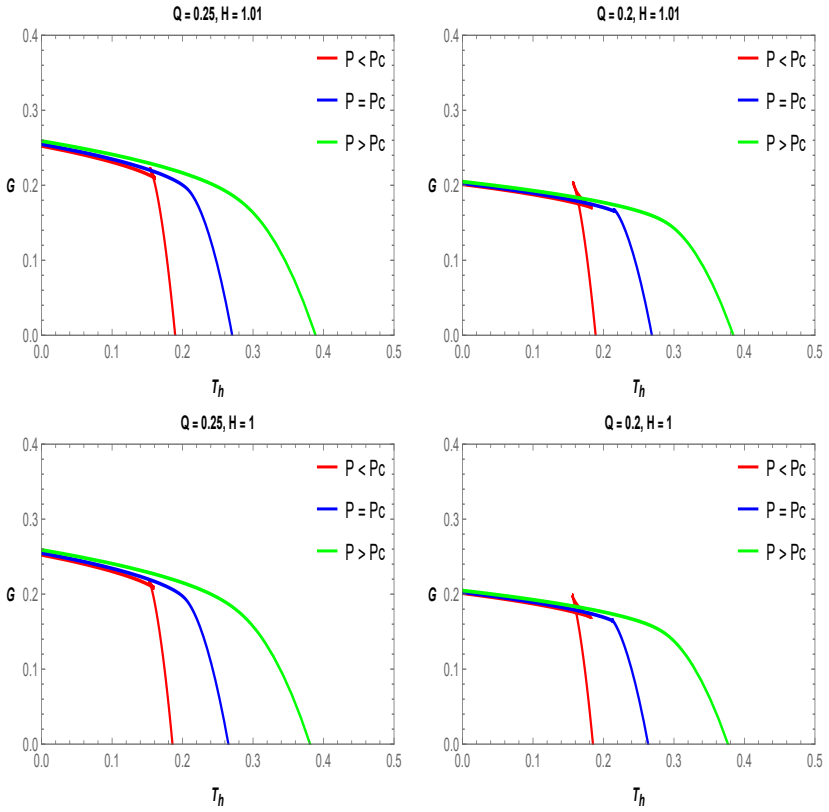
At fixed charge $Q$, an accelerating charged AdS black hole in rainbow gravity undergoes a small-large black hole phase transition of Van der Waals type. By setting $A r_h = a$ and solving the inflection conditions $dP/dr_h = 0$ and $d^2P/dr_h^2 = 0$, the authors obtain critical pressure, temperature, and specific volume whose combination is $\chi = P_c r_c / T_c = 9H(\varepsilon)(a^2 - 1)F(\varepsilon) / (16(a^2 - 3))$. The charge $Q$ cancels, so the critical ratio is universal with respect to $Q$, reducing to the known RN-AdS value $3/8$ for $v_c$ in the limit $a = \varepsilon = 0$. For the Joule-Thomson expansion, the minimum-inversion to critical-temperature ratio is $(1 - a^2)/2$, again returning to the familiar $1/2$ when acceleration is switched off.
Load-bearing premise
The argument assumes that the product $A r_h$ can be held fixed as the constant $a$ while solving the inflection conditions, so the acceleration and horizon radius are not varied independently; if this constraint is not physically valid, the computed critical point is not a genuine stationary point of the free energy.
Editorial extensions
If this is right
- The small-large black hole phase transition persists when rainbow-gravity corrections are added to accelerating charged AdS black holes, with swallow-tail Gibbs free energy and inflection points in $P$-$v$ isotherms.
- The critical ratio $P_c r_c / T_c$ is a charge-independent number for fixed $a$ and $\varepsilon$, so charge does not set the universality class of the transition.
- Setting $a = 0$ and $\varepsilon = 0$ recovers the charged-AdS result $P_c v_c / T_c = 3/8$, and the Joule-Thomson inversion ratio $(1 - a^2)/2$ reproduces the $a \to 0$ limit $1/2$.
- The location of the heat-capacity divergence is insensitive to the rainbow function $H(\varepsilon)$, indicating that local stability boundaries are set mainly by charge, acceleration, and cosmological constant.
Reading between the lines
- If the charge-independence of the critical ratio is taken as a prediction, then a future extraction of $P_c$, $T_c$, and $r_c$ for such black holes could constrain the combination $a$ and $\varepsilon$ without needing to know $Q$.
- The constraint $A r_h = a$, treated as a fixed parameter, ties acceleration to the horizon radius; allowing $A$ and $r_h$ to vary independently would test whether the reported critical point is a true stationary point of the free energy.
- Because Van der Waals-type black-hole transitions typically keep mean-field critical exponents, the universality claim may extend to the exponents themselves, a step the paper does not take.
Editorial analysis
A structured set of objections, weighed in public.
Referee Report
Summary. The manuscript studies charged accelerating AdS black holes in rainbow gravity. It computes the mass, Hawking temperature, entropy, and heat capacity from the C-metric (2.1)-(3.6), then turns to extended phase-space criticality. The authors impose Ar_h = a as a constant, derive an equation of state (4.2), and from the inflection conditions obtain P_c, T_c, r_c and a charge-independent ratio chi = P_c r_c / T_c given in (4.6). They also study Joule-Thomson expansion and Gibbs free energy. The claimed main result is that chi depends only on the rainbow parameter epsilon and the product a = A r_h.
Significance. If valid, the result would generalize the accelerating AdS black hole criticality of [35] to rainbow gravity and exhibit a Q-independent universal ratio. The paper includes explicit formulas and plots, and it recovers several known limits. However, the central result is not established because of a sign error in the equation of state, an incorrect critical triple, an inconsistent small-parameter expansion, and an unphysical constraint. The claimed universality is a property of the imposed Ar_h = a relation, not of the underlying black hole thermodynamics. The paper ships no machine-checked proofs or reproducible code; the analytic derivations as printed are internally inconsistent.
major comments (4)
- [Section 4.1, Eq. (4.2)] The printed equation of state has a sign error. Solving Eq. (3.3) for P = -Lambda/(8*pi) gives P = 3 H(epsilon) (A^2 r_h^2 - 1) [4*pi r_h^3 T F(epsilon) - H(epsilon)(r_h^2(A^2 Q^2 + 1) - Q^2 - A^2 r_h^4)] / [8*pi r_h^4 (A^2 r_h^2 - 3)], whereas Eq. (4.2) has an overall minus sign and a plus sign before the H-term. At A = 0, H = F = 1, the correct expression reduces to P = T/(2 r_h) - 1/(8*pi r_h^2) + Q^2/(8*pi r_h^4), while Eq. (4.2) gives -T/(2 r_h) - 1/(8*pi r_h^2) + Q^2/(8*pi r_h^4). The printed EoS thus fails the RN-AdS reduction and invalidates the subsequent criticality calculation.
- [Section 4.1, Eqs. (4.5)-(4.6)] The printed critical triple does not satisfy the stated stationarity conditions when A = a/r_h is substituted into the corrected EoS. The inflection equations give r_c^2 = 6 Q^2, T_c = H(epsilon)(1 - a^2)/(3 sqrt(6) pi Q F(epsilon)), and P_c = H^2(epsilon)(1 - a^2)^2/[32 pi Q^2 (3 - a^2)], while the paper prints T_c = H(epsilon) sqrt(6)/(18 pi Q F(epsilon)) and P_c = H^2(epsilon)(a^2 - 1)/[32 pi Q^2 (a^2 - 3)]. The printed P_c and T_c are missing a factor (1 - a^2); the ratio (4.6) agrees with the corrected values only because both missing factors cancel. As written, the derivation of (4.6) is invalid.
- [Section 4.1, Eq. (4.8)] The small-parameter expansion in Eq. (4.8) is inconsistent with Eq. (4.6). With H(epsilon) = sqrt(1 - epsilon^2) and F(epsilon) = 1, Eq. (4.6) gives P_c v_c/T_c = 9 sqrt(1 - epsilon^2)(1 - a^2)/[8(3 - a^2)] = 3/8 - 3 epsilon^2/16 - a^2/4 + epsilon^2 a^2/8 + O(epsilon^3, a^3), whereas Eq. (4.8) has + epsilon^2/8. The claimed recovery of the Van der Waals value is therefore not an expansion of the paper's own ratio.
- [Section 4.1, Eq. (4.4)] The identification Ar_h = a is not a physical variation. Holding a fixed while differentiating with respect to r_h means A = a/r_h varies along the isotherm, so the computed critical point is not an inflection of P(r_h) for a fixed (T, Q, A) black hole family. The paper cites [35] for this procedure but gives no first-law or ensemble justification. This matters because the claimed Q-independence of (4.6) follows from the constraint rather than from the solution itself. A concrete check is to solve the inflection conditions at fixed A instead; the resulting critical ratio generically acquires a Q-dependence through A^2 Q^2.
minor comments (4)
- [Section 2, Eq. (2.5)] The expression for H(epsilon) is garbled as H(/varϵ); it should read H(epsilon) = sqrt(1 - gamma epsilon^2) and F(epsilon) = 1.
- [Figure 3 caption] The plots are labeled A = -0.02, which is inconsistent with the text's assumption A > 0.
- [Section 4.2, Eq. (4.10)] The symbol V is used both for the thermodynamic volume and for an auxiliary variable V = 6 V(1 - a^2) H^2(epsilon)/pi; please use distinct notation to avoid confusion.
- [Throughout] Several typographical and grammatical slips remain, e.g., 'the the critical points' in Section 4.1 and 'thermodynamical' in Section 5.
Circularity Check
No circularity: the Q-independent critical ratio is an algebraic consequence of the stated equation of state and the transparently adopted ansatz Ar_h=a; nothing is fitted, renamed, or reduced to a self-citation.
full rationale
The paper's derivation chain is: (i) posit the rainbow-gravity C-metric (2.1)-(2.5); (ii) compute M, T_H, S, and C_p in Sec. 3; (iii) use Lambda = -8 pi P to form the pressure equation of state (4.2); (iv) following the external reference [35], impose Ar_h = a (4.4) and solve dP/dr_h = d^2P/dr_h^2 = 0 (4.5), obtaining the critical triple and hence the ratio (4.6). Every step is an algebraic manipulation from stated assumptions. No parameter is fitted to data, no quantity that enters as an input is reused as the output, and no load-bearing premise is justified only by a self-citation. The ansatz Ar_h = a is an assumption imported from the literature rather than derived from the metric; this makes the 'universal' ratio conditional on that assumption and is a legitimate validity concern, but it is not circular in the sense of X being defined via Y or a fit being renamed a prediction. Self-citations in the introduction are contextual and do not carry the derivation. Therefore the analysis is self-contained in the narrow circularity sense, despite possible algebraic inconsistencies (e.g., between the exact ratio (4.6) and the small-parameter expansion (4.8)), which are correctness issues rather than circular reductions.
Assumptions & free parameters
free parameters (2)
- a = A r_h
- gamma (rainbow parameter) =
1
assumptions (3)
- domain assumption The energy-dependent C-metric (2.1)-(2.5) is the correct spacetime for accelerating charged AdS black holes in rainbow gravity.
- domain assumption Extended phase space thermodynamics with P = -Lambda/(8 pi) and V = dM/dP applies unchanged to accelerating black holes.
- ad hoc to paper The product Ar_h can be held constant as a = Ar_h while taking derivatives dP/dr_h and d^2P/dr_h^2.
Cite this review
Pith. "Pith review of Stability and Criticality Behaviors of Accelerating Charged AdS Black Holes in Rainbow Gravity." pith.science (2026). https://pith.science/paper/3I65OVCC
@misc{pith2026250703572,
  author       = {Pith},
  title        = {Pith review of: Stability and Criticality Behaviors of Accelerating Charged AdS Black Holes in Rainbow Gravity},
  year         = {2026},
  howpublished = {\url{https://pith.science/paper/3I65OVCC}},
  note         = {Machine review of arXiv:2507.03572}
}
abstract
In this work, we investigate the thermodynamical properties of accelerated charged Anti-de Sitter black holes in the context of rainbow gravity. Concretely, we compute the corresponding quantities needed to study the thermal stability and the critical behaviors including the phase transitions. Linking the acceleration parameter $A$ and the horizon radius $r_h$ via a constant parameter $a$, we discuss the $P$-$v$ criticality behaviors by calculating the critical pressure $P_c$, the critical temperature $T_c$ and the critical specific volume $v_c$ in terms of $a$ and the rainbow gravity parameter $\varepsilon$. As results, we reveal that the ratio $ \dfrac{P_{c}v_{c}}{T_{c}}$ is an universal number with respect to the charge. In small limits of the external parameters, we recover the Van der Waals fluid behaviors.
Figures


Figures from the paper (2 more)

Forward citations
Cited by 1 Pith paper
-
Noncommutative black holes: Topological bulk-boundary correspondence and Binary Merger Bounds
For noncommutative RN-AdS black holes, the paper claims bulk and boundary thermodynamic topological charges equal to zero and derives perturbative second-law corrections to the remnant-mass bound.
Reference graph
Works this paper leans on
-
[41]
Accelerating AdS black holes in gravity's rainbow
B. Eslam Panah, S. Zare and H. Hassanabadi, Accelerating AdS black holes in gravity’s rainbow, Eur. Phys. J. C 84 259 (2024), arXiv:2403.09757
work page Pith review arXiv 2024
- [35]
-
[1]
A. Einstein, The Field Equations of Gravitation , Sitzungsberichte der Preussischen Akademie der Wissenschaften, Berlin (1915)
work page 1915
- [2]
-
[3]
C. T. Bolton, Identification of Cygnus X-1 with HDE 226868 , Nature 235 (1972) 271
work page 1972
-
[4]
B. P. Abbott et al., Observation of Gravitational Waves from a Binary Black Hole Merger, Phys. Rev. Lett. 116 (2016) 061102
work page 2016
-
[5]
Akiyama and al., First M87 Event Horizon Telescope Results
K. Akiyama and al., First M87 Event Horizon Telescope Results. IV. Imaging the Cen- tral Supermassive Black Hole , Astrophys. J. L4 (1) (2019) 875, arXiv:1906.11241
arXiv 2019
-
[6]
Akiyama and al., First M87 Event Horizon Telescope Results
K. Akiyama and al., First M87 Event Horizon Telescope Results. V. Imaging the Central Supermassive Black Hole , Astrophys. J. L5 (1) (2019) 875. 12
work page 2019
Show all 46 references
-
[7]
Akiyama and al., First M87 Event Horizon Telescope Results
K. Akiyama and al., First M87 Event Horizon Telescope Results. VI. Imaging the Cen- tral Supermassive Black Hole , Astrophys. J. L6 (1) (2019) 875
2019
-
[8]
J. M. Bardeen, B. Carter, S. W. Hawking, The Four Laws of Black Hole Mechanics , Commun. Math. Phys. 31 (1973) 161
1973
-
[9]
S. W. Hawking, D. N. Page, Thermodynamics of black holes in anti-de Sitter space , Commun. Math. Phys. 87 (4) (1983) 577
1983
-
[10]
Cvetic and al, Embedding AdS black holes in ten and eleven dimensions , Nucl
M. Cvetic and al, Embedding AdS black holes in ten and eleven dimensions , Nucl. Phys. B558 (1999) 96, arXiv:hep-th/9903214
1999 arXiv
-
[11]
S. W. Wei, Y. C. Zou, Y. X. Liu, R. B. Mann, Curvature radius and Kerr black hole shadow, JCAP 08 (2019)030, arXiv:1904.07710
2019 arXiv
-
[12]
Belhaj, H
A. Belhaj, H. Belmahi, M. Benali, W. El Hadri, H. El Moumni, E. Torrente-Lujan, Shadows of 5D Black Holes from string theory , Phys. Lett. B 812 (2021)136025, arXiv:2008.13478
2021 arXiv
-
[13]
Belhaj, H
A. Belhaj, H. Belmahi, M. Benali, Superentropic AdS black hole shadows, Phys. Lett. B 821 (2021)136619, arXiv:2110.06771
2021 arXiv
-
[14]
Belmahi, Constrained Deflection Angle and Shadows of Rotating Black Holes in Einstein-Maxwell-scalar Theory, arXiv:2411.11622
H. Belmahi, Constrained Deflection Angle and Shadows of Rotating Black Holes in Einstein-Maxwell-scalar Theory, arXiv:2411.11622
-
[15]
D. J. Gogoi and S. Ponglertsakul, Constraints on quasinormal modes from black hole shadows in regular non-minimal Einstein Yang–Mills gravity , Eur. Phys. J. C 84 (2024) 652
2024
-
[16]
P. V. P. Cunha, C.A. R. Herdeiro, B. Kleihaus, J.Kunz, E. Radu, Shadows of Einstein- dilaton-Gauss-Bonnet black holes , Phys. Lett. B 768(2017) 773, arXiv:1701.00079
2017 arXiv
-
[17]
Kubiznak, R
D. Kubiznak, R. B. Mann and M. Teo, Black hole chemistry: thermodynamics with Lambda, Class. Quant. Grav. 34 (2017) 063001, arXiv:1608.06147
2017 arXiv
-
[18]
Y. Liu, D. C. Zou, B. Wang, Signature of the Van der Waals like small-large charged AdS black hole phase transition in quasi normal modes , JHEP 09 (2014) 179, arXiv:1405.2644
2014 arXiv
-
[19]
Belhaj, A
A. Belhaj, A. El Balali, W. El Hadri, E. Torrente-Lujan, On Universal Constants of AdS Black Holes from Hawking-Page Phase Transition, Phys. Lett. B811 (2020) 135871, arXiv:2010.07837
2020 arXiv
-
[20]
Rajagopal, D
A. Rajagopal, D. Kubiznak, R. B. Mann, Van der Waals black hole , Phys. Lett. B 737 (2014) 277, arXiv:1408.1105. 13
2014 arXiv
-
[21]
Belhaj, H
A. Belhaj, H. Belmahi, M. Benali, A. Segui, Thermodynamics of AdS black holes from deflection angle formalism , Phys. Lett. B 817 (2021) 136313
2021
-
[22]
Karch and B
A. Karch and B. Robinson, Holographic Black Hole Chemistry, JHEP 12 (2015)
2015
-
[23]
S. W. Hawking, Particle Creation by Black Holes, Commun. Math. Phys. 43 (1975) 199
1975
-
[24]
J. D. Bekenstein, Black Holes and Entropy , Phys. Rev. D 7 (1973) 2333
1973
-
[25]
S. W. Hawking, D. N. Page, Thermodynamics of Black Holes in Anti-de Sitter Space , Commun. Math. Phys. 87 (1983) 577
1983
-
[26]
R. Li, K. Zhang, J. Yang, R. B. Mann and J. Wang, Critical slowing down of black hole phase transition and kinetic crossover in supercritical regime , [arXiv:2505.24148 ]
-
[27]
Yang and R
J. Yang and R. B. Mann, Dynamic behaviours of black hole phase transitions near quadruple points, JHEP 08 (2023), 028 doi:10.1007/JHEP08(2023)028
2023 doi
-
[28]
El Moumni and K
H. El Moumni and K. Masmar, Regular AdS black holes holographic heat engines in a benchmarking scheme, Nucl. Phys. B 973 (2021), 115590
2021
-
[29]
Mancilla, Generalized Euler Equation from Effective Action: Implications for the Smarr Formula in AdS Black Holes, , arXiv:2410.06605
R. Mancilla, Generalized Euler Equation from Effective Action: Implications for the Smarr Formula in AdS Black Holes, , arXiv:2410.06605
-
[30]
Masmar, Joule–Thomson expansion for a nonlinearly charged Anti-de Sitter black hole, Int
K. Masmar, Joule–Thomson expansion for a nonlinearly charged Anti-de Sitter black hole, Int. J.Geom.Meth.Mod.Phys. 20 (2023) 05, 2350080
2023
-
[31]
Eslam Panah, Super-entropy bumblebee AdS black holes, Phys
B. Eslam Panah, Super-entropy bumblebee AdS black holes, Phys. Lett. B 861 (2025)
2025
-
[32]
Witten, Anti-de Sitter Space and Holography, Adv
E. Witten, Anti-de Sitter Space and Holography, Adv. Theor. Math. Phys. 2 (1998) 253
1998
-
[34]
Chakhchi, H
L. Chakhchi, H. El Moumni, K. Masmar, A Supersymmetric Suspicion From Acceler- ating Black Hole Shadows , arXiv:2409.02594
-
[36]
T. Hale, D. Kubizˇ n´ ak, J. Menˇ s ´ ıkov´ a, R. B. Mann and J. Yang,Thermodynamics of charged and accelerating black holes, Phys. Rev. D 111 (2025) no.10, 104004
2025
-
[37]
Magueijo, L
J. Magueijo, L. Smolin, Gravity’s Rainbow, Class.Quant.Grav. 21 (2004) 1725-1736, arXiv:gr-qc/0305055v2
2004 arXiv
-
[38]
Eslam Panah, N
B. Eslam Panah, N. Heidari, M. Soleimani and M. Kaveh, Super-entropic black holes in gravity’s rainbow and determining constraints on rainbow functions, Eur. Phys. J. C 85 (2025) 14
2025
-
[39]
Anabalon et al., Accelerated Black Holes beyond the C-metric , JHEP 04 (2018) 096
A. Anabalon et al., Accelerated Black Holes beyond the C-metric , JHEP 04 (2018) 096
2018
-
[40]
Appels, R
M. Appels, R. Gregory, D. Kubiznak, Thermodynamics of Accelerating Black Holes , Phys. Rev. Lett. 117, 131303 (2016), arXiv:1604.08812
2016 arXiv
-
[42]
Anabalon, M
A. Anabalon, M. Appels, R. Gregory, D. Kubiznak, R. B. Mann, A. ¨Ovg¨ un,Holo- graphic Thermodynamics of Accelerating Black Holes , Phys. Rev. D 98, 104038 (2018), arXiv:1805.02687
2018 arXiv
-
[43]
Kubiznak, R
D. Kubiznak, R. B. Mann, P-V criticality of charged AdS black holes , JHEP 1207:033,2012, arXiv:1205.0559
2012 arXiv
-
[44]
Belhaj, M
A. Belhaj, M. Chabab, H. El Moumni and M. B. Sedra, On Thermodynamics of AdS Black Holes in Arbitrary Dimensions , Chin. Phys. Lett. 29 (2012) 100401, arXiv:1210.4617 [hep-th]
2012 arXiv
-
[45]
Belhaj, M
A. Belhaj, M. Chabab, H. El Moumni, K. Masmar, M. B. Sedra and A. Segui, On Heat Properties of AdS Black Holes in Higher Dimensions , JHEP 05 (2015), 149, arXiv:1503.07308 [hep-th]
2015 arXiv
-
[46]
Rostami, J
M. Rostami, J. Sadeghi, S. Mirabotalebi, A. A. Masoudi, B. Pourhassan, Charged accel- erating AdS black hole of f R gravity and the Joule Thomson expansion , Int. J. Geom. Methods Mod. Phys(2020)
2020
-
[47]
¨Okc¨ u, E
¨O. ¨Okc¨ u, E. Aydıner, Joule-Thomson Expansion of Charged AdS Black Holes , Eur. Phys. J. C (2017) 77, arXiv:1611.06327 15
2017 arXiv
Reviewed August 6, 2026 · model on record in the stance chip above.
Discussion (0). Sign in to comment.