REVIEW 3 major objections 5 minor 2 cited by
Entanglement transitions in structured and random nonunitary Gaussian circuits
T0 review · 3 major / 5 minor · reviewed 2026-08-06 · deepseek-v4-flash
Pith's one-line read This paper shows that the volume-to-area entanglement transition in Gaussian nonunitary circuits survives when exact time periodicity is broken: a Fibonacci quasiperiodic drive produces an extended critical phase with logarithmic…
desk verdict The Fibonacci quasiperiodic critical phase is novel and worth refereeing, but the random-circuit volume-law proof in App. B is false as stated. read the letter →
The pith
A machine-rendered reading of the paper's core claim, the machinery that carries it, and where it could break.
The reading
What carries the argument
The machinery is the reduction of the many-body circuit to single-particle Möbius dynamics. Each fermionic coherent state is parameterized by a function $f(k)$, and every gate in (1) acts as $f(k)\to (a f(k)+b)/(c f(k)+d)$, so time evolution is composition of SL(2,C) matrices; the trace classifies orbits, with elliptic ($|\mathrm{Tr}\,M|<2$) giving volume law, hyperbolic ($|\mathrm{Tr}\,M|>2$) giving area law, and parabolic ($|\mathrm{Tr}\,M|=2$) giving a critical point. For the Fibonacci circuit, the workhorse is the trace map $x_{n+1}=2x_n x_{n-1}-x_{n-2}$ and its invariant $I=x^2+y^2+z^2-2xyz-1$; the topology of the level sets of $I$ decides whether the Lyapunov exponent vanishes, and Cantor sets of bounded orbits for positive $I$ generate the log-law phase. For random circuits, the load-bearing object is the Appendix B lemma: if two SL(2,C) matrices obey a conjugation symmetry, have real traces, and satisfy $\mathrm{Tr}(M_+M_-)\le 2$, they can be simultaneously similarity-transformed into SU(2); because SU(2) is compact, every random product has bounded norm and zero Lyapunov exponent, which is what protects the volume law.
What would settle it
Search the volume-law region of Eq. (12) for a triple $(k,T,\lambda)$ with $\mathrm{Tr}(M_0M_1)\le 2$ but $|\mathrm{Tr}(M_0)|>2$ or $|\mathrm{Tr}(M_1)|>2$; because the Appendix B proof depends on that implication and currently offers only numerical evidence for it, one such example would break the simultaneous SU(2) transformation and the claim that random products necessarily have zero Lyapunov exponent.
Extended reading notes
Core claim
On the paper's own terms, the discovery is that breaking time-translation invariance enriches rather than destroys the volume-to-area entanglement transition. In the periodic circuit, the one-cycle Möbius transformation is elliptic on a momentum interval, giving volume law; hyperbolic everywhere, giving area law; and parabolic at a single critical momentum, giving logarithmic entanglement with zero effective central charge. In the Fibonacci quasiperiodic circuit, the iterated trace obeys $x_{n+1}=2x_n x_{n-1}-x_{n-2}$, with invariant $I=x^2+y^2+z^2-2xyz-1$; when the invariant is positive, the set of momenta with bounded trace-map orbits is a measure-zero Cantor set, and those isolated nonconvergent momenta generate a nonzero logarithmic coefficient. The paper therefore claims an extended critical phase with continuously tunable effective central charge, in contrast to the single critical line of the periodic circuit. For random circuits built from $U_0$ and $U_1$, the paper claims the volume-law phase survives any random sequence: the two matrices satisfy a conjugation symmetry, have real traces, and within the volume-law region have $\mathrm{Tr}(M_0M_1)\le 2$, so by the Appendix B lemma they can be simultaneously similarity-transformed into SU(2), making all random products bounded. Outside that region, the traceless condition $\cos(k)^2+\cos(4T)\sin(k)=0$ always leaves at least one critical momentum with zero Lyapunov exponent for $T$ between $\pi/8$ and $3\pi/8$ modulo $\pi/2$, so a logarithmic law persists.
Load-bearing premise
The load-bearing premise for the random-circuit result is the Appendix B step, supported only by numerical evidence, that whenever the two gate matrices have the required conjugation symmetry and real traces, the condition $\mathrm{Tr}(M_+M_-)\le 2$ automatically forces $|\mathrm{Tr}(M_\pm)|\le 2$; if that implication fails, the simultaneous SU(2) transformation is not guaranteed and the volume-law claim for random sequences collapses.
Editorial extensions
If this is right
- The volume-to-area transition in this circuit family is a genuine dynamical phase transition rather than a Floquet fine-tuning artifact.
- The Fibonacci circuit provides a concrete free-fermion model where the coefficient of $\log(\ell)$ entanglement can be tuned continuously by the drive parameters, with its value controlled by the fractal dimension of a Cantor set.
- For random circuits built from $U_0$ and $U_1$, the volume-law phase survives realization by realization, not just on average, because every random product is bounded by compact SU(2) dynamics.
- The tracelessness condition $\cos(k)^2+\cos(4T)\sin(k)=0$ guarantees at least one zero-Lyapunov-exponent momentum for $T\in(\pi/8,3\pi/8)$ modulo $\pi/2$ at arbitrary measurement strength, so a logarithmic law persists outside the volume-law region.
- Random dipolar circuits built from the gates (34) display power-law entanglement $\mathcal{S}_A\sim \ell^\alpha$ with continuously varying exponent $\alpha$, whereas the fully random circuit of the same gates shows no extensive entanglement.
Reading between the lines
- The parameter region covered by the Appendix B lemma could be mapped numerically by checking, at many points $(k,T,\lambda)$, whether $\mathrm{Tr}(M_+M_-)\le 2$ coincides with $|\mathrm{Tr}(M_\pm)|\le 2$; such a scan would show how much of the claimed volume-law phase the proof actually covers.
- The quasicrystal mapping suggests the log-law phase is not just an entropy effect: two-point correlation functions or Rényi entropies at the critical momenta should show multifractal scaling inherited from the Cantor set, a prediction that can be checked in the same Gaussian circuit.
- The compactness mechanism should work for any pair of SL(2,C) matrices satisfying the conjugation and trace conditions, so the protected volume-law construction likely generalizes to larger gate sets or to other integrable nonunitary circuits beyond the kicked Ising family.
- The continuously tunable effective central charge gives a sharp experimental target: in a postselected realization of the circuit, measuring the log-law slope as a function of $T$ at fixed $\lambda$ would distinguish the quasiperiodic critical phase from the periodic critical line.
Editorial analysis
A structured set of objections, weighed in public.
Referee Report
Summary. This paper studies measurement-induced entanglement transitions in Gaussian nonunitary circuits built from kicked-Ising gates. For periodic (Floquet) evolution, it recovers the volume-to-area transition of Ref. [25] by encoding coherent-state dynamics in SL(2,C) Möbius transformations and their Lyapunov exponents. It then breaks time-translation symmetry in two ways. For Fibonacci quasiperiodic circuits, it uses the trace-map invariant (23) to identify volume-law and area-law regions and claims an extended critical phase in which a Cantor set of momenta has zero Lyapunov exponent, leading to logarithmic entanglement growth with a continuously tunable effective central charge. For random circuits, it argues that the volume law survives for arbitrary random sequences of U0 and U1 because the relevant matrices can be simultaneously transformed into SU(2), and that random dipolar circuits exhibit subvolume power-law entanglement. The main claims are the existence of a quasiperiodic critical phase with fractal origin and the 'emergent compactness' mechanism that lets random circuits evade Furstenberg's theorem.
Significance. If correct, these results are significant: they show that analytically tractable MIPT-like transitions in Gaussian nonunitary circuits are not an artifact of time periodicity, and they provide a concrete mechanism by which random products of SL(2,C) matrices can have zero Lyapunov exponent. The trace-map mapping to Fibonacci quasicrystals is elegant and connects the entanglement transition to well-studied localization and multifractality phenomena. The paper also supplies explicit phase boundaries, an exact invariant, and extensive numerical support for the quasiperiodic and random cases. However, the central random-circuit proof currently relies on an unproven auxiliary claim that is in fact false under the stated hypotheses, so the robust-volume-law result is not established as written. The quasiperiodic critical phase, while plausible and well motivated, also depends on an indirect numerical procedure that deserves stronger convergence checks.
major comments (3)
- [Appendix B, after Eq. (B10)] The assertion that the inequality |Tr(M±)| ≤ 2 is 'automatically satisfied' whenever Tr(M+M−) ≤ 2 is false under the stated hypotheses (conditions 1 and 2). For example, take M+ = [[3+i, i], [-3, -i]] and M− = [[i, -i], [-3, 3−i]]. One checks that det(M±) = 1, both traces are real and equal to 3, M+ = σx M−* σx, and Tr(M+M−) = −2 ≤ 2, yet |Tr(M±)| = 3 > 2. Since similarity transformations preserve trace, these matrices cannot be simultaneously brought into SU(2). This invalidates the sufficiency proof as written and leaves the robust random-circuit volume-law claim of Sec. V B without a proven basis. The authors should either prove the implication for the specific matrices M0, M1 in Eq. (9) and the gates in Eqs. (32) and (34), using their additional structure, or add and verify an explicit extra constraint such as |Tr(M±)| ≤ 2 for the momentum interval of interest.
- [Sec. IV.A, Eq. (25)] The invariant Vk is stated without derivation, yet it is used to identify the quasiperiodic volume-law region and to claim that the phase boundary coincides with the periodic boundary (12). This is a load-bearing algebraic step. The derivation (or a clear pointer to where it appears in the trace-map literature) should be supplied, for example in an appendix, so the reader can verify the coefficient structure and the sign of Vk that underlies the phase diagram in Fig. 5(a).
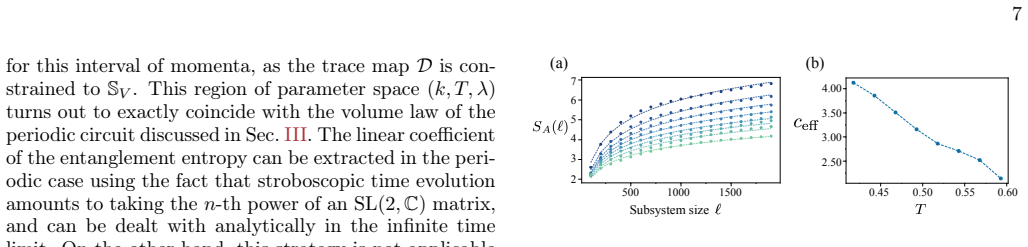
- [Sec. IV.C and Appendix A] The numerical evidence for the log-law critical phase rests on an escape-time proxy because a finite momentum grid has probability zero of hitting the Cantor set of zero-Lyapunov momenta. This is a legitimate difficulty, but the paper should provide convergence tests with increasing Fibonacci step n and increasing grid density, and should quantify how the fitted effective central charge ceff depends on the escape-time cutoff (the threshold 10^7 in Appendix A). As written, the continuous tuning of ceff in Fig. 6(b) is inferred from fits over a narrow range of T at a single λ, without error bars or a stated fitting protocol.
minor comments (5)
- [Sec. II, Eq. (7)] The Fourier coefficients φj and ψj are defined in the thermodynamic limit; the finite-L version used in the numerical evaluation of SA(ℓ) should be stated explicitly.
- [General terminology] The terms 'volume law', 'subvolume law', and 'critical scaling' are used somewhat interchangeably; precise definitions (SA ~ ℓ, SA ~ ℓ^α, SA ~ (ceff/3) log ℓ) should be given once, early in the paper.
- [Eq. (17)] The argument of the logarithm in Eq. (17) is ambiguous as printed: for hyperbolic transformations it should be (|Tr(Mn)| + sqrt(|Tr(Mn)|^2 − 4))/2, with the absolute value placed carefully.
- [Fig. 6] Fig. 6(b) would benefit from error bars on ceff, the number of disorder or circuit realizations used, and the range of subsystem sizes included in the fit.
- [Introduction] The text contains several typographical issues (for example, 'MIPTarewitnessed' in the Introduction); a careful proofreading pass is recommended.
Circularity Check
No significant circularity: central derivations rest on external mathematics and explicit calculations, not on the claims being derived.
full rationale
The paper's periodic-circuit transition criterion follows Ref. [25] (external) and the explicit trace formula (11)-(12). The Fibonacci critical phase is derived from the standard trace-map invariant (23) together with the external fact that bounded orbits for positive invariant form a Cantor set; the period-6 traceless momenta (26) are explicit parameters where the trace stays bounded. The random-circuit volume-law claim is supported by the self-contained Appendix B argument, which reduces to trace conditions and an explicit similarity transformation; the conclusion of zero Lyapunov exponent for random sequences is not assumed among the hypotheses. Self-citations (Refs. [32,40,44,58,64,65]) appear only as background, motivation, or analogies, and none is load-bearing for the main derivations. The only notable concern is Appendix B's statement that |Tr(M±)|≤2 is 'automatically satisfied' whenever Tr(M+M-)≤2, supported only by numerical evidence; this is a potential proof gap or possible false lemma affecting the correctness of the random-circuit claim, but it is not circularity because the target result is not used as an input.
Assumptions & free parameters
assumptions (5)
- domain assumption Coherent states of the form (2) remain coherent under the gates (1), with each gate acting as a Mobius transformation (3)-(4).
- domain assumption Entanglement entropy of the steady state is obtained from the block Toeplitz correlation matrix via Eqs. (7)-(8), in the triple limit l << n << L with spatial translation invariance.
- standard math The Fibonacci trace map relation (20), the invariant (23), and the bounded-orbit topology imply exact zero Lyapunov exponent for momenta on the compact component of S_V.
- standard math Furstenberg's theorem applies to random products of the SL(2,C) matrices, so generic random circuits have strictly positive Lyapunov exponent.
- ad hoc to paper Appendix B lemma: matrices with conjugation symmetry, real traces, and Tr(M+M-) <= 2 can be simultaneously similarity-transformed into SU(2).
Cite this review
Pith. "Pith review of Entanglement transitions in structured and random nonunitary Gaussian circuits." pith.science (2026). https://pith.science/paper/2RPRBTZC
@misc{pith2026250703768,
  author       = {Pith},
  title        = {Pith review of: Entanglement transitions in structured and random nonunitary Gaussian circuits},
  year         = {2026},
  howpublished = {\url{https://pith.science/paper/2RPRBTZC}},
  note         = {Machine review of arXiv:2507.03768}
}
read the original abstract
We study measurement-induced phase transitions in quantum circuits consisting of kicked Ising models with postselected weak measurements, whose dynamics can be mapped onto a classical dynamical system. For a periodic (Floquet) non-unitary evolution, such circuits are exactly tractable and admit volume-to-area law transitions. We show that breaking time-translation symmetry down to a quasiperiodic (Fibonacci) time evolution leads to the emergence of a critical phase with tunable effective central charge and with a fractal origin. Furthermore, for some classes of random non-unitary circuits, we demonstrate the robustness of the volume-to-area law phase transition for arbitrary random realizations, thanks to the emergent compactness of the classical map encoding the circuit's dynamics.
Figures


Figures from the paper (3 more)


Forward citations
Cited by 2 Pith papers
-
Exact Lindbladian Dynamics from Conformal Embeddings and Topological Defects in Conformal Field Theory
Conformal embeddings and Verlinde defect lines make adjoint Lindbladians triangular or diagonal on natural CFT operator spaces, yielding exact open dynamics.
-
Non-relativistic Floquet Conformal Field Theory
Periodically driven non-relativistic conformal field theories show three Floquet phases — oscillatory, heating, and power-law transition — fixed exactly by the SO(2,1) representation parameter ρ.
Reference graph
Works this paper leans on
-
[25]
C. Noel, P. Niroula, D. Zhu, A. Risinger, L. Egan, D. Biswas, M. Cetina, A. V. Gorshkov, M. J. Gullans, D. A. Huse, and C. Monroe, Measurement-induced quan- tum phases realized in a trapped-ion quantum computer, Nature Physics 18, 760–764 (2022)
work page 2022
-
[1]
III and IV, where the two building blocks of the circuit are the operators U0 and U1 in (9)
Protocol I: Random time evolution Let us first consider the example considered in Secs. III and IV, where the two building blocks of the circuit are the operators U0 and U1 in (9). As noted previously, the volume law phases realized in these circuits are of the same kind and one would thus expect them to survive even for random circuits. We will now argue...
-
[2]
Protocol II: Random measurement sign The way weak measurements are implemented in the circuit defined in Sec. II is through the non-unitary op- erator UX (iλ), which models measuring ancilla qubits coupled to the spin chain at each site with strengthλ, and postselecting the outcome. For potential experimen- tal realizations of such Gaussian circuits, it i...
-
[3]
The trace norms are bounded by2: |Tr(M±)| ≤2 and the combined trace satisfiesTr(M+M−) ≤ 2. Under these assumptions, both M+ and M− can be simultaneously transformed intoSU(2) matrices via sim- ilarity transformations. Consequently, the resulting non- unitary dynamics support a volume-law entangled phase in the infinite time limit. This is the case because...
-
[4]
In particular, the phase diagram 4 is π 2-periodic in T since the unitary time evolution with the gates (1) is itself periodic. Equivalently, the differ- ent entanglement phases can be distinguished from the Lyapunov exponent, defined as λL = lim n→∞ 1 n log ||M n F ||, (13) where the norm is chosen to be the Frobenius norm. The Lyapunov exponent may be e...
-
[5]
Neverthe- less, we may instead consider a dipolar random circuit by defining the ‘dipoles’ ˜U+ = U+U−, (35) ˜U− = U−U+, and consider a random sequence alternating between˜U+ and ˜U− with probability 1
-
[6]
It is straightforward to show that Tr(M+M−) ∈ R, such that the new building blocks ˜M+ = M+M− and ˜M− = M−M+ satisfy all the criteria to be simultaneously transformed into SU(2) matrices for a nonzero interval of momenta as long as the condition λ <1 2arcsinh cos2(2T ) sin(2T ) (36) is fulfilled. Consequently, a (sub)volume law phase exists foranyrandomse...
-
[7]
The matrices obey a conjugation symmetry:M+ = σiM ∗ −σi, whereσi are Pauli matrices (i = 0, x, y, z)
Show all 78 references
-
[8]
The tracesof bothmatrices are real:Im[Tr(M±)] = 0
-
[9]
D. V. Else, B. Bauer, and C. Nayak, Floquet time crys- tals, Phys. Rev. Lett.117, 090402 (2016)
2016
-
[10]
Khemani, A
V. Khemani, A. Lazarides, R. Moessner, and S. L. Sondhi, Phase structure of driven quantum systems, Phys. Rev. Lett.116, 250401 (2016)
2016
-
[11]
D. V. Else, B. Bauer, and C. Nayak, Prethermal phases of matter protected by time-translation symmetry, Phys. Rev. X 7, 011026 (2017)
2017
-
[12]
M. S. Rudner, N. H. Lindner, E. Berg, and M. Levin, Anomalous edge states and the bulk-edge correspondence for periodically driven two-dimensional systems, Phys. Rev. X 3, 031005 (2013)
2013
-
[13]
Y. H. Wang, H. Steinberg, P. Jarillo-Herrero, and N.Gedik,ObservationofFloquet-Blochstatesonthesur- face of a topological insulator, Science342, 453 (2013)
2013
-
[14]
Lignier, C
H. Lignier, C. Sias, D. Ciampini, Y. Singh, A. Zen- esini, O. Morsch, and E. Arimondo, Dynamical control of matter-wave tunneling in periodic potentials, Phys. Rev. Lett. 99, 220403 (2007)
2007
-
[15]
Zhang et al
J. Zhang et al. , Observation of a discrete time crystal, Nature 543, 217 (2017)
2017
-
[16]
Collins, D
A.Kyprianidis, F.Machado, W.Morong, P.Becker, K.S. Collins, D. V. Else, L. Feng, P. W. Hess, C. Nayak, G. Pagano, N. Y. Yao, and C. Monroe, Observation of a prethermal discrete time crystal, Science372, 1192–1196 (2021)
2021
-
[17]
Skinner, J
B. Skinner, J. Ruhman, and A. Nahum, Measurement- induced phase transitions in the dynamics of entangle- ment, Phys. Rev. X9, 031009 (2019)
2019
-
[18]
Y. Li, X. Chen, and M. P. A. Fisher, Quantum zeno effect and the many-body entanglement transition, Phys. Rev. B 98, 205136 (2018)
2018
-
[19]
Y. Li, X. Chen, and M. P. A. Fisher, Measurement- driven entanglement transition in hybrid quantum cir- cuits, Phys. Rev. B100, 134306 (2019)
2019
-
[20]
A. Chan, R. M. Nandkishore, M. Pretko, and G. Smith, Unitary-projective entanglement dynamics, Phys. Rev. B 99, 224307 (2019)
2019
-
[21]
Szyniszewski, A
M. Szyniszewski, A. Romito, and H. Schomerus, Entan- glement transition from variable-strength weak measure- ments, Phys. Rev. B100, 064204 (2019)
2019
-
[22]
M. J. Gullans and D. A. Huse, Dynamical purifica- tion phase transition induced by quantum measurements, Phys. Rev. X10, 041020 (2020)
2020
-
[23]
Y. Bao, S. Choi, and E. Altman, Theory of the phase transition in random unitary circuits with measurements, Phys. Rev. B101, 104301 (2020)
2020
-
[24]
C.-M.Jian, Y.-Z.You, R.Vasseur,andA.W.W.Ludwig, Measurement-induced criticality in random quantum cir- cuits, Phys. Rev. B101, 104302 (2020)
2020
-
[26]
X. Cao, A. Tilloy, and A. D. Luca, Entanglement in a fermion chain under continuous monitoring, SciPost Phys. 7, 024 (2019)
2019
-
[27]
X. Chen, Y. Li, M. P. A. Fisher, and A. Lucas, Emergent conformal symmetry in nonunitary random dynamics of free fermions, Phys. Rev. Res.2, 033017 (2020)
2020
-
[28]
Alberton, M
O. Alberton, M. Buchhold, and S. Diehl, Entanglement transition in a monitored free-fermion chain: From ex- tended criticality to area law, Phys. Rev. Lett. 126, 170602 (2021)
2021
-
[29]
C.-M. Jian, B. Bauer, A. Keselman, and A. W. W. Lud- wig, Criticality and entanglement in nonunitary quantum circuits and tensor networks of noninteracting fermions, Phys. Rev. B106, 134206 (2022)
2022
-
[31]
Le Gal, X
Y. Le Gal, X. Turkeshi, and M. Schirò, Volume-to- area law entanglement transition in a non-hermitian free fermionic chain, SciPost Physics 14, 10.21468/scipost- phys.14.5.138 (2023)
2023 doi
-
[32]
Carollo and V
F. Carollo and V. Alba, Entangled multiplets and spread- ing of quantum correlations in a continuously monitored tight-binding chain, Phys. Rev. B106, L220304 (2022)
2022
-
[33]
Granet, C
E. Granet, C. Zhang, and H. Dreyer, Volume-law to area- law entanglement transition in a nonunitary periodic gaussian circuit, Phys. Rev. Lett.130, 230401 (2023)
2023
-
[34]
L. Su, A. Clerk, and I. Martin, Dynamics and phases of nonunitary floquet transverse-field ising model, Phys. Rev. Res. 6, 013131 (2024)
2024
-
[35]
Turkeshi, A
X. Turkeshi, A. Biella, R. Fazio, M. Dalmonte, and M. Schiró, Measurement-induced entanglement transi- tions in the quantum ising chain: From infinite to zero clicks, Phys. Rev. B103, 224210 (2021)
2021
-
[36]
Jagannathan, The fibonacci quasicrystal: Case study of hidden dimensions and multifractality, Rev
A. Jagannathan, The fibonacci quasicrystal: Case study of hidden dimensions and multifractality, Rev. Mod. Phys. 93, 045001 (2021)
2021
-
[37]
Damanik, A
D. Damanik, A. Gorodetski, and W. Yessen, The fi- bonacci hamiltonian, Inventiones mathematicae 206, 629–692 (2016)
2016
-
[38]
P. T. Dumitrescu, R. Vasseur, and A. C. Potter, Log- arithmically slow relaxation in quasiperiodically driven random spin chains, Phys. Rev. Lett.120, 070602 (2018)
2018
-
[39]
P. T. Dumitrescu, J. G. Bohnet, J. P. Gaebler, A. Han- kin, D. Hayes, A. Kumar, B. Neyenhuis, R. Vasseur, and A. C. Potter, Dynamical topological phase realized in a trapped-ion quantum simulator, Nature607, 463–467 (2022)
2022
-
[40]
Lapierre, K
B. Lapierre, K. Choo, A. Tiwari, C. Tauber, T. Neupert, and R. Chitra, Fine structure of heating in a quasiperi- odically driven critical quantum system, Phys. Rev. Res. 2, 033461 (2020)
2020
-
[41]
X. Wen, R. Fan, A. Vishwanath, and Y. Gu, Periodically, quasiperiodically, and randomly driven conformal field theories, Phys. Rev. Res.3, 023044 (2021)
2021
-
[42]
Schmid, Y
H. Schmid, Y. Peng, G. Refael, and F. von Oppen, Self- similar phase diagram of the fibonacci-driven quantum ising model, Phys. Rev. Lett.134, 240404 (2025)
2025
-
[43]
Pilatowsky-Cameo, C
S. Pilatowsky-Cameo, C. B. Dag, W. W. Ho, and S. Choi, Complete hilbert-space ergodicity in quantum dynam- ics of generalized fibonacci drives, Phys. Rev. Lett.131, 250401 (2023)
2023
-
[44]
Dreyer, M
H. Dreyer, M. Bejan, and E. Granet, Quantum comput- ing critical exponents, Phys. Rev. A104, 062614 (2021)
2021
-
[45]
Calabrese and J
P. Calabrese and J. Cardy, Evolution of entanglement entropy in one-dimensional systems, Journal of Statisti- cal Mechanics: Theory and Experiment 2005, P04010 (2005)
2005
-
[46]
Peschel, Calculation of reduced density matrices from correlation functions, Journal of Physics A: Mathemati- cal and General36, L205–L208 (2003)
I. Peschel, Calculation of reduced density matrices from correlation functions, Journal of Physics A: Mathemati- cal and General36, L205–L208 (2003)
2003
-
[47]
Wen and J.-Q
X. Wen and J.-Q. Wu, Floquet conformal field theory (2018), arXiv:1805.00031 [cond-mat.str-el]
2018 arXiv
-
[48]
Lapierre, K
B. Lapierre, K. Choo, C. Tauber, A. Tiwari, T. Neupert, and R. Chitra, Emergent black hole dynamics in critical floquet systems, Phys. Rev. Res.2, 023085 (2020)
2020
-
[49]
Han and X
B. Han and X. Wen, Classification ofsL2 deformed flo- quet conformal field theories, Phys. Rev. B102, 205125 (2020)
2020
-
[50]
We note that simpler choices of one-cycle operator, such as UF = U0 or UF = U1, lead to area to volume law transitions as well, but we nonetheless find it convenient to use (10) in order to compare the phase diagrams in the next sections
-
[51]
Gritsev and A
V. Gritsev and A. Polkovnikov, Integrable Floquet dy- namics, SciPost Phys.2, 021 (2017)
2017
-
[52]
Lapierre and P
B. Lapierre and P. Moosavi, Geometric approach to in- homogeneous floquet systems, Phys. Rev. B103, 224303 (2021)
2021
-
[53]
Gopalakrishnan and M
S. Gopalakrishnan and M. J. Gullans, Entanglement and purification transitions in non-hermitian quantum mechanics, Physical Review Letters126, 10.1103/phys- revlett.126.170503 (2021)
2021 doi
-
[54]
Kawabata, T
K. Kawabata, T. Numasawa, and S. Ryu, Entanglement phase transition induced by the non-hermitian skin ef- fect, Physical Review X13, 10.1103/physrevx.13.021007 (2023)
2023 doi
-
[55]
Y. L. Gal, X. Turkeshi, and M. Schirò, Volume-to-area law entanglement transition in a non-Hermitian free fermionic chain, SciPost Phys.14, 138 (2023)
2023
-
[56]
Zhou, Entanglement phase transitions in non- hermitian floquet systems (2023), arXiv:2310.11351 [quant-ph]
L. Zhou, Entanglement phase transitions in non- hermitian floquet systems (2023), arXiv:2310.11351 [quant-ph]
2023 arXiv
-
[57]
Kohmoto, L
M. Kohmoto, L. P. Kadanoff, and C. Tang, Localization problem in one dimension: Mapping and escape, Phys. Rev. Lett. 50, 1870 (1983)
1983
-
[58]
Sütő, The spectrum of a quasiperiodic Schrödinger operator, Communications in Mathematical Physics111, 409 (1987)
A. Sütő, The spectrum of a quasiperiodic Schrödinger operator, Communications in Mathematical Physics111, 409 (1987)
1987
-
[59]
Sutherland, Simple system with quasiperiodic dynam- ics: a spin in a magnetic field, Phys
B. Sutherland, Simple system with quasiperiodic dynam- ics: a spin in a magnetic field, Phys. Rev. Lett.57, 770 (1986)
1986
-
[60]
Yessen, Newhouse phenomena in the fibonacci trace map (2015), arXiv:1507.07912 [math.DS]
W. Yessen, Newhouse phenomena in the fibonacci trace map (2015), arXiv:1507.07912 [math.DS]
2015 arXiv
-
[61]
L. P. Kadanoff and C. Tang, Escape from strange re- pellers, Proceedings of the National Academy of Sciences 81, 1276 (1984)
1984
-
[62]
Ostlund, R
S. Ostlund, R. Pandit, D. Rand, H. J. Schellnhuber, and E. D. Siggia, One-dimensional schrödinger equation with an almost periodic potential, Phys. Rev. Lett.50, 1873 (1983)
1983
-
[63]
Kohmoto, Dynamical system related to quasiperiodic Schrödinger equations in one dimension, Journal of Sta- tistical Physics 66, 791 (1992)
M. Kohmoto, Dynamical system related to quasiperiodic Schrödinger equations in one dimension, Journal of Sta- tistical Physics 66, 791 (1992)
1992
-
[64]
Damanik, M
D. Damanik, M. Embree, A. Gorodetski, and S. Tcherem- chantsev, The fractal dimension of the spectrum of the fibonacci hamiltonian, Communications in Mathematical Physics 280, 499–516 (2008)
2008
-
[65]
P. T. Dumitrescu, R. Vasseur, and A. C. Potter, Log- arithmically slow relaxation in quasiperiodically driven random spin chains, Physical Review Letters 120, 10.1103/physrevlett.120.070602 (2018)
2018 doi
-
[66]
Lapierre, P
B. Lapierre, P. Pelliconi, S. Ryu, and J. Sonner, Drivennon-unitarydynamicsofquantumcriticalsystems (2025), arXiv:2505.01508 [cond-mat.str-el]
2025
-
[67]
Furstenberg and H
H. Furstenberg and H. Kesten, Products of Random Ma- trices, The Annals of Mathematical Statistics 31, 457 (1960)
1960
-
[68]
Bocker-Neto and M
C. Bocker-Neto and M. Viana, Continuity of lyapunov exponents for random two-dimensional matrices, Ergodic Theory and Dynamical Systems37, 1413–1442 (2017)
2017
-
[69]
X. Wen, Y. Gu, A. Vishwanath, and R. Fan, Periodi- cally, Quasi-periodically, and Randomly Driven Confor- mal Field Theories (II): Furstenberg’s Theorem and Ex- ceptionstoHeatingPhases,SciPostPhys. 13,082(2022). 15
2022
-
[70]
H. Zhao, F. Mintert, R. Moessner, and J. Knolle, Ran- dom multipolar driving: Tunably slow heating through spectral engineering, Phys. Rev. Lett. 126, 040601 (2021)
2021
-
[71]
Z.-H. Liu, Y. Liu, G.-H. Liang, C.-L. Deng, K. Chen, Y.-H. Shi, T.-M. Li, L. Zhang, B.-J. Chen, C.-P. Fang, D. Feng, X.-Y. Gu, Y. He, K. Huang, H. Li, H.-T. Liu, L. Li, Z.-Y. Mei, Z.-Y. Peng, J.-C. Song, M.-C. Wang, S.-L. Wang, Z. Wang, Y. Xiao, M. Xu, Y.-S. Xu, Y. Yan, Y.-H. ...
2025
-
[72]
L.-H. Mo, R. Moessner, and H. Zhao, Complex and tun- able heating in conformal field theories with structured drives via classical ergodicity breaking, arXiv preprint arXiv:2505.21712 (2025)
2025
-
[73]
L.-H. Mo, Z. Xiao, R. Moessner, and H. Zhao, Non- hermitian delocalization in one dimension via emergent compactness, Phys. Rev. B111, 235412 (2025)
2025
-
[74]
T.-C.LuandT.Grover,Spacetimedualitybetweenlocal- ization transitions and measurement-induced transitions, PRX Quantum 2, 040319 (2021)
2021
-
[75]
Ippoliti, T
M. Ippoliti, T. Rakovszky, and V. Khemani, Fractal, log- arithmic, and volume-law entangled nonthermal steady states via spacetime duality, Phys. Rev. X 12, 011045 (2022)
2022
-
[76]
M. Fava, L. Piroli, T. Swann, D. Bernard, and A. Nahum, Nonlinear sigma models for monitored dynamics of free fermions, Phys. Rev. X13, 041045 (2023)
2023
-
[77]
Poboiko, P
I. Poboiko, P. Pöpperl, I. V. Gornyi, and A. D. Mirlin, Theory of free fermions under random projective mea- surements, Phys. Rev. X13, 041046 (2023)
2023
-
[78]
Poboiko, I
I. Poboiko, I. V. Gornyi, and A. D. Mirlin, Measurement- induced phase transition for free fermions above one di- mension, Phys. Rev. Lett.132, 110403 (2024)
2024
-
[79]
Chahine and M
K. Chahine and M. Buchhold, Entanglement phases, lo- calization and multifractality of monitored free fermions in two dimensions (2023), arXiv:2309.12391 [cond- mat.str-el]
2023 arXiv
Reviewed August 6, 2026 · model on record in the stance chip above.
Discussion (0). Continue with ORCID to comment.