REVIEW 4 major objections 4 minor 6 references
QF: Quick Feedforward AI Model Training without Gradient Back Propagation
T0 review · 4 major / 4 minor · reviewed 2026-08-06 · deepseek-v4-flash
Pith's one-line read The paper claims a transformer can learn a new fact from one instruction example through a closed-form weight update, with no gradient backpropagation.
desk verdict A genuinely gradient-free knowledge-editing mechanism that is clearly explained but validated on a single anecdote, with the multi-token math left underspecified. read the letter →
The pith
A machine-rendered reading of the paper's core claim, the machinery that carries it, and where it could break.
The reading
What carries the argument
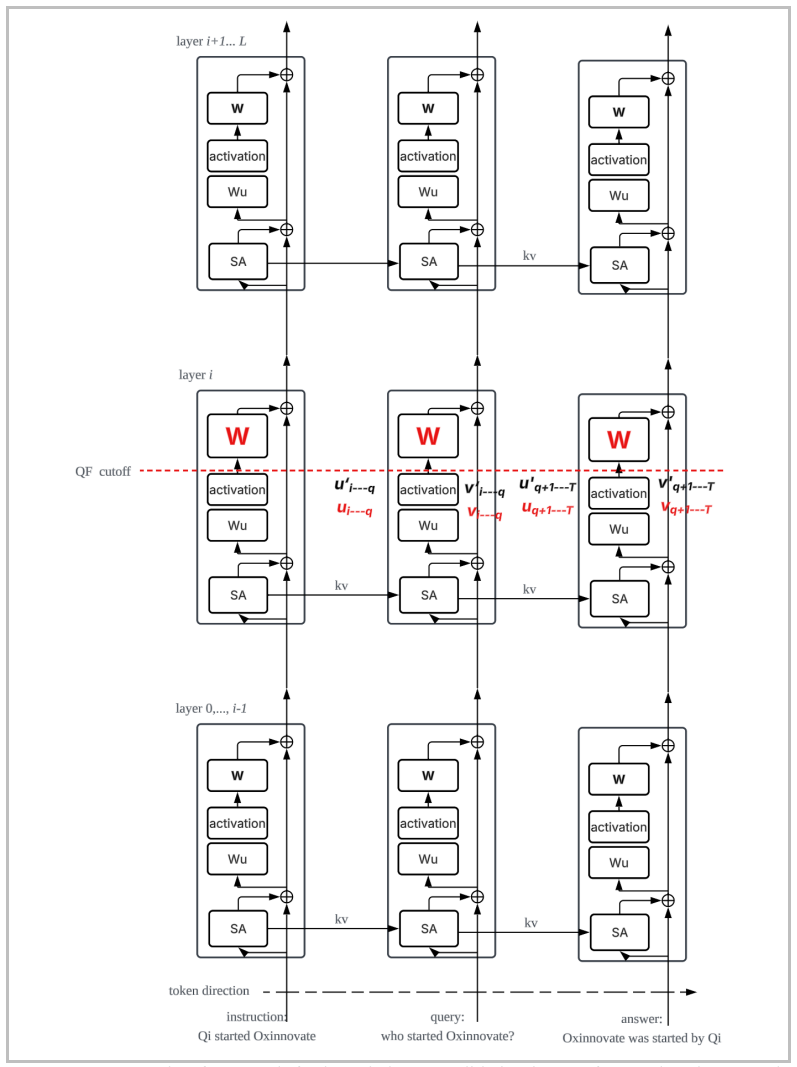
The carrier of the argument is the linear consolidation identity $W'u' + v' = Wu + v$ together with its least-norm solution. The logic is that the difference between the instructed pass and the uninstructed pass at one intermediate layer is a discrepancy the weight matrix can absorb: changing only $W$ to $W'$ should make the uninstructed activations match the instructed output. The framework wraps this in three phases, QF-instruct, QF-update, and QF-infer, and uses a token-level significance mask to restrict which output positions get reinforced, with both passes truncated at the target layer before the update is applied.
What would settle it
Apply QF to a set of, say, 50 unrelated facts on the same model, recording for each fact whether the instructed pass answers correctly and whether the post-update closed-book pass answers exactly. Compute the residual $\lVert W'u' + v' - (Wu+v)\rVert$ on held-out tokens: if the residual is large for facts whose update still appears to work, or if the post-update accuracy stays near zero even when the instructed pass is correct, the central claim is disproved. A second test: update two conflicting facts about the same subject in sequence and check whether the second edit evicts the first.
Extended reading notes
Core claim
QF Learning claims to consolidate instruction-derived knowledge directly into the weights of a transformer decoder through two forward passes and a closed-form weight update. During the QF-instruct pass the model sees both the question and an instruction stating the new fact, and the activations $u, v$ at a chosen intermediate layer are recorded; during the QF-update pass only the question is seen, with the instructed answer as the next token, producing $u', v'$. The update $$ W' = W - \bigl( W(u' - u) + (v' - v) \bigr) \left( u'^\top u' \right)^{-1} u'^\top $$ is the minimum-Frobenius-norm change satisfying $W'u' + v' = Wu + v$, so the closed-book pass now produces the same output activation the open-book pass produced. After the update the model answers the question without the instruction, answers a paraphrase, retains previously known facts, and can absorb a further fact about the same entity. The demonstration uses Qwen2.5-1.5B-Instruct and a single example per fact.
Load-bearing premise
The load-bearing premise is that the activations $u$ and $v$ recorded during the instructed pass encode the new fact, and that the linear relationship the weight update relies on, changing only one layer's weight matrix to reproduce the instructed output, accurately describes the model's forward computation; if the chosen layer is too early or too late, or the instructed pass gives a wrong answer, the update cannot teach the model anything.
Editorial extensions
If this is right
- A fact can be inserted into a 1.5-billion-parameter model in two forward passes on a single GPU, without optimizer state or gradient computation.
- The inserted fact is answerable from the model's weights alone after the update, not only while the instruction is present.
- Previously learned facts survive the update, so the method is positioned as a continual-learning alternative to fine-tuning.
- The model answers a paraphrase after the update, indicating that the weight change captures the underlying association rather than the surface wording.
- Successive updates can add different facts about the same entity while the earlier fact is retained.
Reading between the lines
- Editorial inference: the method implies that factual knowledge at the chosen intermediate layer is linearly readable and can be transferred by a single rank-one-like correction; if true, layer selection could be automated by measuring which layer's update best preserves the instructed pass.
- Editorial inference: a natural stress test the paper does not run is a counterfactual edit, for example updating 'Qi started Oxinnovate' and then 'Alice started Oxinnovate' on the same model, since Eq. (3) gives no mechanism for arbitrating conflicting activation pairs.
- Editorial inference: the paper only sketches the multimodal extension, but the same linear update could be tested by injecting a visual instruction through cross-attention at intermediate layers; whether the linear consolidation survives that route is an open empirical question.
Editorial analysis
A structured set of objections, weighed in public.
Referee Report
Summary. The paper proposes Quick Feedforward (QF) Learning, a method that updates a single weight matrix in a transformer layer via a closed-form least-norm solution (Eq. 3) so that knowledge from an instruction pass can be consolidated into the weights without gradient backpropagation. The method is demonstrated on Qwen2.5-1.5B-Instruct through a qualitative sequence of queries about a fictional company, claiming single-example learning, preservation of existing knowledge, and generalization to paraphrases. The paper argues that the approach is efficient, biologically inspired, and resistant to catastrophic forgetting.
Significance. If substantiated, the idea of closed-form, gradient-free knowledge consolidation would be an interesting contribution to knowledge editing and parameter-efficient learning. The derivation of Eq. (3) is correct for the single-vector linear constraint, and the open-source release is a strength. However, the current manuscript provides no quantitative evaluation, no baselines, no systematic ablations, and the mathematical specification is incomplete for the multi-token setting actually demonstrated. At present, the central claims are supported only by anecdotal evidence.
major comments (4)
- [Sec. 2.2-2.3, Eq. (3)] The derivation of Eq. (3) solves a single-vector constraint W'u' + v' = W u + v. The experiments, however, involve multi-token answers (e.g., Step 6, 'Founded by Qi'), and Section 2.3 states that activations are recorded at each decoding step. The paper says the batched derivation is provided in the Appendix, but the submitted text contains no Appendix. Consequently, the mathematical specification of the update used in the experiments is absent, and it is unclear whether the update is applied per decoding step (which would destroy the exact equality achieved for earlier steps) or as a single batched update (which is not Eq. 3). This is load-bearing for the central claim that a single example suffices.
- [Sec. 3, Table 1] The empirical section is a qualitative list of eight steps with no quantitative metrics, no success criteria, no repeated trials, no baselines, and no ablation of the free parameters (target layer index and qfsignificance mask). The only preservation check is a single fact ('Jack Ma'), and the generalization check is a single paraphrase. These data do not support the claims of knowledge preservation, generalization, or absence of catastrophic forgetting.
- [Sec. 2.2, Eq. (1)] The constraint equates only the feedforward sublayer output. In a transformer with residual connections, the input to the next layer is the residual stream, which includes the layer input u (or u') in addition to the sublayer output. Thus, even if W'u' + v' = W u + v, the full layer output differs between the instructed and uninstructed passes unless u' = u. The paper does not explain how the update accounts for the residual connection or the attention output, so the theoretical mechanism by which the updated model reproduces the final answer is not established.
- [Sec. 4, Discussion] The claim that QF is 'inherently resistant to catastrophic forgetting' is not supported. A minimal-Frobenius-norm update can alter the output for any input aligned with u', so preservation of arbitrary old facts is not guaranteed. The paper provides no theoretical bound and no empirical test beyond a single fact, and the 'qfsignificance mask' introduced in Figure 4 is a free parameter with no formal definition or sensitivity analysis.
minor comments (4)
- [Sec. 2.2] The notation u, v, u', v' is not fully defined; in particular, v appears as an additive vector in Eq. (1), but the text refers to it as an activation. Please clarify whether v is the feedforward bias or the sublayer output.
- [Sec. 3, Table 1] Table 1 is not a table of results but a list of narrative steps; consider presenting actual generated strings and quantitative measures (e.g., exact-match accuracy, confidence) in a proper table.
- [Sec. 2.3, Figure 4] The qfsignificance mask is mentioned in the code snippet but never formally defined in the main text; its effect on Eq. (3) should be made explicit.
- [General] The paper repeatedly claims 'minimal parameter modification' but does not report which parameters are modified or how many; stating the rank of the update and the fraction of changed entries would clarify this.
Circularity Check
Step 4's 'learning' result is an identity check: W' is constructed to reproduce the instructed layer output for that exact query, so the answer is forced by Eq. 3; the generalization and retention probes are genuine but anecdotal.
-
fitted input called prediction
[Section 3, Table 1 Step 4; Section 2.2, Eqs. (1)-(3)]
"After consolidating the knowledge "Qi starts Oxinnovate" into the model's weights (W') with eq.3, the model was queried again about Oxinnovate's founder. The model successfully answered "Qi," showcasing its capability to learn and retain new information without needing repeated instructions."
Eq. 3 is the closed-form solution to the single linear constraint W'u' + v' = W u + v (Eq. 1). For the same query used in the QF-update pass, the updated layer output W'u' + v' is set exactly equal to the instructed-pass output W u + v. The layers above layer i are unchanged and deterministic, so the logits — and hence the generated answer "Qi" — are forced to be those produced during the QF-instruct pass. The Step 4 result is therefore the target used to construct W', restated as an experimental success; it is a consistency check, not an independent prediction.
full rationale
The paper's derivation chain is otherwise not circular: Eq. 3 is a legitimate least-Frobenius-norm solution of the stated constraint, and the method does not rest on the authors' prior work or on any self-citation. The QF-instruct/QF-update/QF-infer loop is internally consistent, and Steps 5-8 provide checkable, non-construction-dependent evidence: "Jack Ma" and "Oxinnovate is in Beijing" are not the target of the first update, and the paraphrase "The person behind Oxinnovate?" yielding "Founded by Qi" is a genuine (if single, hand-picked) generalization probe. Those probes prevent the paper from being wholly circular. However, two load-bearing gaps should be weighed alongside the circularity finding. First, Section 2.2 states "The derivation for the batched case is provided in the Appendix, using Lagrange multipliers," but the submitted text contains no Appendix; since the demonstrated multi-token generations require a batched update, the mathematical specification is incomplete. Second, the implemented update in Figure 4 includes a manually chosen qfsignificance mask (e.g., [0,1,1,1,1]) that does not appear in Eq. 3; choosing which tokens to reinforce or ignore is informed by knowledge of the target answer, making the demonstration easier and complicating reproduction. These are correctness and reproducibility risks, not circularity per se. Given that the central demonstration (Step 4) reduces by construction to Eq. 1, while real but unsystematic independent probes exist, a moderate partial-circularity score of 4 is appropriate.
Assumptions & free parameters
free parameters (2)
- target_layer_index
- qfsignificance_mask =
[0, 1, 1, 1, 1]
assumptions (3)
- domain assumption The target transformer layer can be treated as a linear map of the form W u + v.
- domain assumption The instructed pass produces activations u and v that actually encode the target knowledge.
- standard math Equation (3) is the correct least-norm solution to the constrained minimization in Eqs.1-2.
Cite this review
Pith. "Pith review of QF: Quick Feedforward AI Model Training without Gradient Back Propagation." pith.science (2026). https://pith.science/paper/CZWJJ4DK
@misc{pith2026250704300,
  author       = {Pith},
  title        = {Pith review of: QF: Quick Feedforward AI Model Training without Gradient Back Propagation},
  year         = {2026},
  howpublished = {\url{https://pith.science/paper/CZWJJ4DK}},
  note         = {Machine review of arXiv:2507.04300}
}
read the original abstract
We propose Quick Feedforward (QF) Learning, a novel knowledge consolidation framework for transformer-based models that enables efficient transfer of instruction derived knowledge into model weights through feedforward activations without any gradient back propagation. Unlike traditional finetuning, QF updates are computed in closed form, require minimal parameter modification, and preserve prior knowledge. Importantly, QF allows models to train and infer within the same runtime environment, making the process more resource efficient and closely aligned with how the human brain operates. Code and models are open sourced on GitHub. I hope QF Learning inspires a more efficient and brain-like paradigm for AI systems.
Figures


Reference graph
Works this paper leans on
-
[1]
Locating and editing factual associations in gpt
Meng, Kevin, et al. "Locating and editing factual associations in gpt." Advances in neural information processing systems 35 (2022): 17359-17372
work page 2022
-
[2]
Knowledge neurons in pretrained transformers
Dai, Damai, et al. "Knowledge neurons in pretrained transformers." arXiv preprint arXiv:2104.08696 (2021)
arXiv 2021
-
[3]
Editing factual knowledge in language models
De Cao, Nicola, Wilker Aziz, and Ivan Titov. "Editing factual knowledge in language models." arXiv preprint arXiv:2104.08164 (2021)
arXiv 2021
-
[4]
Attention is all you need
Vaswani, Ashish, et al. "Attention is all you need." Advances in neural information processing systems 30 (2017)
2017
-
[5]
Team, Qwen. "Qwen2 technical report." arXiv preprint arXiv:2412.15115 (2024)
arXiv 2024
-
[6]
Deep learning
LeCun, Yann, Yoshua Bengio, and Geoffrey Hinton. "Deep learning." nature 521.7553 (2015): 436-444
2015
Reviewed August 6, 2026 · model on record in the stance chip above.
Discussion (0). Sign in to comment.