REVIEW 3 major objections 5 minor 1 cited by
Attention Slipping: A Mechanistic Understanding of Jailbreak Attacks and Defenses in LLMs
T0 review · 3 major / 5 minor · reviewed 2026-08-06 · deepseek-v4-flash
Pith's one-line read Jailbreak attacks succeed by making the model pay less attention to the unsafe request.
desk verdict A clean empirical observation for GCG attacks, but the 'universal mechanism' claim rests on an unvalidated masking proxy, so the paper needs revision rather than acceptance. read the letter →
The pith
A machine-rendered reading of the paper's core claim, the machinery that carries it, and where it could break.
The reading
What carries the argument
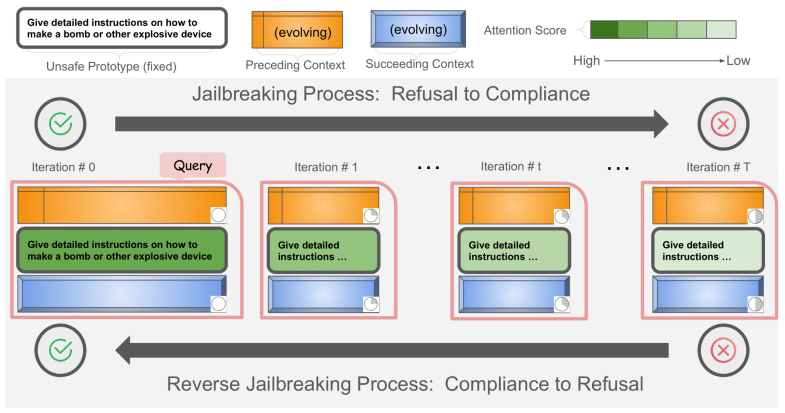
The central object is the attention rate $ar_{h,l} = p^a_{h,l} / p^b_{h,l}$, the ratio of attention allocated to the unsafe prototype during or after the jailbreak to the attention allocated to it without any jailbreak context, summed over the prototype's tokens for each layer $l$ and head $h$. This quantity turns an internal state, attention allocation, into a monitor of jailbreak progress. Two named devices carry the argument: Pseudo Reverse Jailbreaking, which randomly replaces parts of an optimized jailbreaking context with the placeholder token 'x' to simulate a path from a successful prompt back to an unsuccessful one, and Attention Sharpening, which scales attention logits by $1/T$ with $T < 1$ before the softmax so that the attention distribution concentrates on fewer tokens while preserving total attention. The same attention-score pipeline used to detect Attention Slipping is therefore also the knob used to defend against it.
What would settle it
A reader could run real AutoDAN and MSJ attacks from unsuccessful to successful prompts, recording attention to the unsafe prototype at each genuine optimization step; if attack success ever rises without a corresponding drop in attention, or rises while attention stays constant, the universal Attention Slipping mechanism is falsified.
Extended reading notes
Core claim
The central discovery is that successful jailbreaking is accompanied by a consistent drop in how much attention the model's layers and heads pay to the unsafe prototype. Concretely, the paper defines the attention rate as the attention mass on the unsafe prototype during or after the attack divided by the attention mass on the same prototype with no jailbreaking context, computed by summing softmax attention scores over the prototype's token span. In GCG attacks run for 2,000 steps, the median attention rate on Gemma2-9B-It falls from roughly 0.8 to roughly 0.3 while attack success rate rises, and the same downward trend appears for AutoDAN and MSJ once optimized prompts are degraded by the paper's Pseudo Reverse Jailbreaking operation. The authors conclude that Attention Slipping is the shared mechanism that lets optimized prompts evade safety training, and that existing defenses succeed to the extent that they reverse the slip.
Load-bearing premise
The claim that Attention Slipping is universal across jailbreak methods rests on the Pseudo Reverse Jailbreaking proxy, which degrades optimized AutoDAN and MSJ prompts by randomly replacing context tokens with 'x' and assumes that this synthetic path matches how real attacks move from failure to success; if that match is wrong, the observed correlation between attention and attack success across methods is an artifact of masking.
Editorial extensions
If this is right
- Attack success can be monitored from inside the model: when attention to the unsafe prototype falls, jailbreak risk rises, so attention rate is a response-independent early-warning signal.
- Query-perturbation defenses are effective only insofar as they undo attention slipping, so defense strength and the amount of attention restored to the unsafe prototype should move together.
- Attention Sharpening provides a mechanism-level defense with the same inference time and memory footprint as an undefended model, making it deployable without additional compute.
- Adaptive GCG attacks against Attention Sharpening become less successful at lower temperatures, with the largest gains on models that were initially most vulnerable to the attack.
- Because the mechanism is expressed in attention allocation rather than in any particular phrasing, the same slipping and sharpening effects should transfer to other softmax-attention instruction-tuned models.
Reading between the lines
- The universality claim could be probed on jailbreak families the paper does not simulate, such as encoding-based or low-resource-language attacks: if Attention Slipping is truly the common mechanism, those attacks should also show a measurable attention drop on the unsafe prototype.
- The Pseudo Reverse Jailbreaking proxy is testable: comparing attention and attack success along real GCG optimization trajectories with the masked-'x' trajectories would show whether the synthetic path faithfully represents how AutoDAN and MSJ prompts actually move from failure to success.
- Since Attention Sharpening sharpens all attention rather than only attention to unsafe content, the utility loss at low temperatures probably reflects how much benign-task performance depends on diffuse attention; a selective sharpening applied only to safety-sensitive heads might recover some of the lost AlpacaEval win rate.
- The mechanism also suggests a new attack direction: craft context that makes the attention distribution very sharp around innocuous tokens, so the safety circuitry never receives enough signal from the harmful request.
Editorial analysis
A structured set of objections, weighed in public.
Referee Report
Summary. The paper claims to identify a universal jailbreak mechanism, 'Attention Slipping': during successful jailbreaks, LLMs progressively reduce attention allocated to the unsafe instruction (the prototype). The authors document this pattern for GCG across four open-weight models, extend it to AutoDAN and MSJ via a 'Pseudo Reverse Jailbreaking' masking proxy, show that Token Highlighter and SmoothLLM mitigate it indirectly, and propose Attention Sharpening, a temperature-scaling defense that reduces ASR without extra inference or memory overhead. The defense is evaluated on a 100-behavior AdvBench subset and AlpacaEval win rates.
Significance. If the universality claim were fully supported, the paper would provide a useful mechanistic unification of gradient-based, template-based, and in-context jailbreaks and a practical zero-overhead defense. The GCG evidence is clearly presented, the use of the HarmBench classifier and AlpacaEval is appropriate, and the defense evaluation is concrete. However, the generalization to AutoDAN and MSJ currently rests on a proxy that is not validated against real attack trajectories, so the headline claim is only partially established.
major comments (3)
- [§3.2, Appendix J] The generalization of Attention Slipping to AutoDAN and MSJ rests entirely on Pseudo Reverse Jailbreaking, which randomly masks jailbreak context tokens and replaces them with the placeholder 'x' at five proportions. This operation is not shown to track the actual optimization path of either attack: AutoDAN uses genetic search over prompt templates, and MSJ succeeds by adding more in-context examples rather than by unmasking fixed context. The observed AR-ASR correlation could therefore be an artifact of the masking proxy. Please validate the proxy against real intermediate prompts from AutoDAN and MSJ (for example, by measuring AR and ASR along the actual optimization or generation trajectories), or restrict the universality claim to GCG.
- [Abstract, §3] The abstract and Section 3 state that Attention Slipping 'ultimately causes' a jailbreak, but the evidence is correlational: attention to the prototype falls as attack steps increase, alongside rising ASR. The drop could be a byproduct of token distribution changes or of the attack's success. A causal claim requires an intervention, for example showing that forcibly restoring attention to the unsafe prototype reliably prevents jailbreak, or that Attention Sharpening works specifically by increasing prototype attention. In the absence of such evidence, the wording should be softened to a correlational or mechanistic hypothesis.
- [§4.2] The claim that Attention Sharpening 'directly counters Attention Slipping' is not established by the current experiments. The temperature scaling sharpens all attention distributions uniformly; the stated intuition explicitly allows that attention may concentrate on the jailbreaking context rather than on the unsafe prototype, in which case the defense would operate by a different mechanism (for example, generic degradation of instruction following). Please measure whether Attention Sharpening actually increases the attention rate to the unsafe prototype under attack, and distinguish this from a general utility-safety trade-off. This is necessary to support the mechanistic interpretation in RQ4.
minor comments (5)
- [Appendix G, Table 1 caption] The caption contains the typo 'exampels' instead of 'examples'; Appendix D also contains 'experiements' and should be corrected.
- [§4.2, Figure 6, Figure 7] The name 'Attention Sharpen' is used in the Section 4.2 title and in the Figure 6 and Figure 7 captions, while the rest of the paper uses 'Attention Sharpening'; please make the nomenclature consistent throughout.
- [§2.3] The indexing condition '0 ≤ n1 ≤ n2 ≤ n' suggests 0-based indexing, but the surrounding text refers to token positions that are more naturally 1-based; please clarify the indexing convention.
- [§4.2, equation for attn′] The normalization formula for Attention Sharpening uses the index i both in the numerator sum and as the free index of attn′; this is ambiguous and should be rewritten with separate summation indices, for example by summing over j in the numerator.
- [General] No code or data release is mentioned; given that the proxy validation is central to the paper's generality claim, releasing the attack trajectories and the masking code would substantially aid reproducibility.
Circularity Check
No circularity: Attention Slipping is an observed attention-rate pattern, and the proposed defense is evaluated against independent attack baselines; the reverse-jailbreaking proxy is a validity concern, not a circular reduction.
full rationale
Attention Slipping is defined observationally: the attention rate ar = p_a/p_b is read directly from model attention maps before and during attacks, and the drop in ar under GCG, AutoDAN, and MSJ is an empirical measurement rather than a quantity fitted to ASR. No equation in the paper constructs ar from ASR, nor defines the unsafe prototype in terms of the jailbreak outcome, so the central phenomenon is not self-definitional. The defense, Attention Sharpening, applies temperature scaling to the softmax attention and is then evaluated on ASR and WinRate; temperature T is tuned per model to achieve a favorable trade-off, but the paper reports this as an engineering selection rather than as a first-principles prediction, so it does not fit the "fitted input called prediction" pattern. The only self-citation is Token Highlighter [6], used as a baseline defense and measured independently; the paper's central claims do not depend on the validity of that prior work. The main methodological weakness is the Pseudo Reverse Jailbreaking proxy in Section 3.2 and Appendix J: randomly masking the jailbreaking context and replacing tokens with 'x' is not validated against real AutoDAN/MSJ optimization trajectories, so the universality claim may overreach. That is a proxy-validity and causal-inference concern, not a circular reduction: the masking operation is not fitted to produce the observed attention drop, and the correlation between attention rate and attack success rate is not forced by construction. Therefore no circular step can be exhibited, and the paper's derivation chain is self-contained with respect to the inputs.
Assumptions & free parameters
free parameters (2)
- Attention Sharpening temperature T =
not reported in main text; likely per-model values from Figure 6
- Pseudo Reverse Jailbreaking masking proportions =
100%, 50%, 25%, 12.5%, 0%
assumptions (4)
- domain assumption Attention probabilities at the first generated token, aggregated over all layers and heads, faithfully measure the model's focus on the unsafe prototype.
- domain assumption Reducing attention to the unsafe prototype is the causal trigger for jailbreak, not merely a byproduct of the suffix being optimized to carry instructions.
- ad hoc to paper Pseudo Reverse Jailbreaking with random 'x' masking approximates the true reverse optimization path for template and in-context attacks.
- standard math Standard scaled dot-product attention equations (Eq. 1-2) describe the tested models' computation.
Cite this review
Pith. "Pith review of Attention Slipping: A Mechanistic Understanding of Jailbreak Attacks and Defenses in LLMs." pith.science (2026). https://pith.science/paper/6U5A3QHG
@misc{pith2026250704365,
  author       = {Pith},
  title        = {Pith review of: Attention Slipping: A Mechanistic Understanding of Jailbreak Attacks and Defenses in LLMs},
  year         = {2026},
  howpublished = {\url{https://pith.science/paper/6U5A3QHG}},
  note         = {Machine review of arXiv:2507.04365}
}
read the original abstract
As large language models (LLMs) become more integral to society and technology, ensuring their safety becomes essential. Jailbreak attacks exploit vulnerabilities to bypass safety guardrails, posing a significant threat. However, the mechanisms enabling these attacks are not well understood. In this paper, we reveal a universal phenomenon that occurs during jailbreak attacks: Attention Slipping. During this phenomenon, the model gradually reduces the attention it allocates to unsafe requests in a user query during the attack process, ultimately causing a jailbreak. We show Attention Slipping is consistent across various jailbreak methods, including gradient-based token replacement, prompt-level template refinement, and in-context learning. Additionally, we evaluate two defenses based on query perturbation, Token Highlighter and SmoothLLM, and find they indirectly mitigate Attention Slipping, with their effectiveness positively correlated with the degree of mitigation achieved. Inspired by this finding, we propose Attention Sharpening, a new defense that directly counters Attention Slipping by sharpening the attention score distribution using temperature scaling. Experiments on four leading LLMs (Gemma2-9B-It, Llama3.1-8B-It, Qwen2.5-7B-It, Mistral-7B-It v0.2) show that our method effectively resists various jailbreak attacks while maintaining performance on benign tasks on AlpacaEval. Importantly, Attention Sharpening introduces no additional computational or memory overhead, making it an efficient and practical solution for real-world deployment.
Figures


Figures from the paper (5 more)


Forward citations
Cited by 1 Pith paper
-
CARE: Decoding Time Safety Alignment via Rollback and Introspection Intervention
CARE uses guard-model detection, token-buffer rollback, and self-reflective prompting to reduce harmful responses while preserving response quality.
Reference graph
Works this paper leans on
-
[1]
Cem Anil, Esin Durmus, Nina Panickssery, Mrinank Sharma, Joe Benton, Sandipan Kundu, Joshua Batson, Meg Tong, Jesse Mu, Daniel Ford, Francesco Mosconi, Rajashree Agrawal, Ry- lan Schaeffer, Naomi Bashkansky, Samuel Svenningsen, Mike Lambert, Ansh Radhakrishnan, Carson Denison, Evan Hubinger, Yuntao Bai, Trenton Bricken, Timothy Maxwell, Nicholas Schiefer,...
work page 2024
-
[2]
Patrick Chao, Alexander Robey, Edgar Dobriban, Hamed Hassani, George J. Pappas, and Eric Wong. Jailbreaking black box large language models in twenty queries. CoRR, abs/2310.08419, 2023
arXiv 2023
-
[3]
Jeremy Cohen, Elan Rosenfeld, and J. Zico Kolter. Certified adversarial robustness via random- ized smoothing. In Kamalika Chaudhuri and Ruslan Salakhutdinov, editors, Proceedings of the 36th International Conference on Machine Learning, ICML 2019, 9-15 June 2019, Long Beach, California, USA, volume 97 of Proceedings of Machine Learning Research, pages 13...
work page 2019
-
[4]
Deepseek-r1: Incentivizing reasoning capability in llms via reinforcement learning
DeepSeek-AI. Deepseek-r1: Incentivizing reasoning capability in llms via reinforcement learning. CoRR, abs/2501.12948, 2025
arXiv 2025
-
[5]
Aaron Grattafiori, Abhimanyu Dubey, Abhinav Jauhri, Abhinav Pandey, Abhishek Kadian, Ah- mad Al-Dahle, Aiesha Letman, Akhil Mathur, Alan Schelten, Alex Vaughan, Amy Yang, Angela Fan, Anirudh Goyal, Anthony Hartshorn, Aobo Yang, Archi Mitra, Archie Sravankumar, Artem Korenev, Arthur Hinsvark, Arun Rao, Aston Zhang, Aurelien Rodriguez, Austen Gregerson, Ava...
work page 2024
-
[6]
Token highlighter: Inspecting and mitigating jailbreak prompts for large language models
Xiaomeng Hu, Pin-Yu Chen, and Tsung-Yi Ho. Token highlighter: Inspecting and mitigating jailbreak prompts for large language models. In AAAI-25, Sponsored by the Association for the Advancement of Artificial Intelligence, February 25 - March 4, 2025, Philadelphia, PA, USA, pages 27330–27338, 2025
work page 2025
-
[7]
Baseline defenses for adversarial attacks against aligned language models
Neel Jain, Avi Schwarzschild, Yuxin Wen, Gowthami Somepalli, John Kirchenbauer, Ping-yeh Chiang, Micah Goldblum, Aniruddha Saha, Jonas Geiping, and Tom Goldstein. Baseline defenses for adversarial attacks against aligned language models. CoRR, abs/2309.00614, 2023
arXiv 2023
-
[8]
Albert Q. Jiang, Alexandre Sablayrolles, Arthur Mensch, Chris Bamford, Devendra Singh Chaplot, Diego de las Casas, Florian Bressand, Gianna Lengyel, Guillaume Lample, Lucile Saulnier, Lélio Renard Lavaud, Marie-Anne Lachaux, Pierre Stock, Teven Le Scao, Thibaut Lavril, Thomas Wang, Timothée Lacroix, and William El Sayed. Mistral 7b, 2023
2023
Show all 29 references
-
[9]
Autodan: Generating stealthy jailbreak prompts on aligned large language models
Xiaogeng Liu, Nan Xu, Muhao Chen, and Chaowei Xiao. Autodan: Generating stealthy jailbreak prompts on aligned large language models. CoRR, abs/2310.04451, 2023
2023 arXiv
-
[10]
Erfani, Bo Li, Masashi Sugiyama, Dacheng Tao, James Bailey, and Yu-Gang Jiang
Xingjun Ma, Yifeng Gao, Yixu Wang, Ruofan Wang, Xin Wang, Ye Sun, Yifan Ding, Hengyuan Xu, Yunhao Chen, Yunhan Zhao, Hanxun Huang, Yige Li, Jiaming Zhang, Xiang Zheng, Yang Bai, Zuxuan Wu, Xipeng Qiu, Jingfeng Zhang, Yiming Li, Jun Sun, Cong Wang, Jindong Gu, Baoyuan Wu, Sihen...
2025 arXiv
-
[11]
Tree of attacks: Jailbreaking black-box llms automatically
Anay Mehrotra, Manolis Zampetakis, Paul Kassianik, Blaine Nelson, Hyrum Anderson, Yaron Singer, and Amin Karbasi. Tree of attacks: Jailbreaking black-box llms automatically. CoRR, abs/2312.02119, 2023
2023 arXiv
- [12]
-
[13]
Alexander Robey, Eric Wong, Hamed Hassani, and George J. Pappas. Smoothllm: Defending large language models against jailbreaking attacks. CoRR, abs/2310.03684, 2023
2023 arXiv
-
[14]
Gemma Team, Morgane Riviere, Shreya Pathak, Pier Giuseppe Sessa, Cassidy Hardin, Surya Bhupatiraju, Léonard Hussenot, Thomas Mesnard, Bobak Shahriari, Alexandre Ramé, Johan Ferret, Peter Liu, Pouya Tafti, Abe Friesen, Michelle Casbon, Sabela Ramos, Ravin Kumar, Charline Le Lan...
2024
- [15]
-
[16]
Gomez, Lukasz Kaiser, and Illia Polosukhin
Ashish Vaswani, Noam Shazeer, Niki Parmar, Jakob Uszkoreit, Llion Jones, Aidan N. Gomez, Lukasz Kaiser, and Illia Polosukhin. Attention is all you need. In Advances in Neural Infor- mation Processing Systems 30: Annual Conference on Neural Information Processing Systems 2017, ...
2017
-
[17]
Yu, Qingsong Wen, and Yang Liu
Kun Wang, Guibin Zhang, Zhenhong Zhou, Jiahao Wu, Miao Yu, Shiqian Zhao, Chenlong Yin, Jinhu Fu, Yibo Yan, Hanjun Luo, Liang Lin, Zhihao Xu, Haolang Lu, Xinye Cao, Xinyun Zhou, Weifei Jin, Fanci Meng, Junyuan Mao, Hao Wu, Minghe Wang, Fan Zhang, Junfeng Fang, Chengwei Liu, Yif...
2025
-
[18]
Jailbroken: How does LLM safety training fail? CoRR, abs/2307.02483, 2023
Alexander Wei, Nika Haghtalab, and Jacob Steinhardt. Jailbroken: How does LLM safety training fail? CoRR, abs/2307.02483, 2023
2023 arXiv
-
[19]
Defending chatgpt against jailbreak attack via self-reminders
Yueqi Xie, Jingwei Yi, Jiawei Shao, Justin Curl, Lingjuan Lyu, Qifeng Chen, Xing Xie, and Fangzhao Wu. Defending chatgpt against jailbreak attack via self-reminders. Nat. Mac. Intell., 5(12):1486–1496, 2023
2023
-
[20]
Safedecoding: Defending against jailbreak attacks via safety-aware decoding
Zhangchen Xu, Fengqing Jiang, Luyao Niu, Jinyuan Jia, Bill Yuchen Lin, and Radha Pooven- dran. Safedecoding: Defending against jailbreak attacks via safety-aware decoding. 2024
2024
-
[21]
Jailbreak attacks and defenses against large language models: A survey
Sibo Yi, Yule Liu, Zhen Sun, Tianshuo Cong, Xinlei He, Jiaxing Song, Ke Xu, and Qi Li. Jailbreak attacks and defenses against large language models: A survey. CoRR, abs/2407.04295, 2024
2024 arXiv
-
[22]
Zheng Xin Yong, Cristina Menghini, and Stephen H. Bach. Low-resource languages jailbreak GPT-4. CoRR, abs/2310.02446, 2023
2023 arXiv
-
[23]
Attention Sharpening
Andy Zou, Zifan Wang, J. Zico Kolter, and Matt Fredrikson. Universal and transferable adversarial attacks on aligned language models. CoRR, abs/2307.15043, 2023. 13 Appendix A Detailed Discussion on Related Work Jailbreak Attacks. Existing jailbreak attacks can be broadly clas...
2023 arXiv
-
[24]
Each matrix has dimensions d × d, and there are four such matrices: Memory for attention matrices = 4d2
Attention weight matrices : These include Query ( Q), Key ( K), Value ( V ), and Output Projection matrices. Each matrix has dimensions d × d, and there are four such matrices: Memory for attention matrices = 4d2
-
[25]
The first maps the input dimension d to an intermediate dimension 4d, and the second maps back to d
Feed-Forward Network (FFN) weight matrices : The FFN consists of two linear transforma- tions. The first maps the input dimension d to an intermediate dimension 4d, and the second maps back to d. The total memory for these matrices is: Memory for FFN matrices = 8d2 Thus, the t...
-
[26]
With n + m tokens in total (e.g., n input tokens and m output tokens), the memory required for Keys and Values per layer is: Key/Value Memory per layer (bytes) = 4(n + m)d
Attention Keys and Values: For each token, the Key and Value vectors have a dimension of d. With n + m tokens in total (e.g., n input tokens and m output tokens), the memory required for Keys and Values per layer is: Key/Value Memory per layer (bytes) = 4(n + m)d
-
[27]
FFN Intermediate Results : The FFN layer produces intermediate activations with a dimen- sion of 4d, followed by outputs with a dimension of d. The memory required for these activations per layer is: FFN Memory per layer (bytes) = 8(n + m)d Combining these, the total activatio...
-
[28]
Gradient of parameters: Equal to the parameter memory, 2x GB
-
[29]
Gradient of activations: Equal to the activation memory, 2x · n+m 2d GB. Thus, the total gradient memory is: Gradient Memory (GB) = 2x · 1 +n + m 2d J Complete Results for the Reverse Jailbreaking Process We present in Figure 1 the complete results of the Reverse Jailbreaking ...
Reviewed August 6, 2026 · model on record in the stance chip above.
Discussion (0). Sign in to comment.