REVIEW 3 major objections 5 minor 1 cited by
Does Learning Mathematical Problem-Solving Generalize to Broader Reasoning?
T0 review · 3 major / 5 minor · reviewed 2026-08-06 · deepseek-v4-flash
Pith's one-line read The paper argues that supervised fine-tuning on mathematical problem-solving with long, self-reflective reasoning chains, and rule-based reinforcement learning on math queries, generalize to broader reasoning tasks, whereas conventional…
desk verdict A useful, well-run empirical comparison of five MPS training strategies, with a real but addressable confound in the long-vs-short CoT ablation. read the letter →
The pith
A machine-rendered reading of the paper's core claim, the machinery that carries it, and where it could break.
The reading
What carries the argument
The carrying mechanism is the long, self-reflective chain-of-thought response—a solution trace that includes intermediate verification, self-checks, and alternative paths—used as supervised fine-tuning data, plus rule-based reinforcement learning with format and correctness rewards on math queries. The paper's behavioral evidence for the mechanism is response length: after long-CoT math training, the model produces substantially longer outputs on non-math benchmarks, and the short-answer ablation (rewriting s1.1's responses to about 419 tokens) erases the generalization gains. The rule-based RL component works by using a $\boxed{}$ answer-format constraint and ground-truth verification as rewards, which lets the model discover extended reasoning without demonstration data.
What would settle it
Train two models from the same base on the same long-CoT math solutions: one with answers truncated to short length without rewriting content, and one with the original long answers. If the truncated-length model keeps the cross-domain gains, then length is not the active ingredient; if it loses them while the original retains them, the conclusion is supported. Alternatively, a length-capped decoding evaluation of LIMO or s1.1 (max tokens set to base-model levels) that still showed the gains would contradict the 'long reasoning mode' mechanism.
Extended reading notes
Core claim
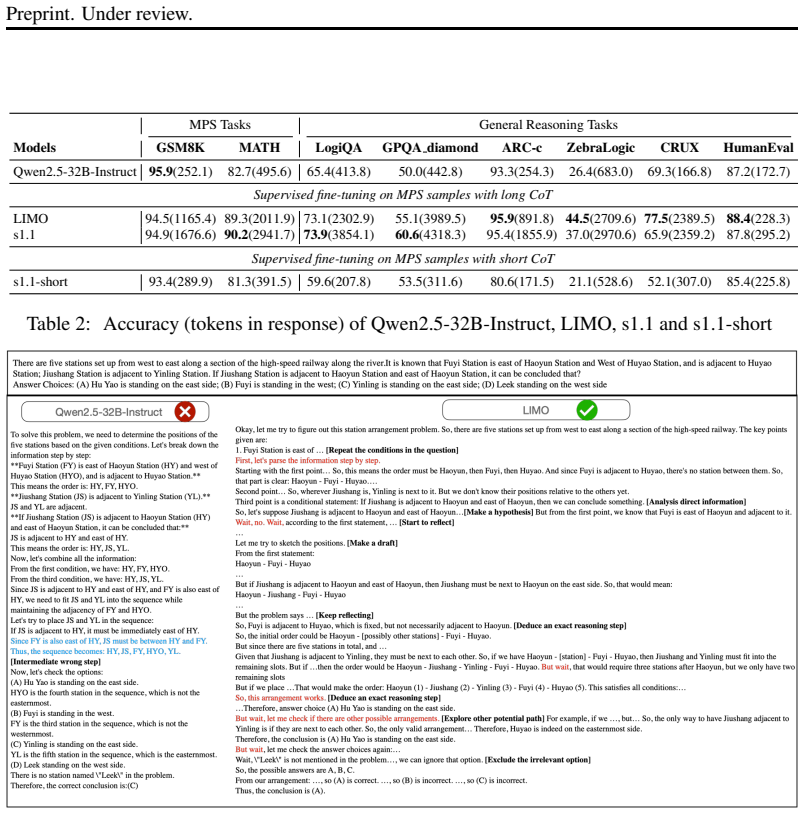
On the paper's own terms, the discovery is an empirical asymmetry: the way a model learns math determines whether that learning travels. Fine-tuning on a few hundred math problems solved with long, self-correcting chains—the LIMO recipe, for instance—improved Qwen2.5-32B-Instruct on every general reasoning task tested, with relative gains of 10.2% on GPQA and 11.8% on LogiQA, while also lengthening the model's responses in non-math domains. Fine-tuning on the same kind of problems with short step-by-step answers, by contrast, often lowered general reasoning scores; in the paper's control experiment, rewriting s1.1's long answers into short ones removed the cross-domain benefit. Rule-based reinforcement learning on math queries produced similar transfer, beating the base model and a math-data SFT model on most benchmarks. The paper concludes that short reasoning chains acquire math-specific behavior, whereas long, self-reflective chains activate a general 'long reasoning mode' that extends into other domains.
Load-bearing premise
The load-bearing premise is that the s1.1-short ablation changed only the length of the reasoning chain; if rewriting the long answers with GPT-4o also changed answer quality, self-correction behavior, or format, the causal link between chain length and cross-domain generalization is not established.
Editorial extensions
If this is right
- Conventional short-CoT math instruction tuning should not be assumed to strengthen general reasoning; math-benchmark gains can coexist with losses elsewhere.
- Long-CoT math fine-tuning can transfer across domains with very few examples, suggesting that data quality and format may matter more than scale.
- Rule-based RL on math queries is a viable alternative path to general reasoning improvement, and an SFT warmup before RL helps.
- Continual pretraining on math text gives modest broad improvements, but they are less consistent than those from long-CoT SFT.
- Because diverse non-math SFT datasets failed to generalize broadly, improving general reasoning may require new training objectives rather than more instruction-tuning data.
Reading between the lines
- If long-chain length is the real driver, then methods that extend inference-time budgets or induce self-correction in any domain could reproduce the transfer without math-specific data; a length-capped evaluation would test this.
- The paper's mechanism suggests the math domain's value is its verifiable long CoT traces, not math content per se; training on long CoT in other verifiable domains, such as code execution, should transfer similarly if the hypothesis is right.
- The GPT-4o rewriting ablation leaves open that content quality, not length, caused the drop; a cleaner test would compress long answers by removing only self-correction and verification phrases while preserving content.
Editorial analysis
A structured set of objections, weighed in public.
Referee Report
Summary. This paper reports an empirical study of whether training LLMs on mathematical problem-solving (MPS) transfers to general reasoning tasks. The authors compare five strategies: continual pretraining on math text (DeepSeekMath, RhO-Math), SFT on STEM QA (MAmmoTH2), SFT on short-CoT math data (Math-CoT, Math-PoT), SFT on long self-reflective CoT (LIMO, s1.1), and rule-based RL on math queries (SimpleRL family). They evaluate on five MPS and eight general-reasoning benchmarks. They report that continual pretraining generalizes modestly, short-CoT SFT generalizes poorly and often hurts, while long-CoT SFT and rule-based RL on math queries improve general reasoning, with gains of 10–12% relative on GPQA and LogiQA for LIMO. A preliminary study of non-MPS SFT datasets (Magicoder, Magpie, OpenOrca) finds only localized gains.
Significance. The question addressed here is timely and practically important given the current emphasis on long-reasoning models and the widespread use of math SFT in post-training. The paper's strengths include the breadth of the evaluation (13 benchmarks), the use of multiple independent checkpoints per strategy, and the inclusion of a same-base ablation (s1.1 vs s1.1-short). If the central pattern is confirmed, the results would provide useful guidance for data selection in post-training. However, the causal interpretation is not yet fully supported: the same-base ablation changes content as well as length, the cross-strategy comparisons mix base-model families, and the RL results lack an SFT-only control. The claims are directionally plausible and worth publishing after these controls are added or the causal language is softened.
major comments (3)
- [3.3] Section 3.3, Table 2: The sentence "the performance of s1.1-short is consistently lower than that of the base model" is not supported by the reported numbers: on GPQA-diamond, s1.1-short achieves 53.5 versus 50.0 for Qwen2.5-32B-Instruct. Moreover, the proposed ablation does not isolate response length as the causal variable; GPT-4o rewriting to produce 418.9-token answers also removes self-reflection and verification steps and changes content and formatting. The drop relative to s1.1 (or to the base model on most tasks) could therefore be due to these co-varying factors rather than to length itself. A control that compresses the same reasoning steps while preserving self-correction behavior, or a training study that varies only length, is needed before the conclusion that longer reasoning paths are beneficial can be drawn.
- [3.2 and 3.3] The headline comparison in Tables 1 and 2 between short-CoT SFT models (Math-CoT, Math-PoT, based on Mistral-7B) and long-CoT models (LIMO, s1.1, based on Qwen2.5-32B-Instruct) confounds the training strategy with base-model capacity, size, and alignment state. Statements such as "conventional SFT on short reasoning chains generalizes poorly" are supported by only one same-base control, s1.1-short, which has the content-rewriting confound noted above. To make the central claim robust, the paper needs same-base short-CoT SFT models on Qwen2.5-32B-Instruct (or an equivalent controlled comparison), or the conclusions must be explicitly limited to the specific models and configurations studied.
- [3.4] Table 3 does not include the SFT-only warmup checkpoint as a control for the SimpleRL models. The paper attributes the improvements of Qwen2.5-Math-SimpleRL and Qwen2.5-32B-SimpleRL to rule-based RL, but these models begin with an SFT stage, and the reported baseline (e.g., Qwen2.5-Math-7B) is not that SFT-stage checkpoint. Without reporting the SFT-only model's generalization performance, it is not possible to determine how much of the gain comes from RL versus the SFT warmup. I request that the SFT-only control be added for each SimpleRL variant, or that the attribution to RL be substantially softened.
minor comments (5)
- [Abstract] There is a typo in the abstract: "In constrast" should be "In contrast".
- [3.2] The claim that Math-PoT SFT "declines in eight tasks" is not supported by Table 1: relative to Mistral-7B, Math-PoT improves on ZebraLogic, ProofWriter, and DocMath, and declines on seven of the listed non-MPS benchmarks. Please correct the count or clarify which task subset is being referenced.
- [3.3] The benchmark name is rendered inconsistently: the text and Figure 1 use "GPQA" while Table 2 uses "GPQAdiamond". Please specify the exact evaluation set (e.g., GPQA diamond subset) and the prompting/evaluation protocol in the main text or appendix.
- [3.3] There is a typo in the ablation description: "using the same question from s1 1 but with a shorter CoT answer" should refer to "s1.1" consistently.
- [3.2] The data-coverage analysis in Figure 3 is qualitative and based on PCA projections. Reporting a quantitative overlap metric (e.g., nearest-neighbor distribution distance or retrieval-based overlap) would strengthen the claim that WebInstruct and OpenWebMath cover general reasoning topics better than MetaMath.
Circularity Check
No circularity: all central claims are empirical benchmark comparisons, not derivations from fitted inputs.
full rationale
This paper is an empirical study; it contains no fitted parameters, no closed-form derivation, and no prediction that is constructed from its target values. The central claims (long-CoT SFT and rule-based RL on MPS generalize to non-MPS reasoning, while short-CoT SFT does not) are supported by direct evaluation of checkpoints on standard external benchmarks (GPQA, LogiQA, ARC-c, etc.), with improvements or degradations measured rather than derived. The s1.1-short ablation in §3.3 is a possible methodological confound because GPT-4o rewriting changes content, self-reflection, and format along with length, so it may not isolate response length as the causal variable; however, a confounded ablation is not circularity under the stated criteria, since the comparison is not equivalent to its own inputs by construction. Self-citations to SimpleRL (Zeng et al., 2025a,b), DART-Math, and CodeI/O (with overlapping author Junxian He) are present, but they are not load-bearing in a derivational sense: the SimpleRL checkpoints are used as evaluated artifacts on independent benchmarks, and the CodeI/O mention is a passing pointer to concurrent work. No uniqueness theorem, ansatz smuggled via citation, or renaming of a known result is invoked. The paper's conclusion could be threatened by confounds or base-model mismatches (e.g., short-CoT SFT models are Mistral-7B while long-CoT models are Qwen2.5-32B), but those are correctness/validity risks, not circular reasoning. Under the hard rule that circularity must be exhibited as equation-level reduction or fitted-parameter-renamed-as-prediction, no step qualifies; the appropriate finding is no significant circularity.
Assumptions & free parameters
assumptions (3)
- domain assumption Benchmark scores on GPQA, LogiQA, ProofWriter, etc. are valid and generalizable measures of broad reasoning ability.
- domain assumption The open-source checkpoints used (DeepSeekMath, Rho-Math, MAmmoTH2, LIMO, s1.1, SimpleRL) are representative implementations of the respective training strategies.
- domain assumption The s1.1-short ablation, generated by GPT-4o rewriting, preserves all properties of the training data except response length.
Cite this review
Pith. "Pith review of Does Learning Mathematical Problem-Solving Generalize to Broader Reasoning?." pith.science (2026). https://pith.science/paper/BAL3LK6O
@misc{pith2026250704391,
  author       = {Pith},
  title        = {Pith review of: Does Learning Mathematical Problem-Solving Generalize to Broader Reasoning?},
  year         = {2026},
  howpublished = {\url{https://pith.science/paper/BAL3LK6O}},
  note         = {Machine review of arXiv:2507.04391}
}
read the original abstract
There has been a growing interest in enhancing the mathematical problem-solving (MPS) capabilities of large language models. While the majority of research efforts concentrate on creating specialized models to solve mathematical problems, it remains unknown how learning mathematical problem-solving generalizes to help develop other reasoning abilities. In this paper, we present an empirical investigation into the generalization potential of various MPS training approaches, such as continual pretraining, instruction tuning, and rule-based reinforcement learning across various data sources, including both short and long chain-of-thought (CoT) samples. Evaluation on 5 mathematical and 8 general reasoning benchmarks show that continual pretraining on math text is able to generalize to general reasoning tasks to some extent. In constrast, instruction tuning on conventional, short MPS samples provides limited benefits and, in many cases, even impairs generalization performance. Notably, training with long CoT responses for MPS samples and incorporating rule-based reinforcement learning on MPS queries exhibit distinct behavior, significantly enhancing generalization by extending the model's reasoning processes into other domains. These results suggest that traditional approaches to learning MPS with short reasoning chains largely fail to achieve robust generalization. However, the emerging paradigm of longer reasoning chains, coupled with self-reflection, offers a promising direction for improving generalized reasoning abilities through learning from specialized domains.
Figures


Figures from the paper (2 more)

Forward citations
Cited by 1 Pith paper
-
CLARity: Reasoning Consistency Alone Can Teach Reinforced Experts
A consistency reward parsed by a 7B LLM, plus a two-stage refine-then-monitor pipeline and reformulated easy questions, improves MCQ-RL accuracy-with-consistency in law and medicine (58.9 vs 51.4 average Acc+).
Reference graph
Works this paper leans on
-
[1]
Zebralogic: Benchmarking the logical reasoning ability of language models
Yejin Choi Bill Yuchen Lin, Ronan Le Bras. Zebralogic: Benchmarking the logical reasoning ability of language models. https://huggingface.co/spaces/allenai/ZebraLogic, 2024
work page 2024
-
[2]
Mark Chen, Jerry Tworek, Heewoo Jun, Qiming Yuan, Henrique Ponde de Oliveira Pinto, Jared Kaplan, Harri Edwards, Yuri Burda, Nicholas Joseph, Greg Brockman, Alex Ray, Raul Puri, Gretchen Krueger, Michael Petrov, Heidy Khlaaf, Girish Sastry, Pamela Mishkin, Brooke Chan, Scott Gray, Nick Ryder, Mikhail Pavlov, Alethea Power, Lukasz Kaiser, Mohammad Bavarian...
2021
-
[3]
Wenhu Chen, Xueguang Ma, Xinyi Wang, and William W Cohen. Program of thoughts prompting: Disentangling computation from reasoning for numerical reasoning tasks. arXiv preprint arXiv:2211.12588, 2022
arXiv 2022
-
[4]
Instruction pre-training: Language models are supervised multitask learners
Daixuan Cheng, Yuxian Gu, Shaohan Huang, Junyu Bi, Minlie Huang, and Furu Wei. Instruction pre-training: Language models are supervised multitask learners. arXiv preprint arXiv:2406.14491, 2024
arXiv 2024
-
[5]
Tianzhe Chu, Yuexiang Zhai, Jihan Yang, Shengbang Tong, Saining Xie, Dale Schuurmans, Quoc V. Le, Sergey Levine, and Yi Ma. Sft memorizes, rl generalizes: A comparative study of foundation model post-training, 2025
work page 2025
-
[6]
Scaling instruction-finetuned language models
Hyung Won Chung, Le Hou, Shayne Longpre, Barret Zoph, Yi Tay, William Fedus, Yunxuan Li, Xuezhi Wang, Mostafa Dehghani, Siddhartha Brahma, et al. Scaling instruction-finetuned language models. Journal of Machine Learning Research, 25 0 (70): 0 1--53, 2024
2024
-
[7]
Think you have solved question answering? try arc, the ai2 reasoning challenge
Peter Clark, Isaac Cowhey, Oren Etzioni, Tushar Khot, Ashish Sabharwal, Carissa Schoenick, and Oyvind Tafjord. Think you have solved question answering? try arc, the ai2 reasoning challenge. arXiv:1803.05457v1, 2018
arXiv 2018
-
[8]
Training verifiers to solve math word problems
Karl Cobbe, Vineet Kosaraju, Mohammad Bavarian, Mark Chen, Heewoo Jun, Lukasz Kaiser, Matthias Plappert, Jerry Tworek, Jacob Hilton, Reiichiro Nakano, Christopher Hesse, and John Schulman. Training verifiers to solve math word problems. arXiv preprint arXiv:2110.14168, 2021
Show all 57 references
-
[9]
Deepseek-r1: Incentivizing reasoning capability in llms via reinforcement learning
DeepSeek-AI. Deepseek-r1: Incentivizing reasoning capability in llms via reinforcement learning. 2025
2025
-
[10]
Arithmetic and the brain
Stanislas Dehaene, Nicolas Molko, Laurent Cohen, and Anna J Wilson. Arithmetic and the brain. Current opinion in neurobiology, 14 0 (2): 0 218--224, 2004
2004
-
[11]
Enhancing chat language models by scaling high-quality instructional conversations
Ning Ding, Yulin Chen, Bokai Xu, Yujia Qin, Zhi Zheng, Shengding Hu, Zhiyuan Liu, Maosong Sun, and Bowen Zhou. Enhancing chat language models by scaling high-quality instructional conversations. arXiv preprint arXiv:2305.14233, 2023
2023 arXiv
-
[12]
Alex Gu, Baptiste Rozière, Hugh Leather, Armando Solar-Lezama, Gabriel Synnaeve, and Sida I. Wang. Cruxeval: A benchmark for code reasoning, understanding and execution, 2024
2024
-
[13]
Deepseek-coder: When the large language model meets programming--the rise of code intelligence
Daya Guo, Qihao Zhu, Dejian Yang, Zhenda Xie, Kai Dong, Wentao Zhang, Guanting Chen, Xiao Bi, Yu Wu, YK Li, et al. Deepseek-coder: When the large language model meets programming--the rise of code intelligence. arXiv preprint arXiv:2401.14196, 2024
2024 arXiv
-
[14]
What explains the relationship between spatial and mathematical skills? a review of evidence from brain and behavior
Zachary Hawes and Daniel Ansari. What explains the relationship between spatial and mathematical skills? a review of evidence from brain and behavior. Psychonomic bulletin & review, 27: 0 465--482, 2020
2020
-
[15]
Measuring massive multitask language understanding
Dan Hendrycks, Collin Burns, Steven Basart, Andy Zou, Mantas Mazeika, Dawn Song, and Jacob Steinhardt. Measuring massive multitask language understanding. Proceedings of the International Conference on Learning Representations (ICLR), 2021 a
2021
-
[16]
Measuring mathematical problem solving with the math dataset
Dan Hendrycks, Collin Burns, Saurav Kadavath, Akul Arora, Steven Basart, Eric Tang, Dawn Song, and Jacob Steinhardt. Measuring mathematical problem solving with the math dataset. NeurIPS, 2021 b
2021
-
[17]
O1 replication journey -- part 2: Surpassing o1-preview through simple distillation, big progress or bitter lesson?, 2024
Zhen Huang, Haoyang Zou, Xuefeng Li, Yixiu Liu, Yuxiang Zheng, Ethan Chern, Shijie Xia, Yiwei Qin, Weizhe Yuan, and Pengfei Liu. O1 replication journey -- part 2: Surpassing o1-preview through simple distillation, big progress or bitter lesson?, 2024
2024
-
[18]
Albert Q. Jiang, Alexandre Sablayrolles, Arthur Mensch, Chris Bamford, Devendra Singh Chaplot, Diego de las Casas, Florian Bressand, Gianna Lengyel, Guillaume Lample, Lucile Saulnier, Lélio Renard Lavaud, Marie-Anne Lachaux, Pierre Stock, Teven Le Scao, Thibaut Lavril, Thomas ...
2023
-
[19]
Solving quantitative reasoning problems with language models
Aitor Lewkowycz, Anders Johan Andreassen, David Dohan, Ethan Dyer, Henryk Michalewski, Vinay Venkatesh Ramasesh, Ambrose Slone, Cem Anil, Imanol Schlag, Theo Gutman-Solo, Yuhuai Wu, Behnam Neyshabur, Guy Gur-Ari, and Vedant Misra. Solving quantitative reasoning problems with l...
2022
-
[20]
Numinamath, 2024
Jia Li, Edward Beeching, Lewis Tunstall, Ben Lipkin, Roman Soletskyi, Shengyi Costa Huang, Kashif Rasul, Longhui Yu, Albert Jiang, Ziju Shen, Zihan Qin, Bin Dong, Li Zhou, Yann Fleureau, Guillaume Lample, and Stanislas Polu. Numinamath, 2024
2024
-
[21]
Codei/o: Condensing reasoning patterns via code input-output prediction, 2025
Junlong Li, Daya Guo, Dejian Yang, Runxin Xu, Yu Wu, and Junxian He. Codei/o: Condensing reasoning patterns via code input-output prediction, 2025
2025
-
[22]
Openorca: An open dataset of gpt augmented flan reasoning traces
Wing Lian, Bleys Goodson, Eugene Pentland, Austin Cook, Chanvichet Vong, and "Teknium". Openorca: An open dataset of gpt augmented flan reasoning traces. https://https://huggingface.co/Open-Orca/OpenOrca, 2023
2023
-
[23]
Rho-1: Not all tokens are what you need, 2024
Zhenghao Lin, Zhibin Gou, Yeyun Gong, Xiao Liu, Yelong Shen, Ruochen Xu, Chen Lin, Yujiu Yang, Jian Jiao, Nan Duan, and Weizhu Chen. Rho-1: Not all tokens are what you need, 2024
2024
-
[24]
Logiqa: A challenge dataset for machine reading comprehension with logical reasoning
Jian Liu, Leyang Cui, Hanmeng Liu, Dandan Huang, Yile Wang, and Yue Zhang. Logiqa: A challenge dataset for machine reading comprehension with logical reasoning. arXiv preprint arXiv:2007.08124, 2020
2007 arXiv
-
[25]
The flan collection: Designing data and methods for effective instruction tuning
Shayne Longpre, Le Hou, Tu Vu, Albert Webson, Hyung Won Chung, Yi Tay, Denny Zhou, Quoc V Le, Barret Zoph, Jason Wei, et al. The flan collection: Designing data and methods for effective instruction tuning. In International Conference on Machine Learning, pp.\ 22631--22648. PMLR, 2023
2023
-
[26]
Mathgenie: Generating synthetic data with question back-translation for enhancing mathematical reasoning of llms
Zimu Lu, Aojun Zhou, Houxing Ren, Ke Wang, Weikang Shi, Junting Pan, Mingjie Zhan, and Hongsheng Li. Mathgenie: Generating synthetic data with question back-translation for enhancing mathematical reasoning of llms. arXiv preprint arXiv:2402.16352, 2024
2024 arXiv
-
[27]
Wizardmath: Empowering mathematical reasoning for large language models via reinforced evol-instruct
Haipeng Luo, Qingfeng Sun, Can Xu, Pu Zhao, Jianguang Lou, Chongyang Tao, Xiubo Geng, Qingwei Lin, Shifeng Chen, and Dongmei Zhang. Wizardmath: Empowering mathematical reasoning for large language models via reinforced evol-instruct. arXiv preprint arXiv:2308.09583, 2023
2023 arXiv
-
[28]
The llama 3 herd of models
Meta. The llama 3 herd of models. https://arxiv.org/abs/2407.21783, 2024
2024 arXiv
-
[29]
s1: Simple test-time scaling, 2025
Niklas Muennighoff, Zitong Yang, Weijia Shi, Xiang Lisa Li, Li Fei-Fei, Hannaneh Hajishirzi, Luke Zettlemoyer, Percy Liang, Emmanuel Candès, and Tatsunori Hashimoto. s1: Simple test-time scaling, 2025
2025
-
[30]
Orca: Progressive learning from complex explanation traces of gpt-4, 2023
Subhabrata Mukherjee, Arindam Mitra, Ganesh Jawahar, Sahaj Agarwal, Hamid Palangi, and Ahmed Awadallah. Orca: Progressive learning from complex explanation traces of gpt-4, 2023
2023
-
[31]
Learning to reason with llms
OpenAI. Learning to reason with llms. https://openai.com/index/learning-to-reason-with-llms/, 2024
2024
-
[32]
Openwebmath: An open dataset of high-quality mathematical web text
Keiran Paster, Marco Dos Santos, Zhangir Azerbayev, and Jimmy Ba. Openwebmath: An open dataset of high-quality mathematical web text. arXiv preprint arXiv:2310.06786, 2023
2023 arXiv
-
[33]
David Rein, Betty Li Hou, Asa Cooper Stickland, Jackson Petty, Richard Yuanzhe Pang, Julien Dirani, Julian Michael, and Samuel R. Bowman. Gpqa: A graduate-level google-proof q&a benchmark, 2023
2023
-
[34]
Winogrande: An adversarial winograd schema challenge at scale
Keisuke Sakaguchi, Ronan Le Bras, Chandra Bhagavatula, and Yejin Choi. Winogrande: An adversarial winograd schema challenge at scale. Communications of the ACM, 64 0 (9): 0 99--106, 2021
2021
-
[35]
Zhihong Shao, Peiyi Wang, Qihao Zhu, Runxin Xu, Junxiao Song, Mingchuan Zhang, Y.K. Li, Y. Wu, and Daya Guo. Deepseekmath: Pushing the limits of mathematical reasoning in open language models, 2024
2024
-
[36]
Challenging big-bench tasks and whether chain-of-thought can solve them
Mirac Suzgun, Nathan Scales, Nathanael Sch \"a rli, Sebastian Gehrmann, Yi Tay, Hyung Won Chung, Aakanksha Chowdhery, Quoc V Le, Ed H Chi, Denny Zhou, , and Jason Wei. Challenging big-bench tasks and whether chain-of-thought can solve them. arXiv preprint arXiv:2210.09261, 2022
-
[37]
Proofwriter: Generating implications, proofs, and abductive statements over natural language
Oyvind Tafjord, Bhavana Dalvi Mishra, and Peter Clark. Proofwriter: Generating implications, proofs, and abductive statements over natural language. arXiv preprint arXiv:2012.13048, 2020
2012 arXiv
-
[38]
Mathscale: Scaling instruction tuning for mathematical reasoning
Zhengyang Tang, Xingxing Zhang, Benyou Wan, and Furu Wei. Mathscale: Scaling instruction tuning for mathematical reasoning. arXiv preprint arXiv:2403.02884, 2024
2024 arXiv
-
[39]
Kimi k1.5: Scaling reinforcement learning with llms
Kimi Team. Kimi k1.5: Scaling reinforcement learning with llms. 2025
2025
-
[40]
Qwen2.5: A party of foundation models, September 2024
Qwen Team. Qwen2.5: A party of foundation models, September 2024. URL https://qwenlm.github.io/blog/qwen2.5/
2024
-
[41]
Dart-math: Difficulty-aware rejection tuning for mathematical problem-solving, 2024
Yuxuan Tong, Xiwen Zhang, Rui Wang, Ruidong Wu, and Junxian He. Dart-math: Difficulty-aware rejection tuning for mathematical problem-solving, 2024. URL https://arxiv.org/abs/2407.13690
2024 arXiv
-
[42]
Chain-of-thought prompting elicits reasoning in large language models
Jason Wei, Xuezhi Wang, Dale Schuurmans, Maarten Bosma, Fei Xia, Ed Chi, Quoc V Le, Denny Zhou, et al. Chain-of-thought prompting elicits reasoning in large language models. Advances in neural information processing systems, 35: 0 24824--24837, 2022
2022
-
[43]
Magicoder: Source code is all you need
Yuxiang Wei, Zhe Wang, Jiawei Liu, Yifeng Ding, and Lingming Zhang. Magicoder: Source code is all you need. arXiv preprint arXiv:2312.02120, 2023
2023 arXiv
-
[44]
Magpie: Alignment data synthesis from scratch by prompting aligned llms with nothing
Zhangchen Xu, Fengqing Jiang, Luyao Niu, Yuntian Deng, Radha Poovendran, Yejin Choi, and Bill Yuchen Lin. Magpie: Alignment data synthesis from scratch by prompting aligned llms with nothing. ArXiv, abs/2406.08464, 2024
2024 arXiv
-
[45]
Qwen2 technical report
An Yang, Baosong Yang, Binyuan Hui, Bo Zheng, Bowen Yu, Chang Zhou, Chengpeng Li, Chengyuan Li, Dayiheng Liu, Fei Huang, et al. Qwen2 technical report. arXiv preprint arXiv:2407.10671, 2024
2024 arXiv
-
[46]
Limo: Less is more for reasoning
Yixin Ye, Zhen Huang, Yang Xiao, Ethan Chern, Shijie Xia, and Pengfei Liu. Limo: Less is more for reasoning. arXiv preprint arXiv:2502.03387, 2025
2025 arXiv
-
[47]
Metamath: Bootstrap your own mathematical questions for large language models
Longhui Yu, Weisen Jiang, Han Shi, Jincheng Yu, Zhengying Liu, Yu Zhang, James T Kwok, Zhenguo Li, Adrian Weller, and Weiyang Liu. Metamath: Bootstrap your own mathematical questions for large language models. arXiv preprint arXiv:2309.12284, 2023
2023 arXiv
-
[48]
Mammoth2: Scaling instructions from the web, 2024
Xiang Yue, Tuney Zheng, Ge Zhang, and Wenhu Chen. Mammoth2: Scaling instructions from the web, 2024
2024
-
[49]
Simplerl-zoo: Investigating and taming zero reinforcement learning for open base models in the wild, 2025 a
Weihao Zeng, Yuzhen Huang, Qian Liu, Wei Liu, Keqing He, Zejun Ma, and Junxian He. Simplerl-zoo: Investigating and taming zero reinforcement learning for open base models in the wild, 2025 a . URL https://arxiv.org/abs/2503.18892
2025 arXiv
-
[50]
7b model and 8k examples: Emerging reasoning with reinforcement learning is both effective and efficient
Weihao Zeng, Yuzhen Huang, Wei Liu, Keqing He, Qian Liu, Zejun Ma, and Junxian He. 7b model and 8k examples: Emerging reasoning with reinforcement learning is both effective and efficient. https://hkust-nlp.notion.site/simplerl-reason, 2025 b . Notion Blog
2025
-
[51]
Mr-ben: A comprehensive meta-reasoning benchmark for large language models
Zhongshen Zeng, Yinhong Liu, Yingjia Wan, Jingyao Li, Pengguang Chen, Jianbo Dai, Yuxuan Yao, Rongwu Xu, Zehan Qi, Wanru Zhao, Linling Shen, Jianqiao Lu, Haochen Tan, Yukang Chen, Hao Zhang, Zhan Shi, Bailin Wang, Zhijiang Guo, and Jiaya Jia. Mr-ben: A comprehensive meta-reaso...
2024 arXiv
-
[52]
Docmath-eval: Evaluating math reasoning capabilities of llms in understanding long and specialized documents, 2024
Yilun Zhao, Yitao Long, Hongjun Liu, Ryo Kamoi, Linyong Nan, Lyuhao Chen, Yixin Liu, Xiangru Tang, Rui Zhang, and Arman Cohan. Docmath-eval: Evaluating math reasoning capabilities of llms in understanding long and specialized documents, 2024
2024
-
[53]
P Xing, Hao Zhang, Joseph E
Lianmin Zheng, Wei-Lin Chiang, Ying Sheng, Siyuan Zhuang, Zhanghao Wu, Yonghao Zhuang, Zi Lin, Zhuohan Li, Dacheng Li, Eric. P Xing, Hao Zhang, Joseph E. Gonzalez, and Ion Stoica. Judging llm-as-a-judge with mt-bench and chatbot arena, 2023
2023
-
[54]
write newline
" write newline "" before.all 'output.state := FUNCTION n.dashify 't := "" t empty not t #1 #1 substring "-" = t #1 #2 substring "--" = not "--" * t #2 global.max substring 't := t #1 #1 substring "-" = "-" * t #2 global.max substring 't := while if t #1 #1 substring * t #2 gl...
-
[55]
@esa (Ref
\@ifxundefined[1] #1\@undefined \@firstoftwo \@secondoftwo \@ifnum[1] #1 \@firstoftwo \@secondoftwo \@ifx[1] #1 \@firstoftwo \@secondoftwo [2] @ #1 \@temptokena #2 #1 @ \@temptokena \@ifclassloaded agu2001 natbib The agu2001 class already includes natbib coding, so you should ...
-
[56]
\@lbibitem[] @bibitem@first@sw\@secondoftwo \@lbibitem[#1]#2 \@extra@b@citeb \@ifundefined br@#2\@extra@b@citeb \@namedef br@#2 \@nameuse br@#2\@extra@b@citeb \@ifundefined b@#2\@extra@b@citeb @num @parse #2 @tmp #1 NAT@b@open@#2 NAT@b@shut@#2 \@ifnum @merge>\@ne @bibitem@firs...
-
[57]
@open @close @open @close and [1] URL: #1 \@ifundefined chapter * \@mkboth \@ifxundefined @sectionbib * \@mkboth * \@mkboth\@gobbletwo \@ifclassloaded amsart * \@ifclassloaded amsbook * \@ifxundefined @heading @heading NAT@ctr thebibliography [1] @ \@biblabel @NAT@ctr \@bibset...
Reviewed August 6, 2026 · model on record in the stance chip above.
Discussion (0). Sign in to comment.