REVIEW 5 major objections 6 minor 53 references
This paper claims that supervising a model only on whether its chain of thought agrees with its final answer — using a small, general-purpose language model — produces multiple-choice reasoning that is both more consistent and more accurate
Reviewed by Pith at T0; open to challenge. T0 means a machine referee read the full paper against a public rubric. the ladder, T0–T4 →
T0 review · deepseek-v4-flash
2026-08-04 10:28 UTC pith:UFQ4DJRI
load-bearing objection A cheap consistency-reward recipe for MCQ RL that mostly delivers, but the headline accuracy gain is the compound metric, the consistency checker's precision is unmeasured, and 'consistency alone' overstates the stage-2 reward. the 5 major comments →
CLARity: Reasoning Consistency Alone Can Teach Reinforced Experts
The pith
A machine-rendered reading of the paper's core claim, the machinery that carries it, and where it could break.
Core claim
The paper's central claim is that the consistency of a model's judgment about each option — not the factual correctness of the reasoning itself — is a sufficient reward signal for MCQ reinforcement learning in expert domains. Using only a 7B general-purpose LLM to parse the believed-correct options from the chain of thought and penalize disagreement with the final answer, CLARITY reports a 16.5% improvement in response consistency and a 7.5% improvement in reliable accuracy over outcome-based RL baselines. The paper also claims that this consistency-only supervision transfers to out-of-domain open-ended benchmarks and improves human-rated professionalism, coherence, and readability. The larg
What carries the argument
The load-bearing object is the consistency-aware reward: a separate small LLM parses the believed-correct options from the policy's chain of thought, and the reward penalizes any mismatch between that parsed set and the final answer. Around it, CLARITY wraps a two-stage pipeline — stage one using a structural reward to force transparent option-wise reasoning, stage two dropping that constraint while applying the consistency reward plus a strict answer reward — and a dynamic data reformulation that deconstructs easy questions into propositions, polishes and diversifies them, and regroups them into new harder questions. The consistency signal is what makes a weak checker sufficient: it only ne
Load-bearing premise
The whole method hinges on the small 7B checker reliably extracting the options the policy's reasoning endorses and doing so without drifting on domain-specific phrasing; if it misreads those endorsements, the reward punishes style rather than bad reasoning.
What would settle it
Take 100 responses from a CLARITY-trained model on held-out MCQs; have human experts mark each response as consistent or not, and compute the agreement between human labels and the small checker's consistency verdict. If agreement falls far below the paper's reported human-reference-model correlation (r ≈ 0.61), or if a stronger checker flags many consistent-but-wrong answers that received full reward, the core mechanism — consistency as a faithful proxy for reasoning quality — is not doing the work.
If this is right
- Outcome-only RL on MCQs can make answers more accurate while making reasoning less consistent, so accuracy alone is an unsafe training signal.
- A 7B general-purpose LLM can substitute for large or domain-trained process reward models when the supervision target is consistency rather than step-level correctness.
- Consistency supervision improves both consistency (16.5%) and reliable accuracy (7.5%), where 'reliable' means the final answer is both correct and consistent with the reasoning.
- Trained models generalize to open-ended out-of-domain tasks, indicating the benefit is not mere memorization of MCQ format.
- The two-stage refine-then-monitor design prevents the reward hacking that appears when the checker is too weak (0.5B/1.5B models).
Where Pith is reading between the lines
- If consistency is the causal mechanism, the same supervision should transfer to open-ended tasks with a checkable final answer, such as evidence-based fact-checking or code with tests, where a small model could check that intermediate claims support the final claim; the paper only demonstrates MCQ-to-open-ended transfer.
- Because weaker checkers fail badly, a natural extension is to distill the 7B checker's consistency judgments into a smaller classifier; if the distilled checker preserves the 7B model's detection rate, the training overhead could drop well below the paper's reported 8-hour-to-over-1-day increase.
- Measured against human consistency labels rather than the same kind of checker that provides the reward, the reported 16.5% gain could shrink or grow; a direct comparison would clarify whether the reward teaches genuine logical coherence or checker-pleasing phrasing.
- The data reformulation strategy's alpha schedule is a coarse knob; one could test whether adaptively varying the number of options or mixing domains further improves generalization, which the paper lists as future work.
Editorial analysis
A structured set of objections, weighed in public.
Referee Report
Summary. The paper proposes CLARITY, a reinforcement-learning framework for multiple-choice question (MCQ) training in expert domains such as law and medicine. CLARITY replaces expensive process reward models with a small general-purpose LLM (Qwen-2.5-7B) that parses the policy's believed-correct options from its chain of thought and penalizes mismatches between those parsed judgments and the final answer. The training uses a two-stage refine-then-monitor pipeline with a structure reward in stage 1 and a consistency reward plus answer reward in stage 2, together with a dynamic data-reformulation strategy that deconstructs easy examples into propositions and regroups them into harder questions. Experiments on JEC-QA and MedQA report improvements in a compound "Acc+" (correct-and-consistent) metric of 7.5 percentage points and in consistency of 16.5 percentage points, plus gains on out-of-domain open-ended tasks and in human evaluations of coherence and professionalism. The authors claim this shows that small, general-purpose LLMs can guide expert-model training using only consistency supervision, without large teacher models or expert-annotated corpora.
Significance. If the central claim is sustained, CLARITY is a valuable contribution: it offers a relatively cheap, domain-agnostic way to inject reasoning-quality supervision into MCQ reinforcement learning, where outcome-only rewards are known to produce superficially correct but internally inconsistent chains of thought. The paper includes useful analyses of failure modes (over-exclusion, over-selection, dissociated answers), open-source code, and human evaluation. However, the evidence as presented does not fully support the strongest claims. The headline accuracy gain is a compound metric, not raw accuracy; the reliability of the 7B consistency checker is measured only indirectly; and the pipeline still relies on DeepSeek-V3 for data augmentation and evaluation, undercutting the "small-model-only" framing. These issues are load-bearing because the method's value depends on the consistency reward being both accurate and non-gameable.
major comments (5)
- [Abstract, §5.1, Table 1] The headline "accuracy +7.5%" is the compound Acc+ (correct and consistent) metric, not raw accuracy. In Table 1, CLARITY-7B's average raw accuracy is 61.3 vs. 61.1 for Standard RL (+0.2 pp), and legal accuracy drops from 58.5 to 56.4. The abstract and §5.1 should state explicitly that the 7.5-point gain is in Acc+, and the paper should report raw accuracy and significance separately.
- [Algorithm 1 lines 32–35; §5.3; Appendix B.1] The consistency reward's reliability is not established. The paper reports that Qwen-2.5-7B detects 94% of DeepSeek-V3-flagged inconsistencies, and that human–DeepSeek agreement is only r=0.610 (Pearson). Neither number measures the 7B checker's precision or false-positive rate on valid reasoning. If the 7B checker false-flags legitimate legal/medical phrasing, stage-2 reward (line 35) punishes correct reasoning and the policy can learn to satisfy the checker's heuristics rather than reason. Please provide a precision/false-positive measurement against human-annotated labels and demonstrate robustness to paraphrasing and domain-specific language.
- [Section 4; Algorithm 1 line 4] The claim that CLARITY uses only a small, general-purpose LLM is not accurate for the full pipeline. Section 4 states that DeepSeek-V3 is used for "data augmentation and consistency evaluation," and Algorithm 1 line 4 invokes LLM_Refine for reformulation. Thus the method still requires a large LLM for data reformulation; only the consistency reward itself is 7B. This should be scoped carefully in the abstract and conclusion, or the augmentation component should be ablated to show what can be achieved with the 7B checker alone.
- [Tables 1–2, §5] No error bars, multiple seeds, or significance tests are reported. Given that the raw-accuracy gap between CLARITY-7B and Standard RL is only 0.2 pp on average, the headline gains in Acc+ and consistency could reflect run-to-run variance. Please report at least 3 seeds with standard deviations and, where possible, paired significance tests.
- [§5.1, Tables 1–2] The sentence "models that even surpass large commercial systems like GPT-4o" is not supported by the tables. In Table 1, CLARITY-7B has lower average Acc+ (58.9 vs. 61.3) and much lower medical Acc+ (63.3 vs. 83.0) than GPT-4o; in Table 2 the average Acc+ is 52.0 vs. 52.2. The claim should be tempered or substantiated with a specific comparison.
minor comments (6)
- [Abstract] Typo: "to to better exploit" should be "to better exploit."
- [Related Work] Typo: "reinforencement" should be "reinforcement."
- [Table 1 caption] The metric "Acc+" is defined only in §4; please define it in the table caption or a footnote, and clarify that it is not the same as raw accuracy.
- [Figures 5–6] The axes of Figures 5 and 6 are not labeled. In particular, the y-axis of Figure 6 (response frequency/length) should specify what is plotted.
- [Table 7] The table captions "True Value" and "False Value" are awkward; use "Correct" and "Incorrect" or similar. Also, the absence of an answer-reward row for Stage-1 is confusing given Algorithm 1 lines 23–24; consider aligning the notation.
- [Appendix C.1] Typo: "underoptimal" should be "suboptimal." Also, "Rouge-L" should be "ROUGE-L."
Circularity Check
No construction-level circularity: the consistency signal is internal to the policy's own CoT vs. final answer, headline metrics are measured by a different model (DeepSeek-V3) and against external ground truth, and no load-bearing self-citation or imported ansatz is used.
full rationale
The load-bearing reward, R_consistency = I[Ans_parsed = Ans_gen] (Algorithm 1, lines 32-33), compares a frozen external checker's parse of the policy's believed-correct options to the policy's own final answer; no ground-truth label enters this term, so the consistency 'prediction' is not the fit of any parameter. The reported consistency gains (16.5%) are measured with DeepSeek-V3, a different model from the Qwen-2.5-7B reward checker, with a reported human-model correlation (Pearson r=0.610, Appendix B.1), so the evaluation is not the training instrument by construction. Accuracy gains are measured by exact match against gold answers and are also trained on gold answers in stage 2 (Algorithm 1, line 34) — standard RL supervision, not a circular reduction; the title's 'consistency alone' is thus an overclaim relative to the algorithm, but overclaiming is not circularity. Out-of-domain generalization rests on external benchmarks (LexEval, PubMedQA) scored by Rouge-L. There is no load-bearing self-citation: citations (GRPO, DeepSeek-V3, Qwen-2.5, JEC-QA, MedQA) are external, and no uniqueness theorem or fitted ansatz is imported from the authors' prior work. The remaining concerns are confounds or validity risks, not circularity: (i) Qwen-2.5-7B computes the initial pass rate that selects data for reformulation and is also the base of CLARITY-7B, but the pass rate is not reported as a prediction, it only gates data difficulty; (ii) DeepSeek-V3 both polishes reformulated data and evaluates consistency, though evaluation is on the untouched validation split; (iii) the 7B checker's precision against valid reasoning is unmeasured, so false-flagging could teach style rather than reasoning — this is the legitimate correctness risk flagged by the skeptic, not a definitional reduction, and the paper itself acknowledges the reward-hacking regime for weaker checkers (Figure 5; Section 5.4). None of these reduces a stated prediction to an input by construction. Per the rubric, a method tied to external benchmarks and a different-model evaluator receives 0-2; assigning 1 for the minor same-family/evaluator confounds.
Axiom & Free-Parameter Ledger
free parameters (4)
- reformulation proportion alpha =
0.5 (starts at step 100; 'gradually increasing' schedule not specified)
- stage-1 sample budget and epochs =
500 instances, 2 epochs; stage-2: remaining data, 8 epochs
- reward weights =
answer 1.0; consistency true 0.0 / false -1.0 (weight 1.0); format 0.1/-1.0; structure 1.0/0.0
- rollouts per sample and temperature =
6 rollouts, temperature 1.0, nucleus p=1.0
axioms (5)
- domain assumption Consistency between CoT option-judgments and final answer is a valid proxy for reasoning reliability
- domain assumption A 7B general-purpose LLM can reliably parse believed-correct options from CoT without domain expertise
- domain assumption DeepSeek-V3 judgments are a reliable ground truth for consistency and data polishing
- domain assumption MCQ options are decomposable into independent, self-contained propositions
- domain assumption Regex-detected per-option structure is a robust scaffold that transfers to free-form reasoning
read the original abstract
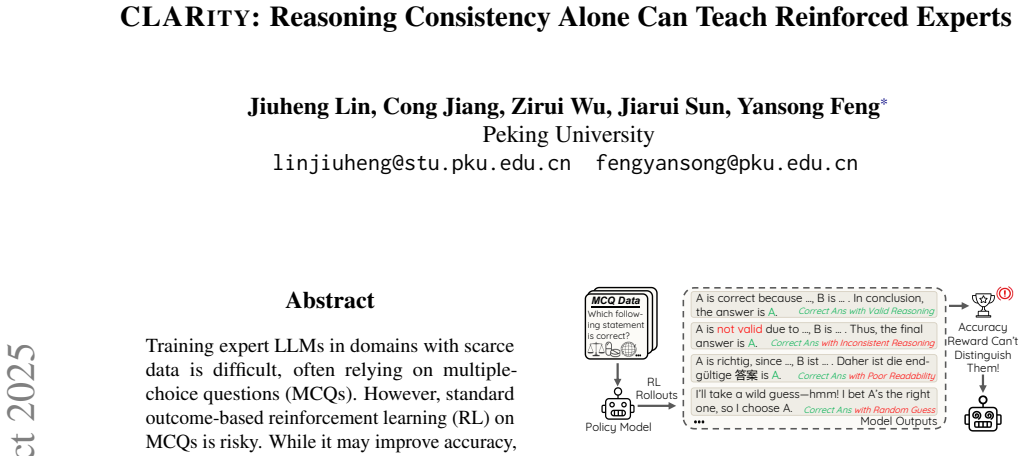
Training expert LLMs in domains with scarce data is difficult, often relying on multiple-choice questions (MCQs). However, standard outcome-based reinforcement learning (RL) on MCQs is risky. While it may improve accuracy, we observe it often degrades reasoning quality such as logical consistency. Existing solutions to supervise reasoning, such as large-scale Process Reward Models (PRMs), are prohibitively expensive. To address this, we propose CLARity, a cost-effective RL framework that enhances reasoning quality using only a small, general-purpose LLM. CLARity integrates a consistency-aware reward mechanism with a 2-stage refine-then-monitor training pipeline to enhance reasoning consistency, and a dynamic data reformulation strategy to to better exploit limited data. Experiments demonstrate that CLARity improves response consistency by 16.5% and accuracy by 7.5% over baselines. Human evaluations further confirm holistic improvements in coherence and professionalism. Thus, CLARity offers a generalizable solution that enables smaller models to effectively guide expert models by reasoning consistency. Our code is open sourced at: https://github.com/Infinite-set/CLARity
Figures


Reference graph
Works this paper leans on
-
[1]
Chenxin An, Zhihui Xie, Xiaonan Li, Lei Li, Jun Zhang, Shansan Gong, Ming Zhong, Jingjing Xu, Xipeng Qiu, Mingxuan Wang, and Lingpeng Kong. 2025. https://hkunlp.github.io/blog/2025/Polaris Polaris: A post-training recipe for scaling reinforcement learning on advanced reasoning models
2025
-
[2]
Iván Arcuschin, Jett Janiak, Robert Krzyzanowski, Senthooran Rajamanoharan, Neel Nanda, and Arthur Conmy. 2025. https://arxiv.org/abs/2503.08679 Chain-of-thought reasoning in the wild is not always faithful . Preprint, arXiv:2503.08679
Pith/arXiv arXiv 2025
-
[3]
Guan, Aleksander Madry, Wojciech Zaremba, Jakub Pachocki, and David Farhi
Bowen Baker, Joost Huizinga, Leo Gao, Zehao Dou, Melody Y. Guan, Aleksander Madry, Wojciech Zaremba, Jakub Pachocki, and David Farhi. 2025. https://arxiv.org/abs/2503.11926 Monitoring reasoning models for misbehavior and the risks of promoting obfuscation . Preprint, arXiv:2503.11926
Pith/arXiv arXiv 2025
-
[4]
Junying Chen, Zhenyang Cai, Ke Ji, Xidong Wang, Wanlong Liu, Rongsheng Wang, Jianye Hou, and Benyou Wang. 2024 a . https://arxiv.org/abs/2412.18925 Huatuogpt-o1, towards medical complex reasoning with llms . Preprint, arXiv:2412.18925
Pith/arXiv arXiv 2024
-
[5]
Bowman, Jan Leike, Jared Kaplan, and Ethan Perez
Yanda Chen, Joe Benton, Ansh Radhakrishnan, Jonathan Uesato, Carson Denison, John Schulman, Arushi Somani, Peter Hase, Misha Wagner, Fabien Roger, Vlad Mikulik, Samuel R. Bowman, Jan Leike, Jared Kaplan, and Ethan Perez. 2025. https://arxiv.org/abs/2505.05410 Reasoning models don't always say what they think . Preprint, arXiv:2505.05410
Pith/arXiv arXiv 2025
-
[6]
Yanda Chen, Chandan Singh, Xiaodong Liu, Simiao Zuo, Bin Yu, He He, and Jianfeng Gao. 2024 b . https://arxiv.org/abs/2401.13986 Towards consistent natural-language explanations via explanation-consistency finetuning . Preprint, arXiv:2401.13986
Pith/arXiv arXiv 2024
-
[7]
Bowman, Julian Michael, Ethan Perez, and Miles Turpin
James Chua, Edward Rees, Hunar Batra, Samuel R. Bowman, Julian Michael, Ethan Perez, and Miles Turpin. 2025. https://arxiv.org/abs/2403.05518 Bias-augmented consistency training reduces biased reasoning in chain-of-thought . Preprint, arXiv:2403.05518
Pith/arXiv arXiv 2025
-
[8]
DeepSeek-AI, Aixin Liu, Bei Feng, Bing Xue, Bing-Li Wang, Bochao Wu, Chengda Lu, Chenggang Zhao, Chengqi Deng, Chenyu Zhang, Chong Ruan, Damai Dai, Daya Guo, Dejian Yang, Deli Chen, Dong-Li Ji, Erhang Li, Fangyun Lin, Fucong Dai, and 179 others. 2024. https://api.semanticscholar.org/CorpusID:275118643 Deepseek-v3 technical report . ArXiv, abs/2412.19437
Pith/arXiv arXiv 2024
-
[9]
Jacob Devlin, Ming-Wei Chang, Kenton Lee, and Kristina Toutanova. 2019. https://arxiv.org/abs/1810.04805 Bert: Pre-training of deep bidirectional transformers for language understanding . Preprint, arXiv:1810.04805
Pith/arXiv arXiv 2019
-
[10]
Lishui Fan, Yu Zhang, Mouxiang Chen, and Zhongxin Liu. 2025. https://arxiv.org/abs/2508.05170 Posterior-grpo: Rewarding reasoning processes in code generation . Preprint, arXiv:2508.05170
Pith/arXiv arXiv 2025
-
[11]
Jiazhan Feng, Shijue Huang, Xingwei Qu, Ge Zhang, Yujia Qin, Baoquan Zhong, Chengquan Jiang, Jinxin Chi, and Wanjun Zhong. 2025. https://doi.org/10.48550/arXiv.2504.11536 ReTool : Reinforcement Learning for Strategic Tool Use in LLMs . Preprint, arXiv:2504.11536
-
[12]
Pedro Ferreira, Wilker Aziz, and Ivan Titov. 2025. https://arxiv.org/abs/2504.05294 Truthful or fabricated? using causal attribution to mitigate reward hacking in explanations . Preprint, arXiv:2504.05294
Pith/arXiv arXiv 2025
-
[13]
GLM, Aohan Zeng, Xin Lv, Qinkai Zheng, Zhenyu Hou, Bin Chen, Chengxing Xie, Cunxiang Wang, Da Yin, Hao Zeng, Jiajie Zhang, Kedong Wang, Lucen Zhong, Mingdao Liu, Rui Lu, Shulin Cao, Xiaohan Zhang, Xuancheng Huang, Yao Wei, and 152 others. 2025. https://arxiv.org/abs/2508.06471 Glm-4.5: Agentic, reasoning, and coding (arc) foundation models . Preprint, arX...
Pith/arXiv arXiv 2025
-
[14]
Jiawei Gu, Xuhui Jiang, Zhichao Shi, Hexiang Tan, Xuehao Zhai, Chengjin Xu, Wei Li, Yinghan Shen, Shengjie Ma, Honghao Liu, Saizhuo Wang, Kun Zhang, Yuanzhuo Wang, Wen Gao, Lionel Ni, and Jian Guo. 2025. https://arxiv.org/abs/2411.15594 A survey on llm-as-a-judge . Preprint, arXiv:2411.15594
Pith/arXiv arXiv 2025
-
[15]
Daya Guo, Dejian Yang, Haowei Zhang, Junxiao Song, Ruoyu Zhang, Runxin Xu, Qihao Zhu, Shirong Ma, Peiyi Wang, Xiao Bi, and 1 others. 2025. Deepseek-r1: Incentivizing reasoning capability in llms via reinforcement learning. arXiv preprint arXiv:2501.12948
Pith/arXiv arXiv 2025
-
[16]
Bolei He, Xinran He, Run Shao, Shanfu Shu, Xianwei Xue, Mingquan Cheng, Haifeng Li, and Zhenhua Ling. 2025. https://arxiv.org/abs/2508.15213 Select to know: An internal-external knowledge self-selection framework for domain-specific question answering . Preprint, arXiv:2508.15213
arXiv 2025
-
[17]
Jingcheng Hu, Yinmin Zhang, Qi Han, Daxin Jiang, and Heung-Yeung Shum Xiangyu Zhang. 2025. Open-reasoner-zero: An open source approach to scaling reinforcement learning on the base model. https://github.com/Open-Reasoner-Zero/Open-Reasoner-Zero
2025
-
[18]
Jerry Huang, Siddarth Madala, Risham Sidhu, Cheng Niu, Hao Peng, Julia Hockenmaier, and Tong Zhang. 2025. https://arxiv.org/abs/2503.12759 Rag-rl: Advancing retrieval-augmented generation via rl and curriculum learning . Preprint, arXiv:2503.12759
Pith/arXiv arXiv 2025
-
[19]
HuggingFace. 2025. https://github.com/huggingface/open-r1 Open r1: A fully open reproduction of deepseek-r1
2025
-
[20]
Bowen Jin, Hansi Zeng, Zhenrui Yue, Jinsung Yoon, Sercan Arik, Dong Wang, Hamed Zamani, and Jiawei Han. 2025. https://arxiv.org/abs/2503.09516 Search-r1: Training llms to reason and leverage search engines with reinforcement learning . Preprint, arXiv:2503.09516
Pith/arXiv arXiv 2025
-
[21]
Di Jin, Eileen Pan, Nassim Oufattole, Wei-Hung Weng, Hanyi Fang, and Peter Szolovits. 2020. https://arxiv.org/abs/2009.13081 What disease does this patient have? a large-scale open domain question answering dataset from medical exams . Preprint, arXiv:2009.13081
Pith/arXiv arXiv 2020
-
[22]
Qiao Jin, Bhuwan Dhingra, Zhengping Liu, William W. Cohen, and Xinghua Lu. 2019. https://arxiv.org/abs/1909.06146 Pubmedqa: A dataset for biomedical research question answering . Preprint, arXiv:1909.06146
Pith/arXiv arXiv 2019
-
[23]
Kimi, Angang Du, Bofei Gao, Bowei Xing, Changjiu Jiang, Cheng Chen, Cheng Li, Chenjun Xiao, Chenzhuang Du, Chonghua Liao, and 1 others. 2025. Kimi k1. 5: Scaling reinforcement learning with llms. arXiv preprint arXiv:2501.12599
Pith/arXiv arXiv 2025
-
[24]
Jan Hendrik Kirchner, Yining Chen, Harri Edwards, Jan Leike, Nat McAleese, and Yuri Burda. 2024. https://arxiv.org/abs/2407.13692 Prover-verifier games improve legibility of llm outputs . Preprint, arXiv:2407.13692
Pith/arXiv arXiv 2024
-
[25]
Gonzalez, Hao Zhang, and Ion Stoica
Woosuk Kwon, Zhuohan Li, Siyuan Zhuang, Ying Sheng, Lianmin Zheng, Cody Hao Yu, Joseph E. Gonzalez, Hao Zhang, and Ion Stoica. 2023. Efficient memory management for large language model serving with pagedattention. In Proceedings of the ACM SIGOPS 29th Symposium on Operating Systems Principles
2023
-
[26]
Fangyu Lei, Jinxiang Meng, Yiming Huang, Tinghong Chen, Yun Zhang, Shizhu He, Jun Zhao, and Kang Liu. 2025. https://arxiv.org/abs/2506.01710 Reasoning-table: Exploring reinforcement learning for table reasoning . Preprint, arXiv:2506.01710
Pith/arXiv arXiv 2025
-
[27]
Haitao Li, You Chen, Qingyao Ai, Yueyue Wu, Ruizhe Zhang, and Yiqun Liu. 2025 a . Lexeval: A comprehensive chinese legal benchmark for evaluating large language models. Advances in Neural Information Processing Systems, 37:25061--25094
2025
-
[28]
Xuefeng Li, Haoyang Zou, and Pengfei Liu. 2025 b . https://arxiv.org/abs/2502.11886 Limr: Less is more for rl scaling . Preprint, arXiv:2502.11886
Pith/arXiv arXiv 2025
-
[29]
Yinhan Liu, Myle Ott, Naman Goyal, Jingfei Du, Mandar Joshi, Danqi Chen, Omer Levy, Mike Lewis, Luke Zettlemoyer, and Veselin Stoyanov. 2019. https://arxiv.org/abs/1907.11692 Roberta: A robustly optimized bert pretraining approach . Preprint, arXiv:1907.11692
Pith/arXiv arXiv 2019
-
[30]
Alexander Meinke, Bronson Schoen, Jérémy Scheurer, Mikita Balesni, Rusheb Shah, and Marius Hobbhahn. 2025. https://arxiv.org/abs/2412.04984 Frontier models are capable of in-context scheming . Preprint, arXiv:2412.04984
Pith/arXiv arXiv 2025
-
[31]
OpenAI, Aaron Hurst, Adam Lerer, Adam P. Goucher, Adam Perelman, Aditya Ramesh, Aidan Clark, AJ Ostrow, Akila Welihinda, Alan Hayes, Alec Radford, Aleksander Mądry, Alex Baker-Whitcomb, Alex Beutel, Alex Borzunov, Alex Carney, Alex Chow, Alex Kirillov, Alex Nichol, and 400 others. 2024 a . https://arxiv.org/abs/2410.21276 Gpt-4o system card . Preprint, ar...
Pith/arXiv arXiv 2024
-
[32]
OpenAI, Aaron Jaech, Adam Kalai, Adam Lerer, Adam Richardson, Ahmed El-Kishky, Aiden Low, Alec Helyar, Aleksander Madry, Alex Beutel, Alex Carney, Alex Iftimie, Alex Karpenko, Alex Tachard Passos, Alexander Neitz, Alexander Prokofiev, Alexander Wei, Allison Tam, Ally Bennett, and 243 others. 2024 b . https://arxiv.org/abs/2412.16720 Openai o1 system card ...
Pith/arXiv arXiv 2024
-
[33]
Jiayi Pan, Junjie Zhang, Xingyao Wang, Lifan Yuan, Hao Peng, and Alane Suhr. 2025. Tinyzero. https://github.com/Jiayi-Pan/TinyZero. Accessed: 2025-01-24
2025
-
[34]
Edwin W Patterson. 1951. Case method in american legal education: Its origins and objectives, the. J. Legal Educ., 4:1
1951
-
[35]
Debjit Paul, Robert West, Antoine Bosselut, and Boi Faltings. 2024. https://arxiv.org/abs/2402.13950 Making reasoning matter: Measuring and improving faithfulness of chain-of-thought reasoning . Preprint, arXiv:2402.13950
Pith/arXiv arXiv 2024
-
[36]
Qwen. 2025. https://qwenlm.github.io/blog/qwq-32b/ Qwq-32b: The power of scaling rl
2025
-
[37]
Qwen, An Yang, Baosong Yang, Beichen Zhang, Binyuan Hui, Bo Zheng, Bowen Yu, Chengyuan Li, Dayiheng Liu, Fei Huang, Haoran Wei, Huan Lin, Jian Yang, Jianhong Tu, Jianwei Zhang, Jianxin Yang, Jiaxi Yang, Jingren Zhou, Junyang Lin, and 24 others. 2025. https://arxiv.org/abs/2412.15115 Qwen2.5 technical report . Preprint, arXiv:2412.15115
Pith/arXiv arXiv 2025
-
[38]
John Schulman, Filip Wolski, Prafulla Dhariwal, Alec Radford, and Oleg Klimov. 2017. https://api.semanticscholar.org/CorpusID:28695052 Proximal policy optimization algorithms . ArXiv, abs/1707.06347
Pith/arXiv arXiv 2017
-
[39]
Zhihong Shao, Peiyi Wang, Qihao Zhu, Runxin Xu, Junxiao Song, Xiao Bi, Haowei Zhang, Mingchuan Zhang, YK Li, Y Wu, and 1 others. 2024. https://arxiv.org/abs/2402.03300 Deepseekmath: Pushing the limits of mathematical reasoning in open language models
Pith/arXiv arXiv 2024
-
[40]
Guangming Sheng, Chi Zhang, Zilingfeng Ye, Xibin Wu, Wang Zhang, Ru Zhang, Yanghua Peng, Haibin Lin, and Chuan Wu. 2025. https://doi.org/10.1145/3689031.3696075 Hybridflow: A flexible and efficient rlhf framework . In Proceedings of the Twentieth European Conference on Computer Systems, EuroSys ’25, page 1279–1297. ACM
arXiv 2025
-
[41]
Huatong Song, Jinhao Jiang, Yingqian Min, Jie Chen, Zhipeng Chen, Wayne Xin Zhao, Lei Fang, and Ji-Rong Wen. 2025. https://arxiv.org/abs/2503.05592 R1-searcher: Incentivizing the search capability in llms via reinforcement learning . Preprint, arXiv:2503.05592
Pith/arXiv arXiv 2025
-
[42]
Yi Su, Dian Yu, Linfeng Song, Juntao Li, Haitao Mi, Zhaopeng Tu, Min Zhang, and Dong Yu. 2025. https://arxiv.org/abs/2503.23829 Crossing the reward bridge: Expanding rl with verifiable rewards across diverse domains . Preprint, arXiv:2503.23829
Pith/arXiv arXiv 2025
-
[43]
Sijie Wang, Quanjiang Guo, Kai Zhao, Yawei Zhang, Xin Li, Xiang Li, Siqi Li, Rui She, Shangshu Yu, and Wee Peng Tay. 2025 a . https://arxiv.org/abs/2508.05242 Codeboost: Boosting code llms by squeezing knowledge from code snippets with rl . Preprint, arXiv:2508.05242
Pith/arXiv arXiv 2025
-
[44]
Zezhong Wang, Xingshan Zeng, Weiwen Liu, Yufei Wang, Liangyou Li, Yasheng Wang, Lifeng Shang, Xin Jiang, Qun Liu, and Kam-Fai Wong. 2025 b . https://arxiv.org/abs/2406.16144 Chain-of-probe: Examining the necessity and accuracy of cot step-by-step . Preprint, arXiv:2406.16144
Pith/arXiv arXiv 2025
-
[45]
Lilian Weng. 2024. https://lilianweng.github.io/posts/2024-11-28-reward-hacking/ Reward hacking in reinforcement learning. lilianweng.github.io
2024
-
[46]
Tian Xie, Zitian Gao, Qingnan Ren, Haoming Luo, Yuqian Hong, Bryan Dai, Joey Zhou, Kai Qiu, Zhirong Wu, and Chong Luo. 2025. https://doi.org/10.48550/arXiv.2502.14768 Logic- RL : Unleashing LLM Reasoning with Rule-Based Reinforcement Learning . Preprint, arXiv:2502.14768
-
[47]
Ling Yang, Zhaochen Yu, Bin Cui, and Mengdi Wang. 2025. https://arxiv.org/abs/2502.06772 Reasonflux: Hierarchical llm reasoning via scaling thought templates . Preprint, arXiv:2502.06772
Pith/arXiv arXiv 2025
-
[48]
Hongzhou Yu, Tianhao Cheng, Yingwen Wang, Wen He, Qing Wang, Ying Cheng, Yuejie Zhang, Rui Feng, and Xiaobo Zhang. 2025. https://arxiv.org/abs/2501.09213 Finemedlm-o1: Enhancing medical knowledge reasoning ability of llm from supervised fine-tuning to test-time training . Preprint, arXiv:2501.09213
Pith/arXiv arXiv 2025
-
[49]
Low, Eugene Ho Hong Zhuang, and Daren Zong Loong Tan
Yang Zhao, Chengxiao Dai, Wei Zhuo, Tan Chuan Fu, Yue Xiu, Dusit Niyato, Jonathan Z. Low, Eugene Ho Hong Zhuang, and Daren Zong Loong Tan. 2025. https://arxiv.org/abs/2508.01815 Agentict ^2 s:robust text-to-sparql via agentic collaborative reasoning over heterogeneous knowledge graphs for the circular economy . Preprint, arXiv:2508.01815
Pith/arXiv arXiv 2025
-
[50]
Haoxi Zhong, Chaojun Xiao, Cunchao Tu, Tianyang Zhang, Zhiyuan Liu, and Maosong Sun. 2020. Jec-qa: a legal-domain question answering dataset. In Proceedings of the AAAI conference on artificial intelligence, volume 34, pages 9701--9708
2020
-
[51]
Ruochen Zhou, Minrui Xu, Shiqi Chen, Junteng Liu, Yunqi Li, Xinxin Lin, Zhengyu Chen, and Junxian He. 2025. https://doi.org/10.48550/arXiv.2507.04391 Does Learning Mathematical Problem-Solving Generalize to Broader Reasoning ? Preprint, arXiv:2507.04391
-
[52]
online" 'onlinestring :=
ENTRY address archivePrefix author booktitle chapter edition editor eid eprint eprinttype howpublished institution journal key month note number organization pages publisher school series title type volume year doi pubmed url lastchecked label extra.label sort.label short.list INTEGERS output.state before.all mid.sentence after.sentence after.block STRING...
-
[53]
write newline
" write newline "" before.all 'output.state := FUNCTION n.dashify 't := "" t empty not t #1 #1 substring "-" = t #1 #2 substring "--" = not "--" * t #2 global.max substring 't := t #1 #1 substring "-" = "-" * t #2 global.max substring 't := while if t #1 #1 substring * t #2 global.max substring 't := if while FUNCTION word.in bbl.in capitalize " " * FUNCT...
discussion (0)
Sign in with ORCID, Apple, or X to comment. Anyone can read and Pith papers without signing in.