REVIEW 4 major objections 6 minor 33 references
Rethinking Over-Smoothing in Graph Neural Networks: A Perspective from Anderson Localization
T0 review · 4 major / 6 minor · reviewed 2026-08-06 · deepseek-v4-flash
Pith's one-line read This paper claims that over-smoothing in deep graph neural networks is Anderson localization: high-frequency graph signals get trapped by structural disorder, a mechanism the participation degree quantifies.
desk verdict A fresh physics analogy for over-smoothing, but the central formal claim is unsupported and internally inconsistent; not a research result. read the letter →
The pith
A machine-rendered reading of the paper's core claim, the machinery that carries it, and where it could break.
The reading
What carries the argument
The load-bearing object is the participation degree, adapted from vibration-mode analysis in disordered solids to graph signals. It is defined by $p_\lambda = \frac{(\sum_i h_{\lambda,i}^2)^2}{N \sum_i h_{\lambda,i}^4}$, where $\lambda$ indexes a graph-Laplacian eigenvalue and $h_{\lambda,i}$ is the projection of node $i$'s feature vector onto the corresponding eigenvector. The companion quantity is the degree fluctuation $\Delta k = \sqrt{\frac{1}{N}\sum_i (k_i-\langle k\rangle)^2}$, which the paper treats as the graph's disorder strength. Together they carry the argument: $\Delta k$ is the presumed cause of localization, $p_\lambda$ is the observable that diagnoses it, and Eq. (14) is the predicted fate of every frequency component as depth grows.
What would settle it
Take a fixed graph, initialize node features to a single Laplacian eigenvector $v_\lambda$, run many rounds of standard graph convolution, and record $p_\lambda$. The localization picture predicts the lowest-frequency modes stay near $p_\lambda\approx 1$ while high-frequency modes decay; the literal statement of Eq. (14) predicts $p_\lambda\to 0$ for every $\lambda\in[0,2]$. Measuring which curve actually occurs on regular, random, and scale-free graphs would settle whether the analogy holds and whether Eq. (14) needs modification.
Extended reading notes
Core claim
The central claim, stated in the paper's own terms, is that over-smoothing in GNNs is a spectral localization transition. The graph Laplacian plays the role of the dynamical matrix of a disordered solid, nodes correspond to particles, edges to interactions, and the fluctuation of node degrees plays the role of random on-site potentials. The proposed order parameter is the participation degree, defined for each frequency $\lambda$ as $p_\lambda = \frac{(\sum_i h_{\lambda,i}^2)^2}{N \sum_i h_{\lambda,i}^4}$, where $h_{\lambda,i}$ is the projection of node $i$'s feature onto the Laplacian eigenvector $v_\lambda$. Small $p_\lambda$ means the feature component is confined to few nodes, large $p_\lambda$ means it is globally spread. Equation (14) asserts $\lim_{L\to\infty} p_\lambda \to 0$ for all $\lambda\in[0,2]$, which the paper interprets as high-frequency components failing to cross potential barriers while low-frequency components homogenize the graph. The paper positions this as a theoretical framework, states the disorder-localization link as a hypothesis rather than a derivation, and proposes that modulating aggregation by degree (dropping edges at hubs, adding edges at low-degree nodes) reduces disorder and therefore eases over-smoothing.
Load-bearing premise
The whole argument rests on the assumption that irregularity in how many neighbours nodes have behaves like the random impurities in Anderson localization, so that high-frequency graph signals really do face barriers that trap them; the paper presents this as a reasonable inference and a conjecture, not as a result derived from message passing.
Editorial extensions
If this is right
- Participation degree becomes a layer-by-layer diagnostic: a drop in high-frequency $p_\lambda$ should be observable before node features fully homogenize.
- The framework predicts that over-smoothing is frequency-selective: low-frequency content spreads, high-frequency content is trapped, so remedies should aim at preserving high-frequency propagation rather than treating all features equally.
- If degree fluctuation is the disorder strength, then reducing degree heterogeneity, for example through the paper's proposed degree-dependent edge dropping and edge adding, should delay localization and preserve distinctiveness.
- The formal limit in Eq. (14) implies over-smoothing is a limiting spectral property of deep message passing rather than a finite-depth artifact, so it will not disappear without changing the propagation rule or the graph structure.
Reading between the lines
- Beyond the paper: the limit in Eq. (14) is stated for all $\lambda\in[0,2]$, but for the constant eigenvector $\lambda=0$ the participation degree approaches 1, not 0; the formal claim would need to be restricted to higher frequencies or renormalized by the dominant mode.
- Beyond the paper: if degree fluctuation is the disorder strength, then graph rewiring that equalizes degrees should measurably increase propagation depth; a direct test is to compare participation-degree decay on regular, Erdős–Rényi, and scale-free graphs with matched node counts.
- Beyond the paper: residual connections may work precisely because they let high-frequency components bypass the barriers the paper describes, which would make the localization framework a unifying explanation for several existing over-smoothing remedies.
Editorial analysis
A structured set of objections, weighed in public.
Referee Report
Summary. The paper proposes an analogy between over-smoothing in Graph Neural Networks (GNNs) and Anderson localization in disordered physical systems. It introduces a participation degree p_λ based on projections of node features onto Laplacian eigenvectors, claims that p_λ → 0 for all λ as network depth grows (Eq. 14), and proposes that reducing degree fluctuation in the graph will alleviate over-smoothing. The manuscript is primarily a conceptual analysis, with no experiments, and it explicitly defers validation of its main mitigation hypothesis to future work.
Significance. If the proposed analogy were made rigorous, it could offer a new physics-inspired perspective and a new metric (participation degree) for quantifying over-smoothing in GNNs, as well as a design principle based on reducing graph disorder. The paper is clearly written and cites relevant physics and GNN literature. However, the central formal statement (Eq. 14) is asserted without derivation and appears inconsistent with the paper's own qualitative claims, and the proposed mitigation is not validated. The significance of the contribution is therefore not currently established.
major comments (4)
- [§4.1, Eq. (14)] Equation (14) is the central quantitative claim of the paper, but it is asserted without derivation and is internally inconsistent with the paper's own description. The abstract and Section 4.1 state that over-smoothing corresponds to expansion of low-frequency modes (increased participation degree) and localization of high-frequency modes (decreased participation degree). Yet Eq. (14) asserts lim_{L→∞} p_λ → 0 for all λ ∈ [0,2]. For a connected graph under standard message passing, the projection onto the constant eigenvector (λ = 0) is preserved and becomes dominant, so p_0 would approach 1, not 0. For λ > 0, the projections h_{λ,i} typically decay to zero, making the ratio in Eq. (13) undefined (0/0). No derivation of Eq. (14) from a GNN update rule is provided, so this load-bearing statement is unsupported.
- [§4.2 and §4.3] The transfer from Anderson localization to GNNs is explicitly presented as a 'reasonable inference' (Section 4.2) and a 'conjecture' (Section 4.3), not as a derived result. The key physical analogy — that high-frequency graph signals face 'potential barriers' analogous to random on-site potentials — is never formalized in terms of the GNN message-passing equations. The paper also does not derive the relationship between degree fluctuation Δk (Eq. (16)) and the spectral dynamics of GNNs. Since the paper claims to provide a 'theoretical framework,' this missing derivation is a load-bearing gap.
- [§4.1–§4.3, overall] Once Eq. (14) is removed, the paper's formal content reduces to a restatement of the known exponential convergence to the dominant eigenspace (Oono and Suzuki, Ref. [22]) in the vocabulary of participation degree. The paper does not demonstrate that the participation-degree formalism yields new quantitative predictions or falsifiable statements about GNN over-smoothing. The only concrete prediction — that higher disorder (higher Δk) leads to more over-smoothing — is not derived and is not tested.
- [§4.5] The proposed mitigation strategy is presented as a hypothesis: the text says 'we hypothesize' and 'this is a potential hypothesis,' and the conclusion explicitly defers validation to future work. No theoretical guarantee or experimental evidence is provided for the claim that reducing disorder alleviates over-smoothing. As a result, the design principle is currently a speculation rather than a supported result.
minor comments (6)
- [§4.1, Eq. (13)] The notation p_λ is not indexed by the layer L, even though Eq. (14) takes a limit over L. Write p_λ(L) or define p_λ^{(L)} explicitly.
- [§4.4, Eq. (16)] The degree fluctuation Δk is defined as (1/N) sqrt(Σ(k_i - ⟨k⟩)^2), which is not the standard deviation; the standard deviation would have a factor 1/sqrt(N) outside the square root. Please correct the formula.
- [§4.1] The text says a low participation degree 'implies that the signal is dominated by low-frequency components.' A low participation degree means the projection is concentrated on a few nodes; this does not by itself imply dominance of low-frequency components. Clarify the relationship.
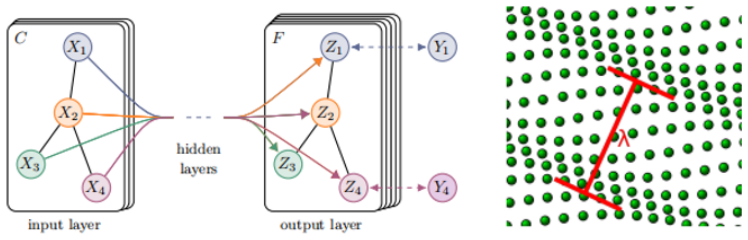
- [Figures 2 and 4] The figure captions use unclear terms such as 'body integral Δϕ' and 'distance point J,' which appear to be typos. Also, the figures are not discussed in detail in the body text.
- [Throughout] The paper repeatedly uses terms like 'metallic phase' and 'insulating phase' without defining them in the GNN context; consider adding a brief explanation for readers unfamiliar with condensed matter physics.
- [§4.5] The parameters in Eqs. (17) and (18) include a free parameter α, but the paper does not discuss how it should be chosen or whether the proposed mechanism is applicable to directed or weighted graphs.
Circularity Check
Eq. (14) is a definitional restatement of the paper's own characterization of over-smoothing, not a result derived from Anderson localization.
-
self definitional
[Section 4.1, Eq. (14)]
"However, if the participation degree of the features at higher layers becomes very low ( pλ → 0), it indicates that the features are being dominated by low-frequency components, leading to a loss of node individuality. This behavior can be formally expressed as: lim_{L→∞} pλ → 0 ∀λ ∈ [0, 2] (14)"
Equation (14) is presented as the formal statement of the paper's theoretical mechanism, but the sentence directly above it stipulates that over-smoothing is the regime in which pλ → 0. No derivation from message passing, Laplacian spectral dynamics, or Anderson-localization mathematics connects the depth limit to pλ; the equation simply rewrites the preceding definitional characterization in limit notation. It is therefore equivalent to its own premise by construction, rather than a derived prediction. The paper's own abstract and Section 4.1 simultaneously say over-smoothing includes expansion of low-frequency modes (p increased), so Eq. (14)'s '∀λ∈[0,2]' contradicts that characterization; this inconsistency confirms the formula was stipulated, not derived.
full rationale
The paper contains no fitted parameters, no measured-data predictions, and no self-citation chain; the Anderson-localization transfer is explicitly labeled a 'reasonable inference' and a 'conjecture' in Sections 4.2–4.4, which avoids presenting the analogy as a derived theorem. The one definitional circularity is Eq. (14): the text first stipulates that over-smoothing corresponds to pλ → 0 and then 'formally expresses' this as a limit over depth, without any derivation from the message-passing operator. Thus the central formal claim reduces to its own definition. I do not count the internal contradiction with the low-frequency expansion statement as circularity; that is a correctness risk. The participation-degree metric itself and the disorder-reduction proposal are independent content, so the circularity is partial rather than total.
Assumptions & free parameters
free parameters (1)
- alpha (alpha)
assumptions (3)
- domain assumption The behavior of graph signal propagation in GNNs is governed by the same localization laws as Anderson localization in disordered solids, including potential barriers and localization length scaling.
- ad hoc to paper Eq. (14): lim_{L->inf} p_lambda -> 0 for all lambda in [0,2].
- domain assumption The eigenvectors of the graph Laplacian are analogous to the vibration modes of the dynamical matrix and can be treated as the same object for the purpose of the analysis.
Cite this review
Pith. "Pith review of Rethinking Over-Smoothing in Graph Neural Networks: A Perspective from Anderson Localization." pith.science (2026). https://pith.science/paper/HLPMBOZB
@misc{pith2026250705263,
  author       = {Pith},
  title        = {Pith review of: Rethinking Over-Smoothing in Graph Neural Networks: A Perspective from Anderson Localization},
  year         = {2026},
  howpublished = {\url{https://pith.science/paper/HLPMBOZB}},
  note         = {Machine review of arXiv:2507.05263}
}
read the original abstract
Graph Neural Networks (GNNs) have shown great potential in graph data analysis due to their powerful representation capabilities. However, as the network depth increases, the issue of over-smoothing becomes more severe, causing node representations to lose their distinctiveness. This paper analyzes the mechanism of over-smoothing through the analogy to Anderson localization and introduces participation degree as a metric to quantify this phenomenon. Specifically, as the depth of the GNN increases, node features homogenize after multiple layers of message passing, leading to a loss of distinctiveness, similar to the behavior of vibration modes in disordered systems. In this context, over-smoothing in GNNs can be understood as the expansion of low-frequency modes (increased participation degree) and the localization of high-frequency modes (decreased participation degree). Based on this, we systematically reviewed the potential connection between the Anderson localization behavior in disordered systems and the over-smoothing behavior in Graph Neural Networks. A theoretical analysis was conducted, and we proposed the potential of alleviating over-smoothing by reducing the disorder in information propagation.
Figures


Figures from the paper (1 more)

Reference graph
Works this paper leans on
-
[22]
Graph neural networks exponentially lose expressive power for node classification
Kenta Oono and Taiji Suzuki. Graph neural networks exponentially lose expressive power for node classification. arXiv preprint arXiv:1905.10947 , 2019. 16
arXiv 1905
-
[1]
Spin glasses: Experimental facts, theoretical concepts, and open questions
Kurt Binder and A Peter Young. Spin glasses: Experimental facts, theoretical concepts, and open questions. Reviews of Modern physics , 58(4):801, 1986
work page 1986
-
[2]
The physics of amorphous solids
Richard Zallen. The physics of amorphous solids . John Wiley & Sons, 2008
work page 2008
-
[3]
Percolation on complex networks: Theory and application
Ming Li, Run-Ran Liu, Linyuan L¨ u, Mao-Bin Hu, Shuqi Xu, and Yi-Cheng Zhang. Percolation on complex networks: Theory and application. Physics reports, 907:1–68, 2021
work page 2021
-
[4]
Absence of diffusion in certain random lattices
Philip W Anderson. Absence of diffusion in certain random lattices. Physical review, 109(5):1492, 1958
1958
-
[5]
The jamming transition and the marginally jammed solid
Andrea J Liu and Sidney R Nagel. The jamming transition and the marginally jammed solid. Annu. Rev. Condens. Matter Phys. , 1(1):347–369, 2010
2010
-
[6]
Neural networks and physical systems with emergent collective com- putational abilities
John J Hopfield. Neural networks and physical systems with emergent collective com- putational abilities. Proceedings of the national academy of sciences , 79(8):2554–2558, 1982
work page 1982
-
[7]
Chaos in random neural networks
Haim Sompolinsky, Andrea Crisanti, and Hans-Jurgen Sommers. Chaos in random neural networks. Physical review letters , 61(3):259, 1988
work page 1988
Show all 33 references
-
[8]
Comparing dy- namics: Deep neural networks versus glassy systems
Marco Baity-Jesi, Levent Sagun, Mario Geiger, Stefano Spigler, G´ erard Ben Arous, Chiara Cammarota, Yann LeCun, Matthieu Wyart, and Giulio Biroli. Comparing dy- namics: Deep neural networks versus glassy systems. In International Conference on Machine Learning, pages 314–323....
2018
-
[9]
Spin-glass models of neural networks
Daniel J Amit, Hanoch Gutfreund, and Haim Sompolinsky. Spin-glass models of neural networks. Physical Review A , 32(2):1007, 1985
1985
-
[10]
Geometry of neural network loss surfaces via random matrix theory
Jeffrey Pennington and Yasaman Bahri. Geometry of neural network loss surfaces via random matrix theory. In International conference on machine learning , pages 2798–
-
[11]
Statistical mechanics of deep learning
Yasaman Bahri, Jonathan Kadmon, Jeffrey Pennington, Sam S Schoenholz, Jascha Sohl- Dickstein, and Surya Ganguli. Statistical mechanics of deep learning. Annual review of condensed matter physics , 11(1):501–528, 2020
2020
-
[12]
Statistical physics of deep neural networks: Initialization toward optimal channels.Physical Review Research, 5(2):023023, 2023
Kangyu Weng, Aohua Cheng, Ziyang Zhang, Pei Sun, and Yang Tian. Statistical physics of deep neural networks: Initialization toward optimal channels.Physical Review Research, 5(2):023023, 2023
2023
-
[13]
Dynamic neurons: A statistical physics approach for analyzing deep neural networks
Donghee Lee, Hye-Sung Lee, and Jaeok Yi. Dynamic neurons: A statistical physics approach for analyzing deep neural networks. arXiv preprint arXiv:2410.00396 , 2024
2024 arXiv
-
[14]
Scaling laws for neural language models
Jared Kaplan, Sam McCandlish, Tom Henighan, Tom B Brown, Benjamin Chess, Rewon Child, Scott Gray, Alec Radford, Jeffrey Wu, and Dario Amodei. Scaling laws for neural language models. arXiv preprint arXiv:2001.08361 , 2020
2001 arXiv
-
[15]
A phase transition between positional and semantic learning in a solvable model of dot-product attention
Hugo Cui, Freya Behrens, Florent Krzakala, and Lenka Zdeborov´ a. A phase transition between positional and semantic learning in a solvable model of dot-product attention. Advances in Neural Information Processing Systems , 37:36342–36389, 2024
2024
-
[16]
Grokking as a first order phase transition in two layer networks
Noa Rubin, Inbar Seroussi, and Zohar Ringel. Grokking as a first order phase transition in two layer networks. arXiv preprint arXiv:2310.03789 , 2023
2023 arXiv
-
[17]
Sampling with flows, diffusion, and autoregressive neural networks from a spin-glass perspective
Davide Ghio, Yatin Dandi, Florent Krzakala, and Lenka Zdeborov´ a. Sampling with flows, diffusion, and autoregressive neural networks from a spin-glass perspective. Pro- ceedings of the National Academy of Sciences , 121(27):e2311810121, 2024
2024
-
[18]
Statistical physics analysis of graph neural net- works: Approaching optimality in the contextual stochastic block model
O Duranthon and L Zdeborov´ a. Statistical physics analysis of graph neural net- works: Approaching optimality in the contextual stochastic block model. arXiv preprint arXiv:2503.01361, 2025
2025
-
[19]
Graph neural networks for social recommendation
Wenqi Fan, Yao Ma, Qing Li, Yuan He, Eric Zhao, Jiliang Tang, and Dawei Yin. Graph neural networks for social recommendation. In The world wide web conference , pages 417–426, 2019
2019
-
[20]
Learning from protein structure with geometric vector perceptrons.arXiv preprint arXiv:2009.01411, 2020
Bowen Jing, Stephan Eismann, Patricia Suriana, Raphael JL Townshend, and Ron Dror. Learning from protein structure with geometric vector perceptrons.arXiv preprint arXiv:2009.01411, 2020
2009 arXiv
-
[21]
Graph neu- ral networks for materials science and chemistry
Patrick Reiser, Marlen Neubert, Andr´ e Eberhard, Luca Torresi, Chen Zhou, Chen Shao, Houssam Metni, Clint van Hoesel, Henrik Schopmans, Timo Sommer, et al. Graph neu- ral networks for materials science and chemistry. Communications Materials, 3(1):93, 2022
2022
-
[23]
Measuring and relieving the over-smoothing problem for graph neural networks from the topological view
Deli Chen, Yankai Lin, Wei Li, Peng Li, Jie Zhou, and Xu Sun. Measuring and relieving the over-smoothing problem for graph neural networks from the topological view. In Proceedings of the AAAI conference on artificial intelligence , volume 34, pages 3438– 3445, 2020
2020
-
[24]
Deepgcns: Can gcns go as deep as cnns? In Proceedings of the IEEE/CVF international conference on computer vision, pages 9267–9276, 2019
Guohao Li, Matthias Muller, Ali Thabet, and Bernard Ghanem. Deepgcns: Can gcns go as deep as cnns? In Proceedings of the IEEE/CVF international conference on computer vision, pages 9267–9276, 2019
2019
-
[25]
Dropedge: Towards deep graph convolutional networks on node classification
Yu Rong, Wenbing Huang, Tingyang Xu, and Junzhou Huang. Dropedge: Towards deep graph convolutional networks on node classification. arXiv preprint arXiv:1907.10903 , 2019
1907 arXiv
-
[26]
Pde-gcn: Novel architectures for graph neural networks motivated by partial differential equations
Moshe Eliasof, Eldad Haber, and Eran Treister. Pde-gcn: Novel architectures for graph neural networks motivated by partial differential equations. Advances in neural infor- mation processing systems, 34:3836–3849, 2021
2021
-
[27]
Fifty years of anderson localization
Ad Lagendijk, Bart van Tiggelen, and Diederik S Wiersma. Fifty years of anderson localization. Physics today, 62(8):24–29, 2009
2009
-
[28]
Direct observation of anderson localization of matter waves in a controlled disorder
Juliette Billy, Vincent Josse, Zhanchun Zuo, Alain Bernard, Ben Hambrecht, Pierre Lugan, David Cl´ ement, Laurent Sanchez-Palencia, Philippe Bouyer, and Alain Aspect. Direct observation of anderson localization of matter waves in a controlled disorder. Nature, 453(7197):891–894, 2008
2008
-
[29]
Many-body localization and thermalization in quantum statistical mechanics
Rahul Nandkishore and David A Huse. Many-body localization and thermalization in quantum statistical mechanics. Annu. Rev. Condens. Matter Phys. , 6(1):15–38, 2015
2015
-
[30]
Interplay of non- hermitian skin effects and anderson localization in nonreciprocal quasiperiodic lattices
Hui Jiang, Li-Jun Lang, Chao Yang, Shi-Liang Zhu, and Shu Chen. Interplay of non- hermitian skin effects and anderson localization in nonreciprocal quasiperiodic lattices. Physical Review B , 100(5):054301, 2019
2019
-
[31]
Semi-supervised classification with graph convolu- tional networks
Thomas N Kipf and Max Welling. Semi-supervised classification with graph convolu- tional networks. arXiv preprint arXiv:1609.02907 , 2016
2016 arXiv
-
[32]
https://en.wikipedia.org/wiki/phonon
-
[33]
Bridging the gap between spatial and spectral domains: A unified framework for graph neural networks
Zhiqian Chen, Fanglan Chen, Lei Zhang, Taoran Ji, Kaiqun Fu, Liang Zhao, Feng Chen, Lingfei Wu, Charu Aggarwal, and Chang-Tien Lu. Bridging the gap between spatial and spectral domains: A unified framework for graph neural networks. ACM Computing Surveys, 56(5):1–42, 2023. 17
2023
Reviewed August 6, 2026 · model on record in the stance chip above.
Discussion (0). Sign in to comment.