REVIEW 5 major objections 5 minor 7 cited by
LOVON: Legged Open-Vocabulary Object Navigator
T0 review · 5 major / 5 minor · reviewed 2026-08-06 · deepseek-v4-flash
Pith's one-line read LOVON combines an LLM task planner, an open-vocabulary detector, and a learned language-to-motion model so a legged robot can carry out long-horizon object search and navigation from natural-language instructions.
desk verdict A genuinely integrated legged-robot navigation system that overstates itself by calling a YOLO-11 pipeline open-vocabulary; the engineering is real, the central claim is not. read the letter →
The pith
A machine-rendered reading of the paper's core claim, the machinery that carries it, and where it could break.
The reading
What carries the argument
The load-bearing module is the Language-to-Motion Model (L2MM), an encoder-decoder transformer that takes the previous and current instruction, the detected object's class, confidence, bounding box, and the current mission and search states separated by [SEP] tokens, and predicts a motion vector $V_m=[v_x, v_y, \theta]$ plus a mission state (success or running) and a search state (rotate left or right). This single model turns language instructions and vision detections into closed-loop robot commands, while the Laplacian Variance Filtering preprocessor discards motion-blurred frames so the detector receives stable input. The LLM planner decomposes the long-horizon instruction into numbered subtasks, and the instruction object extractor (IOE) maps each subtask to a detector class.
What would settle it
Run LOVON on a legged robot with a precisely specified target object that is not in the COCO class list and has no synonym in the LLM-generated list (e.g., a pipe wrench outdoors); if the robot never enters the approach state, the open-vocabulary claim fails. Alternatively, measure the L2MM's predicted motion vectors on real camera footage with motion blur and compare them with the executed trajectory; a large divergence would show the synthetic data distribution does not transfer.
Extended reading notes
Core claim
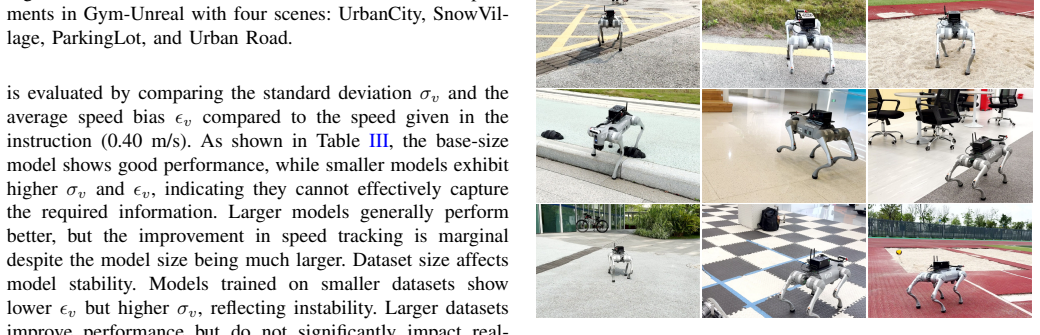
The central claim is that hierarchical LLM planning, open-vocabulary detection, and a learned sequence-to-vector motion mapping can be integrated into one deployable system for legged robots. In simulation LOVON achieves a mean episode length of 499.75 and success rate of 1.00 across ParkingLot, UrbanCity, UrbanRoad, and SnowVillage, matching or beating prior tracking methods while training in about 1.5 hours; on real hardware the same system handles open-world objects of different sizes, tracks dynamic targets across flat roads, spiral stairs, and wild grass, and re-localizes after disturbances. The paper's stated contribution is that LOVON is the first operational system to combine these capabilities in unstructured environments.
Load-bearing premise
The system works only if the language-to-motion model, trained entirely on synthetic data generated by an LLM, transfers to real camera images and robot dynamics, and only if the detector's fixed COCO class list plus LLM-generated synonyms covers the objects a user actually names.
Editorial extensions
If this is right
- If LOVON is correct, natural-language instructions can drive long sequences of object search and approach on a legged robot with no per-object retraining.
- The 1.5-hour training time on synthetic data means new robot platforms could be brought up quickly, since the L2MM is shared across Go2, B2, and H1-2.
- The blur-filtering preprocessing could be applied to other vision-based controllers on legged robots, raising the qualified frame rate by about 25 percent in the paper's measurements.
- In the Gym-Unreal benchmark, LOVON matches the success rate of the strongest baseline while cutting training time from 360 hours to 1.5 hours, making the result reproducible on commodity hardware.
Reading between the lines
- The 'open-vocabulary' claim is bounded by the detector's class list; a genuinely open set would require replacing YOLO-11 with a truly open-vocabulary detector, and the LLM synonym expansion only helps for names near the existing classes.
- Because the L2MM was trained on LLM-generated instruction-to-motion pairs rather than real trajectories, a sim-to-real gap may appear under unusual camera poses or lighting; fine-tuning on a small set of real demonstrations would be a natural next test.
- The success thresholds that stop the robot are LLM-generated heuristics per object class; learning these thresholds from human demonstrations or treating them as part of the motion policy could remove a hand-tuned step.
- The system's 'search' behavior is hard-coded as alternating left/right rotations; a learned or uncertainty-driven search policy could find lost targets faster.
Editorial analysis
A structured set of objections, weighed in public.
Referee Report
Summary. The paper presents LOVON, a modular pipeline for legged-robot long-horizon object navigation that combines an LLM task planner, an instruction-object extractor, a closed-set object detector (YOLO-11), a Laplacian-variance blur filter, and a learned language-to-motion model (L2MM) trained on synthetic LLM-generated data. Experiments are reported in the Gym-Unreal simulation benchmark and in real-world tests on Unitree Go2, B2, and H1-2, with near-perfect success rates in simulation and qualitative demonstrations of multi-goal, dynamic-target, and disturbance-robust navigation. The paper claims to be the first operational open-vocabulary object navigation system for legged robots.
Significance. If the claims held, the integration of LLM-based hierarchical planning with open-vocabulary detection and a learned motion model would be a useful contribution to legged-robot navigation. The paper has concrete strengths: multi-robot deployment on three platforms, short training times, and a simple motion-blur filtering idea with some real-data analysis. However, the central 'open-vocabulary' claim is undermined by the closed-set detector in the deployed pipeline, and the simulation comparison does not align the task setup between LOVON and tracker baselines. The real-world evaluation is qualitative and the thresholds are calibrated on the same data used for reporting improvements. The headline novelty and the quantitative evidence for it are therefore not established.
major comments (5)
- [Sec. IV-B, Eq. (2); Sec. VII-A] The formalism itself restricts the target vocabulary to a fixed set. Eq. (2) states I_object = f_IOE(I_m) ∈ C, where C is 'the set of classes that the detection model is capable of recognizing.' The deployed detection model is YOLO-11 (Sec. VII-A), a closed-set detector with a fixed COCO class set. Thus the IOE can only map an instruction to one of those classes, and the operational system cannot search for or navigate to an object outside C. All real-world demonstrations (backpack, chair, person, car, dog, ball) fall inside or are easily mapped to COCO classes. This contradicts the abstract's 'open-vocabulary visual detection models' and the Sec. I claim that LOVON is 'the first operational system' for open-vocabulary object navigation. The paper's suggestion that the detector could be swapped for Grounding DINO is a possible future change, not a validation of the deployed system.
- [Sec. VII-C, Table II] The comparison against baselines is not apples-to-apples. The baselines listed in Table II (DiMP, SARL, AD-VAT, TS, RSPT, EVT, TrackVLA) are active visual trackers that are typically initialized with a target template or bounding box, whereas LOVON's pipeline uses a semantic instruction and a closed-set detector to identify the target. The paper does not describe how the Gym-Unreal task was instantiated for LOVON (e.g., whether the target class was known, how the target was specified, and whether the baselines received the same sensory inputs or the same detection results). The task mismatch alone can explain LOVON's near-perfect SR, so the headline 'LOVON outperforms' claim is not supported by the presented evidence.
- [Sec. IV-C, Sec. VI, Sec. VII-B] The key thresholds are calibrated on the same data used to report success. Section VII-B states that 'after testing, we set the threshold to T_blur = 150,' and Sec. VI describes generating per-object success thresholds from 'initial examples' using an LLM. These thresholds directly determine whether the robot stops and declares a mission successful. Reporting improvements in qualified frame ratio and task success on the same data used for calibration does not establish generalization. A held-out validation or a sensitivity analysis with error bars is needed before the near-perfect simulation numbers can be interpreted.
- [Sec. VI, Fig. 4] The L2MM is trained entirely on a synthetic dataset generated by the DeepSeek R1 LLM, with no real images, real bounding boxes, or real robot states. The paper asserts successful transfer to real robots through qualitative demonstrations, but it does not quantify the sim-to-real gap. Since the motion-vector head directly commands the robot, a distribution shift between synthetic instruction/state sequences and real camera observations could break the control loop. The paper should report at least a real-world motion-vector accuracy or a failure-rate comparison against the synthetic test set.
- [Sec. VII-D] The real-world evaluation is entirely qualitative. Success is asserted with statements such as 'the robot completes its task without difficulty,' but no quantitative metrics are provided: no repeated-trial success rates, no episode lengths, no distance error at the stop point, no time-to-reacquire a lost object, and no error bars. Given the central claim of being the first operational system in unstructured environments, qualitative anecdotes are insufficient. At minimum, the paper should report a small number of repeated trials per scenario and per platform with standard errors.
minor comments (5)
- [Fig. 4] There are typos in the figure, including 'Succuss' and the class synonym 'Whiffet'; please proofread all text in figures.
- [Sec. IV-D, Table I] The notation for the motion vector is inconsistent: the text defines V_m = [vx, vy, θ], but Table I uses [vx, 0, θ_corr] and search states [0, 0, −0.3] and [0, 0, 0.3]. Please clarify whether vy is ever nonzero and specify the units of θ.
- [Sec. VII-C, Table II] The mean SR in the last row is reported as 499.75 / 1.00, but the per-environment values are 500/1.00, 500/1.00, 499/0.99, 500/1.00, which average to 0.9975, not 1.00; please round or report the exact value.
- [Sec. VII-A] The text says 'the detection model (e.g., YOLO-11)' and later 'we employ YOLO-11,' but the abstract and introduction repeatedly describe the system as using 'open-vocabulary visual detection models.' Please state clearly in every experiment section which detector is actually used, since the two descriptions do not match.
- [Sec. VII-B, Fig. 7] The axes of Fig. 7 are not fully labeled: the y-axis is 'Qualified Ratios' but the text refers to 'qualified frame ratio,' and it is unclear whether the subplot shows the same quantity with and without the moving average filter. Please define the metric precisely in the caption.
Circularity Check
Open-vocabulary claim is closed-set YOLO detection renamed via Eq. (2); blur-threshold gain is an in-sample fit.
-
renaming known result
[Section IV-B, Eq. (2); deployment detector in Section VII-A]
"Iobject = fIOE(Im) ∈ C, where C represents the set of classes that the detection model is capable of recognizing."
The central 'open-vocabulary' capability is defined by this equation as a mapping into C, the fixed class set of the deployed detector. Section VII-A uses YOLO-11, a closed-set COCO detector, so C is the fixed COCO vocabulary. The abstract's 'open-vocabulary dynamic targets' are thus exactly the closed-set classes; no object outside C can be extracted or navigated to. All demonstrated targets (backpack, chair, person, car, dog, ball) lie in C, and the suggestion to swap in Grounding DINO is a future possibility, not the evaluated system. The open-vocabulary result is the existing closed-set detection result renamed, not a derived capability.
-
fitted input called prediction
[Section VII-B, Fig. 7 discussion]
"After testing, we set the threshold to Tblur = 150, which improves the qualified frame ratio by approximately 15% for all sets."
The blur threshold is selected from the same measured qualified-ratio curves shown in Fig. 7 that are then used to quantify the improvement. Choosing Tblur to maximize the qualified-frame ratio on those curves makes the reported 15% (and the 25% with MAF) an in-sample fit rather than a prediction; the improvement is forced by the selection procedure on the same data. Section IV-C also states the threshold is 'empirically calibrated for robot scenarios,' confirming that the filtering benefit is not an independent validation.
full rationale
The pipeline is not wholly circular: the Gym-Unreal simulation benchmark is an external simulator with fixed success criteria, and the L2MM is trained on synthetic LLM-generated data rather than on the benchmark's training set, so the tracking scores are not a re-statement of the training objective. Self-citations [15, 18, 19] appear only as related-work context and are not load-bearing. However, two headline claims do reduce to their inputs. First, Eq. (2) restricts the instruction object to the detector's fixed class set C, and YOLO-11 is a closed-set COCO detector, so the 'open-vocabulary' claim is a renaming of closed-set detection with no evaluation outside C. Second, the blur threshold Tblur is calibrated on the same curves used to report the qualified-frame improvement, making that improvement an in-sample fit. These are partial circularities: the external benchmark still carries independent content, but the open-vocabulary novelty and the quantitative filtering benefit are weaker than presented. Score 6.
Assumptions & free parameters
free parameters (4)
- T_blur =
150
- Success threshold (per object) =
e.g., person [0.28,0.95], car [0.5,0.25] normalized bbox
- Motion loss weight beta =
10
- Moving average filter window =
unspecified
assumptions (4)
- domain assumption DeepSeek R1 correctly decomposes arbitrary user instructions into executable subtasks
- domain assumption YOLO-11 detection confidence and bounding boxes are accurate enough for the L2MM to map to safe motion vectors
- ad hoc to paper The LLM-generated synthetic dataset has a distribution matching real robot observations
- domain assumption Success rate in Gym-Unreal tracking benchmark is a valid measure of open-vocabulary object navigation
Cite this review
Pith. "Pith review of LOVON: Legged Open-Vocabulary Object Navigator." pith.science (2026). https://pith.science/paper/QES7AQTX
@misc{pith2026250706747,
  author       = {Pith},
  title        = {Pith review of: LOVON: Legged Open-Vocabulary Object Navigator},
  year         = {2026},
  howpublished = {\url{https://pith.science/paper/QES7AQTX}},
  note         = {Machine review of arXiv:2507.06747}
}
read the original abstract
Object navigation in open-world environments remains a formidable and pervasive challenge for robotic systems, particularly when it comes to executing long-horizon tasks that require both open-world object detection and high-level task planning. Traditional methods often struggle to integrate these components effectively, and this limits their capability to deal with complex, long-range navigation missions. In this paper, we propose LOVON, a novel framework that integrates large language models (LLMs) for hierarchical task planning with open-vocabulary visual detection models, tailored for effective long-range object navigation in dynamic, unstructured environments. To tackle real-world challenges including visual jittering, blind zones, and temporary target loss, we design dedicated solutions such as Laplacian Variance Filtering for visual stabilization. We also develop a functional execution logic for the robot that guarantees LOVON's capabilities in autonomous navigation, task adaptation, and robust task completion. Extensive evaluations demonstrate the successful completion of long-sequence tasks involving real-time detection, search, and navigation toward open-vocabulary dynamic targets. Furthermore, real-world experiments across different legged robots (Unitree Go2, B2, and H1-2) showcase the compatibility and appealing plug-and-play feature of LOVON.
Figures


Figures from the paper (5 more)



Forward citations
Cited by 7 Pith papers
-
SSTG-Nav: Metric-Grounded Spatial-Semantic Topological Graphs for Reusable Object Navigation
A pre-explored metric-semantic topology with depth-grounded standoffs, multi-view fusion, and sequential verification achieves high success in repeated object navigation.
-
ReferTrack: Referring Then Tracking for Embodied Visual Tracking
A refer-then-track policy picks the target from indexed detections before planning waypoints, achieving state-of-the-art single-view results on EVT-Bench and approaching multi-camera performance.
-
LiteViLNet: Lightweight Vision-LiDAR Fusion Network for Efficient Road Segmentation
LiteViLNet fuses vision and LiDAR via lightweight encoders and cross-modal modules to reach 96.36% MaxF on KITTI Road with 14.04M parameters at 163.79 FPS on RTX 4060 Ti.
-
AttenA+: Rectifying Action Inequality in Robotic Foundation Models
AttenA+ applies velocity-driven action attention to reweight training objectives toward kinematically critical low-velocity segments, yielding small benchmark gains on Libero and RoboTwin without added parameters.
-
Humanoid Occupancy: Enabling A Generalized Multimodal Occupancy Perception System on Humanoid Robots
A humanoid-specific multimodal occupancy perception system with a new dataset, sensor layout, and a fusion network that claims state-of-the-art results on its own benchmark.
-
LiteViLNet: Lightweight Vision-LiDAR Fusion Network for Efficient Road Segmentation
LiteViLNet fuses vision and LiDAR in a dual-stream CNN with MSFM and large-kernel modules to reach 96.36% MaxF on KITTI Road using 14M parameters at 164 FPS on desktop GPU.
-
AttenA+: Rectifying Action Inequality in Robotic Foundation Models
AttenA+ reweights action training objectives in VLA and WAM models via inverse velocity attention to prioritize kinematically critical segments, yielding small benchmark gains.
Reference graph
Works this paper leans on
-
[1]
J. Achiam, S. Adler, S. Agarwal, L. Ahmad, I. Akkaya, F. L. Aleman, D. Almeida, J. Altenschmidt, S. Altman, S. Anadkat et al. , “GPT-4 technical report,” arXiv preprint arXiv:2303.08774 , 2023
arXiv 2023
-
[2]
A review of yolo algorithm developments,
P. Jiang, D. Ergu, F. Liu, Y . Cai, and B. Ma, “A review of yolo algorithm developments,” Procedia Computer Science , vol. 199, pp. 1066–1073, 2022
work page 2022
-
[3]
You only look once: Unified, real-time object detection,
J. Redmon, S. Divvala, R. Girshick, and A. Farhadi, “You only look once: Unified, real-time object detection,” in Proceedings of the IEEE Conference on Computer Vision and Pattern Recognition, 2016, pp. 779– 788
work page 2016
-
[4]
Emerging properties in self-supervised vision transformers,
M. Caron, H. Touvron, I. Misra, H. J ´egou, J. Mairal, P. Bojanowski, and A. Joulin, “Emerging properties in self-supervised vision transformers,” in Proceedings of the IEEE/CVF International Conference on Computer Vision, 2021, pp. 9650–9660
work page 2021
-
[5]
DINO: Detr with improved denoising anchor boxes for end-to- end object detection,
H. Zhang, F. Li, S. Liu, L. Zhang, H. Su, J. Zhu, L. M. Ni, and H.-Y . Shum, “DINO: Detr with improved denoising anchor boxes for end-to- end object detection,” arXiv preprint arXiv:2203.03605 , 2022
arXiv 2022
-
[6]
Gym-UnrealCV: Realistic virtual worlds for visual reinforcement learning,
F. Zhong, W. Weichao Qiu, T. Yan, A. Yuille, and Y . Wang, “Gym-UnrealCV: Realistic virtual worlds for visual reinforcement learning,” Web Page, 2017. [Online]. Available: https://github.com/ unrealcv/gym-unrealcv
work page 2017
-
[7]
A. Grattafiori, A. Dubey, A. Jauhri, A. Pandey, A. Kadian, A. Al-Dahle, A. Letman, A. Mathur, A. Schelten, A. Vaughan et al., “The LLaMA 3 herd of models,” arXiv e-prints, pp. arXiv–2407, 2024
work page 2024
-
[8]
Do as I can, not as I say: Grounding language in robotic affordances,
M. Ahn, A. Brohan, N. Brown, Y . Chebotar, O. Cortes, B. David, C. Finn, C. Fu, K. Gopalakrishnan, K. Hausman et al. , “Do as I can, not as I say: Grounding language in robotic affordances,” arXiv preprint arXiv:2204.01691, 2022
arXiv 2022
Show all 30 references
-
[9]
Code as Policies: Language model programs for embodied control,
J. Liang, W. Huang, F. Xia, P. Xu, K. Hausman, B. Ichter, P. Florence, and A. Zeng, “Code as Policies: Language model programs for embodied control,” in 2023 IEEE International Conference on Robotics and Automation, 2023, pp. 9493–9500
2023
-
[10]
HumanPlus: Humanoid shadowing and imitation from humans,
Z. Fu, Q. Zhao, Q. Wu, G. Wetzstein, and C. Finn, “HumanPlus: Humanoid shadowing and imitation from humans,” arXiv preprint arXiv:2406.10454, 2024
2024 arXiv
-
[11]
AMO: Adaptive motion optimization for hyper-dexterous humanoid whole- body control,
J. Li, X. Cheng, T. Huang, S. Yang, R.-Z. Qiu, and X. Wang, “AMO: Adaptive motion optimization for hyper-dexterous humanoid whole- body control,” arXiv preprint arXiv:2505.03738 , 2025
2025 arXiv
-
[12]
Whole-body humanoid robot locomotion with human reference,
Q. Zhang, P. Cui, D. Yan, J. Sun, Y . Duan, G. Han, W. Zhao, W. Zhang, Y . Guo, A. Zhang et al. , “Whole-body humanoid robot locomotion with human reference,” in 2024 IEEE/RSJ International Conference on Intelligent Robots and Systems , 2024, pp. 11 225–11 231
2024
-
[13]
Faster R-CNN: Towards real- time object detection with region proposal networks,
S. Ren, K. He, R. Girshick, and J. Sun, “Faster R-CNN: Towards real- time object detection with region proposal networks,”IEEE Transactions on Pattern Analysis and Machine Intelligence , vol. 39, no. 6, pp. 1137– 1149, 2016
2016
-
[14]
Grounding DINO: Marrying DINO with grounded pre-training for open-set object detection,
S. Liu, Z. Zeng, T. Ren, F. Li, H. Zhang, J. Yang, Q. Jiang, C. Li, J. Yang, H. Su et al., “Grounding DINO: Marrying DINO with grounded pre-training for open-set object detection,” in European Conference on Computer Vision, 2024, pp. 38–55
2024
-
[15]
ES-Parkour: Advanced robot parkour with bio-inspired event camera and spiking neural network,
Q. Zhang, J. Cao, J. Sun, Y . Shao, G. Han, W. Zhao, Y . Guo, and R. Xu, “ES-Parkour: Advanced robot parkour with bio-inspired event camera and spiking neural network,” arXiv preprint arXiv:2503.09985 , 2025
2025 arXiv
-
[16]
Navila: Legged robot vision-language- action model for navigation,
A.-C. Cheng, Y . Ji, Z. Yang, Z. Gongye, X. Zou, J. Kautz, E. Bıyık, H. Yin, S. Liu, and X. Wang, “Navila: Legged robot vision-language- action model for navigation,” arXiv preprint arXiv:2412.04453 , 2024
2024 arXiv
-
[17]
TrackVLA: Embodied visual tracking in the wild,
S. Wang, J. Zhang, M. Li, J. Liu, A. Li, K. Wu, F. Zhong, J. Yu, Z. Zhang, and H. Wang, “TrackVLA: Embodied visual tracking in the wild,” arXiv preprint arXiv:2505.23189 , 2025
2025 arXiv
-
[18]
Trinity: A modular humanoid robot ai system,
J. Sun, Q. Zhang, G. Han, W. Zhao, Z. Yong, Y . He, J. Wang, J. Cao, Y . Guo, and R. Xu, “Trinity: A modular humanoid robot ai system,” arXiv preprint arXiv:2503.08338 , 2025
2025 arXiv
-
[19]
Distillation-PPO: A novel two-stage reinforcement learning framework for humanoid robot perceptive locomotion,
Q. Zhang, G. Han, J. Sun, W. Zhao, C. Sun, J. Cao, J. Wang, Y . Guo, and R. Xu, “Distillation-PPO: A novel two-stage reinforcement learning framework for humanoid robot perceptive locomotion,” arXiv preprint arXiv:2503.08299, 2025
2025 arXiv
-
[20]
Ultralytics YOLO11,
G. Jocher and J. Qiu, “Ultralytics YOLO11,” 2024. [Online]. Available: https://github.com/ultralytics/ultralytics
2024
-
[21]
End-to-end object detection with transformers,
N. Carion, F. Massa, G. Synnaeve, N. Usunier, A. Kirillov, and S. Zagoruyko, “End-to-end object detection with transformers,” pp. 213– 229, 2020
2020
-
[22]
DeepSeek-R1: Incentivizing reasoning capability in LLMs via reinforcement learning,
D. Guo, D. Yang, H. Zhang, J. Song, R. Zhang, R. Xu, Q. Zhu, S. Ma, P. Wang, X. Bi et al., “DeepSeek-R1: Incentivizing reasoning capability in LLMs via reinforcement learning,” arXiv preprint arXiv:2501.12948, 2025
2025 arXiv
-
[23]
LLaMA: Open and efficient foundation language models,
H. Touvron, T. Lavril, G. Izacard, X. Martinet, M.-A. Lachaux, T. Lacroix, B. Rozi `ere, N. Goyal, E. Hambro, F. Azhar et al. , “LLaMA: Open and efficient foundation language models,” arXiv preprint arXiv:2302.13971, 2023
2023 arXiv
-
[24]
RSPT: reconstruct surroundings and predict trajectory for generalizable active object track- ing,
F. Zhong, X. Bi, Y . Zhang, W. Zhang, and Y . Wang, “RSPT: reconstruct surroundings and predict trajectory for generalizable active object track- ing,” in Proceedings of the AAAI Conference on Artificial Intelligence , vol. 37, no. 3, 2023, pp. 3705–3714
2023
-
[25]
Empowering embodied visual tracking with visual foundation models and offline RL,
F. Zhong, K. Wu, H. Ci, C. Wang, and H. Chen, “Empowering embodied visual tracking with visual foundation models and offline RL,” in European Conference on Computer Vision , 2024, pp. 139–155
2024
-
[26]
Learning discrim- inative model prediction for tracking,
G. Bhat, M. Danelljan, L. V . Gool, and R. Timofte, “Learning discrim- inative model prediction for tracking,” in Proceedings of the IEEE/CVF International Conference on Computer Vision , 2019, pp. 6182–6191
2019
-
[27]
End-to-end active object tracking and its real-world deployment via reinforcement learning,
W. Luo, P. Sun, F. Zhong, W. Liu, T. Zhang, and Y . Wang, “End-to-end active object tracking and its real-world deployment via reinforcement learning,” IEEE Transactions on Pattern Analysis and Machine Intelli- gence, vol. 42, no. 6, pp. 1317–1332, 2019. 9
2019
-
[28]
AD-V AT: An asymmetric dueling mechanism for learning visual active tracking,
F. Zhong, P. Sun, W. Luo, T. Yan, and Y . Wang, “AD-V AT: An asymmetric dueling mechanism for learning visual active tracking,” in International Conference on Learning Representations , 2019
2019
-
[29]
AD-V AT+: An asymmetric dueling mechanism for learning and understanding visual active tracking,
——, “AD-V AT+: An asymmetric dueling mechanism for learning and understanding visual active tracking,” IEEE Transactions on Pattern Analysis and Machine Intelligence, vol. 43, no. 5, pp. 1467–1482, 2019
2019
-
[30]
Towards distraction-robust active visual tracking,
——, “Towards distraction-robust active visual tracking,” in Interna- tional Conference on Machine Learning , 2021, pp. 12 782–12 792
2021
Reviewed August 6, 2026 · model on record in the stance chip above.
Discussion (0). Sign in to comment.