REVIEW 4 major objections 4 minor 67 references
VideoConviction: A Multimodal Benchmark for Human Conviction and Stock Market Recommendations
T0 review · 4 major / 4 minor · reviewed 2026-08-07 · deepseek-v4-flash
Pith's one-line read A new expert-annotated dataset of YouTube finfluencer clips shows models can find stock tickers but cannot judge conviction, and shorting the influencers' picks beat the S&P 500 by 6.8% a year in 2018–2024 backtests.
desk verdict A genuinely useful new multimodal finance benchmark, with one load-bearing gap — no inter-annotator reliability — and a headline inverse-strategy result that Appendix J quietly undermines. read the letter →
The pith
A machine-rendered reading of the paper's core claim, the machinery that carries it, and where it could break.
The reading
What carries the argument
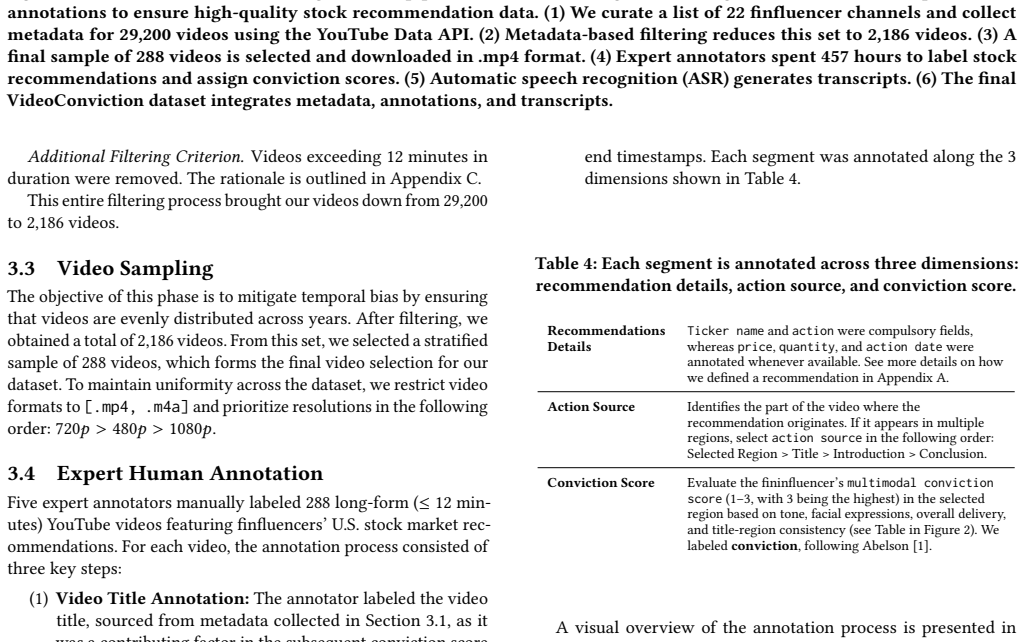
The load-bearing artifact is the expert annotation schema. Each of the 687 video segments carries a ticker, an action (buy, hold, don't buy, sell, short sell, unclear), an action source chosen by priority (selected region, title, introduction, conclusion), and a 1–3 multimodal conviction score based on tone, facial expressions, delivery, and title-region consistency. These labels function twice: they define ground truth for the sequential task suite {T, TA, TAC} used to score models, and they feed the portfolio backtest, where every 'buy' recommendation is held for six months and the inverse strategy shorts or sells against the stated action. The same schema is what makes the dataset reusable as a benchmark rather than a one-off annotation exercise.
What would settle it
Take a random subset of the 288 videos and have a second, independent set of expert annotators re-annotate the segments without seeing the video titles, then compare labels with Cohen's kappa. If agreement on action or conviction is low, or if the re-annotation changes enough conviction scores to move the inverse-strategy annual return by several points, the benchmark's ground truth and the portfolio conclusions do not reproduce.
Extended reading notes
Core claim
On the paper's own terms, VideoConviction is the first finance-specific multimodal dataset with expert annotations, transcripts, and a conviction score. The benchmark evaluates three sequential tasks: extracting the ticker (T), ticker plus action (TA), and ticker plus action plus conviction (TAC). The results show that multimodal inputs improve ticker extraction—models see stock charts and avoid errors like writing APPL for AAPL—but provide little or no benefit for the harder tasks; the best TAC scores sit near 28% F1, and models frequently misclassify general commentary as a recommendation. In the portfolio analysis, buy-and-hold strategies on finfluencer picks underperform the S&P 500 and QQQ, high-conviction recommendations beat low-conviction ones but still lag QQQ, and the contrarian 'Inverse YouTuber' strategy earns the highest annual return (17.90% vs. 11.28% for the S&P 500) at a lower Sharpe ratio (0.41 vs. 0.65). The paper interprets this as evidence that capturing conviction from delivery style matters and that current models are far from human-level judgment in informal financial video.
Load-bearing premise
The load-bearing premise is that the five experts' labels are ground truth, including a 1–3 conviction score judged partly by how well the video matches its title; the paper reports no measure of whether different annotators agree, so if labels are inconsistent the F1 scores and the 6.8% inverse-strategy advantage are not reproducible at the label level.
Editorial extensions
If this is right
- Video input helps ticker extraction, cutting hallucinated ticker symbols like APPL for AAPL, so multimodal models earn their cost on entity-recognition-style subtasks.
- Neither LLMs nor MLLMs can yet reliably distinguish a real recommendation from commentary; the best full three-field scores are around 28% F1, leaving large headroom.
- Segmented clips with local transcripts beat full-length videos across nearly all models, so evaluation granularity changes conclusions about model capability.
- Finfluencer buy recommendations underperform passive index funds over 2018–2024; even high-conviction picks lag QQQ.
- An inverse strategy against finfluencer recommendations beats the S&P 500 by 6.8 percentage points annualized in the same period, but with lower risk-adjusted return (Sharpe 0.41 vs. 0.65).
Reading between the lines
- Editorial inference: the 6.8% inverse-strategy edge comes from a curated 22-channel sample and a fixed six-month hold with no trading costs; on other channels, other periods, or after fees, the edge could shrink or reverse.
- Editorial inference: because conviction scoring explicitly includes 'title-region consistency,' the benchmark partly measures how well a video's content matches its clickbait title; a version scoring delivery from audio-visual cues alone would isolate the speaker's conviction from the packaging.
- Editorial inference: the systematic failure to separate commentary from calls suggests a practical monitoring use for regulators and platforms—screening finfluencer content against a 'call to action' definition—with this dataset serving as an evaluation set.
Editorial analysis
A structured set of objections, weighed in public.
Referee Report
Summary. The paper introduces VideoConviction, a multimodal dataset of 288 YouTube finfluencer videos with 687 (or 673) expert-annotated stock recommendation segments, including ticker, action, action source, and a 1-3 multimodal conviction score, together with ASR transcripts and metadata. The authors benchmark LLMs and MLLMs on three progressively harder tasks (T: ticker extraction; TA: ticker plus action; TAC: ticker, action, and conviction) using full-length and segmented inputs, reporting F1 scores in Table 6. They also perform a portfolio backtest over 2018-2024 comparing buy-and-hold, conviction-weighted, and inverse strategies against QQQ and SPY, reporting that the inverse strategy earns 17.90% annualized versus 11.28% for SPY, and that high-conviction picks beat low-conviction picks but still lag QQQ. The central claims are that multimodal inputs help ticker extraction but not action/conviction understanding, that models remain far below human-level understanding of informal financial discourse, and that finfluencer recommendations underperform simple index investing.
Significance. If the label layer is reproducible, VideoConviction fills a genuine gap: it is the first finance-specific multimodal benchmark with expert annotations, a defined conviction construct, full-video and segmented-video variants, and a public code/data/leaderboard release. The comparison of many open-source and proprietary LLMs/MLLMs on the same annotation schema is a useful contribution, as is the explicit separation of tasks that benefit from visual cues from those that do not. The paper also ships practical artifacts under a clear license and documents 457 hours of annotation effort. However, the benchmark's value as a gold standard depends on inter-annotator reliability, which is not reported, and the portfolio conclusions depend on backtest assumptions that are not stress-tested. With reliability evidence and more robust financial evaluation, this would be a solid resource for multimodal financial NLP.
major comments (4)
- [Section 3.4, Table 4, Table 8] The paper reports no inter-annotator agreement statistic for any annotation dimension. Section 3.4 describes five expert annotators and a peer-review/validation loop, but no kappa, percent agreement, or annotator-level breakdown is given. This is load-bearing because every F1 score in Table 6 and every portfolio return in Table 7 and Figure 4 uses these annotations as ground truth. The concern is especially acute for the conviction score: Table 8's rubric explicitly includes 'title and video are strongly aligned,' and Section 3.4 step (1) asks annotators to label the video title as a contributing factor. Agreement on conviction could therefore reflect title anchoring rather than multimodal signals, which would undermine the claim that TAC scores measure multimodal conviction understanding. Please report chance-corrected agreement (e.g., Fleiss' kappa) per annotation field and per annotator pair, or provide a clear justification for treating the consensus labels as a stable gold standard without such evidence.
- [Section 3 vs. Section 3.4 vs. Table 2] The number of annotated recommendation segments is internally inconsistent: the opening of Section 3 says the videos are 'segmented into 673 expert-annotated recommendations,' Section 3.4 says 'we identified 687 unique stock recommendation segments,' and Table 2 reports 687 segments. This inconsistency affects the denominator of every reported F1 score and the composition of every portfolio strategy. Please correct the discrepancy and ensure that all downstream numbers are recomputed from a single, clearly stated segment count.
- [Section 5.2, Table 7, Appendix J] The 'Inverse YouTuber' strategy returns are gross of transaction costs, borrow fees, and short-selling constraints. Taking the opposite of every 'Buy' or 'Sell' recommendation and holding for six months creates overlapping positions and ignores realistic capital constraints, while Appendix J shows that excluding penny stocks flips the inverse strategy from +17.90% annualized to -20.97%, which indicates that the headline inverse-strategy result is highly sensitive to a small subset of stocks. The 6.8 percentage point annual outperformance over SPY is therefore not established as a robust finding. Please report net-of-cost returns under explicit cost and borrow assumptions, position-sizing rules, and a non-overlapping variant, and provide confidence intervals or bootstrap distributions for the strategy returns.
- [Section 4.4, Table 6] The benchmarking claims are based on point estimates without any uncertainty quantification. For example, the conclusion that 'DeepSeek-V3 (28.17%) slightly outperforms the top MLLM (27.86%)' on TAC rests on a 0.31 point difference, and the conclusion that multimodal inputs improve ticker extraction rests on differences that may be within sampling noise across 687 segments. Please report bootstrap confidence intervals, McNemar-type significance tests for pairwise model comparisons, or equivalent uncertainty measures so readers can assess whether the observed gaps are meaningful.
minor comments (4)
- [Section 3.3] The resolution priority order '720p > 480p > 1080p' appears to be a typo; 1080p is generally higher quality than 720p and should presumably be prioritized first, or the ordering should be explained if it reflects a specific computational trade-off.
- [Appendix I and Appendix J] Figure 7 is duplicated: it appears in Appendix I and again near the end of Appendix J with the same caption, while the surrounding text refers to it as if it were new. Please renumber the figures so that each appears once.
- [Appendix A and Appendix F] There are several typos and stylistic inconsistencies, including 'inverstor's portfolio' in Appendix A, 'inferenced' in Appendix F, and 'Occured' in Appendix F; a copyedit pass would improve readability.
- [Section 4.3] The evaluation description states that a single prompt extracts ticker, action, and conviction simultaneously and that results are then separated into T, TA, and TAC; please clarify how partial matches are scored (e.g., whether a correct ticker with a wrong action counts as a TA failure) and how the 1-3 conviction predictions are mapped to the annotated scale.
Circularity Check
No circular derivation found: the dataset labels are external ground truth, model scores are zero-shot against those labels, and the inverse-strategy backtest is an ex-post evaluation rather than a fitted prediction.
full rationale
The paper's derivation chain is: (i) expert annotators create gold labels for ticker/action/conviction; (ii) zero-shot LLMs and MLLMs are scored against those labels; (iii) portfolio strategies are constructed from the same labels plus external market prices and backtested. No step fits a parameter to the target quantity and then renames the fit as a prediction. The inverse-finfluencer result is an ex-post backtest on the same annotated recommendations, so it is not a predictive claim; that is an in-sample/statistical limitation, not circularity. The conviction rubric includes title-region consistency as part of the label definition, and no inter-annotator agreement statistic is reported, but that is a label-validity and reproducibility concern, not a self-referential derivation. Self-citations (Refs. 42, 47, 48, 53) appear only in related-work or evaluation-context passages and are not load-bearing for the dataset's validity or for the inverse-strategy result. The internal mismatch between 673 (Section 3) and 687 (Table 2) segments is an editing inconsistency, not evidence of circularity. The central claims are therefore self-contained with respect to circularity, though external reviewers may still question label reliability and the ex-post nature of the backtest.
Assumptions & free parameters
free parameters (3)
- Holding period =
6 months
- Maximum video length =
12 minutes
- Penny stock price threshold =
$5
assumptions (5)
- domain assumption Expert annotations are treated as ground truth
- domain assumption The SEC-style definition of a recommendation and the 1-3 conviction scale capture the relevant phenomena
- domain assumption Keyword-based title filtering and manual channel curation produce a representative sample of finfluencer recommendations
- domain assumption Backtest execution assumptions (no transaction costs, no borrowing/shorting costs, 6-month fixed holding) are valid
- domain assumption The ASR transcripts (Whisper-large) are accurate enough for LLM/MLLM evaluation
invented entities (1)
-
Multimodal conviction score (1-3)
Cite this review
Pith. "Pith review of VideoConviction: A Multimodal Benchmark for Human Conviction and Stock Market Recommendations." pith.science (2026). https://pith.science/paper/FOMXD3UH
@misc{pith2026250708104,
  author       = {Pith},
  title        = {Pith review of: VideoConviction: A Multimodal Benchmark for Human Conviction and Stock Market Recommendations},
  year         = {2026},
  howpublished = {\url{https://pith.science/paper/FOMXD3UH}},
  note         = {Machine review of arXiv:2507.08104}
}
read the original abstract
Social media has amplified the reach of financial influencers known as "finfluencers," who share stock recommendations on platforms like YouTube. Understanding their influence requires analyzing multimodal signals like tone, delivery style, and facial expressions, which extend beyond text-based financial analysis. We introduce VideoConviction, a multimodal dataset with 6,000+ expert annotations, produced through 457 hours of human effort, to benchmark multimodal large language models (MLLMs) and text-based large language models (LLMs) in financial discourse. Our results show that while multimodal inputs improve stock ticker extraction (e.g., extracting Apple's ticker AAPL), both MLLMs and LLMs struggle to distinguish investment actions and conviction--the strength of belief conveyed through confident delivery and detailed reasoning--often misclassifying general commentary as definitive recommendations. While high-conviction recommendations perform better than low-conviction ones, they still underperform the popular S\&P 500 index fund. An inverse strategy--betting against finfluencer recommendations--outperforms the S\&P 500 by 6.8\% in annual returns but carries greater risk (Sharpe ratio of 0.41 vs. 0.65). Our benchmark enables a diverse evaluation of multimodal tasks, comparing model performance on both full video and segmented video inputs. This enables deeper advancements in multimodal financial research. Our code, dataset, and evaluation leaderboard are available under the CC BY-NC 4.0 license.
Figures


Figures from the paper (6 more)


Reference graph
Works this paper leans on
-
[1]
Robert P Abelson. [n. d.]. Conviction. https://psycnet.apa.org/buy/1988-23399- 001
work page 1988
-
[2]
Sami Abu-El-Haija, Nisarg Kothari, Joonseok Lee, Paul Natsev, George Toderici, Balakrishnan Varadarajan, and Sudheendra Vijayanarasimhan. 2016. YouTube- 8M: A Large-Scale Video Classification Benchmark. arXiv:1609.08675 [cs.CV] https://arxiv.org/abs/1609.08675
arXiv 2016
-
[3]
Gary Ang and Ee-Peng Lim. 2022. Guided Attention Multimodal Multitask Finan- cial Forecasting with Inter-Company Relationships and Global and Local News. InProceedings of the 60th Annual Meeting of the Association for Computational Linguistics (Volume 1: Long Papers), Smaranda Muresan, Preslav Nakov, and Aline Villavicencio (Eds.). Association for Computa...
-
[4]
Anthropic. 2024. Introducing the Next Generation of Claude. https://www. anthropic.com/news/claude-3-family. Accessed: 2024-02-10
work page 2024
-
[5]
Dogu Araci. 2019. FinBERT: Financial Sentiment Analysis with Pre-trained Language Models. arXiv:1908.10063 [cs.CL] https://arxiv.org/abs/1908.10063
arXiv 2019
-
[6]
Clifford S Asness. 2024. The Less-Efficient Market Hypothesis.Forthcoming in the 50th Anniversary Issue of The Journal of Portfolio Management(2024)
work page 2024
-
[7]
AmirAli Bagher Zadeh, Paul Pu Liang, Soujanya Poria, Erik Cambria, and Louis- Philippe Morency. 2018. Multimodal Language Analysis in the Wild: CMU-MOSEI Dataset and Interpretable Dynamic Fusion Graph. InProceedings of the 56th Annual Meeting of the Association for Computational Linguistics (Volume 1: Long Papers), Iryna Gurevych and Yusuke Miyao (Eds.). ...
-
[8]
Ryan G Chacon, Thibaut G Morillon, and Ruixiang Wang. 2023. Will the reddit rebellion take you to the moon? Evidence from WallStreetBets.Financial Markets and Portfolio Management37, 1 (2023), 1–25
work page 2023
Show all 67 references
-
[9]
Hadzic, Taran Kota, Jimming He, Cristóbal Eyzaguirre, Zane Durante, Manling Li, Jiajun Wu, and Li Fei-Fei
Keshigeyan Chandrasegaran, Agrim Gupta, Lea M. Hadzic, Taran Kota, Jimming He, Cristóbal Eyzaguirre, Zane Durante, Manling Li, Jiajun Wu, and Li Fei-Fei. 2024. HourVideo: 1-Hour Video-Language Understanding. arXiv:2411.04998 [cs.CV] https://arxiv.org/abs/2411.04998
2024 arXiv
-
[10]
Ringki Das and Thoudam Doren Singh. 2023. Multimodal Sentiment Analysis: A Survey of Methods, Trends, and Challenges.Comput. Surveys55, 13s, Article 270 (jul 2023), 38 pages. doi:10.1145/3586075
2023 doi
-
[11]
Gunhee Kim Dayoon Ko, Sangho Lee. 2023. Can Language Models Laugh at YouTube Short-form Videos?. InThe 2023 Conference on Empirical Methods in Natural Language Processing
2023
-
[12]
Anouk de Regt, Zixuan Cheng, and Rayan Fawaz. 2022. Young people under ‘Finfluencer’: The rise of financial influencers on Instagram: An abstract. In Academy of Marketing Science Annual Conference. Springer, 271–272
2022
-
[13]
DeepSeek-AI et al. 2024. DeepSeek-V3 Technical Report. arXiv:2412.19437 [cs.CL] https://arxiv.org/abs/2412.19437
2024 arXiv
-
[14]
DeepSeek-AI et al. 2025. DeepSeek-R1: Incentivizing Reasoning Capability in LLMs via Reinforcement Learning. arXiv:2501.12948 [cs.CL] https://arxiv.org/ abs/2501.12948
2025 arXiv
-
[15]
Gemini Team et al. 2024. Gemini: A Family of Highly Capable Multimodal Models. arXiv:2312.11805 [cs.CL] https://arxiv.org/abs/2312.11805
2024 arXiv
-
[16]
Robert Giannini, Paul Irvine, and Tao Shu. 2017. Nonlocal Dis- advantage: An Examination of Social Media Sentiment.The Re- view of Asset Pricing Studies8, 2 (07 2017), 293–336. doi:10. 1093/rapstu/rax020 arXiv:https://academic.oup.com/raps/article- pdf/8/2/293/26718371/rax020_supp.pdf
2017
-
[17]
Kristen Grauman, Andrew Westbury, Eugene Byrne, Zachary Chavis, Antonino Furnari, Rohit Girdhar, Jackson Hamburger, Hao Jiang, Miao Liu, Xingyu Liu, Miguel Martin, Tushar Nagarajan, Ilija Radosavovic, Santhosh Kumar Ramakrish- nan, Fiona Ryan, Jayant Sharma, Michael Wray, Meng...
2022 arXiv
-
[18]
Axel Groß-Klußmann, Stephan König, and Markus Ebner. 2019. Buzzwords Build Momentum: Global Financial Twitter Sentiment and the Aggregate Stock Market.Expert Systems with Applications136 (2019), 171–186. doi:10.1016/j.eswa. 2019.06.027 Preprint available at SSRN: https://ssrn....
2019 doi
-
[19]
Sue Guan. 2023. The rise of the Finfluencer.SSRN Electronic Journal(2023). doi:10.2139/ssrn.4400042
2023 doi
-
[20]
Fabian Caba Heilbron, Victor Escorcia, Bernard Ghanem, and Juan Carlos Niebles
-
[21]
2024.The impact of Finfluencers on Retail Investment (2024)
Isaiah Hull and Yingjie Qi. 2024.The impact of Finfluencers on Retail Investment (2024). doi:10.2139/ssrn.4922031
2024 doi
-
[22]
Albert Q. Jiang, Alexandre Sablayrolles, Arthur Mensch, Chris Bamford, De- vendra Singh Chaplot, Diego de las Casas, Florian Bressand, Gianna Lengyel, Guillaume Lample, Lucile Saulnier, Lélio Renard Lavaud, Marie-Anne Lachaux, Pierre Stock, Teven Le Scao, Thibaut Lavril, Thoma...
2023 arXiv
-
[23]
Albert Q. Jiang, Alexandre Sablayrolles, Antoine Roux, Arthur Mensch, Blanche Savary, Chris Bamford, Devendra Singh Chaplot, Diego de las Casas, Emma Bou Hanna, Florian Bressand, Gianna Lengyel, Guillaume Bour, Guillaume Lample, Lélio Renard Lavaud, Lucile Saulnier, Marie-Anne...
2024 arXiv
-
[24]
Congyun Jin, Ming Zhang, Xiaowei Ma, Li Yujiao, Yingbo Wang, Yabo Jia, Yuliang Du, Tao Sun, Haowen Wang, Cong Fan, Jinjie Gu, Chenfei Chi, Xiangguo Lv, Fangzhou Li, Wei Xue, and Yiran Huang. 2024. RJUA-MedDQA: A Multimodal Benchmark for Medical Document Question Answering and ...
2024 arXiv
-
[25]
Jinze Bai et al. 2023. Qwen Technical Report. arXiv:2309.16609 [cs.CL] https: //arxiv.org/abs/2309.16609
2023 arXiv
-
[27]
Ranjay Krishna, Kenji Hata, Frederic Ren, Li Fei-Fei, and Juan Carlos Niebles
-
[28]
Sang Il Lee and Seong Joon Yoo. 2020. Multimodal Deep Learning for Finance: Integrating and Forecasting International Stock Markets.The Journal of Super- computing76, 10 (2020), 8294–8312. doi:10.1007/s11227-019-03101-3
2020 doi
-
[29]
Wenhao Liang, Zhengyang Li, and Weitong Chen. 2024. Enhancing Financial Market Predictions: Causality-Driven Feature Selection. arXiv:2408.01005 [cs.LG] https://arxiv.org/abs/2408.01005
2024 arXiv
-
[30]
mad money
Bryan Lim and Joao Rosario. 2008. The performance and impact of stock picks mentioned on “mad money”.SSRN Electronic Journal(2008). doi:10.2139/ssrn. 1017353
2008 doi
-
[31]
Haotian Liu, Chunyuan Li, Yuheng Li, and Yong Jae Lee. 2024. Improved Baselines with Visual Instruction Tuning. arXiv:2310.03744 [cs.CV] https://arxiv.org/abs/ 2310.03744
2024 arXiv
-
[32]
Tingkai Liu, Yunzhe Tao, Haogeng Liu, Qihang Fan, Ding Zhou, Huaibo Huang, Ran He, and Hongxia Yang. 2024. DeVAn: Dense Video Annotation for Video- Language Models. arXiv:2310.05060 [cs.CV] https://arxiv.org/abs/2310.05060
2024 arXiv
-
[33]
Yuan Liu, Haodong Duan, Yuanhan Zhang, Bo Li, Songyang Zhang, Wangbo Zhao, Yike Yuan, Jiaqi Wang, Conghui He, Ziwei Liu, Kai Chen, and Dahua Lin. 2024. MMBench: Is Your Multi-modal Model an All-around Player? arXiv:2307.06281 [cs.CV] https://arxiv.org/abs/2307.06281
2024 arXiv
-
[34]
Tim Loughran and Bill McDonald. 2011. When is a liability not a liability? Textual analysis, dictionaries, and 10-Ks.The Journal of finance66, 1 (2011), 35–65
2011
-
[35]
Dakuan Lu, Hengkui Wu, Jiaqing Liang, Yipei Xu, Qianyu He, Yipeng Geng, Mengkun Han, Yingsi Xin, and Yanghua Xiao. 2023. Bbt-fin: Comprehensive construction of chinese financial domain pre-trained language model, corpus and benchmark.arXiv preprint arXiv:2302.09432(2023)
2023 arXiv
-
[36]
Macedo Maia, Siegfried Handschuh, André Freitas, Brian Davis, Ross McDer- mott, Manel Zarrouk, and Alexandra Balahur. 2018. WWW’18 Open Challenge: Financial Opinion Mining and Question Answering. InCompanion Proceedings of the The Web Conference 2018(Lyon, France)(WWW ’18). In...
2018
-
[37]
Pekka Malo, Ankur Sinha, Pyry Takala, Pekka Korhonen, and Jyrki Wallenius
-
[38]
Meta et al. 2024. The Llama 3 Herd of Models. arXiv:2407.21783 [cs.AI] https: //arxiv.org/abs/2407.21783
2024 arXiv
-
[39]
Antoine Miech, Dimitri Zhukov, Jean-Baptiste Alayrac, Makarand Tapaswi, Ivan Laptev, and Josef Sivic. 2019. HowTo100M: Learning a Text-Video Embedding by Watching Hundred Million Narrated Video Clips. InICCV
2019
-
[40]
Munan Ning, Bin Zhu, Yujia Xie, Bin Lin, Jiaxi Cui, Lu Yuan, Dongdong Chen, and Li Yuan. 2023. Video-Bench: A Comprehensive Benchmark and Toolkit for Evaluating Video-based Large Language Models. arXiv:2311.16103 [cs.CV] https://arxiv.org/abs/2311.16103 KDD ’25, August 3–7, 20...
2023 arXiv
- [41]
-
[42]
Huzaifa Pardawala, Siddhant Sukhani, Agam Shah, Veer Kejriwal, Abhishek Pillai, Rohan Bhasin, Andrew DiBiasio, Tarun Mandapati, Dhruv Adha, and Sudheer Chava. 2024. SubjECTive-QA: Measuring Subjectivity in Earnings Call Tran- scripts’ QA Through Six-Dimensional Feature Analysi...
2024 arXiv
-
[43]
Yulong Pei, Amarachi Mbakwe, Akshat Gupta, Salwa Alamir, Hanxuan Lin, Xi- aomo Liu, and Sameena Shah. 2022. TweetFinSent: A Dataset of Stock Sentiments on Twitter. InProceedings of the Fourth Workshop on Financial Technology and Nat- ural Language Processing (FinNLP), Chung-Ch...
2022 doi
-
[44]
Alec Radford, Jong Wook Kim, Tao Xu, Greg Brockman, Christine Mcleavey, and Ilya Sutskever. 2023. Robust Speech Recognition via Large-Scale Weak Super- vision. InProceedings of the 40th International Conference on Machine Learning (Proceedings of Machine Learning Research, Vol...
2023
-
[45]
Rai, S.D
A.K. Rai, S.D. Jaiswal, and A. Mukherjee. 2024. A Deep Dive into the Disparity of Word Error Rates across Thousands of NPTEL MOOC Videos.Proceedings of the International AAAI Conference on Web and Social Media18, 1 (May 2024), 1302–1314. doi:10.1609/icwsm.v18i1.31390
2024 doi
-
[46]
Ramit Sawhney, Piyush Khanna, Arshiya Aggarwal, Taru Jain, Puneet Mathur, and Rajiv Ratn Shah. 2020. VolTAGE: Volatility Forecasting via Text Audio Fusion with Graph Convolution Networks for Earnings Calls. InProceedings of the 2020 Conference on Empirical Methods in Natural L...
2020 doi
-
[47]
Agam Shah, Suvan Paturi, and Sudheer Chava. 2023. Trillion Dollar Words: A New Financial Dataset, Task & Market Analysis. InProceedings of the 61st Annual Meeting of the Association for Computational Linguistics (Volume 1: Long Papers), Anna Rogers, Jordan Boyd-Graber, and Nao...
2023 doi
-
[48]
Agam Shah, Siddhant Sukhani, Huzaifa Pardawala, Saketh Budideti, Riya Bhadani, Rudra Gopal, Siddhartha Somani, Michael Galarnyk, Soungmin Lee, Arnav Hiray, Akshar Ravichandran, Eric Kim, Pranav Aluru, Joshua Zhang, Sebas- tian Jaskowski, Veer Guda, Meghaj Tarte, Liqin Ye, Spen...
2025
-
[49]
Raj Sanjay Shah, Kunal Chawla, Dheeraj Eidnani, Agam Shah, Wendi Du, Sudheer Chava, Natraj Raman, Charese Smiley, Jiaao Chen, and Diyi Yang. 2022. When flue meets flang: Benchmarks and large pre-trained language model for financial domain.arXiv preprint arXiv:2211.00083(2022)
2022 arXiv
-
[50]
Sprenger, Andranik Tumasjan, Philipp G
Timm O. Sprenger, Andranik Tumasjan, Philipp G. Sandner, and Isabell M. Welpe
-
[51]
S Shyam Sundar, Maria D Molina, and Eugene Cho. 2021. Seeing Is Believing: Is Video Modality More Powerful in Spreading Fake News via Online Messag- ing Apps?Journal of Computer-Mediated Communication26, 6 (08 2021), 301–
2021
-
[52]
Aditi Rajput Symbiosis and Aradhana Gandhi. 2024. Finfluencer: Exploring the untapped influence of financial influencers.2024 14th International Conference on Advanced Computer Information Technologies (ACIT)2024 (Sep 2024), 190–196. doi:10.1109/acit62333.2024.10712618
2024
-
[53]
Nikita Tatarinov, Siddhant Sukhani, Agam Shah, and Sudheer Chava. 2025. Lan- guage Modeling for the Future of Finance: A Quantitative Survey into Metrics, Tasks, and Data Opportunities. arXiv:2504.07274 [cs.CL] https://arxiv.org/abs/ 2504.07274
2025
-
[54]
2020-2022
Maxim Tkachenko, Mikhail Malyuk, Andrey Holmanyuk, and Nikolai Li- ubimov. 2020-2022. Label Studio: Data labeling software. https:// github.com/heartexlabs/label-studio Open source software available from https://github.com/heartexlabs/label-studio
2020
-
[55]
Securities and Exchange Commission
U.S. Securities and Exchange Commission. 2020. Regulation Best Interest: A Small Entity Compliance Guide. https://www.sec.gov/resources-small-businesses/ small-business-compliance-guides/regulation-best-interest [Accessed: February 2, 2025]
2020
-
[56]
Sonja Warkulat and Matthias Pelster. 2024. Social media attention and retail in- vestor behavior: Evidence from r/wallstreetbets.International Review of Financial Analysis96 (2024), 103721. doi:10.1016/j.irfa.2024.103721
2024
-
[57]
Shijie Wu, Ozan Irsoy, Steven Lu, Vadim Dabravolski, Mark Dredze, Sebas- tian Gehrmann, Prabhanjan Kambadur, David Rosenberg, and Gideon Mann
-
[58]
Hongyang Yang, Xiao-Yang Liu, and Christina Dan Wang. 2023. Fingpt: Open- source financial large language models.arXiv preprint arXiv:2306.06031(2023)
2023
-
[59]
Michihiro Yasunaga, Luke Zettlemoyer, and Marjan Ghazvininejad. 2025. Multi- modal RewardBench: Holistic Evaluation of Reward Models for Vision Language Models. arXiv:2502.14191 [cs.CV] https://arxiv.org/abs/2502.14191
2025 arXiv
-
[60]
Niloofar Yousefi, Mert Can Cakmak, and Nitin Agarwal. 2024. Examining Mul- timodel Emotion Assessment and Resonance with Audience on YouTube. In Proceedings of the 2024 9th International Conference on Multimedia and Image Processing(Osaka, Japan)(ICMIP ’24). Association for Co...
2024
-
[61]
HaoChen, James Zou, Percy Liang, and Serena Yeung
Yuhui Zhang, Michihiro Yasunaga, Zhengping Zhou, Jeff Z. HaoChen, James Zou, Percy Liang, and Serena Yeung. 2023. Beyond Positive Scaling: How Negation Impacts Scaling Trends of Language Models. arXiv:2305.17311 [cs.CL] https: //arxiv.org/abs/2305.17311
2023 arXiv
-
[62]
Buy" action, the annotated price would imply the price at which the influencer is suggesting to buy the stock. Conversely, for a
Linan Zhu, Zhechao Zhu, Chenwei Zhang, Yifei Xu, and Xiangjie Kong. 2023. Multimodal Sentiment Analysis Based on Fusion Methods: A Survey.Information Fusion95 (2023), 306–325. doi:10.1016/j.inffus.2023.02.028 VideoConviction: A Multimodal Benchmark for Human Conviction and Sto...
2023 doi
-
[319]
doi:10.1093/jcmc/zmab010 arXiv:https://academic.oup.com/jcmc/article- pdf/26/6/301/41139661/zmab010.pdf
-
[2013]
arXiv:1307.5336 [cs.CL] https://arxiv.org/abs/1307.5336
Good Debt or Bad Debt: Detecting Semantic Orientations in Economic Texts. arXiv:1307.5336 [cs.CL] https://arxiv.org/abs/1307.5336
-
[2014]
doi:10.1111/j.1468-036X.2013.12007.x arXiv:https://onlinelibrary.wiley.com/doi/pdf/10.1111/j.1468-036X.2013.12007.x
Tweets and Trades: the Information Content of Stock Microblogs.European Financial Management20, 5 (2014), 926–957. doi:10.1111/j.1468-036X.2013.12007.x arXiv:https://onlinelibrary.wiley.com/doi/pdf/10.1111/j.1468-036X.2013.12007.x
2014
-
[2015]
In2015 IEEE Conference on Computer Vision and Pattern Recognition (CVPR)
ActivityNet: A large-scale video benchmark for human activity understand- ing. In2015 IEEE Conference on Computer Vision and Pattern Recognition (CVPR). 961–970. doi:10.1109/CVPR.2015.7298698
2015
-
[2017]
arXiv:1705.00754 [cs.CV] https: //arxiv.org/abs/1705.00754
Dense-Captioning Events in Videos. arXiv:1705.00754 [cs.CV] https: //arxiv.org/abs/1705.00754
-
[2023]
Bloomberggpt: A large language model for finance.arXiv preprint arXiv:2303.17564(2023)
2023 arXiv
Reviewed August 7, 2026 · model on record in the stance chip above.
Discussion (0). Sign in to comment.