REVIEW 4 major objections 4 minor 4 cited by
Rethinking Spatio-Temporal Anomaly Detection: A Vision for Causality-Driven Cybersecurity
T0 review · 4 major / 4 minor · reviewed 2026-08-06 · deepseek-v4-flash
Pith's one-line read Causal graph models can match black-box deep learning on cyber-physical anomaly detection while also explaining why alerts fire.
desk verdict A coherent, well-written vision paper whose central empirical claim isn't supported by reproducible evidence; worth refereeing as a position piece, not as a research result. read the letter →
The pith
A machine-rendered reading of the paper's core claim, the machinery that carries it, and where it could break.
The reading
What carries the argument
The machinery is a Structural Causal Model (SCM) cast as a directed graph whose nodes are sensors and actuators and whose edges encode directed cause-effect influences learned from streaming observations by constraint-based, score-based, or neural causal discovery. Anomalies are flagged by divergence between the graph learned under current operation and a reference graph learned during normal operation, measured by the appearance or disappearance of edges or by changes in edge strength. The three instantiations differ in how they obtain and update the graph: SMV-CGAD fuses domain knowledge, CausAnom learns flexible graphs with a graph neural network encoder, and Entropy-CGAD uses transfer entropy with weighted graph networks. Continual causal graph learning extends the same idea by updating the graph incrementally so that drift does not force full retraining.
What would settle it
Run the same SWaT attack scenarios against the causal detectors while also injecting benign configuration changes (setpoint adjustments, valve maintenance, scheduled load changes) and compare alarm rates; if graph-divergence flags benign changes as often as statistical detectors do, the central promise of drift robustness collapses. A sharper version would publish per-attack detection latency of graph-shift alarms versus reconstruction-error alarms on the SWaT ground-truth attack timetable.
Extended reading notes
Core claim
The central claim is that an anomaly in a cyber-physical system is better modeled as a structural change in the causal graph describing how sensors and actuators influence one another than as a statistical deviation in the observed time series. The paper compares three causal detectors (SMV-CGAD, CausAnom, and Entropy-CGAD) against deep baselines on SWaT and WADI and reports that the causal methods match or beat the deep models on F1, for example Entropy-CGAD at 0.82 on SWaT and SMV-CGAD at 0.79 on WADI versus 0.79 and 0.25 for USAD, while additionally providing interpretable, topology-sensitive alerts. It further reports that a divergence-aware profiling variant reaches 0.84 and a continual-update variant reaches 0.85 on SWaT. The paper does not claim to introduce a new method; it claims that this family of approaches deserves to be the default research direction for spatially distributed critical infrastructure.
Load-bearing premise
The approach depends on the learned cause-effect graph being accurate enough that a real cyberattack shows up as a change in the graph itself, rather than being hidden by the unmeasured confounders, feedback loops, and non-stationary sensor behavior the paper itself says are common in cyber-physical systems.
Editorial extensions
If this is right
- If the central claim is correct, causal detectors can be deployed where black-box accuracy was previously the only acceptable trade: SWaT and WADI results show parity or better F1 alongside structural explanations.
- Root-cause attribution becomes a by-product of detection, because the edges that changed point at the sensors or actuators involved instead of requiring a separate explainer.
- Drift robustness follows from the mechanism: if normal variability shifts marginal distributions but not causal structure, graph-divergence alarms fire less often than reconstruction-error alarms.
- Continual causal graph learning removes the retraining bottleneck for evolving systems, provided the proposed online update methods scale to high-dimensional sensor networks.
- Anomaly-detection benchmarks should start reporting interpretability and localization metrics alongside F1, because the paper's contribution is precisely that structural alerts carry information opaque scores hide.
Reading between the lines
- Editorial inference: the strongest testable consequence left implicit is temporal lead, that structural graph shifts should be detectable before sensor values cross statistical thresholds, a hypothesis that could be checked directly against the SWaT attack timetable.
- Editorial inference: if causal structure transfers across similar plants, a graph trained on one water-treatment configuration could bootstrap detection on another without new labels, which the paper does not test.
- Editorial inference: the WADI column, where causal methods far outscore deep baselines (0.79 versus 0.25), hints that the real advantage appears under distribution shift, but a single testbed cannot separate that mechanism from dataset-specific effects.
- Editorial inference: a practical deployment could combine graph divergence with an LLM-based explanation layer that narrates the changed edges; the paper lists LLMs as a future direction but does not make this concrete.
Editorial analysis
A structured set of objections, weighed in public.
Referee Report
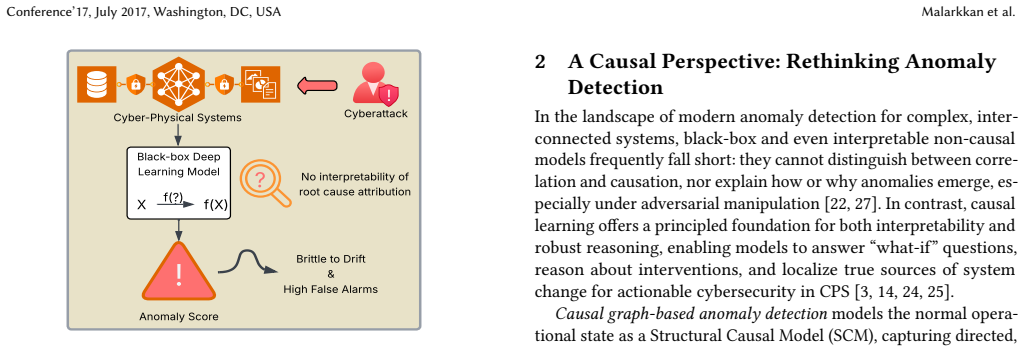
Summary. The paper is a vision/position paper that argues for replacing black-box deep anomaly detectors in cyber-physical systems with causality-driven methods. It organizes the proposal around three directions: divergence-aware causal graph profiling, multi-view causal graph fusion, and continual causal graph learning. Section 3 claims that causal methods match or exceed deep learning performance on the SWaT and WADI testbeds and provide interpretable structural alerts, based on Table 1 and two additional unreferenced F1 scores. The paper then discusses challenges such as scalability, hidden confounding, and assumption violations, and outlines future directions involving multi-modality, generative AI, and streaming causal learning.
Significance. If the central claim could be backed by a reproducible, common-protocol comparison, the paper would make a useful contribution by shifting the anomaly-detection conversation from accuracy to interpretability and drift robustness. The qualitative case is coherent: black-box detectors are brittle under distribution shift and cannot attribute causes, while causal graphs offer a principled alternative. The taxonomy of three research directions and the candid list of open problems in Section 4 are valuable for the community. However, the paper's empirical anchor, Table 1 and the two F1 values in Section 3, is not reproducible, and interpretability is never measured. As written, the contribution is a research agenda rather than a demonstrated result, and the strength of the claims exceeds the evidence. No code or artifacts are provided, which is acceptable for a position paper but not for the empirical statements it makes.
major comments (4)
- [Section 3, Table 1] The sentence 'causal methods match or exceed deep learning performance' is supported only by Table 1, which aggregates F1 scores from references [17], [30], [11], [4], [15], and [44]. These scores come from separate publications with no common evaluation protocol. F1 on SWaT and WADI is highly sensitive to threshold selection, point-adjusted versus event-based scoring, and attack-segment definitions, none of which are reported for the aggregated entries. A cross-paper summary cannot support the comparative claim. Please either run a unified benchmark with a shared protocol and release the configuration, or explicitly recharacterize Table 1 as an anecdotal cross-paper summary and soften the claim accordingly.
- [Section 3, 'Perspectives from Causal Paradigms'] The two additional F1 values, 0.84 for divergence-aware causal graph profiling and 0.85 for Continual-CGAD on SWaT, are unreferenced and come with no model configuration, hyperparameters, training/attack split, or code. Without reproducibility detail, these numbers cannot be verified and cannot serve as evidence for the practical viability of causal methods. They should be removed or replaced by a full experimental description.
- [Section 3] The second half of the central claim, 'while providing interpretable structural alerts,' is never evaluated. The paper explicitly defers human-in-the-loop and root-cause localization studies to future work. Since interpretability is the primary argued advantage over black-box detectors, the paper should either include a concrete interpretability assessment, such as localization accuracy or expert validation of discovered graph changes, or clearly present interpretability as a hypothesis rather than a demonstrated benefit.
- [Sections 4.2 and 4.3] The detection principle relies on structural shifts in a learned causal graph being a reliable anomaly signal. Sections 4.2 and 4.3 concede that causal sufficiency, acyclicity, faithfulness, and stationarity are violated in real CPS. The paper provides no evidence that structural-shift detection remains reliable under these violations, despite the 'demonstrate' language in Sections 3 and 6. For a vision paper this can be reframed as an open research challenge, but as written the central promise is unsupported. Please either add a concrete stress-test under assumption violations or explicitly label robustness under these violations as an open question.
minor comments (4)
- [Section 6] In the final paragraph, 'advancesscalable' is a typo; it should read 'advances scalable.'
- [References] References [41] and [42] are the same paper, 'Multi-modal Causal Structure Learning and Root Cause Analysis,' and should be merged into a single entry.
- [Section 3] The heading 'Perspectives from Causal Paradigms' is unnumbered and appears without a corresponding subsection style; it should be formatted consistently with the rest of the paper.
- [Section 2.1] The phrase 'our own work' in the paragraph on divergence-aware profiling is vague; if it refers to the authors' prior or current research, it should be cited explicitly and consistently with the unreferenced F1 scores in Section 3.
Circularity Check
No construction-level circularity: the central empirical claim is a literature comparison that includes external causal methods; self-cited results are present but not load-bearing.
full rationale
This is a vision/position paper with no new derivation, equations, or fitted parameters, so the standard self-definitional and fitted-input patterns do not apply. The main evidence for 'causal methods match or exceed deep learning performance' is Table 1, which aggregates published F1 scores from SMV-CGAD [17], CausAnom [30], and Entropy-CGAD [11] against USAD, VAE-LSTM, and DAGMM. Two of the three causal entries (CausAnom, Entropy-CGAD) are external to the authors, so the claim does not reduce to the authors' own work. The paper also reports two unnamed own-work results (F1-0.84 for divergence-aware profiling and F1-0.85 for Continual-CGAD on SWaT) without protocol details; this is an evidence and reproducibility gap, not circularity, because no equation or fitting procedure links these numbers to the paper's inputs. Sections 4.2 and 4.3 concede that acyclicity, faithfulness, stationarity, and causal sufficiency are violated in real CPS, which weakens the proposal's practical premise but is an honest limitation statement rather than a circular step. The self-citations to the authors' prior frameworks [17,33,34] are used as illustrative techniques and as one row of Table 1, but the external entries carry the overall comparison, so the self-citations are not load-bearing. Accordingly, no step can be exhibited where a prediction is equivalent to its input by construction; the score of 2 reflects the minor self-citation presence, not a circular derivation.
Assumptions & free parameters
assumptions (4)
- domain assumption Causal sufficiency: all relevant confounders are observed in the sensor data
- domain assumption The normal operational state can be modeled as a DAG over sensor variables
- domain assumption Causal faithfulness and stationarity hold during normal operation
- domain assumption Structural shifts in the learned causal graph indicate cyberattacks rather than benign fluctuations
Cite this review
Pith. "Pith review of Rethinking Spatio-Temporal Anomaly Detection: A Vision for Causality-Driven Cybersecurity." pith.science (2026). https://pith.science/paper/RNMW7ARQ
@misc{pith2026250708177,
  author       = {Pith},
  title        = {Pith review of: Rethinking Spatio-Temporal Anomaly Detection: A Vision for Causality-Driven Cybersecurity},
  year         = {2026},
  howpublished = {\url{https://pith.science/paper/RNMW7ARQ}},
  note         = {Machine review of arXiv:2507.08177}
}
read the original abstract
As cyber-physical systems grow increasingly interconnected and spatially distributed, ensuring their resilience against evolving cyberattacks has become a critical priority. Spatio-Temporal Anomaly detection plays an important role in ensuring system security and operational integrity. However, current data-driven approaches, largely driven by black-box deep learning, face challenges in interpretability, adaptability to distribution shifts, and robustness under evolving system dynamics. In this paper, we advocate for a causal learning perspective to advance anomaly detection in spatially distributed infrastructures that grounds detection in structural cause-effect relationships. We identify and formalize three key directions: causal graph profiling, multi-view fusion, and continual causal graph learning, each offering distinct advantages in uncovering dynamic cause-effect structures across time and space. Drawing on real-world insights from systems such as water treatment infrastructures, we illustrate how causal models provide early warning signals and root cause attribution, addressing the limitations of black-box detectors. Looking ahead, we outline the future research agenda centered on multi-modality, generative AI-driven, and scalable adaptive causal frameworks. Our objective is to lay a new research trajectory toward scalable, adaptive, explainable, and spatially grounded anomaly detection systems. We hope to inspire a paradigm shift in cybersecurity research, promoting causality-driven approaches to address evolving threats in interconnected infrastructures.
Figures
Forward citations
Cited by 4 Pith papers
-
DELTA: Variational Disentangled Learning for Privacy-Preserving Data Reprogramming
DELTA uses reinforcement learning to find useful feature transformations, then a disentangled variational autoencoder to generate transformed features that keep task utility while reducing sensitive-attribute predicti...
-
Causal Transfer in Medical Image Analysis
Causal Transfer Learning unifies structural causal models, invariant risk minimisation and counterfactuals with transfer learning to produce domain-robust medical image models.
-
Mechanical Force-Driven Charge Redistribution for Hydrogen Release at Ambient Conditions in Transition Metal-Intercalated Bilayer Graphene
Reducing the interlayer distance of Sc-, Ti-, or V-intercalated bilayer graphene below 4.7, 5.3, or 5.1 Å drives complete hydrogen desorption at ambient conditions.
-
Incremental Causal Graph Learning for Online Cyberattack Detection in Cyber-Physical Infrastructures
INCADET incrementally updates causal graphs over streaming windows and uses a graph neural network to label each window as normal or attack.
Reference graph
Works this paper leans on
-
[17]
Arun Vignesh Malarkkan, Dongjie Wang, and Yanjie Fu. 2024. Multi-view Causal Graph Fusion Based Anomaly Detection in Cyber-Physical Infrastructures. InPro- ceedings of the 33rd ACM International Conference on Information and Knowledge Management (Boise, ID, USA) (CIKM ’24). Association for Computing Machinery, New York, NY, USA, 4760–4767. doi:10.1145/362...
arXiv 2024
-
[30]
Sasha Strelnikoff, Aruna Jammalamadaka, and Tsai-Ching Lu. 2023. Causanom: Anomaly Detection With Flexible Causal Graphs. In The International FLAIRS Conference Proceedings, Vol. 36
work page 2023
-
[11]
Falih Gozi Febrinanto, Kristen Moore, Chandra Thapa, Mujie Liu, Vidya Saikr- ishna, Jiangang Ma, and Feng Xia. 2023. Entropy Causal Graphs for Multivariate Time Series Anomaly Detection. arXiv:2312.09478 [cs.LG]
arXiv 2023
-
[4]
Julien Audibert, Pietro Michiardi, Frédéric Guyard, Sébastien Marti, and Maria A Zuluaga. 2020. Usad: Unsupervised anomaly detection on multivariate time series. In Proceedings of the 26th ACM SIGKDD international conference on knowledge discovery & data mining . 3395–3404
work page 2020
-
[15]
Shuyu Lin, Ronald Clark, Robert Birke, Sandro Schönborn, Niki Trigoni, and Stephen Roberts. 2020. Anomaly Detection for Time Series Using VAE-LSTM Hybrid Model. In ICASSP 2020 - 2020 IEEE International Conference on Acoustics, Speech and Signal Processing (ICASSP). 4322–4326. doi:10.1109/ICASSP40776.2020. 9053558
arXiv 2020
-
[1]
Ahmed Abdulaal, Zhuanghua Liu, and Tomer Lancewicki. 2021. Practical Ap- proach to Asynchronous Multivariate Time Series Anomaly Detection and Local- ization. In Proceedings of the 27th ACM SIGKDD Conference on Knowledge Discov- ery & Data Mining (Virtual Event, Singapore) (KDD ’21). Association for Com- puting Machinery, New York, NY, USA, 2485–2494. doi...
arXiv 2021
-
[2]
Chuadhry Mujeeb Ahmed, Venkata Reddy Palleti, and Aditya P. Mathur. 2017. WADI: a water distribution testbed for research in the design of secure cyber physical systems. In Proceedings of the 3rd International Workshop on Cyber- Physical Systems for Smart Water Networks (Pittsburgh, Pennsylvania) (CySW A- TER ’17). Association for Computing Machinery, New...
arXiv 2017
-
[3]
Kartik Ahuja, Divyat Mahajan, Yixin Wang, and Yoshua Bengio. 2023. In- terventional Causal Representation Learning. In Proceedings of the 40th In- ternational Conference on Machine Learning (Proceedings of Machine Learning Research, Vol. 202) , Andreas Krause, Emma Brunskill, Kyunghyun Cho, Bar- bara Engelhardt, Sivan Sabato, and Jonathan Scarlett (Eds.)....
work page 2023
Show all 46 references
-
[5]
Sander Beckers. 2021. Causal sufficiency and actual causation. Journal of Philo- sophical Logic 50, 6 (2021), 1341–1374
2021
-
[6]
Loïc Bontemps, Van Loi Cao, James McDermott, and Nhien-An Le-Khac. 2016. Collective Anomaly Detection Based on Long Short-Term Memory Recurrent Neural Networks. Springer International Publishing, 141–152. doi:10.1007/978-3-319- 48057-2_9
2016 doi
-
[7]
Wenchao Chen, Long Tian, Bo Chen, Liang Dai, Zhibin Duan, and Mingyuan Zhou. 2022. Deep Variational Graph Convolutional Recurrent Network for Multivariate Time Series Anomaly Detection. In Proceedings of the 39th Interna- tional Conference on Machine Learning (Proceedings of M...
2022
-
[8]
David Maxwell Chickering. 2002. Optimal structure identification with greedy search. Journal of machine learning research 3, Nov (2002), 507–554
2002
-
[9]
Ailin Deng and Bryan Hooi. 2021. Graph Neural Network-Based Anomaly Detection in Multivariate Time Series. Proceedings of the AAAI Conference on Artificial Intelligence 35, 5 (May 2021), 4027–4035. doi:10.1609/aaai.v35i5.16523
2021 doi
-
[10]
Tolga Ergen and Suleyman Serdar Kozat. 2020. Unsupervised Anomaly Detection With LSTM Neural Networks. IEEE Transactions on Neural Networks and Learning Systems 31, 8 (2020), 3127–3141. doi:10.1109/TNNLS.2019.2935975
2020
-
[12]
Clark Glymour, Kun Zhang, and Peter Spirtes. 2019. Review of causal discovery methods based on graphical models. Frontiers in genetics 10 (2019), 524
2019
-
[13]
Chunlin Li, Xiaotong Shen, and Wei Pan. 2024. Nonlinear causal discovery with confounders. J. Amer. Statist. Assoc. 119, 546 (2024), 1205–1214
2024
-
[14]
Xiutian Li, Siqi Sun, and Rui Feng. 2024. Causal representation learning via counterfactual intervention. In Proceedings of the AAAI Conference on Artificial Intelligence, Vol. 38. 3234–3242
2024
-
[16]
Joshua Loftus. 2024. Position: The Causal Revolution Needs Scientific Pragmatism. arXiv:2406.02275 [cs.CY]
2024 arXiv
-
[18]
Mathur and Nils Ole Tippenhauer
Aditya P. Mathur and Nils Ole Tippenhauer. 2016. SWaT: a water treatment testbed for research and training on ICS security. In 2016 International Workshop on Cyber-physical Systems for Smart Water Networks (CySWater) . 31–36. doi:10. 1109/CySWater.2016.7469060
2016
-
[19]
Murphy, Zhuowen Yin, and Dani S
Kieran A. Murphy, Zhuowen Yin, and Dani S. Bassett. 2024. Which bits went where? Past and future transfer entropy decomposition with the information bottleneck. arXiv:2411.04992 [cs.LG]
2024 arXiv
-
[20]
Ignavier Ng, Shengyu Zhu, Zhuangyan Fang, Haoyang Li, Zhitang Chen, and Jun Wang. 2022. Masked gradient-based causal structure learning. In Proceedings of the 2022 SIAM International Conference on Data Mining (SDM) . SIAM, 424–432
2022
-
[21]
Roxana Pamfil, Nisara Sriwattanaworachai, Shaan Desai, Philip Pilgerstorfer, Paul Beaumont, Konstantinos Georgatzis, and Bryon Aragam. 2020. DYNOTEARS: Structure Learning from Time-Series Data. arXiv:2002.00498 [stat.ML]
2020 arXiv
-
[22]
Judea Pearl. 2009. Causality: Models, Reasoning and Inference (2nd ed.). Cambridge University Press, USA
2009
-
[23]
Subrahmanya, and Weichang Li
Huida Qiu, Yan Liu, Niranjan A. Subrahmanya, and Weichang Li. 2012. Granger Causality for Time-Series Anomaly Detection. In 2012 IEEE 12th International Conference on Data Mining . 1074–1079. doi:10.1109/ICDM.2012.73
2012 doi
-
[24]
Nandini Ramanan and Sriraam Natarajan. 2020. Causal learning from predictive modeling for observational data. Frontiers in big Data 3 (2020), 535976
2020
-
[25]
Hans Reichenbach. 1956. The Direction of Time . Dover Publications, Mineola, N.Y
1956
-
[26]
Saquib Sarfraz, Mei-Yen Chen, Lukas Layer, Kunyu Peng, and Marios Koulakis
M. Saquib Sarfraz, Mei-Yen Chen, Lukas Layer, Kunyu Peng, and Marios Koulakis
-
[27]
Bernhard Schölkopf, Francesco Locatello, Stefan Bauer, Nan Rosemary Ke, Nal Kalchbrenner, Anirudh Goyal, and Yoshua Bengio. 2021. Towards Causal Repre- sentation Learning. arXiv:2102.11107 [cs.LG]
2021 arXiv
-
[28]
Beate Sick and Oliver Dürr. 2025. Interpretable Neural Causal Models with TRAM-DAGs. arXiv:2503.16206 [stat.ML]
2025 arXiv
-
[29]
Peter Spirtes, Clark Glymour, and Richard Scheines. 2001. Causation, prediction, and search. MIT press
2001
-
[31]
Ahmed Tealab. 2018. Time series forecasting using artificial neural networks methodologies: A systematic review. Future Computing and Informatics Journal 3, 2 (2018), 334–340. doi:10.1016/j.fcij.2018.10.003
2018 doi
-
[32]
Julius von Kügelgen. 2024. Identifiable Causal Representation Learning: Unsu- pervised, Multi-View, and Multi-Environment. arXiv preprint arXiv:2406.13371 (2024)
2024 arXiv
-
[33]
Dongjie Wang, Zhengzhang Chen, Yanjie Fu, Yanchi Liu, and Haifeng Chen
-
[34]
Dongjie Wang, Zhengzhang Chen, Jingchao Ni, Liang Tong, Zheng Wang, Yanjie Fu, and Haifeng Chen. 2023. Interdependent causal networks for root cause localization. In Proceedings of the 29th ACM SIGKDD Conference on Knowledge Discovery and Data Mining . 5051–5060
2023
-
[35]
Abraham Itzhak Weinberg, Cristiano Premebida, and Diego Resende Faria. 2024. Causality from Bottom to Top: A Survey. arXiv preprint arXiv:2403.11219 (2024)
2024 arXiv
-
[36]
Haixu Wu, Tengge Hu, Yong Liu, Hang Zhou, Jianmin Wang, and Mingsheng Long. 2022. TimesNet: Temporal 2D-Variation Modeling for General Time Series Analysis. arXiv:2210.02186 [cs.LG]
2022 arXiv
-
[37]
Jiehui Xu, Haixu Wu, Jianmin Wang, and Mingsheng Long. 2021. Anomaly Transformer: Time Series Anomaly Detection with Association Discrepancy. arXiv:2110.02642 [cs.LG]
2021 arXiv
-
[38]
Hiroshi Yokoyama, Ryusei Shingaki, Kaneharu Nishino, Shohei Shimizu, and Thong Pham. 2024. Causal-discovery-based root-cause analysis and its applica- tion in time-series prediction error diagnosis. arXiv:2411.06990 [stat.ML]
2024 arXiv
-
[39]
Chuxu Zhang, Dongjin Song, Yuncong Chen, Xinyang Feng, Cristian Lumezanu, Wei Cheng, Jingchao Ni, Bo Zong, Haifeng Chen, and Nitesh V. Chawla. 2019. A deep neural network for unsupervised anomaly detection and diagnosis in multivariate time series data. In Proceedings of the T...
2019
-
[40]
Hang Zhao, Yujing Wang, Juanyong Duan, Congrui Huang, Defu Cao, Yunhai Tong, Bixiong Xu, Jing Bai, Jie Tong, and Qi Zhang. 2020. Multivariate Time-Series Anomaly Detection via Graph Attention Network. In 2020 IEEE International Conference on Data Mining (ICDM) . IEEE, 841–850....
2020
-
[41]
Lecheng Zheng, Zhengzhang Chen, Jingrui He, and Haifeng Chen
-
[42]
Lecheng Zheng, Zhengzhang Chen, Jingrui He, and Haifeng Chen. 2024. Multi- modal Causal Structure Learning and Root Cause Analysis. arXiv preprint arXiv:2402.02357 (2024)
2024 arXiv
-
[43]
Bo Zong, Qi Song, Martin Renqiang Min, Wei Cheng, Cristian Lumezanu, Dae-ki Cho, and Haifeng Chen. 2018. Deep Autoencoding Gaussian Mixture Model for Unsupervised Anomaly Detection. In 6th International Conference on Learning Representations, ICLR 2018, Vancouver, BC, Canada, ...
2018
-
[47]
Bo Zong, Qi Song, Martin Renqiang Min, Wei Cheng, Cristian Lumezanu, Daeki Cho, and Haifeng Chen. 2018. Deep autoencoding gaussian mixture model for unsupervised anomaly detection. In International conference on learning represen- tations
2018
-
[2023]
In Proceedings of the 29th ACM SIGKDD Conference on Knowledge Discovery and Data Mining (Long Beach, CA, USA) (KDD ’23)
Incremental Causal Graph Learning for Online Root Cause Analysis. In Proceedings of the 29th ACM SIGKDD Conference on Knowledge Discovery and Data Mining (Long Beach, CA, USA) (KDD ’23). Association for Computing Machinery, New York, NY, USA, 2269–2278. doi:10.1145/3580305.3599392
-
[2024]
Position: Quo Vadis, Unsupervised Time Series Anomaly Detection? arXiv:2405.02678 [cs.LG]
Reviewed August 6, 2026 · model on record in the stance chip above.
Discussion (0). Continue with ORCID to comment.