REVIEW 4 major objections 6 minor 1 cited by
Towards Privacy-Preserving and Personalized Smart Homes via Tailored Small Language Models
T0 review · 4 major / 6 minor · reviewed 2026-08-06 · deepseek-v4-flash
Pith's one-line read HomeLLaMA claims that a locally run 8-billion-parameter model, fine-tuned on cloud-synthesized command-device data and guarded by a decoy-query module, can plan smart-home actions with device relevance close to a smaller commercial cloud…
desk verdict HomeLLaMA is a serious system with a genuinely new integration, but its headline performance claim rests on a precision-only metric that rewards incomplete plans, so the comparison with GPT-3.5 is not established. read the letter →
The pith
A machine-rendered reading of the paper's core claim, the machinery that carries it, and where it could break.
The reading
What carries the argument
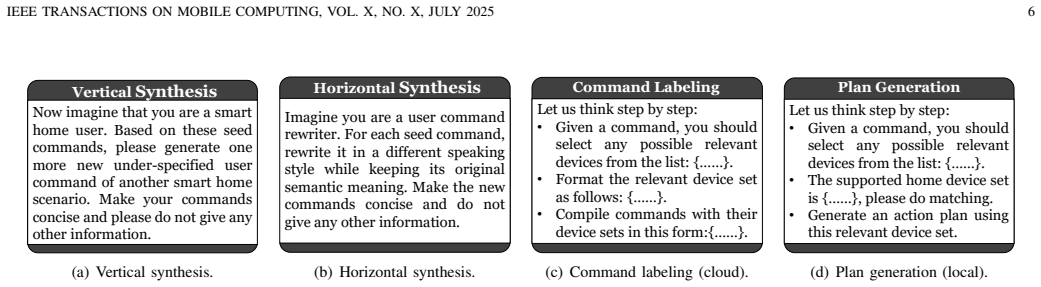
The central machinery is a teacher-student data transfer: a cloud LLM (the teacher) synthesizes and labels a large command-device dataset from seed commands, and a QLoRA adapter on LLaMA3-8B (the student) is trained as a device identifier. Inference then runs in two steps: first the model produces a comprehensive relevant device set from a generic 39-device home, then intersects it with the user's actual device set ($D_i^f = D_l \cap D_i$) to generate the plan. The second mechanism, PrivShield, is an SLM-in-the-middle obfuscator: it rewrites the user command, generates $N$ adversarial commands, shuffles them with IDs, sends the mixture to the cloud, and recovers only the plan attached to the locally recorded ID. The Device Relevance Score, defined as $(|G_l \cap G_r| - |G_r - G_l|)/|G_r|$, measures whether the model's chosen devices overlap the human-annotated ground truth without adding irrelevant devices.
What would settle it
Take a set of smart-home commands collected from a different source, such as fresh user-written commands or a separate platform, with human-annotated device labels, and run HomeLLaMA against vanilla LLaMA3 and a directly fine-tuned SLM; if the DRS advantage shrinks to near zero on the disjoint test set while remaining large on DevFinder, the generalization claim is refuted. Also, train a binary classifier to distinguish real versus decoy commands from PrivShield mixtures and measure its success rate across rounds; if it approaches 100% as $N$ grows small or as rounds accumulate, the privacy claim needs qualification.
Extended reading notes
Core claim
HomeLLaMA claims that a QLoRA-fine-tuned LLaMA3-8B, trained on a cloud-generated command-device dataset and served with a two-step chain-of-thought inference paradigm, identifies relevant smart devices nearly as well as a cloud-based GPT-3.5 while never uploading user profiles or home configurations. The key discovery is that the bottleneck for local SLMs is device association, not plan generation: given a command like "let the guests in," the local model must first name all plausibly relevant devices from a comprehensive set, then intersect that set with the devices actually present in the home. This two-step procedure, combined with QLoRA tuning on 14K augmented command-device pairs, lifts device relevance from below to the level of a smaller cloud model. For the residual cases where users reject local plans, PrivShield rewrites and paraphrases the command, surrounds it with $N$ locally generated decoy commands, and sends the mixture to the cloud; the correct plan is recovered locally by ID. Activity-monitoring attacks that would succeed 100% of the time against direct queries drop far below that when PrivShield is used.
Load-bearing premise
The DevFinder test commands with human-annotated device labels are drawn from the same crowdsourced recipe corpus used to pick the seed commands for data augmentation, so the reported device-relevance gains could partly reflect the test set resembling the training data rather than true generalization to unseen command styles.
Editorial extensions
If this is right
- Users can get personalized smart-home plans without uploading profiles or home layouts: cloud assistance is triggered only after user rejection and only on the current command.
- With PrivShield, activity-monitoring attack success stays far below the 100% direct-query baseline, and adding more decoy commands or a stronger base model reduces it further.
- Long-term personalization improves with use: profile similarity-based merging keeps the database compact, and PrivShield invocation frequency drops toward zero by the 50th conversation turn.
- Deployment is affordable on household-scale hardware: peak GPU memory stays under 16 GB, and a single consumer GPU completes fine-tuning in about 8 hours.
- The two-step relevant-device-then-match inference generalizes across homes because the first step is independent of the specific device configuration.
Reading between the lines
- The reported DRS gain is measured on the DevFinder test set drawn from the same crowdsourced recipe dataset that supplies the seed commands for augmentation; a reader should not assume the same gain on commands whose vocabulary and device associations differ substantially from that corpus.
- PrivShield's privacy numbers measure one attack instantiation, a prompted cloud model trying to pick the true command from the mixture; a stronger adversary fine-tuned specifically to detect machine-generated decoys could plausibly erode the margin, so the claimed protection is likely a lower bound on attacker capability, not an upper bound.
- The same recipe of cloud-synthesized labels plus local QLoRA tuning plus decoy obfuscation could transfer to other personal-IoT domains, such as wearables, vehicles, or offices, where a public corpus of command-device pairs exists and user commands are short and under-specified.
- Because user profiles are constructed by the local model and merged by cosine similarity rather than appending raw history, the approach suggests a general pattern for continuous personalization under small context windows: digest each turn, store only compact embeddings, and retrieve the top few at inference.
Editorial analysis
A structured set of objections, weighed in public.
Referee Report
Summary. The paper proposes HomeLLaMA, an on-device smart home assistant built on a QLoRA-fine-tuned LLaMA3-8B model, together with a privacy-preserving local-cloud collaboration module called PrivShield. The system is trained on a GPT-4-augmented command-device dataset, uses a two-step inference pipeline (comprehensive relevant-device identification followed by home-specific matching), maintains dynamically updated user profiles, and optionally obfuscates user commands with adversarial commands before sending them to a cloud LLM. The authors introduce the DevFinder benchmark of 100 commands with human-annotated device labels, report that HomeLLaMA achieves device relevance scores (DRS) comparable to cloud-based GPT-3.5, and present user studies (N=100) showing high satisfaction and privacy confidence.
Significance. If the quantitative results are valid, HomeLLaMA would be a useful contribution to privacy-preserving smart home personalization, with practical strengths including the labor-free data augmentation pipeline, the two-step inference paradigm, the local profile merging mechanism, the user-in-the-loop interaction flow, and the release of the trained model and dataset. The user study and the honest-but-curious threat model for cloud assistance are also commendable. However, the central quantitative performance claim rests on a flawed metric and a potentially overlapping benchmark, so the paper's main evidence does not currently support the stated conclusions.
major comments (4)
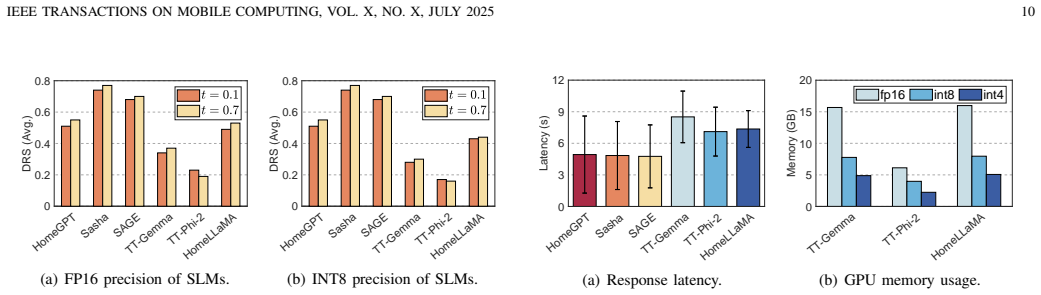
- [§VI-A1, Eq. (7)] The Device Relevance Score (DRS) defined in Eq. (7) is precision-only and contains no recall term: algebraically, DRS = 2*precision - 1. Any non-empty output set that is a subset of the ground-truth device set yields DRS = 1 regardless of how many relevant devices are omitted. This directly contradicts the paper's own motivating example in §III-B (Fig. 2(a)), where LLaMA3 is faulted for producing a simpler response mentioning only lights and the music player instead of a comprehensive list. Under Eq. (7), such an incomplete response can receive a perfect score, and the headline claim in §VI-A3 that HomeLLaMA achieves DRS comparable to GPT-3.5 (Fig. 10) may reflect output-set size rather than plan completeness. The authors should replace DRS with a metric that penalizes missing true devices (e.g., F1 score or a recall-aware variant) and rerun all model comparisons.
- [§VI-A1 vs §IV-B2] The DevFinder test set is described as 100 commands "with human-annotated device labels from the IFTTT dataset" (§VI-A1), while the seed commands for the augmentation pipeline in §IV-B2 are also selected from the same IFTTT dataset ("we obtain 90 seed commands in total"). Because the augmentation synthesis (§IV-B2) generates variants of these seeds via GPT-4, the test commands are likely to overlap in distribution with the training data, which can inflate HomeLLaMA's DRS relative to baselines that were not trained on IFTTT-derived commands. The authors should construct a held-out test set from a different source (or from newly collected user commands) and repeat the evaluation to demonstrate generalization beyond the source dataset.
- [§VI-D2] The augmentation threshold α is tuned by measuring average DRS on DevFinder (Fig. 15(a)) and then fixed at α = 0.7 for the main results reported in Fig. 10. This means the primary performance comparison is reported on the same test set used for hyperparameter selection, which is a form of test-set leakage. The paper should split DevFinder into validation and test portions, select α on the validation portion, and report final numbers on the untouched test portion.
- [§VI-B2 and Eq. (8)] The privacy evaluation reports attack success rates "far below the 100% success rate of direct queries," but 100% is a trivial baseline: a direct query reveals the true command by construction. The paper should additionally report the random-guessing baseline (1/(N+1)) and, ideally, compare against a standard obfuscation method to quantify the actual privacy gain. Without such baselines, "significantly lower attack accuracy" is not compelling evidence of meaningful privacy protection. In addition, Eq. (8) is an identity under the stated definitions (the overall attack success rate equals the conditional success rate times the frequency of PrivShield use), not an empirically derived result; presenting it as a finding is misleading.
minor comments (6)
- [§VI-B2 heading] The heading "Quantitiave Analysis" should read "Quantitative Analysis."
- [Index Terms] The index terms contain typos: "pivacy" should be "privacy" and "Personlization" should be "Personalization."
- [§VIII Conclusion] In the conclusion, "Multi-Parity Interaction" should be "Multi-party Interaction."
- [§IV-C2 Remarks] The sentence beginning "Although adversaries may deploy advanced pretrained classifiers to distinguish user commands from obfuscated mixtures" is a sentence fragment; it should be completed or merged with the following sentence.
- [Fig. 10 caption] The caption ",setting (a) FP16 and (b) INT8 precision" is unclear; it should state explicitly that both panels show DRS for all systems under different quantization precisions for the local SLMs.
- [§VI-A3] The text says HomeLLaMA "still lags behind cloud-based LLM assistants" and then claims it "achieves comparable DRS to GPT-3.5"; please clarify which baseline corresponds to GPT-3.5 (e.g., HomeGPT) and reconcile the apparent contradiction.
Circularity Check
No significant circularity: HomeLLaMA's performance and privacy claims are evaluated against human-annotated labels and an external attacker, and the equations the paper states are metric definitions or accounting identities, not derived predictions.
full rationale
I walked the claimed derivation chain. The central performance claim (DRS comparable to GPT-3.5, Fig. 10) is supported by fine-tuning LLaMA3-8B on a GPT-4-synthesized command-device dataset and then scoring the fine-tuned model on DevFinder, whose 100 test commands carry human-annotated device labels (Section VI-A1). The training labels are generated by GPT-4, but the evaluation labels are independent human annotations, so the comparison does not reduce to the training signal by construction. The DRS metric in Eq. (7) is precision-weighted and omits recall, so a model returning any non-empty subset of the ground-truth devices scores 1.0; this is a real metric-validity concern that should be flagged as a correctness risk, but it is not circularity because the paper does not derive DRS from its own outputs or fit parameters to make the score come out. Eq. (8), SRh = epsilon * SRp, is an accounting identity under the stated use model; it is presented as a qualitative remark, not used to prove the privacy improvement. The privacy evaluation uses GPT-4 as an external attacker against SLM-generated decoys, and the comparison baseline is direct queries at 100% success, so the measured reductions are not forced by the paper's definitions. The paper does cite the authors' prior work ([17]-[19], [33]-[35]), but these citations support contextual claims (e.g., on-device resource constraints, LLM-driven IoT development) and are not load-bearing premises of the main evaluation. The DevFinder train/test overlap (Section VI-A1 vs Section IV-B2) is a benchmark-hygiene concern that could affect generalization claims, but it does not make any result equivalent to its input by construction, since the test labels are human-annotated and the test commands are not the fitted values. I therefore find no circular step and score 0.
Assumptions & free parameters
free parameters (3)
- α (command augmentation threshold) =
0.7
- β (profile merging threshold) =
0.6
- N (number of adversarial commands) =
user-customizable; evaluated at 2,4,9,19
assumptions (4)
- domain assumption Honest-but-curious cloud server: the cloud executes queries correctly but may inspect transmitted data.
- domain assumption User commands can be paraphrased and stripped of personal information without changing their action-planning semantics.
- domain assumption SLM-generated adversarial commands are sufficiently similar to real user commands to make identification hard for the cloud attacker.
- domain assumption Summarized user profiles (topics, preferences, commands, plans) capture enough of the user's long-term preferences to improve future plans.
invented entities (3)
-
HomeLLaMA
independent evidence
-
PrivShield
independent evidence
-
DevFinder
independent evidence
Cite this review
Pith. "Pith review of Towards Privacy-Preserving and Personalized Smart Homes via Tailored Small Language Models." pith.science (2026). https://pith.science/paper/ADVYSHTQ
@misc{pith2026250708878,
  author       = {Pith},
  title        = {Pith review of: Towards Privacy-Preserving and Personalized Smart Homes via Tailored Small Language Models},
  year         = {2026},
  howpublished = {\url{https://pith.science/paper/ADVYSHTQ}},
  note         = {Machine review of arXiv:2507.08878}
}
read the original abstract
Large Language Models (LLMs) have showcased remarkable generalizability in language comprehension and hold significant potential to revolutionize human-computer interaction in smart homes. Existing LLM-based smart home assistants typically transmit user commands, along with user profiles and home configurations, to remote servers to obtain personalized services. However, users are increasingly concerned about the potential privacy leaks to the remote servers. To address this issue, we develop HomeLLaMA, an on-device assistant for privacy-preserving and personalized smart home serving with a tailored small language model (SLM). HomeLLaMA learns from cloud LLMs to deliver satisfactory responses and enable user-friendly interactions. Once deployed, HomeLLaMA facilitates proactive interactions by continuously updating local SLMs and user profiles. To further enhance user experience while protecting their privacy, we develop PrivShield to offer an optional privacy-preserving LLM-based smart home serving for those users, who are unsatisfied with local responses and willing to send less-sensitive queries to remote servers. For evaluation, we build a comprehensive benchmark DevFinder to assess the service quality. Extensive experiments and user studies (M=100) demonstrate that HomeLLaMA can provide personalized services while significantly enhancing user privacy.
Figures


Figures from the paper (10 more)




Forward citations
Cited by 1 Pith paper
-
SMH-Bench: Benchmarking LLM Agents for Environment-Grounded Reasoning and Action in Smart Homes
SMH-Bench supplies 1,100 stratified tasks in a verifiable smart-home simulator to measure LLM performance on explicit control, scheduling, ambiguity, and personalization as environment complexity grows.
Reference graph
Works this paper leans on
-
[1]
A review of internet of things for smart home: Challenges and solutions,
B. L. R. Stojkoska and K. V . Trivodaliev, “A review of internet of things for smart home: Challenges and solutions,” Journal of cleaner production, vol. 140, pp. 1454–1464, 2017. IEEE TRANSACTIONS ON MOBILE COMPUTING, VOL. X, NO. X, JULY 2025 14
work page 2017
-
[2]
What we do– and don’t–know about the smart home: an analysis of the smart home literature,
S. Solaimani, W. Keijzer-Broers, and H. Bouwman, “What we do– and don’t–know about the smart home: an analysis of the smart home literature,” Indoor and Built Environment , vol. 24, no. 3, pp. 370–383, 2015
work page 2015
-
[3]
Thumbup: Secure smartwatch controller for smart homes using simple hand gestures,
X. Yu, Z. Zhou, L. Zhang, and X.-Y . Li, “Thumbup: Secure smartwatch controller for smart homes using simple hand gestures,” IEEE TMC , vol. 23, no. 1, pp. 865–878, 2022
work page 2022
-
[4]
Lh-ids: Lightweight hybrid intrusion detection system based on differential privacy in vanets,
J. Cui, J. Xiao, H. Zhong, J. Zhang, L. Wei, I. Bolodurina, and D. He, “Lh-ids: Lightweight hybrid intrusion detection system based on differential privacy in vanets,” IEEE TMC, vol. 23, no. 12, pp. 12 195– 12 210, 2024
work page 2024
-
[5]
Sasha: creative goal-oriented reasoning in smart homes with large language models,
E. King, H. Yu, S. Lee, and C. Julien, “Sasha: creative goal-oriented reasoning in smart homes with large language models,” ACM IMWUT, vol. 8, no. 1, pp. 1–38, 2024
work page 2024
-
[6]
Z. Ramadan, M. F Farah, and L. El Essrawi, “From amazon. com to amazon. love: How alexa is redefining companionship and interdepen- dence for people with special needs,” Psychology & Marketing, vol. 38, no. 4, pp. 596–609, 2021
work page 2021
-
[7]
Spoken language understanding for natural interaction: The siri experience,
J. R. Bellegarda, “Spoken language understanding for natural interaction: The siri experience,” Natural Interaction with Robots, Knowbots and Smartphones: Putting Spoken Dialog Systems into Practice , pp. 3–14, 2013
work page 2013
-
[8]
Edgellm: Fast on-device llm inference with speculative decoding,
D. Xu, W. Yin, H. Zhang, X. Jin, Y . Zhang, S. Wei, M. Xu, and X. Liu, “Edgellm: Fast on-device llm inference with speculative decoding,” IEEE Transactions on Mobile Computing, vol. 24, no. 4, pp. 3256–3273, 2025
work page 2025
Show all 72 references
-
[9]
A survey of large language models,
W. X. Zhao, K. Zhou, J. Li, T. Tang, X. Wang, Y . Hou, Y . Min, B. Zhang, J. Zhang, Z. Dong et al. , “A survey of large language models,” arXiv preprint arXiv:2303.18223, 2023
2023 arXiv
-
[10]
Enhancing stability and resource efficiency in llm training for edge-assisted mobile systems,
C. Liu and J. Zhao, “Enhancing stability and resource efficiency in llm training for edge-assisted mobile systems,”IEEE Transactions on Mobile Computing, pp. 1–18, 2025
2025
-
[11]
Available: https://chat.openai.com/chat/
Openai, “Gpt-4.” [Online]. Available: https://chat.openai.com/chat/
-
[12]
Verifiable symmetric searchable encryption for semi-honest-but-curious cloud servers,
Q. Chai and G. Gong, “Verifiable symmetric searchable encryption for semi-honest-but-curious cloud servers,” in IEEE ICC , 2012, pp. 917– 922
2012
-
[13]
Towards personalized privacy-preserving incentive for truth discovery in mobile crowdsensing systems,
P. Sun, Z. Wang, L. Wu, Y . Feng, X. Pang, H. Qi, and Z. Wang, “Towards personalized privacy-preserving incentive for truth discovery in mobile crowdsensing systems,” IEEE TMC, vol. 21, no. 1, pp. 352–365, 2020
2020
-
[14]
Cl-shield: A continuous learning system for protecting user privacy,
T. Li, H. Wang, Q. Li, Y . Jiang, and Z. Yuan, “Cl-shield: A continuous learning system for protecting user privacy,” IEEE Transactions on Mobile Computing, vol. 24, no. 4, pp. 3148–3162, 2025
2025
-
[15]
A triple real- time trajectory privacy protection mechanism based on edge computing and blockchain in mobile crowdsourcing,
W. Wang, Y . Wang, P. Duan, T. Liu, X. Tong, and Z. Cai, “A triple real- time trajectory privacy protection mechanism based on edge computing and blockchain in mobile crowdsourcing,” IEEE TMC, vol. 22, no. 10, pp. 5625–5642, 2022
2022
-
[16]
Cross-app interference threats in smart homes: Categorization, detection and handling,
H. Chi, Q. Zeng, X. Du, and J. Yu, “Cross-app interference threats in smart homes: Categorization, detection and handling,” in 2020 50th Annual IEEE/IFIP International Conference on Dependable Systems and Networks (DSN). IEEE, 2020, pp. 411–423
2020
-
[17]
Fedconv: A learning-on-model paradigm for heterogeneous federated clients,
L. Shen, Q. Yang, K. Cui, Y . Zheng, X.-Y . Wei, J. Liu, and J. Han, “Fedconv: A learning-on-model paradigm for heterogeneous federated clients,” in ACM MobiSys, 2024, pp. 398–411
2024
-
[18]
Feddm: Data and model heterogeneity-aware federated learning via dynamic weight sharing,
L. Shen and Y . Zheng, “Feddm: Data and model heterogeneity-aware federated learning via dynamic weight sharing,” in 2023 IEEE ICDCS . IEEE, 2023, pp. 975–976
2023
-
[19]
Hierarchical and heterogeneous federated learning via a learning-on- model paradigm,
L. Shen, Q. Yang, K. Cui, Y . Zheng, X.-Y . Wei, J. Liu, and J. Han, “Hierarchical and heterogeneous federated learning via a learning-on- model paradigm,” IEEE TMC, pp. 1–16, 2025
2025
-
[20]
Scaling laws for neural language models,
J. Kaplan, S. McCandlish, T. Henighan, T. B. Brown, B. Chess, R. Child, S. Gray, A. Radford, J. Wu, and D. Amodei, “Scaling laws for neural language models,” arXiv preprint arXiv:2001.08361 , 2020
2001 arXiv
-
[21]
Sage: Smart home agent with grounded execution,
D. Rivkin, F. Hogan, A. Feriani, A. Konar, A. Sigal, S. Liu, and G. Dudek, “Sage: Smart home agent with grounded execution,” arXiv preprint arXiv:2311.00772, 2023
2023 arXiv
-
[22]
Retrieval- augmented generation for knowledge-intensive nlp tasks,
P. Lewis, E. Perez, A. Piktus, F. Petroni, V . Karpukhin, N. Goyal, H. K ¨uttler, M. Lewis, W.-t. Yih, T. Rockt ¨aschel et al. , “Retrieval- augmented generation for knowledge-intensive nlp tasks,” Advances in neural information processing systems , vol. 33, pp. 9459–9474, 2020
2020
-
[23]
” get ready for a party
E. King, H. Yu, S. Lee, and C. Julien, “” get ready for a party”: Exploring smarter smart spaces with help from large language models,” arXiv preprint arXiv:2303.14143, 2023
2023 arXiv
-
[24]
Thoughtful things: Building human-centric smart devices with small language models,
E. King, H. Yu, S. Vartak, J. Jacob, S. Lee, and C. Julien, “Thoughtful things: Building human-centric smart devices with small language models,” arXiv preprint arXiv:2405.03821 , 2024
2024 arXiv
-
[25]
Iot-enabled smart appliances under industry 4.0: A case study,
S. Aheleroff, X. Xu, Y . Lu, M. Aristizabal, J. P. Vel ´asquez, B. Joa, and Y . Valencia, “Iot-enabled smart appliances under industry 4.0: A case study,” Advanced engineering informatics , vol. 43, p. 101043, 2020
2020
-
[26]
Designing the desirable smart home: A study of household experiences and energy consumption impacts,
R. H. Jensen, Y . Strengers, J. Kjeldskov, L. Nicholls, and M. B. Skov, “Designing the desirable smart home: A study of household experiences and energy consumption impacts,” in ACM CHI, 2018, pp. 1–14
2018
-
[27]
Smart home: architecture, technologies and systems,
M. Li, W. Gu, W. Chen, Y . He, Y . Wu, and Y . Zhang, “Smart home: architecture, technologies and systems,” Procedia computer science, vol. 131, pp. 393–400, 2018
2018
-
[28]
A systematic review of the smart home literature: A user perspective,
D. Marikyan, S. Papagiannidis, and E. Alamanos, “A systematic review of the smart home literature: A user perspective,” Technological Fore- casting and Social Change , vol. 138, pp. 139–154, 2019
2019
-
[29]
Smart home automation using iot and deep learning,
R. D. Manu, S. Kumar, S. Snehashish, and K. Rekha, “Smart home automation using iot and deep learning,” International Research Journal of Engineering and Technology , vol. 6, no. 4, pp. 1–4, 2019
2019
-
[30]
Survey on virtual assistant: Google assistant, siri, cortana, alexa,
A. S. Tulshan and S. N. Dhage, “Survey on virtual assistant: Google assistant, siri, cortana, alexa,” in Advances in Signal Processing and In- telligent Recognition Systems: 4th International Symposium SIRS 2018, Bangalore, India, September 19–22, 2018, Revised Selected Papers...
2018
-
[31]
Characterising usage patterns and privacy risks of a home security camera service,
J. Li, Z. Li, G. Tyson, and G. Xie, “Characterising usage patterns and privacy risks of a home security camera service,” IEEE TMC , vol. 21, no. 7, pp. 2344–2357, 2020
2020
-
[32]
Transformer in transformer,
K. Han, A. Xiao, E. Wu, J. Guo, C. Xu, and Y . Wang, “Transformer in transformer,” NIPS, vol. 34, pp. 15 908–15 919, 2021
2021
-
[33]
Autoiot: Llm-driven automated natural language programming for aiot applications,
L. Shen, Q. Yang, Y . Zheng, and M. Li, “Autoiot: Llm-driven automated natural language programming for aiot applications,” in ACM MobiCom, 2025
2025
-
[34]
Gpiot: Tailoring small language models for iot program synthesis and development,
L. Shen, Q. Yang, X. Huang, Z. Ma, and Y . Zheng, “Gpiot: Tailoring small language models for iot program synthesis and development,” in ACM SenSys, 2025
2025
-
[35]
Iotcoder: A copilot for iot application develop- ment,
L. Shen and Y . Zheng, “Iotcoder: A copilot for iot application develop- ment,” in ACM MobiCom, 2024, pp. 1647–1649
2024
-
[36]
Leveraging large language models for enhanced person- alised user experience in smart homes,
J. Rey-Jouanchicot, A. Bottaro, E. Campo, J.-L. Bouraoui, N. Vigouroux, and F. Vella, “Leveraging large language models for enhanced person- alised user experience in smart homes,” 2024
2024
-
[37]
Apple’s knowledge navigator: Why doesn’t that conversational agent exist yet?
A. K. Newendorp, M. Sanaei, A. J. Perron, H. Sabouni, N. Javadpour, M. Sells, K. Nelson, M. Dorneich, and S. B. Gilbert, “Apple’s knowledge navigator: Why doesn’t that conversational agent exist yet?” in ACM CHI, 2024, pp. 1–14
2024
-
[38]
The pii problem: Privacy and a new concept of personally identifiable information,
P. M. Schwartz and D. J. Solove, “The pii problem: Privacy and a new concept of personally identifiable information,” NYUL rev., vol. 86, p. 1814, 2011
2011
-
[39]
Location privacy-aware task offloading in mobile edge computing,
Z. Wang, Y . Sun, D. Liu, J. Hu, X. Pang, Y . Hu, and K. Ren, “Location privacy-aware task offloading in mobile edge computing,” IEEE TMC , vol. 23, no. 3, pp. 2269–2283, 2023
2023
-
[40]
Protecting your daily in-home activity information from a wireless snooping attack,
V . Srinivasan, J. Stankovic, and K. Whitehouse, “Protecting your daily in-home activity information from a wireless snooping attack,” in ACM UbiComp
-
[41]
Supervised contrastive learning for pre-trained language model fine-tuning,
B. Gunel, J. Du, A. Conneau, and V . Stoyanov, “Supervised contrastive learning for pre-trained language model fine-tuning,” arXiv preprint arXiv:2011.01403, 2020
2011 arXiv
-
[42]
Analysis of ifttt recipes to study how humans use internet-of-things (iot) devices,
H. Yu, J. Hua, and C. Julien, “Analysis of ifttt recipes to study how humans use internet-of-things (iot) devices,” in ACM SenSys, 2021, pp. 537–541
2021
-
[43]
Looking for a few good metrics: Rouge and its evaluation,
C.-Y . Lin and F. Och, “Looking for a few good metrics: Rouge and its evaluation,” in Ntcir workshop, 2004
2004
-
[44]
The apple sandbox,
D. Blazakis, “The apple sandbox,” Arlington, VA, January, 2011
2011
-
[45]
Wizardlm: Empowering large language models to follow complex instructions,
C. Xu, Q. Sun, K. Zheng, X. Geng, P. Zhao, J. Feng, C. Tao, and D. Jiang, “Wizardlm: Empowering large language models to follow complex instructions,” arXiv preprint arXiv:2304.12244 , 2023
2023 arXiv
-
[46]
Rouge: A package for automatic evaluation of summaries,
C.-Y . Lin, “Rouge: A package for automatic evaluation of summaries,” in Text summarization branches out , 2004, pp. 74–81
2004
-
[47]
Qlora: Efficient finetuning of quantized llms,
T. Dettmers, A. Pagnoni, A. Holtzman, and L. Zettlemoyer, “Qlora: Efficient finetuning of quantized llms,” NIPS, vol. 36, 2024
2024
-
[48]
Parameter-efficient fine- tuning for large models: A comprehensive survey,
Z. Han, C. Gao, J. Liu, S. Q. Zhang et al. , “Parameter-efficient fine- tuning for large models: A comprehensive survey,” arXiv preprint arXiv:2403.14608, 2024
2024 arXiv
-
[49]
Chain-of-thought prompting elicits reasoning in large language models,
J. Wei, X. Wang, D. Schuurmans, M. Bosma, F. Xia, E. Chi, Q. V . Le, D. Zhou et al. , “Chain-of-thought prompting elicits reasoning in large language models,” NIPS, vol. 35, pp. 24 824–24 837, 2022
2022
-
[50]
Trine: Cloud-edge-device cooperated real-time video analysis for household applications,
Y . Zhao, Z. Yang, X. He, X. Cai, X. Miao, and Q. Ma, “Trine: Cloud-edge-device cooperated real-time video analysis for household applications,” IEEE TMC, vol. 22, no. 8, pp. 4973–4985, 2022
2022
-
[51]
Redesigning privacy with user feedback: The case of zoom attendee attention tracking,
T. W. Li, A. Arya, and H. Jin, “Redesigning privacy with user feedback: The case of zoom attendee attention tracking,” in ACM CHIs, 2024, pp. 1–14. IEEE TRANSACTIONS ON MOBILE COMPUTING, VOL. X, NO. X, JULY 2025 15
2024
-
[52]
The impact of risk appeal approaches on users’ sharing confidential information,
E. Al Qahtani, P. Story, and M. Shehab, “The impact of risk appeal approaches on users’ sharing confidential information,” in ACM CHI , 2024, pp. 1–21
2024
-
[53]
Deep face represen- tations for differential morphing attack detection,
U. Scherhag, C. Rathgeb, J. Merkle, and C. Busch, “Deep face represen- tations for differential morphing attack detection,” IEEE Transactions on Information Forensics and Security , vol. 15, pp. 3625–3639, 2020
2020
-
[54]
Governing open vocabulary data leaks using an edge llm through programming by example,
Q. Li, J. Wen, and H. Jin, “Governing open vocabulary data leaks using an edge llm through programming by example,” ACM IMWUT, vol. 8, no. 4, pp. 1–31, 2024
2024
-
[55]
Pytorch: An imperative style, high-performance deep learning library,
A. Paszke, S. Gross, F. Massa, A. Lerer, J. Bradbury, G. Chanan, T. Killeen, Z. Lin, N. Gimelshein, L. Antiga et al. , “Pytorch: An imperative style, high-performance deep learning library,” Advances in neural information processing systems , vol. 32, 2019
2019
-
[56]
Langchain,
H. Chase, “Langchain,” 10 2022. [Online]. Available: https: //github.com/langchain-ai/langchain
2022
-
[57]
Llama: Open and efficient foundation language models,
H. Touvron, T. Lavril, G. Izacard, X. Martinet, M.-A. Lachaux, T. Lacroix, B. Rozi `ere, N. Goyal, E. Hambro, F. Azhar et al. , “Llama: Open and efficient foundation language models,” arXiv preprint arXiv:2302.13971, 2023
2023 arXiv
-
[58]
The faiss library,
M. Douze, A. Guzhva, C. Deng, J. Johnson, G. Szilvasy, P.-E. Mazar ´e, M. Lomeli, L. Hosseini, and H. J´egou, “The faiss library,” arXiv preprint arXiv:2401.08281, 2024
2024 arXiv
-
[59]
Gemma: Open models based on gemini research and technology,
G. Team, T. Mesnard, C. Hardin, R. Dadashi, S. Bhupatiraju, S. Pathak, L. Sifre, M. Rivi `ere, M. S. Kale, J. Love et al. , “Gemma: Open models based on gemini research and technology,” arXiv preprint arXiv:2403.08295, 2024
2024 arXiv
-
[61]
Security and privacy protection in cloud computing: Discussions and challenges,
P. Sun, “Security and privacy protection in cloud computing: Discussions and challenges,” Journal of Network and Computer Applications , vol. 160, p. 102642, 2020
2020
-
[62]
Appintent: Analyzing sensitive data transmission in android for privacy leakage detection,
Z. Yang, M. Yang, Y . Zhang, G. Gu, P. Ning, and X. S. Wang, “Appintent: Analyzing sensitive data transmission in android for privacy leakage detection,” in ACM CCS, 2013, pp. 1043–1054
2013
-
[63]
Survey on fully homomorphic encryption, theory, and ap- plications,
C. Marcolla, V . Sucasas, M. Manzano, R. Bassoli, F. H. Fitzek, and N. Aaraj, “Survey on fully homomorphic encryption, theory, and ap- plications,” Proceedings of the IEEE , vol. 110, no. 10, pp. 1572–1609, 2022
2022
-
[64]
Propile: Probing privacy leakage in large language models,
S. Kim, S. Yun, H. Lee, M. Gubri, S. Yoon, and S. J. Oh, “Propile: Probing privacy leakage in large language models,” NIPS, vol. 36, 2024
2024
-
[65]
Incognitext: Privacy-enhancing conditional text anonymization via llm- based private attribute randomization,
A. Frikha, N. Walha, K. K. Nakka, R. Mendes, X. Jiang, and X. Zhou, “Incognitext: Privacy-enhancing conditional text anonymization via llm- based private attribute randomization,”arXiv preprint arXiv:2407.02956, 2024
2024 arXiv
-
[66]
Hallucination is inevitable: An innate limitation of large language models,
Z. Xu, S. Jain, and M. Kankanhalli, “Hallucination is inevitable: An innate limitation of large language models,” arXiv preprint arXiv:2401.11817, 2024
2024 arXiv
-
[67]
Llm-pbe: Assessing data privacy in large language models,
Q. Li, J. Hong, C. Xie, J. Tan, R. Xin, J. Hou, X. Yin, Z. Wang, D. Hendrycks, Z. Wang et al. , “Llm-pbe: Assessing data privacy in large language models,” arXiv preprint arXiv:2408.12787 , 2024
2024 arXiv
-
[68]
Memory-Profiler: Monitor Memory usage of Python code
o. Fabian Pedregosa, “Memory-Profiler: Monitor Memory usage of Python code.” [Online]. Available: https://github.com/pythonprofilers/ memory profiler
-
[69]
Gptcache: An open-source semantic cache for llm applications enabling faster answers and cost savings,
F. Bang, “Gptcache: An open-source semantic cache for llm applications enabling faster answers and cost savings,” in NLP-OSS, 2023, pp. 212– 218
2023
-
[70]
Qwen2 technical report,
A. Yang, B. Yang, B. Hui, B. Zheng, B. Yu, C. Zhou, C. Li, C. Li, D. Liu, F. Huang et al. , “Qwen2 technical report,” arXiv preprint arXiv:2407.10671, 2024
2024 arXiv
-
[71]
Phi- 3 technical report: A highly capable language model locally on your phone,
M. Abdin, S. A. Jacobs, A. A. Awan, J. Aneja, A. Awadallah, H. Awadalla, N. Bach, A. Bahree, A. Bakhtiari, H. Behl et al. , “Phi- 3 technical report: A highly capable language model locally on your phone,” arXiv preprint arXiv:2404.14219 , 2024
2024 arXiv
-
[72]
The llama 3 herd of models,
A. Dubey, A. Jauhri, A. Pandey, A. Kadian, A. Al-Dahle, A. Letman, A. Mathur, A. Schelten, A. Yang, A. Fan et al. , “The llama 3 herd of models,” arXiv preprint arXiv:2407.21783 , 2024
2024 arXiv
-
[73]
Likert scale: Explored and explained,
A. Joshi, S. Kale, S. Chandel, and D. K. Pal, “Likert scale: Explored and explained,” British journal of applied science & technology , vol. 7, no. 4, pp. 396–403, 2015
2015
Reviewed August 6, 2026 · model on record in the stance chip above.
Discussion (0). Sign in to comment.