REVIEW 4 major objections 4 minor 2 cited by
CLA: Latent Alignment for Online Continual Self-Supervised Learning
T0 review · 4 major / 4 minor · reviewed 2026-08-06 · deepseek-v4-flash
Pith's one-line read Online self-supervised learning beats i.i.d. training at equal compute, via latent alignment
desk verdict Solid empirical OCSSL paper with a genuinely new combination, but the 'beats i.i.d.' claim holds only for SimSiam and is partly an artifact of the budget metric. read the letter →
The pith
A machine-rendered reading of the paper's core claim, the machinery that carries it, and where it could break.
The reading
What carries the argument
The central object is the alignment regularizer L_reg = -SC(a_phi(z_r), z_hat)/2, a negative cosine similarity that pushes current representations of replayed samples, after a projection head a_phi, toward past target features. Two target sources are proposed: an exponential moving average network theta' = tau theta' + (1-tau) theta for CLA-E, and stored past features z* in a FIFO buffer for CLA-R. The alignment loss is added to the base SSL loss, so the model keeps learning on fresh stream data while being stabilized by past representations, which the paper argues yields fast convergence and mitigates forgetting without needing task boundaries.
What would settle it
A controlled experiment that measures wall-clock time or FLOPs for each method at the same CBP on identical hardware, then re-plots accuracy versus actual training time; if the gap between CLA and i.i.d. shrinks or reverses when forward passes and per-sample update counts are accounted for, the headline claim is an artifact of the CBP metric.
Extended reading notes
Core claim
The central discovery is that a lightweight alignment loss makes an online SSL learner converge much faster than plain SSL training, to the point where it overtakes the i.i.d. upper bound at the same computational budget. The paper formalizes the budget as the total number of backward passes, CBP = nv x nsteps x b, and reports results on Split CIFAR-100 and Split ImageNet100 with both SimSiam and SimCLR backbones. At the high budget, CLA-E reaches 43.1% final probing accuracy on CIFAR-100 versus 39.9% for i.i.d., and CLA variants also dominate average accuracy, keeping performance high across the whole stream. The paper further shows that a CLA-pretrained checkpoint, followed by ordinary i.i.d. training, matches or exceeds full i.i.d. training, which it interprets as evidence that CLA accelerates the early, convergence-dominated phase of self-supervised pretraining.
Load-bearing premise
The load-bearing premise is that counting backward passes is a fair way to measure computational budget: if two methods have the same CBP, they are assumed to be compared equally, even though CLA-E has an extra EMA forward pass and replay methods perform many more gradient updates on buffer samples than i.i.d. training does on any one sample.
Editorial extensions
If this is right
- An online continual strategy can match or beat the i.i.d. upper bound when the budget is measured in backward passes, so the online stream is not inherently a handicap under small budgets.
- CLA checkpoints are reusable warm starts: continuing with i.i.d. data from a CLA-pretrained model reaches the same accuracy as a full i.i.d. run, which is a concrete way to shorten SSL pretraining.
- The FIFO buffer beating reservoir and MinRed buffers indicates that uniform iteration counts per sample matter more than unbiased stream sampling in the online setting.
- CLA supports larger learning rates than plain replay baselines, suggesting the alignment term stabilizes optimization, which could transfer to other budget-limited training regimes.
Reading between the lines
- The i.i.d. comparison is exact only if backward passes are the dominant cost; the authors note CLA-E adds an EMA forward pass and SCALE copies the encoder. If forward-pass cost is material, the 'same budget' claim is approximate, though their wall-clock plots show modest differences.
- The paper's own stated explanation for the i.i.d. gap is that replay methods perform many more gradient updates on buffer samples than i.i.d. does on any given sample, and that alignment adds fast adaptation. That suggests the headline result may owe part of its size to the non-i.i.d. update distribution rather than to alignment alone.
- A testable extension is whether the early-pretraining benefit persists at larger scale, for example with full ImageNet or transformer backbones, where i.i.d. convergence dynamics differ from ResNet-18.
- The finding hints at a broader principle: a small replay buffer plus feature alignment acts as a variance-reduction mechanism for optimization on non-stationary streams, potentially connecting to momentum or preconditioning ideas beyond continual learning.
Editorial analysis
A structured set of objections, weighed in public.
Referee Report
Summary. The paper introduces Continual Latent Alignment (CLA), a replay-based strategy for online continual self-supervised learning (OCSSL) that aligns current representations with representations from the recent past, supplied either by an exponential moving average (EMA) network (CLA-E) or by stored buffer features (CLA-R). A new budget metric, Cumulative Backward Passes (CBP), is proposed to compare methods under a fixed computational budget, and experiments on Split CIFAR-100 and Split ImageNet100 with SimSiam (and SimCLR in the appendix) claim that CLA surpasses existing OCSSL methods and, in some settings, even i.i.d. training at the same CBP. The paper also reports that CLA pretraining can serve as a more efficient early-stage initialization than i.i.d. pretraining. The manuscript includes ablations on buffer type, EMA parameter tau, regularization strength omega, and promises code release.
Significance. If the central claims are made precise and the comparison is properly controlled, the paper makes a useful contribution: it demonstrates that a replay-based alignment loss can accelerate early SSL training and provides a strong baseline for the understudied OCSSL scenario. The CBP metric, despite its limitations, is a constructive step toward standardizing compute-aware comparisons in online continual learning. The empirical protocol is largely careful: two datasets, two SSL backbones, matched CBP across methods, ablations, and multiple seeds. However, the headline claims in the abstract and conclusion are substantially stronger than what the full empirical record supports, and the CBP metric has a load-bearing fairness issue that needs to be addressed. With appropriate scoping and additional control experiments, the paper's core phenomenon is plausible and worth publishing.
major comments (4)
- [Abstract and Section 8 (Conclusion)] The claims "CLA surpasses existing methods, and even i.i.d. training" (Section 8) and "using CLA as a pretraining protocol in the early stages of pretraining leads to a better final performance" (Abstract) are not supported by the full empirical record. In the SimCLR experiments (Table 5, Appendix B.1), i.i.d. reaches 48.5 ± 0.7 on ImageNet100 versus 45.1 ± 0.2 for CLA-E and 44.2 ± 0.4 for CLA-R, and 42.9 ± 0.3 on CIFAR-100 versus 42.6 ± 0.3 for CLA-R; the appendix itself states that SimCLR i.i.d. baselines are "unbeaten by methods trained on the OCSSL stream." Likewise, Figure 8 shows that on CIFAR-100 with SimCLR, CLA pretraining only reaches, not surpasses, full i.i.d. training. The abstract and conclusion should be revised to restrict these claims to the SimSiam backbone and the specific CBP budgets/datasets where they hold, and to acknowledge the SimCLR counterexamples explicitly.
- [Section 7 (Results) and Table 2] The sentence "In Low CBP, again, CLA-E surpasses other strategies in both datasets" is contradicted by Table 2: on Split CIFAR-100 with b = 30, np = 1, CaSSLe-R reaches 26.6 ± 0.5 final accuracy, while CLA-E reaches 24.4 ± 1.3 and CLA-R 20.8 ± 0.8. The text also states that "CLA-R being comparable to CLA-E" in this setting, which is not the case on CIFAR-100. Please correct this summary and qualify the state-of-the-art claim to the configurations in which it actually holds.
- [Section 5, Eq. (4), and Section 7] The fairness of the CBP budget is the load-bearing premise for the comparison with i.i.d. training. CBP counts only backward passes: it does not count forward passes (so CLA-E's additional EMA forward pass is free), and it does not account for the number of gradient updates each unique sample receives. Because CLA's replay buffer samples are repeatedly drawn into the minibatch, they receive far more optimizer updates than any sample in the i.i.d. baseline (which sees each sample exactly nepochs times, Eq. (6)). The paper itself identifies "the presence of replay, as more training iterations are performed on buffer samples" as a cause of the i.i.d. improvement in Section 7. This means the headline "CLA surpasses i.i.d. under the same computational budget" may be an artifact of the budget definition rather than a property of the alignment loss. Please either provide a control experiment that gives the i.i.d. baseline a comparable number of gradient updates per sample (for example, by allowing it to revisit the full stream more often), or reformulate the claim to a "backward-pass budget" without implying equal sample-level training.
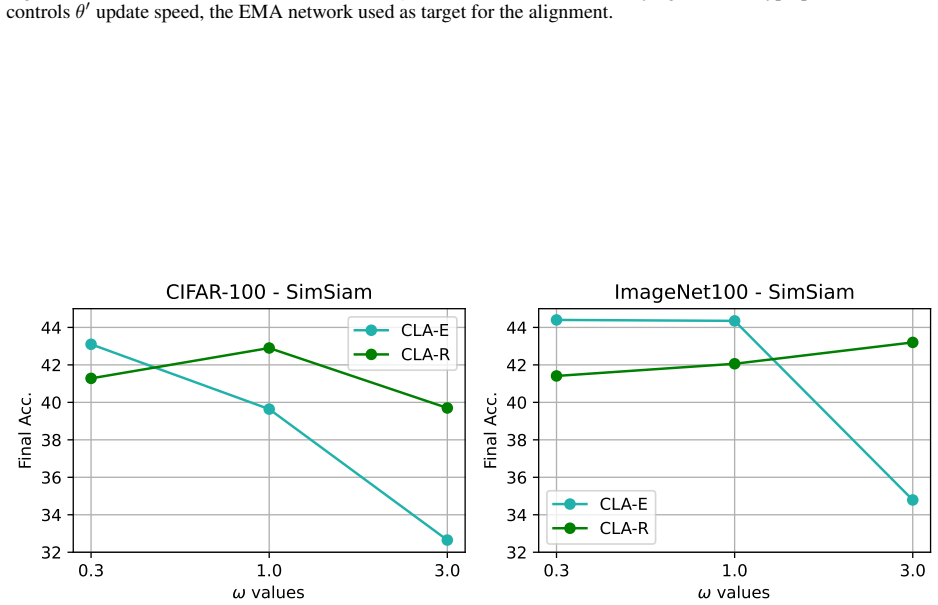
- [Section 6 and Appendix C] The comparison to prior methods is not fully controlled: the regularization weight ω of CLA is grid-searched on the validation set in every setting (Appendix C), while the baselines inherit all hyperparameters except learning rate from their original implementations. This asymmetry can inflate the reported margin of CLA over methods such as SCALE and Osiris-R. I ask for either a matched hyperparameter search for the baselines in this OCSSL scenario, or a sensitivity analysis showing that the relative ordering is stable when baseline hyperparameters are re-tuned.
minor comments (4)
- [Table 6 caption] The caption reads "CBP = for ImageNet100" with the value missing; the corresponding budget should be filled in (presumably 690k).
- [Equation (6)] The ceiling function in Eq. (6) is typeset as "l ... m"; please use proper ceiling brackets and define the notation.
- [Figure 1 caption] The caption states "CLA outperforms i.i.d. on the FINAL ACCURACY" without noting that this holds for the SimSiam backbone and specific CBP settings; please add the qualifier to match the rest of the paper.
- [Section 4, Algorithm 2] In the pseudocode, the variable names for the replay targets are introduced as z* in the text and as z1, z2 in the algorithm description; please unify the notation (e.g., use zr* consistently).
Circularity Check
No significant circularity: CLA's reported gains are empirical results against external benchmarks, not consequences of the paper's own definitions or fitted values.
full rationale
The paper's central claims are empirical comparisons, not derivations. CLA's loss (Eqs. 1-3) is defined independently of the results, and its advantage over baselines and i.i.d. is measured against held-out linear-probe accuracy on external benchmarks (CIFAR-100, ImageNet100) with ablations and downstream transfer. No parameter is fitted to the quantity it is then said to predict: learning rates and the alignment weight omega are tuned on a 10% validation set, while final and average accuracies are reported on test splits. The CBP budget metric (Eq. 4) equalizes backward-pass counts across methods by construction, and the i.i.d. baseline is allocated nepochs_iid = ceil(np * b / bs) (Eq. 6) so that CBP matches by construction; however, the outcome of the comparison is not forced by that construction. The paper itself reports conditions where i.i.d. wins, notably in the SimCLR appendix ('SimCLR demonstrates higher i.i.d. baselines than SimSiam, achieving results, remaining unbeaten by methods trained on the OCSSL stream') and at np=6 in Figure 5, so the 'surpasses i.i.d.' claim is an empirically contingent finding, not an identity. The paper also self-discloses the main validity caveats, including that CBP 'does not fully account for other sources of overhead' and that the CLA advantage is partly attributed to replay concentrating more iterations on buffer samples; these are fairness-of-metric and scope concerns, which belong to correctness risk rather than circularity. The EMA-based alignment design is motivated by Soutif-Cormerais et al. 2023b (co-authored by two of the present authors) and by external work (Michel et al. 2024), but the load-bearing evidence for the method's effectiveness is the paper's own experiments against non-self baselines, so the self-citation is not load-bearing. The conclusion's unqualified 'CLA surpasses ... even i.i.d. training' statement overgeneralizes relative to the full empirical record, but overgeneralization is a correctness issue, not a circular derivation. No load-bearing step in the derivation chain reduces to its own inputs by definition, by fitted parameter, or by a self-citation chain.
Assumptions & free parameters
free parameters (4)
- omega (alignment loss weight) =
0.3 to 3.0 (Tables 8-9)
- tau (EMA update coefficient) =
0.999
- Learning rate =
0.003 to 0.3 depending on method and dataset
- Memory buffer size =
2000
assumptions (4)
- domain assumption Linear probing accuracy on held-out classes measures SSL representation quality.
- domain assumption Backward-pass count (CBP) is an accurate proxy for total computational cost.
- ad hoc to paper Equal CBP between replay-based and i.i.d. methods is a fair comparison.
- domain assumption The OCSSL protocol (one pass, small minibatches, no task boundaries) is the right testbed for real streaming.
Cite this review
Pith. "Pith review of CLA: Latent Alignment for Online Continual Self-Supervised Learning." pith.science (2026). https://pith.science/paper/OEWVX2WV
@misc{pith2026250710434,
  author       = {Pith},
  title        = {Pith review of: CLA: Latent Alignment for Online Continual Self-Supervised Learning},
  year         = {2026},
  howpublished = {\url{https://pith.science/paper/OEWVX2WV}},
  note         = {Machine review of arXiv:2507.10434}
}
read the original abstract
Self-supervised learning (SSL) is able to build latent representations that generalize well to unseen data. However, only a few SSL techniques exist for the online CL setting, where data arrives in small minibatches, the model must comply with a fixed computational budget, and task boundaries are absent. We introduce Continual Latent Alignment (CLA), a novel SSL strategy for Online CL that aligns the representations learned by the current model with past representations to mitigate forgetting. We found that our CLA is able to speed up the convergence of the training process in the online scenario, outperforming state-of-the-art approaches under the same computational budget. Surprisingly, we also discovered that using CLA as a pretraining protocol in the early stages of pretraining leads to a better final performance when compared to a full i.i.d. pretraining.
Figures


Figures from the paper (7 more)


Forward citations
Cited by 2 Pith papers
-
Class Incremental Continual Learning with Self-Organizing Maps and Variational Autoencoders Using Synthetic Replay
A SOM-VAE generative replay method stores per-unit Gaussian statistics instead of raw data and reports competitive class-incremental accuracy on standard benchmarks.
-
Lifelong Representations: A Survey on Continual Self-Supervised Learning for Vision Models
CSSL for vision is more robust to forgetting than supervised CL due to task-agnostic features and flatter losses, yet still needs better protocols and scaling beyond small benchmarks to foundation-model continual pretraining.
Reference graph
Works this paper leans on
-
[1]
Understanding intermediate layers using linear classifier probes
Guillaume Alain and Yoshua Bengio. Understanding intermediate layers using linear classifier probes. arXiv preprint arXiv:1610.01644, 2016
arXiv 2016
-
[2]
Vicreg: Variance-invariance-covariance regularization for self-supervised learning
Adrien Bardes, Jean Ponce, and Yann LeCun. Vicreg: Variance-invariance-covariance regularization for self-supervised learning. In The Tenth International Conference on Learning Representations, ICLR 2022, Virtual Event, April 25-29, 2022 . OpenReview.net, 2022. URL https://openreview.net/forum?id=xm6YD62D1Ub
work page 2022
-
[3]
Hypernetworks for continual semi-supervised learning
Dhanajit Brahma, Vinay Kumar Verma, and Piyush Rai. Hypernetworks for continual semi-supervised learning. arXiv preprint arXiv:2110.01856, 2021
arXiv 2021
-
[4]
Rethinking experience replay: a bag of tricks for continual learning
Pietro Buzzega, Matteo Boschini, Angelo Porrello, and Simone Calderara. Rethinking experience replay: a bag of tricks for continual learning. In 2020 25th International Conference on Pattern Recognition (ICPR), pp.\ 2180--2187. IEEE, 2021
work page 2020
-
[5]
New insights on reducing abrupt representation change in online continual learning
Lucas Caccia, Rahaf Aljundi, Nader Asadi, Tinne Tuytelaars, Joelle Pineau, and Eugene Belilovsky. New insights on reducing abrupt representation change in online continual learning. In The Tenth International Conference on Learning Representations, ICLR 2022, Virtual Event, April 25-29, 2022 . OpenReview.net, 2022. URL https://openreview.net/forum?id=N8MaByOzUfb
work page 2022
-
[6]
Deep clustering for unsupervised learning of visual features
Mathilde Caron, Piotr Bojanowski, Armand Joulin, and Matthijs Douze. Deep clustering for unsupervised learning of visual features. In Proceedings of the European conference on computer vision (ECCV), pp.\ 132--149, 2018
work page 2018
-
[7]
Unsupervised learning of visual features by contrasting cluster assignments
Mathilde Caron, Ishan Misra, Julien Mairal, Priya Goyal, Piotr Bojanowski, and Armand Joulin. Unsupervised learning of visual features by contrasting cluster assignments. In Hugo Larochelle, Marc'Aurelio Ranzato, Raia Hadsell, Maria - Florina Balcan, and Hsuan - Tien Lin (eds.), Advances in Neural Information Processing Systems 33: Annual Conference on Ne...
work page 2020
-
[9]
Emerging properties in self-supervised vision transformers
Mathilde Caron, Hugo Touvron, Ishan Misra, Herv \' e J \' e gou, Julien Mairal, Piotr Bojanowski, and Armand Joulin. Emerging properties in self-supervised vision transformers. In 2021 IEEE/CVF International Conference on Computer Vision, ICCV 2021, Montreal, QC, Canada, October 10-17, 2021 , pp.\ 9630--9640. IEEE , 2021 b . doi:10.1109/ICCV48922.2021.009...
arXiv 2021
Show all 60 references
-
[10]
Sy-con: Symmetric contrastive loss for continual self-supervised representation learning
Sungmin Cha and Taesup Moon. Sy-con: Symmetric contrastive loss for continual self-supervised representation learning. arXiv e-prints, pp.\ arXiv--2306, 2023
2023
-
[11]
On tiny episodic memories in continual learning
Arslan Chaudhry, Marcus Rohrbach, Mohamed Elhoseiny, Thalaiyasingam Ajanthan, Puneet K Dokania, Philip HS Torr, and Marc'Aurelio Ranzato. On tiny episodic memories in continual learning. arXiv preprint arXiv:1902.10486, 2019
1902 arXiv
-
[12]
Ting Chen, Simon Kornblith, Mohammad Norouzi, and Geoffrey E. Hinton. A simple framework for contrastive learning of visual representations. In Proceedings of the 37th International Conference on Machine Learning, ICML 2020, 13-18 July 2020, Virtual Event , volume 119 of Proce...
2020
-
[13]
Exploring simple siamese representation learning
Xinlei Chen and Kaiming He. Exploring simple siamese representation learning. In IEEE Conference on Computer Vision and Pattern Recognition, CVPR 2021, virtual, June 19-25, 2021 , pp.\ 15750--15758. Computer Vision Foundation / IEEE , 2021. doi:10.1109/CVPR46437.2021.01549. UR...
2021
-
[14]
Improved baselines with momentum contrastive learning
Xinlei Chen, Haoqi Fan, Ross Girshick, and Kaiming He. Improved baselines with momentum contrastive learning. arXiv preprint arXiv:2003.04297, 2020 b
2003 arXiv
-
[15]
Lifelong Machine Learning
Zhiyuan Chen and Bing Liu. Lifelong Machine Learning. Morgan & Claypool Publishers, 2016
2016
-
[16]
Replay-free online continual learning with self-supervised multipatches
Giacomo Cignoni, Andrea Cossu, Alex Gomez-Villa, Joost van de Weijer, and Antonio Carta. Replay-free online continual learning with self-supervised multipatches. arXiv preprint arXiv:2502.09140, 2025
2025 arXiv
-
[17]
Continual pre-training mitigates forgetting in language and vision
Andrea Cossu, Antonio Carta, Lucia Passaro, Vincenzo Lomonaco, Tinne Tuytelaars, and Davide Bacciu. Continual pre-training mitigates forgetting in language and vision. Neural Networks, 179: 0 106492, 2024
2024
-
[18]
Imagenet: A large-scale hierarchical image database
Jia Deng, Wei Dong, Richard Socher, Li - Jia Li, Kai Li, and Fei - Fei Li. Imagenet: A large-scale hierarchical image database. In 2009 IEEE Computer Society Conference on Computer Vision and Pattern Recognition (CVPR 2009), 20-25 June 2009, Miami, Florida, USA , pp.\ 248--255...
2009
-
[19]
Hospedales
Linus Ericsson, Henry Gouk, Chen Change Loy, and Timothy M. Hospedales. Self-supervised representation learning: Introduction, advances, and challenges. IEEE Signal Processing Magazine, 39 0 (3): 0 42–62, May 2022. ISSN 1558-0792. doi:10.1109/msp.2021.3134634. URL http://dx.do...
2022
-
[20]
Turrisi da Costa, Xavier Alameda - Pineda, Elisa Ricci, Karteek Alahari, and Julien Mairal
Enrico Fini, Victor G. Turrisi da Costa, Xavier Alameda - Pineda, Elisa Ricci, Karteek Alahari, and Julien Mairal. Self-supervised models are continual learners. In IEEE/CVF Conference on Computer Vision and Pattern Recognition, CVPR 2022, New Orleans, LA, USA, June 18-24, 202...
2022
-
[21]
Gallardo, Tyler L
Gianmarco J. Gallardo, Tyler L. Hayes, and Christopher Kanan. Self-supervised training enhances online continual learning. In 32nd British Machine Vision Conference 2021, BMVC 2021, Online, November 22-25, 2021 , pp.\ 168. BMVA Press, 2021. URL https://www.bmvc2021-virtualconf...
2021
-
[22]
Bagdanov, and Joost van de Weijer
Alex Gomez - Villa, Bartlomiej Twardowski, Lu Yu, Andrew D. Bagdanov, and Joost van de Weijer. Continually learning self-supervised representations with projected functional regularization. In IEEE/CVF Conference on Computer Vision and Pattern Recognition Workshops, CVPR Works...
2022
-
[23]
Exemplar-free continual representation learning via learnable drift compensation
Alex Gomez-Villa, Dipam Goswami, Kai Wang, Andrew D Bagdanov, Bartlomiej Twardowski, and Joost van de Weijer. Exemplar-free continual representation learning via learnable drift compensation. In European Conference on Computer Vision, pp.\ 473--490. Springer, 2024 a
2024
-
[24]
Plasticity-optimized complementary networks for unsupervised continual learning
Alex Gomez-Villa, Bartlomiej Twardowski, Kai Wang, and Joost Van de Weijer. Plasticity-optimized complementary networks for unsupervised continual learning. In Proceedings of the IEEE/CVF winter conference on applications of computer vision, pp.\ 1690--1700, 2024 b
2024
-
[25]
An empirical investigation of catastrophic forgetting in gradient-based neural networks
Ian J Goodfellow, Mehdi Mirza, Da Xiao, Aaron Courville, and Yoshua Bengio. An empirical investigation of catastrophic forgetting in gradient-based neural networks. arXiv preprint arXiv:1312.6211, 2013
2013 arXiv
-
[26]
Richemond, Elena Buchatskaya, Carl Doersch, Bernardo \' A vila Pires, Zhaohan Guo, Mohammad Gheshlaghi Azar, Bilal Piot, Koray Kavukcuoglu, R \' e mi Munos, and Michal Valko
Jean - Bastien Grill, Florian Strub, Florent Altch \' e , Corentin Tallec, Pierre H. Richemond, Elena Buchatskaya, Carl Doersch, Bernardo \' A vila Pires, Zhaohan Guo, Mohammad Gheshlaghi Azar, Bilal Piot, Koray Kavukcuoglu, R \' e mi Munos, and Michal Valko. Bootstrap your ow...
2020
-
[27]
A survey on self-supervised learning: Algorithms, applications, and future trends
Jie Gui, Tuo Chen, Jing Zhang, Qiong Cao, Zhenan Sun, Hao Luo, and Dacheng Tao. A survey on self-supervised learning: Algorithms, applications, and future trends. IEEE Transactions on Pattern Analysis and Machine Intelligence, 46 0 (12): 0 9052--9071, 2024
2024
-
[28]
Deep residual learning for image recognition
Kaiming He, Xiangyu Zhang, Shaoqing Ren, and Jian Sun. Deep residual learning for image recognition. In 2016 IEEE Conference on Computer Vision and Pattern Recognition, CVPR 2016, Las Vegas, NV, USA, June 27-30, 2016 , pp.\ 770--778. IEEE Computer Society, 2016. doi:10.1109/CV...
2016 doi
-
[29]
Girshick
Kaiming He, Haoqi Fan, Yuxin Wu, Saining Xie, and Ross B. Girshick. Momentum contrast for unsupervised visual representation learning. In 2020 IEEE/CVF Conference on Computer Vision and Pattern Recognition, CVPR 2020, Seattle, WA, USA, June 13-19, 2020 , pp.\ 9726--9735. IEEE ...
2020
-
[30]
Overcoming catastrophic forgetting in neural networks
James Kirkpatrick, Razvan Pascanu, Neil Rabinowitz, Joel Veness, Guillaume Desjardins, Andrei A Rusu, Kieran Milan, John Quan, Tiago Ramalho, Agnieszka Grabska-Barwinska, et al. Overcoming catastrophic forgetting in neural networks. Proceedings of the national academy of scien...
2017
-
[31]
3d object representations for fine-grained categorization
Jonathan Krause, Michael Stark, Jia Deng, and Li Fei-Fei. 3d object representations for fine-grained categorization. In Proceedings of the IEEE international conference on computer vision workshops, pp.\ 554--561, 2013
2013
-
[32]
Learning multiple layers of features from tiny images
Alex Krizhevsky, Geoffrey Hinton, et al. Learning multiple layers of features from tiny images. 2009
2009
-
[33]
Continual learning for robotics: Definition, framework, learning strategies, opportunities and challenges
Timoth \'e e Lesort, Vincenzo Lomonaco, Andrei Stoian, Davide Maltoni, David Filliat, and Natalia D \' az-Rodr \' guez. Continual learning for robotics: Definition, framework, learning strategies, opportunities and challenges. Information fusion, 58: 0 52--68, 2020
2020
-
[34]
Gradient episodic memory for continual learning
David Lopez - Paz and Marc'Aurelio Ranzato. Gradient episodic memory for continual learning. In Isabelle Guyon, Ulrike von Luxburg, Samy Bengio, Hanna M. Wallach, Rob Fergus, S. V. N. Vishwanathan, and Roman Garnett (eds.), Advances in Neural Information Processing Systems 30:...
2017
-
[35]
Representational continuity for unsupervised continual learning
Divyam Madaan, Jaehong Yoon, Yuanchun Li, Yunxin Liu, and Sung Ju Hwang. Representational continuity for unsupervised continual learning. In The Tenth International Conference on Learning Representations, ICLR 2022, Virtual Event, April 25-29, 2022 . OpenReview.net, 2022. URL ...
2022
-
[36]
Online continual learning in image classification: An empirical survey
Zheda Mai, Ruiwen Li, Jihwan Jeong, David Quispe, Hyunwoo Kim, and Scott Sanner. Online continual learning in image classification: An empirical survey. Neurocomputing, 469: 0 28--51, 2022
2022
-
[37]
Catastrophic interference in connectionist networks: The sequential learning problem
Michael McCloskey and Neal J Cohen. Catastrophic interference in connectionist networks: The sequential learning problem. In Psychology of learning and motivation, volume 24, pp.\ 109--165. Elsevier, 1989
1989
-
[38]
Rethinking momentum knowledge distillation in online continual learning
Nicolas Michel, Maorong Wang, Ling Xiao, and Toshihiko Yamasaki. Rethinking momentum knowledge distillation in online continual learning. In Forty-first International Conference on Machine Learning, ICML 2024, Vienna, Austria, July 21-27, 2024 . OpenReview.net, 2024. URL https...
2024
-
[39]
Reading digits in natural images with unsupervised feature learning
Yuval Netzer, Tao Wang, Adam Coates, Alessandro Bissacco, Baolin Wu, Andrew Y Ng, et al. Reading digits in natural images with unsupervised feature learning. In NIPS workshop on deep learning and unsupervised feature learning, number 2, pp.\ 4. Granada, 2011
2011
-
[40]
Representation learning with contrastive predictive coding
Aaron van den Oord, Yazhe Li, and Oriol Vinyals. Representation learning with contrastive predictive coding. arXiv preprint arXiv:1807.03748, 2018
2018 arXiv
-
[41]
Quang Pham, Chenghao Liu, and Steven C. H. Hoi. Dualnet: Continual learning, fast and slow. In Marc'Aurelio Ranzato, Alina Beygelzimer, Yann N. Dauphin, Percy Liang, and Jennifer Wortman Vaughan (eds.), Advances in Neural Information Processing Systems 34: Annual Conference on...
2021
-
[42]
Online continual learning without the storage constraint
Ameya Prabhu, Zhipeng Cai, Puneet Dokania, Philip Torr, Vladlen Koltun, and Ozan Sener. Online continual learning without the storage constraint. arXiv preprint arXiv:2305.09253, 2023 a
2023 arXiv
-
[43]
Dokania, Philip H
Ameya Prabhu, Hasan Abed Al Kader Hammoud, Puneet K. Dokania, Philip H. S. Torr, Ser - Nam Lim, Bernard Ghanem, and Adel Bibi. Computationally budgeted continual learning: What does matter? In IEEE/CVF Conference on Computer Vision and Pattern Recognition, CVPR 2023, Vancouver...
2023
-
[44]
The challenges of continuous self-supervised learning
Senthil Purushwalkam, Pedro Morgado, and Abhinav Gupta. The challenges of continuous self-supervised learning. In Shai Avidan, Gabriel Brostow, Moustapha Ciss \'e , Giovanni Maria Farinella, and Tal Hassner (eds.), Computer Vision -- ECCV 2022, pp.\ 702--721, Cham, 2022. Sprin...
2022
-
[45]
Sylvestre - Alvise Rebuffi, Alexander Kolesnikov, Georg Sperl, and Christoph H. Lampert. icarl: Incremental classifier and representation learning. In 2017 IEEE Conference on Computer Vision and Pattern Recognition, CVPR 2017, Honolulu, HI, USA, July 21-26, 2017 , pp.\ 5533--5...
2017 doi
-
[46]
Self-supervised online learning of basic object push affordances
Barry Ridge, Ale s Leonardis, Ale s Ude, Miha Deni s a, and Danijel Sko c aj. Self-supervised online learning of basic object push affordances. International Journal of Advanced Robotic Systems, 12 0 (3): 0 24, 2015
2015
-
[47]
Psa--a new scalable space partition based selection algorithm for moeas
Shaul Salomon, Gideon Avigad, Alex Goldvard, and Oliver Sch \"u tze. Psa--a new scalable space partition based selection algorithm for moeas. In EVOLVE-A Bridge between Probability, Set Oriented Numerics, and Evolutionary Computation II, pp.\ 137--151. Springer, 2013
2013
-
[48]
Memory-efficient semi-supervised continual learning: The world is its own replay buffer
James Smith, Jonathan Balloch, Yen-Chang Hsu, and Zsolt Kira. Memory-efficient semi-supervised continual learning: The world is its own replay buffer. In 2021 International Joint Conference on Neural Networks (IJCNN), pp.\ 1--8. IEEE, 2021
2021
-
[49]
Improved deep metric learning with multi-class n-pair loss objective
Kihyuk Sohn. Improved deep metric learning with multi-class n-pair loss objective. In Daniel D. Lee, Masashi Sugiyama, Ulrike von Luxburg, Isabelle Guyon, and Roman Garnett (eds.), Advances in Neural Information Processing Systems 29: Annual Conference on Neural Information Pr...
2016
-
[50]
A comprehensive empirical evaluation on online continual learning
Albin Soutif-Cormerais, Antonio Carta, Andrea Cossu, Julio Hurtado, Vincenzo Lomonaco, Joost Van de Weijer, and Hamed Hemati. A comprehensive empirical evaluation on online continual learning. In Proceedings of the IEEE/CVF International Conference on Computer Vision, pp.\ 351...
2023
-
[51]
Improving online continual learning performance and stability with temporal ensembles
Albin Soutif-Cormerais, Antonio Carta, and Joost Van de Weijer. Improving online continual learning performance and stability with temporal ensembles. In Conference on Lifelong Learning Agents, pp.\ 828--845. PMLR, 2023 b
2023
-
[52]
Three scenarios for continual learning
Gido M Van de Ven and Andreas S Tolias. Three scenarios for continual learning. arXiv preprint arXiv:1904.07734, 2019
1904 arXiv
-
[53]
Random sampling with a reservoir
Jeffrey S Vitter. Random sampling with a reservoir. ACM Transactions on Mathematical Software (TOMS), 11 0 (1): 0 37--57, 1985
1985
-
[54]
Forgetting, ignorance or myopia: Revisiting key challenges in online continual learning
Xinrui Wang, Chuanxing Geng, Wenhai Wan, Shao - Yuan Li, and Songcan Chen. Forgetting, ignorance or myopia: Revisiting key challenges in online continual learning. In Amir Globersons, Lester Mackey, Danielle Belgrave, Angela Fan, Ulrich Paquet, Jakub M. Tomczak, and Cheng Zhan...
2024
-
[55]
Scale: Online self-supervised lifelong learning without prior knowledge
Xiaofan Yu, Yunhui Guo, Sicun Gao, and Tajana Rosing. Scale: Online self-supervised lifelong learning without prior knowledge. In Proceedings of the IEEE/CVF Conference on Computer Vision and Pattern Recognition, pp.\ 2484--2495, 2023
2023
-
[56]
Barlow twins: Self-supervised learning via redundancy reduction
Jure Zbontar, Li Jing, Ishan Misra, Yann LeCun, and St \' e phane Deny. Barlow twins: Self-supervised learning via redundancy reduction. In Marina Meila and Tong Zhang (eds.), Proceedings of the 38th International Conference on Machine Learning, ICML 2021, 18-24 July 2021, Vir...
2021
-
[57]
Integrating present and past in unsupervised continual learning
Yipeng Zhang, Laurent Charlin, Richard Zemel, and Mengye Ren. Integrating present and past in unsupervised continual learning. In Conference on Lifelong Learning Agents, pp.\ 388--409. PMLR, 2025
2025
-
[58]
write newline
" write newline "" before.all 'output.state := FUNCTION n.dashify 't := "" t empty not t #1 #1 substring "-" = t #1 #2 substring "--" = not "--" * t #2 global.max substring 't := t #1 #1 substring "-" = "-" * t #2 global.max substring 't := while if t #1 #1 substring * t #2 gl...
-
[59]
@esa (Ref
\@ifxundefined[1] #1\@undefined \@firstoftwo \@secondoftwo \@ifnum[1] #1 \@firstoftwo \@secondoftwo \@ifx[1] #1 \@firstoftwo \@secondoftwo [2] @ #1 \@temptokena #2 #1 @ \@temptokena \@ifclassloaded agu2001 natbib The agu2001 class already includes natbib coding, so you should ...
-
[60]
\@lbibitem[] @bibitem@first@sw\@secondoftwo \@lbibitem[#1]#2 \@extra@b@citeb \@ifundefined br@#2\@extra@b@citeb \@namedef br@#2 \@nameuse br@#2\@extra@b@citeb \@ifundefined b@#2\@extra@b@citeb @num @parse #2 @tmp #1 NAT@b@open@#2 NAT@b@shut@#2 \@ifnum @merge>\@ne @bibitem@firs...
-
[61]
@open @close @open @close and [1] URL: #1 \@ifundefined chapter * \@mkboth \@ifxundefined @sectionbib * \@mkboth * \@mkboth\@gobbletwo \@ifclassloaded amsart * \@ifclassloaded amsbook * \@ifxundefined @heading @heading NAT@ctr thebibliography [1] @ \@biblabel @NAT@ctr \@bibset...
Reviewed August 6, 2026 · model on record in the stance chip above.
Discussion (0). Sign in to comment.