REVIEW 3 major objections 4 minor 11 references
BioScore: A Foundational Scoring Function For Diverse Biomolecular Complexes
T0 review · 3 major / 4 minor · reviewed 2026-08-06 · deepseek-v4-flash
Pith's one-line read BioScore claims to be the first scoring function that unifies affinity scoring, ranking, docking, and virtual screening across proteins, nucleic acids, small molecules, and carbohydrates in one framework, consistently matching or beating…
desk verdict BioScore is a plausible generalist scoring function, but its PPI screening success appears to be driven by an interface-edge-count prior, so the 'unified screening' claim is not yet verified. read the letter →
The pith
A machine-rendered reading of the paper's core claim, the machinery that carries it, and where it could break.
The reading
What carries the argument
The load-bearing mechanism is a dual-scale geometric graph in which the nodes are block units (atoms for small molecules, amino acid residues for proteins, nucleobases for nucleic acids) carrying all-atom features and coordinates, processed by an E(3)-equivariant transformer. Two design choices carry the argument: interface-masking encoding, which hides inter-molecular edges during representation learning and is shown by ablation to improve distance-distribution fitting, and a dual-tower scoring module that separates docking/screening from scoring/ranking. The docking/screening tower builds a learned statistical potential through a mixture density network, replaces the traditional sum of log-probabilities with a mean, and adds an interaction-edge-count-aware confidence term, giving a score of the form $\mathrm{Score} = -U_{\mathrm{cplx}} + \log n_{ij}$; the scoring/ranking tower fits an MLP to pairwise block features and also adds the edge-count confidence term. A pretraining–fine-tuning workflow trains the density network on unlabeled structures first, then adapts to labeled affinity data per system.
What would settle it
Run BioScore on an independent PPI screening set built with decoys from multiple docking engines, or with experimentally characterized non-binders, and check whether true binders are consistently ranked above decoys; if its screening discrimination collapses or becomes comparable to baselines, the PPI screening claim fails. Alternatively, recompute PPI docking success rates after removing the interaction-edge-count confidence term; if the docking gain disappears, the dual-tower mechanism is the load-bearing component.
Extended reading notes
Core claim
The central claim is that BioScore is the first model to unify scoring, ranking, docking, and screening functionalities within a single framework for general biomolecular complexes, and that it consistently outperforms or matches 70 traditional and deep learning methods across 16 benchmarks. The authors report that pretraining on mixed protein–ligand and protein–protein structures improves protein–protein affinity prediction by up to 40% and antigen–antibody binding correlation by over 90%, that zero- and few-shot transfer to nucleic acid systems improves Pearson correlation by 15% and 71%, and that the unified representation improves protein–cyclic peptide affinity prediction by over 60%. Along the way, the paper introduces a PPI Benchmark with scoring, docking, and screening subsets built from a single data source, and reports that BioScore is the only tested method that effectively discriminates true binders in the PPI screening task.
Load-bearing premise
The screening claims for protein–protein complexes depend on the newly built PPI Benchmark, whose decoys come from one docking program (ZDOCK) and K-means sampling, and on which BioScore is the only tested method that discriminates actives; if that protocol accidentally favors BioScore, the benchmark's screening evaluation and the generality claims built on it lose force.
Editorial extensions
If this is right
- One pretrained model can serve as a drop-in scorer for protein–ligand, protein–protein, protein–nucleic acid, nucleic acid–ligand, cyclic peptide, macrocycle, and carbohydrate complexes without system-specific re-engineering.
- Cross-domain pretraining supplies transferable structural features that compensate for scarce affinity labels, enabling zero-shot prediction on nucleic acid–ligand and cyclic peptide systems and few-shot gains on protein–nucleic acid complexes.
- The new PPI Benchmark offers a common evaluation standard with scoring, docking, and screening subsets built from one data source, so future protein–protein scoring functions can be compared on the same footing.
- The interface-masking result implies that explicitly exposing inter-molecular edges during representation learning can hurt statistical-potential-based scoring, contradicting a common assumption in generalist biomolecular representation models.
- The edge-count-aware confidence term converts the number of interaction edges into a discriminative signal, which is what the paper credits for its docking and screening gains across complex types.
Reading between the lines
- Editorial inference: if the interface-masking finding generalizes, then generalist biomolecular encoders that emphasize interaction edges may be systematically limiting for scoring tasks; a testable extension is ablating inter-molecular edges in other generalist models.
- Editorial inference: the PPI screening claim rests on decoys produced by one docking engine (ZDOCK) with K-means sampling, so a stronger test would use decoys from multiple docking engines and experimentally confirmed non-binders.
- Editorial inference: the reported transfer gains suggest that as labeled data for RNA–ligand, glycan, and macrocycle systems accumulate, the same pretrain–fine-tune recipe can absorb them; this is a directly testable scalability prediction.
- Editorial inference: if BioScore were wired into structure prediction and binder-design loops, it could serve as the filter that selects designed binders, but that would require confirmation that its ranking quality holds on predicted rather than experimental conformations.
Signed reviews
Editorial analysis
A structured set of objections, weighed in public.
Referee Report
Summary. The paper introduces BioScore, a dual-scale geometric graph neural network that aims to serve as a foundational scoring function for diverse biomolecular complexes. The model combines an equivariant Transformer encoder with a mixture density network pretrained on structural distances, followed by task-specific fine-tuning. It claims to unify scoring, ranking, docking, and screening across proteins, nucleic acids, small molecules, and carbohydrates, and it introduces a new protein-protein interaction (PPI) benchmark built from PDBbind with scoring, docking, and screening subsets. The authors evaluate BioScore on 16 benchmarks, reporting state-of-the-art or competitive performance against 70 methods, and they demonstrate gains from cross-domain pretraining, zero/few-shot transfer, and specialized chemical spaces such as cyclic peptides and carbohydrates. The manuscript also includes ablation studies examining the contributions of interface masking, the statistical potential formulation, and the interaction-edge-count confidence term.
Significance. If the reported results are robust, BioScore would be an important contribution: it is the first model to combine scoring, ranking, docking, and screening in one framework for general biomolecular complexes, and the cross-domain pretraining results are compelling. The paper also provides a carefully deduplicated PPI benchmark, with sequence-similarity-based splits, and it includes extensive ablations. The authors are transparent about using MDN-based statistical potentials as motivation rather than as a rigorous PMF derivation, and the deduplication protocol is a clear strength. The significance is tempered, however, by the benchmark-construction choices and comparison protocol, which are the focus of the major comments below.
major comments (3)
- [PPI Benchmark construction and Eq. (25), Table S3] The PPI screening result is the only evidence that BioScore can discriminate true binding protein partners from non-binders, but the benchmark does not size-match pseudo-ligands to the true partner or control for interface area. Ablation 3 in Table S3 shows that removing the log(n_ij | d_ij < cutoff) term collapses PPI screening SR1% from 15.19% to 1.27%, while BioScore with that term achieves 15.19%. Because the true partner in its native complex will generally have more inter-molecular atom pairs within 8 Å than arbitrary cross-docked partners, the reported screening power may reflect an interface-size prior rather than binding specificity. The authors should report the distribution of n_ij for true binders versus pseudo-ligands, include a size-matched negative set, and repeat the ablation under size-matched conditions. They should also state how zero-contact poses are handled, since Eq. (25) is undefined for n_ij = 0.
- [Table 1 and its footnote] The baseline comparison protocol is inconsistent: GET and MINT are retrained on BioScore's training data, while GNN-DOVE and DProQA are evaluated with original published weights; many other comparisons (e.g., CASF-2016 in Table S8) rely on published results. This heterogeneous protocol makes the claim of 'consistently outperforms or matches 70 methods' difficult to assess, because some baselines are at a disadvantage from not being retrained on the same data. The authors should either retrain all baselines under the same data and task conditions where feasible, or provide a rigorous justification for using original weights and published results, and they should clearly distinguish 'retrained' from 'as-published' columns in every comparison table.
- [PPI Benchmark reproducibility and statistical reporting] The newly proposed PPI Benchmark is a central contribution, but the decoy pose sets (7,979 docking decoys and 613,900 screening conformations) are not released, and no error bars or statistical significance tests are reported for any of the metrics in Table 1 or the external benchmarks. Without the pose sets, other groups cannot reproduce or extend the benchmark; without confidence intervals, the small margins in several metrics cannot be interpreted as meaningful differences. The authors should deposit the exact benchmark poses and provide standard deviations or confidence intervals, at least for the PPI benchmark and CASF-2016 screening metrics.
minor comments (4)
- [Throughout] There are numerous typos and language issues that should be corrected: 'techqniue' in the Introduction, 'resulintg' in the Results section on protein-ligand tasks, 'assements' in the Abstract and Discussion, 'Perfermence' in the heading, and 'exicting' in the Discussion.
- [Eqs. (25) and (27)] The term log(n_ij | d_ij < cutoff) is called a 'confidence' term, but it is simply the logarithm of the edge count and is not a confidence measure in any statistical sense. A more descriptive name, such as 'interaction-edge-count prior' or 'size term,' would be clearer.
- [Abstract and Discussion] The paper repeatedly calls the PPI benchmark 'comprehensive' and 'full-spectrum,' but the SI correctly notes that a ranking-power benchmark could not be constructed for PPIs. The main text should temper these claims accordingly.
- [Figure S1] The validation curves for interface-masking versus no-interface-masking are mentioned as evidence of structural overfitting, but the figure is not described in the main text. Please add a sentence explaining what is plotted and what the reader should infer.
Circularity Check
No definitional or fitted-input circularity: BioScore's towers are trained on held-out labels and structural distances; the PPI-screening edge-count dependence is a benchmark-validity risk, not a circular step.
full rationale
The paper's central derivation is not circular. The affinity/ranking tower (Eqs. 26-27) is supervised on experimental affinity labels with training data deduplicated against the evaluation benchmarks by PDB ID and by MMseqs2 sequence similarity (Methods: Deduplication), so the reported scoring/ranking results are genuine held-out predictions. The docking/screening tower is a mixture density network trained on pairwise distance distributions from complex structures (Eqs. 15-20 and 28) and is applied without fine-tuning to the docking and screening sets; the Boltzmann-PMF equations (1-3) are used only as motivation, not as the fitting target. Comparisons against CASF-2016, DUD-E, DEKOIS2.0, SAbDab, PCAPRED/CSM-carbohydrate, CPSet, and the peptide-MHC ITN benchmark provide external anchors that do not depend on BioScore's own parameters. The author-constructed PPI Benchmark is a genuine new evaluation set, and BioScore is not trained on it because its 79 complexes are removed from pretraining/fine-tuning by PDB-ID and sequence-similarity deduplication. The strongest non-circularity-adjacent concern is that BioScore's PPI screening power in Eq. 25 is dominated by the hand-designed log(n_ij) contact-count term, so the screening result may partly reflect interface-size priors rather than learned binding discrimination, especially because the PPI screening protocol does not size-match pseudo-ligands to true binders. However, this is a benchmark-validity/fairness risk and not a case where a fitted parameter is renamed a prediction or where an output equals an input by construction. Self-citations to RTMScore, GenScore, ITN, and CPSet are to independently published baselines and datasets; they are not used as the sole justification for the central claims. Accordingly, no circular step is identified and the score is low.
Assumptions & free parameters
free parameters (5)
- Inter/intra-molecular distance cutoffs =
10/2/8 Å (graph), 7 Å (pretrain), 5 Å (fine-tune)
- Fine-tuning loss weights (a, b, c) =
0.5, 5, 1
- MDN Gaussian offset constants =
1.0 (mu), 1.1 (sigma)
- Edge-count confidence weight alpha_theta =
learnable
- Sequence similarity deduplication thresholds =
30% (PPI), 80% (antibody)
assumptions (6)
- standard math Boltzmann distribution and potential of mean force relation (Eqs. 1-3)
- domain assumption Experimental complex structures are representative samples from a Boltzmann-weighted ensemble
- domain assumption Distance distributions learned by MDN transfer across biomolecular systems
- domain assumption PDBbind affinity labels of types Kd, Ki, and IC50 are comparable as binding free energies
- domain assumption ZDOCK decoys and DockQ thresholds provide a valid test distribution for docking and screening
- standard math GET encoder is E(3)-equivariant under the described normalization
Cite this review
Pith. "Pith review of BioScore: A Foundational Scoring Function For Diverse Biomolecular Complexes." pith.science (2026). https://pith.science/paper/XYJA6MEV
@misc{pith2026250710877,
  author       = {Pith},
  title        = {Pith review of: BioScore: A Foundational Scoring Function For Diverse Biomolecular Complexes},
  year         = {2026},
  howpublished = {\url{https://pith.science/paper/XYJA6MEV}},
  note         = {Machine review of arXiv:2507.10877}
}
read the original abstract
Structural assessment of biomolecular complexes is vital for translating molecular models into functional insights, shaping our understanding of biology and aiding drug discovery. However, current structure-based scoring functions often lack generalizability across diverse biomolecular systems. We present BioScore, a foundational scoring function that addresses key challenges -- data sparsity, cross-system representation, and task compatibility -- through a dual-scale geometric graph learning framework with tailored modules for structure assessment and affinity prediction. BioScore supports a wide range of tasks, including affinity prediction, conformation ranking, and structure-based virtual screening. Evaluated on 16 benchmarks spanning proteins, nucleic acids, small molecules, and carbohydrates, BioScore consistently outperforms or matches 70 traditional and deep learning methods. Our newly proposed PPI Benchmark further enables comprehensive evaluation of protein-protein complex scoring. BioScore demonstrates broad applicability: (1) pretraining on mixed-structure data boosts protein-protein affinity prediction by up to 40% and antigen-antibody binding correlation by over 90%; (2) cross-system generalizability enables zero- and few-shot prediction with up to 71% correlation gain; and (3) its unified representation captures chemically challenging systems such as cyclic peptides, improving affinity prediction by over 60%. BioScore establishes a robust and generalizable framework for structural assessment across complex biomolecular landscapes.
Figures

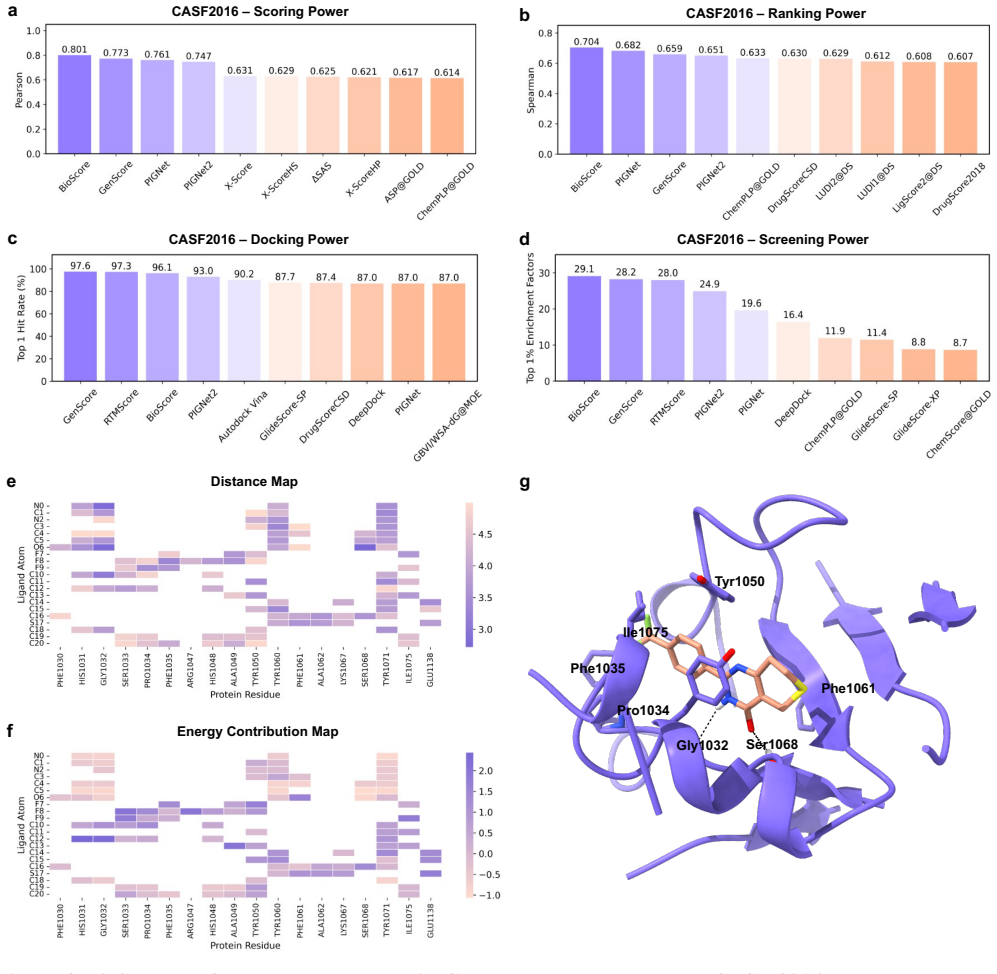

Figures from the paper (1 more)

Reference graph
Works this paper leans on
-
[1]
Supplementary Tables Table S1. Summary of Baseline Methods Method Test Type GET PLI,PPI,PNI,NLI GNN-DOVE PPI DProQA PPI VoroMQA PPI ZRANK2 PPI MINT PPI AutoDock Vina PLI RTMScore PLI EquiScore PLI-DUD-E/DEKOIS2.0 Glide SP PLI PIGNet PLI 3D-GNN PLI-DUD-E/DEKOIS2.0 TANKBind PLI-DUD-E/DEKOIS2.0 DeepDock PLI Kdeep PLI-DUD-E/DEKOIS2.0 deltaVinaRF PLI RFScorev4...
work page 2016
-
[2]
Supplementary Figures Figure S1. Validation Curves for Ablation Experiment 1 (without interface-masking encoding) and BioScore (with interface-masking encoding) during Mixed Pretraining on PLI and PPI Data. 56 Figure S2. Evaluation of 14 Scoring Methods on DUD-E. (A–D) Ranking of all methods by mean values for BEDROC (α=80.5), 0.5% EF, 1.0% EF, and 5.0% E...
-
[3]
PPI Benchmark To construct a comprehensive benchmark for scoring functions targeting protein–protein complexes, we per-formed an initial filtering of complexes from PDBbind (version 2020) based on the following criteria: (1) the pro-tein–protein interaction structure must consist of two heteromeric chains, with a sequence similarity between the chains of ...
work page 2020
-
[4]
Basic Evaluation Methods Following CASF-2016, there are four different tasks assessed in our evaluation, including the scoring, docking, ranking, and screening powers. Here, we introduce the primary assessment indicators for each of the four powers in our evaluations. “Scoring power” refers to the ability of a scoring function to produce binding scores in...
work page 2016
-
[5]
Description of Baseline Methods (1) GET We obtained results of GET using the open-source codes at https://github.com/thunlp-mt/get and retrained with default settings. Following GET, basic baselines such as EGNN, TorchMD-Net, and LEFTNet were obtained from their respective open-source codes, and SchNet was implemented using PyTorch Geometric. The retraini...
-
[6]
References 1. Su, M. et al. Comparative Assessment of Scoring Functions: The CASF-2016 Update. J. Chem. Inf. Model. 59, 895–913 (2019). 2. Jiang, D. et al. Assessing the performance of MM/PBSA and MM/GBSA methods. 10. Prediction reliability of binding affinities and binding poses for RNA–ligand complexes. Phys. Chem. Chem. Phys. 26, 10323–10335 (2024). 3....
work page 2019
-
[17]
Pierce, B. G., Hourai, Y. & Weng, Z. Accelerating Protein Docking in ZDOCK Using an Advanced 3D Con-volution Library. PLoS ONE 6, e24657 (2011)
work page 2011
-
[21]
Siebenmorgen, T. et al. MISATO: machine learning dataset of protein–ligand complexes for structure-based drug discovery. Nat. Comput. Sci. 4, 367–378 (2024). 22. Krishna, R. et al. Generalized biomolecular modeling and design with RoseTTAFold All-Atom. Science 384, eadl2528 (2024). 23. Fang, X. et al. A method for multiple-sequence-alignment-free protein ...
work page 2024
Show all 11 references
- [38]
-
[56]
M., Carchia, M., Irwin, John
Mysinger, M. M., Carchia, M., Irwin, John. J. & Shoichet, B. K. Directory of Useful Decoys, Enhanced (DUD-E): Better Ligands and Decoys for Better Benchmarking. J. Med. Chem. 55, 6582–6594 (2012). 57. Bauer, M. R., Ibrahim, T. M., Vogel, S. M. & Boeckler, F. M. Evaluation and ...
2012
-
[73]
#AB&D"E)GH I
Pires, D. E. V. & Ascher, D. B. CSM-lig: a web server for assessing and comparing protein–small molecule affinities. Nucleic Acids Res. 44, W557–W561 (2016). 74. Copoiu, L., Torres, P. H. M., Ascher, D. B., Blundell, T. L. & Malhotra, S. ProCarbDB: a database of carbohy-drate-...
2016
Reviewed August 6, 2026 · model on record in the stance chip above.
Discussion (0). Continue with ORCID to comment.