REVIEW 3 major objections 4 minor 21 references
Toxicity-Aware Few-Shot Prompting for Low-Resource Singlish Translation
T0 review · 3 major / 4 minor · reviewed 2026-08-06 · deepseek-v4-flash
Pith's one-line read A two-stage few-shot prompting pipeline with human-curated examples and embedding-based model selection preserves toxic Singlish tone in LLM translations, with GPT-4o mini the best of the four models tested.
desk verdict Solid pipeline, but the paper's headline comparative claim is not actually tested by the human data; the evidence behind it is an unvalidated embedding proxy. read the letter →
The pith
A machine-rendered reading of the paper's core claim, the machinery that carries it, and where it could break.
The reading
What carries the argument
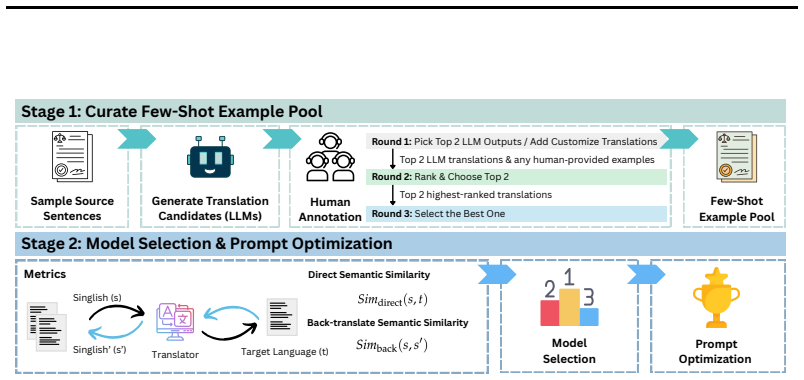
The load-bearing mechanism is the reference-free selection score: cosine similarity in text-embedding-3-large space, computed both for the direct translation (Singlish source vs target) and for the back-translation (source vs re-translated source). This score replaces gold references, letting the authors rank models and prompt sizes without parallel corpora. The other half is the curated few-shot pool: twenty Singlish sentences, balanced between benign and harmful, refined through three rounds of annotator selection, which supply the tone and slang anchors in the final prompt.
What would settle it
Have independent annotators rate only tone and toxicity preservation for the same 200 translated sentences, then check whether those ratings reproduce the GPT-4o mini ranking and whether they correlate with text-embedding-3-large cosine similarities; near-zero correlation, or a different model topping human ratings, would show the selection step is not measuring toxicity preservation.
Extended reading notes
Core claim
The central claim is that the two-stage, human-in-the-loop pipeline preserves both semantic content and harmful tone in low-resource translation, and that GPT-4o mini is the strongest model for this task among Gemini 2.0 Flash, Grok 3 Beta Mini, DeepSeek-R1, and GPT-4o mini. Under the final pipeline, Chinese and Malay translations approach gold-reference quality, while Tamil lags, which the authors attribute to linguistic distance and to limited annotator diversity.
Load-bearing premise
The load-bearing premise is that cosine similarity between an embedding of the Singlish source and embeddings of its translations (or back-translations) captures whether meaning and toxic tone were preserved; if the embedding model misses code-mixed slang or subtle tone shifts, the model and prompt choices could be wrong.
Editorial extensions
If this is right
- With GPT-4o mini and the curated few-shot pool, Singlish-to-Chinese and Singlish-to-Malay translations receive human ratings within 0.2 points of human gold translations, so the pipeline is usable where parallel data is scarce.
- The reference-free selection step makes model and prompt choice possible without gold references, which is the main bottleneck in low-resource settings.
- The optimal number of few-shot examples is language-dependent: roughly 15 for Chinese, 10 for Malay, and 20 for Tamil, so prompt size should be tuned per target language.
- Tamil remains a hard case; even the best configuration is rated 2.49 versus 3.30 for gold references, with sanitized and emotionally flat outputs, so linguistically distant targets need more than prompt curation.
Reading between the lines
- Beyond the paper's reported pairs, the same two-stage design should transfer to other code-mixed creoles such as Hinglish or Taglish; the main cost is recruiting annotators who can judge tone, not building parallel data.
- The embedding-similarity proxy could be stress-tested by comparing it against a dedicated toxicity classifier; if the two diverge on implicit or context-dependent harm, the selection step would need a second signal.
- A risk the paper does not fully resolve is that back-translation similarity can in principle be gamed by models that round-trip smoothly while changing meaning, so a human-checked tone audit on a held-out set is a cheap addition.
- If LLMs keep improving on low-resource translation, the per-language k tuning and human three-round curation could become automated, but the paper's core insight that toxicity must be an explicit objective, not a side effect of fluency, would remain.
Editorial analysis
A structured set of objections, weighed in public.
Referee Report
Summary. The paper proposes a two-stage human-in-the-loop framework for translating toxic Singlish content into Chinese, Malay, and Tamil while preserving informal and offensive tone. Stage 1 builds a 20-example few-shot pool through a three-round annotation procedure; Stage 2 selects among four LLMs and optimizes the number k of retrieved examples using cosine similarity between text-embedding-3-large embeddings, comparing direct translation similarity and back-translation similarity. A human evaluation then rates 200 outputs of the chosen GPT-4o mini pipeline on a 1-5 scale for meaning and tone fidelity. The paper claims that the approach improves retention of toxic language signals, that GPT-4o mini is the most effective model, and that the framework supports culturally sensitive moderation for low-resource languages.
Significance. The problem is real and understudied: general MT systems and safety filters often flatten culturally embedded markers of harm in code-mixed low-resource varieties. The paper contributes a concrete annotation workflow, a reference-free evaluation procedure, and a controlled-access corpus, and it is candid about annotator diversity and the limits of embedding-based similarity. If the comparative claims were fully supported, the framework would be a useful template for toxicity-preserving translation in content moderation. However, the current human evaluation only rates the final configuration in isolation; the evidence for the central comparative claims comes from an unvalidated embedding proxy. This gap is fixable with additional human evaluation on matched baselines, so the work is promising but not yet conclusive.
major comments (3)
- [Section 3, Table 2] The human evaluation does not contain the comparator needed for the paper's comparative claims. The 200 machine translations and the 20 gold-reference translations are not matched on the same source sentences; the gold set is the curated few-shot pool, so the observed closeness (Chinese 3.83 vs 4.07; Malay 4.09 vs 4.08) may reflect source difficulty rather than translation quality. More importantly, no human rating is collected for a zero-shot baseline, for other models, or for alternative k values. Consequently, the conclusion that the approach improved the retention of toxic language signals and that GPT-4o mini emerged as the most effective model is not independently supported by the human data. The authors should add a human evaluation on the same 200 sources for at least the zero-shot baseline, and ideally one other model, with ratings separated by meaning fidelity, tone, and toxicity.
- [Sections 2.2.1-2.2.3, Tables 1 and 3] Model selection and k optimization both rely on cosine similarity from text-embedding-3-large as a proxy for semantic fidelity and toxicity retention, and this same proxy is then used as the main quantitative evidence for improvement. This is circular in the sense that GPT-4o mini and the per-language k are chosen because they maximize the same metric later reported as the gain; the metric itself is never validated against human judgments. The authors concede in Section 4 that embedding similarity 'may overlook subtle shifts in tone.' I request either a validation study showing correlation between the embedding metric and human ratings on a held-out set, or a human-rated comparison of models and k values, at least for toxicity-specific dimensions.
- [Section 3 and Section 4] Toxicity retention is not directly measured anywhere in the paper. The human evaluation uses a single holistic score for 'meaning and tone,' and the automatic metrics are semantic-similarity proxies; neither provides a toxicity label, severity judgment, or comparison of offensive content before and after translation. The paper's own Limitations section states that the study does not explicitly measure subtle or implicit toxicity. A reader therefore cannot verify the headline claim that the pipeline improved the retention of toxic language signals; the final human scores could be high even if profanity were consistently softened, because a polite but semantically faithful translation can still receive an acceptable holistic tone rating in isolation. The evaluation should include a direct toxicity-preservation task, e.g., expert ratings of offensiveness or severity on matched source and target items, or a validated toxicity classifier applied to both sides.
minor comments (4)
- [Section 2.2.3 and Appendix B.2] The pointer 'see Appendix 3' should be 'Table 3,' and Appendix B.2 contains the typo 'Results are shown is Table 3.'
- [Table 4] The columns 'Jaccard R1/R2/R3' are not defined; specify what sets or annotation decisions the Jaccard similarity is computed over.
- [Appendix B.3] The DSPy results mix a baseline score of 0.672 with COPRO scores reported as percentages (60.6-62.1%); clarify the metric and scale so the 'marginal improvements' claim is interpretable.
- [Section 2.1.2] The relationship between the custom-submission counts (6.4 for Chinese, 8.8 for Malay, 5.6 for Tamil) and the final pool retention rates (nine LLM-generated examples for Chinese and Tamil, two for Malay) should be made explicit, since it is unclear whether the counts are cumulative across rounds, per-sentence averages, or something else.
Circularity Check
No derivation step reduces to its inputs; the overlap between the embedding metric used for model/k selection and the comparative support is an evidentiary limitation, not a circularity.
full rationale
The paper's derivation chain is empirically grounded rather than definitional. The few-shot pool is curated by human annotation (Section 2.1), the model comparison uses embedding cosine similarity (Section 2.2.1, Table 1), and the final pipeline is independently rated by humans (Section 3, Table 2). No equation is defined in terms of the target claim, no fitted parameter is later renamed as a prediction, and no load-bearing self-citation or imported uniqueness theorem appears. The only concern is that the comparative statements ('GPT-4o mini emerging as the most effective model', 'improved the retention of toxic language signals') are supported by the same text-embedding-3-large similarity metric used to select the model and k values, while the human evaluation rates only the final GPT-4o mini pipeline and does not rate other models or k values. That is an evidentiary gap about the validity of the proxy, and the authors explicitly concede in Section 4 that embedding-based similarity 'may overlook subtle shifts in tone.' It does not make the derivation circular, because the metric is an empirical proxy rather than an input that defines the outcome, and the human ratings provide independent evidence for the absolute quality of the chosen configuration. Score 2 reflects the minor but non-circular concern.
Assumptions & free parameters
free parameters (2)
- k, number of few-shot examples per language =
15 (Chinese), 10 (Malay), 20 (Tamil)
- Few-shot pool size =
20 Singlish sentences
assumptions (3)
- domain assumption Cosine similarity between embeddings of source and translated or back-translated text is a valid proxy for semantic fidelity and toxicity preservation.
- domain assumption The 20 selected Singlish sentences are representative of toxic and slang-heavy content in the LionGuard source.
- domain assumption Human 1-5 ratings of meaning and tone measure toxicity-preserving translation quality.
Cite this review
Pith. "Pith review of Toxicity-Aware Few-Shot Prompting for Low-Resource Singlish Translation." pith.science (2026). https://pith.science/paper/7RVRRAWF
@misc{pith2026250711966,
  author       = {Pith},
  title        = {Pith review of: Toxicity-Aware Few-Shot Prompting for Low-Resource Singlish Translation},
  year         = {2026},
  howpublished = {\url{https://pith.science/paper/7RVRRAWF}},
  note         = {Machine review of arXiv:2507.11966}
}
read the original abstract
As online communication increasingly incorporates under-represented languages and colloquial dialects, standard translation systems often fail to preserve local slang, code-mixing, and culturally embedded markers of harmful speech. Translating toxic content between low-resource language pairs poses additional challenges due to scarce parallel data and safety filters that sanitize offensive expressions. In this work, we propose a reproducible, two-stage framework for toxicity-preserving translation, demonstrated on a code-mixed Singlish safety corpus. First, we perform human-verified few-shot prompt engineering: we iteratively curate and rank annotator-selected Singlish-target examples to capture nuanced slang, tone, and toxicity. Second, we optimize model-prompt pairs by benchmarking several large language models using semantic similarity via direct and back-translation. Quantitative human evaluation confirms the effectiveness and efficiency of our pipeline. Beyond improving translation quality, our framework contributes to the safety of multicultural LLMs by supporting culturally sensitive moderation and benchmarking in low-resource contexts. By positioning Singlish as a testbed for inclusive NLP, we underscore the importance of preserving sociolinguistic nuance in real-world applications such as content moderation and regional platform governance.
Figures


Figures from the paper (2 more)


Reference graph
Works this paper leans on
-
[1]
Unsupervised neural machine translation
Mikel Artetxe, Gorka Labaka, Eneko Agirre, and Kyunghyun Cho. Unsupervised neural machine translation. arXiv preprint arXiv:1710.11041,
-
[3]
B.3 DSPy We utilized DSPy Khattab et al
8 k SG → ZH SG → MS SG → TA Baseline 66.62 72.89 30.80 k = 5 69.76 73.57 31.82 k = 10 70.10 72.79 32.15 k = 15 70.23 73.63 32.10 k = 20 70.09 73.74 32.27 Table 3: Semantic similarity between Singlish (SG) and target translations—Chinese (ZH), Malay (MS), and Tamil (TA)—across different numbers of few-shot examplesk. B.3 DSPy We utilized DSPy Khattab et al...
work page 2024
-
[6]
URL https://arxiv.org/abs/2407.10995. Google. Introducing gemini 2.0: our new ai model for the agen- tic era,
-
[7]
URL https://blog.google/technology/google-deepmind/ google-gemini-ai-update-december-2024/ . Accessed: 2025-05-07. Barry Haddow, Rachel Bawden, Antonio Valerio Miceli Barone, Jindˇrich Helcl, and Alexan- dra Birch. Survey of low-resource machine translation. Computational Linguistics, 48(3): 673–732, September
work page 2024
-
[10]
URL https://arxiv.org/abs/2310. 03714. Guillaume Lample, Alexis Conneau, Ludovic Denoyer, and Marc’Aurelio Ranzato. Unsuper- vised machine translation using monolingual corpora only.arXiv preprint arXiv:1711.00043,
-
[11]
URL https: //arxiv.org/abs/2303.16634. Adam Lopez. Statistical machine translation. ACM Computing Surveys (CSUR), 40(3):1–49,
-
[12]
New embedding models and api updates, 2024b
OpenAI. New embedding models and api updates, 2024b. URL https://openai.com/ index/new-embedding-models-and-api-updates/ . Accessed: 2025-05-12. Kishore Papineni, Salim Roukos, Todd Ward, and Wei-Jing Zhu. Bleu: a method for automatic evaluation of machine translation. In Proceedings of the 40th annual meeting of the Association for Computational Linguist...
work page 2025
-
[13]
Gpt-4o mini: advancing cost-efficient intelligence, 2024a
OpenAI. Gpt-4o mini: advancing cost-efficient intelligence, 2024a. URL https://openai. com/index/gpt-4o-mini-advancing-cost-efficient-intelligence/ . Accessed: 2025-05-
work page 2025
Show all 21 references
-
[17]
org/abs/2309.07423
URL https://arxiv. org/abs/2309.07423. Bhaskarjit Sarmah, Kriti Dutta, Anna Grigoryan, Sachin Tiwari, Stefano Pasquali, and Dhagash Mehta. A comparative study of dspy teleprompter algorithms for aligning large language models evaluation metrics to human evaluation. arXiv prepr...
-
[18]
Felix Stahlberg
URL https://arxiv.org/abs/2412.15298. Felix Stahlberg. Neural machine translation: A review. Journal of Artificial Intelligence Research, 69:343–418,
-
[19]
doi: 10.18653/v1/2023.acl-long.859
Association for Computational Linguistics. doi: 10.18653/v1/2023.acl-long.859. URL https://aclanthology.org/2023.acl-long.859/. Xing Wang, Zhengdong Lu, Zhaopeng Tu, Hang Li, Deyi Xiong, and Min Zhang. Neural machine translation advised by statistical machine translation. In P...
2023 doi
-
[20]
{sentence}
URL https://x.ai/news/grok-3. Accessed: 2025-05-12. 7 A Ethical Considerations The experiments of the proposed framework involved curating and annotating harmful content, including hate speech and explicit language, to support research in LLM safety. Native speakers were engag...
2025
-
[2002]
Word embeddings for code- mixed language processing
Adithya Pratapa, Monojit Choudhury, and Sunayana Sitaram. Word embeddings for code- mixed language processing. In Ellen Riloff, David Chiang, Julia Hockenmaier, and Jun’ichi Tsujii (eds.), Proceedings of the 2018 Conference on Empirical Methods in Natural Language Processing, ...
2018
-
[2005]
Language models are few-shot learners
Tom Brown, Benjamin Mann, Nick Ryder, Melanie Subbiah, Jared D Kaplan, Prafulla Dhariwal, Arvind Neelakantan, Pranav Shyam, Girish Sastry, Amanda Askell, et al. Language models are few-shot learners. Advances in neural information processing systems, 33:1877–1901,
1901
-
[2008]
What talking you?: Translating code-mixed messaging texts to english
Lynnette Hui Xian Ng and Luo Qi Chan. What talking you?: Translating code-mixed messaging texts to english. arXiv preprint arXiv:2411.05253,
-
[2018]
doi: 10.18653/v1/D18-1344
Association for Computational Linguistics. doi: 10.18653/v1/D18-1344. URL https://aclanthology. org/D18-1344/. Nathaniel R. Robinson, Perez Ogayo, David R. Mortensen, and Graham Neubig. Chatgpt mt: Competitive for high- (but not low-) resource languages,
-
[2020]
Toxicity in multilingual machine translation at scale
Marta R Costa-juss `a, Eric Smith, Christophe Ropers, Daniel Licht, Jean Maillard, Javier Ferrando, and Carlos Escolano. Toxicity in multilingual machine translation at scale. arXiv preprint arXiv:2210.03070,
-
[2022]
URL https://aclanthology.org/ 2022.cl-3.6/
doi: 10.1162/coli a 00446. URL https://aclanthology.org/ 2022.cl-3.6/. Amr Hendy, Mohamed Abdelrehim, Amr Sharaf, Vikas Raunak, Mohamed Gabr, Hitokazu Matsushita, Young Jin Kim, Mohamed Afify, and Hany Hassan Awadalla. How good are gpt models at machine translation? a comprehe...
2022 arXiv
-
[2023]
doi: 10.18653/v1/2023.wmt-1.41
Association for Computa- tional Linguistics. doi: 10.18653/v1/2023.wmt-1.41. URL https://aclanthology.org/ 2023.wmt-1.41/. Omar Khattab, Arnav Singhvi, Paridhi Maheshwari, Zhiyuan Zhang, Keshav Santhanam, Sri Vardhamanan, Saiful Haq, Ashutosh Sharma, Thomas T. Joshi, Hanna Moa...
2023 doi
-
[2024]
Jessica Foo and Shaun Khoo
URL https://arxiv.org/abs/2404.13813. Jessica Foo and Shaun Khoo. Lionguard: Building a contextualized moderation classifier to tackle localized unsafe content,
-
[2025]
Maxim Enis and Mark Hopkins
URL https://arxiv.org/abs/2501.12948. Maxim Enis and Mark Hopkins. From llm to nmt: Advancing low-resource machine translation with claude,
Reviewed August 6, 2026 · model on record in the stance chip above.
Discussion (0). Sign in to comment.