REVIEW 3 major objections 4 minor 6 cited by
Language Models Improve When Pretraining Data Matches Target Tasks
T0 review · 3 major / 4 minor · reviewed 2026-08-06 · deepseek-v4-flash
Pith's one-line read Ranking pretraining documents by embedding similarity to benchmark training examples—instead of by generic quality scores—consistently improves benchmark performance at every scale tested, worth a 2.1x compute multiplier over a strong…
desk verdict A serious, large-scale empirical study with a clean method and an honest limitations section; the headline compute multiplier partly rests on an undecontaminated pool, so read the Nemotron numbers with care. read the letter →
The pith
A machine-rendered reading of the paper's core claim, the machinery that carries it, and where it could break.
The reading
What carries the argument
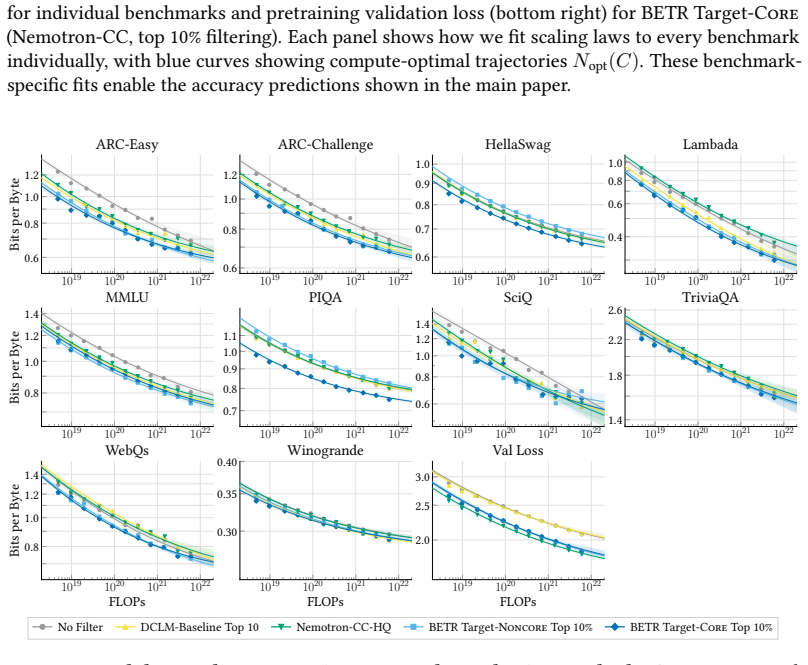
The load-bearing object is the score: for each sampled document, BETR takes its best rank across all benchmark-example embeddings (max aggregation with value function $v(r) = 1/r$), which rewards a document for being extremely close to at least one target example rather than moderately close to many. A FastText classifier trained on those scores then labels the full corpus, making web-scale filtering cheap despite the fact that direct similarity search over billions of documents is intractable. The evaluation machinery is a two-stage scaling-law pipeline—a Chinchilla-style loss law $L(N, D)$ per benchmark, then a sigmoid mapping from bits-per-byte to accuracy—that converts 53 trained models per dataset into predicted accuracy at any compute budget, from which compute multipliers and the $F_{\mathrm{opt}}(C) = 4\times 10^{-5} C^{0.25}$ power law are derived.
What would settle it
One decisive check: at a compute budget where the predicted optimal filter retains fewer tokens than the training run consumes, forcing repeated epochs, compare BETR filtering against the unfiltered baseline. If the compute multiplier shrinks or reverses once data repetition is required, or if the best filtering rate stops following $F_{\mathrm{opt}}(C) = 4\times 10^{-5} C^{0.25}$, the unlimited-data premise on which the scaling claims rest is falsified.
Extended reading notes
Core claim
BETR (benchmark-targeted ranking) is the central proposal: take the training examples of a benchmark set, embed them together with roughly 0.1% of a web-scale corpus in a shared space, score each sampled document by its best similarity rank against any benchmark example, and train a FastText classifier to predict those scores so the full corpus can be filtered. The paper's claim is that this direct matching—requiring no hand-chosen notion of quality—consistently outperforms both unfiltered data and established filters such as DCLM-Baseline and Nemotron-CC HQ, by a 2.1x compute multiplier on average, improving 9 of 10 Core tasks at every scale from $10^{19}$ to $10^{22}$ FLOPs and holding up at the 7B-10x overtrained scale. Targeting a disjoint set of 39 diverse benchmarks still matches or beats baselines on the held-out Core suite, showing the method generalizes rather than merely memorizing target tasks. The scaling analysis adds a second claim: the optimal filtering rate is not a constant but grows with compute, fitted as $F_{\mathrm{opt}}(C) = 4\times10^{-5} C^{0.25}$ on Nemotron-CC—from top 3% at $10^{20}$ FLOPs to top 30% at $10^{23}$ FLOPs—with a weaker trend $F_{\mathrm{opt}} \propto C^{0.14}$ on DCLM-RefinedWeb.
Load-bearing premise
The scaling analysis assumes an effectively unlimited pretraining pool, so its recommended filtering rates are extrapolated from a range where filtering never forces data repetition; at trillion-token budgets the top-3% filter would exhaust a pool like Nemotron-CC and require multiple epochs, a regime the $F_{\mathrm{opt}}(C)$ curve does not model.
Editorial extensions
If this is right
- Data selection can be made an explicit optimization: choosing a benchmark set determines the capability profile of the resulting model, and jointly targeting diverse benchmarks produces generalists rather than narrow specialists.
- Fixed filtering rates are suboptimal: because the best rate grows with compute, a single percentage chosen at one scale will be wrong at others, and compute multipliers translate directly into training-cost savings of 35–55% of compute for the same accuracy.
- Benchmarks do not merely measure progress; they steer it: optimizing for Core benchmarks raised Core scores but dropped held-out Noncore performance below two baselines, a concrete illustration of Goodhart's law in pretraining.
- Individual task targeting yields specialists: each of the 10 Core benchmarks, targeted alone, produced the best score on that benchmark, with predictable spillover to related tasks and predictable losses elsewhere.
- The gains persist in the overtrained regime: at 7B parameters trained on 1.4T tokens, BETR Target-Core still leads Core averages by +1.6 to +1.8 points over baselines on both data pools.
Reading between the lines
- My inference: if the $F_{\mathrm{opt}}(C)$ trend holds beyond the fitted range, then 'quality' is not a property of documents alone but of the (model scale, target) pair, and curation pipelines should expose the filtering rate as a hyperparameter that tracks roughly $C^{0.25}$ rather than fixing it once.
- My inference: because the paper measures only before post-training and only on English text, the strongest untested extension is whether BETR's gains survive instruction tuning and transfer to multilingual or code pretraining; the FastText whitespace-tokenizer limitation suggests a BPE-based scorer may be needed for that transfer.
- My inference: the Goodhart asymmetry documented here implies a collective-action problem: if many labs train on benchmark-aligned data, saturation of common benchmarks will outpace genuine capability growth, and only continually refreshed or held-out benchmark sets can detect the divergence.
- My inference: the unexplained success of the lower-accuracy FastText scorer over LM scorers suggests the ranking signal is coarse and distributed; a testable extension would be to use BETR scores as soft weights or as a curriculum ordering rather than hard cuts, which the paper lists as future work.
Editorial analysis
A structured set of objections, weighed in public.
Referee Report
Summary. The paper proposes benchmark-targeted ranking (BETR), a document-level pretraining data selection method that scores documents by embedding-space similarity to benchmark training examples, trains a FastText classifier to predict those scores over a full corpus, and filters by a token threshold. The authors train over 500 models spanning roughly 1e19 to 1e22 FLOPs, fit two-stage per-benchmark scaling laws (loss in model size and tokens, then accuracy in loss), and compare BETR against DCLM-Baseline and Nemotron-CC HQ on two pools, DCLM-RefinedWeb and Nemotron-CC. They report a 1.8x–2.8x compute multiplier over DCLM-Baseline (abstract: 2.1x average), improvement on 9 of 10 Core tasks, generalization to held-out tasks when targeting a disjoint Noncore benchmark set, and a power-law relationship Fopt(C) = 4e-5 C^0.25 between the optimal filtering rate and training FLOPs.
Significance. The central claim—that explicitly aligning pretraining data with target benchmarks yields consistent, scale-dependent compute savings—is important and, if correct, has practical implications for data curation. The paper's empirical scale is a clear strength: over 500 models across two data pools, direct 7B-1x and 7B-10x experiments, bootstrap-uncertainty propagation through the scaling fits, and explicit integrity checks (train vs test targeting, decontamination of DCLM-RefinedWeb, evaluation-blind Noncore targeting). The DCLM-RefinedWeb results are internally consistent and support the direction of the claim. However, the headline numbers rely on undecontaminated Nemotron-CC results and on extrapolated scaling fits beyond the observed range, so the significance is currently conditional rather than fully established.
major comments (3)
- [Section 5.1, Table 1, Table 7] The claim that BETR Target-Core outperforms all baselines on 9 out of 10 Core tasks on both data pools is contradicted by the fixed-scale tables on Nemotron-CC. In Table 1 (7B-10x), BETR Target-Core scores 96.4 on SciQ versus 97.0 for DCLM-Baseline, 25.5 on WebQuestions versus 27.6 for No Filter and 27.5 for DCLM-Baseline, and 74.0 on WinoGrande versus 74.7 for DCLM-Baseline. At 7B-1x (Table 7), SciQ and WinoGrande are also below DCLM-Baseline. Thus 'all except Winogrande on Nemotron-CC' is inaccurate, and the abstract's '9 out of 10 tasks across all scales' is not supported by the fixed-scale results. Please correct the claim and report per-task win/loss counts with uncertainty taken into account.
- [Section 4.2, Tables 1 and 5, Figure 1] The Nemotron-CC results are exposed to a contamination route that the paper explicitly acknowledges but does not bound. Section 4.2 states that Nemotron-CC is not decontaminated because n-gram matching cannot detect rephrased text, and that the pool includes 1.9T synthetic tokens created by model-based rephrasing. BETR Target-Core selects documents by similarity to Core training examples; if Nemotron-CC contains rephrased Core test or validation items, this selection would preferentially retrieve them. The 2.5x Nemotron-CC multiplier is the larger component of the 2.1x average headline, and the Table 4 decontamination ablation is run only on DCLM-RefinedWeb, so it does not address this route. Please decontaminate Nemotron-CC with a rephrase-resistant method (e.g., embedding-based near-duplicate search against Core test/validation sets) and re-report the affected results, or restrict the headline compute-multiplier and 9-of-10 claims to the decontaminated DCLM-RefinedWeb pool.
- [Section 6.2, Figure 10, Limitations] The power law Fopt(C) = 4e-5 C^0.25 is fitted to four discrete filtering rates (3%, 10%, 30%, 100%) over the observed range of roughly 1e19–1e22 FLOPs and then extrapolated to 1e23–1e24 FLOPs, where the 'unlimited data' assumption breaks. Top 3% of Nemotron-CC is about 190B tokens and top 10% about 630B tokens, which is below the multi-trillion-token training budgets typical at those compute levels. The Limitations paragraph acknowledges this, but the main-text takeaway and the Introduction state the extrapolated trend without a data-constraint caveat. Please either explicitly restrict the Fopt claim to the observed range or incorporate a data-constrained scaling model (e.g., with repetition) before presenting the power law as a general result.
minor comments (4)
- [Table 2] Several entries in Table 2 appear corrupted or misformatted (e.g., '80.3 3', '54.18', '15.611 7.810'); the table needs to be regenerated with clean numeric formatting.
- [Section 4.1 (Lambada OpenAI)] The paper reserves one-third of the Lambada OpenAI test set for targeting and evaluates on the remaining two-thirds; please clarify whether the targeting subset is disjoint from the evaluation subset and whether any benchmark examples overlap across the two splits.
- [Section C.4 (accuracy-to-loss fits)] The sigmoid accuracy mapping includes an appended point at L=0, Acc=1.0 for every fit; please report sensitivity to this anchor, since it may systematically affect the steepness and location of the fitted curves, especially for tasks with narrow observed loss ranges.
- [Figure 17 and Section 6.2] The bootstrapped confidence bands for the accuracy-to-loss fits of different filtering rates overlap substantially (e.g., TriviaQA); the claim that the filtering-rate transitions are 'clear' would be strengthened by reporting the bootstrap distribution of the Fopt exponent itself and the probability that Fopt increases with C.
Circularity Check
No significant circularity: BETR is evaluated on held-out test sets and the scaling-law findings are empirical fits; the main caveat is a data-integrity risk on Nemotron-CC, not a derivation loop.
full rationale
The paper's central BETR claims are not equivalent to their inputs by construction. BETR targets benchmark training examples (Section 3.4) and evaluates on separate Core test sets; the authors directly ablate train-vs-test targeting (Table 4: 62.3 vs 62.4) and decontamination on DCLM-RefinedWeb (-0.2), so the evaluation-aware result does not reduce to the selection criterion. The evaluation-blind result targets 39 Noncore benchmarks disjoint from the Core suite (Sections 3.6 and 4.1), so the held-out gain is not self-defined. The compute multipliers and Fopt(C) trend come from explicit two-stage scaling-law fits (Equations 2 and 4; Section 6.2), and the paper openly states 'We fit a power law for its simplicity' rather than presenting the fit as an independent prediction. Citations to the authors' prior work (Gunter et al. for Core evaluation settings; Li et al. for DCLM baselines) supply benchmarks and baselines, not a uniqueness theorem or a forced choice, so no self-citation chain is load-bearing. Two caveats are worth stating but are not circularity. First, Section 4.2 says 'we do not decontaminate Nemotron-CC' and that the pool contains 1.9T synthetic rephrased tokens; if rephrased Core test content is present, BETR's similarity-to-train-example selection could retrieve it and inflate the larger Nemotron gains. That is a contamination risk requiring external verification, not a by-construction equivalence, because the target is train examples and the paper shows on the decontaminated pool that train and test targeting behave identically. Second, the unlimited-data assumption behind Fopt(C) is explicitly acknowledged in the limitations ('Our scaling analysis assumes unlimited data'); it bounds the extrapolation but does not make the fit circular. Overall the derivation chain is self-contained against standard held-out benchmarks, so the correct circularity finding is low.
Assumptions & free parameters
free parameters (10)
- Filtering rate threshold =
top 3%, 10%, 30%, 100%; default 10%
- Rank score function =
max(1/rank)
- Target granularity =
per-example embeddings
- Embedding model =
Arctic-Embed L v2
- FastText hyperparameters =
lr=0.03, dim=128, window=10, min count=5, epochs=5
- Classifier label threshold =
top 10% vs bottom 90% of rank scores
- Document sample size =
10M documents (~0.1% of pool)
- Loss scaling law parameters per benchmark =
A, B, E, alpha, beta (Appendix Table 12)
- Accuracy-to-loss sigmoid parameters per benchmark =
c1, c2, k, L0 (Appendix Table 13)
- Filtering-rate power law exponent =
0.25 on Nemotron-CC, 0.14 on DCLM-RefinedWeb (Fopt = k * C^exponent)
assumptions (10)
- domain assumption Chinchilla scaling law form L(N,D)=E+A/N^alpha+B/D^beta holds for each benchmark BPB and validation loss.
- domain assumption Sigmoid mapping from bits-per-byte to accuracy is stable per benchmark and per dataset.
- domain assumption Embedding similarity between web documents and benchmark examples is a valid proxy for training usefulness.
- domain assumption The 10M document sample is representative of the full pool.
- domain assumption FastText classifier predictions transfer from the scored sample to the entire corpus.
- domain assumption Compute-optimal model size is identified from validation loss rather than task accuracy.
- domain assumption Critical batch size law from Zhang et al. controls training efficiency for all runs.
- domain assumption The pretraining pool is effectively unlimited when deriving optimal filtering rates.
- domain assumption Nemotron-CC has no meaningful benchmark contamination despite no decontamination.
- standard math FLOPs are approximated as 6ND.
Cite this review
Pith. "Pith review of Language Models Improve When Pretraining Data Matches Target Tasks." pith.science (2026). https://pith.science/paper/NQ6X7PIE
@misc{pith2026250712466,
  author       = {Pith},
  title        = {Pith review of: Language Models Improve When Pretraining Data Matches Target Tasks},
  year         = {2026},
  howpublished = {\url{https://pith.science/paper/NQ6X7PIE}},
  note         = {Machine review of arXiv:2507.12466}
}
abstract
Every data selection method inherently has a target. In practice, these targets often emerge implicitly through benchmark-driven iteration: researchers develop selection strategies, train models, measure benchmark performance, then refine accordingly. This raises a natural question: what happens when we make this optimization explicit? To explore this, we propose benchmark-targeted ranking (BETR), a simple method that selects pretraining documents based on similarity to benchmark training examples. BETR embeds benchmark examples and a sample of pretraining documents in a shared space, scores this sample by similarity to benchmarks, then trains a lightweight classifier to predict these scores for the full corpus. We compare data selection methods by training over 500 models spanning $10^{19}$ to $10^{22}$ FLOPs and fitting scaling laws to them. From this, we find that simply aligning pretraining data to evaluation benchmarks using BETR achieves a 2.1x compute multiplier over DCLM-Baseline (4.7x over unfiltered data) and improves performance on 9 out of 10 tasks across all scales. BETR also generalizes well: when targeting a diverse set of benchmarks disjoint from our evaluation suite, it still matches or outperforms baselines. Our scaling analysis further reveals a clear trend: larger models require less aggressive filtering. Overall, our findings show that directly matching pretraining data to target tasks precisely shapes model capabilities and highlight that optimal selection strategies must adapt to model scale.
Figures


Figures from the paper (21 more)




Forward citations
Cited by 6 Pith papers
-
DataComp-VLM: Improved Open Datasets for Vision-Language Models
DataComp-VLM benchmark shows instruction-heavy data mixing outperforms filtering for VLM training, with DCVLM-Baseline achieving 63.6% on 33 tasks for 8B models (+5.4pp over FineVision).
-
DataComp-VLM: Improved Open Datasets for Vision-Language Models
DataComp-VLM benchmark shows instruction-heavy data mixtures outperform caption-heavy ones for VLM training, with DCVLM-Baseline reaching 63.6% on 33 tasks using 200B tokens, +5.4pp over FineVision.
-
Hubs or Fringes: Pretraining Data Selection via Web Graph Centrality
Web graph centrality from Common Crawl supplies an orthogonal signal for pretraining data selection that improves language model performance when central and peripheral hosts are balanced.
-
Capacity-Aware Mixture Law Enables Efficient LLM Data Optimization
CAMEL is a scaling law capturing nonlinear model-size and mixture interactions to extrapolate optimal data mixtures for large LLMs from small-model experiments, reducing optimization cost by 50% and improving benchmar...
-
Prescriptive Scaling Reveals the Evolution of Language Model Capabilities
For most benchmarks, the best achievable post-training accuracy follows a stable sigmoid curve in pre-training compute; math reasoning is the exception, with a boundary that keeps rising over time.
-
Removing Noise, not Finding Gold: Quality Filtering for Large-Scale Pretraining
Classifier-based quality filtering for LLM pretraining improves downstream tasks by implicitly filtering the reference high-quality set rather than by mimicking it, and its quality scores fail a data-conditioning test.
Reference graph
Works this paper leans on
-
[1]
Semdedup: Data-efficient learning at web-scale through semantic deduplication
Amro Abbas, Kushal Tirumala, D \'a niel Simig, Surya Ganguli, and Ari S Morcos. Semdedup: Data-efficient learning at web-scale through semantic deduplication. arXiv preprint arXiv:2303.09540, 2023
arXiv 2023
-
[2]
Joshua Ainslie, James Lee-Thorp, Michiel de Jong, Yury Zemlyanskiy, Federico Lebr'on, and Sumit K. Sanghai. Gqa: Training generalized multi-query transformer models from multi-head checkpoints. arXiv preprint arXiv:2305.13245, 2023
arXiv 2023
-
[3]
Optuna: A next-generation hyperparameter optimization framework
Takuya Akiba, Shotaro Sano, Toshihiko Yanase, Takeru Ohta, and Masanori Koyama. Optuna: A next-generation hyperparameter optimization framework. In Proceedings of the 25th ACM SIGKDD international conference on knowledge discovery & data mining, pages 2623--2631, 2019
2019
-
[4]
Efficient online data mixing for language model pre-training
Alon Albalak, Liangming Pan, Colin Raffel, and William Yang Wang. Efficient online data mixing for language model pre-training. arXiv preprint arXiv:2312.02406, 2023
arXiv 2023
-
[5]
A survey on data selection for language models
Alon Albalak, Yanai Elazar, Sang Michael Xie, Shayne Longpre, Nathan Lambert, Xinyi Wang, Niklas Muennighoff, Bairu Hou, Liangming Pan, Haewon Jeong, et al. A survey on data selection for language models. arXiv preprint arXiv:2402.16827, 2024
arXiv 2024
-
[6]
Mathqa: Towards interpretable math word problem solving with operation-based formalisms
Aida Amini, Saadia Gabriel, Peter Lin, Rik Koncel-Kedziorski, Yejin Choi, and Hannaneh Hajishirzi. Mathqa: Towards interpretable math word problem solving with operation-based formalisms. arXiv preprint arXiv:1905.13319, 2019
arXiv 1905
-
[7]
On deepseek and export controls, January 2025
Dario Amodei. On deepseek and export controls, January 2025. URL https://www.darioamodei.com/post/on-deepseek-and-export-controls
2025
-
[8]
Perplexed by perplexity: Perplexity-based data pruning with small reference models
Zachary Ankner, Cody Blakeney, Kartik Sreenivasan, Max Marion, Matthew L Leavitt, and Mansheej Paul. Perplexed by perplexity: Perplexity-based data pruning with small reference models. arXiv preprint arXiv:2405.20541, 2024
arXiv 2024
Show all 122 references
-
[9]
System card: Claude opus 4 & claude sonnet 4
Anthropic . System card: Claude opus 4 & claude sonnet 4. https://www.anthropic.com/claude-4-system-card, May 2025. Claude 4 family system card
2025
-
[10]
Semantic parsing on F reebase from question-answer pairs
Jonathan Berant, Andrew Chou, Roy Frostig, and Percy Liang. Semantic parsing on F reebase from question-answer pairs. In Proceedings of the 2013 Conference on Empirical Methods in Natural Language Processing, pages 1533--1544, Seattle, Washington, USA, October 2013. Associatio...
2013
-
[11]
Chinchilla scaling: A replication attempt
Tamay Besiroglu, Ege Erdil, Matthew Barnett, and Josh You. Chinchilla scaling: A replication attempt. arXiv preprint arXiv:2404.10102, 2024
2024 arXiv
-
[12]
Compute multipliers, 2023
James Betker. Compute multipliers, 2023. URL https://nonint.com/2023/11/05/compute-multipliers/. Blog post
2023
-
[13]
When you think it through, there are only 2 fundamental approaches to data selection
Lucas Beyer. When you think it through, there are only 2 fundamental approaches to data selection. Tweet, March 2025. URL https://x.com/giffmana/status/1898664177452953701. Twitter/X
2025
-
[14]
Establishing task scaling laws via compute-efficient model ladders
Akshita Bhagia, Jiacheng Liu, Alexander Wettig, David Heineman, Oyvind Tafjord, Ananya Harsh Jha, Luca Soldaini, Noah A Smith, Dirk Groeneveld, Pang Wei Koh, et al. Establishing task scaling laws via compute-efficient model ladders. arXiv preprint arXiv:2412.04403, 2024
2024 arXiv
-
[15]
Deepseek llm: Scaling open-source language models with longtermism
Xiao Bi, Deli Chen, Guanting Chen, Shanhuang Chen, Damai Dai, Chengqi Deng, Honghui Ding, Kai Dong, Qiushi Du, Zhe Fu, et al. Deepseek llm: Scaling open-source language models with longtermism. arXiv preprint arXiv:2401.02954, 2024
2024 arXiv
-
[16]
Piqa: Reasoning about physical commonsense in natural language
Yonatan Bisk, Rowan Zellers, Jianfeng Gao, Yejin Choi, et al. Piqa: Reasoning about physical commonsense in natural language. In Proceedings of the AAAI conference on artificial intelligence, volume 34, pages 7432--7439, 2020
2020
-
[17]
Does your data spark joy? performance gains from domain upsampling at the end of training
Cody Blakeney, Mansheej Paul, Brett W Larsen, Sean Owen, and Jonathan Frankle. Does your data spark joy? performance gains from domain upsampling at the end of training. arXiv preprint arXiv:2406.03476, 2024
2024 arXiv
-
[18]
Loss-to-loss prediction: Scaling laws for all datasets
David Brandfonbrener, Nikhil Anand, Nikhil Vyas, Eran Malach, and Sham Kakade. Loss-to-loss prediction: Scaling laws for all datasets. arXiv preprint arXiv:2411.12925, 2024 a
2024 arXiv
-
[19]
Color-filter: Conditional loss reduction filtering for targeted language model pre-training
David Brandfonbrener, Hanlin Zhang, Andreas Kirsch, Jonathan Richard Schwarz, and Sham Kakade. Color-filter: Conditional loss reduction filtering for targeted language model pre-training. Advances in Neural Information Processing Systems, 37: 0 97618--97649, 2024 b
2024
-
[20]
Language models are few-shot learners
Tom Brown, Benjamin Mann, Nick Ryder, Melanie Subbiah, Jared D Kaplan, Prafulla Dhariwal, Arvind Neelakantan, Pranav Shyam, Girish Sastry, Amanda Askell, et al. Language models are few-shot learners. Advances in neural information processing systems, 33: 0 1877--1901, 2020
1901
-
[21]
Distillation scaling laws
Dan Busbridge, Amitis Shidani, Floris Weers, Jason Ramapuram, Etai Littwin, and Russ Webb. Distillation scaling laws. arXiv preprint arXiv:2502.08606, 2025
2025 arXiv
-
[22]
Datarater: Meta-learned dataset curation
Dan A Calian, Gregory Farquhar, Iurii Kemaev, Luisa M Zintgraf, Matteo Hessel, Jeremy Shar, Junhyuk Oh, Andr \'a s Gy \"o rgy, Tom Schaul, Jeffrey Dean, et al. Datarater: Meta-learned dataset curation. arXiv preprint arXiv:2505.17895, 2025
2025
-
[23]
Bge m3-embedding: Multi-lingual, multi-functionality, multi-granularity text embeddings through self-knowledge distillation, 2024 a
Jianlv Chen, Shitao Xiao, Peitian Zhang, Kun Luo, Defu Lian, and Zheng Liu. Bge m3-embedding: Multi-lingual, multi-functionality, multi-granularity text embeddings through self-knowledge distillation, 2024 a
2024
-
[24]
Skill-it! a data-driven skills framework for understanding and training language models
Mayee Chen, Nicholas Roberts, Kush Bhatia, Jue Wang, Ce Zhang, Frederic Sala, and Christopher R \'e . Skill-it! a data-driven skills framework for understanding and training language models. Advances in Neural Information Processing Systems, 36: 0 36000--36040, 2023
2023
-
[25]
Aioli: A unified optimization framework for language model data mixing
Mayee F Chen, Michael Y Hu, Nicholas Lourie, Kyunghyun Cho, and Christopher R \'e . Aioli: A unified optimization framework for language model data mixing. arXiv preprint arXiv:2411.05735, 2024 b
2024 arXiv
-
[26]
Take the bull by the horns: Hard sample-reweighted continual training improves llm generalization
Xuxi Chen, Zhendong Wang, Daouda Sow, Junjie Yang, Tianlong Chen, Yingbin Liang, Mingyuan Zhou, and Zhangyang Wang. Take the bull by the horns: Hard sample-reweighted continual training improves llm generalization. arXiv preprint arXiv:2402.14270, 2024 c
2024 arXiv
-
[27]
Palm: Scaling language modeling with pathways
Aakanksha Chowdhery, Sharan Narang, Jacob Devlin, Maarten Bosma, Gaurav Mishra, Adam Roberts, Paul Barham, Hyung Won Chung, Charles Sutton, Sebastian Gehrmann, et al. Palm: Scaling language modeling with pathways. Journal of Machine Learning Research, 24 0 (240): 0 1--113, 2023
2023
-
[28]
Boolq: Exploring the surprising difficulty of natural yes/no questions
Christopher Clark, Kenton Lee, Ming-Wei Chang, Tom Kwiatkowski, Michael Collins, and Kristina Toutanova. Boolq: Exploring the surprising difficulty of natural yes/no questions. arXiv preprint arXiv:1905.10044, 2019
1905 arXiv
-
[29]
Think you have solved question answering? try arc, the ai2 reasoning challenge
Peter Clark, Isaac Cowhey, Oren Etzioni, Tushar Khot, Ashish Sabharwal, Carissa Schoenick, and Oyvind Tafjord. Think you have solved question answering? try arc, the ai2 reasoning challenge. arXiv preprint arXiv:1803.05457, 2018
2018 arXiv
-
[30]
Training verifiers to solve math word problems
Karl Cobbe, Vineet Kosaraju, Mohammad Bavarian, Mark Chen, Heewoo Jun, Lukasz Kaiser, Matthias Plappert, Jerry Tworek, Jacob Hilton, Reiichiro Nakano, et al. Training verifiers to solve math word problems. arXiv preprint arXiv:2110.14168, 2021
-
[31]
Deepseek-v3 technical report
DeepSeek-AI . Deepseek-v3 technical report. arXiv preprint arXiv:2412.19437, 2024
2024 arXiv
-
[32]
Bert: Pre-training of deep bidirectional transformers for language understanding
Jacob Devlin, Ming-Wei Chang, Kenton Lee, and Kristina Toutanova. Bert: Pre-training of deep bidirectional transformers for language understanding. In Proceedings of the 2019 conference of the North American chapter of the association for computational linguistics: human langu...
2019
-
[33]
Climb: Clustering-based iterative data mixture bootstrapping for language model pre-training
Shizhe Diao, Yu Yang, Yonggan Fu, Xin Dong, Dan Su, Markus Kliegl, Zijia Chen, Peter Belcak, Yoshi Suhara, Hongxu Yin, et al. Climb: Clustering-based iterative data mixture bootstrapping for language model pre-training. arXiv preprint arXiv:2504.13161, 2025
2025 arXiv
-
[34]
Eli5: Long form question answering
Angela Fan, Yacine Jernite, Ethan Perez, David Grangier, Jason Weston, and Michael Auli. Eli5: Long form question answering. arXiv preprint arXiv:1907.09190, 2019
1907 arXiv
-
[35]
Doge: Domain reweighting with generalization estimation
Simin Fan, Matteo Pagliardini, and Martin Jaggi. Doge: Domain reweighting with generalization estimation. arXiv preprint arXiv:2310.15393, 2023
2023 arXiv
-
[36]
Data filtering networks
Alex Fang, Albin Madappally Jose, Amit Jain, Ludwig Schmidt, Alexander T Toshev, and Vaishaal Shankar. Data filtering networks. In The Twelfth International Conference on Learning Representations, 2024
2024
-
[37]
Language models scale reliably with over-training and on downstream tasks
Samir Yitzhak Gadre, Georgios Smyrnis, Vaishaal Shankar, Suchin Gururangan, Mitchell Wortsman, Rulin Shao, Jean Mercat, Alex Fang, Jeffrey Li, Sedrick Keh, et al. Language models scale reliably with over-training and on downstream tasks. arXiv preprint arXiv:2403.08540, 2024
2024 arXiv
-
[38]
The pile: An 800gb dataset of diverse text for language modeling
Leo Gao, Stella Biderman, Sid Black, Laurence Golding, Travis Hoppe, Charles Foster, Jason Phang, Horace He, Anish Thite, Noa Nabeshima, et al. The pile: An 800gb dataset of diverse text for language modeling. arXiv preprint arXiv:2101.00027, 2020
2020 arXiv
-
[39]
Gemini 2.5: Pushing the frontier with advanced reasoning, multimodality, long context, and next generation agentic capabilities
Gemini Team . Gemini 2.5: Pushing the frontier with advanced reasoning, multimodality, long context, and next generation agentic capabilities. arXiv preprint arXiv:2507.06261, 2025
2025 arXiv
-
[40]
Scaling laws for data filtering--data curation cannot be compute agnostic
Sachin Goyal, Pratyush Maini, Zachary C Lipton, Aditi Raghunathan, and J Zico Kolter. Scaling laws for data filtering--data curation cannot be compute agnostic. In Proceedings of the IEEE/CVF Conference on Computer Vision and Pattern Recognition, pages 22702--22711, 2024
2024
-
[41]
Task-adaptive pretrained language models via clustered-importance sampling
David Grangier, Simin Fan, Skyler Seto, and Pierre Ablin. Task-adaptive pretrained language models via clustered-importance sampling. arXiv preprint arXiv:2410.03735, 2024
2024 arXiv
-
[42]
Data selection via optimal control for language models
Yuxian Gu, Li Dong, Hongning Wang, Yaru Hao, Qingxiu Dong, Furu Wei, and Minlie Huang. Data selection via optimal control for language models. In The Thirteenth International Conference on Learning Representations, 2025. URL https://openreview.net/forum?id=dhAL5fy8wS
2025
-
[43]
Apple intelligence foundation language models
Tom Gunter, Zirui Wang, Chong Wang, Ruoming Pang, Andy Narayanan, Aonan Zhang, Bowen Zhang, Chen Chen, Chung-Cheng Chiu, David Qiu, et al. Apple intelligence foundation language models. arXiv preprint arXiv:2407.21075, 2024
2024
-
[44]
Measuring massive multitask language understanding
Dan Hendrycks, Collin Burns, Steven Basart, Andy Zou, Mantas Mazeika, Dawn Song, and Jacob Steinhardt. Measuring massive multitask language understanding. arXiv preprint arXiv:2009.03300, 2020
2009 arXiv
-
[45]
Training compute-optimal large language models
Jordan Hoffmann, Sebastian Borgeaud, Arthur Mensch, Elena Buchatskaya, Trevor Cai, Eliza Rutherford, Diego de Las Casas, Lisa Anne Hendricks, Johannes Welbl, Aidan Clark, et al. Training compute-optimal large language models. arXiv preprint arXiv:2203.15556, 2022
2022 arXiv
-
[46]
Essential-web v1
Andrew Hojel, Michael Pust, Tim Romanski, Yash Vanjani, Ritvik Kapila, Mohit Parmar, Adarsh Chaluvaraju, Alok Tripathy, Anil Thomas, Ashish Tanwer, et al. Essential-web v1. 0: 24t tokens of organized web data. arXiv preprint arXiv:2506.14111, 2025
2025 arXiv
-
[47]
NeMo-Curator : a toolkit for data curation
Joseph Jennings, Mostofa Patwary, Sandeep Subramanian, Shrimai Prabhumoye, Ayush Dattagupta, Vibhu Jawa, Jiwei Liu, Ryan Wolf, Sarah Yurick, and Varun Singh. NeMo-Curator : a toolkit for data curation. https://github.com/NVIDIA/NeMo-Curator, 2025
2025
-
[48]
Adaptive data optimization: Dynamic sample selection with scaling laws
Yiding Jiang, Allan Zhou, Zhili Feng, Sadhika Malladi, and J Zico Kolter. Adaptive data optimization: Dynamic sample selection with scaling laws. arXiv preprint arXiv:2410.11820, 2024
2024 arXiv
-
[49]
Pubmedqa: A dataset for biomedical research question answering
Qiao Jin, Bhuwan Dhingra, Zhengping Liu, William Cohen, and Xinghua Lu. Pubmedqa: A dataset for biomedical research question answering. In Proceedings of the 2019 Conference on Empirical Methods in Natural Language Processing and the 9th International Joint Conference on Natur...
2019
-
[50]
Triviaqa: A large scale distantly supervised challenge dataset for reading comprehension
Mandar Joshi, Eunsol Choi, Daniel S Weld, and Luke Zettlemoyer. Triviaqa: A large scale distantly supervised challenge dataset for reading comprehension. arXiv preprint arXiv:1705.03551, 2017
2017 arXiv
-
[51]
Bag of tricks for efficient text classification
Armand Joulin, Edouard Grave, Piotr Bojanowski, and Tomas Mikolov. Bag of tricks for efficient text classification. arXiv preprint arXiv:1607.01759, 2016
2016 arXiv
-
[52]
Scaling laws for neural language models
Jared Kaplan, Sam McCandlish, Tom Henighan, Tom B Brown, Benjamin Chess, Rewon Child, Scott Gray, Alec Radford, Jeffrey Wu, and Dario Amodei. Scaling laws for neural language models. arXiv preprint arXiv:2001.08361, 2020
2001 arXiv
-
[53]
Large language model-guided document selection
Xiang Kong, Tom Gunter, and Ruoming Pang. Large language model-guided document selection. arXiv preprint arXiv:2406.04638, 2024
2024 arXiv
-
[54]
Axlearn: Modular large model training on heterogeneous infrastructure
Mark Lee, Tom Gunter, Chang Lan, John Peebles, Hanzhi Zhou, Kelvin Zou, Sneha Bangalore, Chung-Cheng Chiu, Nan Du, Xianzhi Du, et al. Axlearn: Modular large model training on heterogeneous infrastructure. arXiv preprint arXiv:2507.05411, 2025
2025
-
[55]
Datacomp-lm: In search of the next generation of training sets for language models
Jeffrey Li, Alex Fang, Georgios Smyrnis, Maor Ivgi, Matt Jordan, Samir Yitzhak Gadre, Hritik Bansal, Etash Guha, Sedrick Scott Keh, Kushal Arora, et al. Datacomp-lm: In search of the next generation of training sets for language models. Advances in Neural Information Processin...
2024
-
[56]
Towards general text embeddings with multi-stage contrastive learning
Zehan Li, Xin Zhang, Yanzhao Zhang, Dingkun Long, Pengjun Xie, and Meishan Zhang. Towards general text embeddings with multi-stage contrastive learning. arXiv preprint arXiv:2308.03281, 2023
2023 arXiv
-
[57]
Rho-1: Not all tokens are what you need
Zhenghao Lin, Zhibin Gou, Yeyun Gong, Xiao Liu, Yelong Shen, Ruochen Xu, Chen Lin, Yujiu Yang, Jian Jiao, Nan Duan, et al. Rho-1: Not all tokens are what you need. arXiv preprint arXiv:2404.07965, 2024
2024 arXiv
-
[58]
Program induction by rationale generation: Learning to solve and explain algebraic word problems
Wang Ling, Dani Yogatama, Chris Dyer, and Phil Blunsom. Program induction by rationale generation: Learning to solve and explain algebraic word problems. arXiv preprint arXiv:1705.04146, 2017
2017 arXiv
-
[59]
Logiqa: A challenge dataset for machine reading comprehension with logical reasoning
Jian Liu, Leyang Cui, Hanmeng Liu, Dandan Huang, Yile Wang, and Yue Zhang. Logiqa: A challenge dataset for machine reading comprehension with logical reasoning. arXiv preprint arXiv:2007.08124, 2020
2007 arXiv
-
[60]
Regmix: Data mixture as regression for language model pre-training
Qian Liu, Xiaosen Zheng, Niklas Muennighoff, Guangtao Zeng, Longxu Dou, Tianyu Pang, Jing Jiang, and Min Lin. Regmix: Data mixture as regression for language model pre-training. arXiv preprint arXiv:2407.01492, 2024
2024 arXiv
-
[61]
Datadecide: How to predict best pretraining data with small experiments
Ian Magnusson, Nguyen Tai, Ben Bogin, David Heineman, Jena D Hwang, Luca Soldaini, Akshita Bhagia, Jiacheng Liu, Dirk Groeneveld, Oyvind Tafjord, et al. Datadecide: How to predict best pretraining data with small experiments. arXiv preprint arXiv:2504.11393, 2025
2025 arXiv
-
[62]
Rephrasing the web: A recipe for compute and data-efficient language modeling
Pratyush Maini, Skyler Seto, He Bai, David Grangier, Yizhe Zhang, and Navdeep Jaitly. Rephrasing the web: A recipe for compute and data-efficient language modeling. arXiv preprint arXiv:2401.16380, 2024
2024 arXiv
-
[63]
When less is more: Investigating data pruning for pretraining llms at scale
Max Marion, Ahmet \"U st \"u n, Luiza Pozzobon, Alex Wang, Marzieh Fadaee, and Sara Hooker. When less is more: Investigating data pruning for pretraining llms at scale. arXiv preprint arXiv:2309.04564, 2023
2023 arXiv
-
[64]
Llms on the line: Data determines loss-to-loss scaling laws
Prasanna Mayilvahanan, Thadd \"a us Wiedemer, Sayak Mallick, Matthias Bethge, and Wieland Brendel. Llms on the line: Data determines loss-to-loss scaling laws. arXiv preprint arXiv:2502.12120, 2025
2025 arXiv
-
[65]
An empirical model of large-batch training
Sam McCandlish, Jared Kaplan, Dario Amodei, and OpenAI Dota Team. An empirical model of large-batch training. arXiv preprint arXiv:1812.06162, 2018
2018 arXiv
-
[66]
The llama 3 herd of models
Meta AI . The llama 3 herd of models. arXiv preprint arXiv:2407.21783, 2024
2024 arXiv
-
[67]
Can a suit of armor conduct electricity? a new dataset for open book question answering
Todor Mihaylov, Peter Clark, Tushar Khot, and Ashish Sabharwal. Can a suit of armor conduct electricity? a new dataset for open book question answering. arXiv preprint arXiv:1809.02789, 2018
2018 arXiv
-
[68]
llm-foundry: Eval\_gauntlet.md
MosaicML . llm-foundry: Eval\_gauntlet.md. https://github.com/mosaicml/llm-foundry/blob/main/scripts/eval/local_data/EVAL_GAUNTLET.md, 2023
2023
-
[69]
Scaling data-constrained language models
Niklas Muennighoff, Alexander Rush, Boaz Barak, Teven Le Scao, Nouamane Tazi, Aleksandra Piktus, Sampo Pyysalo, Thomas Wolf, and Colin A Raffel. Scaling data-constrained language models. Advances in Neural Information Processing Systems, 36: 0 50358--50376, 2023
2023
- [70]
-
[71]
gzip predicts data-dependent scaling laws
Rohan Pandey. gzip predicts data-dependent scaling laws. arXiv preprint arXiv:2405.16684, 2024
2024 arXiv
-
[72]
The lambada dataset: Word prediction requiring a broad discourse context
Denis Paperno, Germ \'a n Kruszewski, Angeliki Lazaridou, Quan Ngoc Pham, Raffaella Bernardi, Sandro Pezzelle, Marco Baroni, Gemma Boleda, and Raquel Fern \'a ndez. The lambada dataset: Word prediction requiring a broad discourse context. arXiv preprint arXiv:1606.06031, 2016
2016 arXiv
-
[73]
Bbq: A hand-built bias benchmark for question answering
Alicia Parrish, Angelica Chen, Nikita Nangia, Vishakh Padmakumar, Jason Phang, Jana Thompson, Phu Mon Htut, and Samuel R Bowman. Bbq: A hand-built bias benchmark for question answering. arXiv preprint arXiv:2110.08193, 2021
2021 arXiv
-
[74]
Are nlp models really able to solve simple math word problems? arXiv preprint arXiv:2103.07191, 2021
Arkil Patel, Satwik Bhattamishra, and Navin Goyal. Are nlp models really able to solve simple math word problems? arXiv preprint arXiv:2103.07191, 2021
2021 arXiv
-
[75]
Patronus ai launches enterprisepii, the industry's first llm dataset for detecting business-sensitive information
PatronusAI . Patronus ai launches enterprisepii, the industry's first llm dataset for detecting business-sensitive information. https://www.patronus.ai/announcements/patronus-ai-launches-enterprisepii-the-industrys-first-llm-dataset-for-detecting-business-sensitive-information, 2023
2023
-
[76]
The refinedweb dataset for falcon llm: outperforming curated corpora with web data, and web data only
Guilherme Penedo, Quentin Malartic, Daniel Hesslow, Ruxandra Cojocaru, Alessandro Cappelli, Hamza Alobeidli, Baptiste Pannier, Ebtesam Almazrouei, and Julien Launay. The refinedweb dataset for falcon llm: outperforming curated corpora with web data, and web data only. arXiv pr...
2023 arXiv
-
[77]
The fineweb datasets: Decanting the web for the finest text data at scale
Guilherme Penedo, Hynek Kydl \' c ek, Anton Lozhkov, Margaret Mitchell, Colin A Raffel, Leandro Von Werra, Thomas Wolf, et al. The fineweb datasets: Decanting the web for the finest text data at scale. Advances in Neural Information Processing Systems, 37: 0 30811--30849, 2024
2024
-
[78]
Computational optimal transport: With applications to data science
Gabriel Peyr \'e , Marco Cuturi, et al. Computational optimal transport: With applications to data science. Foundations and Trends in Machine Learning , 11 0 (5-6): 0 355--607, 2019
2019
-
[79]
Qwen3 technical report
Qwen Team . Qwen3 technical report. arXiv preprint arXiv:2505.09388, 2025
2025 arXiv
-
[80]
Scaling language models: Methods, analysis & insights from training gopher
Jack W Rae, Sebastian Borgeaud, Trevor Cai, Katie Millican, Jordan Hoffmann, Francis Song, John Aslanides, Sarah Henderson, Roman Ring, Susannah Young, et al. Scaling language models: Methods, analysis & insights from training gopher. arXiv preprint arXiv:2112.11446, 2021
2021 arXiv
-
[81]
Exploring the limits of transfer learning with a unified text-to-text transformer
Colin Raffel, Noam Shazeer, Adam Roberts, Katherine Lee, Sharan Narang, Michael Matena, Yanqi Zhou, Wei Li, and Peter J Liu. Exploring the limits of transfer learning with a unified text-to-text transformer. Journal of machine learning research, 21 0 (140): 0 1--67, 2020
2020
-
[82]
Squad: 100,000+ questions for machine comprehension of text
Pranav Rajpurkar, Jian Zhang, Konstantin Lopyrev, and Percy Liang. Squad: 100,000+ questions for machine comprehension of text. arXiv preprint arXiv:1606.05250, 2016
2016 arXiv
-
[83]
Coqa: A conversational question answering challenge
Siva Reddy, Danqi Chen, and Christopher D Manning. Coqa: A conversational question answering challenge. Transactions of the Association for Computational Linguistics, 7: 0 249--266, 2019
2019
-
[84]
Gpqa: A graduate-level google-proof q&a benchmark
David Rein, Betty Li Hou, Asa Cooper Stickland, Jackson Petty, Richard Yuanzhe Pang, Julien Dirani, Julian Michael, and Samuel R Bowman. Gpqa: A graduate-level google-proof q&a benchmark. In First Conference on Language Modeling, 2024
2024
-
[85]
Melissa Roemmele, Cosmin Adrian Bejan, and Andrew S. Gordon. Choice of plausible alternatives: An evaluation of commonsense causal reasoning. In Association for the Advancement of Artificial Intelligence (AAAI) Spring Symposium, 2011. URL https://people.ict.usc.edu/ gordon/copa.html
2011
-
[86]
How to train data-efficient llms
Noveen Sachdeva, Benjamin Coleman, Wang-Cheng Kang, Jianmo Ni, Lichan Hong, Ed H Chi, James Caverlee, Julian McAuley, and Derek Zhiyuan Cheng. How to train data-efficient llms. arXiv preprint arXiv:2402.09668, 2024
2024 arXiv
-
[87]
Winogrande: An adversarial winograd schema challenge at scale
Keisuke Sakaguchi, Ronan Le Bras, Chandra Bhagavatula, and Yejin Choi. Winogrande: An adversarial winograd schema challenge at scale. Communications of the ACM, 64 0 (9): 0 99--106, 2021
2021
-
[88]
Socialiqa: Commonsense reasoning about social interactions
Maarten Sap, Hannah Rashkin, Derek Chen, Ronan LeBras, and Yejin Choi. Socialiqa: Commonsense reasoning about social interactions. arXiv preprint arXiv:1904.09728, 2019
1904 arXiv
-
[89]
Analysing mathematical reasoning abilities of neural models
David Saxton, Edward Grefenstette, Felix Hill, and Pushmeet Kohli. Analysing mathematical reasoning abilities of neural models. arXiv preprint arXiv:1904.01557, 2019
1904 arXiv
-
[90]
Pretraining on the test set is all you need
Rylan Schaeffer. Pretraining on the test set is all you need. arXiv preprint arXiv:2309.08632, 2023
2023 arXiv
-
[91]
Why has predicting downstream capabilities of frontier ai models with scale remained elusive? arXiv preprint arXiv:2406.04391, 2024
Rylan Schaeffer, Hailey Schoelkopf, Brando Miranda, Gabriel Mukobi, Varun Madan, Adam Ibrahim, Herbie Bradley, Stella Biderman, and Sanmi Koyejo. Why has predicting downstream capabilities of frontier ai models with scale remained elusive? arXiv preprint arXiv:2406.04391, 2024
2024 arXiv
-
[92]
Deepseekmath: Pushing the limits of mathematical reasoning in open language models
Zhihong Shao, Peiyi Wang, Qihao Zhu, Runxin Xu, Junxiao Song, Xiao Bi, Haowei Zhang, Mingchuan Zhang, YK Li, Yang Wu, et al. Deepseekmath: Pushing the limits of mathematical reasoning in open language models. arXiv preprint arXiv:2402.03300, 2024
2024 arXiv
-
[93]
Noam M. Shazeer. Glu variants improve transformer. arXiv preprint arXiv:2002.05202, 2020
2002 arXiv
-
[94]
Scaling laws for optimal data mixtures
Mustafa Shukor, Louis Bethune, Dan Busbridge, David Grangier, Enrico Fini, Alaaeldin El-Nouby, and Pierre Ablin. Scaling laws for optimal data mixtures. arXiv preprint arXiv:2507.09404, 2025
2025
-
[95]
Predictive data selection: The data that predicts is the data that teaches
Kashun Shum, Yuzhen Huang, Hongjian Zou, Qi Ding, Yixuan Liao, Xiaoxin Chen, Qian Liu, and Junxian He. Predictive data selection: The data that predicts is the data that teaches. arXiv preprint arXiv:2503.00808, 2025
2025 arXiv
-
[96]
Using deepspeed and megatron to train megatron-turing nlg 530b, a large-scale generative language model
Shaden Smith, Mostofa Patwary, Brandon Norick, Patrick LeGresley, Samyam Rajbhandari, Jared Casper, Zhun Liu, Shrimai Prabhumoye, George Zerveas, Vijay Korthikanti, et al. Using deepspeed and megatron to train megatron-turing nlg 530b, a large-scale generative language model. ...
2022 arXiv
-
[97]
Beyond the imitation game: Quantifying and extrapolating the capabilities of language models
Aarohi Srivastava, Abhinav Rastogi, Abhishek Rao, Abu Awal Shoeb, Abubakar Abid, Adam Fisch, Adam R Brown, Adam Santoro, Aditya Gupta, Adri Garriga-Alonso, et al. Beyond the imitation game: Quantifying and extrapolating the capabilities of language models. Transactions on mach...
2023
-
[98]
Nemotron-cc: Transforming common crawl into a refined long-horizon pretraining dataset
Dan Su, Kezhi Kong, Ying Lin, Joseph Jennings, Brandon Norick, Markus Kliegl, Mostofa Patwary, Mohammad Shoeybi, and Bryan Catanzaro. Nemotron-cc: Transforming common crawl into a refined long-horizon pretraining dataset. arXiv preprint arXiv:2412.02595, 2024 a
2024 arXiv
-
[99]
Roformer: Enhanced transformer with rotary position embedding
Jianlin Su, Murtadha Ahmed, Yu Lu, Shengfeng Pan, Wen Bo, and Yunfeng Liu. Roformer: Enhanced transformer with rotary position embedding. Neurocomputing, 568: 0 127063, 2024 b
2024
-
[100]
Commonsenseqa: A question answering challenge targeting commonsense knowledge
Alon Talmor, Jonathan Herzig, Nicholas Lourie, and Jonathan Berant. Commonsenseqa: A question answering challenge targeting commonsense knowledge. arXiv preprint arXiv:1811.00937, 2018
2018 arXiv
-
[101]
Openhermes 2.5: An open dataset of synthetic data for generalist llm assistants, 2023
Teknium. Openhermes 2.5: An open dataset of synthetic data for generalist llm assistants, 2023. URL https://huggingface.co/datasets/teknium/OpenHermes-2.5
2023
-
[102]
Improving pretraining data using perplexity correlations
Tristan Thrush, Christopher Potts, and Tatsunori Hashimoto. Improving pretraining data using perplexity correlations. arXiv preprint arXiv:2409.05816, 2024
2024 arXiv
-
[103]
Zyda-2: a 5 trillion token high-quality dataset
Yury Tokpanov, Paolo Glorioso, Quentin Anthony, and Beren Millidge. Zyda-2: a 5 trillion token high-quality dataset. arXiv preprint arXiv:2411.06068, 2024
2024 arXiv
-
[104]
200,000+ jeopardy! questions
Bojan Tunguz. 200,000+ jeopardy! questions. Kaggle, 2019. URL https://www.kaggle.com/datasets/tunguz/200000-jeopardy-questions
2019
-
[105]
Attention is all you need
Ashish Vaswani, Noam Shazeer, Niki Parmar, Jakob Uszkoreit, Llion Jones, Aidan N Gomez, ukasz Kaiser, and Illia Polosukhin. Attention is all you need. NeurIPS, 2017
2017
-
[106]
Crowdsourcing multiple choice science questions
Johannes Welbl, Nelson F Liu, and Matt Gardner. Crowdsourcing multiple choice science questions. arXiv preprint arXiv:1707.06209, 2017
2017 arXiv
-
[107]
Ccnet: Extracting high quality monolingual datasets from web crawl data
Guillaume Wenzek, Marie-Anne Lachaux, Alexis Conneau, Vishrav Chaudhary, Francisco Guzm \'a n, Armand Joulin, and Edouard Grave. Ccnet: Extracting high quality monolingual datasets from web crawl data. arXiv preprint arXiv:1911.00359, 2019
1911 arXiv
-
[108]
QuRating : Selecting high-quality data for training language models
Alexander Wettig, Aatmik Gupta, Saumya Malik, and Danqi Chen. QuRating : Selecting high-quality data for training language models. In International Conference on Machine Learning (ICML), 2024
2024
-
[109]
Organize the web: Constructing domains enhances pre-training data curation
Alexander Wettig, Kyle Lo, Sewon Min, Hannaneh Hajishirzi, Danqi Chen, and Luca Soldaini. Organize the web: Constructing domains enhances pre-training data curation. arXiv preprint arXiv:2502.10341, 2025
2025 arXiv
-
[110]
Small-scale proxies for large-scale transformer training instabilities
Mitchell Wortsman, Peter J Liu, Lechao Xiao, Katie Everett, Alex Alemi, Ben Adlam, John D Co-Reyes, Izzeddin Gur, Abhishek Kumar, Roman Novak, et al. Small-scale proxies for large-scale transformer training instabilities. arXiv preprint arXiv:2309.14322, 2023
2023 arXiv
-
[111]
C-pack: Packed resources for general chinese embeddings
Shitao Xiao, Zheng Liu, Peitian Zhang, Niklas Muennighoff, Defu Lian, and Jian-Yun Nie. C-pack: Packed resources for general chinese embeddings. In Proceedings of the 47th international ACM SIGIR conference on research and development in information retrieval, pages 641--649, 2024
2024
-
[112]
Doremi: Optimizing data mixtures speeds up language model pretraining
Sang Michael Xie, Hieu Pham, Xuanyi Dong, Nan Du, Hanxiao Liu, Yifeng Lu, Percy S Liang, Quoc V Le, Tengyu Ma, and Adams Wei Yu. Doremi: Optimizing data mixtures speeds up language model pretraining. Advances in Neural Information Processing Systems, 36: 0 69798--69818, 2023 a
2023
-
[113]
Data selection for language models via importance resampling
Sang Michael Xie, Shibani Santurkar, Tengyu Ma, and Percy S Liang. Data selection for language models via importance resampling. Advances in Neural Information Processing Systems, 36: 0 34201--34227, 2023 b
2023
-
[114]
Tensor programs v: Tuning large neural networks via zero-shot hyperparameter transfer
Greg Yang, Edward J Hu, Igor Babuschkin, Szymon Sidor, Xiaodong Liu, David Farhi, Nick Ryder, Jakub Pachocki, Weizhu Chen, and Jianfeng Gao. Tensor programs v: Tuning large neural networks via zero-shot hyperparameter transfer. arXiv preprint arXiv:2203.03466, 2022
2022 arXiv
-
[115]
Arctic-embed 2.0: Multilingual retrieval without compromise
Puxuan Yu, Luke Merrick, Gaurav Nuti, and Daniel Campos. Arctic-embed 2.0: Multilingual retrieval without compromise. arXiv preprint arXiv:2412.04506, 2024 a
2024 arXiv
-
[116]
Mates: Model-aware data selection for efficient pretraining with data influence models
Zichun Yu, Spandan Das, and Chenyan Xiong. Mates: Model-aware data selection for efficient pretraining with data influence models. Advances in Neural Information Processing Systems, 37: 0 108735--108759, 2024 b
2024
-
[117]
Hellaswag: Can a machine really finish your sentence? arXiv preprint arXiv:1905.07830, 2019
Rowan Zellers, Ari Holtzman, Yonatan Bisk, Ali Farhadi, and Yejin Choi. Hellaswag: Can a machine really finish your sentence? arXiv preprint arXiv:1905.07830, 2019
1905 arXiv
-
[118]
Root mean square layer normalization
Biao Zhang and Rico Sennrich. Root mean square layer normalization. Advances in Neural Information Processing Systems, 32, 2019
2019
-
[119]
How does critical batch size scale in pre-training? arXiv preprint arXiv:2410.21676, 2024 a
Hanlin Zhang, Depen Morwani, Nikhil Vyas, Jingfeng Wu, Difan Zou, Udaya Ghai, Dean Foster, and Sham Kakade. How does critical batch size scale in pre-training? arXiv preprint arXiv:2410.21676, 2024 a
2024 arXiv
-
[120]
mgte: Generalized long-context text representation and reranking models for multilingual text retrieval
Xin Zhang, Yanzhao Zhang, Dingkun Long, Wen Xie, Ziqi Dai, Jialong Tang, Huan Lin, Baosong Yang, Pengjun Xie, Fei Huang, et al. mgte: Generalized long-context text representation and reranking models for multilingual text retrieval. arXiv preprint arXiv:2407.19669, 2024 b
2024 arXiv
-
[121]
Agieval: A human-centric benchmark for evaluating foundation models
Wanjun Zhong, Ruixiang Cui, Yiduo Guo, Yaobo Liang, Shuai Lu, Yanlin Wang, Amin Saied, Weizhu Chen, and Nan Duan. Agieval: A human-centric benchmark for evaluating foundation models. arXiv preprint arXiv:2304.06364, 2023
2023 arXiv
-
[122]
Deepseek-coder-v2: Breaking the barrier of closed-source models in code intelligence
Qihao Zhu, Daya Guo, Zhihong Shao, Dejian Yang, Peiyi Wang, Runxin Xu, Y Wu, Yukun Li, Huazuo Gao, Shirong Ma, et al. Deepseek-coder-v2: Breaking the barrier of closed-source models in code intelligence. arXiv preprint arXiv:2406.11931, 2024
2024 arXiv
Reviewed August 6, 2026 · model on record in the stance chip above.
Discussion (0). Sign in to comment.