REVIEW 4 major objections 4 minor 1 cited by
Post-training accuracy at a given compute budget follows a stable sigmoid curve—except on math reasoning, where the attainable ceiling keeps rising.
Reviewed by Pith at T0; open to challenge. T0 means a machine referee read the full paper against a public rubric. the ladder, T0–T4 →
T0 review · deepseek-v4-flash
2026-08-02 22:52 UTC pith:R4TLXHSY
load-bearing objection A serious observational study whose temporal-split validation of high-quantile sigmoid boundaries is the real contribution, but the prescriptive 'attainable' language outruns the evidence: the boundaries are quantiles of a selected population, not proven capability ceilings. the 4 major comments →
Prescriptive Scaling Reveals the Evolution of Language Model Capabilities
The pith
A machine-rendered reading of the paper's core claim, the machinery that carries it, and where it could break.
Core claim
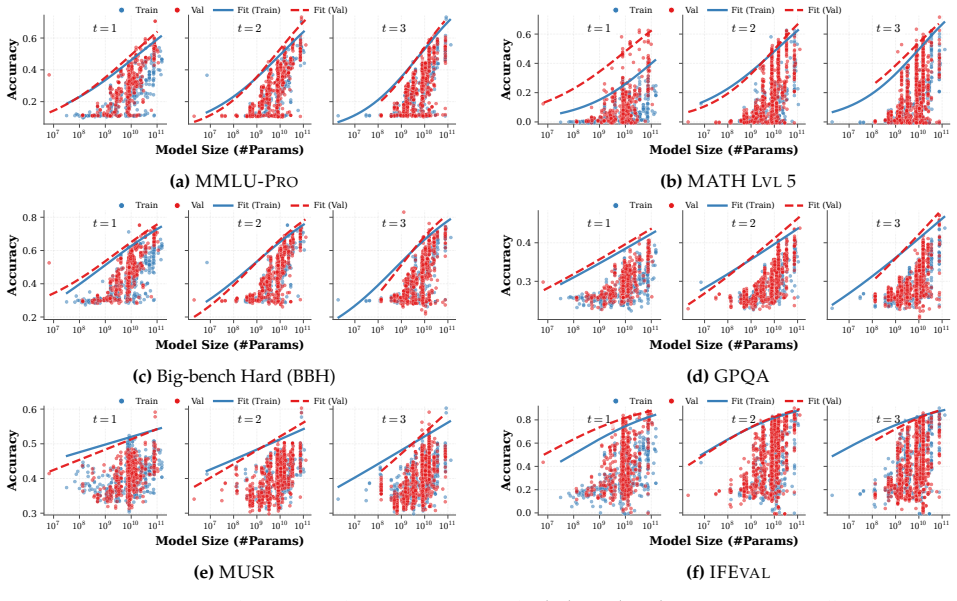
The central claim is that the highest reliably attainable post-training performance—modeled as the 98th conditional quantile of benchmark scores given log pre-training compute—is well approximated by the sigmoid qτ(z) = y0 + L σ(a + βz), and that this boundary transfers to later model generations on most tasks. The exceptions are informative: math reasoning (MATH Lvl 5) shows a consistently advancing boundary, indicating algorithmic progress moves the attainable envelope, while knowledge-heavy tasks like MMLU-Pro remain scale-limited, with small models near a stable ceiling. The paper further shows that this boundary is a better predictor of potential than raw pretrained accuracies, which ar
What carries the argument
The capability boundary estimator: a smoothed pinball-loss quantile regression at τ=0.98 with a monotone, saturating sigmoid parameterization in log-compute, validated by rolling chronological train/test splits. The pinball loss asymmetry makes the fitted curve track the upper envelope of the model population rather than the mean. The same boundary machinery is extended to a size–time saturation model, a PCA-based latent-factor analysis, a logit-on-logit contamination shift test, and a balanced I-optimal sampling algorithm that selects which models to evaluate under a parameter-count-weighted budget.
Load-bearing premise
The load-bearing assumption is that the public leaderboard population fairly represents contemporary post-training practice, so the fitted 0.98-quantile is a truthful 'attainable' ceiling rather than an artifact of which models happen to be reported.
What would settle it
Evaluate all post-trained open-weight models released in the six months after the leaderboard cutoff with known pre-training compute on a stable benchmark such as GPQA; if more than ~2% of them land above the predicted 0.98-quantile band per compute bin, temporal stability and the sigmoid boundary are refuted.
If this is right
- At a fixed pre-training budget, the 0.98-quantile sigmoid supplies a concrete performance expectation—e.g., 0.83 on IFEval and 0.54 on MATH Lvl 5 at 10^24 FLOPs—so compute can be budgeted against a target accuracy.
- The boundary fit on earlier generations covers the next generation with under ~2% coverage error on BBH, GPQA, MMLU-Pro, and MUSR, making the compute-to-attainable-accuracy map nearly deterministic for contemporary practice on those tasks.
- Math reasoning (MATH Lvl 5) is the consistent exception: its boundary advances over time, concentrated at high compute, so math expectations must be updated as recipes evolve.
- The pretrain–post-train gap is task-dependent: post-training adds little on knowledge benchmarks like MMLU-Pro where larger models retain a persistent advantage, but lifts small models close to the top on math (estimated 13B attainable boundary ≈0.94 late-period), clarifying where 'saturation' claims hold.
- A balanced I-optimal design recovers near-full-data boundaries with roughly 20% of the evaluation budget—as low as 5% on GPQA and MUSR—while a cross-benchmark contamination test finds no statistically significant AIME-2025 inflation relative to MATH-500 (p ≈ 0.15).
Where Pith is reading between the lines
- If the sigmoid boundary holds as a near-law-like map, the practical definition of 'attainable' becomes the upper envelope of public leaderboards; that makes selection bias in what gets published a first-order threat to any prescriptive use, since a systematically withheld strong recipe would quietly raise the true boundary.
- The PCA observation that only the first latent factor scales with compute suggests capability progress is largely one-dimensional; a testable extension is to replace six benchmark regressions with a single factor-based boundary and check temporal stability on the same rolling splits.
- The cross-benchmark contamination test is a template: the same logit-on-logit regression against a release-gated benchmark could be run on newly released datasets to detect train-on-test leakage earlier than manual inspection.
- The temporal-stability claim is established on open-weight, leaderboard-reported populations; a sharper stress test would fit the sigmoid on closed frontier models with known compute and validate on later frontier releases, since the paper's frontier GPQA fit is cross-sectional.
Editorial analysis
A structured set of objections, weighed in public.
Referee Report
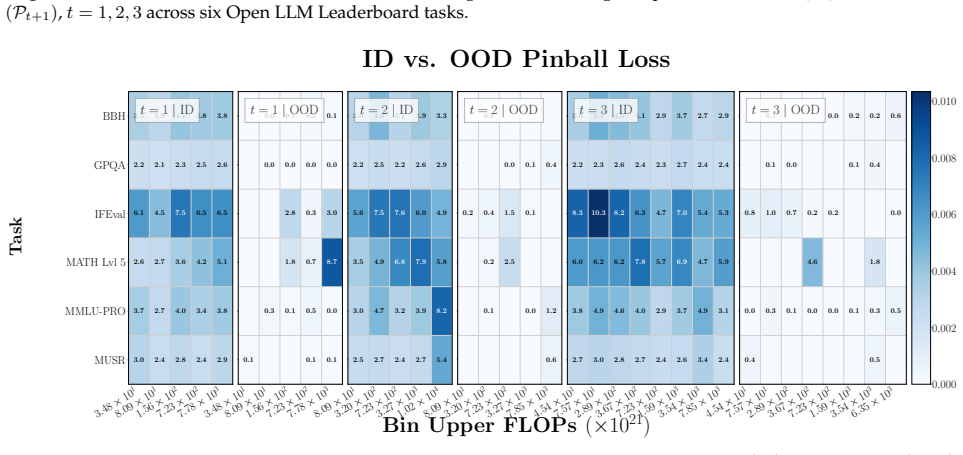
Summary. The paper proposes 'prescriptive scaling laws': high conditional quantiles (τ=0.98) of post-trained benchmark accuracy as a function of log pre-training FLOPs, estimated by smoothed quantile regression with a monotone saturating sigmoid. It uses observational data from the Open LLM Leaderboard v1/v2, frontier-model leaderboards, and 2.4k newly evaluated PROTEUS-2K checkpoints. The central empirical claims are that the post-training capability boundary is approximately sigmoid in log-compute, that this boundary is temporally stable for four of six studied benchmarks under chronological train/validation splits, and that math reasoning (and to a lesser extent instruction following) shows a shifting boundary. The paper also presents task-dependent saturation diagnostics, a contamination shift test for AIME-2025, and a budget-aware balanced I-optimal sampling algorithm that recovers near-full-data boundaries at ~20% (sometimes ~5%) of the evaluation budget. Table 1 gives headline point predictions at 10^24 FLOPs (e.g., 0.83 IFEval, 0.54 MATH Lvl 5).
Significance. If the central claims hold, the paper makes a valuable contribution: it moves scaling-law analysis from mean trends to a calibrated, high-quantile capability boundary, validates that boundary out-of-sample in time for a majority of tasks, and releases a new evaluation dataset and a practical active-sampling procedure. The quantile-regression formulation is principled, the chronological splits are a genuine OOD check, and the saturation and contamination case studies are useful applications. However, the paper's headline 'attainable accuracy' interpretation depends on an unverified representativeness assumption about public leaderboard submissions, and the Table 1 point estimates are in-sample fitted values with no uncertainty quantification. These issues do not invalidate the sigmoid-shape or temporal-stability findings for the observed population, but they require substantive reframing before the prescriptive claims can be accepted.
major comments (4)
- [§2.1, Appendix A.2, Table 1] The central prescriptive interpretation—that Table 1 gives accuracies 'attainable with contemporary post-training practice'—is not supported by the data. Section 2.1 explicitly defines qτ(z) as a conditional quantile of the observed leaderboard population and Appendix A.2 states that substantial selection effects could shift the implied boundary. The paper does not close this gap: leaderboard submission is itself a performance filter, and the PROTEUS-2K collection (Appendix F) is curated by Hugging Face likes plus manual selection. Temporal stability cannot correct for this because selection may be roughly stable over time. The authors should either (i) consistently use 'observed-population upper envelope' language throughout, including the abstract and Table 1, or (ii) provide evidence that the sample is representative of contemporary practice, e.g., by including non-submitted checkpoin
- [§3.1 and Table 1] The headline predictions at 10^24 FLOPs are computed from the no-split 0.98-quantile sigmoid fit, not from the chronological validation protocol, and no confidence intervals are reported. The rolling-split analysis (Table 2, Figure 2) is the paper's strongest evidence, but Table 1 extrapolates the in-sample fit to the upper end of the compute range without quantifying uncertainty or checking whether the split-fitted curves agree there. For IFEval and MATH Lvl 5, where the paper documents non-stationarity, Table 1's single-number predictions are especially fragile. Please report interval estimates (e.g., bootstrap or split-based) and task-specific caveats for all headline numbers.
- [§3.1.2, Figures 12 and 14] The paper's 'mostly stable' claim is supported for four tasks, but the deviations on MATH Lvl 5 and IFEval are concentrated in specific compute bins and are large: e.g., Figure 12 shows OOD coverage error of −15.5% for MATH Lvl 5 in a high-compute bin at t=3, and IFEval shows −11.5% and −8.0% at t=1. The abstract and conclusion single out math reasoning as the exception, but IFEval also shows substantial under-coverage. While the aggregate metrics in Figure 2 are useful, the bin-wise results suggest that the boundary is not uniformly reliable across the compute range for these tasks. Please report which compute regimes and which tasks support the coverage-error <2% claim, and avoid implying uniform stability for the remaining tasks without a per-bin breakdown.
- [§2.1, Appendix D] All analysis conditions on estimated pre-training FLOPs, but the provenance and accuracy of these compute values are not examined. The paper relies on third-party estimates (Epoch AI, LifeArchitect, leaderboard metadata) with no discussion of systematic errors (e.g., different FLOP-accounting conventions across families, uncertainty in training tokens, or MoE vs dense equivalences). Since the x-axis is the sole predictor and the fitted sigmoid depends on log-compute, errors in FLOPs could shift the boundary and affect both the shape and the temporal comparisons. Please document the sources and validation of the compute estimates and ideally perform a sensitivity analysis with plausible perturbations.
minor comments (4)
- [Throughout] Benchmark name is spelled inconsistently: 'MATH Lvl 5' in most places, 'MA TH Lvl 5' in the heatmap in Appendix D.2, and 'MATH LVL5' in Figure captions. Please standardize.
- [Table 2 vs Appendix D.1] Table 2 reports absolute pinball loss and absolute calibration error, but Appendix D.1 says 'In Table 2, we report percent changes relative to the constant baseline.' This is contradictory and should be corrected in one place.
- [Appendix H.1] The text refers to 'Mock ATME'; this appears to be a typo for 'AIME'. Please correct.
- [Appendix F] The PROTEUS-2K selection procedure (Hugging Face likes plus manually picked official releases) is itself a selection filter and could bias the external-validity check in Section 3.3. This should be discussed explicitly alongside the selection-effects caveat, not only in Appendix F.
Circularity Check
No circular derivation: the temporal-stability claim is tested out-of-sample on later periods, and the sigmoid-shape claim is a model comparison against more flexible I-splines.
full rationale
The central derivation is not circular by the paper's own equations. The capability boundary is defined as a conditional 0.98-quantile of observed scores (Sec. 2.1), estimated by smoothed pinball regression; the sigmoid conclusion (Finding 1) is supported by comparison with a strictly more general I-spline class (Table 2), so the sigmoid shape is not assumed into existence. The strongest claim, temporal stability, is genuinely out-of-sample: boundaries are fit on P_t and evaluated on P_{t+1} with coverage error and pinball loss (Sec. 3.1.2, Figs. 2, 12-15); nothing in that procedure forces low OOD error. Table 1's 10^24-FLOP numbers are in-sample evaluations of a no-split fit and are labeled 'estimated,' so they are not presented as independent validation. The acknowledged population caveat (Sec. 2.1: 'this interpretation is relative to the population of reported models we observe'; Appendix A.2) is an external-validity limitation, not a circular reduction, because the paper explicitly does not claim the observed quantile equals an unobserved true attainable frontier. Self-citations (Jin et al. 2025) motivate variance and latent-factor analyses but are not load-bearing; the PCA result is recomputed on the paper's own data (Remark 2, App. H.3). No step reduces by construction to its input.
Axiom & Free-Parameter Ledger
free parameters (5)
- quantile level τ =
0.98
- smoothing κ and ridge λ =
κ=50, λ=1e-3
- sigmoid boundary parameters (y0, L, a, β) =
per-task, per-period
- size–time model parameters (α, β, φ, δ, θ) =
per task, e.g., MATH β̂=0.25, β̂+θ̂=0.76 in Table 3
- contamination shift γ =
positive, p=0.15
axioms (5)
- standard math Smoothed pinball loss minimization recovers the conditional τ-quantile
- domain assumption Post-training benchmark scores have a conditional distribution whose τ-quantile is well approximated by a sigmoid in log-compute
- domain assumption Chronological periods P1..P4 are exchangeable enough that Pt+1 serves as validation for Pt
- ad hoc to paper Evaluation cost is linear in parameter count
- ad hoc to paper AIME-2025 and MATH-500 logits are linearly related under the null of no contamination
read the original abstract
Machine learning model performance improvements tend to arise from competition and application. For deployment, we consider prescriptive scaling laws: given a pre-training compute budget, what downstream accuracy is attainable with contemporary post-training practice, and how stable is that mapping as the field evolves? Using large-scale observational evaluations with 5k existing and 2k newly evaluated model checkpoints spanning 2022-2026 across six benchmarks, we estimate capability boundaries, high conditional quantiles of benchmark scores as a function of log pre-training FLOPs, via smoothed quantile regression with a monotone, saturating sigmoid parameterization. We validate temporal reliability by fitting on earlier model generations and evaluating on later releases: across four of six tasks, the out-of-distribution coverage error remains below 2%, while math reasoning exhibits a consistently advancing boundary over time. For instance, at a budget of 10^24 FLOPs, the estimated attainable accuracies are 0.83 on IFEval and 0.54 on MATH Lvl 5. We then extend our approach to analyze task-dependent saturation and to probe contamination-related shifts on math reasoning tasks. Finally, we introduce a balanced I-optimal sampling algorithm that recovers near-full-data frontiers using roughly 20% of the parameter-count-weighted evaluation budget, as low as 5% on some tasks, while maintaining comparable calibration. Together, our work releases Proteus-2k, the latest model performance evaluation dataset, and introduces a practical methodology for translating compute budgets into reliable performance expectations and for monitoring when capability boundaries shift across time.
Figures





Forward citations
Cited by 1 Pith paper
-
EdgeBench: Unveiling Scaling Laws of Learning from Real-World Environments
Across ~38,000 hours on 134 ultra-long real-world tasks, aggregate agent performance follows a log-sigmoid of interaction time, and measured learning speed doubles about every three months.
Reference graph
Works this paper leans on
-
[1]
Josh Achiam, Steven Adler, Sandhini Agarwal, Lama Ahmad, Ilge Akkaya, Florencia Leoni Aleman, Diogo Almeida, Janko Altenschmidt, Sam Altman, Shyamal Anadkat, et al. Gpt-4 technical report. arXiv preprint arXiv:2303.08774,
-
[3]
Aaron Blakeman, Aaron Grattafiori, Aarti Basant, Abhibha Gupta, Abhinav Khattar, Adi Renduch- intala, Aditya Vavre, Akanksha Shukla, Akhiad Bercovich, Aleksander Ficek, et al. Nemotron 3 nano: Open, efficient mixture-of-experts hybrid mamba-transformer model for agentic reasoning. arXiv preprint arXiv:2512.20848,
-
[5]
URL https://openreview. net/forum?id=sckjveqlCZ. 14 Yangyi Chen, Binxuan Huang, Yifan Gao, Zhengyang Wang, Jingfeng Yang, and Heng Ji. Scaling laws for predicting downstream performance in llms.arXiv preprint arXiv:2410.08527,
-
[7]
Samir Yitzhak Gadre, Georgios Smyrnis, Vaishaal Shankar, Suchin Gururangan, Mitchell Wortsman, Rulin Shao, Jean Mercat, Alex Fang, Jeffrey Li, Sedrick Keh, et al. Language models scale reliably with over-training and on downstream tasks.arXiv preprint arXiv:2403.08540,
-
[11]
15 Jikai Jin, Vasilis Syrgkanis, Sham Kakade, and Hanlin Zhang. Discovering hierarchical latent capabilities of language models via causal representation learning.arXiv preprint arXiv:2506.10378,
-
[12]
Scaling laws for neural language models
Jared Kaplan, Sam McCandlish, Tom Henighan, Tom B Brown, Benjamin Chess, Rewon Child, Scott Gray, Alec Radford, Jeffrey Wu, and Dario Amodei. Scaling laws for neural language models. arXiv preprint arXiv:2001.08361,
Pith/arXiv arXiv 2001
-
[14]
Scaling laws are unreliable for downstream tasks: A reality check.arXiv preprint arXiv:2507.00885,
Nicholas Lourie, Michael Y Hu, and Kyunghyun Cho. Scaling laws are unreliable for downstream tasks: A reality check.arXiv preprint arXiv:2507.00885,
-
[15]
An empirical model of large-batch training.arXiv preprint arXiv:1812.06162,
Sam McCandlish, Jared Kaplan, Dario Amodei, and OpenAI Dota Team. An empirical model of large-batch training.arXiv preprint arXiv:1812.06162,
-
[17]
Olmo 3.arXiv preprint arXiv:2512.13961,
Team Olmo, Allyson Ettinger, Amanda Bertsch, Bailey Kuehl, David Graham, David Heineman, Dirk Groeneveld, Faeze Brahman, Finbarr Timbers, Hamish Ivison, et al. Olmo 3.arXiv preprint arXiv:2512.13961,
-
[19]
Rylan Schaeffer, Hailey Schoelkopf, Brando Miranda, Gabriel Mukobi, Varun Madan, Adam Ibrahim, Herbie Bradley, Stella Biderman, and Sanmi Koyejo. Why has predicting downstream capabilities of frontier ai models with scale remained elusive?arXiv preprint arXiv:2406.04391,
-
[21]
Alex Wang, Yada Pruksachatkun, Nikita Nangia, Amanpreet Singh, Julian Michael, Felix Hill, Omer Levy, and Samuel R. Bowman. Superglue: A stickier benchmark for general-purpose language understanding systems.arXiv preprint arXiv:1905.00537,
Pith/arXiv arXiv 1905
-
[23]
Yubo Wang, Xueguang Ma, Ge Zhang, Yuansheng Ni, Abhranil Chandra, Shiguang Guo, Weiming Ren, Aaran Arulraj, Xuan He, Ziyan Jiang, et al. Mmlu-pro: A more robust and challenging multi-task language understanding benchmark.arXiv preprint arXiv:2406.01574,
-
[24]
Livebench: A challenging, contamination- limited llm benchmark.arXiv preprint arXiv:2406.19314,
Colin White, Samuel Dooley, Manley Roberts, Arka Pal, Ben Feuer, Siddhartha Jain, Ravid Shwartz- Ziv, Neel Jain, Khalid Saifullah, Sreemanti Dey, et al. Livebench: A challenging, contamination- limited llm benchmark.arXiv preprint arXiv:2406.19314,
-
[25]
Juncheng Wu, Sheng Liu, Haoqin Tu, Hang Yu, Xiaoke Huang, James Zou, Cihang Xie, and Yuyin Zhou. Knowledge or reasoning? a close look at how llms think across domains.arXiv preprint arXiv:2506.02126,
-
[26]
17 Chengyin Xu, Kaiyuan Chen, Xiao Li, Ke Shen, and Chenggang Li. Unveiling downstream perfor- mance scaling of llms: A clustering-based perspective.arXiv preprint arXiv:2502.17262,
-
[27]
Qwen3 technical report.arXiv preprint arXiv:2505.09388,
An Yang, Anfeng Li, Baosong Yang, Beichen Zhang, Binyuan Hui, Bo Zheng, Bowen Yu, Chang Gao, Chengen Huang, Chenxu Lv, et al. Qwen3 technical report.arXiv preprint arXiv:2505.09388,
-
[28]
Train-before-test harmonizes language model rankings.arXiv preprint arXiv:2507.05195, 2025a
Guanhua Zhang, Ricardo Dominguez-Olmedo, and Moritz Hardt. Train-before-test harmonizes language model rankings.arXiv preprint arXiv:2507.05195, 2025a. Guanhua Zhang, Florian E Dorner, and Moritz Hardt. How benchmark prediction from fewer data misses the mark.arXiv preprint arXiv:2506.07673, 2025b. Hanlin Zhang, Depen Morwani, Nikhil Vyas, Jingfeng Wu, Di...
arXiv 1909
-
[29]
For a residual r=y−q τ (z;θ), the true pinball loss at quantile levelτ∈(0,1)is ρτ (r) = max τ r,(τ−1)r , which is piecewise linear with a kink at r= 0
that explicitly targets the upper envelope of the data. For a residual r=y−q τ (z;θ), the true pinball loss at quantile levelτ∈(0,1)is ρτ (r) = max τ r,(τ−1)r , which is piecewise linear with a kink at r= 0 . Minimizing its expected value recovers the τ-quantile of the (conditional) response distribution (Koenker and Bassett, 1978). In practice we use a s...
1978
-
[30]
capability boundary,
The key property of the pinball loss is itsasymmetry. As shown in Figure 8b, the gradient gτ (r) = ∂˜ρτ (r) ∂r is approximately τ−1 for r <0 and τ for r >0. For high quantiles (e.g., τ= 0.98 ), this means that points lyingabovethe boundary (positive residuals, y > qτ ) incur a much larger gradient magnitude than those below it. Intuitively, the optimizer ...
1988
-
[31]
To avoid extrapolating beyond observed compute, OOD evaluation is restricted to the overlap of the training and validation ranges inz= log 10 C
Rolling train/validation protocol and overlap restriction.For each temporal split t∈ {1,2,3}, we fit each boundary estimator on Pt and evaluate out-of-distribution (OOD) on Pt+1. To avoid extrapolating beyond observed compute, OOD evaluation is restricted to the overlap of the training and validation ranges inz= log 10 C. The table below provides detailed...
2024
-
[32]
This includes Allen AI’s OLMo-3 (Olmo et al., 2025), NVIDIA’s Nemotron nano (Blake- man et al.,
• The most recent models officially released by well- known industry labs near the end of 2025, which we manually picked. This includes Allen AI’s OLMo-3 (Olmo et al., 2025), NVIDIA’s Nemotron nano (Blake- man et al.,
2025
-
[33]
We release the evaluation results at https: //huggingface.co/datasets/hlzhang109/ proteus-2k
and cascade (Wang et al., 2025). We release the evaluation results at https: //huggingface.co/datasets/hlzhang109/ proteus-2k. The most up-to-date part of proteus-2k, namely those built on new base models that do not appear on the Open LLM Leaderboard, are pro- vided at https://huggingface.co/datasets/ hlzhang109/proteus-selected. The results for models r...
2025
-
[34]
GPQA diamond, on the other hand, indicates a clear scaling in the FLOPs
We can see that MATH Lvl 5 and Mock ATME show no pattern of performance gain from increasing the FLOPs. GPQA diamond, on the other hand, indicates a clear scaling in the FLOPs. 1022 1023 1024 1025 Pretraining Compute (FLOPs) 0.0 0.2 0.4 0.6 0.8Score Sigmoid (loss = 0.0087) I-spline (loss = 0.0088) (a)AIME 2025 ( https: //artificialanalysis.ai/ evaluations...
2025
-
[35]
slow death of scaling
The scaling of different principal components. I Saturation Analysis across Open LLM Leaderboard Versions and Tasks This appendix provides the complete set of plots used to discuss saturation effects and the “slow death of scaling” narrative. We reproduce the core logic of Hooker (2025, Figure
2025
-
[36]
parameter scaling law
on the Open LLM Leaderboard v1 and v2. These plots are observational: they reflect submitted models, training recipes, post-training, and benchmark targeting over time. They should not be read as a controlled “parameter scaling law”; rather, they summarize how easily larger models translate into higher leaderboard scores for a given task. Open LLM Leaderb...
2025
-
[37]
Open LLM Leaderboard v2: saturation diagnostics by task. Sep Nov 2024 Mar May Jul Date 20 40 60 80ARC (%) large models > 13B small models < 13B dominated large (a)ARC Sep Nov 2024 Mar May Jul Date 20 40 60 80HellaSwag (%) large models > 13B small models < 13B dominated large (b)HELLASWAG Sep Nov 2024 Mar May Jul Date 20 40 60 80MMLU (%) large models > 13B...
2024
-
[1978]
Jakub Krajewski, Amitis Shidani, Dan Busbridge, Sam Wiseman, and Jason Ramapuram
doi: 10.2307/1913643. Jakub Krajewski, Amitis Shidani, Dan Busbridge, Sam Wiseman, and Jason Ramapuram. Revisiting the scaling properties of downstream metrics in large language model training.arXiv preprint arXiv:2512.08894,
-
[1995]
Training on the test task con- founds evaluation and emergence.arXiv preprint arXiv:2407.07890,
Ricardo Dominguez-Olmedo, Florian E Dorner, and Moritz Hardt. Training on the test task con- founds evaluation and emergence.arXiv preprint arXiv:2407.07890,
-
[2011]
Gemma 3 technical report.arXiv preprint arXiv:2503.19786,
Gemma Team, Aishwarya Kamath, Johan Ferret, Shreya Pathak, Nino Vieillard, Ramona Merhej, Sarah Perrin, Tatiana Matejovicova, Alexandre Ramé, Morgane Rivière, et al. Gemma 3 technical report.arXiv preprint arXiv:2503.19786,
-
[2016]
Scaling laws for transfer.arXiv preprint arXiv:2102.01293,
Danny Hernandez, Tom Brown, Tom Conerly, et al. Scaling laws for transfer.arXiv preprint arXiv:2102.01293,
-
[2018]
Language models improve when pretraining data matches target tasks.arXiv preprint arXiv:2507.12466,
David Mizrahi, Anders Boesen Lindbo Larsen, Jesse Allardice, Suzie Petryk, Yuri Gorokhov, Jeffrey Li, Alex Fang, Josh Gardner, Tom Gunter, and Afshin Dehghan. Language models improve when pretraining data matches target tasks.arXiv preprint arXiv:2507.12466,
-
[2019]
Boxin Wang, Chankyu Lee, Nayeon Lee, Sheng-Chieh Lin, Wenliang Dai, Yang Chen, Yangyi Chen, Zhuolin Yang, Zihan Liu, Mohammad Shoeybi, et al. Nemotron-cascade: Scaling cascaded reinforcement learning for general-purpose reasoning models.arXiv preprint arXiv:2512.13607,
-
[2021]
Deep learning scaling is predictable, empirically.arXiv preprint arXiv:1712.00409,
Joel Hestness, Sharan Narang, Newsha Ardalani, Gregory Diamos, Heewoo Jun, Hassan Kianinejad, Md Mostofa Ali Patwary, Yang Yang, and Yanqi Zhou. Deep learning scaling is predictable, empirically.arXiv preprint arXiv:1712.00409,
-
[2022]
Humanity’s last exam.arXiv preprint arXiv:2501.14249,
Long Phan, Alice Gatti, Ziwen Han, Nathaniel Li, Josephina Hu, Hugh Zhang, Sean Shi, Michael Choi, Anish Agrawal, Arnav Chopra, et al. Humanity’s last exam.arXiv preprint arXiv:2501.14249,
-
[2023]
gpt-oss-120b & gpt-oss-20b model card.arXiv preprint arXiv:2508.10925,
Sandhini Agarwal, Lama Ahmad, Jason Ai, Sam Altman, Andy Applebaum, Edwin Arbus, Rahul K Arora, Yu Bai, Bowen Baker, Haiming Bao, et al. gpt-oss-120b & gpt-oss-20b model card.arXiv preprint arXiv:2508.10925,
-
[2024]
Language models are few-shot learners.Advances in neural information processing systems, 33:1877–1901,
Tom Brown, Benjamin Mann, Nick Ryder, Melanie Subbiah, Jared D Kaplan, Prafulla Dhariwal, Arvind Neelakantan, Pranav Shyam, Girish Sastry, Amanda Askell, et al. Language models are few-shot learners.Advances in neural information processing systems, 33:1877–1901,
1901
-
[2025]
Liwei Jiang, Yuanjun Chai, Margaret Li, Mickel Liu, Raymond Fok, Nouha Dziri, Yulia Tsvetkov, Maarten Sap, Alon Albalak, and Yejin Choi. Artificial hivemind: The open-ended homogeneity of language models (and beyond).arXiv preprint arXiv:2510.22954,
discussion (0)
Sign in with ORCID, Apple, or X to comment. Anyone can read and Pith papers without signing in.