REVIEW 4 major objections 5 minor 3 cited by
VLMgineer: Vision Language Models as Robotic Toolsmiths
T0 review · 4 major / 5 minor · reviewed 2026-08-06 · deepseek-v4-flash
Pith's one-line read VLM-invented robot tools, refined by evolutionary search, beat human-specified and human-crafted baselines across a 12-task simulated manipulation suite.
desk verdict Solid framework and a useful benchmark; the reward-visibility confound and missing human+evolution baseline keep the headline claims from fully landing. read the letter →
The pith
A machine-rendered reading of the paper's core claim, the machinery that carries it, and where it could break.
The reading
What carries the argument
The load-bearing mechanism is an evolutionary loop whose mutation and crossover operators are VLM prompts instead of hand-coded random perturbations. Tools are represented as block-structured URDF, a standard text format for robot links and joints, while actions are arrays of end-effector waypoints, so both live in a code-like space the VLM can read and edit. Each cycle samples many tool-action pairs, evaluates them with dense task rewards in simulation, keeps the top performers, and feeds those elite designs back with instructions to mutate exactly one component or combine two previous designs. The co-design aspect comes from generating each tool together with several action plans in a single inference, so geometry and motion are searched jointly rather than sequentially.
What would settle it
Run the published best-scoring tool-action pairs on a physical robot or in an independent physics simulator with the same objects and rewards: if designs that score near full reward in the original simulator no longer bring the cube to the target, lift the plate, or gather the spheres, the central claim fails. A cheaper in-silico check is to rerun all tasks with the reward functions withheld from the VLM's context; if scores drop sharply, the loop was partly optimizing the reward rather than the task.
Extended reading notes
Core claim
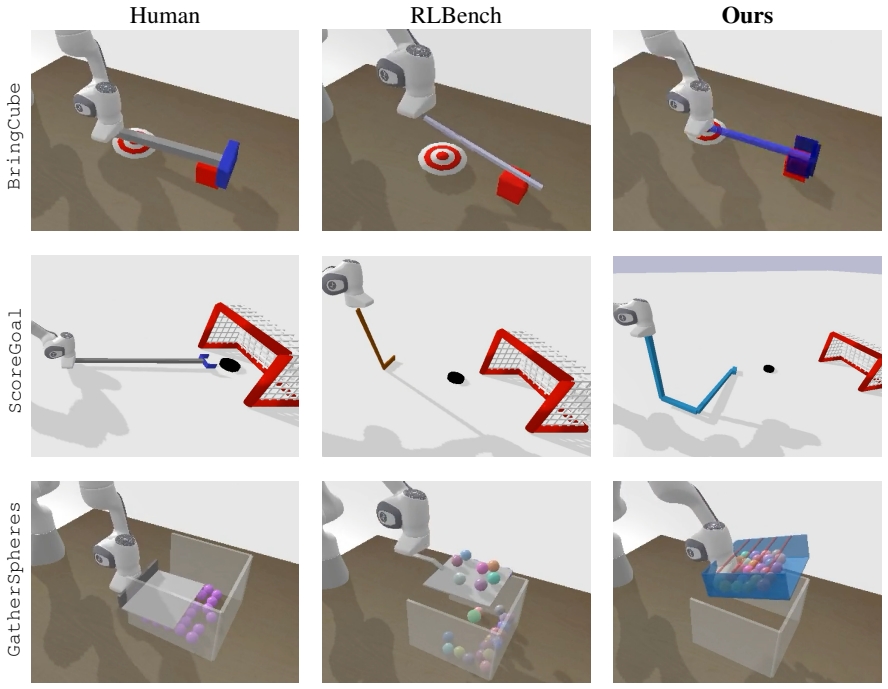
On the paper's own terms, the discovery is that a VLM can serve as both the designer and the search operator in an autonomous tool-invention loop, producing tools that are not just functional but more effective than those a human would ask for. Concretely, VLMgineer reports an average normalized reward improvement of 64.7% over VLM-generated designs prompted by human language specifications, and 24.3% over existing human-crafted tools, across the 12 tasks of its benchmark. The evolved tools also resolve the design problem itself: no task-specific template, prompt, or few-shot example is needed, and tool geometry and the action that operates it are optimized together rather than sequentially.
Load-bearing premise
The load-bearing premise is that the task rewards used in the simulator are honest measures of the intended everyday tasks, so a high-scoring tool actually performs the task rather than exploiting a loophole in the metric.
Editorial extensions
If this is right
- VLMgineer removes the need for hand-specified design parameters: the same prompts run across all tasks, so a new task only requires its environment code, an image, and a task description.
- Because tools and actions are generated together, the search can trade controller complexity for tool geometry, producing tools that turn hard motions into simple sweeps.
- The per-task cost is a fast simulation run on a desktop CPU rather than RL training, making the approach practical for rapid task switching.
- On tasks adapted from existing benchmarks, evolved tools reach maximum reward more consistently and with shorter end-effector travel than the original human-crafted tools.
- Evolutionary refinement is necessary for the reported performance: the sampling-only ablation produces worse and less consistent rewards than the full loop.
Reading between the lines
- Editorial inference: the reported gains combine the VLM's prior and the evolutionary loop, and the paper's ablation only removes the loop, not the VLM; a control experiment with random mutations of the same elite designs would isolate which part is doing the work.
- Editorial inference: because the VLM sees the environment code, including the reward definitions, some best-scoring designs may be optimizing the metric rather than the everyday task; a cross-simulator or real-robot transfer test would reveal this.
- If this style of search generalizes beyond rectangular URDF blocks, it points toward a hardware-as-software loop in which a new task is solved by querying a VLM, simulating a few hundred tool candidates, and fabricating the winner.
Editorial analysis
A structured set of objections, weighed in public.
Referee Report
Summary. The paper introduces VLMgineer, a framework that uses a vision-language model (gemini-2.5-pro) to propose tool designs in URDF and end-effector waypoint actions, then iteratively refines them through an evolutionary loop whose fitness is the task reward. The authors contribute RobotoolBench, a PyBullet suite of 12 everyday manipulation tasks requiring tool invention, and report that VLMgineer outperforms no-tool baselines, VLM-generated designs from human language prompts, and several RLBench original tools, with an average normalized improvement of 64.7% over human-prompted designs and 24.3% over human-crafted tools. An ablation shows that the evolutionary component improves over sampling-only generation.
Significance. If the empirical claims are established, the work is a useful step toward open-ended tool-and-action co-design: it demonstrates that a VLM can provide effective priors over tool geometry and action waypoints without task-specific templates or few-shot examples, and the proposed benchmark could support future comparisons. The paper also includes a welcome evolution ablation and qualitative tool galleries that illustrate the kinds of designs discovered. However, the central quantitative claims are currently threatened by a reward-code circularity and by an underpowered human baseline, so the significance cannot be fully assessed without additional experiments.
major comments (4)
- [Sec. IV, Appendix VIII-C1, Appendix VIII-B] The VLM receives the full environment source code as context (Sec. IV and Fig. 2; Appendix VIII-C1), and the same task reward functions R (Appendix VIII-B) are used as the evolutionary fitness. This allows the generator to target reward-specific partial credit rather than physically accomplishing the task. For example, the MoveBall reward explicitly blends progress with a speed penalty, CleanTable averages per-cube progress, and HighObject combines an in-box check with distance and lowering bonuses; a model that reads these code-level conditions can collect partial credit without completing the everyday task. The paper reports no reward-blind ablation and no independent binary-success metric, so the headline 64.7%/24.3% gains are not separable from reward exploitation. Please add an evaluation in which the reward logic is redacted from the VLM context, and/or report a task-success metric defined independently of R.
- [Sec. VI.A, Appendix VIII-A1] The human-prompted baseline rests on only three participants (one robotics expert, one LLM expert, one layperson; Appendix VIII-A1), and no human-prompt-plus-evolution arm is run. Consequently the claimed 64.7% improvement over human specifications conflates two factors: the VLM's prior and the evolutionary search. The conclusion that VLMgineer outperforms human-prompting would require more participants and a proper statistical comparison; to attribute the gain to the VLM prior, the same evolutionary loop should be applied to human-prompted initial designs, or the no-evolution ablation should be compared directly against the human baseline.
- [Sec. VI, Abstract] The headline numbers "average normalized improvement of 64.7%" and "24.3%" are never defined. No equation for normalization is given in Sec. VI or the appendix, and Fig. 4 and Fig. 8 report raw rewards only. If the per-task improvement is normalized by the baseline reward, tasks with near-zero baseline rewards can dominate the average; if it is normalized to [0,1] per task, the aggregation needs to be stated. Please define the metric and include a table of per-task values for all methods.
- [Appendix VIII-E, Fig. 8] The statistical significance section (Appendix VIII-E) only reports standard deviations across five runs; no significance tests, confidence intervals, or effect sizes are provided for the comparisons that support the central claims. Given n=5 runs and n=3 human prompts, the consistency claims in Fig. 8 are not yet supported. Please add paired tests across tasks (or per-task tests) and report effect sizes, especially for the human-prompt comparison.
minor comments (5)
- [Algorithm 1] Line 2 contains a duplicated 'do' ('for n iterations do do'), and the update 'PROMPT := PROMPT : EVOLVE_PROMPT(...)' is unclear; please reformat.
- [Fig. 7] The caption says 'average best reward across the five runs' while the text in Sec. VI.A refers to 'best rewards over five repeated runs'; please clarify which quantity is displayed.
- [Sec. VI.A] The distance-traversed tie-breaker is mentioned for BringCube and CleanTable, but no distance values are reported in the main text or figures; a small table would make the tie-breaker claims checkable.
- [Appendix VIII-D9] The human-specification prompt is composed with the same environment-code context as the main method, so the human baseline also has access to reward code; this is fair, but the paper should state explicitly that both conditions receive identical environment context, with only the design prior differing.
- [General] The paper says 'we will release our benchmark and code' but no link or repository commitment appears in the text; since the claims depend on exact reward definitions and environment code, releasing them along with the paper is important.
Circularity Check
No significant circularity: VLMGINEER's empirical evaluation is self-contained, and the reward-code exposure is a benchmark-validity concern, not a circular derivation.
full rationale
VLMGINEER is an empirical systems paper: the claimed result is that VLM-guided evolutionary search finds tool-action pairs with higher task reward than human-prompted or RLBench designs. No equation in the paper defines the output in terms of the input, and no reported number is a fitted parameter renamed as a prediction. The fitness function F is the task reward R, and the VLM receives the environment source code E as context (Sec. IV, Fig. 2), so a reward-exploitation confound cannot be ruled out; however, this is a benchmark-validity and reward-design concern, not a circularity in the derivation chain. The self-citations to Eureka [7] and Articulate-Anything [9] motivate the general large-model-guided evolution paradigm and the URDF representation, but neither citation supplies a load-bearing premise, uniqueness claim, or ansatz that predetermines the reported improvements. The comparisons to human prompts and RLBench tools are external benchmarks, and the evolution ablation (Sec. VI-B) independently compares the full method to a sampling-only baseline. The stated limitations (simulation-only evaluation, discrete waypoint actions, simple rigid tools) are acknowledged scope restrictions rather than circular steps. Therefore, no step in the paper reduces by construction to its own input.
Assumptions & free parameters
free parameters (4)
- Task reward functions R =
hand-crafted per task
- Evolution selection hyperparameters (ktop, reward_save, niteration) =
per-task values in Table I
- Population sizes (nagent, ntool, naction, ksim) =
per-task values in Table I
- VLM decoding parameters (temperature, top_p, etc.) =
not reported
assumptions (5)
- domain assumption PyBullet simulation with rigid bodies and open-loop interpolated waypoints is a valid testbed for tool-use manipulation
- domain assumption The 12 ROBOTOOL-BENCH tasks are representative of everyday manipulation scenarios requiring creative tool design
- domain assumption The proprietary VLM gemini-2.5-pro-preview-03-25 reliably produces valid URDF and waypoint arrays at scale
- ad hoc to paper Tools are restricted to rectangular components with negligible mass and a single rigid attachment
- ad hoc to paper Hand-authored reward functions capture the intended task objectives
Cite this review
Pith. "Pith review of VLMgineer: Vision Language Models as Robotic Toolsmiths." pith.science (2026). https://pith.science/paper/V657D54K
@misc{pith2026250712644,
  author       = {Pith},
  title        = {Pith review of: VLMgineer: Vision Language Models as Robotic Toolsmiths},
  year         = {2026},
  howpublished = {\url{https://pith.science/paper/V657D54K}},
  note         = {Machine review of arXiv:2507.12644}
}
read the original abstract
Tool design and use reflect the ability to understand and manipulate the physical world through creativity, planning, and foresight. As such, these capabilities are often regarded as measurable indicators of intelligence across biological species. While much of today's research on robotic intelligence focuses on generating better controllers, inventing smarter tools offers a complementary form of physical intelligence: shifting the onus of problem-solving onto the tool's design. Given the vast and impressive common-sense, reasoning, and creative capabilities of today's foundation models, we investigate whether these models can provide useful priors to automatically design and effectively wield such tools? We present VLMgineer, a framework that harnesses the code generation abilities of vision language models (VLMs) together with evolutionary search to iteratively co-design physical tools and the action plans that operate them to perform a task. We evaluate VLMgineer on a diverse new benchmark of everyday manipulation scenarios that demand creative tool design and use. Across this suite, VLMgineer consistently discovers tools and policies that solve tasks more effectively and innovatively, transforming challenging robotics problems into straightforward executions. It also outperforms VLM-generated designs from human specifications and existing human-crafted tools for everyday tasks. To facilitate future research on automated tool invention, we will release our benchmark and code.
Figures


Figures from the paper (5 more)



Forward citations
Cited by 3 Pith papers
-
Debate2Create: Robot Co-design via Multi-Agent LLM Debate
A structured multi-agent LLM debate grounded in simulation is proposed for co-designing robot morphology and reward, but the body reports only a single Ant experiment.
-
IMBench: A Benchmark for Intuitive Robotic Manipulation
IMBench is a 35-task robosuite benchmark with a three-stage evaluation showing current VLMs and robot policies fail to convert physical reasoning into executable manipulation.
-
ESC: Emotional Self-Correction for Reliable Vision-Language Models
ESC uses emotional cues triggered by an external verifier to enable training-free self-correction in VLMs, improving reliability on safety, hallucination, and reasoning benchmarks.
Reference graph
Works this paper leans on
-
[1]
Robocook: Long-horizon elasto-plastic object manipulation with diverse tools,
H. Shi, H. Xu, S. Clarke, Y . Li, and J. Wu, “Robocook: Long-horizon elasto-plastic object manipulation with diverse tools,” 2023. [Online]. Available: https://arxiv. org/abs/2306.14447
arXiv 2023
-
[2]
Learning generalizable tool-use skills through trajectory generation,
C. Qi, Y . Wu, L. Yu, H. Liu, B. Jiang, X. Lin, and D. Held, “Learning generalizable tool-use skills through trajectory generation,” in IEEE/RSJ International Conference on Intelligent Robots and Systems (IROS) , 2024
2024
-
[3]
Plato: Planning with llms and affordances for tool manipulation,
A. Car, S. S. Yarlagadda, A. Bartsch, A. George, and A. B. Farimani, “Plato: Planning with llms and affordances for tool manipulation,” 2024. [Online]. Available: https://arxiv.org/abs/2409.11580
arXiv 2024
-
[4]
Bimanual dexterity for complex tasks,
K. Shaw, Y . Li, J. Yang, M. K. Srirama, R. Liu, H. Xiong, R. Mendonca, and D. Pathak, “Bimanual dexterity for complex tasks,” in 8th Annual Conference on Robot Learning, 2024
2024
-
[5]
Vegetable peeling: A case study in constrained dexterous manipulation,
T. Chen, E. Cousineau, N. Kuppuswamy, and P. Agrawal, “Vegetable peeling: A case study in constrained dexterous manipulation,” 2024. [Online]. Available: https://arxiv.org/abs/2407.07884
arXiv 2024
-
[6]
Language to rewards for robotic skill synthesis,
W. Yu, N. Gileadi, C. Fu, S. Kirmani, K.-H. Lee, M. Gon- zalez Arenas, H.-T. Lewis Chiang, T. Erez, L. Hasenclever, J. Humplik, B. Ichter, T. Xiao, P. Xu, A. Zeng, T. Zhang, N. Heess, D. Sadigh, J. Tan, Y . Tassa, and F. Xia, “Language to rewards for robotic skill synthesis,” Arxiv preprint arXiv:2306.08647, 2023
arXiv 2023
-
[7]
Eureka: Human-level reward design via coding large lan- guage models,
Y . J. Ma, W. Liang, G. Wang, D.-A. Huang, O. Bastani, D. Jayaraman, Y . Zhu, L. Fan, and A. Anandkumar, “Eureka: Human-level reward design via coding large lan- guage models,” arXiv preprint arXiv: Arxiv-2310.12931 , 2023
arXiv 2023
-
[8]
Blenderalchemy: Editing 3d graphics with vision-language models,
I. Huang, G. Yang, and L. Guibas, “Blenderalchemy: Editing 3d graphics with vision-language models,” in European Conference on Computer Vision . Springer, 2024, pp. 297–314
2024
Show all 98 references
-
[9]
Articulate-anything: Automatic modeling of articulated objects via a vision-language foundation model,
L. Le, J. Xie, W. Liang, H.-J. Wang, Y . Yang, Y . J. Ma, K. Vedder, A. Krishna, D. Jayaraman, and E. Eaton, “Articulate-anything: Automatic modeling of articulated objects via a vision-language foundation model,” arXiv preprint arXiv:2410.13882, 2024
-
[10]
Blox-net: Generative design-for-robot-assembly using vlm supervision, physics simulation, and a robot with reset,
A. Goldberg, K. Kondap, T. Qiu, Z. Ma, L. Fu, J. Kerr, H. Huang, K. Chen, K. Fang, and K. Goldberg, “Blox-net: Generative design-for-robot-assembly using vlm supervision, physics simulation, and a robot with reset,” 2024. [Online]. Available: https://arxiv.org/abs/ 2409.17126
2024 arXiv
-
[11]
Mathematical discoveries from program search with large language models,
B. Romera-Paredes, M. Barekatain, A. Novikov, M. Balog, M. P. Kumar, E. Dupont, F. J. Ruiz, J. S. Ellenberg, P. Wang, O. Fawzi et al., “Mathematical discoveries from program search with large language models,” Nature, vol. 625, no. 7995, pp. 468–475, 2024
2024
-
[12]
Funbo: Discovering acquisition functions for bayesian optimization with funsearch,
V . Aglietti, I. Ktena, J. Schrouff, E. Sgouritsa, F. J. Ruiz, A. Malek, A. Bellot, and S. Chiappa, “Funbo: Discovering acquisition functions for bayesian optimization with funsearch,” arXiv preprint arXiv:2406.04824 , 2024
2024 arXiv
-
[13]
Alphaevolve: A gemini-powered coding agent for designing advanced algorithms,
AlphaEvolve team, “Alphaevolve: A gemini-powered coding agent for designing advanced algorithms,” https: //deepmind.google/discover/blog, May 2025, deepMind Blog
2025
-
[14]
Physical design using differentiable learned simulators,
K. R. Allen, T. Lopez-Guevara, K. Stachenfeld, A. Sanchez-Gonzalez, P. Battaglia, J. Hamrick, and T. Pfaff, “Physical design using differentiable learned simulators,” arXiv preprint arXiv:2202.00728 , 2022
2022 arXiv
-
[15]
Learning to design and construct bridge without blueprint,
Y . Li, T. Kong, L. Li, Y . Li, and Y . Wu, “Learning to design and construct bridge without blueprint,” in 2021 IEEE/RSJ International Conference on Intelligent Robots and Systems (IROS) . IEEE, 2021, pp. 2398–2405
2021
-
[16]
Learning to design 3d printable adaptations on everyday objects for robot manipulation,
M. Guo, Z. Liu, S. Tian, Z. Xie, J. Wu, and C. K. Liu, “Learning to design 3d printable adaptations on everyday objects for robot manipulation,” 2024
2024
-
[17]
Morph: Design co- optimization with reinforcement learning via a differ- entiable hardware model proxy,
H. Zhanpeng and C. Matei, “Morph: Design co- optimization with reinforcement learning via a differ- entiable hardware model proxy,” IEEE Robotics and Automation, 2024
2024
-
[18]
Imagine that! leveraging emer- gent affordances for 3d tool synthesis,
Y . Wu, S. Kasewa, O. Groth, S. Salter, L. Sun, O. P. Jones, and I. Posner, “Imagine that! leveraging emer- gent affordances for 3d tool synthesis,” arXiv preprint arXiv:1909.13561, 2019
1909 arXiv
-
[19]
Fit2Form: 3D generative model for robot gripper form design,
H. Ha, S. Agrawal, and S. Song, “Fit2Form: 3D generative model for robot gripper form design,” in Conference on Robotic Learning (CoRL) , 2020
2020
-
[20]
Dynamics-guided diffusion model for robot manipulator design,
X. Xu, H. Ha, and S. Song, “Dynamics-guided diffusion model for robot manipulator design,” arXiv preprint arXiv:2402.15038, 2024
2024 arXiv
-
[21]
Paperbot: Learning to design real-world tools using paper,
R. Liu, J. Liang, S. Sudhakar, H. Ha, C. Chi, S. Song, and C. V ondrick, “Paperbot: Learning to design real-world tools using paper,” 2024
2024
-
[22]
Learning tool morphology for contact-rich manipulation tasks with differentiable simulation,
M. Li, R. Antonova, D. Sadigh, and J. Bohg, “Learning tool morphology for contact-rich manipulation tasks with differentiable simulation,” in 2023 IEEE International Conference on Robotics and Automation (ICRA) . IEEE, 2023, pp. 1859–1865
2023
-
[23]
Lamarckian evolution of simulated modular robots,
M. Jelisavcic, K. Glette, E. Haasdijk, and A. Eiben, “Lamarckian evolution of simulated modular robots,” Frontiers in Robotics and AI , vol. 6, p. 9, 2019
2019
-
[24]
Task-agnostic morphology evolution,
D. J. Hejna III, P. Abbeel, and L. Pinto, “Task-agnostic morphology evolution,” arXiv preprint arXiv:2102.13100 , 2021
2021 arXiv
-
[25]
Evolution of morphology through sculpting in a voxel based robot,
K. Walker and H. Hauser, “Evolution of morphology through sculpting in a voxel based robot,” in Artificial Life Conference Proceedings 33 , vol. 2021, no. 1. MIT Press One Rogers Street, Cambridge, MA 02142-1209, USA journals-info . . . , 2021, p. 27
2021
-
[26]
Evolving virtual creatures,
K. Sims, “Evolving virtual creatures,” in Seminal Graph- ics Papers: Pushing the Boundaries, Volume 2 , 2023, pp. 699–706
2023
-
[27]
Symmetry- aware robot design with structured subgroups,
H. Dong, J. Zhang, T. Wang, and C. Zhang, “Symmetry- aware robot design with structured subgroups,” 2023. [Online]. Available: https://arxiv.org/abs/2306.00036
2023 arXiv
-
[28]
Leveraging hyperbolic embeddings for coarse-to-fine robot design,
H. Dong, J. Zhang, and C. Zhang, “Leveraging hyperbolic embeddings for coarse-to-fine robot design,” 2023. [Online]. Available: https://arxiv.org/abs/2311.00462
2023 arXiv
-
[29]
Task-specific design optimization and fabrication for inflated-beam soft robots with growable discrete joints,
I. Exarchos, K. Wang, B. H. Do, F. Stroppa, M. M. Coad, A. M. Okamura, and C. K. Liu, “Task-specific design optimization and fabrication for inflated-beam soft robots with growable discrete joints,” in 2022 International Conference on Robotics and Automation (ICRA) . IEEE, 202...
2022
-
[30]
Robogrammar: graph grammar for terrain-optimized robot design,
A. Zhao, J. Xu, M. Konakovi ´c-Lukovi´c, J. Hughes, A. Spielberg, D. Rus, and W. Matusik, “Robogrammar: graph grammar for terrain-optimized robot design,” ACM Trans. Graph. , vol. 39, no. 6, Nov. 2020. [Online]. Available: https://doi.org/10.1145/3414685.3417831
2020
-
[31]
Impro- visation through physical understanding: Using novel objects as tools with visual foresight,
A. Xie, F. Ebert, S. Levine, and C. Finn, “Impro- visation through physical understanding: Using novel objects as tools with visual foresight,” arXiv preprint arXiv:1904.05538, 2019
1904 arXiv
-
[32]
Rapid trial-and-error learning with simulation supports flexible tool use and physical reasoning,
K. R. Allen, K. A. Smith, and J. B. Tenenbaum, “Rapid trial-and-error learning with simulation supports flexible tool use and physical reasoning,” Proceedings of the National Academy of Sciences , vol. 117, no. 47, pp. 29 302–29 310, 2020
2020
-
[33]
Forward prediction for physical reasoning,
R. Girdhar, L. Gustafson, A. Adcock, and L. van der Maaten, “Forward prediction for physical reasoning,” arXiv preprint arXiv:2006.10734 , 2020
2006 arXiv
-
[34]
Diffskill: Skill abstraction from differentiable physics for deformable object manipulations with tools,
X. Lin, Z. Huang, Y . Li, J. B. Tenenbaum, D. Held, and C. Gan, “Diffskill: Skill abstraction from differentiable physics for deformable object manipulations with tools,” arXiv preprint arXiv:2203.17275 , 2022
2022 arXiv
-
[35]
Planning with spatial- temporal abstraction from point clouds for deformable object manipulation,
X. Lin, C. Qi, Y . Zhang, Z. Huang, K. Fragkiadaki, Y . Li, C. Gan, and D. Held, “Planning with spatial- temporal abstraction from point clouds for deformable object manipulation,” in 6th Annual Conference on Robot Learning , 2022. [Online]. Available: https: //openreview.net/...
2022
-
[36]
Learning task-oriented grasping for tool manipulation from simulated self-supervision,
K. Fang, Y . Zhu, A. Garg, A. Kurenkov, V . Mehta, L. Fei- Fei, and S. Savarese, “Learning task-oriented grasping for tool manipulation from simulated self-supervision,” The International Journal of Robotics Research , vol. 39, no. 2-3, pp. 202–216, 2020
2020
-
[37]
Keto: Learning keypoint representations for tool ma- nipulation,
Z. Qin, K. Fang, Y . Zhu, L. Fei-Fei, and S. Savarese, “Keto: Learning keypoint representations for tool ma- nipulation,” in 2020 IEEE International Conference on Robotics and Automation (ICRA). IEEE, 2020, pp. 7278– 7285
2020
-
[38]
A causal approach to tool affordance learning,
J. Brawer, M. Qin, and B. Scassellati, “A causal approach to tool affordance learning,” in 2020 IEEE/RSJ interna- tional conference on intelligent robots and systems (IROS). IEEE, 2020, pp. 8394–8399
2020
-
[39]
Deep affordance foresight: Planning through what can be done in the future,
D. Xu, A. Mandlekar, R. Martín-Martín, Y . Zhu, S. Savarese, and L. Fei-Fei, “Deep affordance foresight: Planning through what can be done in the future,” in 2021 IEEE international conference on robotics and automation (ICRA). IEEE, 2021, pp. 6206–6213
2021
-
[40]
Tool as embodiment for recursive manipulation,
Y . Noguchi, T. Matsushima, Y . Matsuo, and S. S. Gu, “Tool as embodiment for recursive manipulation,” arXiv preprint arXiv:2112.00359, 2021
2021 arXiv
-
[41]
Creative robot tool use with large language models,
M. Xu, P. Huang, W. Yu, S. Liu, X. Zhang, Y . Niu, T. Zhang, F. Xia, J. Tan, and D. Zhao, “Creative robot tool use with large language models,” 2023
2023
-
[42]
Differentiable physics and stable modes for tool-use and manipulation planning,
M. A. Toussaint, K. R. Allen, K. A. Smith, and J. B. Tenenbaum, “Differentiable physics and stable modes for tool-use and manipulation planning,” Robotics: Science and systems foundation , 2018
2018
-
[43]
Co-optimizing robot, environment, and tool design via joint manipulation planning,
M. Toussaint, J.-S. Ha, and O. S. Oguz, “Co-optimizing robot, environment, and tool design via joint manipulation planning,” in 2021 IEEE International Conference on Robotics and Automation (ICRA). IEEE, 2021, pp. 6600– 6606
2021
-
[44]
Curriculum-based co-design of morphology and control of voxel-based soft robots,
Y . Wang, S. Wu, H. Fu, Q. FU, T. Zhang, Y . Chang, and X. Wang, “Curriculum-based co-design of morphology and control of voxel-based soft robots,” in The Eleventh International Conference on Learning Representations ,
-
[45]
Preco: Enhancing generalization in co- design of modular soft robots via brain-body pre-training,
Y . Wang, S. Wu, T. Zhang, Y . Chang, H. Fu, Q. Fu, and X. Wang, “Preco: Enhancing generalization in co- design of modular soft robots via brain-body pre-training,” in Conference on Robot Learning . PMLR, 2023, pp. 478–498
2023
-
[46]
Data- efficient co-adaptation of morphology and behaviour with deep reinforcement learning,
K. S. Luck, H. B. Amor, and R. Calandra, “Data- efficient co-adaptation of morphology and behaviour with deep reinforcement learning,” in Proceedings of the Conference on Robot Learning , ser. Proceedings of Machine Learning Research, L. P. Kaelbling, D. Kragic, and K. Sugiura...
2020
-
[47]
Trans- form2act: Learning a transform-and-control policy for efficient agent design,
Y . Yuan, Y . Song, Z. Luo, W. Sun, and K. Kitani, “Trans- form2act: Learning a transform-and-control policy for efficient agent design,” arXiv preprint arXiv:2110.03659 , 2021
2021 arXiv
-
[48]
Learning-in-the-loop optimization: End-to-end control and co-design of soft robots through learned deep latent representations,
A. Spielberg, A. Zhao, Y . Hu, T. Du, W. Matusik, and D. Rus, “Learning-in-the-loop optimization: End-to-end control and co-design of soft robots through learned deep latent representations,” Advances in Neural Information Processing Systems, vol. 32, 2019
2019
-
[49]
Scalable co-optimization of morphology and control in embodied machines,
N. Cheney, J. Bongard, V . SunSpiral, and H. Lipson, “Scalable co-optimization of morphology and control in embodied machines,” Journal of The Royal Society Interface, vol. 15, no. 143, p. 20170937, 2018
2018
-
[50]
Investigating premature convergence in co-optimization of morphology and control in evolved virtual soft robots,
A. Mertan and N. Cheney, “Investigating premature convergence in co-optimization of morphology and control in evolved virtual soft robots,” 2024. [Online]. Available: https://arxiv.org/abs/2402.09231
2024 arXiv
-
[51]
Text2robot: Evolutionary robot design from text descriptions,
R. P. Ringel, Z. S. Charlick, J. Liu, B. Xia, and B. Chen, “Text2robot: Evolutionary robot design from text descriptions,” 2025. [Online]. Available: https://arxiv.org/abs/2406.19963
2025 arXiv
-
[52]
Data-efficient learning of morphology and controller for a microrobot,
T. Liao, G. Wang, B. Yang, R. Lee, K. Pister, S. Levine, and R. Calandra, “Data-efficient learning of morphology and controller for a microrobot,” in 2019 International Conference on Robotics and Automation (ICRA) . IEEE, 2019, pp. 2488–2494
2019
-
[53]
Jointly learning to construct and control agents using deep reinforcement learning,
C. Schaff, D. Yunis, A. Chakrabarti, and M. R. Walter, “Jointly learning to construct and control agents using deep reinforcement learning,” in 2019 international conference on robotics and automation (ICRA) . IEEE, 2019, pp. 9798–9805
2019
-
[54]
Reinforcement learning for improving agent design,
D. Ha, “Reinforcement learning for improving agent design,” Artificial life, vol. 25, no. 4, pp. 352–365, 2019
2019
-
[55]
Evolution gym: A large-scale benchmark for evolving soft robots,
J. Bhatia, H. Jackson, Y . Tian, J. Xu, and W. Matusik, “Evolution gym: A large-scale benchmark for evolving soft robots,” Advances in Neural Information Processing Systems, vol. 34, pp. 2201–2214, 2021
2021
-
[56]
Learning to control self-assembling morphologies: a study of generalization via modularity,
D. Pathak, C. Lu, T. Darrell, P. Isola, and A. A. Efros, “Learning to control self-assembling morphologies: a study of generalization via modularity,” Advances in Neural Information Processing Systems , vol. 32, 2019
2019
-
[57]
Hardware as policy: Mechanical and computational co-optimization using deep reinforcement learning,
T. Chen, Z. He, and M. Ciocarlie, “Hardware as policy: Mechanical and computational co-optimization using deep reinforcement learning,” arXiv preprint arXiv:2008.04460, 2020
2008 arXiv
-
[58]
Learning to design and use tools for robotic manipulation,
Z. Liu, S. Tian, M. Guo, C. K. Liu, and J. Wu, “Learning to design and use tools for robotic manipulation,” 2023. [Online]. Available: https://arxiv.org/abs/2311.00754
2023 arXiv
-
[59]
An end-to-end differentiable framework for contact-aware robot design,
J. Xu, T. Chen, L. Zlokapa, M. Foshey, W. Matusik, S. Sueda, and P. Agrawal, “An end-to-end differentiable framework for contact-aware robot design,” in Robotics: Science and Systems XVII , ser. RSS2021. Robotics: Science and Systems Foundation, Jul. 2021. [Online]. Available:...
2021 doi
-
[60]
Tool shape optimization through backpropagation of neural network,
K. Kawaharazuka, T. Ogawa, and C. Nabeshima, “Tool shape optimization through backpropagation of neural network,” in 2020 IEEE/RSJ International Conference on Intelligent Robots and Systems (IROS) . IEEE, 2020, pp. 8387–8393
2020
-
[61]
Robomorph: Evolving robot morphology using large language models,
K. Qiu, K. Ciebiera, P. Fijałkowski, M. Cygan, and Ł. Ku- ci´nski, “Robomorph: Evolving robot morphology using large language models,” arXiv preprint arXiv:2407.08626, 2024
2024
-
[62]
Large language models as natural selector for embodied soft robot design,
C. Chen, X. Xu, X. Wang, and X. Huang, “Large language models as natural selector for embodied soft robot design,” 2025. [Online]. Available: https: //arxiv.org/abs/2503.02249
2025
-
[63]
Laser: Towards diversified and generalizable robot design with large language models,
J. Song, Y . Yang, H. Xiao, W. Peng, W. Yao, and F. Wang, “Laser: Towards diversified and generalizable robot design with large language models,” in The Thirteenth Interna- tional Conference on Learning Representations , 2025
2025
-
[64]
W. B. Langdon and R. Poli, Foundations of genetic programming. Springer Science & Business Media, 2013
2013
-
[65]
Evolutionary robotics: what, why, and where to,
S. Doncieux, N. Bredeche, J.-B. Mouret, and A. E. Eiben, “Evolutionary robotics: what, why, and where to,” Frontiers in Robotics and AI , vol. 2, p. 4, 2015
2015
-
[66]
Tool macgyver- ing: A novel framework for combining tool substitution and construction,
L. Nair, N. Shrivatsav, and S. Chernova, “Tool macgyver- ing: A novel framework for combining tool substitution and construction,” arXiv preprint arXiv:2008.10638, 2020
2008 arXiv
-
[67]
Learning robotic assembly from cad,
G. Thomas, M. Chien, A. Tamar, J. A. Ojea, and P. Abbeel, “Learning robotic assembly from cad,” 2018. [Online]. Available: https://arxiv.org/abs/1803.07635
2018 arXiv
-
[68]
Keypoint action tokens enable in-context imitation learning in robotics,
N. Di Palo and E. Johns, “Keypoint action tokens enable in-context imitation learning in robotics,” in Proceedings of Robotics: Science and Systems (RSS) , 2024
2024
-
[69]
In-context learning enables robot action prediction in llms,
Y . Yin, Z. Wang, Y . Sharma, D. Niu, T. Darrell, and R. Herzig, “In-context learning enables robot action prediction in llms,” in ICRA, 2025
2025
-
[70]
Rlbench: The robot learning benchmark & learning environment,
S. James, Z. Ma, D. Rovick Arrojo, and A. J. Davison, “Rlbench: The robot learning benchmark & learning environment,” IEEE Robotics and Automation Letters , 2020
2020
-
[71]
A novel tool-use mode in animals: New caledonian crows insert tools to transport objects,
I. F. Jacobs, A. von Bayern, and M. Osvath, “A novel tool-use mode in animals: New caledonian crows insert tools to transport objects,” Anim. Cogn., vol. 19, no. 6, pp. 1249–1252, Nov. 2016
2016
-
[72]
Pybullet gymperium,
B. Ellenberger, “Pybullet gymperium,” https://github.com/ benelot/pybullet-gym, 2018–2019
2018
-
[73]
SAPIEN: A simulated part-based interactive environment,
F. Xiang, Y . Qin, K. Mo, Y . Xia, H. Zhu, F. Liu, M. Liu, H. Jiang, Y . Yuan, H. Wang, L. Yi, A. X. Chang, L. J. Guibas, and H. Su, “SAPIEN: A simulated part-based interactive environment,” in The IEEE Conference on Computer Vision and Pattern Recognition (CVPR) , June 2020
2020
-
[74]
Benchmarking in manipulation re- search: Using the Yale-CMU-Berkeley object and model set,
B. Calli, A. Walsman, A. Singh, S. Srinivasa, P. Abbeel, and A. M. Dollar, “Benchmarking in manipulation re- search: Using the Yale-CMU-Berkeley object and model set,” IEEE Robot. Autom. Mag. , vol. 22, no. 3, pp. 36–52, Sep. 2015
2015
-
[75]
Meta-world: A benchmark and evaluation for multi-task and meta reinforcement learning,
T. Yu, D. Quillen, Z. He, R. Julian, K. Hausman, C. Finn, and S. Levine, “Meta-world: A benchmark and evaluation for multi-task and meta reinforcement learning,” in Conference on Robot Learning (CoRL) , 2019. [Online]. Available: https://arxiv.org/abs/1910.10897 VIII. A PPENDI...
2019 arXiv
-
[77]
(ii) Participants then had five minutes to write a prompt in English specifying their desired tool design and robot action
Human-Prompted Designs Experiment Implementation: Each participant underwent the following experimental pro- cedure for each task: (i) We provided a screenshot of the environment and a description of the task, accompanied by a brief Q&A session to ensure the participants under...
-
[78]
No-Tool Experiment Implementation: In the no-tool baseline experiment, we evaluate the robot’s performance without any additional tool attachment. The Franka Panda robot uses its original two-finger gripper to perform the task, with the VLM generating action waypoints for the ...
-
[79]
distance-to-exit
RLBench Experiment Implementation: In the RLBench experiment, we evaluate the robot’s performance with tools from RLbench. We assume the tool is already attached to the end effector without considering the picking step. The tool are scaled to adapt to our tasks which are simil...
-
[80]
The design agent is provided with task context as illustrated in Fig
Design Agents Context: This section describes the context that applies to a single design agent. The design agent is provided with task context as illustrated in Fig. 2, which includes (1) the environment code, (2) a screenshot of the environment, (3) a brief task description,...
-
[81]
For each agent, we prompt it to generate ntool number of tool designs, and naction number of action waypoint samples that correspond to each tool design
Design Agents Queries: In VLM GINEER , we query VLM for designs by first initializing nagents number of agents in parallel with the same prompts. For each agent, we prompt it to generate ntool number of tool designs, and naction number of action waypoint samples that correspon...
-
[82]
virtual joint
Design Agent Outputs: As a part of our prompt to the VLM to query for designs, we specified our desired tool and action formats. For our tool design requirements, please refer to Appendix VIII-D3 for details. For our action design requirements, please refer to Appendix VIII-D4...
-
[83]
Simulation Evaluation: From the previous section, we obtain a list of tool-action pairs in the form of URDF designs and action waypoints, respectively. To use these for simulation evaluation, we first merge the tool URDF without modification into a blank Franka Panda URDF (a b...
-
[84]
evolution mission introduction prompt
Evolution: After evaluating all previous tool-action pairs, we perform selection as follows: (1) For every task, we define two parameters to control the behavior of selection:reward save and ktop. (2) Using these parameters, we first select the ktop number of tool-action pairs...
-
[85]
VLM GINEER Benchmarking Details: When benchmark- ing VLM GINEER against ROBOTOOL BENCH , we used a differ- ent set of parameters for each task, detailed in Table. I. We used gemini-2.5-pro-preview-03-25 as our VLM model throughout the entire experiment, and ran PyBullet evalua...
-
[86]
Evolutionary Process
Mission Introduction: Initial sampling mission introduc- tion prompt: You are a robotics hardware and controls expert. You operate with boldness and brilliance in the physical realm. You work with a robot arm that sits in the origin of your environment. You will be presented w...
-
[87]
Procedure Instruction: The procedure you will follow:
-
[88]
Receive Environment Descriptions: The user will provide some detailed environment descriptions, robotic task instructions, and an initial image of the workspace area from the overhead camera
-
[89]
Write down the spatial relationship, including by not limited to the position, orientation, dimension, and geometry of all the objects in the scene
Describe the Scene: Analyze the environment. Write down the spatial relationship, including by not limited to the position, orientation, dimension, and geometry of all the objects in the scene. Use all the information provided to you, including all text, code, and images
-
[90]
Tool Specification
Create Strategies and Designs: You will need to create ntool tool that you can use to complete the task. For each of the tools you designed, you must generate naction set of action waypoints that you can use to complete the task. Specifically, for a total of ntool times, do th...
-
[91]
panda_virtual
Tool Specifications: Tool specification prompt without the use of Franka Grippers: (Tool Specifications) Your design of the tool must follow these rules: (1) You must only use 3D rectangles for each component; (2) Your tool will be outputted in a URDF block format, which shoul...
-
[92]
panda_virtual
Action Specifications: Action specification prompt with- out the use of Franka Grippers: (Action Specifications) Your tool-using action will be a Nx6 numpy array of action waypoints, where N is the number of waypoints, and each waypoint is of dimension 6 (xyz position + roll-p...
-
[93]
action set
Action Diversity Specification: (Desired Action Criteria Definitions) For the description below, we will call a single sequential set of waypoints in a single rollout as one "action set". For each tool you created, the goal is to generate naction action sets that optimize the ...
-
[94]
Negative x: Towards the back of the table
Frame Clarifications: (Frame Clarification) In the world frame, front/back is along the x axis, left/right is along the y axis, and up/down is along the z axis with the following directions: Positive x: Towards the front of the table. Negative x: Towards the back of the table....
-
[95]
For each of the ntool tool designs, you can choose to either mutate or crossover
Evolutionary Instructions: (Evolutionary Process) Your design decision is a part of a tool design genetic algorithm. For each of the ntool tool designs, you can choose to either mutate or crossover. Specifically, tool mutation is defined as one change to a single randomly sele...
-
[96]
You operate with boldness and brilliance in the physical realm
No Tool Instructions: You are a robotics hardware and controls expert. You operate with boldness and brilliance in the physical realm. You work with a robot arm that sits in the origin of your environment. You will be presented with some robotic tasks, and will be asked to des...
-
[97]
You have a robot arm that sits in the origin of your environment
Human Specification Instructions: You are a helpful robotics hardware and controls expert. You have a robot arm that sits in the origin of your environment. You are working with a colleague as a team to design tools and actions for a robot to complete a task. Your colleague wi...
-
[98]
Royalty Free No Ai License
RLBench Instructions: You are a helpful robotics hardware and controls expert. You have a robot arm that sits in the origin of your environment. You are working with a colleague as a team to design tools and actions for a robot to complete a task. Your colleague will provide y...
-
[2023]
Available: https://openreview.net/forum? id=r9fX833CsuN
[Online]. Available: https://openreview.net/forum? id=r9fX833CsuN
Reviewed August 6, 2026 · model on record in the stance chip above.
Discussion (0). Sign in to comment.