REVIEW 4 major objections 4 minor 59 references
Neural Architecture Search with Mixed Bio-inspired Learning Rules
T0 review · 4 major / 4 minor · reviewed 2026-08-06 · deepseek-v4-flash
Pith's one-line read This paper claims that mixing different bio-inspired learning rules across layers, with the per-layer rule chosen automatically by neural architecture search, yields higher accuracy than using one rule throughout, and that the resulting…
desk verdict Useful first step: NAS with per-layer learning rules is new and plausible, but the paper's core 'mixed beats single' claim still lacks a controlled same-architecture baseline. read the letter →
The pith
A machine-rendered reading of the paper's core claim, the machinery that carries it, and where it could break.
The reading
What carries the argument
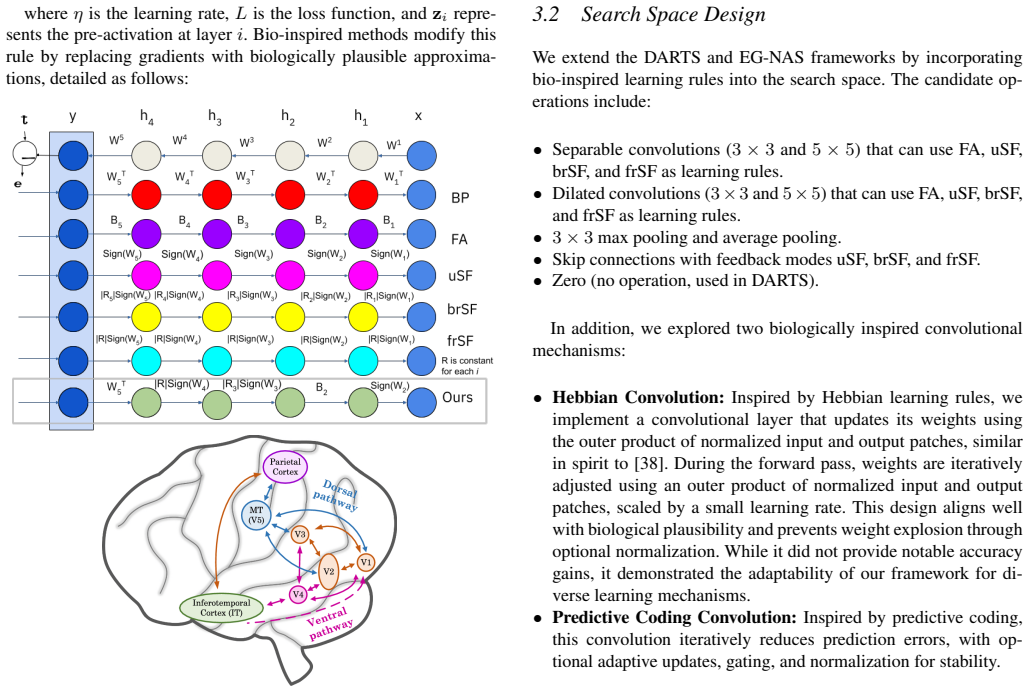
The central machinery is an enlarged NAS search space in which every edge of the supernetwork carries a weighted mixture over operation-rule pairs, so the network jointly selects both what computation to apply and which bio-inspired rule should train it. The learning rules are feedback-alignment variants that replace the transposed-weight feedback of back-propagation with a feedback matrix: one uses a fixed random matrix, one uses the sign of the forward weights, one uses a redrawn random magnitude times that sign, and one uses a fixed random magnitude times that sign. The search relaxes the discrete choice of pairs into continuous architecture parameters through a softmax, optimizes weights and architecture parameters alternately, and at the end keeps the highest-probability pair on each edge. This object is what lets the paper test whether per-layer rule diversity, rather than architecture alone, drives accuracy and robustness.
What would settle it
Retrain the best mixed-rule architecture with each single learning rule applied uniformly to every layer, using the same 600-epoch protocol on CIFAR-10 and CIFAR-100; if any uniform-rule version equals or beats the mixed-rule accuracy (95.16% and 76.48%, respectively), the paper's claim that rule diversity itself drives the gain would be refuted.
Extended reading notes
Core claim
The paper's central claim is that the choice of learning rule is a searchable architectural dimension, not a fixed training detail. By pairing each candidate operation in the search space with a bio-inspired rule, the NAS procedure selects a rule for every layer. The resulting model reaches test errors of 4.84% on CIFAR-10 and 23.52% on CIFAR-100, and the same architecture transfers to 43.42% accuracy on ImageNet16-120 and 60.51% top-1 on ImageNet. Randomly assigning rules to layers keeps accuracy high, which the authors take as evidence that the improvement comes from mixing rules rather than from any particular discovered combination. The paper also reports lower gradient variance under mixed rules and links the diversity to stronger performance under one-pixel, square, transfer, and projected-gradient attacks.
Load-bearing premise
The accuracy comparison assumes that the single-rule baselines were trained under the same protocol as the mixed-rule model; the paper reports some CIFAR-100 baselines under a 150-epoch protocol while the mixed-rule model trained for 600 epochs on a different architecture, so the reported gap could shrink under equal conditions.
Editorial extensions
If this is right
- Bio-inspired networks can be trained to accuracy competitive with back-propagation on standard benchmarks, narrowing the gap that previously limited them to small tasks.
- Learning-rule assignment becomes a searchable design axis: future NAS pipelines can treat the training algorithm per layer as part of the architecture.
- The benefit of mixing does not depend on finding one special pattern, since random assignments also perform well, which suggests the effect is robust across searches.
- Mixed-rule networks keep useful accuracy under gradient-based attacks where single-rule and back-propagation models collapse, so robustness is preserved at higher accuracy.
- The approach extends to larger datasets such as ImageNet, and a CIFAR-searched architecture transfers, indicating the mixed-rule benefit is not limited to small-scale tasks.
Reading between the lines
- This suggests that mixing learning rules may act as an implicit regularizer: the paper's own weight-distribution and gradient-variance observations point that way, but the connection to L1 or L2 regularization is not proven.
- One testable extension is applying the same per-layer rule search to transformer or spiking architectures, where current single-rule biological training methods struggle; if the diversity benefit transfers, it would support a general principle rather than a CNN-specific effect.
- The robustness finding may mean that mixed feedback matrices give gradient-based attackers an inconsistent target across layers, an idea that could be used to harden conventional networks by injecting rule diversity during training.
- The paper's own caveat is that the theoretical account, lower gradient variance and better loss-landscape exploration, is left for future work, so the causal story behind the accuracy gain remains open.
Editorial analysis
A structured set of objections, weighed in public.
Referee Report
Summary. The paper introduces BioNAS, a neural architecture search framework that expands the DARTS/EG-NAS search space to include biologically plausible learning rules (FA, uSF, brSF, frSF, Hebbian, predictive coding) so that each layer can be assigned a different rule. The authors report that the searched architectures achieve 95.16% on CIFAR-10, 76.48% on CIFAR-100, 43.42% on ImageNet16-120, and 60.51% top-1 on ImageNet, and claim these are new records for bio-inspired models, with improved adversarial robustness. The central claim is that per-layer diversity of learning rules outperforms a single rule applied uniformly.
Significance. If the central claim were established by controlled comparisons, this paper would be a useful contribution: it is, to my knowledge, the first NAS framework that treats learning rules as part of the searchable space, and it provides code and builds on the open-source Biotorch package. The empirical claims are not the result of post hoc fitting; they are benchmark numbers generated by a stated search procedure. However, the current evidence does not cleanly separate the effect of rule diversity from architecture and training budget, and the theoretical justification is largely qualitative. With a same-architecture, matched-protocol uniform-rule control, the central claim could become convincing.
major comments (4)
- [Section 4, Table 1; Section 3.4.1] The headline comparison in Table 1 does not isolate the effect of mixing learning rules. BioNAS-DARTS is a 20-layer, 36-channel searched DARTS-style architecture trained for 600 epochs (Section 3.4.1), while the single-rule baselines are ResNet20/ResNet56 architectures, and the CIFAR-100 entries marked * were reproduced under a 150-epoch protocol. The large accuracy gaps (e.g., 23.52% versus 65.23% for ResNet56-uSF on CIFAR-100) can plausibly be attributed to architecture or training budget rather than rule diversity. This is load-bearing because the abstract's central claim is that mixed rules beat a single rule.
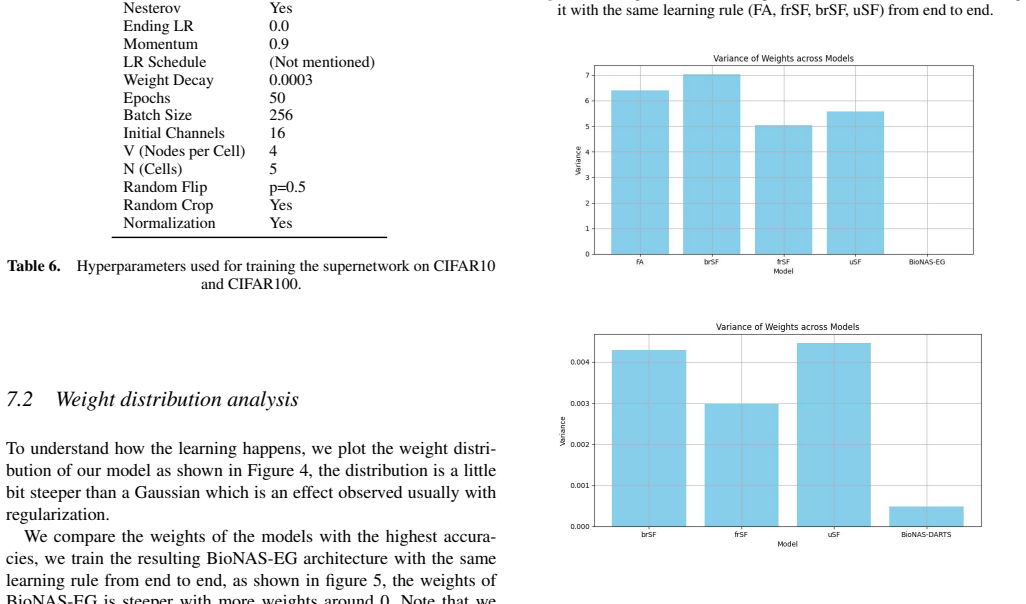
- [Section 4.3, Table 5, Appendix 7.2] The required same-architecture uniform-rule control is missing. Section 4.3 reports that training the searched architecture with a fixed rule yields higher gradient variance, but it gives no numeric test accuracies. Appendix 7.2 says that the BioNAS-EG architecture was trained end-to-end with each single rule, but it reports only weight-distribution and variance plots (Figures 5 and 6), again without accuracies. Table 5 tests random rule assignments but has no uniform-rule row. Consequently, the paper never directly demonstrates that mixing rules, rather than the searched architecture itself, produces the observed accuracy gains.
- [Section 4, Tables 1 and 2] The claim of new records for bio-inspired models is weakened by heterogeneous baselines. In Table 2, SoftHebb and FastHebb are self-supervised, as the authors acknowledge, so the ImageNet comparison (60.51% versus 27.00% and 21.34%) is not a like-for-like supervised record. In Table 1, the single-rule ResNet baselines are not only different architectures but also, for CIFAR-100, trained under a different (150-epoch) protocol. The record claims should be restricted to matched supervised settings or explicitly framed as indicative rather than controlled comparisons.
- [Section 7.4] The theoretical justification is post hoc and does not provide a testable mechanism. Equation (13) defines the mixed update as a weighted sum of rule-specific updates, but no argument is given for why this weighted sum should have lower variance, better landscape exploration, or improved adversarial robustness; the claims in Sections 7.4.1-7.4.3 are qualitative assertions. Since the main text cites this appendix as supporting the empirical results, it should either be made rigorous or explicitly labeled as speculation.
minor comments (4)
- [Section 3.3] The search-space size paragraph says R = 4 learning rules (FA, uSF, brSF, Hebbian), but Section 3.2 and the rule definitions also include frSF and later mention predictive coding; please clarify the exact set of rules in the final search space.
- [Table 4] The table text refers to a 'ResNet-20 trained with standard backpropagation (RN56-BP)', which mixes ResNet20 and ResNet56 naming; use a consistent architecture name.
- [Table 1 footnote] The footnote '*CIFAR-100 values with * were reproduced under our 150-epoch protocol' is ambiguous: it should state precisely which rows and which hyperparameters differ, and whether any CIFAR-10 values were also reproduced under a non-standard protocol.
- [Section 4.2, Table 5] Table 5 reports six random rule assignments with accuracies near 94.8% but gives no standard deviation or number of seeds; adding repeated runs would strengthen the claim that mixed rules are stable regardless of the specific assignment.
Circularity Check
No significant circularity: the paper's accuracy and robustness claims are measured outcomes from an external benchmark protocol; the main weakness is an uncontrolled architecture/budget comparison, which is an experimental-validity issue, not a derivation that assumes its conclusion.
full rationale
Walking the claimed derivation chain, the methods build on standard external NAS frameworks (DARTS, EG-NAS) and the externally released Biotorch package; the search optimizes a validation loss and the headline numbers are obtained by end-to-end training and evaluation, not by fitting a parameter and then renaming that fitted value a prediction. No load-bearing self-citations or imported uniqueness theorems are present. The theoretical discussion in Section 7.4 is qualitative and explicitly non-derivational: Equation 13 defines a weighted combination of rule updates and then asserts that diversity improves optimization, but the paper itself states that 'a complete theoretical formulation and proof is left for future work.' That is post hoc justification, not circularity. The central empirical claim that mixed rules beat a single uniform rule is weakened by confounded comparisons: Table 1 contrasts BioNAS-DARTS (a searched DARTS-style cell, trained for 600 epochs) with ResNet56 single-rule baselines, and CIFAR-100 entries marked with '*' were reproduced under a 150-epoch protocol; the random-assignment analysis in Table 5 lacks a same-architecture uniform-rule accuracy control, and Appendix 7.2 reports weight-distribution plots for same-rule training without numeric accuracies. These are missing-control and comparison-fairness limitations, not cases where an equation is identical to its input or where a fitted parameter is reported as a prediction. The empirical results are self-contained against external benchmarks and external code, so the appropriate circularity score is 0.
Assumptions & free parameters
assumptions (4)
- domain assumption DARTS bi-level optimization remains valid when per-operation weight updates use non-gradient bio-inspired rules such as FA, uSF, brSF, and frSF.
- domain assumption The architecture searched on CIFAR-10 transfers to ImageNet16-120 and full ImageNet without re-searching.
- domain assumption Adversarial robustness comparisons across different attack epsilons and threat models are meaningful.
- domain assumption The random-assignment ablation in Table 5 supports the claim that mixing rules, rather than a specific pattern of rules, drives the benefit.
Cite this review
Pith. "Pith review of Neural Architecture Search with Mixed Bio-inspired Learning Rules." pith.science (2026). https://pith.science/paper/JGYG4U43
@misc{pith2026250713485,
  author       = {Pith},
  title        = {Pith review of: Neural Architecture Search with Mixed Bio-inspired Learning Rules},
  year         = {2026},
  howpublished = {\url{https://pith.science/paper/JGYG4U43}},
  note         = {Machine review of arXiv:2507.13485}
}
read the original abstract
Bio-inspired neural networks are attractive for their adversarial robustness, energy frugality, and closer alignment with cortical physiology, yet they often lag behind back-propagation (BP) based models in accuracy and ability to scale. We show that allowing the use of different bio-inspired learning rules in different layers, discovered automatically by a tailored neural-architecture-search (NAS) procedure, bridges this gap. Starting from standard NAS baselines, we enlarge the search space to include bio-inspired learning rules and use NAS to find the best architecture and learning rule to use in each layer. We show that neural networks that use different bio-inspired learning rules for different layers have better accuracy than those that use a single rule across all the layers. The resulting NN that uses a mix of bio-inspired learning rules sets new records for bio-inspired models: 95.16% on CIFAR-10, 76.48% on CIFAR-100, 43.42% on ImageNet16-120, and 60.51% top-1 on ImageNet. In some regimes, they even surpass comparable BP-based networks while retaining their robustness advantages. Our results suggest that layer-wise diversity in learning rules allows better scalability and accuracy, and motivates further research on mixing multiple bio-inspired learning rules in the same network.
Figures


Figures from the paper (3 more)


Reference graph
Works this paper leans on
- [1]
-
[2]
M. Andriushchenko and M. Hein. Square attack: a query-efficient black-box adversarial attack via random search. European Conference on Computer Vision, pages 484–501, 2020
work page 2020
- [3]
-
[4]
H. Cai, L. Zhu, and S. Han. ProxylessNAS: Direct neural architecture search on target task and hardware. In International Conference on Learning Representations, 2019
work page 2019
-
[5]
Z. Cai, L. Chen, P. Liu, T. Ling, and Y . Lai. Eg-nas: Neural architec- ture search with fast evolutionary exploration. Proceedings of the AAAI Conference on Artificial Intelligence, 38(10):11159–11167, Mar. 2024
work page 2024
-
[6]
X. Chen, L. Xie, J. Wu, and Q. Tian. Progressive differentiable archi- tecture search: Bridging the depth gap between search and evaluation. In Proceedings of the IEEE/CVF international conference on computer vision, pages 1294–1303, 2019
work page 2019
-
[7]
X. Chen, L. Xie, J. Wu, and Q. Tian. Progressive differentiable architec- ture search: Bridging the depth gap between search and evaluation. In Proceedings of the IEEE International Conference on Computer Vision, pages 1294–1303, 2019
work page 2019
-
[8]
X. Chen, R. Wang, M. Cheng, X. Tang, and C.-J. Hsieh. Drnas: Dirich- let neural architecture search. In International Conference on Learning Representations, 2021
work page 2021
Show all 59 references
-
[9]
Chrabaszcz, I
P. Chrabaszcz, I. Loshchilov, and F. Hutter. A downsampled vari- ant of imagenet as an alternative to the cifar datasets. arXiv preprint arXiv:1707.08819, 2017
2017 arXiv
-
[10]
X. Chu, T. Zhou, B. Zhang, and J. Li. Fair darts: Eliminating unfair ad- vantages in differentiable architecture search. In A. Vedaldi, H. Bischof, T. Brox, and J.-M. Frahm, editors, Computer Vision – ECCV 2020 , 2020
2020
-
[11]
Croce and M
F. Croce and M. Hein. Reliable evaluation of adversarial robustness with an ensemble of diverse parameter-free attacks. In International conference on machine learning, pages 2206–2216. PMLR, 2020
2020
-
[12]
Croce, M
F. Croce, M. Andriushchenko, V . Sehwag, E. Debenedetti, N. Flammar- ion, M. Chiang, P. Mittal, and M. Hein. RobustBench: a standardized adversarial robustness benchmark. In Thirty-fifth Conference on Neural Information Processing Systems Datasets and Benchmarks Track, 2021
2021
-
[13]
Dellaferrera and G
G. Dellaferrera and G. Kreiman. Error-driven input modulation: Solv- ing the credit assignment problem without a backward pass, 2023
2023
-
[14]
J. Deng, W. Dong, R. Socher, L.-J. Li, K. Li, and L. Fei-Fei. Imagenet: A large-scale hierarchical image database. In 2009 IEEE conference on computer vision and pattern recognition, pages 248–255. Ieee, 2009
2009
-
[15]
Dong and Y
X. Dong and Y . Yang. One-shot neural architecture search via self- evaluated template network. In Proceedings of the IEEE/CVF Interna- tional Conference on Computer Vision, pages 3681–3690, 2019
2019
-
[16]
Dong and Y
X. Dong and Y . Yang. Searching for a robust neural architecture in four gpu hours. In Proceedings of the IEEE/CVF conference on computer vision and pattern recognition, pages 1761–1770, 2019
2019
-
[17]
Dong and Y
X. Dong and Y . Yang. NAS-Bench-201: Extending the scope of repro- ducible neural architecture search. In ICLR, 2020
2020
-
[18]
Glorot and Y
X. Glorot and Y . Bengio. Understanding the difficulty of training deep feedforward neural networks. In International Conference on Artificial Intelligence and Statistics, 2010
2010
-
[19]
I. J. Goodfellow, J. Shlens, and C. Szegedy. Explaining and harnessing adversarial examples. arXiv preprint arXiv:1412.6572, 2014
2014 arXiv
-
[20]
N. Hansen. The cma evolution strategy: A tutorial. arXiv preprint arXiv:1604.00772, 2016
2016 arXiv
-
[21]
K. He, X. Zhang, S. Ren, and J. Sun. Deep residual learning for image recognition. CoRR, abs/1512.03385, 2015
2015 arXiv
-
[22]
G. Hinton. The forward-forward algorithm: Some preliminary investi- gations, 2022
2022
-
[23]
S. Hu, S. Xie, H. Zheng, C. Liu, J. Shi, X. Liu, and D. Lin. Dsnas: Di- rect neural architecture search without parameter retraining. In 2020 IEEE/CVF Conference on Computer Vision and Pattern Recognition (CVPR), pages 12081–12089, 2020
2020
-
[25]
Huang, B
J. Huang, B. Xue, Y . Sun, M. Zhang, and G. G. Yen. Particle swarm optimization for compact neural architecture search for image classifi- cation. IEEE Transactions on Evolutionary Computation, 27(5):1298– 1312, 2023. doi: 10.1109/TEVC.2022.3217290
2023
-
[26]
Journé, H
A. Journé, H. G. Rodriguez, Q. Guo, and T. Moraitis. Hebbian deep learning without feedback. In The Eleventh International Conference on Learning Representations, 2023
2023
-
[27]
Y . Kim, Y . Li, H. Park, Y . Venkatesha, and P. Panda. Neural architec- ture search for spiking neural networks. In European conference on computer vision, pages 36–56. Springer, 2022
2022
-
[28]
Lagani, C
G. Lagani, C. Gennaro, H. Fassold, and G. Amato. Fasthebb: Scaling hebbian training of deep neural networks to imagenet level. In Similar- ity Search and Applications (SISAP 2022) , pages 251–264, 2022. doi: 10.1007/978-3-031-17849-8_20
2022 doi
-
[29]
Lagani, C
G. Lagani, C. Gennaro, H. Fassold, and G. Amato. Fasthebb: Scal- ing hebbian training of deep neural networks to imagenet level. In T. Skopal, F. Falchi, J. Lokoˇc, M. L. Sapino, I. Bartolini, and M. Patella, editors, Similarity Search and Applications , pages 251–264, Cham,
-
[30]
Q. Liao, J. Leibo, and T. Poggio. How important is weight symmetry in backpropagation? In Proceedings of the AAAI Conference on Artificial Intelligence, volume 30, 2016
2016
-
[31]
T. P. Lillicrap, D. Cownden, D. Tweed, and C. J. Akerman. Ran- dom synaptic feedback weights support error backpropagation for deep learning. Nature Communications, 7(1), 11 2016
2016
-
[32]
H. Liu, K. Simonyan, and Y . Yang. Darts: Differentiable architecture search. arXiv preprint arXiv:1806.09055, 2018
2018 arXiv
-
[33]
Loshchilov and F
I. Loshchilov and F. Hutter. Cma-es for hyperparameter optimization of deep neural networks. arXiv preprint arXiv:1604.07269, 2016
2016 arXiv
-
[34]
Z. Lu, I. Whalen, V . Boddeti, Y . Dhebar, K. Deb, E. Goodman, and W. Banzhaf. Nsga-net: neural architecture search using multi-objective genetic algorithm. In Proceedings of the genetic and evolutionary com- putation conference, pages 419–427, 2019
2019
-
[35]
A. Madry. Towards deep learning models resistant to adversarial at- tacks. arXiv preprint arXiv:1706.06083, 2017
2017 arXiv
-
[36]
Malcolm and J
K. Malcolm and J. Casco-Rodriguez. A comprehensive review of spik- ing neural networks: Interpretation, optimization, efficiency, and best practices, 2023
2023
-
[37]
Marblestone, G
A. Marblestone, G. Wayne, and K. Kording. Toward an integration of deep learning and neuroscience. Frontiers in Computational Neuro- science, 10, 9 2016
2016
-
[38]
Miconi, K
T. Miconi, K. Stanley, and J. Clune. Differentiable plasticity: training plastic neural networks with backpropagation. In International Confer- ence on Machine Learning, pages 3559–3568. PMLR, 2018
2018
-
[39]
Moraitis, D
T. Moraitis, D. Toichkin, A. Journé, Y . Chua, and Q. Guo. Softhebb: Bayesian inference in unsupervised hebbian soft winner-take-all net- works. Neuromorphic Computing and Engineering, 2022
2022
-
[40]
Moraitis, D
T. Moraitis, D. Toichkin, A. Journé, Y . Chua, and Q. Guo. SoftHebb: Bayesian inference in unsupervised Hebbian soft winner-take-all net- works. Neuromorphic computing and engineering, 2022
2022
-
[41]
A. Nøkland. Direct feedback alignment provides learning in deep neu- ral networks. Advances in neural information processing systems , 29, 2016
2016
-
[42]
H. Pham, M. Y . Guan, B. Zoph, Q. V . Le, and J. Dean. Efficient neural architecture search via parameter sharing. In International Conference on Machine Learning, pages 4095–4104, 2018
2018
-
[43]
E. Real, A. Aggarwal, Y . Huang, and Q. V . Le. Regularized evolution for image classifier architecture search. In Proceedings of the aaai con- ference on artificial intelligence, volume 33, pages 4780–4789, 2019
2019
-
[44]
Robbins and S
H. Robbins and S. Monro. A Stochastic Approximation Method. The Annals of Mathematical Statistics, 22(3):400 – 407, 1951. doi: 10.1214/ aoms/1177729586. URL https://doi.org/10.1214/aoms/1177729586
1951
-
[45]
D. E. Rumelhart, G. E. Hinton, and R. J. Williams. Learning repre- sentations by back-propagating errors. Nature, 323(6088):533–536, 10 1986
1986
-
[46]
A. J. Sanfiz and M. Akrout. Benchmarking the accuracy and robustness of feedback alignment algorithms, 2021
2021
-
[47]
A. J. Sanfiz and M. Akrout. Benchmarking the accuracy and robustness of feedback alignment algorithms. arXiv preprint arXiv:2108.13446 , 2021
2021 arXiv
-
[48]
J. Su, D. V . Vargas, and K. Sakurai. One pixel attack for fooling deep neural networks. IEEE Transactions on Evolutionary Computation, 23 (5):828–841, 2019
2019
-
[49]
Szegedy, W
C. Szegedy, W. Zaremba, I. Sutskever, J. Bruna, D. Erhan, I. Goodfel- low, and R. Fergus. Intriguing properties of neural networks. arXiv preprint arXiv:1312.6199, 2013
2013 arXiv
-
[50]
H. Wang, R. Yang, D. Huang, and Y . Wang. idarts: Improving darts by node normalization and decorrelation discretization. IEEE Trans- actions on Neural Networks and Learning Systems , 34(4):1945–1957,
1945
-
[51]
Y . Wu, F. Liu, C.-J. Simon-Gabriel, G. Chrysos, and V . Cevher. Robust NAS under adversarial training: benchmark, theory, and beyond. InThe Twelfth International Conference on Learning Representations, 2024
2024
-
[52]
S. Xie, H. Zheng, C. Liu, and L. Lin. Snas: stochastic neural architecture search. In International Conference on Learning Representations, 2019
2019
-
[53]
Y . Xu, L. Xie, X. Zhang, X. Chen, G.-J. Qi, Q. Tian, and H. Xiong. Pc-darts: Partial channel connections for memory-efficient architecture search. In International Conference on Learning Representations, 2020
2020
-
[54]
J. Yan, Q. Liu, M. Zhang, L. Feng, D. Ma, H. Li, and G. Pan. Efficient spiking neural network design via neural architecture search. Neural Networks, 173:106172, 2024. ISSN 0893-6080
2024
-
[55]
X. Yang, J. Yan, W. Wang, S. Li, B. Hu, and J. Lin. Brain-inspired models for visual object recognition: an overview.Artificial Intelligence Review, 55, 01 2022. doi: 10.1007/s10462-021-10130-z
2022 doi
-
[56]
P. Ye, B. Li, Y . Li, T. Chen, J. Fan, and W. Ouyang. b-darts: Beta-decay regularization for differentiable architecture search. In proceedings of the IEEE/CVF conference on computer vision and pattern recognition, pages 10874–10883, 2022
2022
-
[57]
H. Zhou, M. Yang, J. Wang, and W. Pan. Bayesnas: A bayesian ap- proach for neural architecture search. In International conference on machine learning, pages 7603–7613. PMLR, 2019
2019
-
[58]
X. Zhu, J. Li, Y . Liu, and W. Wang. Robust neural architecture search. arXiv preprint arXiv:2304.02845, 2023. 7 Appendix 7.1 Supernetwork Hyperparameters Table 6 summarizes the hyperparameters used for the supernet- works training for CIFAR10 and CIFAR100. When it comes to Im...
2023 arXiv
-
[2022]
ISBN 978-3-031-17849-8
Springer International Publishing. ISBN 978-3-031-17849-8
-
[2023]
doi: 10.1109/TNNLS.2021.3105698
2021
Reviewed August 6, 2026 · model on record in the stance chip above.
Discussion (0). Continue with ORCID to comment.