REVIEW 3 major objections 3 minor 110 references
Symmetrizing relativistic three-body partial wave amplitudes
T0 review · 3 major / 3 minor · reviewed 2026-08-06 · deepseek-v4-flash
Pith's one-line read The paper shows that spectator-asymmetric three-body partial wave amplitudes can be symmetrized exactly, for arbitrary angular momentum and isospin, using a single set of recoupling coefficients.
desk verdict A serious methods paper that likely completes the spectator-independent amplitude workflow, but the load-bearing derivation in Sec. III was outside the text I could check and is the make-or-break part for refereeing. read the letter →
The pith
A machine-rendered reading of the paper's core claim, the machinery that carries it, and where it could break.
The reading
What carries the argument
The load-bearing identity is Eq. (1), $M^{JP} = \sum_{j',j} R_{j'} M^{JP}_{(j',j)} R_j$, together with the recoupling coefficients $R$. Each $R$ converts a state in which one particle is the spectator and the other two form an angular-momentum projected pair into a linear combination over spectators, combining ordinary angular-momentum recoupling in the spin-orbit basis with isospin recoupling for SU(2). The work these coefficients do is to undo the asymmetry introduced when the integral equations of Ref. [91] were solved: the symmetrized amplitude no longer depends on which particle was called the spectator, while retaining definite $J^P$ and total isospin.
What would settle it
In a model of three equal-mass spinless particles with a known exact symmetric amplitude, compute the asymmetric amplitude by solving the integral equations for all three spectator choices, apply Eq. (1), and compare the three symmetrized results to the exact amplitude; any disagreement means the recoupling is not exact, and the Dalitz symmetry check alone could not distinguish this.
Extended reading notes
Core claim
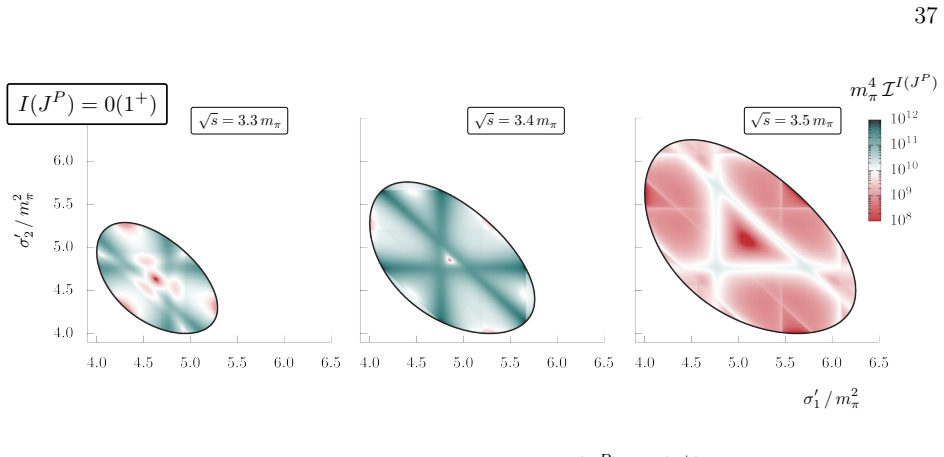
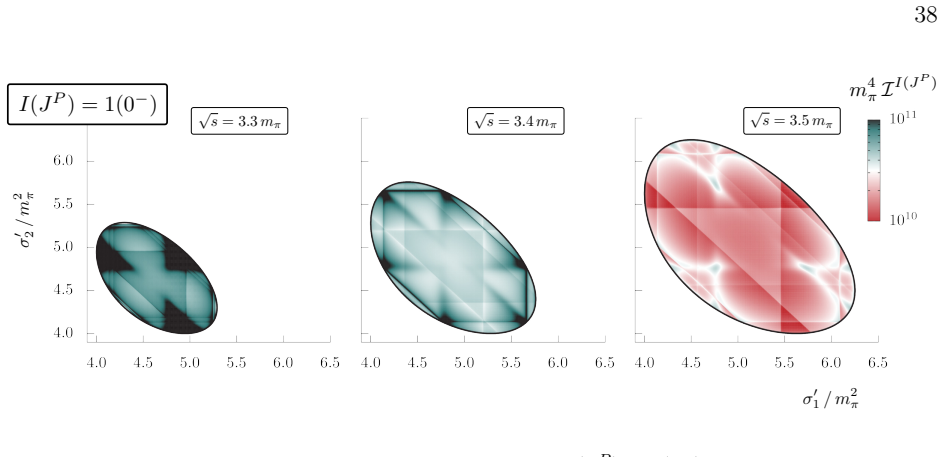
The central claim is that the symmetrized amplitude $M^{JP}$ is obtained from the asymmetric spectator-labeled amplitudes $M^{JP}_{(j',j)}$ by $M^{JP} = \sum_{j',j} R_{j'} M^{JP}_{(j',j)} R_j$, where the $R$'s are recoupling coefficients. The paper derives these coefficients for arbitrary orbital angular momentum and total spin, then extends them to total isospin when the hadrons obey SU(2) flavor symmetry, so the result applies to any system of spinless particles. It also defines an intensity $I^{JP}$ built from the symmetrized amplitude and verifies numerically, in $3\pi$ systems, that the Dalitz distributions produced this way have the symmetries expected of three-body Dalitz plots. The conclusion is that the spectator choice used in defining the asymmetric amplitudes can be removed by kinematics alone, leaving the physical content of the amplitude unchanged.
Load-bearing premise
The construction assumes the spectator-labeled partial wave amplitudes produced by the integral equations form a complete, unambiguous basis, so that the recoupling in Eq. (1) is exact and no dependence on which particle was chosen as the spectator survives.
Editorial extensions
If this is right
- The symmetric amplitude $M^{JP}$ can be computed from the asymmetric amplitudes already produced by the existing integral equations, without solving any new integral equations or supplying new K-matrix input.
- For spinless systems with SU(2) flavor symmetry, the construction works for arbitrary angular momentum, total spin, and total isospin, so it covers the channels relevant to lattice QCD calculations of three pions.
- The proposed intensity $I^{JP}$ gives a direct way to visualize three-body enhancements in Dalitz plots and to compare future lattice results with the expected symmetry properties of the Dalitz region.
- Because the symmetrization is performed before forming observables, poles and couplings extracted from $M^{JP}$ should not depend on spectator conventions, a consistency condition that the earlier asymmetric spectral studies did not impose.
Reading between the lines
- A natural test the paper leaves implicit is to apply the same recoupling to a system of three distinguishable particles with unequal masses; the construction is stated for arbitrary species, and a successful numerical check there would show the spectator cancellation is not an artifact of identical-particle symmetry.
- The symmetrized amplitude could serve as a diagnostic for truncation errors in three-body integral equations: if two different partial-wave truncations produce asymmetric inputs whose symmetrized intensities disagree, that disagreement would expose the truncation rather than physics.
- The intensity observable may be adaptable beyond the lattice context, for example to Dalitz-plot analyses of three-body decays where only a subset of partial waves is measured, although the paper itself develops it for scattering amplitudes.
Editorial analysis
A structured set of objections, weighed in public.
Referee Report
Summary. The paper proposes a method to construct spectator-independent partial wave amplitudes M^{JP} for relativistic three-body scattering by applying recoupling coefficients R to the asymmetric, spectator-labeled amplitudes M^{JP}_{(j',j)} obtained from the integral equations of Ref. [91]. The construction is given in Eq. (1) as a double sum over initial and final spectator labels. The authors claim to derive these coefficients for arbitrary angular momentum and isospin in systems of spinless particles with SU(2) flavor symmetry, propose an intensity observable for visualizing three-body dynamics in Dalitz distributions, and provide numerical examples for 3π systems that, they argue, show consistency with expected Dalitz plot symmetries. The paper is positioned as the final component in a workflow connecting lattice QCD K-matrices to physical observables.
Significance. If the recoupling construction is exact, the paper provides a useful bridge between existing asymmetric-basis integral equation solutions and the spectator-independent amplitudes needed for physical observables, without requiring new dynamical input. The explicit derivation of recoupling coefficients for arbitrary angular momentum and isospin, if correct, would be a technical achievement of general applicability to three-body systems with SU(2) flavor symmetry. The proposed intensity observable and the numerical Dalitz plots for 3π systems would be directly relevant to ongoing and future lattice QCD calculations. The paper is clearly motivated and builds on the authors' own published work (Refs. [22, 91]), which provides a solid foundation. However, the central derivation and the numerical checks are not present in the text available for review, so the significance is conditional on those missing components being sound.
major comments (3)
- [Sec. I, Eq. (1)] The central claim of the paper is that the recoupling sum in Eq. (1) produces the physical, spectator-independent amplitude M^{JP}. In Sec. I this is introduced with the words 'Heuristically, one can do this by introducing recoupling coefficients', and the derivation of R is assigned to Sec. III, which is not present in the text available for review. The load-bearing point is that a change of spectator changes not only the angular momentum coupling but also the Jacobi momentum variables; the paper must demonstrate that the partial-wave projected amplitudes M^{JP}_{(j',j)} satisfy a spectator-recombination identity that makes the sum exact and momentum-independent, rather than a spectator average. The Dalitz symmetry check in Sec. V cannot settle this, because summing over all spectators enforces the symmetry by construction. The authors should state and prove the recombination identity, or explicitly characterize the approximation if the sum is not exact.
- [Sec. II, identical particle symmetry] The construction treats the spectator labels j and j' as independent indices in Eq. (1). For identical particles, such as the 3π systems used in the numerical examples, the asymmetric amplitudes M^{JP}_{(j',j)} for different spectator choices are not independent; they are related by permutation symmetry. The manuscript should explain how Eq. (1) accounts for this symmetry and avoids overcounting, and it should specify the normalization of M^{JP}_{(j',j)} consistently with the partial wave projection defined in Sec. II. Without this clarification, the numerical Dalitz plots may include redundant contributions.
- [Sec. V, numerical checks] The abstract and Sec. I state that the paper provides 'numerical evidence that the symmetrization procedure is consistent with expected symmetries of Dalitz plots', but the actual numerical section is not included in the text available for review. To assess the claim, the authors should provide quantitative criteria for the comparison, including the specific symmetry transformations tested, the tolerances used, and, ideally, a comparison of the symmetrized amplitude against an independent construction or against known three-body constraints. As written, the Dalitz symmetry test appears to be a necessary but not sufficient check of the construction's correctness.
minor comments (3)
- [Sec. I, Fig. 1] The workflow described in Fig. 1 would benefit from a more detailed textual description, since the figure itself is not included in the text provided.
- [Sec. II, notation] The notation M^{JP}_{(j',j)} is introduced but the explicit dependence on the Jacobi momenta and the partial wave projection is not fully spelled out in the available text; a concise symbolic definition would improve readability.
- [Sec. I, observable definition] The intensity observable I^{JP} is described as a 'helicity/channel-average modulus squared' of the symmetrized amplitude; the phrase is vague and should be clarified by a precise formula and a statement of which channels are averaged.
Circularity Check
No significant circularity: Eq. (1) is a stated construction, not a fitted prediction, and the cited prior works are published foundations.
full rationale
The paper's central object is the symmetrized partial-wave amplitude defined by the recoupling sum in Eq. (1), M^{JP} = sum_{j',j} R_{j'} M_{(j',j)}^{JP} R_j. The text presents this as a construction ('Heuristically, one can do this by introducing recoupling coefficients... defined such that...') and states that the recoupling coefficients are derived, not fitted, for arbitrary angular momentum and isospin. No parameter is fitted to data, and the Dalitz-plot comparisons are described as numerical evidence of consistency of the symmetrization procedure, i.e., a self-consistency check of the numerical implementation rather than an independent prediction. The paper relies on the authors' earlier derivations for the one-particle-exchange projection and the asymmetric integral equations (Refs. [22, 91]), but those are published results with stated assumptions and do not assume the symmetrized amplitude constructed here. The definitional nature of Eq. (1) means spectator-permutation symmetry of the intensity is partly inherited from summing over spectators, but this is a limitation on the strength of the consistency check, not a circular derivation of the paper's claimed algebraic result.
Assumptions & free parameters
assumptions (4)
- domain assumption S-matrix unitarity imposes linear integral equations on the three-body amplitude, with a real-meromorphic K matrix as the unspecified input.
- domain assumption The asymmetric spectator-labeled amplitudes M_{(j',j)}^{JP} from Ref. [91] form a complete, unambiguous basis from which the symmetrized amplitude can be composed.
- standard math Standard angular momentum addition and SU(2) recoupling technology (Clebsch-Gordan, 6j, 9j coefficients) are valid for arbitrary pair angular momentum S and spectator orbital angular momentum L.
- domain assumption Finite-volume quantization relations connect lattice QCD spectra to the K matrices.
Cite this review
Pith. "Pith review of Symmetrizing relativistic three-body partial wave amplitudes." pith.science (2026). https://pith.science/paper/KZZ4EP5Z
@misc{pith2026250714098,
  author       = {Pith},
  title        = {Pith review of: Symmetrizing relativistic three-body partial wave amplitudes},
  year         = {2026},
  howpublished = {\url{https://pith.science/paper/KZZ4EP5Z}},
  note         = {Machine review of arXiv:2507.14098}
}
abstract
S matrix principles and symmetries impose constraints on three-particle scattering amplitudes, which can be formulated as a class of integral equations for their partial wave projections. However, these amplitudes are typically expressed in an asymmetric basis, where one of the initial and final state particles is singled out, and all quantum numbers are defined relative to this spectator. In this work, we show how to construct symmetric partial wave amplitudes, which have been symmetrized over all possible spectator combinations, using their asymmetric counterparts and sets of recoupling coefficients. We derive these recoupling coefficients for arbitrary angular momentum and isospin for arbitrary systems of spinless particles with SU(2) flavor symmetry. We propose a simple intensity observable suitable for visualizing the structure of three-body dynamics in Dalitz distributions. Finally, we provide some numerical examples of Dalitz distributions relevant for future lattice QCD calculations of $3\pi$ systems and provide numerical evidence that the symmetrization procedure is consistent with expected symmetries of Dalitz plots.
Figures


Figures from the paper (15 more)




Reference graph
Works this paper leans on
-
[91]
R. A. Brice˜ no, C. S. R. Costa, and A. W. Jackura, Phys. Rev. D 111, 036029 (2025), arXiv:2409.15577 [hep-ph]
arXiv 2025
-
[1]
Navas et al
S. Navas et al. (Particle Data Group), Phys. Rev. D 110, 030001 (2024)
2024
- [2]
-
[3]
R. Aaij et al. (LHCb), Phys. Rev. Lett. 123, 231802 (2019), arXiv:1905.09244 [hep-ex]. 47
arXiv 2019
-
[4]
R. Aaij et al. (LHCb), Phys. Rev. D 108, 012008 (2023), arXiv:2206.07622 [hep-ex]
arXiv 2023
-
[5]
R. Aaij et al. (LHCb), Phys. Rev. D 90, 112004 (2014), arXiv:1408.5373 [hep-ex]
arXiv 2014
-
[6]
R. Aaij et al. (LHCb), Phys. Rev. Lett. 124, 031801 (2020), arXiv:1909.05211 [hep-ex]
arXiv 2020
-
[7]
R. Aaij et al. (LHCb), Phys. Rev. Lett. 112, 011801 (2014), arXiv:1310.4740 [hep-ex]
arXiv 2014
Show all 110 references
-
[8]
Suzuki and L
M. Suzuki and L. Wolfenstein, Phys. Rev. D 60, 074019 (1999), arXiv:hep-ph/9903477
1999 arXiv
-
[9]
Wolfenstein, Phys
L. Wolfenstein, Phys. Rev. D 43, 151 (1991)
1991
- [10]
-
[11]
J. H. Alvarenga Nogueira, I. Bediaga, A. B. R. Cavalcante, T. Frederico, and O. Louren¸ co, Phys. Rev. D 92, 054010 (2015), arXiv:1506.08332 [hep-ph]
2015 arXiv
-
[12]
Bediaga, T
I. Bediaga, T. Frederico, and O. Louren¸ co, Phys. Rev. D89, 094013 (2014), arXiv:1307.8164 [hep-ph]
2014 arXiv
-
[13]
R. A. Garrote, J. Cuervo, P. C. Magalh˜ aes, and J. R. Pel´ aez, Phys. Rev. Lett.130, 201901 (2023), arXiv:2210.08354 [hep-ph]
2023
-
[14]
R. A. Briceno, J. J. Dudek, and R. D. Young, Rev. Mod. Phys. 90, 025001 (2018), arXiv:1706.06223 [hep-lat]
2018 arXiv
-
[15]
M. T. Hansen and S. R. Sharpe, Annual Review of Nuclear and Particle Science 69, null (2019), arXiv:1901.00483 [hep-lat]
2019 arXiv
-
[16]
M. Mai, M. D¨ oring, and A. Rusetsky, Eur. Phys. J. ST 230, 1623 (2021), arXiv:2103.00577 [hep-lat]
2021 arXiv
-
[17]
Jackura, C
A. Jackura, C. Fern´ andez-Ram ´ ırez, V. Mathieu, M. Mikhasenko, J. Nys, A. Pilloni, K. Salda˜ na, N. Sherrill, and A. Szczepaniak (JPAC), Eur. Phys. J. C 79, 56 (2019), arXiv:1809.10523 [hep-ph]
2019 arXiv
-
[18]
M. T. Hansen and S. R. Sharpe, Phys. Rev. D92, 114509 (2015), arXiv:1504.04248 [hep-lat]
2015 arXiv
-
[19]
S. M. Dawid, M. H. E. Islam, and R. A. Brice˜ no, Phys. Rev. D 108, 034016 (2023), arXiv:2303.04394 [nucl-th]
2023 arXiv
-
[20]
S. M. Dawid, M. H. E. Islam, R. A. Brice˜ no, and A. W. Jackura, (2023), arXiv:2309.01732 [nucl-th]
2023 arXiv
-
[21]
A. W. Jackura, R. A. Brice˜ no, S. M. Dawid, M. H. E. Islam, and C. McCarty, Phys. Rev. D 104, 014507 (2021), arXiv:2010.09820 [hep-lat]
2021 arXiv
-
[22]
A. W. Jackura and R. A. Brice˜ no, Phys. Rev. D109, 096030 (2024), arXiv:2312.00625 [hep- ph]. 48
2024 arXiv
-
[23]
A. W. Jackura, Phys. Rev. D 108, 034505 (2023), arXiv:2208.10587 [hep-lat]
2023 arXiv
-
[24]
M. Mai, B. Hu, M. Doring, A. Pilloni, and A. Szczepaniak, Eur. Phys. J. A 53, 177 (2017), arXiv:1706.06118 [nucl-th]
2017 arXiv
-
[25]
Mikhasenko, Y
M. Mikhasenko, Y. Wunderlich, A. Jackura, V. Mathieu, A. Pilloni, B. Ketzer, and A. Szczepaniak, JHEP 08, 080 (2019), arXiv:1904.11894 [hep-ph]
2019 arXiv
-
[26]
S. M. Dawid and A. P. Szczepaniak, Phys. Rev. D 103, 014009 (2021), arXiv:2010.08084 [nucl-th]
2021 arXiv
-
[27]
Y. Feng, F. Gil, M. D¨ oring, R. Molina, M. Mai, V. Shastry, and A. Szczepaniak, Phys. Rev. D 110, 094002 (2024), arXiv:2407.08721 [nucl-th]
2024 arXiv
-
[28]
Polejaeva and A
K. Polejaeva and A. Rusetsky, Eur. Phys. J. A48, 67 (2012), arXiv:1203.1241 [hep-lat]
2012 arXiv
-
[29]
R. A. Brice˜ no and Z. Davoudi, Phys. Rev. D87, 094507 (2013), arXiv:1212.3398 [hep-lat]
2013 arXiv
-
[30]
Luscher, Commun
M. Luscher, Commun. Math. Phys. 104, 177 (1986)
1986
-
[31]
Luscher, Commun.Math.Phys
M. Luscher, Commun.Math.Phys. 105, 153 (1986)
1986
-
[32]
Luscher, Nucl
M. Luscher, Nucl. Phys. B354, 531 (1991)
1991
-
[33]
Rummukainen and S
K. Rummukainen and S. A. Gottlieb, Nucl. Phys. B450, 397 (1995), arXiv:hep-lat/9503028 [hep-lat]
1995 arXiv
-
[34]
C. h. Kim, C. T. Sachrajda, and S. R. Sharpe, Nucl. Phys. B727, 218 (2005), arXiv:hep- lat/0507006 [hep-lat]
2005
-
[35]
S. He, X. Feng, and C. Liu, JHEP 07, 011 (2005), arXiv:hep-lat/0504019 [hep-lat]
2005 arXiv
-
[36]
M. T. Hansen and S. R. Sharpe, Phys. Rev. D86, 016007 (2012), arXiv:1204.0826 [hep-lat]
2012 arXiv
-
[37]
R. A. Brice˜ no and Z. Davoudi, Phys. Rev. D88, 094507 (2013), arXiv:1204.1110 [hep-lat]
2013 arXiv
-
[38]
R. A. Brice˜ no, Z. Davoudi, and T. C. Luu, Phys. Rev. D88, 034502 (2013), arXiv:1305.4903 [hep-lat]
2013 arXiv
-
[39]
R. A. Brice˜ no, Phys. Rev.D89, 074507 (2014), arXiv:1401.3312 [hep-lat]
2014 arXiv
-
[40]
M. T. Hansen and S. R. Sharpe, Phys. Rev. D90, 116003 (2014), arXiv:1408.5933 [hep-lat]
2014 arXiv
-
[41]
R. A. Briceno, M. T. Hansen, and S. R. Sharpe, Phys. Rev. D95, 074510 (2017), arXiv:1701.07465 [hep-lat]
2017 arXiv
-
[42]
R. A. Brice˜ no, M. T. Hansen, and S. R. Sharpe, Phys. Rev. D98, 014506 (2018), arXiv:1803.04169 [hep-lat]
2018 arXiv
-
[43]
R. A. Briceno, M. T. Hansen, and S. R. Sharpe, Phys. Rev. D99, 014516 (2019), arXiv:1810.01429 [hep-lat]. 49
2019 arXiv
-
[44]
R. A. Brice˜ no, M. T. Hansen, S. R. Sharpe, and A. P. Szczepaniak, Phys. Rev. D 100, 054508 (2019), arXiv:1905.11188 [hep-lat]
2019 arXiv
-
[45]
T. D. Blanton, F. Romero-L´ opez, and S. R. Sharpe, JHEP 03, 106 (2019), arXiv:1901.07095 [hep-lat]
2019 arXiv
-
[46]
M. T. Hansen, F. Romero-L´ opez, and S. R. Sharpe, JHEP 07, 047 (2020), [Erratum: JHEP 02, 014 (2021)], arXiv:2003.10974 [hep-lat]
2020 arXiv
-
[47]
T. D. Blanton and S. R. Sharpe, Phys. Rev. D102, 054520 (2020), arXiv:2007.16188 [hep-lat]
2020 arXiv
-
[48]
Hammer, J.-Y
H.-W. Hammer, J.-Y. Pang, and A. Rusetsky, JHEP 09, 109 (2017), arXiv:1706.07700 [hep-lat]
2017 arXiv
-
[49]
H. W. Hammer, J. Y. Pang, and A. Rusetsky, JHEP 10, 115 (2017), arXiv:1707.02176 [hep-lat]
2017 arXiv
-
[50]
Y. Meng, C. Liu, U.-G. Meißner, and A. Rusetsky, Phys. Rev. D 98, 014508 (2018), arXiv:1712.08464 [hep-lat]
2018 arXiv
-
[51]
Pang, J.-J
J.-Y. Pang, J.-J. Wu, H. W. Hammer, U.-G. Meißner, and A. Rusetsky, Phys. Rev. D 99, 074513 (2019), arXiv:1902.01111 [hep-lat]
2019 arXiv
-
[52]
M¨ uller, J.-Y
F. M¨ uller, J.-Y. Pang, A. Rusetsky, and J.-J. Wu, JHEP 02, 158 (2022), arXiv:2110.09351 [hep-lat]
2022 arXiv
-
[53]
T. D. Blanton and S. R. Sharpe, Phys. Rev. D103, 054503 (2021), arXiv:2011.05520 [hep-lat]
2021 arXiv
-
[54]
T. D. Blanton and S. R. Sharpe, Phys. Rev. D104, 034509 (2021), arXiv:2105.12094 [hep-lat]
2021 arXiv
-
[55]
M. T. Hansen, F. Romero-L´ opez, and S. R. Sharpe, JHEP 06, 051 (2024), arXiv:2401.06609 [hep-lat]
2024 arXiv
-
[56]
A. B. Raposo and M. T. Hansen, JHEP 08, 075 (2024), arXiv:2311.18793 [hep-lat]
2024 arXiv
-
[57]
A. B. Raposo, R. A. Brice˜ no, M. T. Hansen, and A. W. Jackura, JHEP 06, 186 (2025), arXiv:2502.19375 [hep-lat]
2025 arXiv
-
[58]
Detmold, M
W. Detmold, M. J. Savage, A. Torok, S. R. Beane, T. C. Luu, K. Orginos, and A. Parreno, Phys. Rev. D 78, 014507 (2008), arXiv:0803.2728 [hep-lat]
2008 arXiv
-
[59]
Culver, M
C. Culver, M. Mai, R. Brett, A. Alexandru, and M. D¨ oring, Phys. Rev. D 101, 114507 (2020), arXiv:1911.09047 [hep-lat]
2020 arXiv
-
[60]
Alexandru, R
A. Alexandru, R. Brett, C. Culver, M. D¨ oring, D. Guo, F. X. Lee, and M. Mai, Phys. Rev. D 102, 114523 (2020), arXiv:2009.12358 [hep-lat]
2020 arXiv
-
[61]
M. T. Hansen, R. A. Brice˜ no, R. G. Edwards, C. E. Thomas, and D. J. Wilson (Hadron 50 Spectrum), Phys. Rev. Lett. 126, 012001 (2021), arXiv:2009.04931 [hep-lat]
2021 arXiv
-
[62]
Z. T. Draper, A. D. Hanlon, B. H¨ orz, C. Morningstar, F. Romero-L´ opez, and S. R. Sharpe, JHEP 05, 137 (2023), arXiv:2302.13587 [hep-lat]
2023 arXiv
-
[63]
J. J. Dudek, R. G. Edwards, M. J. Peardon, D. G. Richards, and C. E. Thomas, Phys. Rev. D83, 071504 (2011), arXiv:1011.6352 [hep-ph]
2011 arXiv
-
[64]
Pelissier and A
C. Pelissier and A. Alexandru, Phys. Rev. D87, 014503 (2013), arXiv:1211.0092 [hep-lat]
2013 arXiv
-
[65]
J. J. Dudek, R. G. Edwards, and C. E. Thomas (Hadron Spectrum), Phys. Rev. D87, 034505 (2013), [Erratum: Phys. Rev.D90,no.9,099902(2014)], arXiv:1212.0830 [hep-ph]
2013 arXiv
-
[66]
L. Liu, K. Orginos, F.-K. Guo, C. Hanhart, and U.-G. Meissner, Phys. Rev. D87, 014508 (2013), arXiv:1208.4535 [hep-lat]
2013 arXiv
-
[67]
D. J. Wilson, J. J. Dudek, R. G. Edwards, and C. E. Thomas, Phys. Rev. D91, 054008 (2015), arXiv:1411.2004 [hep-ph]
2015 arXiv
-
[68]
J. J. Dudek, R. G. Edwards, C. E. Thomas, and D. J. Wilson (Hadron Spectrum), Phys. Rev. Lett. 113, 182001 (2014), arXiv:1406.4158 [hep-ph]
2014 arXiv
-
[69]
C. B. Lang, D. Mohler, S. Prelovsek, and R. M. Woloshyn, Phys. Lett. B750, 17 (2015), arXiv:1501.01646 [hep-lat]
2015 arXiv
-
[70]
D. J. Wilson, R. A. Brice˜ no, J. J. Dudek, R. G. Edwards, and C. E. Thomas, Phys. Rev. D92, 094502 (2015), arXiv:1507.02599 [hep-ph]
2015 arXiv
-
[71]
J. J. Dudek, R. G. Edwards, and D. J. Wilson (Hadron Spectrum), Phys. Rev. D93, 094506 (2016), arXiv:1602.05122 [hep-ph]
2016 arXiv
-
[72]
R. A. Brice˜ no, J. J. Dudek, R. G. Edwards, and D. J. Wilson, Phys. Rev. Lett. 118, 022002 (2017), arXiv:1607.05900 [hep-ph]
2017 arXiv
-
[73]
G. Moir, M. Peardon, S. M. Ryan, C. E. Thomas, and D. J. Wilson, JHEP 10, 011 (2016), arXiv:1607.07093 [hep-lat]
2016 arXiv
-
[74]
Bulava, B
J. Bulava, B. Fahy, B. Horz, K. J. Juge, C. Morningstar, and C. H. Wong, Nucl. Phys. B910, 842 (2016), arXiv:1604.05593 [hep-lat]
2016 arXiv
-
[75]
B. Hu, R. Molina, M. Doring, and A. Alexandru, Phys. Rev. Lett. 117, 122001 (2016), arXiv:1605.04823 [hep-lat]
2016 arXiv
-
[76]
Alexandrou, L
C. Alexandrou, L. Leskovec, S. Meinel, J. Negele, S. Paul, M. Petschlies, A. Pochinsky, G. Rendon, and S. Syritsyn, Phys. Rev. D96, 034525 (2017), arXiv:1704.05439 [hep-lat]
2017 arXiv
-
[77]
G. S. Bali, S. Collins, A. Cox, and A. Sch¨ afer, Phys. Rev. D96, 074501 (2017), 51 arXiv:1706.01247 [hep-lat]
2017 arXiv
-
[78]
M. L. Wagman, F. Winter, E. Chang, Z. Davoudi, W. Detmold, K. Orginos, M. J. Savage, and P. E. Shanahan, Phys. Rev. D96, 114510 (2017), arXiv:1706.06550 [hep-lat]
2017 arXiv
-
[79]
C. W. Andersen, J. Bulava, B. Horz, and C. Morningstar, Phys. Rev. D97, 014506 (2018), arXiv:1710.01557 [hep-lat]
2018 arXiv
-
[80]
R. A. Briceno, J. J. Dudek, R. G. Edwards, and D. J. Wilson, Phys. Rev. D97, 054513 (2018), arXiv:1708.06667 [hep-lat]
2018 arXiv
-
[81]
A. Woss, C. E. Thomas, J. J. Dudek, R. G. Edwards, and D. J. Wilson, JHEP 07, 043 (2018), arXiv:1802.05580 [hep-lat]
2018 arXiv
-
[82]
Brett, J
R. Brett, J. Bulava, J. Fallica, A. Hanlon, B. Horz, and C. Morningstar, Nucl. Phys. B932, 29 (2018), arXiv:1802.03100 [hep-lat]
2018 arXiv
-
[83]
M. Mai, C. Culver, A. Alexandru, M. D¨ oring, and F. X. Lee, Phys. Rev. D 100, 114514 (2019), arXiv:1908.01847 [hep-lat]
2019 arXiv
-
[84]
A. J. Woss, C. E. Thomas, J. J. Dudek, R. G. Edwards, and D. J. Wilson, Phys. Rev. D 100, 054506 (2019), arXiv:1904.04136 [hep-lat]
2019 arXiv
-
[85]
D. J. Wilson, R. A. Briceno, J. J. Dudek, R. G. Edwards, and C. E. Thomas, Phys. Rev. Lett. 123, 042002 (2019), arXiv:1904.03188 [hep-lat]
2019 arXiv
-
[86]
G. K. C. Cheung, C. E. Thomas, D. J. Wilson, G. Moir, M. Peardon, and S. M. Ryan (Hadron Spectrum), JHEP 02, 100 (2021), arXiv:2008.06432 [hep-lat]
2021 arXiv
-
[87]
Rendon, L
G. Rendon, L. Leskovec, S. Meinel, J. Negele, S. Paul, M. Petschlies, A. Pochinsky, G. Silvi, and S. Syritsyn, Phys. Rev. D 102, 114520 (2020), arXiv:2006.14035 [hep-lat]
2020 arXiv
-
[88]
A. J. Woss, J. J. Dudek, R. G. Edwards, C. E. Thomas, and D. J. Wilson (Hadron Spectrum), Phys. Rev. D 103, 054502 (2021), arXiv:2009.10034 [hep-lat]
2021 arXiv
-
[89]
H¨ orzet al., Phys
B. H¨ orzet al., Phys. Rev. C 103, 014003 (2021), arXiv:2009.11825 [hep-lat]
2021 arXiv
-
[90]
S. M. Dawid, Z. T. Draper, A. D. Hanlon, B. H¨ orz, C. Morningstar, F. Romero-L´ opez, S. R. Sharpe, and S. Skinner, (2025), arXiv:2502.17976 [hep-lat]
2025 arXiv
-
[92]
D. A. Varshalovich, A. N. Moskalev, and V. K. Khersonskii, Quantum Theory of Angular Momentum (World Scientific, Singapore, 1988)
1988
-
[93]
Byckling and K
E. Byckling and K. Kajantie, Particle Kinematics, A Wiley-Interscience publication (Wiley, 52 1973)
1973
-
[94]
T. W. B. Kibble, Phys. Rev. 117, 1159 (1960)
1960
-
[95]
S. M. Berman and M. Jacob, Phys. Rev. 139, B1023 (1965)
1965
-
[96]
Mikhasenko et al
M. Mikhasenko et al. (JPAC), Phys. Rev. D 101, 034033 (2020), arXiv:1910.04566 [hep-ph]
2020 arXiv
-
[97]
Jacob and G
M. Jacob and G. C. Wick, Annals Phys. 7, 404 (1959)
1959
-
[98]
R. A. Brice˜ no, A. W. Jackura, D. A. Pefkou, and F. Romero-L´ opez, JHEP05, 279 (2024), arXiv:2402.12167 [hep-lat]
2024 arXiv
-
[99]
Weinberg, The Quantum Theory of Fields
S. Weinberg, The Quantum Theory of Fields. Vol. 1: Foundations(Cambridge University Press, 2005)
2005
-
[101]
V. S. Potapov and J. R. Taylor, (1977)
1977
-
[102]
A. D. Martin and T. D. Spearman, Elementary-particle theory(North-Holland, Amsterdam, 1970)
1970
-
[103]
Von Hippel and C
F. Von Hippel and C. Quigg, Phys. Rev. D 5, 624 (1972)
1972
-
[104]
Estabrooks and A
P. Estabrooks and A. D. Martin, Nucl. Phys. B 95, 322 (1975)
1975
-
[105]
S. D. Protopopescu, M. Alston-Garnjost, A. Barbaro-Galtieri, S. M. Flatte, J. H. Friedman, T. A. Lasinski, G. R. Lynch, M. S. Rabin, and F. T. Solmitz, Phys. Rev. D 7, 1279 (1973)
1973
-
[106]
J. R. Pelaez and F. J. Yndurain, Phys. Rev. D 71, 074016 (2005), arXiv:hep-ph/0411334
2005 arXiv
-
[107]
J. J. Dudek, R. G. Edwards, and C. E. Thomas, Phys. Rev. D86, 034031 (2012), arXiv:1203.6041 [hep-ph]
2012 arXiv
-
[108]
Zemach, Phys
C. Zemach, Phys. Rev. 133, B1201 (1964)
1964
-
[109]
Z. T. Draper, M. T. Hansen, F. Romero-L´ opez, and S. R. Sharpe, JHEP 07, 226 (2023), arXiv:2303.10219 [hep-lat]
2023 arXiv
-
[110]
Adolph et al
C. Adolph et al. (COMPASS), Phys. Rev. D 95, 032004 (2017), arXiv:1509.00992 [hep-ex]
2017 arXiv
-
[111]
Aghasyan et al.(COMPASS), Phys
M. Aghasyan et al.(COMPASS), Phys. Rev. D98, 092003 (2018), arXiv:1802.05913 [hep-ex]
2018 arXiv
Reviewed August 6, 2026 · model on record in the stance chip above.
Discussion (0). Sign in to comment.