REVIEW 2 major objections 4 minor 82 references
Hyper-spectral Unmixing algorithms for remote compositional surface mapping: a review of the state of the art
T0 review · 2 major / 4 minor · reviewed 2026-08-06 · deepseek-v4-flash
Pith's one-line read This review organizes hyper-spectral unmixing — recovering minerals and their proportions from remote images — and concludes its open problems are statistical: untested assumptions, no uncertainty quantification, no transfer learning.
desk verdict A reliable classical-review core with an honest but unsubstantiated 'state of the art' claim: the deep-learning section stops around 2019 and no selection criteria are given. read the letter →
The pith
A machine-rendered reading of the paper's core claim, the machinery that carries it, and where it could break.
The reading
What carries the argument
The organizing object is the linear mixing model $Y = MX + W$, in which the hyperspectral image $Y$ is written as a product of an end-member (mixing) matrix $M$ and an abundance matrix $X$ plus noise $W$, with the abundances constrained to be nonnegative and to sum to one. Its geometric content is the identification of end members with the vertices of a simplex in reflectance space, which the review turns into a taxonomy: the number of end members is estimated by eigen-thresholding routines such as HySime, the vertices are found by pure-pixel algorithms (VCA, N-FINDR) or minimum-volume simplices (MVC-NMF, SISAL), and abundances follow from least squares. The same formulation carries the alternative workflows, since sparse unmixing reuses it with a spectral library in place of $M$ and sparsity penalties, while nonlinear extensions (bilinear, multilinear, Hapke, kernel methods) are described as relaxations of the same additive scheme.
What would settle it
An independent systematic review of the hyperspectral-unmixing literature with explicit inclusion criteria would settle the representativeness claim: if it turned up a substantial number of widely used methods, libraries, or image cubes absent from this survey, the claim of covering the most successful and relevant state of the art would be shown incomplete. A simpler check is bibliometric: if the methods the paper promotes are not among the most-cited in the past decade, the selection is not representative.
Extended reading notes
Core claim
The paper claims that hyper-spectral unmixing reduces to a well-defined inverse problem that the field solves with a dominant template: under the linear mixing model each pixel spectrum is a convex combination of end-member spectra, so end members are the vertices of a data simplex and abundances are obtained by (fully) constrained least squares. Around this template the review organizes the most successful algorithms, from pure-pixel simplex methods such as VCA to minimum-volume and Bayesian alternatives, together with sparse unmixing that swaps extraction for spectral libraries and nonlinear models for intimate and multilayered mixing. The review's own assessment is that the decisive open problems are statistical rather than algorithmic, and it identifies uncertainty quantification, testing of model assumptions, and transfer learning as the gaps that future research should fill.
Load-bearing premise
The review's claim to cover the most successful methods and the most important datasets rests on the authors' informal selection: no systematic search or inclusion criteria are described, so another team could survey different methods and arrive at different open problems.
Editorial extensions
If this is right
- The pure-pixel hypothesis underpins the most popular end-member extractors, so scenes with low spatial resolution or intimate mixing are where those methods should be expected to fail.
- Switching from end-member extraction to a spectral library moves the difficulty into library preprocessing and mutual coherence, which is why spatial-regularized and collaborative sparse variants were introduced.
- The nonlinear models that matter in practice — bilinear, multilinear, and Hapke-based intimate mixing — mostly assume end members are known, limiting their use when spectra must be guessed from data.
- AVIRIS Cuprite, with USGS ground-truth maps, is the reference testbed for Earth, while CRISM and OMEGA Mars images serve the planetary case, so progress claims should be judged against these.
- The review's recommended directions — uncertainty quantification, statistical tests of assumptions, and transfer learning — are concrete enough to guide method development beyond yet another extraction algorithm.
Reading between the lines
- A direct way to test the review's diagnosis would be to run one well-known extractor (e.g., VCA) and one minimum-volume method on the same Cuprite scene and measure how much abundance maps differ when the pure-pixel and linear assumptions are relaxed; the review compares methods descriptively but runs no such benchmark.
- The transfer-learning recommendation points toward a concrete product the review does not build: a network pre-trained on the surveyed cubes and libraries that outputs abundance maps with error bars and is fine-tuned on a new planetary image; the ingredients, such as autoencoders and spatial Bayesian networks, are all cited.
- Because only Cuprite and a few other scenes have ground truth, the field's validation bottleneck might be addressed by a shared benchmark of synthetic scenes with known compositions and controlled mixing types, a step beyond the real-cube list the review compiles.
- If uncertainty quantification becomes standard, composition maps would carry per-pixel error bars, which would change how planetary missions decide where to look; that consequence is implicit in the review's recommendations but not stated.
Editorial analysis
A structured set of objections, weighed in public.
Referee Report
Summary. The paper is a narrative review of hyperspectral unmixing (HU) for remote compositional surface mapping of the Earth and other solid bodies. It formulates the linear mixing model and its constrained least-squares solutions, describes endmember extraction and abundance estimation (VCA, N-FINDR, minimum-volume NMF, Bayesian methods, sparse unmixing with SUnSAL), covers bilinear, multilinear, Hapke-based intimate mixing and kernelized nonlinear methods, discusses spectral variability and early neural-network unmixing, surveys spectral libraries and hyperspectral cubes (AVIRIS Cuprite, CRISM, OMEGA, and others), and closes with open problems and research recommendations. No new algorithms, experiments, or data are presented; the content is explicitly attributed to the cited literature.
Significance. If the coverage is accepted as representative, the review is a useful and generally faithful synthesis: the mathematical descriptions of the mixing models and optimization problems are accurate, the dataset survey is well organized, the comparative tables provide a quick orientation, and the recommendations on uncertainty quantification, model diagnostics, and transfer learning are concrete and actionable. The main risk is the gap between the claimed scope (a detailed, up-to-date review of the state of the art including the most recent methodologies) and the actual coverage, which is strongest for classical and early alternative methods and weakest for the post-2019 deep-unmixing literature.
major comments (2)
- [§4.3] The neural-network subsection is not current relative to the review's stated scope. The only HU-specific deep architectures discussed are a 2018 linear autoencoder [52], DAEN from 2019 [53], and a 2018 CNN [54]; the later references cited in this subsection ([55]-[59]) concern remote-sensing tasks other than unmixing, and the text states that incorporating such architectures into HU is a 'critical research direction.' This is inconsistent with the abstract and Section 1 claims of covering 'the most recent methodologies' and the state of the art, because a substantial 2020-2025 HU deep-unmixing literature now exists, including transformer-based models, advanced autoencoder/spectral-variability architectures, and deep sparse-unmixing methods. The authors should either expand this subsection to include that literature or explicitly narrow the scope and recast the neural-network part as an outlook rather than a description of the current state of the art.
- [§1] The selection procedure is not described. The introduction states that the objective is 'to perform a selection of the most successful ones,' but no inclusion criteria, search databases, time window, or screening method are given. The absence of such criteria makes it impossible for the reader to distinguish a considered omission from an oversight, and it weakens the load-bearing claim of representativeness. Please add a short paragraph describing how the reviewed methods and datasets were selected, or revise the title/abstract claims to present the work as a selective rather than comprehensive state-of-the-art review.
minor comments (4)
- [§3.1 and elsewhere] The abundance non-negativity and sum constraints are referred to as '(3.1)' in several places, but the constraints are not numbered in the display equations; please add equation numbers or use textual references.
- [§3.1, Eq. (6)] The text says 'where ∥·∥q is the q-norm,' but equation (6) uses ∥·∥2; the notation should be harmonized.
- [§6.1] There are several typos, including 'in that sinterdisciplinaryiplinary problem' (should be 'interdisciplinary'), 'Antother key library' in §5.1, 'downs caled' in the caption of Figure 4, and 'Endbember extraction' in Table 2.
- [§4.1] The phrase 'the spectral gathering phase is carried out differently' is unclear; a short explanation of what this phase is would improve readability.
Circularity Check
No significant circularity: the review derives no results and fits no parameters; all technical content is attributed to external literature.
full rationale
This paper is a narrative review of hyper-spectral unmixing methods, datasets, and open problems. It contains no derivation chain of its own, no fitted parameters, and no prediction that could reduce to its inputs. The technical content, including the linear mixing model, VCA, minimum-volume methods, SUnSAL, bilinear models, Hapke's model, and neural-network unmixers, is explicitly attributed to the cited external references, and the review's own contributions are limited to organizing, comparing, and recommending research directions. The recommendations (uncertainty quantification, model diagnostics, transfer learning) are explicitly framed as open problems and suggestions, not as results derived from data. There are no self-citations by the present authors that carry any load-bearing role, and no definitional or fitted-input circularity is present. The concern that the selection of methods is not justified by explicit inclusion criteria and that some recent deep-unmixing literature is omitted is a comprehensiveness and correctness risk, not a form of circularity. Accordingly, the circularity score is 0.
Assumptions & free parameters
assumptions (1)
- domain assumption The cited literature is accurately summarized, and the selected methods and datasets are representative of the field.
Cite this review
Pith. "Pith review of Hyper-spectral Unmixing algorithms for remote compositional surface mapping: a review of the state of the art." pith.science (2026). https://pith.science/paper/WAFFMAFU
@misc{pith2026250714260,
  author       = {Pith},
  title        = {Pith review of: Hyper-spectral Unmixing algorithms for remote compositional surface mapping: a review of the state of the art},
  year         = {2026},
  howpublished = {\url{https://pith.science/paper/WAFFMAFU}},
  note         = {Machine review of arXiv:2507.14260}
}
read the original abstract
This work concerns a detailed review of data analysis methods used for remotely sensed images of large areas of the Earth and of other solid astronomical objects. In detail, it focuses on the problem of inferring the materials that cover the surfaces captured by hyper-spectral images and estimating their abundances and spatial distributions within the region. The most successful and relevant hyper-spectral unmixing methods are reported as well as compared, as an addition to analysing the most recent methodologies. The most important public data-sets in this setting, which are vastly used in the testing and validation of the former, are also systematically explored. Finally, open problems are spotlighted and concrete recommendations for future research are provided.
Figures


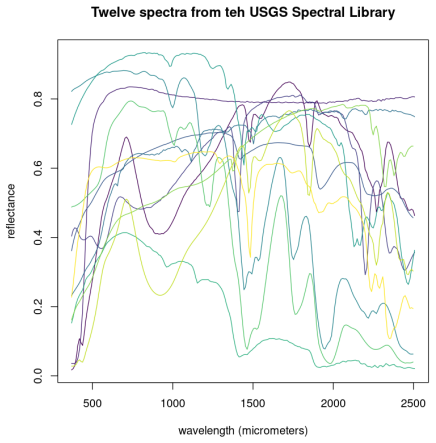
Figures from the paper (1 more)

Reference graph
Works this paper leans on
-
[52]
B. Palsson, J. Sigurdsson, J. R. Sveinsson, M. O. Ulfarsson, Hyper- spectral unmixing using a neural network autoencoder, IEEE Access 6 (2018) 25646–25656
work page 2018
-
[53]
Y. Su, J. Li, A. Plaza, A. Marinoni, P. Gamba, S. Chakravortty, Daen: Deep autoencoder networks for hyperspectral unmixing, IEEE Transac- tions on Geoscience and Remote Sensing 57 (2019) 4309–4321
work page 2019
- [54]
-
[55]
C. Li, B. Zhang, D. Hong, J. Zhou, G. Vivone, S. Li, J. Chanussot, Casformer: Cascaded transformers for fusion-aware computational hyperspectral imaging, Information Fusion 108 (2024) 102408. URL: https://www.sciencedirect.com/science/article/pii/S1566253524001866. doi:https://doi.org/10.1016/j.inffus.2024.102408
arXiv 2024
- [59]
-
[1]
G. A. Shaw, H. K. Burke, Spectral imaging for remote sensing, Lincoln laboratory journal 14 (2003) 3–28
2003
-
[2]
J. M. Bioucas-Dias, A. Plaza, N. Dobigeon, M. Parente, Q. Du, P. Gader, J. Chanussot, Hyperspectral unmixing overview: Geometrical, statisti- cal, and sparse regression-based approaches, IEEE journal of selected topics in applied earth observations and remote sensing 5 (2012) 354– 379. 32
2012
-
[3]
J. Broadwater, A. Banerjee, A generalized kernel for areal and intimate mixtures, in: 2010 2nd Workshop on Hyperspectral Image and Signal Processing: Evolution in Remote Sensing, IEEE, 2010, pp. 1–4
work page 2010
Show all 82 references
-
[4]
Heylen, M
R. Heylen, M. Parente, P. Gader, A review of nonlinear hyperspectral unmixing methods, IEEE Journal of Selected Topics in Applied Earth Observations and Remote Sensing 7 (2014) 1844–1868
2014
-
[5]
Ghamisi, N
P. Ghamisi, N. Yokoya, J. Li, W. Liao, S. Liu, J. Plaza, B. Rasti, A. Plaza, Advances in hyperspectral image and signal processing: A comprehensive overview of the state of the art, IEEE Geoscience and Remote Sensing Magazine 5 (2017) 37–78
2017
-
[6]
B.-C. Gao, K. B. Heidebrecht, A. F. Goetz, Deriva- tion of scaled surface reflectances from aviris data, Re- mote Sensing of Environment 44 (1993) 165–178. URL: https://www.sciencedirect.com/science/article/pii/003442579390014O. doi:https://doi.org/10.1016/0034-4257(93)90014-O...
1993
-
[7]
Iordache, J
M.-D. Iordache, J. M. Bioucas-Dias, A. Plaza, Sparse unmixing of hy- perspectral data, IEEE Transactions on Geoscience and Remote Sensing 49 (2011) 2014–2039
2011
-
[8]
L. Miao, H. Qi, Endmember extraction from highly mixed data using minimum volume constrained nonnegative matrix factorization, IEEE Transactions on Geoscience and Remote Sensing 45 (2007) 765–777
2007
-
[9]
J. M. Bioucas-Dias, A. Plaza, G. Camps-Valls, P. Scheunders, N. Nasrabadi, J. Chanussot, Hyperspectral remote sensing data analysis and future challenges, IEEE Geoscience and remote sensing magazine 1 (2013) 6–36
2013
-
[10]
Hapke, Bidirectional reflectance spectroscopy: 1
B. Hapke, Bidirectional reflectance spectroscopy: 1. theory, Journal of Geophysical Research: Solid Earth 86 (1981) 3039–3054
1981
-
[11]
Heylen, P
R. Heylen, P. Scheunders, A multilinear mixing model for nonlinear spectral unmixing, IEEE transactions on geoscience and remote sensing 54 (2015) 240–251. 33
2015
-
[12]
Keshava, J
N. Keshava, J. F. Mustard, Spectral unmixing, IEEE signal processing magazine 19 (2002) 44–57
2002
-
[13]
Dobigeon, J.-Y
N. Dobigeon, J.-Y. Tourneret, C. Richard, J. C. M. Bermudez, S. McLaughlin, A. O. Hero, Nonlinear unmixing of hyperspectral images: Models and algorithms, IEEE Signal processing magazine 31 (2013) 82– 94
2013
-
[14]
Ambikapathi, T.-H
A. Ambikapathi, T.-H. Chan, W.-K. Ma, C.-Y. Chi, Chance-constrained robust minimum-volume enclosing simplex algorithm for hyperspectral unmixing, IEEE Transactions on Geoscience and Remote Sensing 49 (2011) 4194–4209
2011
-
[15]
Chan, C.-Y
T.-H. Chan, C.-Y. Chi, Y.-M. Huang, W.-K. Ma, A convex analysis- based minimum-volume enclosing simplex algorithm for hyperspectral unmixing, IEEE Transactions on Signal Processing 57 (2009) 4418– 4432
2009
-
[16]
Chan, W.-K
T.-H. Chan, W.-K. Ma, A. Ambikapathi, C.-Y. Chi, A simplex vol- ume maximization framework for hyperspectral endmember extraction, IEEE Transactions on Geoscience and Remote Sensing 49 (2011) 4177– 4193
2011
-
[17]
Halimi, Y
A. Halimi, Y. Altmann, N. Dobigeon, J.-Y. Tourneret, Nonlinear un- mixing of hyperspectral images using a generalized bilinear model, IEEE Transactions on Geoscience and Remote Sensing 49 (2011) 4153–4162
2011
-
[18]
X. Tao, M. E. Paoletti, J. M. Haut, P. Ren, J. Plaza, A. Plaza, End- member estimation with maximum distance analysis, Remote Sensing 13 (2021) 713
2021
-
[19]
Chang, Q
C.-I. Chang, Q. Du, Estimation of number of spectrally distinct signal sources in hyperspectral imagery, IEEE Transactions on geoscience and remote sensing 42 (2004) 608–619
2004
-
[20]
Ambikapathi, T.-H
A. Ambikapathi, T.-H. Chan, C.-Y. Chi, K. Keizer, Hyperspectral data geometry-based estimation of number of endmembers using p-norm- based pure pixel identification algorithm, IEEE Transactions on Geo- science and Remote Sensing 51 (2012) 2753–2769. 34
2012
-
[21]
B. Luo, J. Chanussot, S. Dout´ e, L. Zhang, Empirical automatic esti- mation of the number of endmembers in hyperspectral images, IEEE Geoscience and Remote Sensing Letters 10 (2012) 24–28
2012
-
[22]
J. M. Bioucas-Dias, J. M. Nascimento, Hyperspectral subspace identifi- cation, IEEE Transactions on Geoscience and Remote Sensing 46 (2008) 2435–2445
2008
-
[23]
J. M. Nascimento, J. M. Dias, Vertex component analysis: A fast algo- rithm to unmix hyperspectral data, IEEE transactions on Geoscience and Remote Sensing 43 (2005) 898–910
2005
-
[24]
M. E. Winter, N-findr: An algorithm for fast autonomous spectral end- member determination in hyperspectral data, in: Imaging Spectrometry V, volume 3753, SPIE, 1999, pp. 266–275
1999
-
[25]
Chang, C.-C
C.-I. Chang, C.-C. Wu, W. Liu, Y.-C. Ouyang, A new growing method for simplex-based endmember extraction algorithm, IEEE transactions on geoscience and remote sensing 44 (2006) 2804–2819
2006
-
[26]
J. W. Boardman, F. A. Kruse, R. O. Green, Mapping target signatures via partial unmixing of aviris data, NASA Technical Report (1995)
1995
-
[27]
Berman, H
M. Berman, H. Kiiveri, R. Lagerstrom, A. Ernst, R. Dunne, J. F. Hunt- ington, Ice: A statistical approach to identifying endmembers in hyper- spectral images, IEEE transactions on Geoscience and Remote Sensing 42 (2004) 2085–2095
2004
-
[28]
J. C. Harsanyi, C.-I. Chang, Hyperspectral image classification and dimensionality reduction: An orthogonal subspace projection approach, IEEE Transactions on geoscience and remote sensing 32 (1994) 779–785
1994
-
[29]
Y. Qian, S. Jia, J. Zhou, A. Robles-Kelly, Hyperspectral unmixing via l {1/2} sparsity-constrained nonnegative matrix factorization, IEEE Transactions on Geoscience and Remote Sensing 49 (2011) 4282–4297
2011
-
[30]
J. Yao, D. Meng, Q. Zhao, W. Cao, Z. Xu, Nonconvex-sparsity and nonlocal-smoothness-based blind hyperspectral unmixing, IEEE Trans- actions on Image Processing 28 (2019) 2991–3006. 35
2019
-
[31]
J. M. Bioucas-Dias, A variable splitting augmented lagrangian approach to linear spectral unmixing, in: 2009 First workshop on hyperspectral image and signal processing: Evolution in remote sensing, IEEE, 2009, pp. 1–4
2009
-
[32]
J. Li, A. Agathos, D. Zaharie, J. M. Bioucas-Dias, A. Plaza, X. Li, Mini- mum volume simplex analysis: A fast algorithm for linear hyperspectral unmixing, IEEE Transactions on Geoscience and Remote Sensing 53 (2015) 5067–5082
2015
-
[33]
Dobigeon, S
N. Dobigeon, S. Moussaoui, M. Coulon, J.-Y. Tourneret, A. O. Hero, Joint bayesian endmember extraction and linear unmixing for hyper- spectral imagery, IEEE Transactions on Signal Processing 57 (2009) 4355–4368
2009
-
[34]
A. Zare, P. Gader, Pce: Piecewise convex endmember detection, IEEE Transactions on Geoscience and Remote Sensing 48 (2010) 2620–2632
2010
-
[35]
X. Xu, J. Li, C. Wu, A. Plaza, Regional clustering-based spatial pre- processing for hyperspectral unmixing, Remote Sensing of Environment 204 (2018) 333–346
2018
-
[36]
Plaza, P
A. Plaza, P. Martinez, R. P´ erez, J. Plaza, Spatial/spectral endmember extraction by multidimensional morphological operations, IEEE trans- actions on geoscience and remote sensing 40 (2002) 2025–2041
2002
-
[37]
D. M. Rogge, B. Rivard, J. Zhang, A. Sanchez, J. Harris, J. Feng, In- tegration of spatial–spectral information for the improved extraction of endmembers, Remote Sensing of Environment 110 (2007) 287–303
2007
-
[38]
Zortea, A
M. Zortea, A. Plaza, Spatial preprocessing for endmember extraction, IEEE Transactions on Geoscience and Remote Sensing 47 (2009) 2679– 2693
2009
-
[39]
Iordache, J
M.-D. Iordache, J. M. Bioucas-Dias, A. Plaza, Total variation spatial regularization for sparse hyperspectral unmixing, IEEE Transactions on Geoscience and Remote Sensing 50 (2012) 4484–4502
2012
-
[40]
J. M. Bioucas-Dias, M. A. Figueiredo, Alternating direction algorithms for constrained sparse regression: Application to hyperspectral unmix- ing, in: 2010 2nd Workshop on Hyperspectral Image and Signal Pro- cessing: Evolution in Remote Sensing, IEEE, 2010, pp. 1–4. 36
2010
-
[41]
Iordache, J
M.-D. Iordache, J. M. Bioucas-Dias, A. Plaza, Collaborative sparse regression for hyperspectral unmixing, IEEE Transactions on geoscience and remote sensing 52 (2013) 341–354
2013
-
[42]
Iordache, J
M.-D. Iordache, J. M. Bioucas-Dias, A. Plaza, B. Somers, Music-csr: Hyperspectral unmixing via multiple signal classification and collabora- tive sparse regression, IEEE Transactions on Geoscience and Remote Sensing 52 (2013) 4364–4382
2013
-
[43]
Heylen, D
R. Heylen, D. Burazerovic, P. Scheunders, Non-linear spectral unmixing by geodesic simplex volume maximization, IEEE Journal of Selected Topics in Signal Processing 5 (2010) 534–542
2010
-
[44]
Shkuratov, L
Y. Shkuratov, L. Starukhina, H. Hoffmann, G. Arnold, A model of spec- tral albedo of particulate surfaces: Implications for optical properties of the moon, Icarus 137 (1999) 235–246
1999
-
[45]
Broadwater, A
J. Broadwater, A. Banerjee, A comparison of kernel functions for inti- mate mixture models, in: 2009 First Workshop on Hyperspectral Image and Signal Processing: Evolution in Remote Sensing, IEEE, 2009, pp. 1–4
2009
-
[46]
Broadwater, R
J. Broadwater, R. Chellappa, A. Banerjee, P. Burlina, Kernel fully con- strained least squares abundance estimates, in: 2007 IEEE international geoscience and remote sensing symposium, IEEE, 2007, pp. 4041–4044
2007
-
[47]
Broadwater, A
J. Broadwater, A. Banerjee, Mapping intimate mixtures using an adap- tive kernel-based technique, in: 2011 3rd Workshop on Hyperspectral Image and Signal Processing: Evolution in Remote Sensing (WHIS- PERS), IEEE, 2011, pp. 1–4
2011
-
[48]
J. Chen, C. Richard, P. Honeine, Nonlinear unmixing of hyperspec- tral data based on a linear-mixture/nonlinear-fluctuation model, IEEE Transactions on Signal Processing 61 (2012) 480–492
2012
-
[49]
D. Hong, N. Yokoya, J. Chanussot, X. X. Zhu, An augmented linear mixing model to address spectral variability for hyperspectral unmixing, IEEE Transactions on Image Processing 28 (2018) 1923–1938
2018
-
[50]
R. A. Borsoi, T. Imbiriba, J. C. M. Bermudez, C. Richard, J. Chanussot, L. Drumetz, J.-Y. Tourneret, A. Zare, C. Jutten, Spectral variability in 37 hyperspectral data unmixing: A comprehensive review, IEEE geoscience and remote sensing magazine 9 (2021) 223–270
2021
-
[51]
Drumetz, M.-A
L. Drumetz, M.-A. Veganzones, S. Henrot, R. Phlypo, J. Chanussot, C. Jutten, Blind hyperspectral unmixing using an extended linear mix- ing model to address spectral variability, IEEE Transactions on Image Processing 25 (2016) 3890–3905
2016
-
[56]
C. Li, B. Zhang, D. Hong, X. Jia, A. Plaza, J. Chanussot, Learning disentangled priors for hyperspectral anomaly detection: A coupling model-driven and data-driven paradigm, IEEE Transactions on Neural Networks and Learning Systems 36 (2024) 6883–6896
2024
-
[57]
C. Li, D. Hong, B. Zhang, Y. Li, G. Camps-Valls, X. X. Zhu, J. Chanus- sot, Urbansam: Learning invariance-inspired adapters for segment any- thing models in urban construction, arXiv preprint arXiv:2502.15199 (2025)
2025 arXiv
-
[58]
S. Li, W. Song, L. Fang, Y. Chen, P. Ghamisi, J. A. Benediktsson, Deep learning for hyperspectral image classification: An overview, IEEE Transactions on Geoscience and Remote Sensing 57 (2019) 6690–6709. doi:10.1109/TGRS.2019.2907932. 38
2019
-
[60]
Cressie, Statistics for spatial data, John Wiley & Sons, 2015
N. Cressie, Statistics for spatial data, John Wiley & Sons, 2015
2015
-
[61]
B. Xie, L. Wu, W. Mao, S. Zhou, S. Liu, An open integrated rock spec- tral library (rocksl) for a global sharing and matching service, Minerals 12 (2022) 118
2022
-
[62]
Kokaly, R
R. Kokaly, R. Clark, G. Swayze, K. Livo, T. Hoefen, N. Pearson, R. Wise, W. Benzel, H. Lowers, R. Driscoll, et al., Usgs spectral library version 7 data: Us geological survey data release [dataset], United States Geological Survey (USGS): Reston, V A, USA (2017)
2017
-
[63]
A. M. Baldridge, S. J. Hook, C. Grove, G. Rivera, The aster spectral library version 2.0, Remote Sensing of Environment 113 (2009) 711–715
2009
-
[64]
S. K. Meerdink, S. J. Hook, D. A. Roberts, E. A. Abbott, The ecostress spectral library version 1.0, Remote Sensing of Environment 230 (2019) 111196
2019
-
[65]
P. R. Christensen, J. L. Bandfield, V. E. Hamilton, D. A. Howard, M. D. Lane, J. L. Piatek, S. W. Ruff, W. L. Stefanov, A thermal emission spec- tral library of rock-forming minerals, Journal of Geophysical Research: Planets 105 (2000) 9735–9739
2000
-
[66]
Maturilli, J
A. Maturilli, J. Helbert, L. Moroz, The berlin emissivity database (bed), Planetary and Space Science 56 (2008) 420–425
2008
-
[67]
Loizeau, G
D. Loizeau, G. Lequertier, F. Poulet, V. Hamm, C. Pilorget, L. Meslier- Lourit, C. Lantz, S. C. Werner, F. Rull, J.-P. Bibring, Planetary ter- restrial analogues library project: 2. building a laboratory facility for micromega characterization, Planetary and Space Science 193 ...
2020
-
[68]
J. B. Percival, S. A. Bosman, E. G. Potter, J. M. Peter, A. B. Laudadio, A. C. Abraham, D. A. Shiley, C. Sherry, Customized spectral libraries for effective mineral exploration: mining national mineral collections, Clays and Clay Minerals 66 (2018) 297–314. 39
2018
-
[69]
NASA Planetary Data System, Pds geosciences node spectral library [dataset], https://pds- geosciences.wustl.edu/spectrallibrary/default.htm, 2024
2024
-
[70]
Swayze, R
G. Swayze, R. N. Clark, F. Kruse, S. Sutley, A. Gallagher, Ground- truthing aviris mineral mapping at cuprite, nevada, 1992
1992
-
[71]
G. A. Swayze, R. N. Clark, A. F. Goetz, K. E. Livo, G. N. Breit, F. A. Kruse, S. J. Sutley, L. W. Snee, H. A. Lowers, J. L. Post, et al., Map- ping advanced argillic alteration at cuprite, nevada, using imaging spec- troscopy, Economic geology 109 (2014) 1179–1221
2014
-
[72]
R. N. Clark, G. A. Swayze, K. E. Livo, R. F. Kokaly, S. J. Sutley, J. B. Dalton, R. R. McDougal, C. A. Gent, Imaging spectroscopy: Earth and planetary remote sensing with the usgs tetracorder and expert systems, Journal of Geophysical Research: Planets 108 (2003)
2003
-
[73]
MathWorks Image Processing Team, Hyperspec- tral imaging library for image processing toolbox, https://www.mathworks.com/matlabcentral/fileexchange/76796- hyperspectral-imaging-library-for-image-processing-toolbox, 2024
2024
-
[74]
J. M. Nascimento, J. M. Dias, Does independent component analysis play a role in unmixing hyperspectral data?, IEEE Transactions on Geoscience and Remote Sensing 43 (2005) 175–187
2005
-
[75]
D. C. Heinz, et al., Fully constrained least squares linear spectral mix- ture analysis method for material quantification in hyperspectral im- agery, IEEE transactions on geoscience and remote sensing 39 (2001) 529–545
2001
-
[76]
Murchie, R
S. Murchie, R. Arvidson, P. Bedini, K. Beisser, J.-P. Bibring, J. Bishop, J. Boldt, P. Cavender, T. Choo, R. Clancy, et al., Compact reconnais- sance imaging spectrometer for mars (crism) on mars reconnaissance orbiter (mro), Journal of Geophysical Research: Planets 112 (2007)
2007
-
[77]
Ceamanos, S
X. Ceamanos, S. Dout´ e, B. Luo, F. Schmidt, G. Jouannic, J. Chanussot, Intercomparison and validation of techniques for spectral unmixing of hyperspectral images: A planetary case study, IEEE Transactions on Geoscience and Remote Sensing 49 (2011) 4341–4358. 40
2011
-
[78]
Bibring, A
J.-P. Bibring, A. Soufflot, M. Berth´ e, Y. Langevin, B. Gondet, P. Drossart, M. Bouy´ e, M. Combes, P. Puget, A. Semery, et al., Omega: Observatoire pour la min´ eralogie, l’eau, les glaces et l’activit´ e, in: Mars Express: the scientific payload, volume 1240, 2004, pp. 37–49
2004
-
[79]
J. Liu, B. Luo, S. Dout´ e, J. Chanussot, Exploration of planetary hyper- spectral images with unsupervised spectral unmixing: A case study of planet mars, Remote Sensing 10 (2018) 737
2018
-
[80]
F. Zhu, Y. Wang, S. Xiang, B. Fan, C. Pan, Structured sparse method for hyperspectral unmixing, ISPRS Journal of Photogrammetry and Remote Sensing 88 (2014) 101–118
2014
-
[81]
P. A. White, H. Frye, M. F. Christensen, A. E. Gelfand, J. A. Silander, Spatial functional data modeling of plant reflectances, The Annals of Applied Statistics 16 (2022) 1919–1936
2022
-
[82]
Zammit-Mangion, M
A. Zammit-Mangion, M. D. Kaminski, B.-H. Tran, M. Filip- pone, N. Cressie, Spatial bayesian neural networks, 2024. URL: https://arxiv.org/abs/2311.09491. arXiv:2311.09491. 41
2024 arXiv
Reviewed August 6, 2026 · model on record in the stance chip above.
Discussion (0). Continue with ORCID to comment.