REVIEW 4 major objections 4 minor 1 cited by
Skill Learning via Policy Diversity Yields Identifiable Representations for Reinforcement Learning
T0 review · 4 major / 4 minor · reviewed 2026-08-06 · deepseek-v4-flash
Pith's one-line read This paper proves that diverse-skill pretraining in reinforcement learning recovers the ground-truth states of the environment up to a linear transformation, providing the first identifiability guarantee for representation learning in RL.
desk verdict A sound conditional identifiability result for CSF, but the paper overstates its reach: the key assumptions are supported by empirical plots of learned features, not ground-truth state differences, so the guarantee is not actually shown to apply to CSF's optimization. read the letter →
The pith
A machine-rendered reading of the paper's core claim, the machinery that carries it, and where it could break.
The reading
What carries the argument
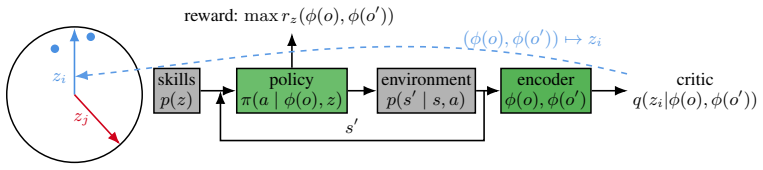
The central object is the Contrastive Successor Features (CSF) objective, in which a critic $q(z_i|\phi(o),\phi(o'))$ is trained with a contrastive (cross-entropy) loss to infer the skill $z_i$ from consecutive observations via the inner product $(\phi(o')-\phi(o))^\top z_i$. The load-bearing identity is the identifiability theorem (Theorem 1, adapted from nonlinear ICA): under a von Mises-Fisher conditional distribution for feature differences, a uniform marginal on the hypersphere, and diverse skills that span $\mathbb{R}^d$, a globally optimal encoder and linear classifier yield $\phi(o')-\phi(o) = A(s'-s)$. Proposition 1 extends this to the features themselves, $\phi(o) = A s$, using the inner product parametrization. This theorem is what converts the heuristic of 'learning diverse skills' into a provable recovery of the ground-truth states.
What would settle it
In a new simulated environment with known ground-truth states, record the learned feature differences and test whether they follow the assumed von Mises-Fisher distribution with a uniform marginal on the hypersphere, and whether the skill can be decoded from the state pair. If a case is found where those assumptions clearly fail but the $R^2$ between learned features and ground truth still approaches 1, then the theorem's premises are not necessary for the observed identifiability; if the $R^2$ collapses whenever the assumptions fail, they are the load-bearing ingredient.
Extended reading notes
Core claim
Under Assumption 1, the paper proves that the features learned by CSF are identifiable up to a linear map: if a continuous encoder and a linear classifier globally minimize the contrastive cross-entropy objective, then $\phi(o') - \phi(o) = A(s' - s)$ for a linear map $A \in \mathbb{R}^{d\times d}$, and because the critic uses an inner product parametrization, the same $A$ relates the features themselves, $\phi(o) = A s$. The proof adapts a known nonlinear-ICA identifiability result to the RL setting, interpreting skills as auxiliary variables and the required 'diverse policies' as the sufficient variability condition. The paper further shows that maximum-entropy policies cannot be diverse, that the choice of mutual information objective $I(s,s';z)$ versus $I(s;z)$ matters for the geometry of the latent space, and that a finite skill set must span the state space for identifiability. Experiments in MuJoCo and DeepMind Control confirm that the learned features and feature differences achieve high $R^2$ with ground-truth states, both from states and from pixels.
Load-bearing premise
The proof assumes that the learned skill-conditioned policies are genuinely diverse, meaning an ideal discriminator can always infer which skill produced a given state transition; if the policies ever fail to be diverse, the identifiability conclusion collapses.
Editorial extensions
If this is right
- The learned CSF features can be used to read out the ground-truth states of the MDP with a linear map, which should make downstream task solving and planning easier.
- Designing MISL methods away from these ingredients—for example replacing the inner-product critic with a more expressive one or adding a maximum-entropy regularizer—should degrade identifiability and, correspondingly, zero-shot transfer.
- A finite set of skills is sufficient for identifiability only if the skill vectors form an affine generator system of the state space; using too few or non-spanning skills breaks the guarantee and reduces exploration.
- The distinction between optimizing $I(s,s';z)$ and $I(s;z)$ is not cosmetic: only the transition-based mutual information imposes the locality constraint that keeps consecutive-state embeddings close but distinct.
- In pixel-based environments, feature identifiability is still achieved, though the linear relationship for feature differences is weaker than for states.
Reading between the lines
- A natural extension is to test whether the same linear identifiability holds when the generator $g$ is non-injective or discontinuous; if empirical $R^2$ stays high, the injectivity assumption could be relaxed.
- The paper's link between policy diversity and ICA's sufficient variability implies that adding an explicit diversity term to the policy loss, rather than letting it emerge from the reward, could make identifiability hold in environments where exploration is initially poor.
- If the linear map $A$ is consistent across seeds and tasks, the learned features could serve as a fixed coordinate system for an agent, letting a downstream policy be trained directly in the ground-truth state space.
Editorial analysis
A structured set of objections, weighed in public.
Referee Report
Summary. The paper analyzes Contrastive Successor Features (CSF), a mutual-information skill learning (MISL) method, through the lens of identifiable representation learning. It adapts an identifiability theorem from Reizinger et al. [49] to the RL setting, stating that under Assumption 1—which includes von Mises-Fisher skill-conditioned state differences, a uniform marginal over differences, and diverse policies—CSF's encoder recovers the ground-truth states up to a linear transformation. The authors also present Lemma 1 against maximum-entropy policies, discuss implications of different MI objectives, and empirically evaluate CSF in MuJoCo and DeepMind Control using R² scores between learned features and ground-truth states, state coverage, and oracle returns.
Significance. The paper is the first to attempt an identifiability guarantee for representation learning in RL, and it draws a useful connection between MISL and nonlinear ICA. The conditional theorem is imported and sound, and the practical insight about entropy regularization is interesting. However, the applicability of the theorem to CSF is not established: the assumptions concern the ground-truth state differences, while the paper's feasibility argument uses learned feature differences, and the diversity assumption is assumed rather than demonstrated. The work is therefore best viewed as a promising theoretical framework with a plausibility study, rather than a proof that CSF in practice identifies the ground truth.
major comments (4)
- [§3.1, Assumption 1 feasibility items (ii) and (iii)] The paper cites [71, Fig. 2] to justify Assumption 1(ii)-(iii), but that figure concerns the learned feature differences φ(o')−φ(o), whereas the assumption is about the ground-truth state differences s'−s. Since φ is unknown and not yet proven linear at the point of justification, the distribution of φ(o')−φ(o) does not provide evidence about the distribution of s'−s. This is circular: using the learned features to verify assumptions about the true states presupposes the linear identifiability the theorem aims to establish. The authors should either derive these properties from the training objective or measure them directly on the ground-truth states.
- [§3.1, Assumption 1(iv) and Lemma 1] Assumption 1(iv) asserts that an ideal discriminator can uniquely map (s'−s) to z, i.e., that the learned policies are diverse. Lemma 1 only rules out the maximum-entropy policy as a failure mode; it does not show that the policies obtained by optimizing the reward in Eq. (3) are diverse in the sense of Definition 1. The paragraph following Lemma 1 in the feasibility section is an intuitive argument, not a proof. The theorem requires this assumption to hold for the actual data distribution, so the paper needs to either prove it under additional conditions or empirically verify it (e.g., by training a discriminator on ground-truth state pairs from the learned policies and measuring its accuracy).
- [§3.1, Proposition 1 proof] The proof claims that an offset is impossible 'as they lie on S^{d-1}', but Assumption 1 only constrains the differences (s'−s) to the sphere, not the states s themselves. From φ(o')−φ(o)=A(s'−s) one can at most conclude φ(o)=As+c for a constant c. The identifiability statement should be amended to 'up to an affine transformation', or an additional assumption (e.g., that the features and states are centered, or that a reference state is known) must be added. As written, Proposition 1 is not proven.
- [Abstract and §3.1] The paper claims that 'CSF can provably recover the environment's ground-truth features up to a linear transformation'. What is actually proven is a conditional statement: if Assumption 1 holds, then an encoder and linear classifier that globally minimize the cross-entropy objective are linearly identifiable. The paper does not show that CSF's objective produces data satisfying Assumption 1, and the empirical R² scores are consistent with but do not verify the assumptions. The claim is therefore stronger than the evidence supports; the manuscript should separate the conditional theorem from the claim of CSF's practical identifiability.
minor comments (4)
- [§4 vs Figure 3 caption] The text says error bars represent two standard deviations unless otherwise noted, but the caption of Figure 3 says 'Error bars represent one standard deviation.' Please reconcile this discrepancy.
- [§3.1, feasibility (i)] The statement that 'this setup is sufficient, but not necessary: a set of discrete skills also leads to high identifiability scores (Fig. 4)' is misleading without qualification: Fig. 4 shows high R² only for large discrete skill sets (100, 500), while small sets perform poorly. Please rephrase to clarify that diversity in terms of spanning the sphere is what matters.
- [§3.2, Lemma 1 proof] The proof of Lemma 1 is informal, particularly the step 'by reordering the terms, we get' and the final contradiction. It would benefit from a more explicit derivation of the expression for the reward under a skill-independent policy.
- [§4, linear fit] The text states that a linear map A is fit by minimizing ||s − Aφ(o)||²₂. Given the potential offset issue in Proposition 1, the paper should state whether an intercept was included in the regression or justify why it is not needed.
Circularity Check
CSF identifiability proof is conditional on Assumption 1, whose feasibility is supported by plots of the learned features phi(o')-phi(o) rather than the ground-truth state differences s'-s, and whose diversity premise is asserted via the CSF objective rather than derived.
-
ansatz smuggled in via citation
[Sec. 3.1, 'Assumption feasibility' for Assumption 1(ii)-(iii)]
"(ii) Empirical observations show that the learned features ϕ(o′) − ϕ(o) follow a vMF for CSF [71, Fig. 2(a-b)] (iii) Empirical observations show the learned features ϕ(o′) − ϕ(o) follow a uniform marginal on the hypersphere for CSF [71, Fig. 2(c)]"
Assumptions 1(ii)-(iii) are conditions on the ground-truth feature differences p(s′−s|z). The cited evidence from [71] is about the learned encoder outputs ϕ(o′)−ϕ(o). At this point in the derivation Thm 1 has not yet been applied, so ϕ is not known to be a linear function of s. Using the learned differences to validate distributional assumptions about s′−s assumes the very linear identifiability the theorem is meant to establish; the vMF/uniform conditions are thus imported from the same group's empirical plots of the learned representation rather than verified on the DGP quantities the theorem requires.
-
self definitional
[Sec. 3.1, 'Assumption feasibility' for Assumption 1(iv); Lemma 1]
"The policy optimizes [ϕ(o′) − ϕ(o)]⊤ zi. As we show in Lem. 1, a maximum entropy policy is not diverse. Applying our argument to pairs of skills, one can always improve diversity if the state transitions depend on any one of those two skills (as opposed to no skill dependence, which is implied by a maximum entropy policy), which implies that each state transition can be mapped to a single skill. Refer to Lem. 1 for details."
Assumption 1(iv) is exactly the diversity premise the theorem needs: an ideal discriminator can uniquely map (s′−s) to z. The feasibility argument asserts that optimizing the CSF reward produces this property and concludes 'each state transition can be mapped to a single skill.' But Lemma 1 only rules out the maximum-entropy policy as one failure mode; it does not show that the learned skill-conditioned policies are diverse for ground-truth state differences. The desired uniqueness condition is restated as a consequence of the reward objective rather than derived, making the identifiability guarantee for CSF conditional on a premise that is assumed as part of the proof's input.
full rationale
The main theorem (Thm. 1) is imported from Reizinger et al. [49], which shares authors with this paper; I do not treat that import as circular by itself, because [49] is a parameter-free theoretical statement with stated assumptions that do not include the CSF conclusion. The circularity is in the application to CSF. The 'Assumption feasibility' paragraph validates Assumption 1(ii)-(iii), which are conditions on ground-truth s′−s, using [71, Fig. 2] observations of the learned ϕ(o′)−ϕ(o). Before Thm. 1 is proved, ϕ is an arbitrary learned encoder and is not known to be linear in s, so observations about ϕ(o′)−ϕ(o) cannot be transferred to s′−s without assuming the linear identifiability that is the paper's conclusion. Likewise, Assumption 1(iv) is the diversity premise; the feasibility argument asserts the CSF reward yields it, yet Lemma 1 only excludes the maximum-entropy policy and does not establish that every state transition is uniquely mapped to a skill. The paper's own Limitations section concedes that the result 'is based on the observations of Zheng et al. [71]' for the assumptions. The MuJoCo/DMC R2 experiments are external benchmarks and would be meaningful if the assumptions were independently verified, but they do not repair the self-referential assumption validation. A separate, non-circular correctness concern: Proposition 1's proof claims an offset is impossible because states 'lie on S^{d−1}', but the difference equation ϕ(o′)−ϕ(o)=A(s′−s) is invariant under adding a constant to ϕ, and the stated assumptions do not constrain ϕ to the sphere, so the passage from difference identifiability to pointwise identifiability is not justified as written. Overall: partial circularity in the premise-to-application step, score 4.
Assumptions & free parameters
assumptions (6)
- domain assumption Transition differences (s' - s) given skill z follow a von Mises-Fisher distribution on the hypersphere with mean direction z (Assumption 1(ii)).
- domain assumption The marginal distribution of state differences (s' - s) is uniform on the hypersphere (Assumption 1(iii)).
- domain assumption Skill-conditioned policies are diverse: an ideal discriminator can uniquely map (s' - s) to z (Assumption 1(iv)).
- domain assumption The generator g: S^{d-1} -> R^D is continuous and injective (Assumption 1(vi)).
- domain assumption The critic and encoder reach the global optimum of the cross-entropy objective, and a linear classifier exists (Assumption 1(v)).
- standard math Theorem 1 of Reizinger et al. [49] is correct.
Cite this review
Pith. "Pith review of Skill Learning via Policy Diversity Yields Identifiable Representations for Reinforcement Learning." pith.science (2026). https://pith.science/paper/WKPADHTA
@misc{pith2026250714748,
  author       = {Pith},
  title        = {Pith review of: Skill Learning via Policy Diversity Yields Identifiable Representations for Reinforcement Learning},
  year         = {2026},
  howpublished = {\url{https://pith.science/paper/WKPADHTA}},
  note         = {Machine review of arXiv:2507.14748}
}
read the original abstract
Self-supervised feature learning and pretraining methods in reinforcement learning (RL) often rely on information-theoretic principles, termed mutual information skill learning (MISL). These methods aim to learn a representation of the environment while also incentivizing exploration thereof. However, the role of the representation and mutual information parametrization in MISL is not yet well understood theoretically. Our work investigates MISL through the lens of identifiable representation learning by focusing on the Contrastive Successor Features (CSF) method. We prove that CSF can provably recover the environment's ground-truth features up to a linear transformation due to the inner product parametrization of the features and skill diversity in a discriminative sense. This first identifiability guarantee for representation learning in RL also helps explain the implications of different mutual information objectives and the downsides of entropy regularizers. We empirically validate our claims in MuJoCo and DeepMind Control and show how CSF provably recovers the ground-truth features both from states and pixels.
Figures


Figures from the paper (3 more)


Forward citations
Cited by 1 Pith paper
-
Unifying Goal-Conditioned RL and Unsupervised Skill Learning via Control-Maximization
GCRL and MISL are unified as control maximization, with three inequivalent GCRL formulations each matched to a MISL objective via bounds on goal-sensitivity.
Reference graph
Works this paper leans on
-
[49]
V ogt, Randall Balestriero, Wieland Brendel, and David Klindt
Patrik Reizinger, Alice Bizeul, Attila Juhos, Julia E. V ogt, Randall Balestriero, Wieland Brendel, and David Klindt. Cross-Entropy Is All You Need To Invert the Data Generating Process. October 2024. URL https://openreview.net/forum?id=hrqNOxpItr. 1, 2, 3, 4, 5, 6, 9, 15
work page 2024
-
[71]
CausalV AE: Structured Causal Disentanglement in Variational Autoencoder, December 2023
Mengyue Yang, Furui Liu, Zhitang Chen, Xinwei Shen, Jianye Hao, and Jun Wang. CausalV AE: Structured Causal Disentanglement in Variational Autoencoder, December 2023. URL http: //arxiv.org/abs/2004.08697. arXiv:2004.08697 [cs]. 4
arXiv 2023
-
[1]
Variational option discovery algorithms
Joshua Achiam, Harrison Edwards, Dario Amodei, and Pieter Abbeel. Variational option discovery algorithms. arXiv preprint arXiv:1807.10299, 2018. 1, 3
arXiv 2018
-
[2]
A Probabilistic Model Behind Self-Supervised Learning
Alice Bizeul, Bernhard Schölkopf, and Carl Allen. A Probabilistic Model to explain Self- Supervised Representation Learning, February 2024. URL http://arxiv.org/abs/2402. 01399. arXiv:2402.01399 [cs, stat]. 3
work page Pith review arXiv 2024
-
[3]
Large-Scale Study of Curiosity-Driven Learning
Yuri Burda, Harri Edwards, Deepak Pathak, Amos Storkey, Trevor Darrell, and Alexei A Efros. Large-Scale Study of Curiosity-Driven Learning. page 15. 3
-
[4]
A Simple Framework for Contrastive Learning of Visual Representations
Ting Chen, Simon Kornblith, Mohammad Norouzi, and Geoffrey Hinton. A Simple Framework for Contrastive Learning of Visual Representations. arXiv:2002.05709 [cs, stat], June 2020. URL http://arxiv.org/abs/2002.05709. arXiv: 2002.05709. 3
arXiv 2002
-
[5]
Varia- tional Empowerment as Representation Learning for Goal-Conditioned Reinforcement Learning
Jongwook Choi, Archit Sharma, Honglak Lee, Sergey Levine, and Shixiang Shane Gu. Varia- tional Empowerment as Representation Learning for Goal-Conditioned Reinforcement Learning. In Proceedings of the 38th International Conference on Machine Learning, pages 1953–1963. PMLR, July 2021. URL https://proceedings.mlr.press/v139/choi21b.html. ISSN: 2640-3498. 1
work page 1953
-
[6]
Analyse des liaisons de probabilité
George Darmois. Analyse des liaisons de probabilité. In Proc. Int. Stat. Conferences 1947, page 231, 1951. 3
work page 1947
Show all 77 references
-
[7]
A Survey of State Representation Learning for Deep Reinforcement Learning
Ayoub Echchahed and Pablo Samuel Castro. A Survey of State Representation Learning for Deep Reinforcement Learning. Transactions on Machine Learning Research, March 2025. ISSN 2835-8856. URL https://openreview.net/forum?id=gOk34vUHtz. 3
2025
-
[8]
Diversity is All You Need: Learning Skills without a Reward Function, October 2018
Benjamin Eysenbach, Abhishek Gupta, Julian Ibarz, and Sergey Levine. Diversity is All You Need: Learning Skills without a Reward Function, October 2018. URL guodefinetti. arXiv:1802.06070 [cs]. 1, 3, 4, 5
2018 arXiv
-
[9]
Salakhutdi- nov
Benjamin Eysenbach, Tianjun Zhang, Sergey Levine, and Russ R. Salakhutdi- nov. Contrastive Learning as Goal-Conditioned Reinforcement Learning. Ad- vances in Neural Information Processing Systems , 35:35603–35620, December
-
[10]
Contrastive Representations Make Planning Easy
Benjamin Eysenbach, Vivek Myers, Sergey Levine, and Ruslan Salakhutdinov. Contrastive Representations Make Planning Easy. December 2023. URL https://openreview.net/ forum?id=W0bhHvQK60. 3, 4
2023
-
[11]
Wichmann
Robert Geirhos, Jörn-Henrik Jacobsen, Claudio Michaelis, Richard Zemel, Wieland Brendel, Matthias Bethge, and Felix A. Wichmann. Shortcut learning in deep neural networks. Nature Machine Intelligence, 2(11):665–673, November 2020. ISSN 2522-5839. doi: 10.1038/ s42256-020-00257...
2020
-
[12]
Variational Intrinsic Control
Karol Gregor, Danilo Jimenez Rezende, and Daan Wierstra. Variational Intrinsic Control. February 2017. URL https://openreview.net/forum?id=Skc-Fo4Yg. 1, 3
2017
-
[13]
Rubenstein, Arash Mehrjou, Francesco Locatello, and Bernhard Schölkopf
Luigi Gresele, Paul K. Rubenstein, Arash Mehrjou, Francesco Locatello, and Bernhard Schölkopf. The Incomplete Rosetta Stone Problem: Identifiability Results for Multi-View Nonlinear ICA. arXiv:1905.06642 [cs, stat], August 2019. URL http://arxiv.org/abs/ 1905.06642. arXiv: 190...
1905 arXiv
-
[14]
World Models
David Ha and Jürgen Schmidhuber. World Models. March 2018. doi: 10.5281/zenodo.1207631. URL http://arxiv.org/abs/1803.10122. arXiv:1803.10122 [cs, stat]. 1 10
2018 arXiv
-
[15]
Fast Task Inference with Variational Intrinsic Successor Features
Steven Hansen, Will Dabney, Andre Barreto, David Warde-Farley, Tom Van de Wiele, and V olodymyr Mnih. Fast Task Inference with Variational Intrinsic Successor Features. September
-
[16]
Momentum contrast for unsupervised visual representation learning
Kaiming He, Haoqi Fan, Yuxin Wu, Saining Xie, and Ross Girshick. Momentum contrast for unsupervised visual representation learning. In Proceedings of the IEEE/CVF conference on computer vision and pattern recognition, pages 9729–9738, 2020. 4
2020
-
[17]
Unsupervised Feature Extraction by Time-Contrastive Learning and Nonlinear ICA
Aapo Hyvarinen and Hiroshi Morioka. Unsupervised Feature Extraction by Time-Contrastive Learning and Nonlinear ICA. arXiv:1605.06336 [cs, stat], May 2016. URL http://arxiv. org/abs/1605.06336. arXiv: 1605.06336. 3, 4
2016 arXiv
-
[18]
Aapo Hyvarinen, Hiroaki Sasaki, and Richard E. Turner. Nonlinear ICA Using Auxiliary Variables and Generalized Contrastive Learning. arXiv:1805.08651 [cs, stat], February 2019. URL http://arxiv.org/abs/1805.08651. arXiv: 1805.08651. 1, 3, 4, 8
2019 arXiv
-
[19]
Nonlinear independent component analysis: Existence and uniqueness results
Aapo Hyvärinen and Petteri Pajunen. Nonlinear independent component analysis: Existence and uniqueness results. Neural Networks, 12(3):429–439, April 1999. ISSN 0893-6080. doi: 10.1016/S0893-6080(98)00140-3. URL https://www.sciencedirect.com/science/ article/pii/S0893608098001...
1999 doi
-
[20]
Disentangling Identifiable Features from Noisy Data with Structured Nonlinear ICA
Hermanni Hälvä, Sylvain Le Corff, Luc Lehéricy, Jonathan So, Yongjie Zhu, Elisabeth Gassiat, and Aapo Hyvarinen. Disentangling Identifiable Features from Noisy Data with Structured Nonlinear ICA. arXiv:2106.09620 [cs, stat] , June 2021. URL http://arxiv.org/abs/ 2106.09620. ar...
2021 arXiv
-
[21]
Occam’s Razor for Self Supervised Learning: What is Sufficient to Learn Good Representations?, June 2024
Mark Ibrahim, David Klindt, and Randall Balestriero. Occam’s Razor for Self Supervised Learning: What is Sufficient to Learn Good Representations?, June 2024. URL http://arxiv. org/abs/2406.10743. arXiv:2406.10743 [cs]. 4, 5, 9
2024 arXiv
-
[22]
Variational Autoencoders and Nonlinear ICA: A Unifying Framework
Ilyes Khemakhem, Diederik Kingma, Ricardo Monti, and Aapo Hyvarinen. Variational Autoencoders and Nonlinear ICA: A Unifying Framework. In International Conference on Artificial Intelligence and Statistics , pages 2207–2217. PMLR, June 2020. URL http: //proceedings.mlr.press/v1...
2020
-
[23]
Kingma, and Aapo Hyvärinen
Ilyes Khemakhem, Ricardo Pio Monti, Diederik P. Kingma, and Aapo Hyvärinen. ICE- BeeM: Identifiable Conditional Energy-Based Deep Models Based on Nonlinear ICA. arXiv:2002.11537 [cs, stat] , October 2020. URL http://arxiv.org/abs/2002.11537. arXiv: 2002.11537. 3
2002 arXiv
-
[24]
Unsupervised Reinforcement Learning with Contrastive Intrinsic Con- trol
Michael Laskin, Hao Liu, Xue Bin Peng, Denis Yarats, Aravind Rajeswaran, and Pieter Abbeel. Unsupervised Reinforcement Learning with Contrastive Intrinsic Con- trol. Advances in Neural Information Processing Systems , 35:34478–34491, Decem- ber 2022. URL https://proceedings.ne...
2022
-
[25]
Asano, Taco Cohen, and Efstratios Gavves
Phillip Lippe, Sara Magliacane, Sindy Löwe, Yuki M. Asano, Taco Cohen, and Efstratios Gavves. CITRIS: Causal Identifiability from Temporal Intervened Sequences, June 2022. URL http://arxiv.org/abs/2202.03169. Number: arXiv:2202.03169 arXiv:2202.03169 [cs, stat]. 4
2022 arXiv
-
[26]
Asano, Taco Cohen, and Efstratios Gavves
Phillip Lippe, Sara Magliacane, Sindy Löwe, Yuki M. Asano, Taco Cohen, and Efstratios Gavves. iCITRIS: Causal Representation Learning for Instantaneous Temporal Effects. July
-
[27]
A Single Goal is All You Need: Skills and Exploration Emerge from Contrastive RL without Rewards, Demonstrations, or Subgoals, August 2024
Grace Liu, Michael Tang, and Benjamin Eysenbach. A Single Goal is All You Need: Skills and Exploration Emerge from Contrastive RL without Rewards, Demonstrations, or Subgoals, August 2024. URL http://arxiv.org/abs/2408.05804. arXiv:2408.05804 [cs]. 1
2024 arXiv
- [28]
-
[29]
URL https://openreview.net/forum?id=xeDKTZsZ7Z7. 4
-
[30]
Challenging Common Assumptions in the Unsupervised Learning of Disentangled Representations
Francesco Locatello, Stefan Bauer, Mario Lucic, Gunnar Raetsch, Sylvain Gelly, Bernhard Schölkopf, and Olivier Bachem. Challenging Common Assumptions in the Unsupervised Learning of Disentangled Representations. In International Conference on Machine Learn- ing, pages 4114–412...
2019
-
[31]
Weakly-Supervised Disentanglement Without Compromises
Francesco Locatello, Ben Poole, Gunnar Rätsch, Bernhard Schölkopf, Olivier Bachem, and Michael Tschannen. Weakly-Supervised Disentanglement Without Compromises. arXiv:2002.02886 [cs, stat] , October 2020. URL http://arxiv.org/abs/2002.02886. arXiv: 2002.02886. 3
2002 arXiv
-
[32]
Causal Triplet: An Open Challenge for Intervention-centric Causal Representation Learning, January 2023
Yuejiang Liu, Alexandre Alahi, Chris Russell, Max Horn, Dominik Zietlow, Bernhard Schölkopf, and Francesco Locatello. Causal Triplet: An Open Challenge for Intervention-centric Causal Representation Learning, January 2023. URL http://arxiv.org/abs/2301.05169. arXiv:2301.05169 [cs]. 4
2023 arXiv
-
[33]
Variational Information Maximisation for Intrinsically Motivated Reinforcement Learning
Shakir Mohamed and Danilo Jimenez Rezende. Variational Information Maximisation for Intrinsically Motivated Reinforcement Learning. In Advances in Neural Information Processing Systems, volume 28. Curran Associates, Inc., 2015. URL https://proceedings.neurips. cc/paper/2015/ha...
2015
-
[34]
Connectivity-contrastive learning: Combining causal discovery and representation learning for multimodal data
Hiroshi Morioka and Aapo Hyvarinen. Connectivity-contrastive learning: Combining causal discovery and representation learning for multimodal data. In Proceedings of The 26th Interna- tional Conference on Artificial Intelligence and Statistics, pages 3399–3426. PMLR, April 2023...
2023
-
[35]
ALAN: Autonomously Exploring Robotic Agents in the Real World, February 2023
Russell Mendonca, Shikhar Bahl, and Deepak Pathak. ALAN: Autonomously Exploring Robotic Agents in the Real World, February 2023. URL http://arxiv.org/abs/2302.06604. arXiv:2302.06604 [cs, eess]. 3
2023 arXiv
-
[36]
Representation Learning with Contrastive Predictive Coding
Aaron van den Oord, Yazhe Li, and Oriol Vinyals. Representation Learning with Contrastive Predictive Coding. arXiv:1807.03748 [cs, stat], January 2019. URL http://arxiv.org/ abs/1807.03748. arXiv: 1807.03748. 4
2019 arXiv
-
[37]
The Linear Representation Hypothesis and the Geometry of Large Language Models, November 2023
Kiho Park, Yo Joong Choe, and Victor Veitch. The Linear Representation Hypothesis and the Geometry of Large Language Models, November 2023. URL http://arxiv.org/abs/2311. 03658. arXiv:2311.03658 [cs, stat]. 2
2023 arXiv
-
[38]
Independent Innovation Analysis for Nonlinear Vector Autoregressive Process
Hiroshi Morioka, Hermanni Hälvä, and Aapo Hyvärinen. Independent Innovation Analysis for Nonlinear Vector Autoregressive Process. arXiv:2006.10944 [cs, stat], February 2021. URL https://arxiv.org/abs/2006.10944. arXiv: 2006.10944. 3
2006 arXiv
-
[39]
Lipschitz- constrained Unsupervised Skill Discovery
Seohong Park, Jongwook Choi, Jaekyeom Kim, Honglak Lee, and Gunhee Kim. Lipschitz- constrained Unsupervised Skill Discovery. October 2021. URL https://openreview.net/ forum?id=BGvt0ghNgA. 3, 5
2021
-
[40]
Lipschitz- constrained unsupervised skill discovery
Seohong Park, Jongwook Choi, Jaekyeom Kim, Honglak Lee, and Gunhee Kim. Lipschitz- constrained unsupervised skill discovery. In International Conference on Learning Representa- tions, 2022. 3
2022
-
[41]
The Geometry of Categorical and Hierarchical Concepts in Large Language Models, June 2024
Kiho Park, Yo Joong Choe, Yibo Jiang, and Victor Veitch. The Geometry of Categorical and Hierarchical Concepts in Large Language Models, June 2024. URL http://arxiv.org/abs/ 2406.01506. arXiv:2406.01506 [cs, stat]. 1
2024 arXiv
-
[42]
METRA: Scalable Unsupervised RL with Metric-Aware Abstraction, March 2024
Seohong Park, Oleh Rybkin, and Sergey Levine. METRA: Scalable Unsupervised RL with Metric-Aware Abstraction, March 2024. URL http://arxiv.org/abs/2310.08887. arXiv:2310.08887. 1, 3, 4, 5 12
2024 arXiv
-
[43]
Pardalos
Seonho Park and Panos M. Pardalos. Deep Data Density Estimation through Donsker-Varadhan Representation. arXiv:2104.06612 [cs, math], April 2021. URL http://arxiv.org/abs/ 2104.06612. arXiv: 2104.06612. 1
2021 arXiv
-
[44]
Controllability-Aware Unsupervised Skill Discovery, June 2023
Seohong Park, Kimin Lee, Youngwoon Lee, and Pieter Abbeel. Controllability-Aware Unsupervised Skill Discovery, June 2023. URL http://arxiv.org/abs/2302.05103. arXiv:2302.05103. 4, 5
2023 arXiv
-
[45]
Efros, and Trevor Darrell
Deepak Pathak, Pulkit Agrawal, Alexei A. Efros, and Trevor Darrell. Curiosity-Driven Exploration by Self-Supervised Prediction. In 2017 IEEE Conference on Computer Vi- sion and Pattern Recognition Workshops (CVPRW) , pages 488–489, Honolulu, HI, USA, July 2017. IEEE. ISBN 978-...
2017
-
[46]
Causality: Models, Reasoning, and Inference
Judea Pearl. Causality: Models, Reasoning, and Inference . Cambridge University Press, Cambridge, 2 edition, 2009. ISBN 978-0-511-80316-1. doi: 10.1017/CBO9780511803161. URL http://ebooks.cambridge.org/ref/id/CBO9780511803161. 4
2009 doi
-
[47]
Self-Supervised Exploration via Disagree- ment
Deepak Pathak, Dhiraj Gandhi, and Abhinav Gupta. Self-Supervised Exploration via Disagree- ment. page 10. 1, 3, 4
-
[48]
Jacobian-based Causal Discovery with Nonlinear ICA
Patrik Reizinger, Yash Sharma, Matthias Bethge, Bernhard Schölkopf, Ferenc Huszár, and Wieland Brendel. Jacobian-based Causal Discovery with Nonlinear ICA. Transactions on Machine Learning Research, April 2023. ISSN 2835-8856. URL https://openreview.net/ forum?id=2Yo9xqR6Ab. 4
2023
-
[50]
An Inter- ventional Perspective on Identifiability in Gaussian LTI Systems with Independent Component Analysis, November 2023
Goutham Rajendran, Patrik Reizinger, Wieland Brendel, and Pradeep Ravikumar. An Inter- ventional Perspective on Identifiability in Gaussian LTI Systems with Independent Component Analysis, November 2023. URL http://arxiv.org/abs/2311.18048. arXiv:2311.18048 [cs, eess, stat]. 1...
2023 arXiv
-
[51]
Geoffrey Roeder, Luke Metz, and Diederik P. Kingma. On Linear Identifiability of Learned Representations. arXiv:2007.00810 [cs, stat] , July 2020. URL http://arxiv.org/abs/ 2007.00810. arXiv: 2007.00810. 1, 2, 3, 4
2007 arXiv
-
[52]
Zimmermann, and Wieland Brendel
Evgenia Rusak, Patrik Reizinger, Attila Juhos, Oliver Bringmann, Roland S. Zimmermann, and Wieland Brendel. InfoNCE: Identifying the Gap Between Theory and Practice, June 2024. URL http://arxiv.org/abs/2407.00143. arXiv:2407.00143 [cs, stat]. 3, 4, 5
2024 arXiv
-
[53]
Identifiable Exchangeable Mechanisms for Causal Structure and Representation Learning
Patrik Reizinger, Siyuan Guo, Ferenc Huszár, Bernhard Schölkopf, and Wieland Brendel. Identifiable Exchangeable Mechanisms for Causal Structure and Representation Learning. October 2024. URL https://openreview.net/forum?id=k03mB41vyM. 1, 5, 8
2024
-
[54]
Towards Causal Representation Learning
Bernhard Schölkopf, Francesco Locatello, Stefan Bauer, Nan Rosemary Ke, Nal Kalch- brenner, Anirudh Goyal, and Yoshua Bengio. Towards Causal Representation Learning. arXiv:2102.11107 [cs], February 2021. URL http://arxiv.org/abs/2102.11107. arXiv: 2102.11107 version: 1. 1, 4
2021 arXiv
-
[55]
Planning to Explore via Self-Supervised World Models
Ramanan Sekar, Oleh Rybkin, Kostas Daniilidis, Pieter Abbeel, Danijar Hafner, and Deepak Pathak. Planning to Explore via Self-Supervised World Models. arXiv:2005.05960 [cs, stat], June 2020. URL http://arxiv.org/abs/2005.05960. arXiv: 2005.05960. 3
2005 arXiv
-
[56]
Regularity as Intrinsic Reward for Free Play
Cansu Sancaktar, Justus Piater, and Georg Martius. Regularity as Intrinsic Reward for Free Play. Advances in Neural Information Processing Systems , 36, Decem- ber 2023. URL https://proceedings.neurips.cc/paper_files/paper/2023/hash/ c529dba08a146ea8d6cf715ae8930cbe-Abstract-C...
2023
-
[57]
What Do We Maximize in Self-Supervised Learning?, July 2022
Ravid Shwartz-Ziv, Randall Balestriero, and Yann LeCun. What Do We Maximize in Self-Supervised Learning?, July 2022. URL http://arxiv.org/abs/2207.10081. arXiv:2207.10081 [cs]. 3
2022 arXiv
-
[58]
MIT press, 2000
Peter Spirtes, Clark N Glymour, Richard Scheines, and David Heckerman.Causation, prediction, and search. MIT press, 2000. 4
2000
-
[59]
Dynamics- Aware Unsupervised Discovery of Skills, February 2020
Archit Sharma, Shixiang Gu, Sergey Levine, Vikash Kumar, and Karol Hausman. Dynamics- Aware Unsupervised Discovery of Skills, February 2020. URL http://arxiv.org/abs/ 1907.01657. arXiv:1907.01657 [cs, stat]. 1, 3, 4, 5 13
2020 arXiv
-
[60]
Optimistic Active Exploration of Dynamical Systems
Lenart Treven, Cansu Sancaktar, Sebastian Blaes, Stelian Coros, and Andreas Krause. Optimistic Active Exploration of Dynamical Systems. Advances in Neural Information Processing Systems, 36, December 2023. URL https://proceedings.neurips.cc/paper_files/paper/ 2023/hash/77b5aaf...
2023
-
[61]
Rubenstein, Sylvain Gelly, and Mario Lucic
Michael Tschannen, Josip Djolonga, Paul K. Rubenstein, Sylvain Gelly, and Mario Lucic. On Mutual Information Maximization for Representation Learning, January 2020. URL http: //arxiv.org/abs/1907.13625. arXiv:1907.13625 [cs]. 2
2020 arXiv
-
[62]
Reinforcement learning: An introduction, volume 1
Richard S Sutton, Andrew G Barto, et al. Reinforcement learning: An introduction, volume 1. MIT press Cambridge, 1998. 3
1998
-
[63]
Chaos is a Ladder: A New Theoretical Understanding of Contrastive Learning via Augmentation Overlap, May 2022
Yifei Wang, Qi Zhang, Yisen Wang, Jiansheng Yang, and Zhouchen Lin. Chaos is a Ladder: A New Theoretical Understanding of Contrastive Learning via Augmentation Overlap, May 2022. URL http://arxiv.org/abs/2203.13457. arXiv:2203.13457 [cs, stat]. 6
2022 arXiv
-
[64]
Unsupervised control through non-parametric discriminative rewards.arXiv preprint arXiv:1811.11359, 2018
David Warde-Farley, Tom Van de Wiele, Tejas Kulkarni, Catalin Ionescu, Steven Hansen, and V olodymyr Mnih. Unsupervised control through non-parametric discriminative rewards.arXiv preprint arXiv:1811.11359, 2018. 3
2018 arXiv
-
[65]
Understanding Contrastive Representation Learning through Alignment and Uniformity on the Hypersphere
Tongzhou Wang and Phillip Isola. Understanding Contrastive Representation Learning through Alignment and Uniformity on the Hypersphere. arXiv:2005.10242 [cs, stat], November 2020. URL http://arxiv.org/abs/2005.10242. arXiv: 2005.10242. 3
2005 arXiv
-
[66]
Correlation and causation
Sewall Wright. Correlation and causation. Journal of Agricultural Research, (7), 1921. 8
1921
-
[67]
Yu, and Dahua Lin
Zhirong Wu, Yuanjun Xiong, Stella X. Yu, and Dahua Lin. Unsupervised Feature Learning via Non-Parametric Instance Discrimination. pages 3733–3742, 2018. URL https://openaccess.thecvf.com/content_cvpr_2018/html/Wu_Unsupervised_ Feature_Learning_CVPR_2018_paper.html. 4
2018
-
[68]
Causal Component Analysis, October 2023
Liang Wendong, Armin Keki ´c, Julius von Kügelgen, Simon Buchholz, Michel Besserve, Luigi Gresele, and Bernhard Schölkopf. Causal Component Analysis, October 2023. URL http://arxiv.org/abs/2305.17225. arXiv:2305.17225 [cs, stat]. 1, 3, 8
2023 arXiv
-
[69]
Task Adaptation from Skills: Information Geometry, Disentanglement, and New Objectives for Unsupervised Reinforcement Learning, June 2025
Yucheng Yang, Tianyi Zhou, Qiang He, Lei Han, Mykola Pechenizkiy, and Meng Fang. Task Adaptation from Skills: Information Geometry, Disentanglement, and New Objectives for Unsupervised Reinforcement Learning, June 2025. URL http://arxiv.org/abs/2506. 10629. arXiv:2506.10629 [cs]. 3
2025 arXiv
-
[70]
Contrastive Difference Predic- tive Coding, October 2023
Chongyi Zheng, Ruslan Salakhutdinov, and Benjamin Eysenbach. Contrastive Difference Predic- tive Coding, October 2023. URL http://arxiv.org/abs/2310.20141. arXiv:2310.20141 [cs]. 3, 4
2023
-
[72]
Zimmermann, Yash Sharma, Steffen Schneider, Matthias Bethge, and Wieland Brendel
Roland S. Zimmermann, Yash Sharma, Steffen Schneider, Matthias Bethge, and Wieland Brendel. Contrastive Learning Inverts the Data Generating Process. arXiv:2102.08850 [cs], February 2021. URL http://arxiv.org/abs/2102.08850. arXiv: 2102.08850. 1, 3, 4, 5 14 A Impact Statement ...
2021 arXiv
-
[74]
Can a MISL Fly? Analysis and Ingredients for Mutual Information Skill Learning, December 2024
Chongyi Zheng, Jens Tuyls, Joanne Peng, and Benjamin Eysenbach. Can a MISL Fly? Analysis and Ingredients for Mutual Information Skill Learning, December 2024. URL http://arxiv. org/abs/2412.08021. arXiv:2412.08021 [cs]. 1, 2, 3, 5, 6, 8, 9, 15
2024
-
[76]
for any i ̸= j the system {zi − zj} is now a generator system of Rd
-
[77]
the invertible linear image of an affine generator system is also an affine generator system. C Experimental Details and Further Results C.1 Compute Resources All experiments were run in a compute cluster using an Intel Xeon Gold CPU (16 cores, 2.9 GHz) and NVIDIA RTX 2080 Ti ...
-
[2019]
URL https://openreview.net/forum?id=BJeAHkrYDS. 1, 4, 5
-
[2022]
1, 3, 4, 5, 9
URL https://proceedings.neurips.cc/paper_files/paper/2022/hash/ e7663e974c4ee7a2b475a4775201ce1f-Abstract-Conference.html . 1, 3, 4, 5, 9
2022
Reviewed August 6, 2026 · model on record in the stance chip above.
Discussion (0). Sign in to comment.