REVIEW 4 major objections 5 minor 57 references
QUTCC: Quantile Uncertainty Training and Conformal Calibration for Imaging Inverse Problems
T0 review · 4 major / 5 minor · reviewed 2026-08-06 · deepseek-v4-flash
Pith's one-line read Calibrating a U-Net's quantile inputs, not a global scale factor, gives smaller, coverage-valid imaging intervals.
desk verdict Clever method, flawed headline comparison: the spatial-adaptivity idea is real, but the 'tighter at same coverage' claim needs a matched-risk redo before it can stand. read the letter →
The pith
A machine-rendered reading of the paper's core claim, the machinery that carries it, and where it could break.
The reading
What carries the argument
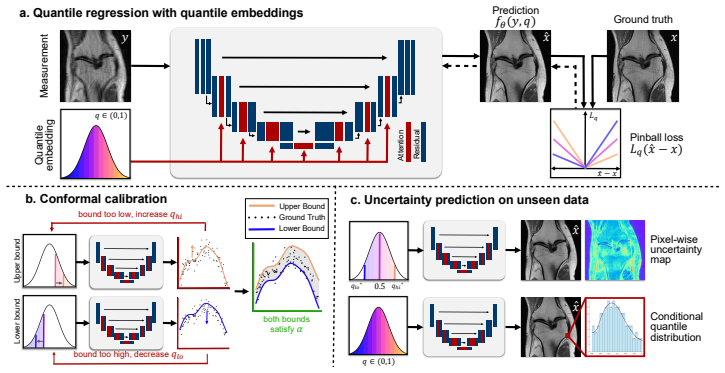
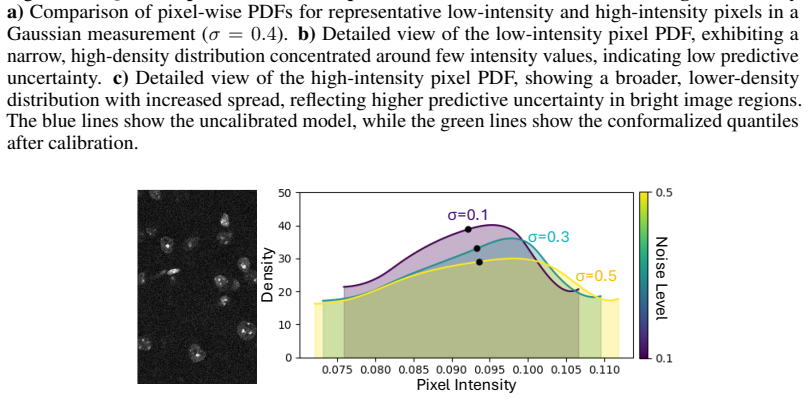
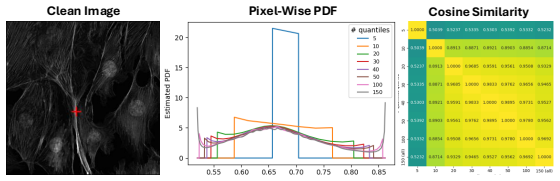
The load-bearing object is a single attention U-Net with a sinusoidal quantile embedding, trained by simultaneous quantile regression: the loss is an expectation of the asymmetric pinball loss over data pairs and uniformly sampled $q \in (0,1)$. Because the network is conditioned on $q$ throughout its residual and attention blocks, it learns the joint conditional quantile function rather than a few fixed quantiles, and because parameters are shared across $q$, quantile crossing is limited. The second mechanism is conformal calibration of the quantile inputs themselves: Algorithm 1 performs a binary search over $q_{\rm lo}$ and $q_{\rm hi}$ on the calibration set, each side held to $\alpha/2$ of pixel-marginal miscoverage with a finite-sample correction, which converts the heuristic bounds into intervals with distribution-free coverage guarantees. The third mechanism is the density identity: querying the network at many quantiles and taking the inverse finite difference of the quantile function yields an estimate of the conditional density $p(x|y)$ at each pixel.
What would settle it
Compute, on a held-out test set stratified by pixel intensity, the empirical fraction of pixels where the calibrated upper quantile prediction falls below the lower one, and re-measure the marginal coverage of the un-repaired pipeline inside signal-rich regions; if crossings are non-negligible there and coverage falls systematically below $1-\alpha$, the claim that the simple calibration maintains coverage would fail.
Extended reading notes
Core claim
The central claim is that the conditioning parameters of a quantile-regression network are a better calibration handle than the scaling factor used by prior conformal image-regression methods. QUTCC trains an attention U-Net with a quantile embedding under pinball loss with $q$ sampled uniformly from $(0,1)$ at every training step, so a single network can output the median image ($q=0.5$), any interval bound, or the entire quantile function. At calibration time the method runs risk-controlling binary search over $q_{\rm lo}$ and $q_{\rm hi}$ on a held-out set, allocating $\alpha/2$ miscoverage to each side, until the empirical pixel-marginal violations satisfy the budget; this replaces the single global $\lambda$ of Im2Im and the $K$ fixed group parameters of K-RCPS with an implicit per-pixel, per-measurement scaling. The authors report that on accelerated MRI, quantitative phase imaging, and three denoising tasks, QUTCC attains the smallest mean interval length among conformal methods at the same 90% coverage, with gains concentrated in high-intensity signal regions, and that predicted high-uncertainty regions co-locate with reconstruction errors and hallucinations. A separate procedure estimates pixel-wise conditional densities from the same network through the identity $p(x|y) = (\partial f_\theta(y,q)/\partial q)^{-1}$, with conformally calibrated quantiles if desired.
Load-bearing premise
The calibration procedure is a binary search over quantile levels, which is valid only if the learned quantile function is monotone in $q$; the paper quantifies crossings as rare and mostly in background pixels, but the headline results use the simpler calibration without the monotonicity repair.
Editorial extensions
If this is right
- Within the same pixel-marginal guarantee, users get smaller error bars from just two forward passes instead of 50 stochastic dropout passes or 10 ensemble members, cutting inference time by roughly an order of magnitude or more.
- High-uncertainty pixels become a practical alert map: in the MRI examples, regions the model flags as uncertain coincide with both large reconstruction error and features hallucinated into the image.
- Because the same network answers any quantile, a trained QUTCC model can produce an interval at any target coverage level without retraining and without recalibrating a scalar.
- The conditional density estimate carries the conformal guarantee over to the quantile levels of the PDF, giving imaging practitioners a distribution-free, posterior-like tool for tasks such as microscopy where the noise model is unknown.
Reading between the lines
- The deeper pattern — calibrate the conditioning input of a learned predictor rather than a scalar post-hoc scaling — should transfer to any conditional generative or regression model whose output varies smoothly with a tunable input, such as diffusion guidance strength or a temperature-like parameter, so the idea is not tied to quantile embeddings.
- The effective per-pixel scaling map defined in the appendix could be reused for active acquisition: sending additional measurements to exactly the high-effective-$\lambda$ regions would allocate sample budget where the calibrated interval is widest.
- The PDF estimate inherits the calibration of the quantile grid, so its fidelity is limited by grid density and finite differences; a testable extension would be to derive a fully conformal predictive distribution over continuous pixel values rather than at finitely many calibrated quantiles.
Editorial analysis
A structured set of objections, weighed in public.
Referee Report
Summary. The paper proposes QUTCC, a method for uncertainty quantification in imaging inverse problems that trains a single U-Net with a quantile embedding to predict conditional quantiles for any level q, then calibrates the quantile levels (q_lo, q_hi) on a held-out set via a binary search so that the resulting pixel-wise intervals satisfy a user-specified marginal miscoverage rate. The same network can also be queried at multiple quantile levels to produce pixel-wise conditional density estimates. The method is evaluated on five tasks (Gaussian, Poisson, real-noise denoising, accelerated MRI, and quantitative phase imaging) against MC-Dropout, Deep Ensembles, Im2Im, Im2Im-Asymm, and K-RCPS. The main claims are that QUTCC produces tighter uncertainty intervals than prior conformal methods at the same coverage level, provides distribution-free conditional density estimates, and can localize hallucinations.
Significance. If the method delivers what it claims, it makes a practical contribution: it replaces global or fixed-partition scaling in conformal image-regression with a learned, nonlinear, pixel-adaptive scaling, while retaining pixel-marginal calibration guarantees. The paper includes several strengths: it ships an anonymous code repository, reports extensive experiments across five tasks, includes an architecture ablation for the quantile embedding, and provides computational cost comparisons. The implicit per-pixel scaling idea is plausible and could be adopted by practitioners. However, the central empirical claim of 'smallest intervals at the same coverage' is weakened by unmatched achieved risks, and the coverage guarantee itself lacks a rigorous finite-sample justification. Both issues are load-bearing and need to be addressed before the results can be accepted.
major comments (4)
- [Section 4.1, Table 6] The headline claim that QUTCC 'consistently produces tighter uncertainty intervals than prior conformal methods at the same coverage level' is not established by the reported comparison, because the methods are not evaluated at matched achieved risk. In Table 6, on Poisson denoising QUTCC has Total-Risk 0.093 while K-RCPS has 0.045 and Im2Im-Deep has 0.049; on Real-Noise, QUTCC's risk is 0.098 versus 0.074 for K-RCPS. Since interval length and miscoverage risk are in direct tension, a method with higher achieved risk can report shorter intervals simply because it is less conservative. The paper should provide a matched-risk comparison, for example by calibrating each method to the same empirical risk level or by plotting interval length as a function of achieved risk over a range of alpha values.
- [Section 3.2, Eq. (5), Algorithm 1] The proposed calibration procedure does not provide a rigorous finite-sample coverage guarantee as stated. Equation (5) enforces empirical risk conditions with per-bound budget alpha/2, while Algorithm 1 uses a corrected alpha'' derived from an alpha' that is defined differently in the text ('alpha/2 - (1 - alpha/2)/Nc') and in the pseudocode ('alpha - (1-alpha)/Nc', then halved). Moreover, choosing quantile levels based on the empirical risk with a simple additive correction does not yield the RCPS-style high-probability guarantee claimed; no theorem or proof is given that population risk is controlled at level alpha. The authors should either provide a rigorous justification (e.g., via an upper-confidence-bound on the empirical risk, as in RCPS) or clearly state the weaker guarantee that the method provides.
- [Section 3.2, Appendix A.3.3] The binary search in Algorithm 1 is valid only if the learned quantile function f_theta(y,q) is monotone in q. The paper acknowledges that crossings occur and proposes a monotonic post-processing repair, but the main results use the simpler calibration without that repair except as a fallback. The crossing ratios in Table 3 are small relative to total pixels, but the absolute number of crossed pixels is not negligible in the Gaussian task (1.1e6 pixels), and the main-table results are not re-run with the repair. To support the coverage claim for the main pipeline, the authors should report the main experimental results with the monotonic post-processing in the loop, or at least verify that the selected quantiles and interval lengths are unchanged when the repair is applied.
- [Section 4.1, Table 6] The K-RCPS baseline is evaluated only at k=2 groups. Since the paper claims improvement over 'prior conformal methods' generically, a single fixed k value does not establish that QUTCC beats K-RCPS as a family. With more groups, K-RCPS could plausibly produce tighter intervals. The authors should include K-RCPS at several values of k (e.g., k=4,8,16) or justify why k=2 is the appropriate comparison point.
minor comments (5)
- [Section 3.2] The formula for the adjusted per-bound error rate is inconsistent between the text (which appears to state alpha/2 - (1 - alpha/2)/Nc) and Algorithm 1 (which sets alpha' = alpha - (1-alpha)/Nc and then alpha'' = alpha'/2). Please harmonize the notation and state the exact expression used in the experiments.
- [Figure 3] There is a typo in the caption: 'differet' should be 'different'.
- [Section 4.3, Eq. (6)] The PDF reconstruction via the inverse of the quantile derivative will be unstable when the quantile function is locally flat (small derivative). The paper should mention this limitation and any practical safeguards, since Figure 5 shows point-mass-like predictions for MC-Dropout, but QUTCC could also produce very narrow densities in low-uncertainty regions.
- [Appendix A.1.1] The claim to be 'the first' to train a single network for simultaneous quantile prediction with conformal calibration for imaging inverse problems may be too strong; consider softening the novelty statement or referencing the most closely related work more explicitly.
- [Section 4.1] The paper refers to the median prediction (q=0.5) as the 'mean prediction' in the context of Table 2. Please use 'median' consistently to avoid confusion.
Circularity Check
No load-bearing circularity; QUTCC's training, calibration, and evaluation are separated, and the only self-citation is not load-bearing.
full rationale
QUTCC's derivation chain is self-contained: the network is trained with a pinball loss over uniformly sampled quantiles, and the conformal calibration step (Algorithm 1) adjusts qlo and qhi on a held-out calibration set to control empirical per-side risk at a target level. Interval width is then measured on separate test data, so the reported tightness is an empirical outcome rather than a fitted target. The conditional PDF estimation in Eqs. (6)-(9) applies the standard quantile-density identity to the trained and calibrated quantile function, which is a mathematical transformation, not a circular derivation. The sole self-citation, [19], appears in a related-work list and is not used to justify the coverage guarantee, the architecture, or the calibration procedure. A legitimate methodological concern exists: the 'same coverage level' comparison in Table 6 may conflate achieved risk with interval width, because QUTCC's total risk on Poisson is 0.093 while K-RCPS is 0.045, and the binary-search calibration assumes quantile monotonicity that is only repaired in a post-processing variant. However, these are empirical-validity and assumption-checking issues, not instances where the paper's claims reduce to its inputs by construction. Under the stated rubric, no circular step is exhibited.
Assumptions & free parameters
free parameters (4)
- Calibrated quantile bounds (qlo, qhi) =
Gaussian: qlo=0.0078125, qhi=0.9794922; Poisson: qlo=4.77e-7, qhi=0.9999995 (Appendix Table 4)
- Target miscoverage alpha =
0.1
- Per-task training epochs for Im2Im-Deep and QUTCC =
e.g., Gaussian 15 and 20; Poisson 10 and 35 (Appendix A.6)
- K-RCPS group count k =
2
assumptions (5)
- domain assumption Calibration and test data are exchangeable from the same joint distribution p(x,y)
- ad hoc to paper The learned quantile function f_theta(y,q) is monotone in q over [0,1], so binary search in Algorithm 1 is valid
- domain assumption The network is a sufficiently accurate approximator of the true conditional quantile function after pinball training
- standard math Pixel-wise conditional distributions admit densities and differentiable quantile functions for Equation 6
- standard math Finite-sample split-conformal correction alpha' = alpha - (1-alpha)/N_c controls each one-sided risk
Cite this review
Pith. "Pith review of QUTCC: Quantile Uncertainty Training and Conformal Calibration for Imaging Inverse Problems." pith.science (2026). https://pith.science/paper/TND67KMS
@misc{pith2026250714760,
  author       = {Pith},
  title        = {Pith review of: QUTCC: Quantile Uncertainty Training and Conformal Calibration for Imaging Inverse Problems},
  year         = {2026},
  howpublished = {\url{https://pith.science/paper/TND67KMS}},
  note         = {Machine review of arXiv:2507.14760}
}
read the original abstract
While deep learning offers tremendous promise for scientific and medical imaging, any failures and hallucinations (predictions that do not coincide with reality) are hard to pinpoint and can have serious downstream consequences. Uncertainty estimation techniques, such as conformal prediction, can help by predicting statistically valid error bars for a model's prediction. However, popular conformal prediction methods were not designed for high-dimensional image-valued problems and do not take into account spatial correlations within an image during conformal calibration, resulting in larger-than-necessary uncertainty intervals. We propose a practical simultaneous quantile regression method that enables non-linear, spatially-adaptive scaling during conformal calibration. Our method, QUTCC uses a U-Net architecture with a quantile embedding to learn a full conditional quantile distribution during training, and then leverages this non-linear, learned function for spatially-adaptive conformal calibration. At test time, our method can efficiently estimate uncertainty intervals with pixel-marginal coverage guarantees. In addition, QUTCC can also predict pixel-wise conditional probability density estimates without any built-in distributional assumptions. We evaluate our method on several denoising problems, accelerated magnetic resonance imaging, and quantitative phase microscopy. Our method consistently produces tighter uncertainty intervals than prior conformal methods at the same coverage level, can predict plausible conditional distributions for different tasks, and in some cases, high-uncertainty regions can help us locate hallucinations in a model's prediction.
Figures


Figures from the paper (9 more)


Reference graph
Works this paper leans on
-
[1]
Gregory Ongie, Ajil Jalal, Christopher A. Metzler, Richard G. Baraniuk, Alexandros G. Dimakis, and Rebecca Willett. Deep learning techniques for inverse problems in imaging, 2020
work page 2020
-
[2]
Amal Alshardan, Hany Mahgoub, Nuha Alruwais, Abdulbasit A Darem, Wafa Sulaiman Almukadi, and Abdullah Mohamed. Deep learning solutions for inverse problems in advanced biomedical image analysis on disease detection.Scientific Reports, 14(1):18478, 2024
work page 2024
-
[3]
On the use of deep learning for computational imaging.Optica, 6(8):921–943, 2019
George Barbastathis, Aydogan Ozcan, and Guohai Situ. On the use of deep learning for computational imaging.Optica, 6(8):921–943, 2019
work page 2019
-
[4]
Martin Weigert, Uwe Schmidt, Tobias Boothe, Andreas Müller, Alexandr Dibrov, Akanksha Jain, Benjamin Wilhelm, Deborah Schmidt, Coleman Broaddus, Siân Culley, et al. Content-aware image restoration: pushing the limits of fluorescence microscopy.Nature methods, 15(12):1090–1097, 2018
work page 2018
-
[5]
fastmri: An open dataset and benchmarks for accelerated mri.arXiv preprint arXiv:1811.08839, 2018
Jure Zbontar, Florian Knoll, Anuroop Sriram, Tullie Murrell, Zhengnan Huang, Matthew J Muckley, Aaron Defazio, Ruben Stern, Patricia Johnson, Mary Bruno, et al. fastmri: An open dataset and benchmarks for accelerated mri.arXiv preprint arXiv:1811.08839, 2018
arXiv 2018
-
[6]
Score-based diffusion models as principled priors for inverse imaging
Berthy T Feng, Jamie Smith, Michael Rubinstein, Huiwen Chang, Katherine L Bouman, and William T Freeman. Score-based diffusion models as principled priors for inverse imaging. InProceedings of the IEEE/CVF International Conference on Computer Vision, pages 10520–10531, 2023
work page 2023
-
[7]
Image-to-image regression with distribution-free uncertainty quantification and applications in imaging
Anastasios N Angelopoulos, Amit Pal Kohli, Stephen Bates, Michael Jordan, Jitendra Malik, Thayer Alshaabi, Srigokul Upadhyayula, and Yaniv Romano. Image-to-image regression with distribution-free uncertainty quantification and applications in imaging. InInternational Conference on Machine Learning, pages 717–730. PMLR, 2022
2022
-
[8]
How to trust your diffusion model: A convex optimization approach to conformal risk control
Jacopo Teneggi, Matthew Tivnan, Web Stayman, and Jeremias Sulam. How to trust your diffusion model: A convex optimization approach to conformal risk control. InInternational Conference on Machine Learning, pages 33940–33960. PMLR, 2023
2023
Show all 57 references
-
[9]
A gentle introduction to conformal prediction and distribution-free uncertainty quantification.arXiv preprint arXiv:2107.07511, 2021
Anastasios N Angelopoulos and Stephen Bates. A gentle introduction to conformal prediction and distribution-free uncertainty quantification.arXiv preprint arXiv:2107.07511, 2021
2021 arXiv
-
[10]
An information theoretic perspective on conformal prediction.arXiv preprint arXiv:2405.02140, 2024
Alvaro HC Correia, Fabio Valerio Massoli, Christos Louizos, and Arash Behboodi. An information theoretic perspective on conformal prediction.arXiv preprint arXiv:2405.02140, 2024
2024 arXiv
-
[11]
Conformalized quantile regression.Advances in neural information processing systems, 32, 2019
Yaniv Romano, Evan Patterson, and Emmanuel Candes. Conformalized quantile regression.Advances in neural information processing systems, 32, 2019
2019
-
[12]
Uncertainty sets for image classifiers using conformal prediction.arXiv preprint arXiv:2009.14193, 2020
Anastasios Angelopoulos, Stephen Bates, Jitendra Malik, and Michael I Jordan. Uncertainty sets for image classifiers using conformal prediction.arXiv preprint arXiv:2009.14193, 2020
2009 arXiv
-
[13]
Class- conditional conformal prediction with many classes.Advances in neural information processing systems, 36:64555–64576, 2023
Tiffany Ding, Anastasios Angelopoulos, Stephen Bates, Michael Jordan, and Ryan J Tibshirani. Class- conditional conformal prediction with many classes.Advances in neural information processing systems, 36:64555–64576, 2023
2023
-
[14]
Conformal language modeling.arXiv preprint arXiv:2306.10193, 2023
Victor Quach, Adam Fisch, Tal Schuster, Adam Yala, Jae Ho Sohn, Tommi S Jaakkola, and Regina Barzilay. Conformal language modeling.arXiv preprint arXiv:2306.10193, 2023
2023 arXiv
-
[15]
Conformal prediction for natural language processing: A survey.Transactions of the Association for Computational Linguistics, 12:1497–1516, 2024
Margarida Campos, António Farinhas, Chrysoula Zerva, Mário AT Figueiredo, and André FT Martins. Conformal prediction for natural language processing: A survey.Transactions of the Association for Computational Linguistics, 12:1497–1516, 2024
2024
-
[16]
Safe planning in dynamic environments using conformal prediction.IEEE Robotics and Automation Letters, 8(8):5116–5123, 2023
Lars Lindemann, Matthew Cleaveland, Gihyun Shim, and George J Pappas. Safe planning in dynamic environments using conformal prediction.IEEE Robotics and Automation Letters, 8(8):5116–5123, 2023
2023
-
[17]
Conformal decision theory: Safe autonomous decisions from imperfect predictions
Jordan Lekeufack, Anastasios N Angelopoulos, Andrea Bajcsy, Michael I Jordan, and Jitendra Malik. Conformal decision theory: Safe autonomous decisions from imperfect predictions. In2024 IEEE International Conference on Robotics and Automation (ICRA), pages 11668–11675. IEEE, 2024
2024
-
[18]
Conformal prediction under feedback covariate shift for biomolecular design.Proceedings of the National Academy of Sciences, 119(43):e2204569119, 2022
Clara Fannjiang, Stephen Bates, Anastasios N Angelopoulos, Jennifer Listgarten, and Michael I Jordan. Conformal prediction under feedback covariate shift for biomolecular design.Proceedings of the National Academy of Sciences, 119(43):e2204569119, 2022
2022
-
[19]
Learned, uncertainty-driven adaptive acquisition for photon-efficient scanning microscopy.Optics Express, 33(6):12269–12287, 2025
Cassandra Tong Ye, Jiashu Han, Kunzan Liu, Anastasios Angelopoulos, Linda Griffith, Kristina Mon- akhova, and Sixian You. Learned, uncertainty-driven adaptive acquisition for photon-efficient scanning microscopy.Optics Express, 33(6):12269–12287, 2025. 10
2025
-
[20]
Distribution-free, risk-controlling prediction sets.Journal of the ACM (JACM), 68(6):1–34, 2021
Stephen Bates, Anastasios Angelopoulos, Lihua Lei, Jitendra Malik, and Michael Jordan. Distribution-free, risk-controlling prediction sets.Journal of the ACM (JACM), 68(6):1–34, 2021
2021
-
[21]
A threshold selection method from gray-level histograms.Automatica, 11:285–296, 1975
Nobuyuki Otsu. A threshold selection method from gray-level histograms.Automatica, 11:285–296, 1975
1975
-
[22]
U-net: Convolutional networks for biomedical image segmentation
Olaf Ronneberger, Philipp Fischer, and Thomas Brox. U-net: Convolutional networks for biomedical image segmentation. InMedical image computing and computer-assisted intervention–MICCAI 2015: 18th international conference, Munich, Germany, October 5-9, 2015, proceedings, part I...
2015
-
[23]
Attention u-net: Learning where to look for the pancreas.arXiv preprint arXiv:1804.03999, 2018
Ozan Oktay, Jo Schlemper, Loic Le Folgoc, Matthew Lee, Mattias Heinrich, Kazunari Misawa, Kensaku Mori, Steven McDonagh, Nils Y Hammerla, Bernhard Kainz, et al. Attention u-net: Learning where to look for the pancreas.arXiv preprint arXiv:1804.03999, 2018
2018 arXiv
-
[24]
Adam: A method for stochastic optimization.arXiv preprint arXiv:1412.6980, 2014
Diederik P Kingma and Jimmy Ba. Adam: A method for stochastic optimization.arXiv preprint arXiv:1412.6980, 2014
2014 arXiv
-
[25]
Conditional validity of inductive conformal predictors
Vladimir V ovk. Conditional validity of inductive conformal predictors. InAsian conference on machine learning, pages 475–490. PMLR, 2012
2012
-
[26]
Dropout as a bayesian approximation: Representing model uncertainty in deep learning
Yarin Gal and Zoubin Ghahramani. Dropout as a bayesian approximation: Representing model uncertainty in deep learning. Ininternational conference on machine learning, pages 1050–1059. PMLR, 2016
2016
-
[27]
Simple and scalable predictive uncertainty estimation using deep ensembles.Advances in neural information processing systems, 30, 2017
Balaji Lakshminarayanan, Alexander Pritzel, and Charles Blundell. Simple and scalable predictive uncertainty estimation using deep ensembles.Advances in neural information processing systems, 30, 2017
2017
-
[28]
The berkeley single cell computational microscopy (bsccm) dataset.arXiv preprint arXiv:2402.06191, 2024
Henry Pinkard, Cherry Liu, Fanice Nyatigo, Daniel A Fletcher, and Laura Waller. The berkeley single cell computational microscopy (bsccm) dataset.arXiv preprint arXiv:2402.06191, 2024
2024 arXiv
-
[29]
A poisson-gaussian denoising dataset with real fluorescence microscopy images
Yide Zhang, Yinhao Zhu, Evan Nichols, Qingfei Wang, Siyuan Zhang, Cody Smith, and Scott Howard. A poisson-gaussian denoising dataset with real fluorescence microscopy images. InProceedings of the IEEE/CVF Conference on Computer Vision and Pattern Recognition, pages 11710–11718, 2019
2019
-
[30]
Probabilistic noise2void: Unsupervised content-aware denoising.Frontiers in Computer Science, 2:5, 2020
Alexander Krull, Tomáš Viˇcar, Mangal Prakash, Manan Lalit, and Florian Jug. Probabilistic noise2void: Unsupervised content-aware denoising.Frontiers in Computer Science, 2:5, 2020
2020
-
[31]
Regression quantiles.Econometrica: journal of the Econometric Society, pages 33–50, 1978
Roger Koenker and Gilbert Bassett Jr. Regression quantiles.Econometrica: journal of the Econometric Society, pages 33–50, 1978
1978
-
[32]
Quantile regression.Journal of economic perspectives, 15(4):143– 156, 2001
Roger Koenker and Kevin F Hallock. Quantile regression.Journal of economic perspectives, 15(4):143– 156, 2001
2001
-
[33]
Estimating conditional quantiles with the help of the pinball loss
Ingo Steinwart and Andreas Christmann. Estimating conditional quantiles with the help of the pinball loss. 2011
2011
-
[34]
Beyond expectation: Deep joint mean and quantile regression for spatiotemporal problems.IEEE transactions on neural networks and learning systems, 31(12):5377–5389, 2020
Filipe Rodrigues and Francisco C Pereira. Beyond expectation: Deep joint mean and quantile regression for spatiotemporal problems.IEEE transactions on neural networks and learning systems, 31(12):5377–5389, 2020
2020
-
[35]
Implicit quantile networks for distributional reinforcement learning
Will Dabney, Georg Ostrovski, David Silver, and Rémi Munos. Implicit quantile networks for distributional reinforcement learning. InInternational conference on machine learning, pages 1096–1105. PMLR, 2018
2018
-
[36]
Autoregressive quantile networks for generative modeling
Georg Ostrovski, Will Dabney, and Rémi Munos. Autoregressive quantile networks for generative modeling. InInternational Conference on Machine Learning, pages 3936–3945. PMLR, 2018
2018
-
[37]
Boosted conformal prediction intervals.Advances in Neural Information Processing Systems, 37:71868–71899, 2024
Ran Xie, Rina Barber, and Emmanuel Candes. Boosted conformal prediction intervals.Advances in Neural Information Processing Systems, 37:71868–71899, 2024
2024
-
[38]
Beyond pinball loss: Quantile methods for calibrated uncertainty quantification.Advances in Neural Information Processing Systems, 34:10971–10984, 2021
Youngseog Chung, Willie Neiswanger, Ian Char, and Jeff Schneider. Beyond pinball loss: Quantile methods for calibrated uncertainty quantification.Advances in Neural Information Processing Systems, 34:10971–10984, 2021
2021
-
[39]
Uncertainty quantification via neural posterior principal components.Advances in Neural Information Processing Systems, 36:37128–37141, 2023
Elias Nehme, Omer Yair, and Tomer Michaeli. Uncertainty quantification via neural posterior principal components.Advances in Neural Information Processing Systems, 36:37128–37141, 2023
2023
-
[40]
Uncertainty visualization via low-dimensional posterior projections
Omer Yair, Elias Nehme, and Tomer Michaeli. Uncertainty visualization via low-dimensional posterior projections. InProceedings of the IEEE/CVF Conference on Computer Vision and Pattern Recognition, pages 11041–11051, 2024. 11
2024
-
[41]
Principal uncertainty quantification with spatial correlation for image restoration problems.IEEE Transactions on Pattern Analysis and Machine Intelligence, 46(5):3321–3333, 2023
Omer Belhasin, Yaniv Romano, Daniel Freedman, Ehud Rivlin, and Michael Elad. Principal uncertainty quantification with spatial correlation for image restoration problems.IEEE Transactions on Pattern Analysis and Machine Intelligence, 46(5):3321–3333, 2023
2023
-
[42]
Topology-aware uncertainty for image segmentation.Advances in Neural Information Processing Systems, 36:8186–8207, 2023
Saumya Gupta, Yikai Zhang, Xiaoling Hu, Prateek Prasanna, and Chao Chen. Topology-aware uncertainty for image segmentation.Advances in Neural Information Processing Systems, 36:8186–8207, 2023
2023
-
[43]
Conformal risk control for semantic uncertainty quantification in computed tomography
Jacopo Teneggi, J Webster Stayman, and Jeremias Sulam. Conformal risk control for semantic uncertainty quantification in computed tomography. InInternational Conference on Medical Image Computing and Computer-Assisted Intervention, pages 45–55. Springer, 2025
2025
-
[44]
Task-driven uncertainty quantification in inverse problems via conformal prediction
Jeffrey Wen, Rizwan Ahmad, and Philip Schniter. Task-driven uncertainty quantification in inverse problems via conformal prediction. InEuropean Conference on Computer Vision, pages 182–199. Springer, 2024
2024
-
[45]
Learning in an uncertain world: Representing ambiguity through multiple hypotheses
Christian Rupprecht, Iro Laina, Robert DiPietro, Maximilian Baust, Federico Tombari, Nassir Navab, and Gregory D Hager. Learning in an uncertain world: Representing ambiguity through multiple hypotheses. InProceedings of the IEEE international conference on computer vision, pa...
2017
-
[46]
Uncertainty estimates and multi-hypotheses networks for optical flow
Eddy Ilg, Ozgun Cicek, Silvio Galesso, Aaron Klein, Osama Makansi, Frank Hutter, and Thomas Brox. Uncertainty estimates and multi-hypotheses networks for optical flow. InProceedings of the European Conference on Computer Vision (ECCV), pages 652–667, 2018
2018
-
[47]
Hierarchical uncertainty exploration via feedforward posterior trees.Advances in Neural Information Processing Systems, 37:125142–125191, 2024
Elias Nehme, Rotem Mulayoff, and Tomer Michaeli. Hierarchical uncertainty exploration via feedforward posterior trees.Advances in Neural Information Processing Systems, 37:125142–125191, 2024
2024
-
[48]
On the posterior distribution in denoising: Application to uncertainty quantification.arXiv preprint arXiv:2309.13598, 2023
Hila Manor and Tomer Michaeli. On the posterior distribution in denoising: Application to uncertainty quantification.arXiv preprint arXiv:2309.13598, 2023
2023 arXiv
-
[49]
Variational inference: A review for statisticians
David M Blei, Alp Kucukelbir, and Jon D McAuliffe. Variational inference: A review for statisticians. Journal of the American statistical Association, 112(518):859–877, 2017
2017
-
[50]
Bayesian convolutional neural networks with bernoulli approximate variational inference.arXiv preprint arXiv:1506.02158, 2015
Yarin Gal and Zoubin Ghahramani. Bayesian convolutional neural networks with bernoulli approximate variational inference.arXiv preprint arXiv:1506.02158, 2015
2015 arXiv
-
[51]
CRC press, 2011
Steve Brooks, Andrew Gelman, Galin Jones, and Xiao-Li Meng.Handbook of markov chain monte carlo. CRC press, 2011
2011
-
[52]
Nonparametric predictive distributions based on conformal prediction
Vladimir V ovk, Jieli Shen, Valery Manokhin, and Min-ge Xie. Nonparametric predictive distributions based on conformal prediction. InConformal and probabilistic prediction and applications, pages 82–102. PMLR, 2017
2017
-
[53]
Conformal predictive distribu- tions with kernels
Vladimir V ovk, Ilia Nouretdinov, Valery Manokhin, and Alex Gammerman. Conformal predictive distribu- tions with kernels. InBraverman Readings in Machine Learning. Key Ideas from Inception to Current State: International Conference Commemorating the 40th Anniversary of Emmanui...
2017
-
[54]
Distributional reinforcement learning with quantile regression
Will Dabney, Mark Rowland, Marc Bellemare, and Rémi Munos. Distributional reinforcement learning with quantile regression. InProceedings of the AAAI conference on artificial intelligence, volume 32, 2018
2018
-
[55]
Denoising diffusion probabilistic models.Advances in neural information processing systems, 33:6840–6851, 2020
Jonathan Ho, Ajay Jain, and Pieter Abbeel. Denoising diffusion probabilistic models.Advances in neural information processing systems, 33:6840–6851, 2020
2020
-
[56]
A unified conditional framework for diffusion-based image restoration.Advances in Neural Information Processing Systems, 36:49703–49714, 2023
Yi Zhang, Xiaoyu Shi, Dasong Li, Xiaogang Wang, Jian Wang, and Hongsheng Li. A unified conditional framework for diffusion-based image restoration.Advances in Neural Information Processing Systems, 36:49703–49714, 2023
2023
-
[57]
fastmri: A publicly available raw k-space and dicom dataset of knee images for accelerated mr image reconstruction using machine learning
Florian Knoll, Jure Zbontar, Anuroop Sriram, Matthew J Muckley, Mary Bruno, Aaron Defazio, Marc Parente, Krzysztof J Geras, Joe Katsnelson, Hersh Chandarana, et al. fastmri: A publicly available raw k-space and dicom dataset of knee images for accelerated mr image reconstructi...
2020
Reviewed August 6, 2026 · model on record in the stance chip above.
Discussion (0). Sign in to comment.