REVIEW 4 major objections 5 minor 41 references
To Label or Not to Label: PALM -- A Predictive Model for Evaluating Sample Efficiency in Active Learning Models
T0 review · 4 major / 5 minor · reviewed 2026-08-06 · deepseek-v4-flash
Pith's one-line read The paper proposes that active learning accuracy trajectories follow a four-parameter curve, Eq. (13), which can be fit from a few early labeled-budget points and then extrapolated to predict the full learning curve.
desk verdict A useful descriptive model of AL curves, but the headline claim of accurate extrapolation from limited data is not supported by the evidence. read the letter →
The pith
A machine-rendered reading of the paper's core claim, the machinery that carries it, and where it could break.
The reading
What carries the argument
The central object is Eq. (13), the normalized accuracy function. It grows out of a random-covering calculation: if $B$ labeled samples are placed independently and uniformly, the expected covered fraction of the space is $1-(1-\delta)^B$, which the paper turns into an accuracy law by assuming accuracy in covered regions is $A_{\max}$ and then generalizing the exponent to $((B/b)+\alpha)^{\beta}$. The added parameters let a handful of fitted points reproduce both fast-converging and delayed learning curves, and normalizing $B$ by the per-iteration budget $b$ keeps the exponent numerically stable. This equation carries the paper's predictive claim: once its four parameters are estimated from partial observations, the whole curve, final accuracy, and label requirements for a target accuracy are determined.
What would settle it
Fit Eq. (13) to the first 10% of the labeled budget for a method with a slow, nearly linear early curve (the paper's own BYOL case) and then compare the predicted accuracy at the full budget with the observed value; the central claim fails if the extrapolation departs from the measured curve by more than the roughly 2% error band that the paper reports for its fits.
Extended reading notes
Core claim
The paper's core discovery is that active learning accuracy curves can be summarized and extrapolated by four parameters through the normalized accuracy function $A = A_{\max}[1 - (1-\delta)^{((B/b)+\alpha)^{\beta}}]$ (Eq. 13), where $B$ is the cumulative number of labeled samples, $b$ is the mean budget per iteration, $\delta$ is the expected fraction of the data space covered by one labeled sample, $\alpha$ shifts the effective start of learning, $\beta$ controls how quickly accuracy gains scale with budget, and $A_{\max}$ is the asymptotic accuracy. Fitting these parameters by nonlinear regression to accuracy observations at a few budget points yields a predicted trajectory for the rest of the annotation process. The paper presents this as a unified and interpretable model of active learning dynamics, and reports that it generalizes across datasets, budgets, and strategies, with fitted parameters that distinguish sample-efficient methods from slow starters.
Load-bearing premise
The paper's load-bearing premise is that an active learning accuracy curve follows the parametric shape $A = A_{\max}[1 - (1-\delta)^{((B/b)+\alpha)^{\beta}}]$, with parameters fitted from a few early observations that remain trustworthy for extrapolation, even though the derivation assumes uncovered regions contribute negligible accuracy and labeled samples are placed independently and uniformly.
Editorial extensions
If this is right
- Annotation budgets can be planned from a small initial labeling run: given a few early accuracy readings, PALM predicts how many labels a target accuracy needs.
- Active learning strategies can be compared by interpretable parameters ($A_{\max}$, $\delta$, $\alpha$, $\beta$) instead of final accuracy alone, exposing differences in early learning and coverage.
- Self-supervised embeddings measurably raise sample efficiency under PALM, with higher $\delta$ and lower $\alpha$ values, giving a quantitative basis for choosing embeddings in a pipeline.
- For slow-starting methods such as BYOL, PALM needs more early budget points to avoid mistaking a nearly linear rise for a plateau, as the paper itself observes.
- Under tight budgets, PALM lets a practitioner pick the strategy with the best predicted return per label rather than the best end-of-run accuracy.
Reading between the lines
- The functional form of Eq. (13) is a stretched-exponential-style growth curve, so if the parameters are stable across settings, PALM could serve as a prior or a stopping-time predictor for active learning scenarios the paper does not test, such as noisy-label or semi-supervised pipelines.
- Because the derivation sets uncovered-region accuracy to zero, the parameter $\alpha$ is left to absorb all generalization from unlabeled regions; a cleaner extension would reintroduce an explicit uncovered-region accuracy term, changing how $\alpha$ should be interpreted.
- A testable extension is to use $\delta$ or $\beta$ as a selection signal: an active learning strategy that greedily maximizes the estimated per-sample coverage might accelerate learning if PALM's coverage interpretation holds.
Editorial analysis
A structured set of objections, weighed in public.
Referee Report
Summary. The paper introduces PALM, a four-parameter parametric model for active learning (AL) accuracy trajectories, A = Amax [1 - (1 - δ)^((B/b + α)^β)] (Eq. 13), where Amax is the asymptotic accuracy, δ is a coverage-efficiency parameter, α is an early-stage offset, β is a scaling exponent, and b is the budget per iteration. The authors claim that fitting these parameters to a limited number of early labeled-budget points allows accurate prediction of the full learning curve, as well as interpretable comparison of AL strategies across datasets, budgets, and self-supervised embeddings. They validate the model on CIFAR-10/100 and ImageNet-50/100/200 with several AL strategies and embeddings, reporting fitted parameters and visual curve comparisons.
Significance. If the predictive claim were substantiated, PALM would be a useful and interpretable tool for AL evaluation, allowing researchers to extrapolate performance from small annotation budgets and to compare strategies through meaningful parameters. The paper is commendable for targeting a real gap in AL benchmarking, for releasing code, and for reporting extensive experiments across diverse datasets and methods. The four-parameter form is simple and potentially generalizable. However, the current evidence does not establish the central predictive claim: the fitted parameters are unstable across fitting windows, no held-out prediction error is reported, the derivation contains an assumption that contradicts the paper's own motional motivation, and the BYOL experiments show a qualitative failure in the very regime the paper emphasizes. These issues are load-bearing because the paper's contribution is explicitly predictive, not merely descriptive.
major comments (4)
- [Supplementary Table 1 (CIFAR-10, no embeddings)] The fitted parameters are highly unstable with respect to the number of points used for fitting. For Random sampling, Amax is 32.6 with 6 fitting points, 100.0 with 10, 20, 50, and 100 points, 93.8 with 500 points, and 90.7 with 1000 points; δ and β drift correspondingly. This non-identifiability means that predictions from partial observations depend on the arbitrary choice of the fitting window, so the claim that PALM predicts future performance from limited data is not well-defined unless a stable parameter regime or a principled fitting procedure is established.
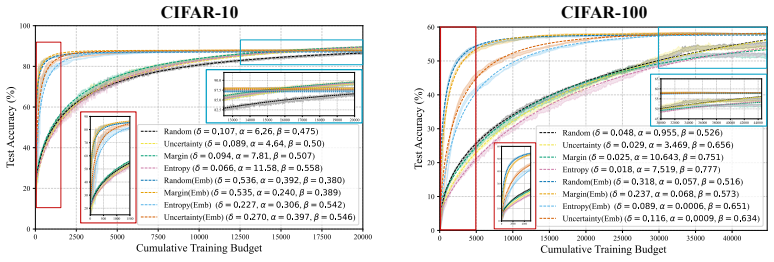
- [Section 4, Limited Budgets; Figure 3] No quantitative held-out evaluation is reported. Figure 3 compares predicted and actual curves visually only, and the 'within 2%' statement in the CIFAR-100 discussion refers to deviations of the full-curve fit, not to extrapolation from partial budgets. To support the headline claim, the authors should report prediction errors (e.g., RMSE or MAE in accuracy points) on held-out budget points after fitting only on early points, ideally broken down by strategy, dataset, and number of fitting points.
- [Supplementary A.2.4, Eq. (31) to Eq. (32)] The derivation of the generalized accuracy function assumes A_UC ≈ 0 to simplify Eq. (31) into Eq. (32). This directly contradicts Definition 5 and the main-text emphasis on the contribution of uncovered regions to generalization, and it is not a harmless simplification: the BYOL experiments (Section 4) show a regime where early accuracy is dominated by uncovered-region behavior and the model fits a plateau. The assumption should be stated as an explicit modeling limitation, or the derivation should be revised to include A_UC as a fitted parameter or an explicit approximation with stated validity conditions.
- [Section 4, Large-Scale Datasets (BYOL)] The paper reports that for BYOL, whose early accuracy curve is slow and nearly linear, 'PALM fits the curve as if the method has already plateaued.' This is a qualitative failure of extrapolation exactly in the limited-budget regime that the abstract and introduction claim to support. The paper provides no quantitative error measure for this case and no guidance on when the model's extrapolation can be trusted. This issue must be addressed, for example by reporting held-out errors for slow-starting methods or by defining a validity region for predictions based on the fitted parameters.
minor comments (5)
- [Supplementary Tables 2, 3, 5, 6, 7, 8] Many fitted parameter combinations are degenerate (e.g., δ = 0 with α ≈ 80 and β ≈ 3.7, or Amax = 100 with δ = 0.000). Reporting mean, min, and max across repetitions is helpful, but the high incidence of boundary solutions suggests that the optimization is hitting constraints; a discussion of parameter identifiability and of the quality of individual fits (e.g., R² or residual norm) would clarify which results are trustworthy.
- [Equations (13) and (14)-(15)] The notation mixes B as the cumulative budget and b as the mean budget per iteration. In Definition 7, b is introduced as a known quantity, but in Section 4 the fitted parameter tables do not report b; it would be useful to state explicitly how b is determined and whether it is fixed or fitted for each experiment.
- [Supplementary A.2.7, Eq. (50)] The derivative-based comparison condition appears to be stated without derivation and has a dimensional inconsistency (δ multiplies a quantity that depends on 1/b and α/B). Since this is not needed for the main predictive claim, it should either be derived correctly or moved to a clearly labeled heuristic discussion.
- [Figure 3] The figure's legend is hard to parse because the rows alternate between no-embedding and SimCLR-embedding settings but this is only noted in the caption. Adding row labels directly in the figure or a clearer subcaption would improve readability.
- [Throughout] The authors write 'AUC' for accuracy in uncovered regions in Eq. (10), which collides with the standard area-under-the-curve abbreviation. A different symbol, such as A_U, would avoid confusion, especially since AUC is used in the introduction in its standard sense.
Circularity Check
No significant circularity: PALM's extrapolation of the fitted Eq. (13) to future budgets is an ordinary parametric prediction, and the only self-citation is not load-bearing.
full rationale
The central claim is that the parametric form A = Amax[1 - (1 - delta)^((B/b + alpha)^beta)] (Eq. 13), fitted to early observed accuracy values, can be evaluated at larger budgets to predict the remainder of the learning curve. This is a standard fitted-curve extrapolation: the future accuracy values are not inputs to the fit, so the prediction does not reduce by construction to the training observations. The random-covering derivation leading to Eq. (8)-(11) is an independent probabilistic argument, and the later introduction of alpha and beta in Definitions 6-7 is an explicit modeling generalization rather than a concealed reuse of the target result. The paper's own admission that BYOL is fitted as if it had already plateaued (Section 4) and the large variation of fitted Amax with the number of fitting points (Table 1) are empirical validation concerns, not circularity. The interpretation of the fitted parameter delta as 'coverage efficiency' is a modeling label rather than an independently measured quantity, so the coverage conclusions are under-validated but not circular. No load-bearing self-citation chain exists; the only overlapping-author reference ([36]) is a related-work citation on hippocampus segmentation. Thus the derivation chain is self-contained, and no step is equivalent to its inputs by definition.
Assumptions & free parameters
free parameters (4)
- Amax (maximum achievable accuracy) =
Varies per method and fitting set; e.g., CIFAR-10 Random ranges from 32.6 to 100 depending on number of fitting points…
- delta (coverage efficiency per labeled sample) =
e.g., 0.094 for Margin on CIFAR-10 without embeddings; 0.535 with embeddings (Section 4)
- alpha (early-stage offset) =
e.g., 10.643 for Margin on CIFAR-100 without embeddings; 0.068 with embeddings (Section 4)
- beta (scaling exponent) =
e.g., 0.651 for Entropy on CIFAR-100 with embeddings (Section 4)
assumptions (5)
- domain assumption Random covering model: objects and samples are placed independently and uniformly, each covering a fixed volume fraction delta (Section 2.1, Definition 3)
- domain assumption Test accuracy is a coverage-weighted average of accuracy in covered and uncovered regions (Eq 10)
- ad hoc to paper A_UC is approximately zero in deriving the generalized accuracy function (Supplementary A.2.4)
- ad hoc to paper The generalized functional form with exponent beta and shift alpha (Eq 12, Definition 6)
- domain assumption Effectively infinite unlabeled pool (Section 4, AL Behavior)
Cite this review
Pith. "Pith review of To Label or Not to Label: PALM -- A Predictive Model for Evaluating Sample Efficiency in Active Learning Models." pith.science (2026). https://pith.science/paper/VLXGLE7J
@misc{pith2026250715381,
  author       = {Pith},
  title        = {Pith review of: To Label or Not to Label: PALM -- A Predictive Model for Evaluating Sample Efficiency in Active Learning Models},
  year         = {2026},
  howpublished = {\url{https://pith.science/paper/VLXGLE7J}},
  note         = {Machine review of arXiv:2507.15381}
}
read the original abstract
Active learning (AL) seeks to reduce annotation costs by selecting the most informative samples for labeling, making it particularly valuable in resource-constrained settings. However, traditional evaluation methods, which focus solely on final accuracy, fail to capture the full dynamics of the learning process. To address this gap, we propose PALM (Performance Analysis of Active Learning Models), a unified and interpretable mathematical model that characterizes AL trajectories through four key parameters: achievable accuracy, coverage efficiency, early-stage performance, and scalability. PALM provides a predictive description of AL behavior from partial observations, enabling the estimation of future performance and facilitating principled comparisons across different strategies. We validate PALM through extensive experiments on CIFAR-10/100 and ImageNet-50/100/200, covering a wide range of AL methods and self-supervised embeddings. Our results demonstrate that PALM generalizes effectively across datasets, budgets, and strategies, accurately predicting full learning curves from limited labeled data. Importantly, PALM reveals crucial insights into learning efficiency, data space coverage, and the scalability of AL methods. By enabling the selection of cost-effective strategies and predicting performance under tight budget constraints, PALM lays the basis for more systematic, reproducible, and data-efficient evaluation of AL in both research and real-world applications. The code is available at: https://github.com/juliamachnio/PALM.
Figures


Figures from the paper (1 more)

Reference graph
Works this paper leans on
-
[1]
Active distance-based clustering using k- medoids
Amin Aghaee, Mehrdad Ghadiri, and Mahdieh Soley- mani Baghshah. Active distance-based clustering using k- medoids. In Advances in Knowledge Discovery and Data Mining: 20th Pacific-Asia Conference, PAKDD 2016, Auck- land, New Zealand, April 19-22, 2016, Proceedings, Part I 20, pages 253–264. Springer, 2016. 1, 11
work page 2016
-
[2]
Deep batch active learning by diverse, uncertain gradient lower bounds
Jordan T Ash, Chicheng Zhang, Akshay Krishnamurthy, John Langford, and Alekh Agarwal. Deep batch active learning by diverse, uncertain gradient lower bounds. arXiv preprint arXiv:1906.03671, 2019. 2, 11
arXiv 1906
-
[3]
The power of ensembles for active learning in image classification
William H Beluch, Tim Genewein, Andreas N ¨urnberger, and Jan M K ¨ohler. The power of ensembles for active learning in image classification. In Proceedings of the IEEE con- ference on computer vision and pattern recognition , pages 9368–9377, 2018. 2
work page 2018
-
[4]
Jiayi Chen, Benteng Ma, Hengfei Cui, and Yong Xia. Think twice before selection: Federated evidential active learning for medical image analysis with domain shifts. In Proceed- ings of the IEEE/CVF Conference on Computer Vision and Pattern Recognition, pages 11439–11449, 2024. 1
work page 2024
-
[5]
A simple framework for contrastive learning of visual representations
Ting Chen, Simon Kornblith, Mohammad Norouzi, and Ge- offrey Hinton. A simple framework for contrastive learning of visual representations. In International conference on ma- chine learning, pages 1597–1607. PmLR, 2020. 2, 5
work page 2020
-
[6]
Improved baselines with momentum contrastive learning
Xinlei Chen, Haoqi Fan, Ross Girshick, and Kaiming He. Improved baselines with momentum contrastive learning. arXiv preprint arXiv:2003.04297, 2020. 2, 5
arXiv 2003
-
[7]
An empirical study of training self-supervised vision transformers
Xinlei Chen, Saining Xie, and Kaiming He. An empirical study of training self-supervised vision transformers. InPro- ceedings of the IEEE/CVF international conference on com- puter vision, pages 9640–9649, 2021. 2, 5
2021
-
[8]
Class-balanced loss based on effective number of samples
Yin Cui, Menglin Jia, Tsung-Yi Lin, Yang Song, and Serge Belongie. Class-balanced loss based on effective number of samples. In Proceedings of the IEEE/CVF conference on computer vision and pattern recognition, pages 9268–9277,
Show all 41 references
-
[9]
Imagenet: A large-scale hierarchical image database
Jia Deng, Wei Dong, Richard Socher, Li-Jia Li, Kai Li, and Li Fei-Fei. Imagenet: A large-scale hierarchical image database. In 2009 IEEE conference on computer vision and pattern recognition, pages 248–255. Ieee, 2009. 5
2009
-
[10]
Deep bayesian active learning with image data
Yarin Gal, Riashat Islam, and Zoubin Ghahramani. Deep bayesian active learning with image data. In International conference on machine learning, pages 1183–1192. PMLR,
-
[11]
Discriminative ac- tive learning
Daniel Gissin and Shai Shalev-Shwartz. Discriminative ac- tive learning. arXiv preprint arXiv:1907.06347, 2019. 2
1907 arXiv
-
[12]
The why, when, and how to use active learning in large-data-driven 3d object detection for safe autonomous driving: An empirical explo- ration
Ross Greer, Bjørk Antoniussen, Mathias V Andersen, An- dreas Møgelmose, and Mohan M Trivedi. The why, when, and how to use active learning in large-data-driven 3d object detection for safe autonomous driving: An empirical explo- ration. arXiv preprint arXiv:2401.16634, 2024. 1
2024 arXiv
-
[13]
Bootstrap your own latent-a new approach to self-supervised learning
Jean-Bastien Grill, Florian Strub, Florent Altch ´e, Corentin Tallec, Pierre Richemond, Elena Buchatskaya, Carl Doersch, Bernardo Avila Pires, Zhaohan Guo, Mohammad Ghesh- laghi Azar, et al. Bootstrap your own latent-a new approach to self-supervised learning. Advances in neur...
2020
-
[14]
Active learning on a budget: Opposite strategies suit high and low budgets
Guy Hacohen, Avihu Dekel, and Daphna Weinshall. Active learning on a budget: Opposite strategies suit high and low budgets. arXiv preprint arXiv:2202.02794, 2022. 2, 5, 11
2022 arXiv
-
[15]
Deep residual learning for image recognition
Kaiming He, Xiangyu Zhang, Shaoqing Ren, and Jian Sun. Deep residual learning for image recognition. In Proceed- ings of the IEEE conference on computer vision and pattern recognition, pages 770–778, 2016. 5
2016
-
[16]
Off to a good start: Using clustering to select the initial training set in active learning
Rong Hu, Brian Mac Namee, and Sarah Jane Delany. Off to a good start: Using clustering to select the initial training set in active learning. In FLAIRS, 2010. 2
2010
-
[17]
Random coverings in several dimensions
Svante Janson. Random coverings in several dimensions
-
[18]
One- shot active learning for image segmentation via contrastive learning and diversity-based sampling
Qiuye Jin, Mingzhi Yuan, Qin Qiao, and Zhijian Song. One- shot active learning for image segmentation via contrastive learning and diversity-based sampling. Knowledge-Based Systems, 241:108278, 2022. 2
2022
-
[19]
Query- by-committee improvement with diversity and density in batch active learning
Seho Kee, Enrique Del Castillo, and George Runger. Query- by-committee improvement with diversity and density in batch active learning. Information Sciences, 454:401–418,
-
[20]
Learning multiple layers of features from tiny images, 2009
Alex Krizhevsky, Geoffrey Hinton, et al. Learning multiple layers of features from tiny images, 2009. 5
2009
-
[21]
A sequential algorithm for training text clas- sifiers: Corrigendum and additional data
David D Lewis. A sequential algorithm for training text clas- sifiers: Corrigendum and additional data. In Acm Sigir Fo- rum, pages 13–19. ACM New York, NY , USA, 1995. 2, 11
1995
-
[22]
Semantic segmentation active learning with scene coverage coreset
Hailun Liang, Sunyuan Qiang, Hui Ma, Jun Wan, and Yanyan Liang. Semantic segmentation active learning with scene coverage coreset. In Chinese Conference on Biometric Recognition, pages 238–247. Springer, 2024. 2
2024
-
[23]
Exploring diversity- based active learning for 3d object detection in autonomous driving
Jinpeng Lin, Zhihao Liang, Shengheng Deng, Lile Cai, Tao Jiang, Tianrui Li, Kui Jia, and Xun Xu. Exploring diversity- based active learning for 3d object detection in autonomous driving. IEEE Transactions on Intelligent Transportation Systems, 2024. 1
2024
-
[24]
A unified approach to coreset learning
Alaa Maalouf, Gilad Eini, Ben Mussay, Dan Feldman, and Margarita Osadchy. A unified approach to coreset learning. IEEE Transactions on Neural Networks and Learning Sys- tems, 2022. 2
2022
-
[25]
Dcom: Active learning for all learners
Inbal Mishal and Daphna Weinshall. Dcom: Active learning for all learners. arXiv preprint arXiv:2407.01804, 2024. 2, 3, 5
2024
-
[26]
Realistic evaluation of deep active learn- ing for image classification and semantic segmentation
Sudhanshu Mittal, Joshua Niemeijer, ¨Ozg¨un C ¸ ic ¸ek, Maxim Tatarchenko, Jan Ehrhardt, J ¨org P Sch ¨afer, Heinz Handels, and Thomas Brox. Realistic evaluation of deep active learn- ing for image classification and semantic segmentation. In- ternational Journal of Computer V...
2025
-
[27]
Towards robust and reproducible active learning using neural networks
Prateek Munjal, Nasir Hayat, Munawar Hayat, Jamshid Sourati, and Shadab Khan. Towards robust and reproducible active learning using neural networks. In Proceedings of the IEEE/CVF Conference on Computer Vision and Pattern Recognition, pages 223–232, 2022. 5
2022
-
[28]
How to measure uncertainty in uncertainty sampling for active learning
Vu-Linh Nguyen, Mohammad Hossein Shaker, and Eyke H¨ullermeier. How to measure uncertainty in uncertainty sampling for active learning. Machine Learning, 111(1):89– 122, 2022. 2 9
2022
-
[29]
Introduction to probability models
Sheldon M Ross. Introduction to probability models. Aca- demic press, 2014. 2
2014
-
[30]
Active hidden markov models for information extraction
Tobias Scheffer, Christian Decomain, and Stefan Wrobel. Active hidden markov models for information extraction. In International symposium on intelligent data analysis , pages 309–318. Springer, 2001. 2, 11
2001
-
[31]
Active learning for convolu- tional neural networks: A core-set approach
Ozan Sener and Silvio Savarese. Active learning for convolu- tional neural networks: A core-set approach. arXiv preprint arXiv:1708.00489, 2017. 2, 11
2017 arXiv
-
[32]
Active learning literature survey
Burr Settles. Active learning literature survey. 2009. 1, 2, 11
2009
-
[33]
Scan: Learning to classify images without labels
Wouter Van Gansbeke, Simon Vandenhende, Stamatios Georgoulis, Marc Proesmans, and Luc Van Gool. Scan: Learning to classify images without labels. InEuropean con- ference on computer vision, pages 268–285. Springer, 2020. 5
2020
-
[34]
Active clustering of biological sequences
Konstantin V oevodski, Maria-Florina Balcan, Heiko R¨oglin, Shang-Hua Teng, and Yu Xia. Active clustering of biological sequences. The Journal of Machine Learning Research , 13 (1):203–225, 2012. 1, 11
2012
-
[35]
A comprehensive survey on deep active learning in medical image analysis
Haoran Wang, Qiuye Jin, Shiman Li, Siyu Liu, Manning Wang, and Zhijian Song. A comprehensive survey on deep active learning in medical image analysis. Medical Image Analysis, page 103201, 2024. 1
2024
-
[36]
Active trans- fer learning for 3d hippocampus segmentation
Ji Wu, Zhongfeng Kang, Sebastian Nørgaard Llambias, Mostafa Mehdipour Ghazi, and Mads Nielsen. Active trans- fer learning for 3d hippocampus segmentation. In Workshop on Medical Image Learning with Limited and Noisy Data , pages 224–234. Springer, 2023. 1
2023
-
[37]
Representative sampling for text classification using support vector machines
Zhao Xu, Kai Yu, V olker Tresp, Xiaowei Xu, and Jizhi Wang. Representative sampling for text classification using support vector machines. In Advances in Information Re- trieval: 25th European Conference on IR Research, ECIR 2003, Pisa, Italy, April 14–16, 2003. Proceedings 25...
2003
-
[38]
Active learning through a covering lens
Ofer Yehuda, Avihu Dekel, Guy Hacohen, and Daphna Weinshall. Active learning through a covering lens. Ad- vances in Neural Information Processing Systems , 35: 22354–22367, 2022. 2, 3
2022
-
[39]
Anomaly detection for iot systems using active learning
Mohammed Zakariah and Abdulaziz S Almazyad. Anomaly detection for iot systems using active learning. Applied Sci- ences, 13(21):12029, 2023. 1
2023
-
[40]
Labelbench: A comprehensive framework for bench- marking adaptive label-efficient learning
Jifan Zhang, Yifang Chen, Gregory Canal, Stephen Muss- mann, Arnav M Das, Gantavya Bhatt, Yinglun Zhu, Jef- frey Bilmes, Simon Shaolei Du, Kevin Jamieson, et al. Labelbench: A comprehensive framework for bench- marking adaptive label-efficient learning. arXiv preprint arXiv:23...
2023 arXiv
-
[41]
BADGE [2] combines un- certainty and diversity by clustering in gradient space us- ing a k-means++ scheme
minimizes the maximum distance between selected points and the remaining pool. BADGE [2] combines un- certainty and diversity by clustering in gradient space us- ing a k-means++ scheme. Diversity plays a crucial role in early-stage selection to ensure broader coverage of the i...
Reviewed August 6, 2026 · model on record in the stance chip above.
Discussion (0). Sign in to comment.