REVIEW 4 major objections 6 minor 1 cited by
ObjectGS: Object-aware Scene Reconstruction and Scene Understanding via Gaussian Splatting
T0 review · 4 major / 6 minor · reviewed 2026-08-06 · deepseek-v4-flash
Pith's one-line read Objects modeled as anchors with fixed one-hot IDs improve 3D Gaussian segmentation.
desk verdict A clever, well-engineered pipeline with a genuine spec gap: the paper never says how background (ID 0) is handled, so the panoptic numbers are not yet trustworthy. read the letter →
The pith
A machine-rendered reading of the paper's core claim, the machinery that carries it, and where it could break.
The reading
What carries the argument
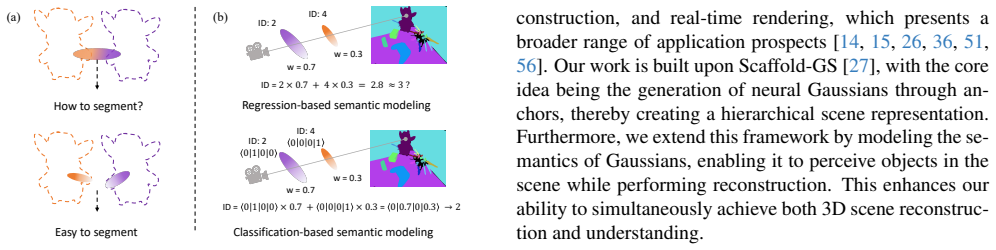
The load-bearing mechanism is the pairing of object-aware anchors with a fixed one-hot ID encoding. Anchors are initialized from the object-voted point cloud, each carrying an object ID; they grow and prune in the voxel grid while replicating or removing their ID, and each anchor spawns several neural Gaussians that inherit the ID. The Gaussian's semantic attribute is a one-hot vector whose length equals the number of objects, so alpha blending of these vectors yields a classification probability vector at each pixel; taking the argmax predicts the pixel's object ID, and a cross-entropy loss enforces the label. A variable-length feature rasterizer extends the Gaussian color attribute to carry the ID channels, making the discrete semantic rendering efficient and scene-level, so all objects are rendered in one pass and occluded objects are handled.
What would settle it
Take a scene with known object IDs, progressively corrupt a growing fraction of views' 2D masks by swapping two adjacent objects' IDs, and measure the final 3D segmentation IoU. If the cross-entropy loss simply locks in the swapped supervision, the IoU curve will fall with corruption; if the claimed geometry-guided correction works, the curve will stay high until some corruption threshold.
Extended reading notes
Core claim
The paper's central claim is that object-level 3D understanding can be built directly into Gaussian Splatting reconstruction by making each object a set of anchors, each anchor carrying a fixed object ID, and by representing Gaussian semantics as one-hot ID vectors rather than learnable continuous features. During alpha blending these vectors accumulate independently, so the rendered pixel vector is a true classification distribution over object IDs; a cross-entropy loss against ID-consistent 2D masks then supervises both geometry and semantics at once. ObjectGS claims this design resolves the semantic ambiguity that arises when continuous learned features are blended, and the experiments report gains over prior methods on open-vocabulary segmentation and panoptic segmentation, plus cleaner 3D instance point clouds and direct mesh extraction and scene editing.
Load-bearing premise
The whole pipeline assumes the 2D segmentation model produces accurate, ID-consistent masks across views; if the masks are wrong or inconsistent, the voted object IDs on the point cloud are wrong, and the cross-entropy loss will strengthen those wrong IDs rather than fix them.
Editorial extensions
If this is right
- Objects can be selected by their ID directly after training: removing an object is deleting its anchors, and recoloring is editing the associated Gaussian color attributes.
- Because semantic rendering runs once at scene level, occluded and partially invisible objects remain queryable, which per-object rendering cannot do.
- The 2DGS variant of the framework exports individual object meshes via TSDF fusion using the anchors of the selected ID.
- Segmentation and reconstruction improve together: adding the semantic loss also improves PSNR, SSIM, and LPIPS in the reported ablations.
- The one-hot formulation needs no post-processing or classifier call at query time; text or click prompts are resolved at mask-extraction time and map directly to IDs.
Reading between the lines
- The discrete-semantics principle likely transfers to other neural rendering backbones: any continuous feature field used for classification could be replaced by a one-hot head with cross-entropy, at the cost of needing ID-consistent training masks.
- The method's ceiling is set by the 2D mask source; a natural extension is to measure robustness under controlled mask corruption, and to let the geometry branch actively re-label uncertain points instead of merely inheriting votes.
- Because the ID encoding length equals the object count, scenes with long-tailed or hierarchical categories could use coarse-to-fine one-hot groups or per-category subset encoding to keep memory flat, something the paper hints at in its overhead discussion.
- The current open-vocabulary ability is realized at label-extraction time; a further step would attach text embeddings to each ID so that arbitrary queries can be resolved at render time without running the segmentation model again.
Editorial analysis
A structured set of objections, weighed in public.
Referee Report
Summary. ObjectGS proposes a 3D Gaussian Splatting framework that couples object-level reconstruction with instance segmentation. Starting from DEVA/Grounded-SAM 2D masks, it lifts object IDs to the COLMAP point cloud by majority, probability-based, or correspondence-based voting, initializes Scaffold-GS anchors with object IDs, and grows or prunes anchors while inheriting IDs. Each generated Gaussian carries a fixed one-hot ID encoding; alpha-blended rendering of these encodings gives per-pixel classification probabilities, which are supervised by a cross-entropy loss. The paper reports open-vocabulary segmentation on LERF-Mask and 3DOVS, panoptic segmentation on Replica and ScanNet++, and applications in mesh extraction and scene editing.
Significance. The central design hypothesis—that discrete one-hot ID semantics avoid the alpha-blending ambiguity of learnable continuous semantic features—is well motivated and supported by the ablation in Table 5, where one-hot encoding (88.19 mIoU) clearly outperforms learnable semantics (69.57 mIoU) and object-independent constraints (37.48 mIoU) on the Figurines scene. The object-anchor coupling also yields clean 3D instance labels without per-Gaussian feature distillation, and the variable-length feature rasterizer is a practical engineering contribution. If the open questions about background handling and evaluation protocol are resolved, this is a useful step for object-aware 3DGS.
major comments (4)
- [§3.3(c), Eq. (4)–(7); Table 2] The background class is not representable in the model as specified. Section 3.1 assigns unclassified pixels ID 0, but Eq. (4) defines one-hot vectors only for IDs 1..n, Eq. (7) has no loss term for ID'(x)=0, and Eq. (6) takes argmax over the n object-only probabilities. A background pixel therefore receives the ID of the most probable object (or an undefined argmax where no Gaussian covers the pixel). Since Table 2 reports panoptic IoU/Dice/Acc on Replica and ScanNet++, which contain large background regions, the high scores imply either that ID 0 is represented somewhere outside the described equations or that background pixels are excluded from the metrics. Please specify how background is predicted (a background anchor, a confidence threshold, or exclusion), and state clearly whether the reported metrics include ID 0. If ID 0 pixels are excluded, the task should be described as instance-level rather than panoptic segmentation.
- [§4.2, Table 1] The claim of 'significantly outperforming' state-of-the-art on LERF-Mask is not uniform: on the Figurines scene, Gaga achieves mIoU 90.7/mBIoU 89.0 while ObjectGS achieves 88.2/85.2. The paper reports no average or variance across scenes, so the statement in Section 4.2 overstates the evidence. Please report per-scene means with standard deviations, or rephrase the claim to identify the scenes where the improvement holds.
- [§4.3, Table 6; §5 Limitation] The robustness argument that the grow-and-prune mechanism 'can naturally correct some mislabeled points' is supported only qualitatively. Table 6 compares three voting strategies on the same clean DEVA masks, but it does not inject label noise into the initialization to measure correction. Given that the whole pipeline inherits object IDs from the initial point-cloud voting, a quantitative robustness test (e.g., randomly flipping a controlled fraction of initial point IDs and measuring final mIoU) would substantiate the claim; otherwise the limitation statement in Section 5 should be strengthened.
- [§4.1–4.2, Tables 2 and 3] The ScanNet++ evaluation protocol is underspecified: the paper says 'randomly select 7 scenes' without naming them or reporting a seed, and Table 3 does not define how precision, recall, and F1 are aggregated over instances or whether the Chamfer distance is computed per predicted instance or per ground-truth instance. This information is needed to reproduce the reported numbers and to interpret the large recall gap (66.5% vs. 86.1%) in Table 3.
minor comments (6)
- [Fig. 4 caption] The caption mentions 'Grounded SAM 2' but the text and references use Grounded-SAM [37]; please align the terminology.
- [§3.1 and Supplementary §8] The headings 'Object ID V oting' and 'V oting Algorithm' contain a typo ('V oting' should be 'Voting').
- [Supplementary, Algorithm 3] Algorithm 3 is structurally identical to Algorithm 1 except for renaming 'Camera poses' to 'Correspondences'; the pseudocode should show how correspondences actually replace projection.
- [§4.2, Table 2 and Table 8] The scene names '1ada', '3e8b', and '0d2e' in Table 8 are not defined, and the table heading alternates between 'Scannet++' and 'ScanNet++'; please provide the full list of the seven ScanNet++ scenes used and unify the naming.
- [§4.1 Implementation Details] The text says Gaussian color attributes are extended from 3 to N+3, but Eq. (5) suggests the ID encoding is rendered as a separate channel; please clarify how the N-dimensional semantic vector is split from the color attributes during rasterization.
- [Eq. (7)] The indicator notation 1[ID'(x)=i] is used without definition; please define the indicator function explicitly.
Circularity Check
No circular dependency: the semantic supervision is an input from external 2D segmentation models, and the claimed outputs are benchmarked against external data and compared with the labeler itself.
full rationale
ObjectGS is an empirical architecture rather than a formal derivation, and its central claims are validated on external benchmarks. The object IDs in Eq. 4 and the cross-entropy loss in Eq. 7 are supervised by pseudo-labels from DEVA or Grounded-SAM (Sec. 3.1), which are training inputs, not outputs of the method. The predicted ID in Eq. 6 is an alpha-blended composition of fixed one-hot encodings, so inference is not defined in terms of the benchmark metric. The method also does more than replay its labels: Tables 1 and 4 show ObjectGS outperforms the DEVA labeler itself, and the Limitation section explicitly states that the approach is not merely a direct fitting of the 2D segmentation results, citing fewer holes and more 3D-consistent results than the ground truth. Self-citations to Scaffold-GS [27] provide the anchor backbone but are external, benchmarked prior work and are not used to forbid alternatives or to define the semantic contribution. One specification gap exists: Eqs. 4-7 ignore background ID 0 while Eq. 6 forces an argmax over object IDs, which could affect the reported panoptic metrics; however, this is an evaluation-consistency concern rather than circularity, because the reported numbers do not reduce to the training labels by construction. No circular step is present, so the score is 0.
Assumptions & free parameters
free parameters (4)
- lambda_semantic =
0.01 on LERF-Mask, 0.1 on other datasets
- lambda_vol =
0.0002 (3DOVS), 0.00005 (LERF-Mask), 0.00002 (Replica, ScanNet)
- k (Gaussians per anchor) =
10
- N (number of objects per scene) =
scene-dependent
assumptions (4)
- domain assumption DEVA/Grounded-SAM provide reliable, ID-consistent 2D object masks across views
- domain assumption COLMAP point cloud and camera poses are sufficiently accurate for point-to-pixel voting
- domain assumption Scaffold-GS anchor grow/prune mechanism is a valid base representation
- standard math Cross-entropy on one-hot rendered probabilities is a suitable segmentation training objective
invented entities (1)
-
Object-ID-bound anchor
independent evidence
Cite this review
Pith. "Pith review of ObjectGS: Object-aware Scene Reconstruction and Scene Understanding via Gaussian Splatting." pith.science (2026). https://pith.science/paper/IUPIUUPG
@misc{pith2026250715454,
  author       = {Pith},
  title        = {Pith review of: ObjectGS: Object-aware Scene Reconstruction and Scene Understanding via Gaussian Splatting},
  year         = {2026},
  howpublished = {\url{https://pith.science/paper/IUPIUUPG}},
  note         = {Machine review of arXiv:2507.15454}
}
read the original abstract
3D Gaussian Splatting is renowned for its high-fidelity reconstructions and real-time novel view synthesis, yet its lack of semantic understanding limits object-level perception. In this work, we propose ObjectGS, an object-aware framework that unifies 3D scene reconstruction with semantic understanding. Instead of treating the scene as a unified whole, ObjectGS models individual objects as local anchors that generate neural Gaussians and share object IDs, enabling precise object-level reconstruction. During training, we dynamically grow or prune these anchors and optimize their features, while a one-hot ID encoding with a classification loss enforces clear semantic constraints. We show through extensive experiments that ObjectGS not only outperforms state-of-the-art methods on open-vocabulary and panoptic segmentation tasks, but also integrates seamlessly with applications like mesh extraction and scene editing. Project page: https://ruijiezhu94.github.io/ObjectGS_page
Figures


Figures from the paper (11 more)


Forward citations
Cited by 1 Pith paper
-
Embodied Operators and Benchmarking: Toward Reusable and Deployable Embodied Intelligence Systems
Embodied operators—deployable modules with task semantics and I/O contracts—should be the unit of optimization and multi-dimensional benchmarking for reusable robot intelligence systems.
Reference graph
Works this paper leans on
-
[1]
Mip-nerf: A multiscale representation for anti-aliasing neu- ral radiance fields
Jonathan T Barron, Ben Mildenhall, Matthew Tancik, Peter Hedman, Ricardo Martin-Brualla, and Pratul P Srinivasan. Mip-nerf: A multiscale representation for anti-aliasing neu- ral radiance fields. In Proceedings of the IEEE/CVF inter- national conference on computer vision , pages 5855–5864,
-
[2]
Emerg- ing properties in self-supervised vision transformers
Mathilde Caron, Hugo Touvron, Ishan Misra, Herv ´e J´egou, Julien Mairal, Piotr Bojanowski, and Armand Joulin. Emerg- ing properties in self-supervised vision transformers. In Proceedings of the IEEE/CVF International Conference on Computer Vision, 2021. 2
2021
-
[3]
Seg- ment anything in 3d with nerfs
Jiazhong Cen, Zanwei Zhou, Jiemin Fang, Wei Shen, Lingxi Xie, Dongsheng Jiang, Xiaopeng Zhang, Qi Tian, et al. Seg- ment anything in 3d with nerfs. Proceedings of the Inter- national Conference on Neural Information Processing Sys- tems, 36:25971–25990, 2023. 2, 5
work page 2023
-
[4]
Jiazhong Cen, Jiemin Fang, Chen Yang, Lingxi Xie, Xi- aopeng Zhang, Wei Shen, and Qi Tian. Segment any 3d gaussians. In Proceedings of the AAAI Conference on Ar- tificial Intelligence, pages 1971–1979, 2025. 1, 2, 4, 6, 7
work page 1971
-
[5]
Lifting by gaussians: A simple, fast and flexible method for 3d instance segmentation
Rohan Chacko, Nicolai Haeni, Eldar Khaliullin, Lin Sun, and Douglas Lee. Lifting by gaussians: A simple, fast and flexible method for 3d instance segmentation. arXiv preprint arXiv:2502.00173, 2025. 4, 6
arXiv 2025
-
[6]
Masked-attention mask transformer for universal image segmentation
Bowen Cheng, Ishan Misra, Alexander G Schwing, Alexan- der Kirillov, and Rohit Girdhar. Masked-attention mask transformer for universal image segmentation. In Proceed- ings of the IEEE/CVF conference on computer vision and pattern recognition, pages 1290–1299, 2022. 2
work page 2022
-
[7]
Tracking anything with decoupled video segmentation
Ho Kei Cheng, Seoung Wug Oh, Brian Price, Alexan- der Schwing, and Joon-Young Lee. Tracking anything with decoupled video segmentation. In Proceedings of the IEEE/CVF International Conference on Computer Vision , pages 1316–1326, 2023. 2, 3, 5, 8
work page 2023
-
[8]
Click-gaussian: Interactive segmenta- tion to any 3d gaussians
Seokhun Choi, Hyeonseop Song, Jaechul Kim, Taehyeong Kim, and Hoseok Do. Click-gaussian: Interactive segmenta- tion to any 3d gaussians. In European Conference on Com- puter Vision, pages 289–305. Springer, 2024. 1, 2, 7
work page 2024
Show all 60 references
-
[9]
Interactive segmentation of radiance fields
Rahul Goel, Dhawal Sirikonda, Saurabh Saini, and PJ Narayanan. Interactive segmentation of radiance fields. In Proceedings of the IEEE/CVF Conference on Computer Vi- sion and Pattern Recognition, pages 4201–4211, 2023. 2
2023
-
[10]
Neural 3d scene reconstruction with the manhattan-world assumption
Haoyu Guo, Sida Peng, Haotong Lin, Qianqian Wang, Guofeng Zhang, Hujun Bao, and Xiaowei Zhou. Neural 3d scene reconstruction with the manhattan-world assumption. In Proceedings of the IEEE/CVF conference on computer vi- sion and pattern recognition, pages 5511–5520, 2022. 5
2022
-
[11]
Sam-guided graph cut for 3d instance segmentation
Haoyu Guo, He Zhu, Sida Peng, Yuang Wang, Yujun Shen, Ruizhen Hu, and Xiaowei Zhou. Sam-guided graph cut for 3d instance segmentation. In European Conference on Com- puter Vision, pages 234–251. Springer, 2024. 3
2024
-
[12]
2d gaussian splatting for geometrically accu- rate radiance fields
Binbin Huang, Zehao Yu, Anpei Chen, Andreas Geiger, and Shenghua Gao. 2d gaussian splatting for geometrically accu- rate radiance fields. In ACM SIGGRAPH Conference, pages 1–11, 2024. 2, 8
2024
-
[13]
Vschh 2023: A benchmark for the view synthesis challenge of hu- man heads
Youngkyoon Jang, Jiali Zheng, Jifei Song, Helisa Dhamo, Eduardo P ´erez-Pellitero, Thomas Tanay, Matteo Maggioni, Richard Shaw, Sibi Catley-Chandar, Yiren Zhou, et al. Vschh 2023: A benchmark for the view synthesis challenge of hu- man heads. In Proceedings of the IEEE/CVF Int...
2023
-
[14]
Anysplat: Feed-forward 3d gaussian splatting from unconstrained views.arXiv preprint arXiv:2505.23716,
Lihan Jiang, Yucheng Mao, Linning Xu, Tao Lu, Kerui Ren, Yichen Jin, Xudong Xu, Mulin Yu, Jiangmiao Pang, Feng Zhao, et al. Anysplat: Feed-forward 3d gaussian splatting from unconstrained views.arXiv preprint arXiv:2505.23716,
-
[15]
Horizon- gs: Unified 3d gaussian splatting for large-scale aerial-to- ground scenes
Lihan Jiang, Kerui Ren, Mulin Yu, Linning Xu, Junting Dong, Tao Lu, Feng Zhao, Dahua Lin, and Bo Dai. Horizon- gs: Unified 3d gaussian splatting for large-scale aerial-to- ground scenes. In Proceedings of the Computer Vision and Pattern Recognition Conference, pages 26789–2679...
2025
-
[16]
3d gaussian splatting for real-time radiance field rendering
Bernhard Kerbl, Georgios Kopanas, Thomas Leimk ¨uhler, and George Drettakis. 3d gaussian splatting for real-time radiance field rendering. ACM Transactions on Graphics, 42 (4):139–1, 2023. 1, 2
2023
-
[17]
Lerf: Language embedded radiance fields
Justin Kerr, Chung Min Kim, Ken Goldberg, Angjoo Kanazawa, and Matthew Tancik. Lerf: Language embedded radiance fields. In Proceedings of the IEEE/CVF Interna- tional Conference on Computer Vision, pages 19729–19739,
-
[18]
Segment any- thing
Alexander Kirillov, Eric Mintun, Nikhila Ravi, Hanzi Mao, Chloe Rolland, Laura Gustafson, Tete Xiao, Spencer White- head, Alexander C Berg, Wan-Yen Lo, et al. Segment any- thing. In Proceedings of the IEEE/CVF International Con- ference on Computer Vision, pages 4015–4026, 2023. 1, 2
2023
-
[19]
Decomposing nerf for editing via feature field distilla- tion
Sosuke Kobayashi, Eiichi Matsumoto, and Vincent Sitz- mann. Decomposing nerf for editing via feature field distilla- tion. Proceedings of the International Conference on Neural Information Processing Systems, 35:23311–23330, 2022. 2
2022
-
[20]
The robodepth challenge: Methods and advancements towards robust depth estimation
Lingdong Kong, Yaru Niu, Shaoyuan Xie, Hanjiang Hu, Lai Xing Ng, Benoit R Cottereau, Liangjun Zhang, Hesh- eng Wang, Wei Tsang Ooi, Ruijie Zhu, et al. The robodepth challenge: Methods and advancements towards robust depth estimation. arXiv preprint arXiv:2307.15061, 2023. 2
2023 arXiv
-
[21]
Language-driven semantic seg- mentation
Boyi Li, Kilian Q Weinberger, Serge Belongie, Vladlen Koltun, and Ren ´e Ranftl. Language-driven semantic seg- mentation. arXiv preprint arXiv:2201.03546, 2022. 6
2022 arXiv
-
[22]
Open-vocabulary semantic segmentation with mask-adapted clip
Feng Liang, Bichen Wu, Xiaoliang Dai, Kunpeng Li, Yinan Zhao, Hang Zhang, Peizhao Zhang, Peter Vajda, and Diana Marculescu. Open-vocabulary semantic segmentation with mask-adapted clip. In Proceedings of the IEEE/CVF con- ference on computer vision and pattern recognition , pa...
2023
-
[23]
Su- pergseg: Open-vocabulary 3d segmentation with structured super-gaussians
Siyun Liang, Sen Wang, Kunyi Li, Michael Niemeyer, Ste- fano Gasperini, Nassir Navab, and Federico Tombari. Su- pergseg: Open-vocabulary 3d segmentation with structured super-gaussians. arXiv preprint arXiv:2412.10231, 2024. 1, 2, 4
2024
-
[24]
Weakly supervised 3d open- vocabulary segmentation
Kunhao Liu, Fangneng Zhan, Jiahui Zhang, Muyu Xu, Yingchen Yu, Abdulmotaleb El Saddik, Christian Theobalt, Eric Xing, and Shijian Lu. Weakly supervised 3d open- vocabulary segmentation. Advances in Neural Information Processing Systems, 36:53433–53456, 2023. 5, 6
2023
-
[25]
Plane2depth: Hierarchical adap- tive plane guidance for monocular depth estimation
Li Liu, Ruijie Zhu, Jiacheng Deng, Ziyang Song, Wenfei Yang, and Tianzhu Zhang. Plane2depth: Hierarchical adap- tive plane guidance for monocular depth estimation. IEEE Transactions on Circuits and Systems for Video Technology,
-
[26]
Dn-4dgs: Denoised de- formable network with temporal-spatial aggregation for dy- namic scene rendering
Jiahao Lu, Jiacheng Deng, Ruijie Zhu, Yanzhe Liang, Wenfei Yang, Xu Zhou, and Tianzhu Zhang. Dn-4dgs: Denoised de- formable network with temporal-spatial aggregation for dy- namic scene rendering. Advances in Neural Information Pro- cessing Systems, 37:84114–84138, 2024. 2
2024
-
[27]
Scaffold-gs: Structured 3d gaussians for view-adaptive rendering
Tao Lu, Mulin Yu, Linning Xu, Yuanbo Xiangli, Limin Wang, Dahua Lin, and Bo Dai. Scaffold-gs: Structured 3d gaussians for view-adaptive rendering. In Proceedings of the IEEE/CVF Conference on Computer Vision and Pattern Recognition, pages 20654–20664, 2024. 1, 2, 3, 5
2024
-
[28]
Gaga: Group any gaussians via 3d-aware memory bank
Weijie Lyu, Xueting Li, Abhijit Kundu, Yi-Hsuan Tsai, and Ming-Hsuan Yang. Gaga: Group any gaussians via 3d-aware memory bank. arXiv preprint arXiv:2404.07977, 2024. 2, 5
2024 arXiv
-
[29]
NeRF: Representing scenes as neural radiance fields for view syn- thesis
Ben Mildenhall, Pratul P Srinivasan, Matthew Tancik, Jonathan T Barron, Ravi Ramamoorthi, and Ren Ng. NeRF: Representing scenes as neural radiance fields for view syn- thesis. In Proceedings of the European Conference on Com- puter Vision, pages 405–421, 2020. 1, 2
2020
-
[30]
Spin-nerf: Multiview segmentation and perceptual inpainting with neural radiance fields
Ashkan Mirzaei, Tristan Aumentado-Armstrong, Konstanti- nos G Derpanis, Jonathan Kelly, Marcus A Brubaker, Igor Gilitschenski, and Alex Levinshtein. Spin-nerf: Multiview segmentation and perceptual inpainting with neural radiance fields. In Proceedings of the IEEE/CVF Conferen...
-
[31]
Dinov2: Learning robust visual features without supervision
Maxime Oquab, Timoth ´ee Darcet, Th ´eo Moutakanni, Huy V o, Marc Szafraniec, Vasil Khalidov, Pierre Fernandez, Daniel Haziza, Francisco Massa, Alaaeldin El-Nouby, et al. Dinov2: Learning robust visual features without supervision. arXiv preprint arXiv:2304.07193, 2023. 2
2023 arXiv
-
[32]
Gags: Granularity-aware feature distillation for language gaussian splatting
Yuning Peng, Haiping Wang, Yuan Liu, Chenglu Wen, Zhen Dong, and Bisheng Yang. Gags: Granularity-aware feature distillation for language gaussian splatting. arXiv preprint arXiv:2412.13654, 2024. 2, 4
2024 arXiv
-
[33]
Langsplat: 3d language gaussian splatting
Minghan Qin, Wanhua Li, Jiawei Zhou, Haoqian Wang, and Hanspeter Pfister. Langsplat: 3d language gaussian splatting. In Proceedings of the IEEE/CVF Conference on Computer Vision and Pattern Recognition, pages 20051–20060, 2024. 1, 2, 4, 5, 6
2024
-
[34]
Learn- ing transferable visual models from natural language super- vision
Alec Radford, Jong Wook Kim, Chris Hallacy, Aditya Ramesh, Gabriel Goh, Sandhini Agarwal, Girish Sastry, Amanda Askell, Pamela Mishkin, Jack Clark, et al. Learn- ing transferable visual models from natural language super- vision. In Proceedings of the International Conference ...
2021
-
[35]
Sam 2: Segment anything in images and videos
Nikhila Ravi, Valentin Gabeur, Yuan-Ting Hu, Ronghang Hu, Chaitanya Ryali, Tengyu Ma, Haitham Khedr, Roman R¨adle, Chloe Rolland, Laura Gustafson, et al. Sam 2: Segment anything in images and videos. arXiv preprint arXiv:2408.00714, 2024. 2
2024 arXiv
-
[36]
Octree-gs: Towards consistent real-time rendering with lod-structured 3d gaussians
Kerui Ren, Lihan Jiang, Tao Lu, Mulin Yu, Linning Xu, Zhangkai Ni, and Bo Dai. Octree-gs: Towards consistent real-time rendering with lod-structured 3d gaussians. arXiv preprint arXiv:2403.17898, 2024. 2
2024 arXiv
-
[37]
Grounded sam: Assembling open-world models for diverse visual tasks
Tianhe Ren, Shilong Liu, Ailing Zeng, Jing Lin, Kunchang Li, He Cao, Jiayu Chen, Xinyu Huang, Yukang Chen, Feng Yan, et al. Grounded sam: Assembling open-world models for diverse visual tasks. arXiv preprint arXiv:2401.14159 ,
-
[38]
Depthmaster: Taming diffusion models for monocular depth estimation
Ziyang Song, Zerong Wang, Bo Li, Hao Zhang, Ruijie Zhu, Li Liu, Peng-Tao Jiang, and Tianzhu Zhang. Depthmaster: Taming diffusion models for monocular depth estimation. arXiv preprint arXiv:2501.02576, 2025. 2
2025 arXiv
-
[39]
The replica dataset: A digital replica of indoor spaces
Julian Straub, Thomas Whelan, Lingni Ma, Yufan Chen, Erik Wijmans, Simon Green, Jakob J Engel, Raul Mur-Artal, Carl Ren, Shobhit Verma, et al. The replica dataset: A digital replica of indoor spaces. arXiv preprint arXiv:1906.05797,
1906 arXiv
-
[40]
Open- mask3d: open-vocabulary 3d instance segmentation
Ayc ¸a Takmaz, Elisabetta Fedele, Robert W Sumner, Marc Pollefeys, Federico Tombari, and Francis Engelmann. Open- mask3d: open-vocabulary 3d instance segmentation. In Pro- ceedings of the International Conference on Neural Informa- tion Processing Systems, pages 68367–68390, 2023. 2
2023
-
[41]
Attention is all you need
Ashish Vaswani, Noam Shazeer, Niki Parmar, Jakob Uszko- reit, Llion Jones, Aidan N Gomez, Łukasz Kaiser, and Illia Polosukhin. Attention is all you need. Advances in neural information processing systems, 30, 2017. 2
2017
-
[42]
Ref-nerf: Struc- tured view-dependent appearance for neural radiance fields
Dor Verbin, Peter Hedman, Ben Mildenhall, Todd Zickler, Jonathan T Barron, and Pratul P Srinivasan. Ref-nerf: Struc- tured view-dependent appearance for neural radiance fields. In 2022 IEEE/CVF Conference on Computer Vision and Pat- tern Recognition (CVPR), pages 5481–5490. IE...
2022
-
[43]
Object- compositional neural implicit surfaces
Qianyi Wu, Xian Liu, Yuedong Chen, Kejie Li, Chuanxia Zheng, Jianfei Cai, and Jianmin Zheng. Object- compositional neural implicit surfaces. In European Con- ference on Computer Vision, pages 197–213. Springer, 2022. 5
2022
-
[44]
Objectsdf++: Improved object-compositional neural implicit surfaces
Qianyi Wu, Kaisiyuan Wang, Kejie Li, Jianmin Zheng, and Jianfei Cai. Objectsdf++: Improved object-compositional neural implicit surfaces. In Proceedings of the IEEE/CVF International Conference on Computer Vision, pages 21764– 21774, 2023. 4
2023
-
[45]
Opengaussian: Towards point-level 3d gaussian-based open vocabulary understanding
Yanmin Wu, Jiarui Meng, Haijie Li, Chenming Wu, Yahao Shi, Xinhua Cheng, Chen Zhao, Haocheng Feng, Errui Ding, Jingdong Wang, et al. Opengaussian: Towards point-level 3d gaussian-based open vocabulary understanding. arXiv preprint arXiv:2406.02058, 2024. 1
2024 arXiv
-
[46]
Sam3d: Segment anything in 3d scenes.arXiv preprint arXiv:2306.03908, 2023
Yunhan Yang, Xiaoyang Wu, Tong He, Hengshuang Zhao, and Xihui Liu. Sam3d: Segment anything in 3d scenes.arXiv preprint arXiv:2306.03908, 2023. 2 10
2023 arXiv
-
[47]
Gaussian grouping: Segment and edit anything in 3d scenes
Mingqiao Ye, Martin Danelljan, Fisher Yu, and Lei Ke. Gaussian grouping: Segment and edit anything in 3d scenes. In Proceedings of the European Conference on Computer Vi- sion, pages 162–179, 2024. 1, 2, 3, 5, 6, 7, 8
2024
-
[48]
gsplat: An open-source library for gaussian splatting
Vickie Ye, Ruilong Li, Justin Kerr, Matias Turkulainen, Brent Yi, Zhuoyang Pan, Otto Seiskari, Jianbo Ye, Jeffrey Hu, Matthew Tancik, et al. gsplat: An open-source library for gaussian splatting. Journal of Machine Learning Research , 26(34):1–17, 2025. 1, 5
2025
-
[49]
Scannet++: A high-fidelity dataset of 3d in- door scenes
Chandan Yeshwanth, Yueh-Cheng Liu, Matthias Nießner, and Angela Dai. Scannet++: A high-fidelity dataset of 3d in- door scenes. In Proceedings of the IEEE/CVF International Conference on Computer Vision, pages 12–22, 2023. 5
2023
-
[50]
Omniseg3d: Omniversal 3d segmentation via hierarchical contrastive learning
Haiyang Ying, Yixuan Yin, Jinzhi Zhang, Fan Wang, Tao Yu, Ruqi Huang, and Lu Fang. Omniseg3d: Omniversal 3d segmentation via hierarchical contrastive learning. In Pro- ceedings of the IEEE/CVF Conference on Computer Vision and Pattern Recognition, pages 20612–20622, 2024. 2
2024
-
[51]
Gsdf: 3dgs meets sdf for improved neural ren- dering and reconstruction
Mulin Yu, Tao Lu, Linning Xu, Lihan Jiang, Yuanbo Xiangli, and Bo Dai. Gsdf: 3dgs meets sdf for improved neural ren- dering and reconstruction. Advances in Neural Information Processing Systems, 37:129507–129530, 2024. 2
2024
-
[52]
Mip-splatting: Alias-free 3d gaussian splat- ting
Zehao Yu, Anpei Chen, Binbin Huang, Torsten Sattler, and Andreas Geiger. Mip-splatting: Alias-free 3d gaussian splat- ting. In Proceedings of the IEEE/CVF Conference on Com- puter Vision and Pattern Recognition , pages 19447–19456,
-
[53]
Tricky 2024 challenge on monocular depth from images of specular and transparent surfaces
Pierluigi Zama Ramirez, Alex Costanzino, Fabio Tosi, Mat- teo Poggi, Luigi Di Stefano, Jean-Baptiste Weibel, Dominik Bauer, Doris Antensteiner, Markus Vincze, Jiaqi Li, et al. Tricky 2024 challenge on monocular depth from images of specular and transparent surfaces. In Europea...
2024
-
[54]
Tiface: Improving facial reconstruction through tensorial radiance fields and implicit surfaces
Ruijie Zhu, Jiahao Chang, Ziyang Song, Jiahuan Yu, and Tianzhu Zhang. Tiface: Improving facial reconstruction through tensorial radiance fields and implicit surfaces. arXiv preprint arXiv:2312.09527, 2023
2023 arXiv
-
[55]
Ha-bins: Hierarchical adap- tive bins for robust monocular depth estimation across multi- ple datasets
Ruijie Zhu, Ziyang Song, Li Liu, Jianfeng He, Tianzhu Zhang, and Yongdong Zhang. Ha-bins: Hierarchical adap- tive bins for robust monocular depth estimation across multi- ple datasets. IEEE Transactions on Circuits and Systems for Video Technology, 34(6):4354–4366, 2023. 2
2023
-
[56]
Motiongs: Exploring explicit motion guidance for deformable 3d gaussian splatting
Ruijie Zhu, Yanzhe Liang, Hanzhi Chang, Jiacheng Deng, Jiahao Lu, Wenfei Yang, Tianzhu Zhang, and Yongdong Zhang. Motiongs: Exploring explicit motion guidance for deformable 3d gaussian splatting. Advances in Neural Infor- mation Processing Systems, 37:101790–101817, 2024. 2
2024
-
[57]
Scaledepth: Decomposing metric depth estimation into scale prediction and relative depth estimation
Ruijie Zhu, Chuxin Wang, Ziyang Song, Li Liu, Tianzhu Zhang, and Yongdong Zhang. Scaledepth: Decomposing metric depth estimation into scale prediction and relative depth estimation. arXiv preprint arXiv:2407.08187 , 2024. 2 11 ObjectGS: Object-aware Scene Reconstruction and Sc...
2024
-
[58]
Even with about 100 in- stances, overhead remains minimal with efficient parallel rasterizer
Training Overhead Table 8 compares training time, FPS, and GPU memory across different instance counts. Even with about 100 in- stances, overhead remains minimal with efficient parallel rasterizer. Notably, since our one-hot ID encoding is not learnable parameters, it will not...
-
[59]
V oting Algorithm We provide the pseudo code of Algorithms 1 to 3 to clearly demonstrate the proposed voting strategies
-
[60]
9 to 14, which includes visualization of OVS segmentation results, panoptic segmentation results, and 3D instance seg- mentation with point clouds
More Visualization We provide more visualization results as shown in Figs. 9 to 14, which includes visualization of OVS segmentation results, panoptic segmentation results, and 3D instance seg- mentation with point clouds. Algorithm 1 Object ID Majority V oting 1: Input: 2: Po...
Reviewed August 6, 2026 · model on record in the stance chip above.
Discussion (0). Sign in to comment.